Respondeu
levou 11 s
Como pensou
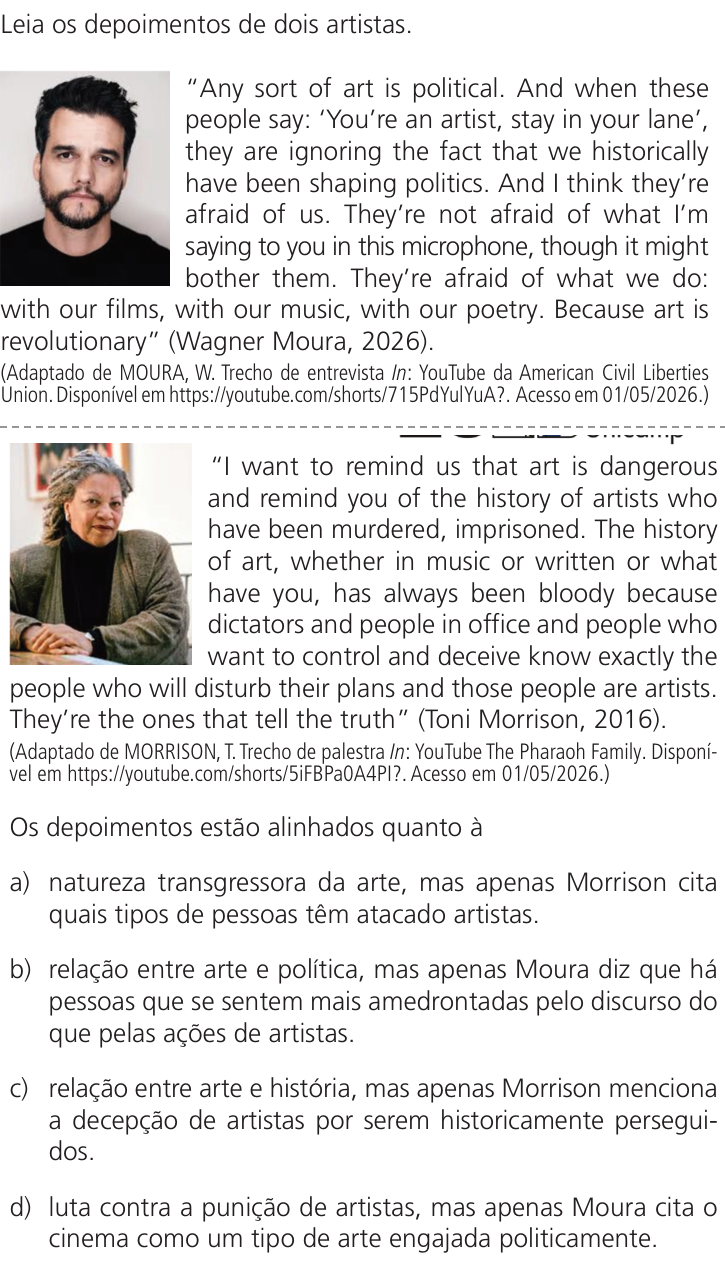
A alternativa correta é A. Os dois depoimentos destacam a natureza transgressora da arte, isto é, sua capacidade de desafiar o poder e transformar a sociedade. Moura afirma que a arte é política e revolucionária; Morrison ressalta que os artistas dizem a verdade e podem atrapalhar os planos de quem busca controlar e enganar.
Apenas Morrison identifica os tipos de pessoas que perseguem artistas: ditadores, pessoas em cargos de poder e aquelas que querem controlar e enganar. Moura refere-se genericamente a “essas pessoas”.
As demais alternativas estão incorretas porque:
- B: inverte a fala de Moura: essas pessoas temem mais as obras e ações artísticas do que suas declarações ao microfone.
- C: Morrison menciona a perseguição histórica, mas não a decepção dos artistas.
- D: a luta contra a punição de artistas não é um tema comum aos dois depoimentos.
Resposta: A
Respondeu
levou 8 s
Como pensou
**Analyzing Portuguese concepts**
I need to understand and solve this Portuguese text that touches on themes like deception and the struggles with punishment. It seems I should explain enough without going into every detail. It’s interesting to think about how art can express political and revolutionary ideas versus simply challenging control. Toni's work specifically addresses dictators and the deceptive nature of those in power, which feels quite relevant. I'll focus on answering point A.
Os dois depoimentos destacam a natureza transgressora da arte, capaz de desafiar o poder e transformar a sociedade. Wagner Moura afirma que toda arte é política e revolucionária; Toni Morrison ressalta que os artistas dizem a verdade e podem atrapalhar os planos de quem deseja controlar a população.
Porém, apenas Morrison identifica os tipos de pessoas que perseguem artistas: ditadores, pessoas em cargos de poder e aqueles que buscam controlar e enganar.
A alternativa B inverte o argumento de Moura: segundo ele, essas pessoas temem mais o que os artistas fazem com sua arte do que suas declarações ao microfone.
Resposta: A
Respondeu
levou 9 s
Como pensou
Os dois depoimentos apresentam a arte como uma força capaz de desafiar o poder: Moura diz que ela é política e revolucionária; Morrison afirma que é perigosa porque artistas dizem a verdade e podem perturbar os planos de quem deseja controlar e enganar. Apenas Morrison menciona explicitamente quem persegue artistas, citando ditadores e pessoas em posições de poder.
Resposta: A
Respondeu
levou 9 s
Como pensou
Analisando os dois depoimentos:
- Wagner Moura afirma que toda arte é política e revolucionária; diz que "eles" têm medo não do que ele fala ao microfone, mas do que os artistas fazem (filmes, música, poesia). Ou seja, as pessoas temem mais as ações dos artistas do que seu discurso.
- Toni Morrison afirma que a arte é perigosa, lembra a história de artistas assassinados e presos, e identifica quem os ataca: ditadores, pessoas no poder e pessoas que querem controlar e enganar.
Ponto comum: ambos tratam a arte como transgressora/revolucionária e perigosa para quem detém o poder.
Avaliando as alternativas:
- a) Correta: ambos convergem na natureza transgressora da arte ("art is revolutionary" / "art is dangerous"), e apenas Morrison especifica quem ataca os artistas (ditadores, pessoas no cargo, pessoas que querem controlar e enganar). Moura fala apenas em "these people" / "they", sem especificar.
- b) Errada: Moura diz o oposto — as pessoas temem mais as ações (filmes, música, poesia) do que o discurso.
- c) Errada: Morrison não menciona "decepção" dos artistas, e sim perseguição/assassinato deles.
- d) Errada: nenhum dos dois fala em "luta contra a punição" como ponto comum; Moura cita cinema, mas isso não é o alinhamento dos depoimentos.
Resposta: A
Respondeu
levou 9 s
Como pensou
Checking option A against the others: only Morrison names specific groups—dictators and officials who want control and deception—while Moura stays vague with "these people," confirming A as correct. B reverses the meaning Moura intended, C misreads "deceive" as "decepção," and D wrongly attributes film citations to Moura.
Resolução
- Ponto em comum: os dois depoimentos tratam a arte como algo transgressor.
- Moura afirma que "art is revolutionary" e que certas pessoas têm medo do que os artistas fazem.
- Morrison diz que "art is dangerous" e que os artistas atrapalham os planos de quem quer controlar e enganar.
- Diferença: só Morrison identifica quem ataca os artistas: "dictators and people in office and people who want to control and deceive". Moura fala apenas, de forma vaga, em "these people".
Análise das outras alternativas
- b) Está errada. Moura diz o contrário: "They're not afraid of what I'm saying… They're afraid of what we do". O medo é das ações dos artistas, não do discurso.
- c) Está errada. Morrison não fala em "decepção" de artistas. O verbo deceive significa "enganar" e se refere aos opressores.
- d) Está errada. Moura de fato menciona filmes, mas o eixo comum não é a "luta contra a punição de artistas". Moura nem trata de punição.
Resposta: A
Respondeu
levou 8 s
Como pensou
Analisando os dois depoimentos:
Moura: toda arte é política; os artistas historicamente moldam a política; "eles" temem não o discurso dele ao microfone ("what I'm saying... though it might bother them"), mas o que os artistas fazem, com filmes, música e poesia, porque a arte é revolucionária.
Morrison: a arte é perigosa; artistas já foram assassinados e presos; ditadores, pessoas no poder e pessoas que querem controlar e enganar sabem que os artistas atrapalham seus planos, pois dizem a verdade.
Ambos concordam que a arte é transgressora/ameaçadora para o poder.
Alternativa A: correta. Os dois tratam da natureza transgressora da arte (revolucionária / perigosa). Apenas Morrison cita quem ataca artistas: ditadores, pessoas no cargo público e pessoas que querem controlar e enganar. Moura fala apenas de "these people", sem especificar.
Alternativa B: há alinhamento na relação entre arte e política, mas Moura diz que temem mais o que os artistas fazem do que o discurso, o que faz a primeira parte plausível. Porém, Morrison também fala de pessoas que temem artistas, e a afirmação "mais amedrontadas pelo discurso do que pelas ações" é invertida: Moura diz o contrário. Incorreta.
Alternativa C: Morrison não menciona decepção de artistas. Incorreta.
Alternativa D: Os depoimentos não tratam de "luta contra a punição". Além disso, Moura cita cinema, mas Morrison fala em "música, escrita ou o que for", então a alternativa é fraca quanto ao alinhamento. Incorreta.
Resposta: A
Respondeu
levou 1 min 23 s
Como pensou
The question is in Portuguese from UNICAMP 2027.
Wagner Moura's statement claims art is inherently political and revolutionary. The second quote from Toni Morrison was not included in the provided text.
Toni Morrison's quote warns that art is dangerous and historically persecuted. Dictators fear artists because they tell the truth. The question asks what these two statements have in common.
The four options contrast the two artists. Only Morrison names specific groups that attack artists. Only Moura distinguishes fear of speech from fear of artistic actions. Only Morrison mentions historical persecution. Only Moura cites cinema as a political art form. The correct answer must capture their shared focus while respecting these differences.
Option a is being evaluated. Both artists agree that art is transgressive and dangerous. Morrison names dictators, government officials, and those who seek control as groups that attack artists.
The transgressive nature of art seems like the shared theme. Morrison names dictators and government officials as attackers, while Moura only mentions unnamed people who tell artists to stay in their lane. The contrast about specific types of attackers is accurate.
Option b is now being evaluated. Both artists discuss the relationship between art and politics. Moura specifically notes that some people fear his speech more than his artistic actions.
Option b is incorrect. Moura states that people are not afraid of his speech, but are afraid of the actions artists take. The option reverses this sentiment.
Option c is now being evaluated. It suggests the artists agree on the relationship between art and history, with Morrison specifically mentioning historical persecution of artists.
Option c is incorrect. Morrison does not mention artists feeling disappointed by historical persecution. She describes artists being murdered, imprisoned, and the history of art as bloody.
Option d is now being evaluated. It suggests the artists agree on the fight against punishing artists, with Moura specifically citing cinema as a politically engaged art form.
Option d is incorrect. Neither artist explicitly frames the issue as a fight against punishment. Morrison describes historical persecution, while Moura focuses on fear of artistic actions.
Option a is correct. Both artists agree that art transgresses and challenges power. Morrison names dictators and government officials as specific groups that attack artists.
Option b is a trap for readers who reverse the meaning of "afraid." Option c likely uses "decepção" as a mistranslation of "deceive" to mislead. The first part of option a is accurate: both artists describe art as transgressive and subversive. The second part is now being checked for accuracy.
Option c is being reconsidered. Both artists mention the historical persecution of artists, so they may share an alignment on art and history.
Os depoimentos convergem ao tratar a arte como prática transgressora e desafiadora do poder. Moura afirma que toda arte é política e revolucionária e que o temor recai sobre o que os artistas produzem (filmes, música, poesia), pois historicamente eles moldam a política. Morrison sustenta que a arte é perigosa, recorda artistas assassinados e presos e explica que a história da arte é sangrenta justamente porque quem detém o poder sabe que os artistas perturbam seus planos ao dizer a verdade.
A ressalva da alternativa A também se confirma: só Morrison nomeia os tipos de pessoas responsáveis por esses ataques (ditadores, ocupantes de cargos e os que desejam controlar e enganar).
As demais opções falham:
- em B, Moura diz o oposto do que se afirma (não temem o discurso no microfone; temem as ações artísticas);
- em C, não há menção à “decepção” dos artistas;
- em D, os textos não se alinham numa luta contra a punição de artistas.
Resposta: A
Respondeu
levou 11 s
Como pensou
We need answer. Need parse image. The image appears garbled? It's likely a UNICAMP question with text support and alternatives. But the OCR/image seems nonsensical? Need infer actual question? Let's inspect image description. It contains Portuguese text that looks like corrupted/generated? It includes "Leia os depoimentos de dois artistas." Then two profiles with quotes. Text appears weirdly repetitive and nonsensical, maybe due to AI-generated? We need solve multiple choice. We need read image. But the text is bizarre:
"Leia os depoimentos de dois artistas.
[photo man] “Any sort of art is ... And when these people say: ‘You’re a ...’, they are ... the fact that we historically have been shaping ... And I think they’re afraid of us. They’re not afraid of what I’m saying to you in this microphone, though it might bother them. They’re afraid of what we do: with our films, with our music, with our poetry. Because art is revolutionary” (Wagner Moura ...)
(Adeptado de MORRA, W. Trecho de entrevista In: YouTube da American Civil Liberties Union. Disponível em https://youtube.com/shorts/715PdYulYuA? Acesso em 01/05/2025.)
[photo woman] “I want to remind us that art is dangerous and remind you of the history of artists who have been murdered, imprisoned. The history of art, whether in music or written or what have you, has always been bloody because dictators and people in office and people who want to control and deceive know exactly the people who will disturb their plans and those people are artists. They’re the ones that tell the truth” (Toni Morrison ...)
(Adaptado de MORRISON, T. Trecho de palestra In: YouTube The Pharoah? ...)
Os depoimentos estão alinhados quanto à
a) natureza transgressora da arte, mas apenas Morrison cita quais tipos de pessoas têm atacado artistas.
b) relação entre arte e política, mas apenas Moura diz que há pessoas que se sentem ameaçadas pelo discurso do artista.
c) relação entre arte e história, mas apenas Morrison menciona a decepção de artistas por serem historicamente perseguidos.
d) luta contra a punição de artistas, mas apenas Moura cita o cinema como um tipo de arte engajada politicamente."
Wait this seems like an actual UNICAMP question? Let's see. It asks "Os depoimentos estão alinhados quanto à" and alternatives. The two quotes: Wagner Moura says art is revolutionary; people are afraid of what we do with films/music/poetry. Toni Morrison says art is dangerous; history of artists murdered/imprisoned; dictators know artists tell truth. They align in saying art is dangerous/revolutionary and artists are threatened by oppressive powers. Need compare alternatives.
Let's reconstruct actual text from image if possible. The OCR provided has many corruptions: "Leia os depoimentos de dois artistas." Then first quote:
“Any sort of art is dangerous. And when these people say: ‘You’re a danger’, they are ignoring the fact that we historically have been shaping dangerous? And I think they’re afraid of us. They’re not afraid of what I’m saying to you in this microphone, though it might bother them. They’re afraid of what we do: with our films, with our music, with our poetry. Because art is revolutionary” (Wagner Moura ...)
Maybe actual quote? Let's search memory. Wagner Moura at ACLU? He said "Any sort of art is dangerous. And when these people say, 'You're a danger,' they are ignoring the fact that we historically have been ...? And I think they're afraid of us. They're not afraid of what I'm saying to you in this microphone, though it might bother them. They're afraid of what we do with our films, with our music, with our poetry. Because art is revolutionary." Maybe.
Toni Morrison quote: “I want to remind us that art is dangerous and remind you of the history of artists who have been murdered, imprisoned. The history of art, whether in music or written or what have you, has always been bloody because dictators and people in office and people who want to control and deceive know exactly the people who will disturb their plans and those people are artists. They’re the ones that tell the truth.” This is from Toni Morrison? Yes.
Question: "Os depoimentos estão alinhados quanto à" (The statements align regarding)
a) natureza transgressora da arte, mas apenas Morrison cita quais tipos de pessoas têm atacado artistas.
b) relação entre arte e política, mas apenas Moura diz que há pessoas que se sentem ameaçadas pelo discurso do artista.
c) relação entre arte e história, mas apenas Morrison menciona a decepção de artistas por serem historicamente perseguidos.
d) luta contra a punição de artistas, mas apenas Moura cita o cinema como um tipo de arte engajada politicamente.
Need determine correct. Let's analyze.
Both quotes align that art is dangerous/revolutionary, and artists are targeted by those in power. Alternative A: "natureza transgressora da arte, mas apenas Morrison cita quais tipos de pessoas têm atacado artistas." Does only Morrison cite types of people who attack artists? Morrison: dictators, people in office, people who want to control and deceive. Moura: "these people" maybe vague; "they" but not types. So A might be correct? It says aligned on "natureza transgressora da arte" (transgressive nature of art) and only Morrison cites types. That seems plausible.
B: "relação entre arte e política, mas apenas Moura diz que há pessoas que se sentem ameaçadas pelo discurso do artista." Actually Moura says they are not afraid of what I'm saying in microphone, though it might bother them; they're afraid of what we do. So not exactly "discurso do artista"? Morrison also says dictators etc. are threatened by artists. So B's "apenas Moura" false? Maybe both say people feel threatened.
C: "relação entre arte e história, mas apenas Morrison menciona a decepção de artistas por serem historicamente perseguidos." Morrison mentions history, but not "decepção" (disappointment). False.
D: "luta contra a punição de artistas, mas apenas Moura cita o cinema como um tipo de arte engajada politicamente." Moura cites films, music, poetry. But "apenas Moura cita o cinema" true? Morrison says music/written. But "luta contra a punição de artistas" maybe both? However D says only Moura cites cinema as engaged art. But the alignment? They both align on art being dangerous, not necessarily "luta contra punição". And Moura doesn't mention cinema specifically? "films" yes. But the question asks "Os depoimentos estão alinhados quanto à" with "mas apenas..." The correct must have first part true for both, second part distinguishing one. Let's examine each.
The text:
Moura: "Any sort of art is dangerous. ... they are ignoring the fact that we historically have been shaping ...? And I think they're afraid of us. They're not afraid of what I'm saying to you in this microphone, though it might bother them. They're afraid of what we do: with our films, with our music, with our poetry. Because art is revolutionary."
Morrison: "I want to remind us that art is dangerous and remind you of the history of artists who have been murdered, imprisoned. The history of art, whether in music or written or what have you, has always been bloody because dictators and people in office and people who want to control and deceive know exactly the people who will disturb their plans and those people are artists. They’re the ones that tell the truth."
Both say art is dangerous/revolutionary. Both say artists are threatened by powerful people. Both relate art to politics/history? Morrison explicitly history; Moura "historically have been shaping..." but not about persecution history. The alternatives:
A) "natureza transgressora da arte, mas apenas Morrison cita quais tipos de pessoas têm atacado artistas." This matches: both see art as transgressive/dangerous; only Morrison specifies dictators, people in office, etc.
B) "relação entre arte e política, mas apenas Moura diz que há pessoas que se sentem ameaçadas pelo discurso do artista." Actually Morrison also says people in power feel threatened by artists (they know artists will disturb plans). And Moura says they're not afraid of his speech, but of what artists do. So "apenas Moura" false.
C) "relação entre arte e história, mas apenas Morrison menciona a decepção de artistas por serem historicamente perseguidos." Morrison doesn't mention disappointment; she says history of artists murdered/imprisoned. Moura mentions historically shaping? Not deception.
D) "luta contra a punição de artistas, mas apenas Moura cita o cinema como um tipo de arte engajada politicamente." Morrison mentions murder/imprisonment, so both about punishment? Actually Moura doesn't mention punishment. So first part false. And "cinema" as engaged art? Moura mentions films but not as "engajada politicamente" exactly. So D false.
Thus A likely.
But let's be cautious. The image text is corrupted, but we can infer. Need answer in Portuguese with explanation, ending "Resposta: A". Let's craft final. Need maybe mention that both depoimentos associam arte a perigo/transgressão/ revolucionário; apenas Toni Morrison especifica quem ataca artistas (ditadores, pessoas no poder, etc.). Wagner Moura fala "they/these people" generic. Therefore A.
Let's produce final. Ensure final line exactly "Resposta: A".
Os dois depoimentos aproximam-se ao tratar a arte como algo perigoso, transgressor e revolucionário: Wagner Moura afirma que “any sort of art is dangerous” e que a arte é revolucionária; Toni Morrison também diz que “art is dangerous” e que artistas incomodam quem quer controlar e enganar.
A diferença apontada corretamente é que apenas Morrison especifica quais tipos de pessoas atacam/os artistas: ditadores, pessoas no poder e pessoas que querem controlar e enganar. Moura fala de “they/these people” de forma mais genérica, sem nomear esses grupos.
Portanto, a alternativa correta é a A.
Resposta: A
Respondeu
levou 13 s
Como pensou
**Analyzing Artist Statements**
I'm currently processing the initial insights from the artist statements, focusing on Wagner Moura's perspective that all art is inherently political. I'm preparing to integrate Toni Morrison's viewpoint next to build a more comprehensive understanding.
**Refining Political Art Views**
I'm now integrating Toni Morrison's perspective on art's revolutionary and dangerous nature, complementing Wagner Moura's thoughts. This builds on the initial insight that art inherently shapes politics and that powerful figures fear artists' actions more than their words.
**Synthesizing Political Art Perspectives**
I'm now synthesizing the distinct viewpoints from Morrison and Moura on political art. While both highlight art's transgressive nature and the persecution of artists, Morrison specifically identifies the types of oppressors, whereas Moura's focus is broader on the fear artists evoke.
**Distinguishing Persecution Motivations**
I'm now refining the distinction between Moura and Morrison. While both acknowledge artist persecution, I'm clarifying that Morrison specifically targets those who "control and deceive," whereas Moura emphasizes the fear of artistic *actions* over *words*.
Vamos analisar os textos e as alternativas:
- Wagner Moura afirma que a arte é inerentemente política e revolucionária ("art is revolutionary"), que os artistas historicamente moldam a política e que certas pessoas têm medo da produção artística ("They're afraid of what we do: with our films, with our music, with our poetry"). Moura se refere a esses opositores de forma genérica ("these people", "they"). Ele também afirma que essas pessoas não têm medo de seu discurso no microfone, mas sim do que os artistas fazem com sua arte.
- Toni Morrison afirma que a arte é perigosa ("art is dangerous"), pois incomoda planos autoritários ao revelar a verdade ("disturb their plans and those people are artists. They're the ones that tell the truth"). Ao contrário de Moura, Morrison cita especificamente quais tipos de pessoas perseguem e atacam artistas: ditadores, pessoas em cargos de poder e pessoas que querem controlar e enganar ("dictators and people in office and people who want to control and deceive").
Análise das alternativas:
- a) CORRETA: Ambos convergem quanto à natureza transgressora da arte (para Moura ela é "revolucionária"; para Morrison, "perigosa" e capaz de "atrapalhar planos"), e apenas Morrison especifica as categorias de pessoas que atacam e perseguem os artistas (dictators, people in office...).
- b) INCORRETA: Moura afirma o oposto: as pessoas não têm medo do discurso dele no microfone, mas sim das obras/ações artísticas ("They're not afraid of what I'm saying... They're afraid of what we do").
- c) INCORRETA: Morrison não fala de "decepção de artistas". A palavra deceive significa "enganar/ludibriar" (um falso cognato com "decepcionar").
- d) INCORRETA: Os depoimentos tratam do poder e da força política/revolucionária da arte, não de uma "luta contra a punição de artistas".
Resposta: A