Como pensou
We need answer question. Need infer from image? The user provided an image that seems garbled? Let's inspect. It appears text in image is likely an Italian? Wait the text looks like Portuguese? But garbled with words like "exerto abaixo pertence ao conto A viúva Montiel, do livro Os funerais da Mamãe Grande." Actually that's Portuguese? "O excerto abaixo pertence ao conto A viúva Montiel, do livro Os funerais da Mamãe Grande." It's a literature question maybe in Portuguese. The text is weirdly spelled? Let's parse.
Image contains a text:
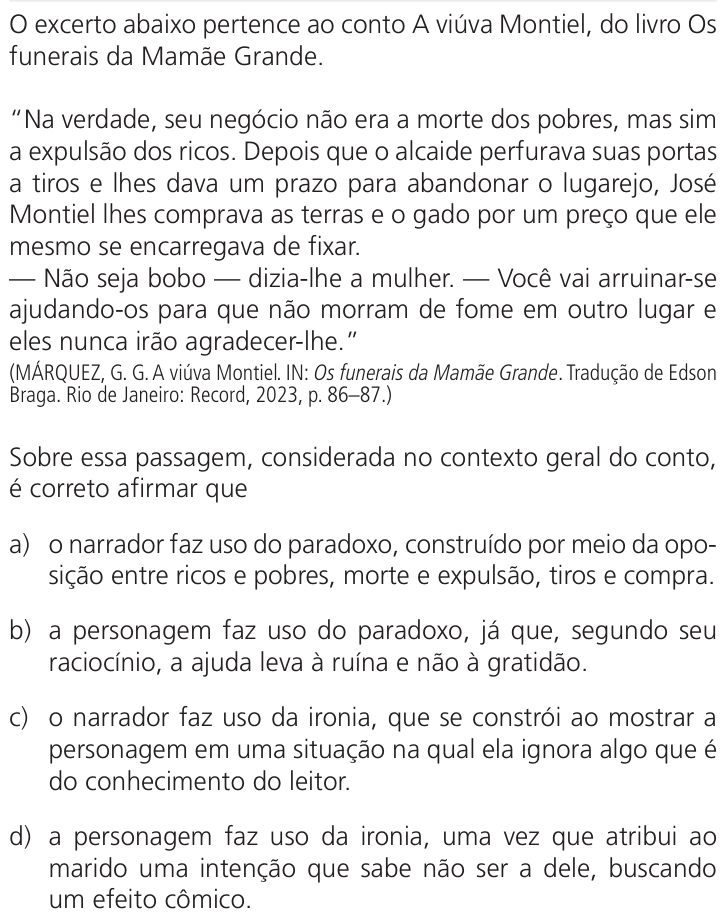
"O excerto abaixo pertence ao conto A viúva Montiel, do livro Os funerais da Mamãe Grande.
“Na verdade, seu negócio não era a morte dos pobres, mas sim a expulsão dos ricos. Depois que o alcaide perdurava suas portas a tiros e lhes dava um prazo para abandonar o lugarejo, José Montiel lhes comprava as terras e o gado por um preço que ele mesmo se encarregava de fixar.
— Não seja bobo — dizia-lhe a mulher. — Você vai arruinar-se ajudando-os para que não morram de fome em outro lugar e eles nunca irão agradecer-lhe.”
(MÁRQUEZ, G. G. A viúva Montiel. In: Os funerais da Mamãe Grande. Tradução de Edson Braga. Rio de Janeiro: Record, 2013, p. 86-87.)
Sobre essa passagem, considerada no contexto geral do conto, é correto afirmar que
a) o narrador faz uso de paradoxo, construído por meio da oposição entre ricos e pobres, morte e expulsão, tiros e compra.
b) a personagem faz uso de paradoxo, já que, segundo seu raciocínio, a ajuda leva à ruína e não à gratidão.
c) o narrador faz uso da ironia, que se constrói ao mostrar a personagem em uma situação na qual ela ignora algo que é do conhecimento do leitor.
d) a personagem faz uso da ironia, uma vez que atribui ao marido uma intenção que sabe não ser a dele, buscando um efeito cômico."
This is likely a question about "paradoxo" vs "ironia". Need answer. Need know story "A viúva Montiel" by Gabriel García Márquez? Actually "La viuda de Montiel" from "Los funerales de la Mamá Grande". The excerpt: José Montiel? Wait "A viúva Montiel" is about widow of José Montiel? The passage: "Na verdade, seu negócio não era a morte dos pobres, mas sim a expulsão dos ricos..." It says narrator? Let's understand.
The excerpt: "Na verdade, seu negócio não era a morte dos pobres, mas sim a expulsão dos ricos. Depois que o alcaide perdurava suas portas a tiros e lhes dava um prazo para abandonar o lugarejo, José Montiel lhes comprava as terras e o gado por um preço que ele mesmo se encarregava de fixar.
— Não seja bobo — dizia-lhe a mulher. — Você vai arruinar-se ajudando-os para que não morram de fome em outro lugar e eles nunca irão agradecer-lhe."
This is narration, then dialogue by wife? "a mulher" is José Montiel's wife? She says: Don't be silly, you'll ruin yourself helping them so they don't die of hunger elsewhere and they'll never thank you.
Question: About this passage, considered in general context of the short story, correct afirmative:
a) The narrator uses paradox, constructed by opposition between rich and poor, death and expulsion, shots and purchase.
b) The character uses paradox, since according to her reasoning, help leads to ruin and not gratitude.
c) The narrator uses irony, which is constructed by showing the character in a situation in which she ignores something that is known to the reader.
d) The character uses irony, since she attributes to her husband an intention she knows is not his, seeking comic effect.
Need decide. Let's recall "La viuda de Montiel" by Gabriel García Márquez. Plot: José Montiel is a rich, powerful, corrupt man in a small town? He dies; his widow? Actually "La viuda de Montiel" maybe about the widow after José Montiel's death; she discovers his infidelities? Let's recall.
In "Los funerales de la Mamá Grande" collection, there's story "La viuda de Montiel". It tells of José Montiel, a wealthy man, and his wife. He dies? The widow? The excerpt refers to José Montiel buying lands from rich people who are expelled by the mayor? Actually "seu negócio não era a morte dos pobres, mas sim a expulsão dos ricos" - "his business was not the death of the poor, but the expulsion of the rich." The mayor would shoot up their doors and give them a deadline to leave town; José Montiel bought their lands and cattle at a price he fixed. His wife says: "Don't be silly. You'll ruin yourself helping them so they don't die of hunger elsewhere, and they'll never thank you."
Wait, if he buys lands from rich people expelled, that's profitable? But wife says helping them so they don't die of hunger? Maybe he gives them money? It seems contradictory: he buys at price he fixes (low), exploiting the expelled rich? But wife says "ajudando-os" - helping them? Maybe because he pays them something instead of letting them be killed? Hmm.
Let's search memory: "La viuda de Montiel" is about José Montiel, a powerful cacique. The story is narrated after his death? The widow, Adelaida? She is left with children. There is irony: José Montiel had illegitimate children? The widow lives in fear? The excerpt maybe about how José Montiel made fortune by buying cheap from expelled conservatives? Hmm.
The question likely from a Brazilian exam (UNICAMP 2027? maybe "UNICAMP 2027" is simulated). It asks about "paradoxo" and "ironia". Options: a) narrator uses paradox; b) character uses paradox; c) narrator uses irony; d) character uses irony. Need identify literary device.
Let's analyze passage. The narrator says: "Na verdade, seu negócio não era a morte dos pobres, mas sim a expulsão dos ricos." That's a paradox? It contrasts expected. Then describes: mayor expels rich; José Montiel buys their lands and cattle at price he fixes. Then wife says: "Não seja bobo... Você vai arruinar-se ajudando-os para que não morram de fome em outro lugar e eles nunca irão agradecer-lhe." That's dramatic irony? The character (wife) has a limited perspective; reader knows something? What does reader know? In context of story, maybe José Montiel is actually not helping them; he is exploiting them. The wife's statement is ironic because she thinks he is helping, but actually he's profiting. Or she is being ironic? Let's see.
Option c: "o narrador faz uso da ironia, que se constrói ao mostrar a personagem em uma situação na qual ela ignora algo que é do conhecimento do leitor." That matches dramatic irony: the character (wife) says he'll ruin himself helping them, but the reader knows (from previous narration) that his business is buying lands at fixed low prices, i.e., he's not helping, he's exploiting. So she ignores that. The narrator uses irony by showing her unaware. This seems plausible.
Option d: "a personagem faz uso da ironia, uma vez que atribui ao marido uma intenção que sabe não ser a dele, buscando um efeito cômico." Does she know? Maybe she is being sarcastic? The quote: "Não seja bobo... Você vai arruinar-se ajudando-os..." If she knows his intention isn't to help, she might be ironic. But the passage says "dizia-lhe a mulher" - she says. Is she being ironic? She says helping them so they don't die of hunger elsewhere and they'll never thank you. That could be ironic if she actually knows he's not helping but exploiting? But if she knows he's buying cheap, she wouldn't say "ajudando-os" seriously? Hmm.
Need recall story. In "La viuda de Montiel", José Montiel's wife is named Adelaida? She is portrayed as a woman who didn't love him? Actually the story: José Montiel dies, and his widow is left with a house full of clocks? She discovers he had a mistress and illegitimate children? Let's remember.
"La viuda de Montiel" is a short story by Gabriel García Márquez. It starts: "Cuando José Montiel murió, su viuda..."? Actually I remember: José Montiel is a character also in "La siesta del martes"? No, "La siesta del martes" has a widow? In "La viuda de Montiel", the widow is Adelaida? The story is about the widow's life after her husband's death. Her husband was a rich man who had made fortune by hook or crook. The widow is afraid of the town? There is a phrase: "José Montiel no era más que un pobre diablo"?? Not sure.
Let's search memory internally. I read "Los funerales de la Mamá Grande" collection. Stories:
- La siesta del martes
- Un día después del sábado
- En este pueblo no hay ladrones
- La prodigiosa tarde de Baltazar
- La viuda de Montiel
- Rosas artificiales
- Un día de estos
- El mar del tiempo perdido? No.
Actually collection includes:
1. La siesta del martes
2. Un día después del sábado
3. En este pueblo no hay ladrones
4. La prodigiosa tarde de Baltazar
5. La viuda de Montiel
6. Rosas artificiales
7. Un día de estos
8. Los funerales de la Mamá Grande
"La viuda de Montiel": The widow of José Montiel. José Montiel was a powerful man. In the story, after his death, the widow lives in poverty? She has a farm? The story reveals that José Montiel had a secret: he had a mistress and many children? The widow, Adelaida, is lonely and bitter. The excerpt likely from early part, describing how José Montiel made his money by buying lands from people expelled by the mayor. The wife's comment: "No seas tonto... Vas a arruinarte ayudando a esa gente para que no se muera de hambre en otra parte, y nunca te lo agradecerán." This shows she is also cynical? But she thinks he's helping; actually he's buying cheap. The narrator's irony: she calls it "helping" but it's exploitation. The reader knows from the previous sentence that he buys at a price he fixes. So she ignores that? Or she is being ironic? Let's examine.
Option a: "o narrador faz uso de paradoxo, construído por meio da oposição entre ricos e pobres, morte e expulsão, tiros e compra." The first sentence has "não era a morte dos pobres, mas sim a expulsão dos ricos" - that's a paradox? It's an antithesis? But "seu negócio não era a morte dos pobres, mas sim a expulsão dos ricos" is not exactly a paradox; it's a correction. The oppositions are not paradox but contrast. Also "tiros e compra" are not paradox. So a unlikely.
Option b: "a personagem faz uso de paradoxo, já que, segundo seu raciocínio, a ajuda leva à ruína e não à gratidão." Is that paradox? A paradox is a statement that seems contradictory but may be true. "Ajuda leva à ruína" is not necessarily paradox; it's ironic? The wife says helping will ruin him and not bring gratitude. That's not paradox; it's a prediction. So b unlikely.
Option c: narrator uses irony, showing character ignores something reader knows. This is dramatic irony. Yes.
Option d: character uses irony, attributing to husband an intention she knows is not his. But does she know? The text says she says "Você vai arruinar-se ajudando-os..." If she knows he's not helping, she might be ironic. But the question says "considerada no contexto geral do conto". In the general context, maybe the wife is the one who is ironic? Let's recall the story: The wife of José Montiel, after his death, discovers he had a double life. She is bitter. In the excerpt, she is advising him not to help because they won't thank him. This could be irony on her part? She knows he's not helping, but she says "ajudando-os" to mock him? Hmm.
Let's read the excerpt carefully: "Na verdade, seu negócio não era a morte dos pobres, mas sim a expulsão dos ricos. Depois que o alcaide perdurava suas portas a tiros e lhes dava um prazo para abandonar o lugarejo, José Montiel lhes comprava as terras e o gado por um preço que ele mesmo se encarregava de fixar.
— Não seja bobo — dizia-lhe a mulher. — Você vai arruinar-se ajudando-os para que não morram de fome em outro lugar e eles nunca irão agradecer-lhe."
The narrator says his business was not the death of the poor but the expulsion of the rich. Then explains: after the mayor shot up their doors and gave them a deadline to leave, José Montiel bought their lands and cattle at a price he fixed. So he profits from their expulsion. Then the wife says: Don't be silly, you'll ruin yourself helping them so they don't die of hunger elsewhere, and they'll never thank you.
Wait, if he buys at a price he fixes, that's not helping; it's exploiting. But the wife says "ajudando-os" (helping them) so they don't die of hunger elsewhere. That is ironic: she calls his exploitative purchase "help". Is she being ironic? Or is she genuinely thinking he's helping? If she genuinely thinks he's helping, then it's dramatic irony: she doesn't realize he's exploiting. But the narrator just told us he fixes the price, implying exploitation. So the reader knows he's not helping. The wife's comment is ironic in the sense that she is unaware. That is dramatic irony, which is a type of irony where the audience knows something the character doesn't. The narrator uses it.
Option c says exactly: "o narrador faz uso da ironia, que se constrói ao mostrar a personagem em uma situação na qual ela ignora algo que é do conhecimento do leitor." That fits perfectly.
Option d says the character uses irony, attributing to husband an intention she knows is not his. That would be sarcasm, not dramatic irony. Does she know? If she knows he's exploiting, why would she say "ajudando-os"? She might be sarcastic. But the text doesn't indicate she knows. The phrase "Não seja bobo" suggests she believes he is being foolish by helping, so she thinks he is helping. She is unaware that he is actually profiting? Wait, if he is profiting, why would she say he'll ruin himself? Maybe because he is buying at a fixed price, but he pays something, so she thinks he is losing money? Actually, if he buys lands and cattle at a price he fixes, he could fix a very low price, so he profits. But she says "ajudando-os para que não morram de fome" - she thinks he is paying them enough to survive? Maybe she is naive? Or maybe she is being ironic? Let's think about the story's context.
In "La viuda de Montiel", José Montiel is a rich man who made his fortune by buying cheap from people expelled by the mayor. His wife, Adelaida, is from a wealthy family? She might be complicit? Actually, in the story, after José Montiel dies, the widow discovers that he had a mistress and many children. She also discovers that he was not as rich as she thought? The story might be about her hypocrisy. The excerpt might be showing that both José Montiel and his wife are hypocritical: he exploits, she calls it help. But the wife's line: "Você vai arruinar-se ajudando-os..." could be read as her being ironic or sarcastic? If she knows he's not helping, why would she say "Você vai arruinar-se"? She might be mocking him: "You'll ruin yourself helping them" meaning "You're not helping them, you're exploiting them, but you pretend to help." That would be irony from the character. But the question asks "considerada no contexto geral do conto". In the general context, the wife is a victim? Let's recall: The widow of Montiel is actually the protagonist. She is not a nice person? She is vain, hypocritical. She married José Montiel for money. After his death, she is left with nothing? Actually, I remember a line: "La viuda de Montiel era una mujer que no había hecho nada en la vida..."? Not sure.
Let's search memory: "La viuda de Montiel" story summary. I recall: José Montiel dies of natural causes? His widow, Adelaida, is left with a large house and many children. She is afraid of the town because her husband had many enemies. She discovers that José Montiel had a mistress named...? She finds a letter? The story ends with her realizing that her husband had a secret life. The excerpt might be from the beginning, describing José Montiel's business. The wife's comment might be ironic because she is the one who actually encouraged him? Hmm.
Let's consider the options in the context of Brazilian literature exams. The question asks about "paradoxo" and "ironia". The passage contains a clear example of dramatic irony: the wife says "ajudando-os" but the reader knows from the narrator's explanation that he is buying at a price he fixes, which is not helping. So the narrator uses irony by showing the character's ignorance. That is option c. Option d would require the character to be consciously ironic, which is not supported by the text; she seems sincere in her advice.
Let's check if there's any paradox. The first sentence: "seu negócio não era a morte dos pobres, mas sim a expulsão dos ricos." This is an antithesis, not paradox. The wife's reasoning: "a ajuda leva à ruína e não à gratidão" is not a paradox; it's a cynical observation. So a and b are out.
Thus answer is c.
But let's be thorough: The question says "Sobre essa passagem, considerada no contexto geral do conto, é correto afirmar que". The passage includes the narrator's statement and the wife's dialogue. The narrator's statement about José Montiel's business is ironic? Actually, the narrator says his business was not the death of the poor but the expulsion of the rich. That is a paradox? It's a twist: one would expect a powerful man's business to be exploiting the poor, but here he profits from the rich being expelled. Then the wife's comment is ironic because she calls it "helping". The irony is dramatic: the reader knows he's not helping. So c.
Let's ensure no other option fits better. Option d: "a personagem faz uso da ironia, uma vez que atribui ao marido uma intenção que sabe não ser a dele, buscando um efeito cômico." Does the wife know his intention? If she knows he's buying cheap, she wouldn't say "ajudando-os". She might be ironic if she knows he's not helping, but the text doesn't suggest she knows; she seems to believe he is helping. The phrase "Não seja bobo" suggests she thinks he is being foolishly generous. So she is not using irony; she is unaware. Thus c is correct.
Final answer: C.
Now produce final in Portuguese, explain reasoning, end with "Resposta: C".