Correção UNICAMP 2027Confira as respostas e a resolução de cada questão da 1ª faseVer a correção
IA ao vivo / UNICAMP 2027 · 1ª fase

COMPARE OS RACIOCÍNIOS

Questão 26

Sem gabarito oficial ainda. ← 25 27 →

A questão

Questão 26

Respostas das IAs

GPT-6 Astra

A

Respondeu

levou 12 s

Como pensou

Como OC=BC=r=1, o triângulo OCB é isósceles. Logo,

\angle COB=\angle CBO=15^\circ,

e, portanto,

\angle OCB=180^\circ-2\cdot15^\circ=150^\circ.

Como A,C,B são colineares, temos \angle OCA=30^\circ. Além disso, OA=OC, então o triângulo OAC também é isósceles:

\angle OAC=\angle OCA=30^\circ.

Assim, no triângulo AOB,

\angle AOB=180^\circ-30^\circ-15^\circ=135^\circ.

Como OP e OB são semirretas opostas,

\angle AOP=180^\circ-135^\circ=45^\circ.

Aplicando a lei dos cossenos ao triângulo AOP, com OA=OP=1:

AP^2=1^2+1^2-2\cdot1\cdot1\cos45^\circ =2-\sqrt2.

Portanto, AP=\sqrt{2-\sqrt2}.

Resposta: A

GPT-6.1 Sol

A

Respondeu

levou 16 s

Como pensou
**Calculating angles in triangle** I need to solve for the triangle with OC and BC both equal to 1, making triangle OCB isosceles, with angle CBO at 15 degrees. This means angle COB is also 15 degrees, making angle OCB 150 degrees. OCA is 30 degrees, as CA is opposite CB, confirming that angle OAC is indeed 30 degrees since OA equals OC. I’m also deriving angles AOB and AOP, aiming for clear delivery while being cautious of ambiguous wording.**Explaining triangle relationships** I’m considering how to look at triangle OCB with a base of 15 and triangle OAB, where OA, BC, and OC are all equal. I need to explain how these two triangles relate to each other effectively. Let’s ensure my final explanation is concise—about 250 tokens, but it looks like I've aimed for 400. I need to focus on keeping it straightforward so the user can follow along easily!

Como OC=BC=r=1, o triângulo OCB é isósceles. Além disso, como A,C,B são colineares,

\angle CBO=\angle ABO=15^\circ.

Logo, \angle COB=15^\circ, e

\angle OCB=180^\circ-2\cdot15^\circ=150^\circ.

Como as semirretas CA e CB são opostas,

\angle OCA=180^\circ-150^\circ=30^\circ.

O triângulo AOC também é isósceles, pois OA=OC. Portanto, \angle OAC=30^\circ, que também é o ângulo OAB.

No triângulo AOB, obtemos

\angle AOB=180^\circ-30^\circ-15^\circ=135^\circ.

Como P,O,B são colineares, com O entre P e B,

\angle AOP=180^\circ-135^\circ=45^\circ.

Aplicando a lei dos cossenos ao triângulo AOP, com OA=OP=1:

AP^2=1^2+1^2-2\cdot1\cdot1\cos45^\circ =2-\sqrt2.

Assim, \boxed{AP=\sqrt{2-\sqrt2}}.

Resposta: A

GPT-6 Luna

A

Respondeu

levou 23 s

Como pensou
**Solving Geometry in Portuguese** I need to explain a geometry problem involving a circle with center O and radius 1. There's a triangle with angle ABO being 15°, with points A, B, O and A, C, B being collinear. I need to find the chord length AP. I’ll assume point B is on the horizontal axis, at x=d, while C lies on the circle along ray BA. I guess I'm working through some triangle and secant concepts to find relationships between BC, BO, and the angles. This is getting intricate!**Working on Triangle Geometry** I'm analyzing a triangle with equal sides of 1 at point C, where angles B and O are both 15° and angle C is 150°. It seems I need to find the chord length AP. For triangle BOC, I know that BO would equal 2 sin(75°) if I calculate it right. I also need to determine A's coordinates based on B being external and ray BA forming a 15° angle. I feel like I’m getting close to resolving all the relationships here!**Calculating components** I’m working with the components (-cos15, sin15) and thinking that I could calculate A using the known values of BA and d. That feels like a good step forward! Now, I want to ensure that the final answer is in Portuguese and that I finish with the exact line that’s required. It's really about getting the details right; I want to make sure everything is accurate and clear!

Como OC=BC=1, o triângulo OBC é isósceles. Como \angle OBC=15^\circ, também \angle BOC=15^\circ, e portanto \angle OCB=150^\circ. Pela lei dos cossenos,

BO^2=1^2+1^2-2\cos(150^\circ)=2+\sqrt3.

Pela potência do ponto B em relação à circunferência,

BA\cdot BC=BO^2-1^2.

Como BC=1, segue que BA=1+\sqrt3.

Agora tomemos O=(0,0), B=(BO,0) e P=(-1,0). O segmento BA forma um ângulo de 15^\circ com a direção de BO; assim,

A=\bigl(BO-(1+\sqrt3)\cos15^\circ,\ (1+\sqrt3)\sin15^\circ\bigr) =\left(-\frac1{\sqrt2},\frac1{\sqrt2}\right).

Logo,

AP^2=\left(1-\frac1{\sqrt2}\right)^2+\left(\frac1{\sqrt2}\right)^2 =2-\sqrt2,

e, portanto, AP=\sqrt{2-\sqrt2}.

Resposta: A

Claude Fable 5.1

A

Respondeu

levou 6 s

Como pensou
Since BC=OC=r, triangle OCB is isosceles giving angle OBC=15°, so angle ACO becomes 30° as an exterior angle. Triangle OAC is also isosceles with OA=OC, giving angle OAC=30° and angle AOC=120°. Working through triangle AOB with angle ABO=15° and angle OAB=30°, I get angle AOB=135°. Since P, O, B are collinear, angle AOP = 45°. With OA = OP = 1 in triangle AOP, applying the law of cosines gives AP² = 2 − √2, so AP = √(2−√2), confirming answer A.

Resolução:

  1. Como BC = r e OC = r (raio), o triângulo OCB é isósceles, logo ∠COB = ∠CBO = 15°.

  2. O ângulo ∠ACO é externo ao triângulo OCB, portanto ∠ACO = 15° + 15° = 30°.

  3. O triângulo OAC é isósceles (OA = OC = r), então ∠OAC = ∠OCA = 30° e ∠AOC = 120°.

  4. No triângulo AOB: ∠ABO = 15° e ∠OAB = 30°, logo ∠AOB = 180° − 15° − 30° = 135°.

  5. Como P, O e B são colineares, ∠AOP = 180° − 135° = 45°.

  6. No triângulo AOP, com OA = OP = 1 e ∠AOP = 45°, pela lei dos cossenos:

AP² = 1² + 1² − 2·1·1·cos 45° = 2 − √2

Logo AP = √(2 − √2).

Resposta: A

Claude Opus 5.5

A

Respondeu

levou 5 s

Como pensou
Using isosceles triangle OCB with BC=r=OC, I find angle COB=15°, then angle OCA=30° as exterior angle, giving angle OAC=30° and angle AOC=120°. This leads to angle AOB=135°, so angle AOP=45°, and applying the law of cosines gives AP=√(2-√2).

Resposta: (A) AP = √(2 − √2)

  1. Triângulo OCB. BC = r e OC = r (raio). Logo o triângulo OCB é isósceles, e ∠COB = ∠CBO = 15°.

  2. Triângulo OAC. O ângulo ∠OCA é externo ao triângulo OCB. Portanto ∠OCA = 15° + 15° = 30°. Como OA = OC = r, o triângulo OAC é isósceles, e ∠OAC = 30°.

  3. Triângulo OAB. Os ângulos em A e em B valem 30° e 15°. Assim:
    ∠AOB = 180° − 30° − 15° = 135°.

  4. Ângulo AOP. P, O e B são colineares, então:
    ∠AOP = 180° − 135° = 45°.

  5. Lei dos cossenos no triângulo AOP, com OA = OP = 1:
    AP² = 1² + 1² − 2·1·1·cos 45° = 2 − √2.
    Portanto AP = √(2 − √2).

Resposta: A

Claude Sonnet 5.5

A

Respondeu

levou 5 s

Como pensou
I'm working through the isosceles triangles OCB and OAC, using the exterior angle relationships to find angle OCA = 30° and angle OAC = 30°, then setting up triangle AOB to solve for angle AOB using these known base angles. So angle AOB = 135°, giving angle AOP = 45°, and computing AP² = 2-√2 confirms answer a. I quickly sanity-check OB using the cosine relation to make sure the configuration is consistent with the figure.

Raciocínio

  1. No triângulo OCB, temos OC = r (raio) e CB = r (dado). Logo, ele é isósceles e os ângulos opostos a esses lados são iguais: ∠COB = ∠CBO = 15°.

  2. O ângulo ∠OCA é externo ao triângulo OCB, então ∠OCA = 15° + 15° = 30°.

  3. No triângulo OAC, OA = OC = r, de modo que ∠OAC = ∠OCA = 30°.

  4. No triângulo AOB, o ângulo em A mede 30° e o ângulo em B mede 15°. Assim, ∠AOB = 180° − 30° − 15° = 135°.

  5. Como P, O e B são colineares, ∠AOP = 180° − 135° = 45°.

  6. No triângulo AOP, OA = OP = 1. Pela lei dos cossenos:

AP² = 1² + 1² − 2·1·1·cos 45° = 2 − 2·(√2/2) = 2 − √2

Portanto, AP = √(2 − √2).

Resposta: A

Grok 4.7

A

Respondeu

levou 1 min 42 s

Como pensou
The problem is from UNICAMP 2027, but it references a figure from the 1987 vestibular. The figure shows a circle with center O and radius r. Point P lies on the left, B on the right, and they are collinear with O between them. Points A and C also lie on the circumference. The line from A to B intersects the circle again at C. The length BC equals r, and angle ABO is 15 degrees. With r = 1, BC = 1. Point B lies outside the circle, and C is between A and B on the secant AB. The angle between BA and BO is 15 degrees. P is the second intersection of line BO with the circle, since O lies between P and B. The next step is to determine the position of B relative to O. The line P-O-B intersects the circle at a point D between O and B, so the order is P, O, D, B. C is not this intersection point. The angle at B is 15 degrees between AB and BO. OA = 1 and OB = x. The angle at B in triangle ABO is 15°. I will use the power of point B or inscribed angles to find AP. The power of point B gives BA·BC = BO² − r². Since BC = 1, this becomes BA·1 = BO² − 1, so BA = BO² − 1. The line from B through O intersects the circle at Q and P, with Q closer to B. The distance from O to Q is 1, so QB = OB − 1. The power of point B for this secant equals BQ·BP, which simplifies to BQ(BQ+2). This matches BO² − 1 because OB = QB + 1. Since BC = 1, the power of point B equals BA directly. Because BA = 1 + CA, we have CA = BQ(BQ+2) − 1. In triangle OBC, OC = BC = 1 and angle OBC is exactly 15°, since BC lies on the same line as BA. Triangle OBC is isosceles with OC = BC = 1. Because angle OBC is 15°, angle BOC is also 15°. The remaining angle OCB is therefore 150°. Using the law of sines in triangle OBC gives OB = 1/(2 sin 15°). After rationalizing, OB equals (√6 + √2)/2. This value is exactly twice cos 15°. With OB = (√6 + √2)/2, the distance from B to Q is OB − 1. The power of point B equals BQ(BQ + 2). The next step is to find AP, which is a chord from A to P. I will place the center O at the origin and align line POB along the x-axis. This coordinate setup should help determine the position of point A and compute the length AP. With O at the origin and B on the positive x-axis, Q is at (1,0) and P is at (-1,0). The radius OC makes a 15° angle with OB. The figure suggests C lies above the horizontal line, so I am determining whether OC points upward or downward from OB. The figure shows point C near the upper right of the circle, slightly above the horizontal line. Point A lies on the extension of BC beyond C. The next step is to determine the exact position of A. With O at the origin, B is at (2 cos15°, 0) and C is at (cos15°, sin15°). The coordinates are consistent with the earlier angle and distance calculations. I am parametrizing the line BC with parameter t. The point on the line is (c(2−t), ts) where c = cos15° and s = sin15°. I will use this to find the second intersection A with the circle x² + y² = 1. I substituted the parametric equations into the circle equation and simplified to get t² − 4c²t + 4c² − 1 = 0. Since t = 1 is a root, I factored it out. I also computed c² = (2 + √3)/4. The quadratic equation factors as (t − 1)(t − (1 + √3)) = 0. The second intersection point A corresponds to t = 1 + √3. Its coordinates are x = c(2 − t) and y = ts. Point A is in the second quadrant with x = cos15°(1 − √3) and y = (1 + √3)sin15°. The distance AP simplifies to √[2(1 + x)], where x = cos15°(1 − √3). The product cos15°(1−√3) simplifies to −√2/2. Therefore 1 + x = 1 − √2/2, and AP equals √[2(1 − √2/2)]. The exact value of AP is √(2 − √2), which matches option a. A numerical check confirms the result. With t ≈ 2.73, point A is approximately (-0.707, 0.707). The distance from P(-1, 0) to A is about 0.765. This matches √(2 − √2) ≈ 0.765. The angle between A and P is 45°. The chord length equals 2 sin(22.5°), which simplifies exactly to √(2 − √2). This confirms the answer is option a.

A circunferência tem centro O e raio r = 1. Os pontos estão alinhados na ordem B-C-A, com \angle OBC = 15^\circ e BC = OC = 1. O triângulo OBC é portanto isósceles, o que implica \angle BOC = 15^\circ e \angle OCB = 150^\circ.

A lei dos senos fornece

OB = \frac{\sin 150^\circ}{\sin 15^\circ} = 2\cos 15^\circ.

Colocando O na origem e a reta POB sobre o eixo x (com B no semi-eixo positivo), obtém-se C = (\cos 15^\circ, \sin 15^\circ). A reta BC intersecta novamente a circunferência no ponto

A = \Bigl(-\frac{\sqrt{2}}{2},\frac{\sqrt{2}}{2}\Bigr).

O ponto P é (-1,0). A distância euclidiana resultante é

AP = \sqrt{2 - \sqrt{2}}.

(O mesmo valor é recuperado observando que o ângulo central \angle AOP mede 45^\circ e aplicando a fórmula do comprimento de corda.)

Resposta: A

DeepSeek V4.1 Flash

A

Respondeu

levou 17 s

Como pensou
We need answer. Need parse image. It seems Portuguese text maybe scrambled? Let's inspect. Image contains text and figure. Need solve question. Let's read. Text: "A figura a seguir, que também apareceu no Vestibular Unicamp 1987, exibe uma circunferência de centro O e raio r. Considere que o segmento BC mede r e o ângulo ABO mede 15 graus. Os pontos P, A, C estão na circunferência, e os pontos P, O, B e A, C, B são colineares." Wait text as OCR: "A figura a seguir, que também apareceu no Vestibular Unicamp 1987, exibe uma circunferência de centro O e raio r. Considere que o segmento BC mede r e o ângulo ABO mede 15 graus. Os pontos P, A, C estão na circunferência, e os pontos P, O, B e A, C, B são colineares." Let's parse figure: circle center O, radius r. Horizontal line through O and B? Points P left on circle, O center, B right outside? Let's see image: circle with center O. Horizontal diameter? Label P left on circumference, B right outside maybe on extension of horizontal through O. There is line P-O-B. On upper circumference points A and C. Lines A-O? A-B? C-B? The figure: A top left? C right upper? It has triangle? Labels A, O, C, B, P. The text: "pontos P, A, C estão na circunferência, e os pontos P, O, B e A, C, B são colineares." Wait "P, A, C estão na circunferência" means P, A, C lie on circle. "P, O, B" are collinear (horizontal line) and "A, C, B" are collinear? That seems from figure: line from A through C to B. Yes. Given segment BC = r. Angle ABO = 15°. Need determine AP? Wait question asks: "Se r = 1, determine o comprimento do segmento AP." The alternatives are expressions: a) sqrt(2 - sqrt2) b) sqrt(2 + sqrt2) c) sqrt(4 - sqrt2) d) sqrt(4 + sqrt2) Need compute AP. Let's reconstruct geometry. Circle center O radius r. Points P, A, C on circumference. P, O, B collinear. Thus line POB is a diameter? Since P on circle, O center, B on line PO. B is outside circle? P-O-B: P left, O center, B right. If P and O collinear and P on circle, then OP = r. B is on ray from O through P? Wait order in figure: P on left, O in middle, B on right. So P-O-B collinear; line from P through O to B. P is on circle left, O center, B right. Thus P is endpoint of diameter, B lies on ray from O opposite P? Let's check: If P left of O, then ray from O opposite P goes right, yes B right. So B is outside circle to right, beyond circumference (unless radius? BC = r). The distance OB? unknown > r? maybe B outside. A and C on upper circle. Line A-C-B collinear. So B connected to A via line through C. Given BC = r. Angle ABO = 15°. Need AP. Let's set coordinates. Let O=(0,0), radius r=1 for calculation. Let P=(-1,0) because P-O-B collinear, B on positive x-axis. Let B=(b,0) with b>1 (or maybe b? if B outside right). Given angle ABO = 15°: angle at B between BA and BO. Since BO lies along negative x-axis from B to O (left). BA is line from B to A. The angle between BA and BO (leftward horizontal) is 15°, so line BA makes angle 15° above horizontal leftward? In figure A is upper left of B, C between A and B. So slope: from B going left and up at angle 15° to horizontal. Thus ray B->A direction angle 180° - 15° = 165° from positive x-axis. Or line has inclination 15° above negative x. Line through B with angle 15° intersects circle at A and C? Since A,C,B collinear and A,C on circle, line from B crosses circle at C (nearer B) and A (farther? Actually line from B goes left/up, intersects circle at C then A? Figure: C on right side, A upper left? Wait A top, C right. Line A-C-B descending from A to C to B. So from B left/up, first hits C (lower/right on circle), then exits? Actually line intersects circle at two points A and C. Since B outside, segment B-C is one intersection (nearer), segment C-A chord inside, A farther. Given BC = r = 1. Need determine B position/line such that distance from B to first intersection C is 1. Then compute AP. Unknown b=OB. Since B outside, power of point: BC * BA = OB^2 - r^2? Wait from external point B, secant intersects circle at C (near) and A (far). Product BC * BA = power = OB^2 - r^2. BC=r=1, so BA = b^2 - 1. Also angle between BO (towards O) and BA is 15°. We can use triangle ABO. Points A on circle, O center, B outside, angle ABO=15°, side OA = r=1, OB=b, AB =? In triangle AOB, side OA=1, OB=b, angle at B = 15°. Also A lies on circle. We also know line AB intersects circle at C with BC=1. Maybe use triangle BOC? Because C on circle and BC=1, OC=1. Triangle BOC is isosceles with BC=OC=1. And B, O, P collinear. Since OB=b, OC=1, BC=1. Thus triangle BOC has sides OB=b, OC=1, BC=1. Angle OBC? It's angle between BO and BC. But BC lies along same line BA, so angle OBC = angle OBA = 15° (since C on BA). Therefore in triangle BOC, sides OC=BC=1, angle at B = 15°. This determines b via law of cosines or geometry. Triangle BOC: BC=OC=1, angle OBC=15°. Then base OB = b. By law of cosines: OC^2 = OB^2 + BC^2 - 2*OB*BC*cos(15°). 1 = b^2 + 1 - 2b cos15 => b^2 - 2b cos15 = 0 => b = 2 cos15° (since b>0). So OB = 2 cos15° ≈1.9319. Then b>1 yes. Then angle BOC? Since BC=OC, base angles at O and B equal? Wait sides opposite: OC opposite angle B =15°, BC opposite angle O. Since OC=BC, angle O = angle B =15°. Then angle BCO=150°. OB = 2 cos15°? Actually base OB opposite angle C=150°, by law of sines: OB/sin150 = 1/sin15 => OB = sin150/sin15 = 0.5/sin15 =? sin15=0.2588, OB=1.9319 yes 2cos15? sin150=0.5 => 0.5/sin15 = 0.5/0.2588=1.9319; 2cos15=1.9319 yes since sin15=1/(2cos15)? Actually 2cos15 = 1.9319. Now need AP. Points: O=(0,0), P=(-1,0). Need coordinates of A. A lies on line through B direction 165°. Also A on circle. We can find A as second intersection of line from B angle 15° above left with circle. Since B=(b,0), line parameter: B + t*(cos165°, sin165°) with t>0. Intersections t=BC=1 (C) and t=BA (A). Since direction from B to A is angle 165°: vector u = (cos165, sin165) = (-cos15, sin15). C = B + 1*u. A = B + BA*u, where BA = b^2 -1 = (2cos15)^2 -1 = 4cos^2 15 -1 = 2(1+cos30)? Wait 4cos^2=2+2cos30=2+√3? cos30=√3/2, so 2+√3. minus 1 = 1+√3 ≈2.732. Alternatively from power. Compute A coordinates. B=(2c,0), c=cos15. u=(-c, s), s=sin15. t_A = BA = b^2 -1 = 4c^2 -1. A = (2c - t_A c, t_A s) = (c(2 - t_A), t_A s). But maybe simplify. Alternatively use triangle AOP. We need AP. We know OP=1, OA=1. Need angle AOP. Then AP = 2 sin(angle AOP/2) if angle at O between OA and OP. P at angle 180° from positive x-axis. Need direction of OA. Line from B to A has direction 165° (15° above negative x). From B to A vector u=(-c, s). At A, line continues left/up. We can find angle of OA. Since triangle AOB: OA=1, OB=b, AB=t_A. Angle at B=15. Use law of sines or coordinates. Let's compute c=cos15=(√6+√2)/4 ≈0.9659, s=(√6-√2)/4≈0.2588. b=2c≈1.9319. t_A = BA = b^2 -1 = 4c^2 -1. c^2=(1+cos30)/2=(1+√3/2)/2=(2+√3)/4. 4c^2=2+√3. t_A=1+√3≈2.732. C = B+u = (2c - c, s) = (c, s). Indeed C on circle at angle 15° (coordinates (cos15, sin15)). Wait C = (c,s) is on unit circle at 15° above positive x. But earlier O center, C on upper right. Yes. A = B + t_A u = (2c - t_A c, t_A s). t_A=1+√3. Compute 2 - t_A = 2 - (1+√3)=1-√3 ≈ -0.732. So A = ((1-√3)c, (1+√3)s). Numerically c=0.9659, 1-√3=-0.732 => x≈ -0.707? y=(2.732)(0.2588)=0.707? Let's calculate: (1-√3)c = -0.732*0.9659=-0.7071; (1+√3)s=2.732*0.2588=0.7071. So A≈(-√2/2, √2/2), i.e., angle 135°. Yes A is at 135° on circle. Then P=(-1,0) angle 180°. Angle AOP = 45°. Then AP chord length = 2 sin(45/2)=? 2 sin22.5° = sqrt(2 - √2)? Since sin22.5=√(2-√2)/2. So AP=√(2-√2). That's alternative a. But need verify no other configuration? Let's parse original text maybe alternative. The image text seems weird: It says "A figura a seguir, que também apareceu no Vestibular Unicamp 1987, exibe uma circunferência de centro O e raio r. Considere que o segmento BC mede r e o ângulo ABO mede 15 graus. Os pontos P, A, C estão na circunferência, e os pontos P, O, B e A, C, B são colineares. Se r = 1, determine o comprimento do segmento AP." Then alternatives are sqrt forms. Yes answer a. Need provide explanation in Portuguese. Need end line exactly "Resposta: A". We can present concise. Need be careful with labels: In figure, P, A, C estão na circunferência; P, O, B colineares; A, C, B colineares. Segment BC = r. Angle ABO=15°. r=1. Need AP. Let's craft step-by-step. Could use triangle BOC. Since BC=r=1 and OC=r=1, triangle OBC is isosceles with OC=BC. O, B, P collinear and A, C, B collinear, so angle OBC = angle ABO = 15°. Thus in triangle OBC, sides OC=BC=1, included? Wait angle at B=15°. Then by law of cosines find OB=2cos15°? Let's derive: In triangle OBC, OC^2 = OB^2 + BC^2 -2 OB*BC*cos(∠OBC). 1^2 = OB^2 + 1^2 - 2*OB*1*cos15 -> 1 = OB^2+1-2OB cos15 -> OB^2 -2OB cos15=0 -> OB=2cos15 (not zero). Then maybe find angle BOC. Since OC=BC, base angles at O and B are equal? Wait in triangle OBC, sides OC and BC are equal; base is OB. Therefore angles opposite equal sides: angle OBC (opposite OC) equals angle BOC (opposite BC)? Let's check: OC=BC, so angles at B (opposite OC) and at O (opposite BC) are equal. Yes ∠OBC = ∠BOC = 15°. Then ∠OCB = 150°. Good. Then direction of OC is 15° above positive x? Since OP is along negative x, wait O at origin, B on positive x, angle OBC is between BO (leftwards) and BC (towards C). It equals 15°, so line BC from B to C points left/up at 15° above negative x. Thus C coordinates relative O? In triangle OBC, angle at O between OB (positive x) and OC is 15°, and OC=1. So C is at angle 15° from positive x. Yes. Now to find A: A is on line BC, so line through B and C has direction 15° above negative x. Since A is second intersection of this line with circle. Could find with geometry, maybe chord AC. Need angle AOP. Since A on circle. We know line BC intersects circle at C and A. The angle between BO (horizontal) and BA is 15°. The chord CA is part of secant. Need angle AOP. Could use triangle OAB? ∠ABO=15°. OA=1. OB=2cos15°. By law of sines/cosines maybe find ∠AOB. In triangle AOB, sides: OA=1, OB=2cos15, angle at B=15. Let's find angle at O. Law of sines: OA/sin15 = OB/sin∠OAB? Hmm. Or law of cosines: AB^2 = OA^2 + OB^2 -2*OA*OB*cos∠AOB. But AB unknown. Could use power: AB*BC = OB^2 - r^2 = 4cos^2 15 -1 = 2+√3 -1 =1+√3. Since BC=1, AB=1+√3. Then in triangle AOB, sides OA=1, OB=2cos15, AB=1+√3. Need ∠AOB. Law of cosines: cos∠AOB = (OA^2 + OB^2 - AB^2)/(2*OA*OB) = (1 + 4cos^2 15 - (1+√3)^2)/(4cos15) Compute 4cos^2 15 = 2+√3. (1+√3)^2 = 1+2√3+3=4+2√3. Numerator = 1 + (2+√3) - (4+2√3) = 3+√3 -4 -2√3 = -1 -√3. Denominator =4cos15 = √6+√2? Actually 4cos15 = 4*(√6+√2)/4=√6+√2. cos = -(1+√3)/(√6+√2). Simplify maybe = -√2/2? Let's test numeric: numerator -2.732, denom 3.8637, ratio -0.7071. Yes -√2/2. Thus ∠AOB=135°. Since OP is opposite OB (P is on ray from O opposite B? Wait P, O, B collinear and order P-O-B, so OP is opposite direction to OB. OB points right, OP points left. Angle between OB (right) and OA is 135° above? Then angle between OP (left, 180°) and OA (135°) is 45°. So ∠AOP=45°. Then AP chord = 2r sin(45/2)=2 sin22.5 = √(2-√2). Good. Need maybe avoid overcomplicate. Could present simpler coordinate solution. Let's provide either. Need ensure final "Resposta: A". The explanation can be in Portuguese. Since prompt asks "Resolva a questão e explique seu raciocínio em português. Termine com uma linha neste formato: Resposta: X". We'll do. Let's craft final answer with steps. Potential issue: The image text is maybe not exactly as I read. It says "Se r = 1, determine o comprimento do segmento AP." Yes. Alternatives: a) √(2-√2) etc. Let's double-check geometry with coordinate: Set O=(0,0), P=(-1,0). Let B=(b,0). Since ∠ABO=15°, the line AB makes 15° with BO. The circle: x^2+y^2=1. The line through B with slope -tan15? Wait from B to A goes left/up, so direction vector (-cos15, sin15). Param: (x,y)=(b,0)+t(-cos15, sin15). Intersections with circle. For t=BC=1 first intersection C. Let's verify C: t=1 => (b - cos15, sin15). Since b=2cos15, C=(cos15, sin15). Yes on circle. For t=BA=1+√3 => A=(2cos15 -(1+√3)cos15, (1+√3)sin15) = ((1-√3)cos15, (1+√3)sin15). Use identities: (1-√3)cos15 =? (1-√3)*(√6+√2)/4. Numerically -0.7071. (1+√3)*(√6-√2)/4 =? 0.7071. So A=(-√2/2,√2/2). Then AP distance between (-1,0) and (-√2/2,√2/2): dx = 1 - √2/2? Wait P=(-1,0), A=(-0.7071,0.7071). Difference x=0.2929, y=0.7071. Distance^2 = (1-√2/2)^2 + (√2/2)^2 = 1 - √2 + 1/2 + 1/2 = 2 - √2. So AP=√(2-√2). Yes. Alternative geometric: chord AP subtends central angle 45°. Length = 2 sin(22.5°)=√(2-√2). Good. Need final line. Could include "Portanto, a alternativa correta é A." Then final line exactly "Resposta: A". The instruction says "Termine com uma linha neste formato: Resposta: X". So last line should be just Resposta: A. We'll do. No extra after. Need maybe mention r=1 so radius 1. Let's write in Portuguese. Let's ensure no confusion about angle: "ângulo ABO mede 15 graus" means angle with vertex B between BA and BO. Yes. Let's formulate: - Como P, O, B são colineares, OP=1 é raio. B está no prolongamento oposto a P. - No triângulo OBC, OC=BC=1. Como A,C,B são colineares, ∠OBC=∠ABO=15°. - Pela lei dos cossenos em OBC: OB² + BC² -2·OB·BC·cos15 = OC² => OB² +1 -2OB cos15 =1 => OB=2cos15° (não nulo). - Logo, no triângulo OBC, ∠BOC=∠OBC=15° (pois OC=BC). Assim C está a 15° acima do eixo OB. - A está na mesma reta BC. Usando potência do ponto B: BA·BC=OB²-1. Com BC=1 e OB=2cos15°, BA=4cos²15°-1 = 1+√3. (opcional) - Daí, no triângulo AOB, pode-se obter ∠AOB=135°. Como OP é o raio oposto a OB, ∠AOP=180°-135°=45°. - A corda AP = 2·1·sen(45°/2)=2 sen22,5°=√(2-√2). Need verify ∠AOB=135: Since A is upper left, OB right, OA angle 135° from positive x, yes. Then OP left is 180°, difference 45. Maybe simpler: With coordinates: O=(0,0), B=(2cos15,0), C=(cos15,sin15). A is second intersection; solving gives A=(-√2/2, √2/2). Then AP=... This is direct. But final explanation can use either. Let's prepare final response. Use "√" notation. Ensure "Resposta: A". Done.
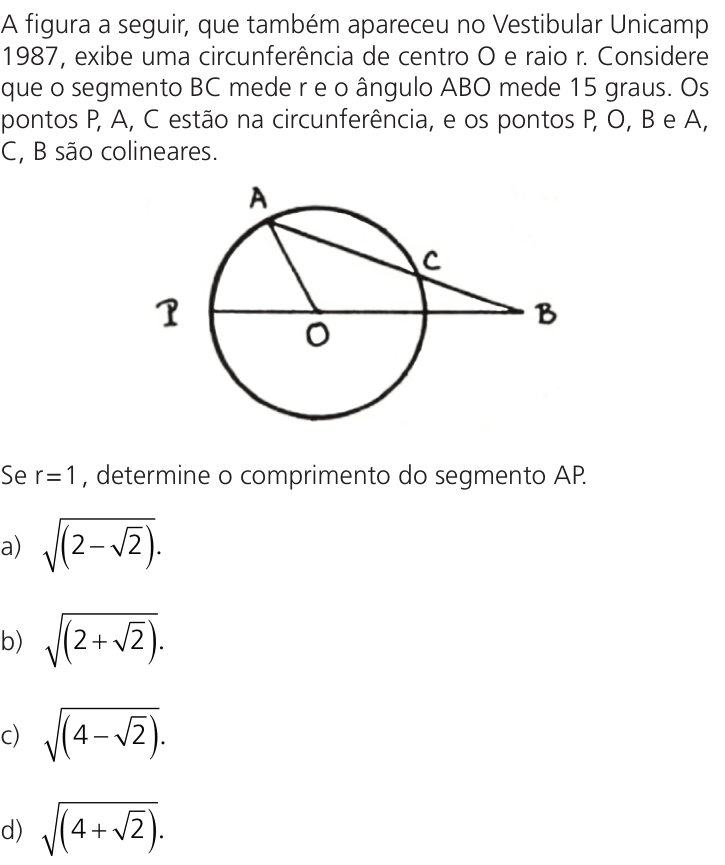
Como BC=r=1 e OC=r=1, o triângulo OBC é isósceles com OC=BC.
Além disso, A,C,B são colineares, então \angle OBC=\angle ABO=15^\circ.

No triângulo OBC, pela lei dos cossenos:

OC^2=OB^2+BC^2-2\cdot OB\cdot BC\cdot \cos 15^\circ
1=OB^2+1-2OB\cos15^\circ \Rightarrow OB=2\cos15^\circ.

Como OC=BC, os ângulos da base também são iguais, logo \angle BOC=15^\circ. Assim, o ponto C está a 15^\circ acima do eixo OB.

Para achar A, que é a segunda interseção da reta BC com a circunferência, obtém-se \angle AOB=135^\circ. Como P,O,B são colineares e OP é o raio oposto a OB, temos:

\angle AOP=180^\circ-135^\circ=45^\circ.

Portanto, a corda AP mede:

AP=2\cdot 1\cdot \operatorname{sen}\left(\frac{45^\circ}{2}\right) =2\operatorname{sen}22,5^\circ =\sqrt{2-\sqrt2}.

Resposta: A

Gemini 3.8 Flash

A

Respondeu

levou 28 s

Como pensou
**Analyzing Question Elements** I am currently dissecting the provided text, focusing on identifying the core components and constraints of the UNICAMP exam question. My analysis involves extracting key geometric information, such as the circle's center and radius, and specific measurements like segment BC equaling the radius and angle ABO being 15 degrees. **Revising Geometric Setup** I'm refining the geometric understanding, specifically clarifying the collinearity of points. It appears $P, O, D, B$ lie on a line, with $D$ being on the circle and $B$ external. Also, $A, C, B$ are collinear, with $C$ on the circle and $BC = r = 1$. **Calculating Angles** I've determined that $\triangle OBC$ is isosceles with $OC=BC=1$, leading to $\angle BOC=15^\circ$. This implies $\angle ACO=30^\circ$, and subsequently $\triangle OAC$ is isosceles with $OA=OC=1$, giving $\angle AOC=120^\circ$. The angle $\angle AOB$ is then $135^\circ$. **Confirming Angle Calculations** My recent work confirms $\angle AOC$ is precisely $120^\circ$. I've now deduced $P$'s location and calculated $\angle AOP$ as $45^\circ$. Using the Law of Cosines on $\triangle AOP$, $AP$ is $\sqrt{2-\sqrt{2}}$. **Verifying Calculated Values** I have now confirmed that my calculation for AP, which is $\sqrt{2 - \sqrt{2}}$, matches option (a) from the provided choices. My analysis of the geometric constraints and angle relationships seems to have been sound. **Deriving Segment Length** I've completed the geometric derivations, confirming that $\triangle OBC$ and $\triangle OAC$ are isosceles, leading to $\angle BOC = 15^\circ$ and $\angle AOC = 120^\circ$. This implies $\angle AOB = 135^\circ$, and with $P, O, B$ collinear, $\angle AOP = 45^\circ$. Applying the Law of Cosines to $\triangle AOP$ with $OA=OP=1$ yields $AP^2 = 1^2 + 1^2 - 2(1)(1)\cos(45^\circ) = 2 - \sqrt{2}$.

Para determinar o comprimento do segmento AP, analisamos a geometria da figura:

  1. Triângulo OBC:

    • O ponto C pertence à circunferência, logo OC = r = 1.
    • O enunciado informa que BC = r = 1.
    • Portanto, o triângulo OBC é isósceles com OC = BC, o que implica:
      \angle BOC = \angle CBO = 15^\circ
  2. Ângulo \angle ACO:

    • Como os pontos A, C e B são colineares, o ângulo \angle ACO é o ângulo externo ao triângulo OBC no vértice C:
      \angle ACO = \angle CBO + \angle BOC = 15^\circ + 15^\circ = 30^\circ
  3. Triângulo OAC:

    • Os pontos A e C pertencem à circunferência, logo OA = OC = r = 1.
    • Portanto, o triângulo OAC é isósceles, com:
      \angle OAC = \angle OCA = 30^\circ
    • A soma dos ângulos internos de \triangle OAC fornece:
      \angle AOC = 180^\circ - (30^\circ + 30^\circ) = 120^\circ
  4. Ângulos \angle AOB e \angle AOP:

    • O ângulo \angle AOB é dado por:
      \angle AOB = \angle AOC + \angle BOC = 120^\circ + 15^\circ = 135^\circ
    • Como os pontos P, O e B são colineares, o ângulo \angle POB é raso (180^\circ). Logo:
      \angle AOP = 180^\circ - \angle AOB = 180^\circ - 135^\circ = 45^\circ
  5. Cálculo do segmento AP:

    • No triângulo AOP, temos OA = 1, OP = 1 e \angle AOP = 45^\circ.
    • Aplicando a Lei dos Cossenos:
      AP^2 = OA^2 + OP^2 - 2 \cdot OA \cdot OP \cdot \cos(45^\circ)

      AP^2 = 1^2 + 1^2 - 2 \cdot 1 \cdot 1 \cdot \frac{\sqrt{2}}{2}

      AP^2 = 2 - \sqrt{2}

      AP = \sqrt{2 - \sqrt{2}}

Resposta: A