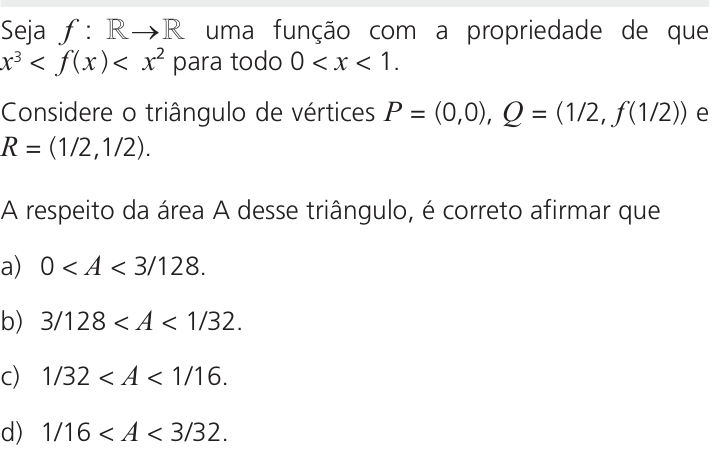
Respondeu
levou 6 s
Como pensou
**Explaining equations succinctly**
I need to simplify the explanation of an equation in Portuguese. It looks like I’m dealing with areas represented as fractions, specifically between 1/8 and 1/4, and also between 1/4 and 3/8. When I take the perpendicular at x=1/2, the distance 1/2 gives me these areas, culminating in values of 1/16 and 3/32. I'll focus on making this clearer and easier to understand for anyone reading it!
Aplicando a condição dada em x=\frac12, temos
\frac18<f\left(\frac12\right)<\frac14.
O segmento QR é vertical e tem comprimento
QR=\frac12-f\left(\frac12\right),
pois f(\frac12)<\frac12. A altura relativa a essa base é a distância de P=(0,0) à reta x=\frac12, ou seja, \frac12.
Assim, a área do triângulo é
A=\frac12\cdot QR\cdot\frac12
=\frac14\left(\frac12-f\left(\frac12\right)\right).
Como
\frac14<\frac12-f\left(\frac12\right)<\frac38,
concluímos que
\boxed{\frac1{16}<A<\frac3{32}}.
Resposta: D
Respondeu
levou 7 s
Como pensou
**Explaining equations concisely**
I need to read about an issue related to the image property involving x^3 being less than f(x), which is less than x^2. It looks like for half, f should be between 1/8 and 1/4, with a base of 0.5 minus f ranging between 0.25 and 0.375 in height. Also, I’ll note that a quarter base fits between 1/16 and 3/32. I need to explain these equations in a concise way in Portuguese.
Aplicando a propriedade em x=\frac12, temos
\frac18<f\left(\frac12\right)<\frac14.
O segmento QR é vertical e tem comprimento
QR=\frac12-f\left(\frac12\right).
A altura relativa a essa base é a distância de P=(0,0) à reta x=\frac12, ou seja, \frac12. Portanto,
A=\frac12\cdot QR\cdot\frac12
=\frac14\left(\frac12-f\left(\frac12\right)\right).
Pelos limites de f\left(\frac12\right),
\frac14<\frac12-f\left(\frac12\right)<\frac38.
Multiplicando por \frac14, obtemos
\boxed{\frac1{16}<A<\frac3{32}}.
Resposta: D
Respondeu
levou 4 s
Como pensou
**Interpreting inequalities**
I need to tackle the problem in Portuguese about interpreting inequalities, specifically x^3 < f(x) < x^2 for 0<x<1. I can consider triangle vertices P(0,0), Q(1/2,f(1/2)), and R(1/2,1/2). At x=0.5, f should be between 1/8 and 1/4, which helps find the area of triangle QR. I'm computing the area and verifying that option D says 1/16 < A < 3/32 is correct. So, I confirm the answer is D!
Para x=\frac12, a condição dada implica
\frac18<f\left(\frac12\right)<\frac14.
O segmento QR é vertical e tem comprimento \frac12-f(\frac12), portanto
\frac14<QR<\frac38.
A distância de P à reta que contém QR é \frac12. Assim, a área do triângulo é
A=\frac12\cdot QR\cdot\frac12,
o que resulta em
\frac1{16}<A<\frac3{32}.
Resposta: D
Respondeu
levou 5 s
Como pensou
Temos x = 1/2, logo (1/2)^3 = 1/8 < f(1/2) < (1/2)^2 = 1/4.
Os pontos Q = (1/2, f(1/2)) e R = (1/2, 1/2) estão sobre a reta vertical x = 1/2. Assim, o triângulo PQR tem base QR (vertical) de comprimento 1/2 - f(1/2) e altura igual à distância de P=(0,0) à reta x = 1/2, que é 1/2.
Logo:
A = \frac{1}{2}\cdot\frac{1}{2}\cdot\left(\frac12 - f(1/2)\right) = \frac{1}{4}\left(\frac12 - f(1/2)\right).
Como 1/8 < f(1/2) < 1/4:
- \frac12 - f(1/2) está entre \frac12 - \frac14 = \frac14 e \frac12 - \frac18 = \frac38.
Portanto:
\frac14\cdot\frac14 = \frac1{16} < A < \frac14\cdot\frac38 = \frac{3}{32}.
Resposta: D
Respondeu
levou 6 s
Como pensou
Since f(1/2) lies between 1/8 and 1/4, the triangle PQR with vertical base QR at x=1/2 has length between 1/4 and 3/8, and height 1/2, giving an area between 1/16 and 3/32 — matching answer D.
Resposta: D
1. Limites para f(1/2). Como 0 < 1/2 < 1, vale a propriedade dada:
(1/2)³ < f(1/2) < (1/2)², ou seja, 1/8 < f(1/2) < 1/4.
2. Base e altura do triângulo. Os pontos Q e R têm a mesma abscissa, x = 1/2. Logo o lado QR é vertical e serve de base.
- Base: QR = 1/2 − f(1/2). Como f(1/2) < 1/4 < 1/2, esse comprimento é positivo.
- Altura: é a distância de P = (0,0) à reta x = 1/2, que vale 1/2.
3. Área.
A = (1/2) · (1/2) · (1/2 − f(1/2)) = (1/2 − f(1/2)) / 4
4. Limites da área. Com 1/8 < f(1/2) < 1/4:
- 1/2 − 1/4 < 1/2 − f(1/2) < 1/2 − 1/8, ou seja, 1/4 < 1/2 − f(1/2) < 3/8.
- Dividindo por 4: 1/16 < A < 3/32.
Esse intervalo corresponde à alternativa D.
Resposta: D
Respondeu
levou 3 s
Como pensou
Em x = 1/2, a propriedade dá 1/8 < f(1/2) < 1/4.
Os vértices são P = (0,0), Q = (1/2, f(1/2)) e R = (1/2, 1/2). Q e R estão na mesma reta vertical x = 1/2, então o lado QR é vertical e tem comprimento 1/2 − f(1/2). A altura relativa a esse lado é a distância de P à reta x = 1/2, que vale 1/2.
Logo:
A = (1/2) · (1/2 − f(1/2)) · (1/2) = (1/4)(1/2 − f(1/2)).
Como 1/8 < f(1/2) < 1/4, temos 1/2 − f(1/2) entre 1/4 e 3/8. Então:
- limite inferior: (1/4)(1/4) = 1/16;
- limite superior: (1/4)(3/8) = 3/32.
Portanto 1/16 < A < 3/32.
Resposta: D
Respondeu
levou 17 s
Como pensou
The problem is in Portuguese. I will translate it.
The problem asks for the area of a triangle with vertices P(0,0), Q(1/2, f(1/2)), and R(1/2, 1/2). Since Q and R share the same x-coordinate, the side QR is vertical. I need to use the given inequality constraints on f(x) to find the bounds for A.
The area is A = (1/2 − f(1/2))/4. Since 0 < f(1/2) < 1/4, the bounds are 1/8 − 1/16 < A < 1/8 − 1/32.
The correct answer is option d: 1/16 < A < 3/32.
A área do triângulo de vértices P=(0,0), Q=(1/2,f(1/2)) e R=(1/2,1/2) é dada pela fórmula do determinante (ou, equivalentemente, por base vertical e altura horizontal):
A=\frac18-\frac{f(1/2)}{4}.
A hipótese x^3<f(x)<x^2 aplicada em x=1/2 fornece
\frac18<f(1/2)<\frac14.
Substituindo esses limites estritos na expressão de A obtém-se imediatamente
\frac1{16}<A<\frac3{32}.
Assim, a alternativa correta é a (d).
Resposta: D
Respondeu
levou 3 s
Como pensou
We need answer in Portuguese. Need solve. Let's parse problem. Image in Portuguese. It says:
"Seja f: R → R uma função com a propriedade de que x^3 < f(x) < x^2 para todo 0 < x < 1.
Considere o triângulo de vértices P = (0,0), Q = (1/2, f(1/2)) e R = (1/2, 1/2).
A respeito da área A desse triângulo, é correto afirmar que
a) 0 < A < 3/128.
b) 3/128 < A < 1/32.
c) 1/32 < A < 1/16.
d) 1/16 < A < 3/32."
Need determine interval for area. Let's compute area of triangle with vertices P=(0,0), Q=(1/2, f(1/2)), R=(1/2,1/2). Since Q and R have same x=1/2, vertical segment QR length = |1/2 - f(1/2)|. Since 0<x<1, at x=1/2, property: (1/2)^3 < f(1/2) < (1/2)^2 => 1/8 < f(1/2) < 1/4. Also 1/2 > f? Since f<1/4<1/2. So vertical distance = 1/2 - f(1/2). Base from P to line x=1/2? Triangle area = 1/2 * base? Let's calculate: vertices (0,0), (1/2, y_Q), (1/2, 1/2). Determinant area = 1/2 |det(Q-P, R-P)| = 1/2 |(1/2)*1/2 - y_Q*(1/2)|? Let's compute: vectors Q=(1/2,y), R=(1/2,1/2). det = (1/2)*(1/2) - y*(1/2) = 1/4 - y/2 = (1 - 2y)/4. Area = 1/2 * |(1 - 2y)/4| = |1 - 2y|/8. Since y between 1/8 and 1/4, 1 - 2y between 1 - 1/2 = 1/2 and 1 - 1/4 = 3/4. So area between (1/2)/8 = 1/16 and (3/4)/8 = 3/32. Wait area = (1-2y)/8. If y=1/8, area=(1-1/4)/8=(3/4)/8=3/32. If y=1/4, area=(1-1/2)/8=(1/2)/8=1/16. Since strict inequalities, A between 1/16 and 3/32? Let's check endpoints: y approaches 1/8 from above => A approaches 3/32 from below. y approaches 1/4 from below => A approaches 1/16 from above. So 1/16 < A < 3/32. That's option d.
Need explain. Check if any alternative? d) 1/16 < A < 3/32. Yes.
But let's ensure no sign issue. f(x) could be negative? But inequality x^3 < f(x) < x^2 for 0<x<1, x^3>0, so f positive. At x=1/2, 1/8 < f < 1/4. R=(1/2,1/2) y=1/2. Thus Q below R. Area = 1/2 * (horizontal distance from P to x=1/2) * vertical distance? Wait triangle with base QR vertical length = 1/2 - y. Height from P to line x=1/2 is 1/2. Area = 1/2 * base * height = 1/2 * (1/2 - y) * (1/2) = (1/2 - y)/4 = (1 - 2y)/8. Same. Bound: if y in (1/8,1/4), then base in (1/4, 3/8)? Let's compute: 1/2 - y. y=1/8 => 3/8; y=1/4 => 1/4. Area = 1/2 * (1/2) * base = 1/4 * base. base in (1/4, 3/8) => area in (1/16, 3/32). Good.
Final answer with explanation. Include line "Resposta: D". Need use correct format. Since question alternatives A-D. Option d. Use D.
A área do triângulo pode ser calculada a partir dos vértices:
- P=(0,0)
- Q=\left(\frac12, f\left(\frac12\right)\right)
- R=\left(\frac12,\frac12\right)
Como Q e R têm a mesma abscissa x=\frac12, o segmento QR é vertical. Assim, a base do triângulo é
\frac12 - f\left(\frac12\right)
e a altura relativa a essa base é a distância horizontal de P até a reta x=\frac12, que vale \frac12.
Logo,
A=\frac12 \cdot \left(\frac12 - f\left(\frac12\right)\right)\cdot \frac12
= \frac{1}{4}\left(\frac12 - f\left(\frac12\right)\right)
= \frac{1-2f\left(\frac12\right)}{8}.
Pela propriedade dada, para 0<x<1,
x^3 < f(x) < x^2.
Em x=\frac12,
\left(\frac12\right)^3 < f\left(\frac12\right) < \left(\frac12\right)^2,
ou seja,
\frac18 < f\left(\frac12\right) < \frac14.
Substituindo na expressão da área:
- Se f\left(\frac12\right) se aproxima de \frac14, então A se aproxima de
\frac{1-2\cdot\frac14}{8}=\frac{1-\frac12}{8}=\frac{1}{16}.
- Se f\left(\frac12\right) se aproxima de \frac18, então A se aproxima de
\frac{1-2\cdot\frac18}{8}=\frac{1-\frac14}{8}=\frac{3}{32}.
Como as desigualdades são estritas,
\frac{1}{16}<A<\frac{3}{32}.
Resposta: D
Respondeu
levou 12 s
Como pensou
**Analyzing Triangle Area**
I'm currently focused on determining the correct statement regarding the area $A$ of a triangle defined by specific vertices. The key challenge lies in the inequality $x^3 < f(x) < x^2$ that governs the function $f(x)$ for all $x$. This relationship will be crucial in calculating the triangle's area and identifying the correct assertion.
**Calculating Triangle Area**
I've calculated the area $A$ of the triangle with vertices $P(0,0)$, $Q(1/2, f(1/2))$, and $R(1/2, 1/2)$ as $A = \frac{1}{8} - \frac{1}{4} f(1/2)$, utilizing the given inequality $x^3 < f(x) < x^2$ for $x=1/2$. This specific calculation is a key step in determining the correct assertion about the triangle's area.
Para determinar o intervalo de valores da área A do triângulo com vértices P = (0,0), Q = \left(\frac{1}{2}, f\left(\frac{1}{2}\right)\right) e R = \left(\frac{1}{2}, \frac{1}{2}\right), seguimos os seguintes passos:
-
Limites para f(1/2):
Como a propriedade x^3 < f(x) < x^2 é válida para todo 0 < x < 1, aplicando para x = \frac{1}{2}, temos:
\left(\frac{1}{2}\right)^3 < f\left(\frac{1}{2}\right) < \left(\frac{1}{2}\right)^2 \implies \frac{1}{8} < f\left(\frac{1}{2}\right) < \frac{1}{4}
-
Cálculo da área A do triângulo:
Os pontos Q e R possuem a mesma coordenada x = \frac{1}{2}, portanto o segmento QR é vertical.
- O comprimento da base do triângulo é:
b = \left|\frac{1}{2} - f\left(\frac{1}{2}\right)\right| = \frac{1}{2} - f\left(\frac{1}{2}\right) \quad \left(\text{pois } f\left(\frac{1}{2}\right) < \frac{1}{4} < \frac{1}{2}\right)
- A altura h em relação a essa base é a distância horizontal do ponto P(0,0) à reta x = \frac{1}{2}:
h = \frac{1}{2} - 0 = \frac{1}{2}
Logo, a área A é dada por:
A = \frac{b \cdot h}{2} = \frac{\left(\frac{1}{2} - f\left(\frac{1}{2}\right)\right) \cdot \frac{1}{2}}{2} = \frac{1}{4}\left(\frac{1}{2} - f\left(\frac{1}{2}\right)\right)
-
Determinando a desigualdade para A:
A partir de \frac{1}{8} < f\left(\frac{1}{2}\right) < \frac{1}{4}:
-\frac{1}{4} < -f\left(\frac{1}{2}\right) < -\frac{1}{8}
\frac{1}{2} - \frac{1}{4} < \frac{1}{2} - f\left(\frac{1}{2}\right) < \frac{1}{2} - \frac{1}{8}
\frac{1}{4} < \frac{1}{2} - f\left(\frac{1}{2}\right) < \frac{3}{8}
Multiplicando todos os termos por \frac{1}{4}:
\frac{1}{16} < A < \frac{3}{32}
Resposta: D