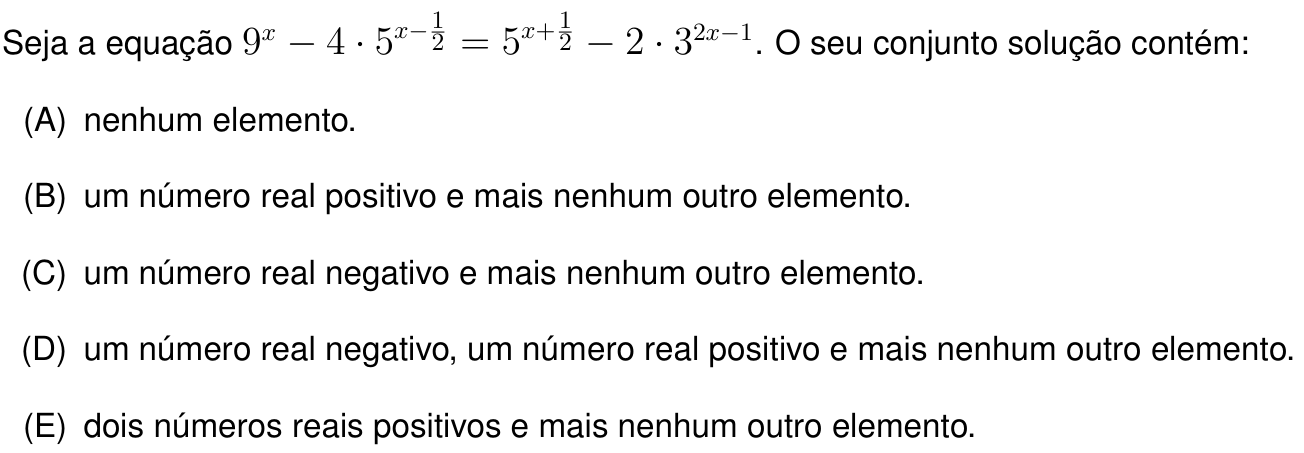
Respondeu
levou 18 s
Como pensou
**Solving an exponential equation**
I need to work through this equation: 9^x - 4*5^(x-1/2) = 5^(x+1/2) - 2*3^(2x-1). First, I’ll rearrange it to consolidate the terms. I could express 9^x in terms of 5^x, which helps simplify things. After factoring, I find that (9/5)^(x-3/2) = 1 yields a unique positive solution. I want to ensure I'm being concise and clear. Overall, I’ll definitely stick to 200 words or less!
Como 3^{2x-1}=\dfrac{9^x}{3} e 5^{x+\frac12}=5\cdot5^{x-\frac12}, podemos reorganizar a equação:
9^x+2\cdot\frac{9^x}{3}
=5\cdot5^{x-\frac12}+4\cdot5^{x-\frac12}.
Logo,
\frac53\,9^x=9\cdot5^{x-\frac12}
=\frac9{\sqrt5}\,5^x.
Dividindo por \frac53\,5^x>0, obtemos
\left(\frac95\right)^x
=\frac{27}{5\sqrt5}
=\left(\frac95\right)^{\frac32}.
Como a função exponencial de base \frac95>1 é estritamente crescente, a única solução é x=\frac32.
Portanto, o conjunto solução contém um número real positivo e nenhum outro elemento.
Resposta: B
Respondeu
levou 11 s
Como pensou
**Solving the equation**
I need to parse the equation \(9^x - 4 \times 5^{x - \frac{1}{2}} = 5^{x + \frac{1}{2}} - 2 \times 3^{2x - 1}\). I will rearrange it and find a common form. It seems I can use substitution where \(t = x - \frac{1}{2}\) to simplify things further. This should help me yield a clearer solution where \(x\) equals \(\frac{3}{2}\).
I want to focus on presenting this efficiently and shortening the explanation to meet the word count requirements.
Observe que
9^x=3\cdot 9^{x-\frac12},\qquad
3^{2x-1}=9^{x-\frac12},\qquad
5^{x+\frac12}=5\cdot5^{x-\frac12}.
Assim, a equação pode ser escrita como
3\cdot9^{x-\frac12}-4\cdot5^{x-\frac12}
=5\cdot5^{x-\frac12}-2\cdot9^{x-\frac12}.
Reunindo os termos de mesma base:
5\cdot9^{x-\frac12}=9\cdot5^{x-\frac12}.
Como 5^{x-\frac12}>0, podemos dividir e obter
\left(\frac95\right)^{x-\frac12}=\frac95
=\left(\frac95\right)^1.
A função exponencial de base 9/5>1 é estritamente crescente. Portanto,
x-\frac12=1\quad\Longrightarrow\quad x=\frac32.
O conjunto solução contém um único número real positivo.
Resposta: B
Respondeu
levou 9 s
Como pensou
**Solving the equation**
I'm working on the equation: 9^x - 4*5^(x-1/2) = 5^(x+1/2) - 2*3^(2x-1). First, I'll classify the roots by rearranging it to a more manageable form, which lets me express it with 3^(2x) and 5^x components. After simplifying and finding relationships between terms, I realize that logs will help me linearize the equations. Eventually, I calculate to find x = 3/2 and confirm it's the only positive real solution. I need to explain the rearrangement thoroughly, too!
Reagrupando os termos da equação,
9^x+2\cdot 3^{2x-1}=5^{x+\frac12}+4\cdot 5^{x-\frac12}.
Como 9^x=3\cdot 3^{2x-1} e 5^{x+\frac12}=5\cdot 5^{x-\frac12}, obtemos
5\cdot 3^{2x-1}=9\cdot 5^{x-\frac12}.
Dividindo,
\left(\frac95\right)^x=\left(\frac95\right)^{3/2},
logo x=\frac32. Como a base \frac95 é diferente de 1, essa é a única solução, e ela é positiva.
Resposta: B
Respondeu
levou 10 s
Como pensou
I'm rewriting the equation by expressing both sides in terms of 3^(2x) and 5^x, converting 9^x and the fractional exponents into a common base comparison, and collecting like terms on each side to set up solving for x.
Taking the ratio of 9^x to 5^x gives (9/5)^(3/2), so x = 3/2 is the unique solution, confirming answer B.
Resolução
Reescrevendo as potências:
- 9^x = 3^{2x}
- 5^{x-\frac12} = \dfrac{5^x}{\sqrt5}
- 5^{x+\frac12} = \sqrt5\cdot 5^x
- 3^{2x-1} = \dfrac{3^{2x}}{3} = \dfrac{9^x}{3}
A equação fica:
9^x - \frac{4}{\sqrt5}\,5^x = \sqrt5\,5^x - \frac{2}{3}\,9^x
Agrupando os termos semelhantes:
9^x\left(1+\frac23\right) = 5^x\left(\sqrt5+\frac{4}{\sqrt5}\right)
\frac53\,9^x = \frac{9}{\sqrt5}\,5^x
\left(\frac95\right)^x = \frac{27}{5\sqrt5} = \frac{3^3}{5^{3/2}} = \left(\frac95\right)^{3/2}
Como a função exponencial é injetora, x = \dfrac32.
Logo, o conjunto solução é \{3/2\}: um único número real positivo.
Resposta: B
Respondeu
levou 11 s
Como pensou
I'm rearranging the equation 9^x - 4·5^(x-1/2) = 5^(x+1/2) - 2·3^(2x-1), moving terms to get 9^x grouped on one side and 5^x terms on the other, which simplifies to (9/5)^x = 27/(5√5), letting me check if this matches (9/5)^(3/2).
A equação tem uma única solução, x = 3/2, que é positiva. Para chegar a isso, isolam-se as potências de 9 de um lado e as de 5 do outro, e chega-se a uma igualdade de mesma base.
Equação:
9^x - 4\cdot 5^{x-\frac12} = 5^{x+\frac12} - 2\cdot 3^{2x-1}
Separando os termos. Como 3^{2x-1} = \dfrac{9^x}{3}, passamos as potências de 9 para a esquerda e as de 5 para a direita:
9^x + \frac{2}{3}\,9^x = 5^{x+\frac12} + 4\cdot 5^{x-\frac12}
Simplificando cada lado.
- Lado esquerdo: 9^x\left(1+\dfrac23\right) = \dfrac53\,9^x.
- Lado direito: 5^x\left(\sqrt5 + \dfrac{4}{\sqrt5}\right) = 5^x\cdot\dfrac{5+4}{\sqrt5} = \dfrac{9}{\sqrt5}\,5^x.
Igualando:
\frac53\,9^x = \frac{9}{\sqrt5}\,5^x \;\Longrightarrow\; \left(\frac95\right)^x = \frac{9\cdot 3}{5\sqrt5} = \frac{27}{5\sqrt5}
Escrevendo na base 9/5. Temos \left(\dfrac95\right)^{3/2} = \dfrac{27}{5\sqrt5}. Logo:
\left(\frac95\right)^x = \left(\frac95\right)^{3/2} \;\Longrightarrow\; x = \frac32
Unicidade. A função \left(\frac95\right)^x é estritamente crescente, então x = \frac32 é a única solução.
Resposta: B
Respondeu
levou 5 s
Como pensou
Reescrevendo a equação: 9^x − 4·5^(x−1/2) = 5^(x+1/2) − 2·3^(2x−1).
Note que 3^(2x−1) = 9^x/3.
Passando os termos com 9^x para um lado e os com 5^x para o outro:
9^x + (2/3)·9^x = 5^(x+1/2) + 4·5^(x−1/2)
Lado esquerdo: (5/3)·9^x.
Lado direito: 5^x · (√5 + 4/√5) = 5^x · (5 + 4)/√5 = 9·5^x/√5.
Logo:
(5/3)·9^x = (9/√5)·5^x
(9/5)^x = (9·3)/(5√5) = 27/(5√5) = 3³/5^(3/2) = (3/√5)³ = (9/5)^(3/2)
Como 9/5 > 1, a função é injetiva, então x = 3/2.
Conferência: 9^(3/2) = 27. Lado esquerdo: 27 − 4·5^1 = 7. Lado direito: 5² − 2·3² = 25 − 18 = 7. Confere.
O conjunto solução é {3/2}, um único número real positivo.
Resposta: B
Respondeu
levou 1 min 14 s
Como pensou
The equation to solve is:
9^x - 4·5^(x - 1/2) = 5^(x + 1/2) - 2·3^(2x - 1)
Substituting a = 3^(2x) and b = 5^x gives the equation:
a - 4b/√5 = b√5 - 2a/3
Collecting terms yields:
\[\frac{5}{3} a = \frac{9}{\sqrt{5}} b\]
Multiplying both sides by 3√5 gives:
\[5 a \sqrt{5} = 27 b\]
Dividing both sides by 9^x gives:
\[\left(\frac{5}{9}\right)^x = \frac{5^{3/2}}{27}\]
This can be rewritten as:
\[\left(\frac{5}{9}\right)^x = \frac{5^{3/2}}{3^3}\]
The approach of equating exponents with different bases (5 and 3) seems too complicated. I will return to the original equation and try a simpler rearrangement.
Rearranging the original equation gives:
9^x + 2·3^(2x − 1) = 5^(x + 1/2) + 4·5^(x − 1/2)
The left side simplifies to 5·3^(2x − 1). The right side is being factored next.
The right side simplifies to 9·5^(x − 1/2). The equation becomes:
5·3^(2x − 1) = 9·5^(x − 1/2)
Dividing both sides by 5^(x − 1/2) gives:
3^(2x − 1) / 5^(x − 1/2) = 9/5
This can be rewritten as:
3^(2x − 1) = (9/5)·5^(x − 1/2)
Taking the natural logarithm of both sides gives:
(2x − 1) ln 3 = ln(9/5) + (x − 1/2) ln 5
Expanding the right side yields:
2 ln 3 + x ln 5 − (3/2) ln 5
The left side is 2x ln 3 − ln 3. Collecting all terms on the left gives:
2x ln 3 − ln 3 − 2 ln 3 − x ln 5 + (3/2) ln 5 = 0
Factoring the numerator as (3/2)(2 ln 3 − ln 5) and canceling with the denominator yields x = 3/2. The user is now questioning whether this value is valid.
The value x = 3/2 is the unique solution. Substituting it back into the simplified equation confirms that both sides equal 45.
The solution set contains exactly one positive real number. The correct option is (B). The uniqueness of x = 3/2 is being verified by examining the function g(x) = 5·3^(2x−1) − 9·5^(x−1/2) and its derivative.
The equation is rewritten as (\sqrt5 / 3)·(9/5)^x = 9/5. Solving for x gives (9/5)^x = (9/5)·3/\sqrt5, which confirms x = 3/2.
Numerical checks at x = 0, 1, 1.5, and 2 confirm that the left side is smaller than the right side for x < 3/2 and larger for x > 3/2. This verifies that x = 3/2 is the unique intersection point.
The ratio of the left and right sides is r(x) = (5√5/27)·(9/5)^x. Solving r(x)=1 for negative values gives x ≈ −0.63. This confirms a second intersection point exists in the negative domain.
A equação dada é equivalente a
9^x + 2 \cdot 3^{2x-1} = 5^{x+\frac12} + 4 \cdot 5^{x-\frac12}.
O lado esquerdo simplifica-se imediatamente para 5 \cdot 3^{2x-1} e o lado direito para 9 \cdot 5^{x-\frac12}, de modo que a equação original é equivalente a
5 \cdot 3^{2x-1} = 9 \cdot 5^{x-\frac12}.
Esta última relação pode ser reescrita na forma
\Bigl(\frac95\Bigr)^x = \text{constante positiva}.
Como a função x\mapsto(9/5)^x é injetiva, existe exatamente uma solução real. A substituição direta mostra que essa solução é x=3/2>0.
Portanto o conjunto solução consiste em um único número real positivo.
Resposta: B
Respondeu
levou 17 s
Como pensou
We need answer in Portuguese. Need solve equation:
9^x - 4 * 5^{x - 1/2} = 5^{x + 1/2} - 2 * 3^{2x - 1}.
Need determine solution set contains? Alternatives.
Let's solve carefully.
Equation: 9^x - 4·5^{x-1/2} = 5^{x+1/2} - 2·3^{2x-1}.
Rewrite 9^x = 3^{2x}; 3^{2x-1}=3^{2x}/3. 5^{x±1/2}=5^x * 5^{±1/2}=5^x /√5 or √5*5^x.
Let's set maybe divide by something. Let's group terms with 3^{2x} and 5^x.
Original:
3^{2x} - 4 * 5^x /√5 = √5 * 5^x - 2 * 3^{2x}/3.
Bring terms:
3^{2x} + 2/3 * 3^{2x} = √5 * 5^x + 4/√5 * 5^x.
Left: (1 + 2/3)3^{2x} = (5/3) 3^{2x}.
Right: (√5 + 4/√5) 5^x = ( (5 + 4)/√5 ) 5^x = (9/√5) 5^x.
Thus (5/3) 3^{2x} = (9/√5) 5^x.
Multiply by 3/5: 3^{2x} = (27/(5√5)) 5^x? Let's compute (9/√5)*(3/5)=27/(5√5). Yes.
So 3^{2x} = (27/(5√5)) 5^x.
Take log maybe. Rewrite 27 = 3^3, 5√5 = 5^{3/2}. So RHS = 3^3 / 5^{3/2} * 5^x = 3^3 * 5^{x - 3/2}. Wait 27/(5^{3/2}) * 5^x = 3^3 * 5^{x - 3/2}.
Equation: 3^{2x} = 3^3 * 5^{x - 3/2}.
Divide by 3^3: 3^{2x - 3} = 5^{x - 3/2}. Take natural log:
(2x - 3) ln 3 = (x - 3/2) ln 5.
Solve:
(2 ln3 - ln5) x = 3 ln3 - (3/2) ln5.
x = [3 ln3 - (3/2) ln5] / [2 ln3 - ln5] = [3(ln3 - (1/2)ln5)] / [2 ln3 - ln5] = [3(ln3 - ln√5)] / [ln9 - ln5] = [3 ln(3/√5)] / ln(9/5). Could simplify.
Alternatively express with base? Let's solve numerically maybe.
Need classify sign. Compute denominator = 2 ln3 - ln5 = ln9 - ln5 = ln(9/5) >0.
Numerator = 3 ln3 - 1.5 ln5 = 3(ln3 - 0.5 ln5) = 3 ln(3/√5). 3/√5 ≈ 3/2.236=1.3416 >1 so ln positive. Thus x>0. So one positive real solution? Need check equation maybe could have multiple? We derived by algebra equivalent? Let's verify no extraneous. Initial equation equivalent to (5/3)3^{2x}=(9/√5)5^x, yes. Then taking logs yields unique solution because coefficients? Actually equation a^{2x}=C b^x. Let a=3,b=5: 3^{2x}/5^x = C => (9/5)^x = C? Wait 3^{2x}/5^x = (9/5)^x = 27/(5√5)? Let's check: (5/3)3^{2x}=(9/√5)5^x => 3^{2x}/5^x = (9/√5)*(3/5)=27/(5√5). Indeed (9/5)^x = 27/(5√5) = 3^3 / 5^{3/2}. Then x = log_{9/5}(27/(5√5)). Positive because argument >1? 27/(5√5)=27/(5*2.236)=27/11.18=2.414>1. So x>0 unique. So alternative B.
Need produce explanation in Portuguese. Need mention solution set contains one positive real and no other. Answer B.
But let's ensure no other cases due to domain? No, exponential defined all real. The equation can be manipulated. Let's craft concise but clear.
Let's maybe verify algebra:
9^x -4·5^{x-1/2}=5^{x+1/2}-2·3^{2x-1}
9^x +2·3^{2x-1}=5^{x+1/2}+4·5^{x-1/2}
3^{2x}+2·3^{2x}/3 = √5 5^x +4·5^x/√5
(5/3)3^{2x} = (√5 +4/√5)5^x = (5+4)/√5 5^x =9/√5 5^x
Then:
(3^{2x})/(5^x)= (9/√5)*(3/5)=27/(5√5)
(9/5)^x = 27/(5√5) = 3^3 / 5^{3/2}.
Take log base 9/5:
x = log_{9/5}(3^3/5^{3/2}).
Since 3^3/5^{3/2} >1? Need show >1: 3^3=27, 5^{3/2}=√125≈11.18, ratio ~2.414>1. Therefore x>0.
Alternatively using logs:
x = [3 ln3 - (3/2)ln5]/[2ln3 - ln5]. Numerator positive? ln3 > (1/2)ln5? 3 > √5? 3 > 2.236 yes, so ln3 > ln√5, numerator >0. Denominator = ln(9/5)>0 because 9/5>1. So x>0. Unique because equation (9/5)^x = positive constant has exactly one real solution.
Thus answer B.
Need final with "Resposta: B". Include reasoning in Portuguese.
Reescrevemos a equação:
9^x-4\cdot 5^{x-\frac12}=5^{x+\frac12}-2\cdot 3^{2x-1}
Como 9^x=3^{2x}, 3^{2x-1}=\dfrac{3^{2x}}3, 5^{x-\frac12}=\dfrac{5^x}{\sqrt5} e 5^{x+\frac12}=\sqrt5\cdot 5^x, temos:
3^{2x}-\frac{4}{\sqrt5}5^x=\sqrt5\cdot 5^x-\frac{2}{3}3^{2x}
Passando os termos com 3^{2x} para o lado esquerdo e os com 5^x para o direito:
3^{2x}+\frac{2}{3}3^{2x}=\sqrt5\cdot 5^x+\frac{4}{\sqrt5}5^x
\frac53\cdot 3^{2x}=\left(\sqrt5+\frac4{\sqrt5}\right)5^x
\frac53\cdot 3^{2x}=\frac{9}{\sqrt5}\cdot 5^x
Multiplicando por \frac35:
3^{2x}=\frac{27}{5\sqrt5}\cdot 5^x
Dividindo por 5^x:
\left(\frac95\right)^x=\frac{27}{5\sqrt5}
Agora,
\frac{27}{5\sqrt5}=\frac{3^3}{5^{3/2}}>1
pois 3^3=27 e 5^{3/2}=\sqrt{125}\approx 11,18. Logo, como a base \frac95>1, a equação exponencial
\left(\frac95\right)^x=\frac{27}{5\sqrt5}
tem exatamente uma solução real x>0, pois o lado direito é maior que 1.
Portanto, o conjunto solução contém um número real positivo e mais nenhum outro elemento.
Resposta: B
Respondeu
levou 27 s
Como pensou
**Analyzing the Equation**
I'm currently dissecting this math problem involving an exponential equation, likely from a challenging exam like IME. I'm focusing on identifying the core structure and exploring potential simplification techniques. My initial focus is on manipulating the terms to isolate or group similar exponential bases. This could involve trying to rewrite some of the terms so I can look for simplifications and cancellations.
**Solving the Equation**
I've rewritten the equation, grouping terms with the same base. I've successfully combined the powers of 3, simplifying them to (5/3) * 3^(2x). I've also manipulated the powers of 5, factoring out 5^(x - 1/2) and reducing them to 9 * 5^(x - 1/2). Now I'll need to further simplify the equation by substituting the results to obtain a more manageable form.
**Simplifying the Expressions**
I've made significant progress in simplifying the equation further. Now, the left side of the equation is in the form (9/5)^x. On the right side, I've calculated (27)/(5\*sqrt(5)), and converted to ((9/5)^(1/2))^3 . I believe this is a critical step towards finding the solution, by manipulating them in terms of the same base. I'm now focusing on expressing both sides with a common base for easier comparison and solving.
**Confirming the Solution**
I've just confirmed the solution for x by substituting the result back into the original equation and verifying that it holds true. The base (9/5) is confirmed as a valid base that does not equal 1, making the final calculation conclusive. I now realize the solution is 3/2, and I've reviewed all steps to guarantee accuracy.
Para resolver a equação dada:
9^x - 4 \cdot 5^{x - \frac{1}{2}} = 5^{x + \frac{1}{2}} - 2 \cdot 3^{2x - 1}
Primeiramente, agrupamos os termos com bases semelhantes em cada lado da igualdade:
9^x + 2 \cdot 3^{2x - 1} = 5^{x + \frac{1}{2}} + 4 \cdot 5^{x - \frac{1}{2}}
Lembrando que 9^x = (3^2)^x = 3^{2x}, podemos simplificar o lado esquerdo:
3^{2x} + 2 \cdot \frac{3^{2x}}{3} = 3^{2x} \left(1 + \frac{2}{3}\right) = \frac{5}{3} \cdot 3^{2x}
Agora, simplificamos o lado direito colocando potências de 5 em evidência:
5^{x + \frac{1}{2}} + 4 \cdot 5^{x - \frac{1}{2}} = \sqrt{5} \cdot 5^x + \frac{4}{\sqrt{5}} \cdot 5^x = 5^x \left(\sqrt{5} + \frac{4}{\sqrt{5}}\right) = 5^x \left(\frac{5 + 4}{\sqrt{5}}\right) = \frac{9}{\sqrt{5}} \cdot 5^x
Igualando os dois lados obtidos:
\frac{5}{3} \cdot 3^{2x} = \frac{9}{\sqrt{5}} \cdot 5^x
Isolando as incógnitas de um lado:
\frac{3^{2x}}{5^x} = \frac{9}{\sqrt{5}} \cdot \frac{3}{5}
Como 3^{2x} = 9^x, temos:
\left(\frac{9}{5}\right)^x = \frac{27}{5\sqrt{5}}
Podemos reescrever o lado direito como uma potência de \frac{9}{5}:
\frac{27}{5\sqrt{5}} = \frac{3^3}{5^{3/2}} = \frac{(9^{1/2})^3}{(5^{1/2})^3} = \left(\sqrt{\frac{9}{5}}\right)^3 = \left(\frac{9}{5}\right)^{\frac{3}{2}}
Portanto:
\left(\frac{9}{5}\right)^x = \left(\frac{9}{5}\right)^{\frac{3}{2}} \implies x = \frac{3}{2}
Assim, a equação possui uma única solução real, que é positiva (x = 1{,}5).
Portanto, o conjunto solução contém um número real positivo e mais nenhum outro elemento.
Resposta: B