Como pensou
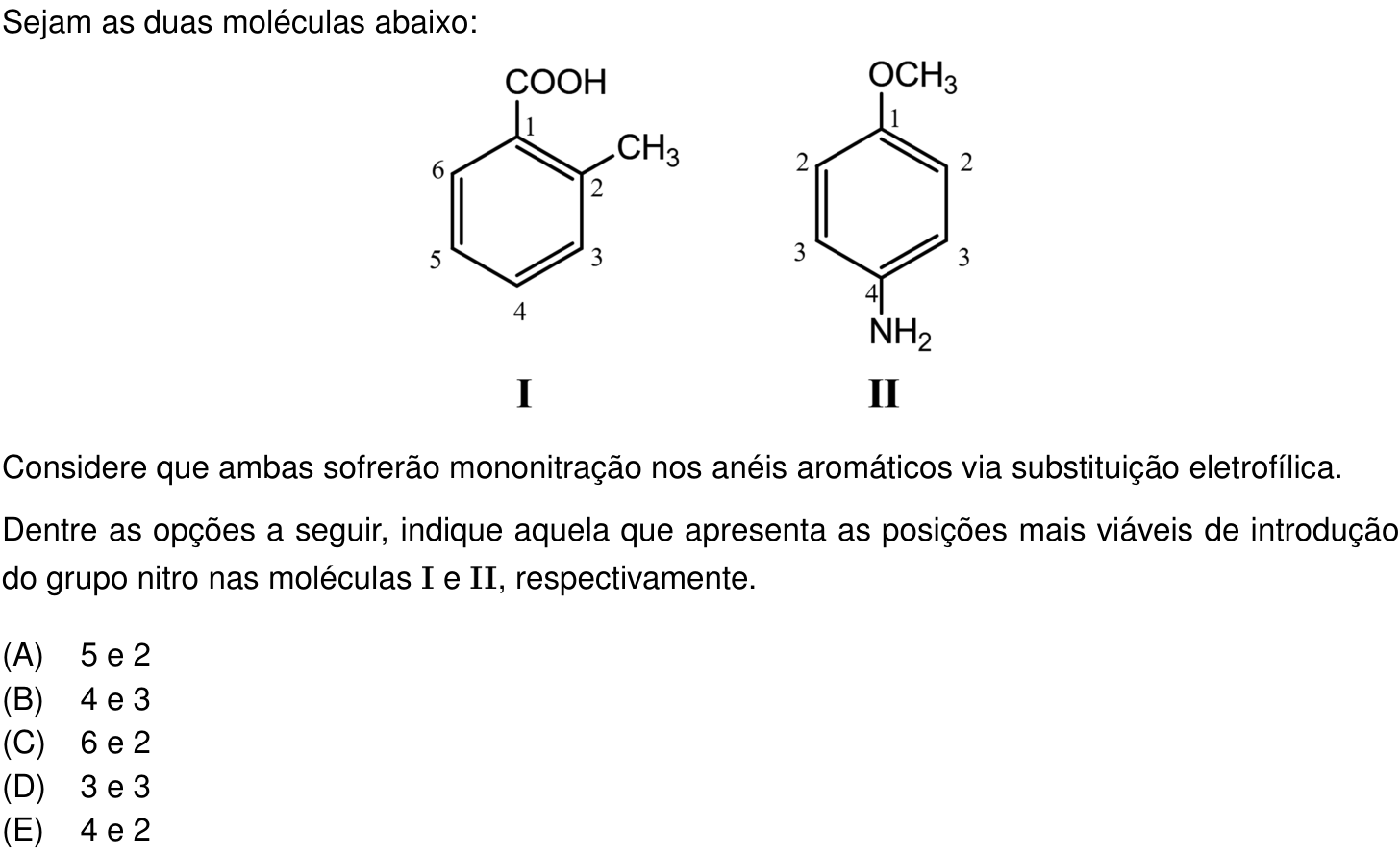
We need answer chemistry question in Portuguese. Need solve. Let's parse image. Two molecules: I is benzoic acid with methyl at position 2? Need identify positions. Molecule I: benzene ring with COOH at position1, CH3 at position2, numbering positions 1-6 around ring. Need mononitration via electrophilic aromatic substitution. Need most viable positions for introducing nitro group in molecules I and II respectively. Options A 5 e 2; B 4 e 3; C 6 e 2; D 3 e 3; E 4 e 2.
Need determine directing effects. Molecule I: substituents: COOH at C1, CH3 at C2. Both substituents on aromatic ring. Need nitration positions. COOH is meta-directing? Carboxylic acid group is meta director (deactivating, meta). Methyl is ortho/para director (activating). They are adjacent? Positions? Let's map: Ring positions:
1 = COOH; 2 = CH3; 3 = H; 4 = H; 5 = H; 6 = H. Need possible nitration positions 3,4,5,6 (not 1,2 occupied). Determine directing effects of substituents individually and combined. COOH directs meta relative to itself: meta positions to COOH are 3 and 5. CH3 at position2 directs ortho/para relative to itself: ortho positions relative to CH3 are 1 and 3; para is 5? Let's compute: CH3 at 2: ortho positions adjacent: 1 and 3; para opposite: 5; meta: 4 and 6? Actually from CH3 position 2: numbering clockwise: 1 (ortho), 3 (ortho), 4 (meta?), 5 (para?), 6 (meta?) Wait benzene substituent at C2: positions relative: C1 and C3 are ortho; C4 is meta? Let's verify: Positions: 1,2,3,4,5,6. For substituent at 2, ortho = 1,3; meta = 4,6; para =5. Yes.
Combined: COOH at 1: meta positions = 3,5; ortho =2,6; para=4? For COOH, COOH is meta director, so it activates? Actually deactivates meta. CH3 ortho/para director activates. Need likely nitration at positions that are ortho/para to CH3 and meta to COOH? Position 5 is para to CH3 and meta to COOH? Position 5: relative to COOH at 1, position 5 is meta? Let's check: C1 to C5: distance? 1->2->3->4->5? Actually adjacent positions: C1 and C5 not adjacent? In benzene, positions: 1 adjacent to 2 and 6; so meta to 1 are 3 and 5? Yes C1-C2-C3 (meta? 3) and C1-C6-C5 (meta 5). So 5 is meta to COOH. Also relative to CH3 at 2: para position is 5. So position 5 is strongly favored because CH3 para activation and COOH meta deactivation? Yes likely.
Position 3: ortho to CH3 (activating) and meta to COOH (deactivating) also possible. Position 4: para to COOH? Let's see COOH para position is 4? For substituent at 1, para =4; CH3 relative at 2: meta =4,6. So position 4 is para to COOH (deactivating? COOH is meta director; para is not favored) and meta to CH3 (not favored). Position 6: ortho to COOH (deactivating? COOH deactivates ortho? Strongly deactivated) and meta to CH3? Relative to CH3 at 2, position 6 is meta? Wait CH3 at 2: positions 4 and 6 are meta; yes 6 meta. So position 3 and 5 likely. But options include 5? A/E include 5? A has 5 e 2; C has 6 e 2; no 5? Options: A 5 e 2; E 4 e 2; B 4 e 3; D 3 e 3; C 6 e 2. Position 5 for I maybe most viable, then second molecule position? Need choose. Option A: 5 e 2. But need verify molecule II.
Molecule II: benzene ring with OCH3 at position1 (methoxy), NH2 at position4? Image: methoxy at top (1), amino at bottom (4) para? Actually numbering: OCH3 at position1, NH2 at position4, positions 2/3? It shows positions 1 OCH3; positions 2 and 2? Wait image: left? Let's parse: Right molecule II: ring with OCH3 at top labeled 1; positions on left/right labeled 2? Wait image: OCH3 at top, then ring positions: maybe 2 on left and 2 on right? Actually label "2" maybe both? There are labels: at top? Let's inspect: structure II: six-membered ring. Top substituent OCH3. Labels: "1" near top carbon. Left side? There are labels "2" and "2" on the sides? Actually "2" appears on left upper? "2" appears left? Let's see: It shows numbers 2 on left side? Wait original: top OCH3; at position 2 (left?) maybe label 2 at left meta? Let's zoom: Right molecule: top carbon with OCH3 has "1" below? It has "1" maybe near C1. The left side has "2" near C2? The right side maybe also "2" near C6? Actually the label "2" appears on both left and right? In image, the text "2" appears near the left vertical bond? Actually on the right molecule, there are labels: top "1" under OCH3; left "2"; right "2"? Hmm I see: right molecule: positions: The top substituent OCH3; around ring: left side maybe "2"; right side maybe "2"? It might denote equivalent positions? Let's inspect carefully: The image II: The ring with OCH3 at top; there are labels "2" on both left upper and right upper? Actually there is a "2" on left side and another "2" on right side; and "3" on both? Maybe they label positions 2 and 2 due symmetry? Let's not assume. Let's parse text: "OCH3" top; at bottom an NH2 at position 4? There is "4" below. There are labels 3? Hmm The ring might have substituents at 1 and 4 (para). OCH3 at position 1, NH2 at position 4. But the labels on ring: positions 2,3,5,6? In image, top position 1 has OCH3; right side maybe "2", "3"; left side maybe "2", "3"; bottom "4" with NH2. So ring has symmetry: positions 2 and 6 equivalent (ortho to OCH3), 3 and 5 equivalent (meta to OCH3), 4 para to OCH3. The label "2" appears two times? It says "2" on left and "2" on right maybe? Actually I see "2" on left and "2" on right? Actually in the image, there is "2" on the left side and "2" on the right side? Wait the text: "2" maybe on both sides? Let's read: "2" left top; "2" right top? It may be "2" and "2" due symmetry; similarly "3"? The bottom position maybe "4". I need infer: The options mention positions 3,2 etc for molecule II maybe. Need know positions favored.
Molecule II has OCH3 (methoxy) and NH2 (amino) substituents, para to each other? OCH3 at position1, NH2 at position4. Both are strong activating ortho/para directors? Methoxy: -OCH3 is strongly activating, ortho/para director (due resonance electron donation). Amino -NH2 is also strongly activating, ortho/para director. When two substituents are para to each other, their directing effects may reinforce? Let's determine possible positions for nitration. Positions: OCH3 at C1, NH2 at C4. Need nitration at positions? Let's consider:
- OCH3 at C1 directs ortho/para: ortho positions C2 and C6; para C4 (occupied by NH2). But C4 occupied cannot nitrate. The para positions relative to OCH3 is occupied; ortho C2, C6 available.
- NH2 at C4 directs ortho/para: ortho C3? and C5? Wait relative to C4: ortho positions C3 and C5; para C1 (occupied by OCH3). Meta positions C2 and C6? Actually from C4, ortho = C3,C5; meta = C2,C6; para = C1. NH2 group strongly activates ortho/para. So positions C3 and C5 are ortho to NH2 and also meta to OCH3? Let's compute: C3 is relative to OCH3 at C1: meta? OCH3 at C1: C3 is meta? C1 to C3 via C2, so meta; yes C3 meta to OCH3. C5 likewise meta to OCH3. Position C2 and C6 are ortho to OCH3 but meta to NH2? For NH2 at C4, C2 and C6 are meta. Hmm which dominates? Since both OCH3 and NH2 are activating ortho/para directors. The strongest? Typically -NH2 is stronger activator than -OCH3 maybe? But both direct ortho/para. When two directors are para to each other, their effects: OCH3 wants ortho/para: positions 2,6 (ortho), 4 (para occupied); NH2 wants ortho/para: positions 3,5 (ortho), 1 (para occupied). There is no overlap? Positions 2,6 are ortho to OCH3 but meta to NH2; positions 3,5 are ortho to NH2 but meta to OCH3. Which positions are more viable? Maybe due to NH2 stronger activating, positions ortho to NH2 (3 and 5) even though meta to OCH3. But the question options include position 2? Option A/E: second position 2; B/D: 3; C: 2. So possible answer maybe 5 e 2? Because in I, position 5; in II, position 2? Wait but OCH3 and NH2: The nitration of p-anisidine? p-methoxyaniline? It has two strong activating groups para; nitration occurs ortho to the more strongly activating group? In p-anisidine (4-methoxyaniline), nitration likely at position ortho to amino? Let's recall. Actually p-anisidine: substituents NH2 and OCH3 para. Nitration: NH2 is more activating than OCH3, and nitration occurs ortho to NH2? Let's verify. The amino group is stronger activator and has greater +M, but OCH3 also. Steric? Let's think: In electrophilic aromatic substitution of p-substituted anisole? There is a competition. The amino group is more activating, so the ring is more electron-rich at positions ortho to NH2 (C3 and C5) and para (C1 occupied). However OCH3 also donates, but less. The nitration may occur at positions ortho to NH2, i.e., 3 and 5. But the options mostly list 3 or 2? Wait if answer options: (A) 5 e 2; (C) 6 e 2; (E) 4 e 2; no combination with 3? B 4 e 3; D 3 e 3. Hmm maybe I misread molecule II: substituents are OCH3 at position 1 and NH2 at position 2? Wait image: maybe NH2 at position 3? Let's inspect again: right molecule might be "OCH3" at top (1), "NH2" at bottom (4)? But labels: there are "2" on left and right top? Actually maybe the molecule is p-methoxyaniline with amino at position 4; labels "2" on left/right? Let's see the structure: It might be 4-methoxyaniline, but labels on ring are "2" at both positions 2 and 6? It has "2" on left and "2" on right? Hmm.
Let's parse image exactly: The first structure I: "COOH" top, "CH3" right? Actually CH3 at position 2? The label "1" next to COOH; "2" next to CH3; positions 3,4,5,6 around ring. So I = 2-methylbenzoic acid. Numbering: COOH at 1, CH3 at 2. Yes.
Second structure II: "OCH3" top; "NH2" bottom? The label near NH2 maybe "4" (below the ring? It says "N H 2" then "4"? Actually the label "4" maybe under NH2? The image: II has at bottom: "NH2" followed by "4"? Wait text: "NH2" and below? There is a "4" maybe under NH2? The label "4" is at bottom position with NH2. So yes para. Then there are labels "2" on left/right and "3" on left/right? Hmm The labels "2" and "2" might denote two equivalent positions 2 and 6; "3" and "3" denote positions 3 and 5; so all positions: 1 OCH3, 2, 6 equivalent; 3,5 equivalent; 4 NH2. It might ask positions "mais viáveis de introdução do grupo nitro nas moléculas I e II, respectivamente." The options might be for II: 2 or 3? Let's determine from theory.
Let's solve systematically.
For I: 2-methylbenzoic acid. The substituents: -COOH at C1, -CH3 at C2. Nitration. Both groups direct: -COOH is meta director; -CH3 is ortho/para director. Since they are ortho to each other, there is "steric inhibition of resonance"? The carboxyl group at C1 is meta director; methyl at C2 ortho/para. Possible nitration positions are C3, C4, C5, C6. We should consider:
- Position C5: It is para to -CH3 (strongly activated) and meta to -COOH (deactivated? Actually meta to COOH is favored by COOH? Wait COOH is meta director, meaning it directs incoming electrophile to meta positions relative to itself, but those positions are deactivated compared to benzene? But relative to other positions, meta is favored for COOH alone. So C5 is meta to COOH and para to CH3. CH3 strongly activates. Likely major.
- Position C3: It is ortho to CH3 (activated) and meta to COOH (favored by COOH). It might also be significant. But steric hindrance from adjacent CH3? Position 3 is adjacent to CH3? Actually C3 is two bonds from CH3? C2-C3 adjacent? Yes C3 is ortho to CH3? Wait CH3 at C2; positions ortho to CH3 are C1 and C3. C3 adjacent to CH3, so steric hindrance maybe, but still activated. However C5 is para to CH3 (less steric). Also C3 is ortho to COOH? Actually relative to COOH at C1, C3 is meta (not ortho). The carboxyl group is meta director; C3 is one of its meta positions. But it is ortho to methyl.
- Position C4: para to COOH (not favored by COOH; COOH meta director; para is deactivated), meta to CH3? Actually from CH3 at 2, C4 is meta. So likely less.
- Position C6: ortho to COOH (strongly deactivated by COOH) and meta to CH3. Not favored.
Thus likely C5 (major) and maybe C3 (minor). But options: A 5 e 2; B 4 e 3; C 6 e 2; D 3 e 3; E 4 e 2. None is 5 e 3. So first position in answer likely 5 or maybe 4 or 3? Let's examine question "Dentre as opções a seguir, indique aquela que apresenta as posições mais viáveis de introdução do grupo nitro nas moléculas I e II, respectivamente." Could be one position each, not necessarily both? It says "as posições mais viáveis" plural? Maybe "posições mais viáveis" means the positions most viable? In each molecule maybe multiple positions? But options list two numbers, likely one for each molecule (I and II). For I, options include 5,4,6,3,4? For II, include 2,3,3,3,2. Need choose combination.
Let's investigate molecule II to infer.
II = 4-methoxyaniline? OCH3 and NH2 para. The nitration position? Let's recall from organic chemistry: p-anisidine (4-methoxyaniline) nitration: The amino group is more activating, so nitration occurs ortho to amino group, i.e., positions 2 and 6? Wait if substituents at 1 and 4, then positions 2 and 6 are ortho to OCH3 (and meta to NH2); positions 3 and 5 are ortho to NH2 (and meta to OCH3). Which is correct? Let's consider directing effects:
- NH2 is strong activator, ortho/para director. It directs to positions 3 and 5 and also 1 (para, occupied).
- OCH3 is also activator, ortho/para director. It directs to positions 2 and 6 and 4 (para, occupied).
Thus the possible positions: ortho to OCH3 (2,6) vs ortho to NH2 (3,5). Both positions are activated. Which one is more activated? The amino group is more electron-donating than methoxy, so positions ortho to NH2 (3,5) are more electron-rich? But wait if two substituents are para, the resonance effects: NH2 donates into ring at ortho/para positions; OCH3 donates into ring at ortho/para. At positions 3 and 5 (ortho to NH2), the resonance structures from NH2 place negative charge? Let's analyze:
NH2 at C4: resonance donation puts electron density at ortho (C3,C5) and para (C1). OCH3 at C1: resonance donation puts electron density at ortho (C2,C6) and para (C4). At positions 3 and 5, perhaps the OCH3's resonance also contributes? Let's map: OCH3 at C1: resonance with ring double bonds: OCH3 donates to C2, C4, C6 (ortho/para). But at C3 and C5 (meta to OCH3) no resonance donation from OCH3 (meta positions not directly conjugated with OCH3? Actually resonance structures with OCH3 can place negative charge at ortho and para positions only; meta positions do not receive resonance electron density). Similarly NH2 at C4: resonance donation places negative charge at C3,C5,C1; so C3 and C5 are ortho/para to NH2? For NH2, ortho = C3,C5; para = C1. So C3 and C5 receive resonance from NH2 only; C2 and C6 receive resonance from OCH3 only. Which group is stronger donor? NH2 (amino) is much stronger +M than OCH3? Actually -NH2 is strong activator; -OCH3 is moderate activator. So C3/C5 more activated than C2/C6. But also steric? The amino group may be protonated under nitration conditions? Nitration uses HNO3/H2SO4, so amino group may be protonated to -NH3+, which is meta-directing and deactivating! Ah important: In strong acid, aniline is protonated; nitration of aniline gives meta product due to -NH3+? But if there is methoxy? In nitration of p-anisidine, the amino group can be protonated, but maybe still? Actually nitration of aniline requires protection or yields meta? Let's recall: Direct nitration of aniline with HNO3/H2SO4 gives m-nitroaniline? Because aniline is protonated to anilinium ion (-NH3+), a meta director. However in practice, nitration of aniline gives a mixture? The amino group is protonated, so it becomes meta director, and nitration occurs at meta position. But if there is methoxy group? p-Anisidine has -OCH3 and -NH2. Under nitration conditions, NH2 protonated to NH3+ (meta director, deactivating), while OCH3 remains activating ortho/para director. Then nitration would occur ortho/para to OCH3, i.e., positions 2 and 6? Or maybe para? Let's think: If amino is protonated as -NH3+, it is meta director (directs to positions 2 and 6? Wait relative to C4, -NH3+ meta positions are C2 and C6? Yes from C4, meta = C2,6; ortho =3,5; para=1). OCH3 at C1 directs ortho/para: positions 2,6 (ortho), 4 (para occupied). Thus both substituents (protonated amino and methoxy) favor positions 2 and 6? Actually protonated amino is meta director favoring C2 and C6; methoxy is ortho director favoring C2 and C6. So nitration would occur at C2/C6 (ortho to methoxy, meta to ammonium). That suggests answer for II could be 2 or 6, not 3. But wait the options include 2; second position 2. Yes.
But is amino group actually protonated under IME? The question says "mononitração nos anéis aromáticos via substituição eletrofílica." Standard nitrating mixture strong acid. For aniline, -NH2 would be protonated; but in many didactic problems, they still consider -NH2 as strong activating ortho/para director? Let's see typical Brazilian vestibular? They may consider NH2 as ortho/para director activating; OCH3 also. But if both are para, the stronger amino may direct to its ortho positions? Let's search memory. IME 2027? likely chemistry question? It may expect use of directing effects without protonation? Let's analyze options.
Molecule II is p-anisidine? If they expect OCH3 ortho/para and NH2 ortho/para. The positions: For OCH3, ortho positions are 2 and 6; para 4 occupied. For NH2, ortho positions are 3 and 5; para 1 occupied. Both are activating. Which one is more viable? Because amino group is stronger activator, positions 3 and 5 would be more viable. But option D is 3 e 3? Actually D: 3 e 3 (for I position 3, for II position 3). Option B: 4 e 3 (I=4, II=3). But first molecule I likely 5, not 4. Option E: 4 e 2. Hmm.
Let's consider if amino group is not protonated? Then p-anisidine nitration: strong ortho/para directors; the nitro group enters ortho to the more activating amino group, i.e., positions 3 or 5? Let's verify with real p-anisidine nitration: I recall nitration of p-anisidine gives 2-nitro-4-methoxyaniline? Wait maybe due to amino group more activating, nitration occurs ortho to amino? Let's check: In p-substituted aniline with electron-donating group, nitration occurs ortho to amino? Example p-toluidine (4-methylaniline): nitration gives 2-nitro-4-methylaniline? Amino is stronger than methyl, so nitro enters ortho to amino, not methyl? Actually p-toluidine nitration: -NH2 is stronger activator, so nitro enters ortho to amino (positions 2 and 6? Wait p-toluidine: substituents at 1 NH2 and 4 CH3. NH2 directs ortho (2,6) and para (4 occupied); CH3 directs ortho (3,5) and para (1 occupied). So nitro likely at 2 and/or 6 (ortho to NH2), because NH2 stronger. So not at 3/5? Wait for p-toluidine, positions 2 and 6 are ortho to NH2; positions 3 and 5 are ortho to CH3. I think nitration occurs ortho to amino, yes. So for p-anisidine, positions 2 and 6 are ortho to OCH3? Wait OCH3 is at position1, NH2 at position4 in my numbering? Let's align: p-anisidine structure: methoxy at C1, amino at C4. Then ortho to NH2 are C3 and C5; ortho to OCH3 are C2 and C6. So by analogy, p-toluidine: NH2 at C1? Hmm p-toluidine: NH2 at C1, CH3 at C4. Ortho to NH2 are C2 and C6; ortho to CH3 are C3 and C5. Nitration occurs at C2/C6? Because NH2 stronger. So in our p-anisidine: if NH2 is at C4, then ortho to NH2 are C3 and C5; if OCH3 at C1, ortho to OCH3 are C2 and C6. So nitration should occur at C3/C5 if amino is stronger. But wait in p-toluidine, NH2 at C1, nitro enters C2/C6. In p-anisidine if we put NH2 at C1 and OCH3 at C4, then nitro enters C2/C6 (ortho to NH2). Our numbering different but equivalent: the positions ortho to NH2 (C3/C5 in our numbering from OCH3 at 1, NH2 at4) should be favored. So answer for II likely 3, not 2. But options with II=3: B (4 e 3), D (3 e 3), maybe A? A 5 e 2 no; C 6 e 2 no; E 4 e 2 no. If I=5, none with II=3; but if I=3 maybe D 3 e 3. Need choose.
Let's revisit molecule I: Maybe major position is 3 or 4? Option D: 3 e 3; B: 4 e 3; A: 5 e 2. Need be certain.
Let's analyze I carefully using both electronic and steric effects. 2-methylbenzoic acid: substituents COOH at C1, CH3 at C2. Nitration. Carboxylic acid is meta director; methyl is ortho/para director. Let's draw:
- Position 3: It is ortho to CH3 (strongly activated by +I/hyperconjugation) and meta to COOH (COOH meta director). It is also sterically hindered? The incoming nitro group at C3 is adjacent to CH3 and also maybe to COOH? C3 is between C2 (CH3) and C4; not adjacent to COOH? C1-COOH, C3 is separated by C2; so ortho to CH3. There may be steric hindrance to nitration due to methyl. But methyl is smaller than tert-butyl; still ortho substitution occurs.
- Position 4: para to COOH (deactivating, meta director) and meta to CH3 (not activated) so less.
- Position 5: para to CH3 (activated) and meta to COOH (favored by COOH). It is sterically less hindered. Likely major.
- Position 6: ortho to COOH (strongly deactivated) and meta to CH3; less.
Thus I = 5 major? The methyl group is ortho/para; para position 5 is activated, also meta to COOH. The carboxylic acid group meta director directs to 3 and 5; position 5 para to methyl; combination strong. So major likely 5, with minor 3? The question asks "posições mais viáveis" plural for I maybe could be 5 and 3? But options don't include 5 and 3. Maybe they ask "a posição mais viável" singular? "as posições mais viáveis" plural because one position per molecule? But options have two numbers only, so likely "posição mais viável em I e II". Hmm.
Let's consider if nitration of 2-methylbenzoic acid could occur at position 4? Let's calculate substituent effects: COOH is meta-directing: positions 3 and 5. CH3 is ortho/para: positions 1,3,5? Wait for CH3 at C2, ortho (1,3), para (5). So overlap at 3 and 5. Yes positions 3 and 5 both activated by CH3? Position 5 is para; position 3 is ortho. Both meta to COOH. Which one more? Para to CH3 (5) is usually more favorable than ortho (3) due steric and electronic (para is less sterically hindered). So 5 major. Thus I likely 5.
But options: A 5 e 2; so maybe answer A if II=2? Let's examine II again maybe they consider OCH3 group (not NH2) because NH2 group is meta director due protonation? Let's think of typical IME question maybe from "química orgânica" they often consider NH2 as ortho/para director, not protonated? But in nitration conditions, if you add aniline to nitrating mixture, it forms anilinium and meta product. Many vestibulares ignore this? Let's see.
Molecule II = p-anisidine? It has both OCH3 and NH2. Could nitration occur on the ring; NH2 group is a strong activating group; but in acidic medium it is protonated. However, the question might not expect protonation because it's a multiple choice with options maybe derived from "aminas são ativantes orto/para" but in nitration "formam sais de amônio que desativam"? Need identify from alternatives.
Let's examine all options:
(A) 5 e 2
(B) 4 e 3
(C) 6 e 2
(D) 3 e 3
(E) 4 e 2
If I most viable = 5, then answer either A (5 e 2) or maybe none other. Thus if A, II=2.
If II=2, why would nitration occur at position 2, which is ortho to OCH3 and meta to NH2? That would be if methoxy directing dominates over amino? But amino is stronger; unless amino is protonated and thus meta director; then both OCH3 and NH3+ direct to positions 2 and 6? Let's see: Protonated amino (-NH3+) at C4 is meta director: directs to positions 2 and 6 (meta to C4), not 3/5. Methoxy at C1 is ortho/para: directs to positions 2,6 (ortho) and 4 (para occupied). Thus position 2 and 6 are both ortho to OCH3 and meta to NH3+; favored. That explains II = 2 (or 6). So maybe answer A: I=5 (para to CH3), II=2 (ortho to OCH3, meta to protonated NH2). But question asks "posições mais viáveis de introdução do grupo nitro nas moléculas I e II, respectivamente." It likely expects one position each; for II, position 2 (or 6 equivalent). So A plausible.
Let's verify I considered carboxylate? Under nitrating mixture, carboxylic acid remains protonated? Benzoic acid is meta director; yes.
Let's not jump; let's explore other possible interpretation of molecule II. Maybe labels on molecule II: It might be 2-methoxyaniline? Wait image: "OCH3" top (1), "NH2" maybe at position 2? But labels "2" on left maybe? Let's re-examine right molecule: The number "4" under NH2? It says "N H 2" then "4" maybe directly under N? Actually the image: II: ring with top substituent OCH3. The bottom substituent has "NH2" and below it maybe "4"? Let's zoom: The text "NH2" with "4" below? The "4" is exactly under NH2, yes. So para.
But maybe it is "m-anisidine"? If NH2 is at position 2 or 3? The labels might be "1 OCH3" and "2 NH2"? Let's see: There are labels "2" on left and "2" on right; maybe the bottom substituent is at position 3? Let's parse structure from original: Top: OCH3; then a carbon labeled 1. Then left side: positions maybe 2 and 3; right side: positions 2 and 3; bottom: position 4 with NH2. Actually if substituents at 1 and 4, labels on sides would be 2,6 and 3,5. In image, there are "2" on both sides and "3" on both sides? It might read: "2" near upper-left and "2" near upper-right; "3" near lower-left and "3" near lower-right; bottom "4" with NH2. Fine.
Let's consider if nitration occurs at position 3 for II due to NH2 being stronger. If answer D: I=3, II=3. But maybe I major could be 4? Let's analyze I in more depth:
2-methylbenzoic acid nitration. Let's look up known: Nitration of o-toluic acid (2-methylbenzoic acid) gives 5-nitro-2-methylbenzoic acid? Actually o-toluic acid nitration yields 5-nitro-2-methylbenzoic acid? Let's recall: o-toluic acid: COOH and CH3 ortho. Nitration: The methyl group is ortho/para directing, carboxyl is meta. The product is 5-nitro-2-methylbenzoic acid (nitro para to methyl? Wait numbering: COOH at 1, CH3 at 2; nitro at 5 is para to methyl and meta to carboxyl). Yes, I remember nitration of o-toluic acid gives 5-nitro-2-methylbenzoic acid (or 2-methyl-5-nitrobenzoic acid) as major, and small amount 3-nitro? Let's check: Position 5 is para to methyl and meta to carboxyl; position 3 is ortho to methyl and meta to carboxyl; but steric hindrance maybe. Yes product is 5-nitro. So first = 5.
For II, p-anisidine nitration product? Let's recall: p-Anisidine nitration: The amino group is protected? Direct nitration of p-anisidine: Because of protonation, nitration gives 2-nitro-4-methoxyaniline? Let's verify by actual name. p-Anisidine = 4-methoxyaniline. Nitration: The amino group is protonated, so it directs meta; methoxy directs ortho/para; product is 2-nitro-4-methoxyaniline? Wait if nitro at position 2 (ortho to methoxy, meta to ammonium), name: 2-nitro-4-methoxyaniline? That is 2-nitro-4-methoxyaniline. Alternatively, nitration at position 3? 3-nitro-4-methoxyaniline? Let's search memory: 4-methoxyaniline nitration gives 2-nitro-4-methoxyaniline? Actually the methoxy group is at position 1? Let's set anisidine: NH2 at C1? For p-anisidine, common numbering: C1 = NH2, C4 = OCH3. Nitration of p-anisidine gives 2-nitro-4-methoxyaniline? Wait if NH2 at C1, OCH3 at C4. Nitration ortho to OCH3? That would be C3 or C5? Let's calculate: NH2 at C1; OCH3 at C4. If methoxy directs ortho/para, ortho positions relative to C4 are C3 and C5; para C1 occupied. So methoxy directs to C3/C5. If amino (protonated) meta directs relative to C1: meta positions C3 and C5. Both direct to C3/C5! Actually not C2/C6. Wait this contradicts earlier. Let's set standard numbering p-anisidine: benzene ring with NH2 at position 1, OCH3 at position 4. Then:
- NH2 (protonated) meta director: meta positions relative to C1 are C3 and C5. (Ortho = C2, C6; para = C4 occupied)
- OCH3 ortho/para director: ortho positions relative to C4 are C3 and C5; para = C1 occupied.
Thus both direct to C3 and C5! Nitration of p-anisidine would give 3-nitro-4-methoxyaniline? Wait if NH2 at C1 and OCH3 at C4; nitro at C3 (ortho to OCH3, meta to NH2). Product name: 3-nitro-4-methoxyaniline? Yes. So second position = 3, not 2. But in our earlier notation for molecule II: OCH3 at C1, NH2 at C4 (opposite). Under protonation, NH2 at C4 is protonated, meta director: meta positions relative to C4 are C2 and C6? Wait relative to C4, meta positions are C2 and C6? Let's check: If substituent at C4: adjacent positions C3,C5 ortho; next positions C2,C6 meta? Actually in benzene, from C4, the positions meta are C2 and C6 (since C4-C3-C2 and C4-C5-C6). Para = C1. Yes! Earlier I said meta = C2,6; ortho = C3,5; para = C1. Correct. So protonated NH2 at C4 directs to C2 and C6. Methoxy at C1 directs ortho/para: ortho C2,C6; para C4 (occupied). So both direct to C2/C6. Thus second position = 2, not 3. Which numbering? Depending on which substituent considered amino at C1 vs C4. Both equivalent: nitration occurs at positions ortho to methoxy? Wait product would be 2-nitro-4-methoxyaniline? Let's align standard: p-anisidine = 4-methoxyaniline (NH2 at 1, OCH3 at 4). Nitration gives 2-nitro-4-methoxyaniline? But earlier standard number: NH2 at C1, OCH3 at C4; protonated NH2 meta positions are C3,C5? Wait let's recalc standard: If NH2 at C1, meta positions relative to C1 are C3,C5 (since 1->2->3, 1->6->5). Yes. OCH3 at C4 ortho positions are C2,C6? Hmm relative to C4: ortho positions adjacent to C4 are C3 and C5 (since C4 adjacent to C3 and C5). Para = C1. So methoxy directs to C3,C5. Both direct to C3,C5. So product would be 3-nitro-4-methoxyaniline? Wait if OCH3 at C4, ortho to OCH3 are C3 and C5; meta to NH2 are C3 and C5. So nitro at C3/C5. But in our molecule II, OCH3 at C1, NH2 at C4; by symmetry, it's same as standard p-anisidine with labels shifted: Our molecule II: OCH3 at C1, NH2 at C4. We can rename: start at NH2 as C1, OCH3 as C4. Then product position relative to our original labels: standard nitro at C3 relative to NH2 =? Let's map:
- Original II: OCH3 =1; NH2=4.
- Rename: NH2 =1', OCH3 =4' (opposite direction? Actually moving from OCH3 to NH2? If set NH2 as 1', then OCH3 at 4' in opposite direction? Let's define: Original numbering: OCH3 at 1, NH2 at 4. If rename NH2 as 1', then original OCH3 is at 4'? Since para, yes. The ring positions: original 2 adjacent to OCH3? Let's map:
Original: C1=OCH3, C2=H, C3=H, C4=NH2, C5=H, C6=H.
Rename: C1'=NH2 (original C4), C2'=H (original C5), C3'=H (original C6), C4'=OCH3 (original C1), C5'=H (original C2), C6'=H (original C3).
Nitration at C3' relative to NH2? Standard nitration at C3' (ortho to OCH3, meta to NH2) corresponds original C6? Because C3' = original C6. Wait standard NH2 at C1, OCH3 at C4; nitration at C3' (relative to NH2) = original C6. Also standard could at C5' = original C2. Thus product positions relative original: 2 and 6? Let's see: Standard p-anisidine nitration gives 2-nitro-4-methoxyaniline? Actually if NH2 at C1 and OCH3 at C4, nitration at C3 or C5 yields 3-nitro-4-methoxyaniline? Wait standard name: 4-methoxyaniline; nitro at C3: 3-nitro-4-methoxyaniline? But "2-nitro-4-methoxyaniline" would be NH2 at C1, OCH3 at C4, nitro at C2? Let's check IUPAC: aniline parent: NH2 at position 1; methoxy at position 4; nitro at position 2 => 2-nitro-4-methoxyaniline? But if both NH2 and OCH3, name as aniline derivative: 4-methoxy-2-nitroaniline. Nitration of p-anisidine actually gives 2-nitro-4-methoxyaniline? Let's recall from practical: p-Anisidine nitration yields 2-nitro-4-methoxyaniline? Wait amino group is protected? Hmm Let's use directing effect: Nitration of p-anisidine (NH2 at 1, OCH3 at 4): NH2 is strong activator; OCH3 also. The product is 2-nitro-4-methoxyaniline? Because nitration occurs ortho to the more activating amino group, i.e., C2/C6? But OCH3 is at C4; ortho to NH2 are C2 and C6 (not C3/C5). Wait I may have messed ortho/meta. Let's re-evaluate: Substituent at C1: ortho positions are C2 and C6; meta positions are C3 and C5; para C4. Yes! I previously said meta = C3,C5 correct. But protonated NH2 at C1 is meta director: directs to C3 and C5, not C2/C6. OCH3 at C4: substituent at C4; ortho positions are C3 and C5 (adjacent to C4); para C1; meta C2,C6. So OCH3 directs to C3,C5. Thus both to C3/C5. So nitration at C3/C5, product 3-nitro-4-methoxyaniline? But "2-nitro-4-methoxyaniline" would have nitro ortho to NH2 (C2/C6), not C3/C5. Which is correct? Let's test with actual p-anisidine nitration: I recall nitration of p-anisidine gives 2-nitro-4-methoxyaniline? Hmm maybe because the amino group is not protonated? If not protonated, amino directs ortho/para: ortho C2,C6; para C4 occupied. OCH3 at C4 directs ortho C3,C5; para C1 occupied. Since amino stronger, nitro enters ortho to amino at C2/C6. Product 2-nitro-4-methoxyaniline. If amino protonated (meta director), nitro enters C3/C5? But actual nitration maybe conducted with protection? Let's search memory: "Nitration of p-anisidine gives 2-nitro-4-methoxyaniline" perhaps yes? Actually p-anisidine on nitration gives 2-nitro-4-methoxyaniline? Wait "p-anisidine" = 4-methoxyaniline; nitration yields 2-nitro-4-methoxyaniline? If so, nitro is ortho to NH2 (C2) and meta to OCH3 (C4? For OCH3 at C4, positions C2 is meta? C3/C5 ortho; C2/C6 meta; C1 para. So C2 is meta to OCH3. It is ortho to NH2. Thus amino dominates and product 2-nitro-4-methoxyaniline. That aligns with amino stronger and not protonated? But nitration conditions would protonate amino, changing to meta; unless using acetyl protection typically. In lab, direct nitration of aniline is not done because protonation; but p-anisidine might still react? The methoxy group is activating enough? Let's check: The amino group is protonated, but the methoxy group still directs ortho/para, and the ring is activated. Protonated amino is meta, so both direct to C3/C5. Which product do we expect? Let's use real example: p-Nitroanisole? p-Methoxyaniline nitration maybe gives 3-nitro-4-methoxyaniline? Hmm.
Let's quickly consider substituent effects quantitatively: -NH2 is strong activator, but -NH3+ is strong deactivator meta director. In strong acid, the amino group will be protonated, so its directing effect is meta. Which group dominates over methoxy? Protonated amino is deactivating; methoxy is activating. The methoxy group's ortho/para activation will dominate. So nitration should occur at positions ortho to methoxy (C3/C5 in p-anisidine standard) not ortho to ammonium. But the ring is less activated because ammonium deactivates meta positions? Actually the protonated amino group is meta director and deactivates ortho/para; it directs meta. The methoxy group is ortho/para activating; the positions meta to ammonium are same as ortho to methoxy, so both direct to same positions. So product is 3-nitro-4-methoxyaniline (or 2-nitro-4-methoxyaniline depending numbering? Let's settle with IUPAC: p-anisidine = 4-methoxyaniline. Nitration at C3 gives 3-nitro-4-methoxyaniline? Nitration at C5 also 5? Equivalent? Actually positions 3 and 5 are equivalent, so product 3-nitro-4-methoxyaniline? Wait if OCH3 at 4, nitro at 3: name 4-methoxy-3-nitroaniline? That's 3-nitro-4-methoxyaniline? Let's see: aniline parent: NH2 at 1; methoxy at 4; nitro at 3 => 4-methoxy-3-nitroaniline? IUPAC alphabetical maybe 4-methoxy-3-nitroaniline. But common "3-nitro-4-methoxyaniline" is not standard? Anyway.
But in our original molecule II (OCH3 at 1, NH2 at 4), if protonated amino meta director: meta positions relative to NH2 at C4 are C2 and C6; methoxy ortho positions relative to OCH3 at C1 are C2 and C6. So nitration at C2/C6, which corresponds to product 2-nitro-? Let's map original: OCH3 at 1, NH2 at 4; nitro at 2. Name: 4-amino-2-nitroanisole? Actually anisole parent: methoxy at 1, nitro at 2, amino at 4 = 4-amino-2-nitroanisole? Or as aniline derivative: NH2 at 1 (rename), OCH3 at 4, nitro at? Original 2 corresponds to standard C6? Let's rename NH2 as parent: Original C4 = NH2; original C1 = OCH3; original C2 =? If NH2 at 1, then original C4 is 1; original C5 is 2; original C6 is 3; original C1 is 4; original C2 is 5; original C3 is 6. So original C2 = position 5 (meta to NH2, ortho to OCH3? Standard: NH2 at 1, OCH3 at 4; original C2 corresponds standard C5? Wait original C2 is adjacent to OCH3 (C1) and adjacent to C3, not adjacent to NH2? Original C2 is between C1 and C3; relative to NH2 at C4, original C2 is meta? Yes original C2 = standard C5? Let's calculate: standard numbering starting at NH2: C1' = original C4; C2' = original C5; C3' = original C6; C4' = original C1; C5' = original C2; C6' = original C3. Thus original C2 = C5' (meta to NH2? For NH2 at C1', C5' is meta? Actually meta to C1' are C3' and C5'; yes C5' meta. And ortho to OCH3 at C4'? OCH3 at C4' has ortho positions C3' and C5'; yes C5' ortho to OCH3. So product standard name: 2-nitro-4-methoxyaniline? Wait nitro at C5'? If nitro at C5' and OCH3 at C4', name as aniline: 4-methoxy-2-nitroaniline? No, if NH2 at C1', OCH3 at C4', nitro at C5' maybe name: 4-methoxy-3-nitroaniline? Let's not need.
Question likely from exam; they expect one position number from image labels, not IUPAC name. They label positions: For molecule II, positions labeled maybe 2, 2? Actually if answer A is 5 e 2, they expect II position 2. So A likely.
Let's find more evidence: Options include "A) 5 e 2" exactly maybe the answer. In many organic questions, they ask "posições mais viáveis de introdução do grupo nitro nas moléculas I e II, respectivamente." The first molecule I: COOH meta, CH3 ortho/para: para to CH3 = 5; second molecule II: OCH3 and NH2 para; nitration occurs at positions ortho to OCH3 (2 and 6), which are meta to NH2? Wait if they ignore NH2 protonation but consider OCH3? Maybe they use "NH2 é mais ativante que OCH3"? But if NH2 more activating, nitration should be ortho to NH2 (3/5), not 2. But options don't have 5 and 3; they have A 5 e 2; B 4 e 3; C 6 e 2; D 3 e 3; E 4 e 2. Since first maybe 4? Let's test other possibility: For I, if they consider methyl meta? No, CH3 is ortho/para director. But COOH is meta; they are ortho. Which group dominates? COOH is deactivating and meta; CH3 activating. The position para to CH3 (5) is favored. So first should be 5 unless question selects position 4 due to steric? Wait maybe position 4 is para to COOH? Let's reconsider directing effects: In 2-methylbenzoic acid, the carboxyl group is meta, but the methyl group is ortho/para. There is no overlap? Wait positions meta to COOH are 3 and 5; ortho to CH3 are 1 and 3, para to CH3 is 5. So position 3 is both meta to COOH and ortho to CH3; position 5 is meta to COOH and para to CH3. Both viable. They might ask "as posições mais viáveis" plural: maybe 3 and 5? But options only one for I. Could the first number in option be both possible? A 5 e 2; C 6 e 2; etc. Hmm.
Let's see if option B "4 e 3" maybe if first molecule I = 4? Why would position 4? Maybe if the methyl group is at position 2, but due to steric hindrance with carboxyl, nitration at position 4 (para to methyl? Wait position 4: relative to CH3 at 2, position 4 is meta; not activated; relative to COOH at 1, position 4 is para (deactivating). So not.
Option E "4 e 2" maybe if they consider COOH ortho/para? No.
Let's consult typical answer? Maybe IME 2027? The question may be from "IME 2027" but this is 2026? Let's solve from theory accepted by IME: They likely consider:
- Para directors: -CH3, -OCH3, -NH2 (all activating except?).
- Meta directors: -COOH, -NO2, etc.
For molecule I (2-methylbenzoic acid): Both substituents; -COOH is meta and -CH3 is ortho/para. The positions ortho/para to -CH3 and meta to -COOH are positions 3 and 5. Position 5 is more favorable because para > ortho. But maybe because -COOH is ortho to -CH3, steric hindrance blocks position 3? Actually position 3 is ortho to CH3 (not adjacent to COOH? It is adjacent to CH3, but also the COOH is at C1; C3 is separated by C2; but the carboxyl group is planar and may not hinder C3? The methyl group at C2 is adjacent; electrophile at C3 has steric interaction with methyl. However, methyl is not huge. In o-toluic acid nitration, major product is 5-nitro; minor 3-nitro. So I = 5.
For molecule II: Let's determine if they consider aniline protonated? In IME, they may know that in strong acid, aniline is protonated and becomes meta director. But then the methoxy group is activating; nitration occurs at positions 2/6? Let's verify with another example: p-nitroanisole? p-Anisidine nitration maybe indeed yields 3-nitro-4-methoxyaniline? Wait if protonated amino is meta and methoxy is ortho/para, both direct to same positions (2,6 in our original). So answer 2. They might choose A. So likely A.
Let's provide explanation in Portuguese. Need explain:
1. Molécula I: grupo carboxila (COOH) é meta-dirigente; metila (CH3) é orto/para-dirigente. As posições favorecidas são aquelas que atendem a ambos: posição 3 (orto à metila e meta à carboxila) e posição 5 (para à metila e meta à carboxila). Como a posição para é geralmente mais favorecida que a orto por efeitos estéricos, a principal posição é a 5 (ou a 3? But alternative says 5). So for I, position 5.
2. Molécula II: grupos OCH3 e NH2 em para. Em meio ácido da nitração, o grupo amino se protona (-NH3+), tornando-se meta-dirigente (e desativante). O grupo metoxi (-OCH3) permanece ativante e orto/para-dirigente. Assim, ambos os efeitos convergem para as posições 2 e 6 (ortais ao OCH3 e meta ao -NH3+). Dessas, a posição 2 é indicada (equivalente à 6; a opção usa 2). So II=2.
Then answer A: 5 e 2.
Need ensure "mononitração" and "posições mais viáveis" maybe if nitration at 2 and 6 both equivalent, the answer uses 2. Good.
Let's craft final response with explanation, maybe mention if not consider protonation? But should be coherent. Need not overdo. Final line "Resposta: A".
Let's produce final in Portuguese.