Como pensou
We need answer solve physics problem. Need understand. Let's restate.
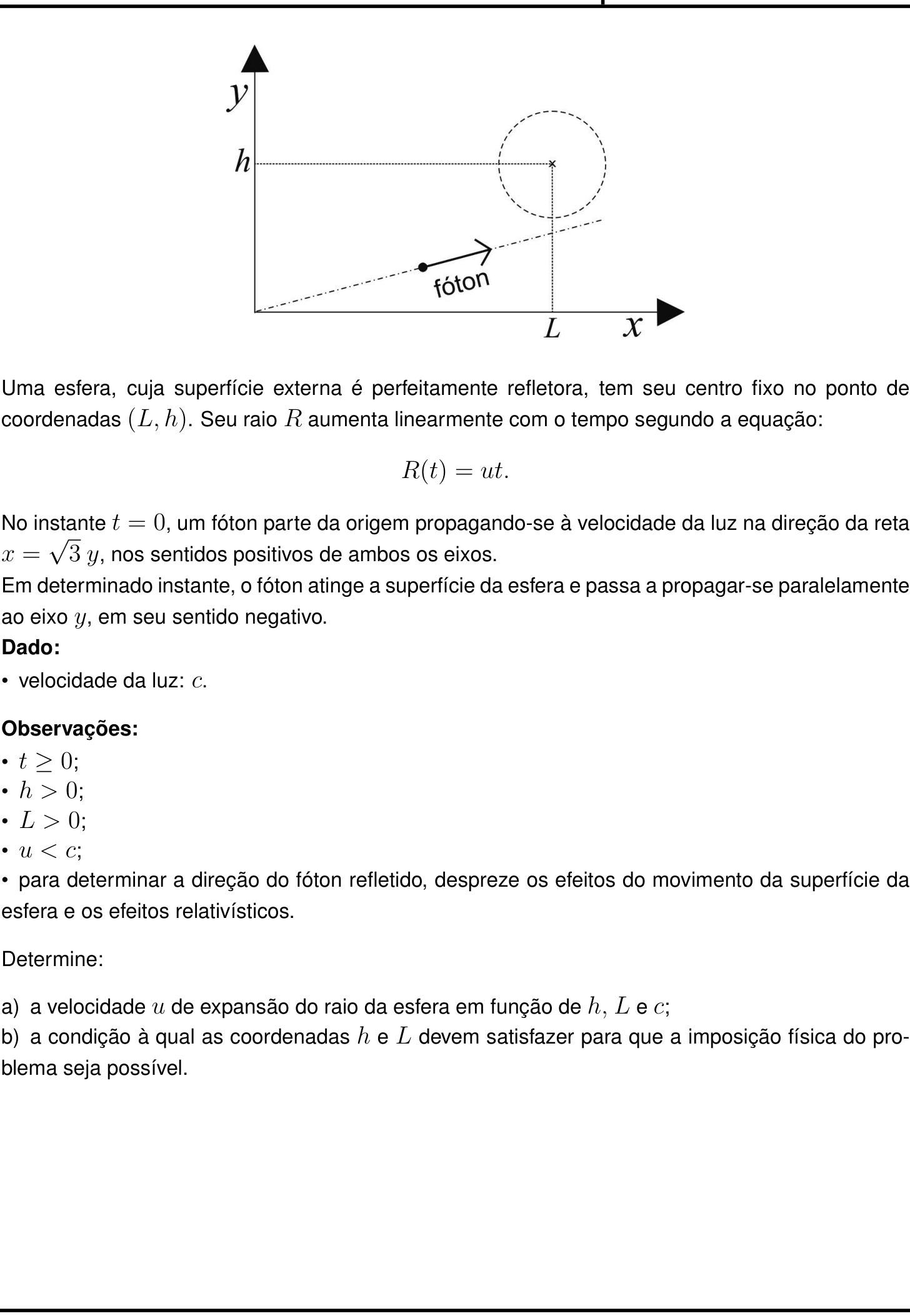
We have sphere reflective surface, center fixed at coordinates (L,h). Radius R(t)=u t increasing linearly. At t=0 photon leaves origin propagating at speed c in direction of line x = sqrt(3) y, positive senses both axes. In certain instant photon hits sphere surface and then propagates parallel to y axis, in negative sense. Determine:
a) speed u of expansion of sphere radius as function of h,L,c;
b) condition on h,L for physical possibility.
Need solve. Let's parse.
Coordinate system: x-y. Sphere center at (L,h) fixed. Radius R(t)=u t. At t=0 radius zero? Sphere starts as point at t=0? R=0. Then expands linearly. Photon emitted from origin at t=0 along line x = sqrt(3) y, positive x,y. So direction vector has slope y/x = 1/√3? Equation x = √3 y => y = x/√3. So angle with x-axis tan θ = y/x = 1/√3 => θ = 30°? Actually tan=1/√3 -> 30°, so direction angle 30° above x-axis. So photon direction unit vector: (cos30, sin30) = (√3/2, 1/2). Or vector proportional (√3,1). Since x=√3 y => point (√3 y, y). Yes direction (√3,1). Speed c => position at time t: r_p(t)= c t (cos30, sin30) = (c t √3/2, c t/2). Let's denote t_hit = τ maybe time when photon hits sphere. At that instant, sphere radius R(τ)=u τ. Photon position P = ( (√3/2)c τ, (1/2)c τ ). It lies on sphere surface: distance from center C=(L,h) equals R=u τ. Equation:
( x_P - L)^2 + ( y_P - h)^2 = (u τ)^2.
x_P = (√3/2) c τ; y_P = (1/2) c τ.
After reflection, photon propagates parallel to y axis in negative sense. So reflected direction is downward vertical: (0, -1). We need reflection law on sphere at point P: incident ray direction from origin to P: unit vector v_i = (√3/2, 1/2). Outgoing/reflected ray direction v_r = (0, -1). Surface normal at P? For sphere, normal is along radius from center C to P or opposite? Reflection: incident direction v_i reflects to v_r. For specular reflection, the normal direction n (unit pointing maybe from surface outward? or inward?) satisfies v_r = v_i - 2 (v_i · n) n if n points from surface toward incident side? Need careful sign. Actually if n is outward unit normal at surface (from center to point), then reflected direction = v_i - 2 (v_i · n) n. Depending incident from outside approaching surface? The photon hits external surface, medium? Surface perfectly reflector, so reflection formula standard with n pointing outward. Let's verify. If n points outward, incident ray coming from outside to point has direction v_i towards surface (into? Actually photon travels along v_i, from origin to P. The direction v_i points from origin to P, so at P it is arriving. For reflection, the incident ray direction vector is v_i (towards surface/point). Reflection formula for mirror with normal n (outward from surface) is v_r = v_i - 2(v_i·n)n. Yes because v_i component normal reversed. Alternatively if n inward, use different sign. Let's test simple: surface horizontal y=0, incident downward (0,-1) hits, reflect upward (0,1). n outward upward (0,1). v_i=(0,-1). v_i·n=-1. v_r = (0,-1)-2(-1)(0,1)=(0,1). Correct. So formula with outward normal works. Good. So n = (P-C)/R = (x_P-L, y_P-h)/R. We know v_r = (0,-1), v_i=(√3/2, 1/2). Then v_r = v_i - 2(v_i·n)n. Let n=(n_x,n_y). Equivalently v_i - v_r = 2(v_i·n)n. Compute left Lvec = v_i - v_r = (√3/2, 1/2) - (0,-1) = (√3/2, 3/2). This vector must be parallel to n. So n is along (√3/2, 3/2), unit. Thus normal direction at P is proportional to (√3, 3). Let's compute magnitude: |(√3/2, 3/2)| = sqrt(3/4 + 9/4)=sqrt(12/4)=sqrt(3) ≈1.732. Unit n = (√3/2, 3/2)/√3 = (1/2, √3/2)? Wait (√3/2)/√3 = 1/2; (3/2)/√3 = (3)/(2√3)=√3/2. So n=(1/2, √3/2). That means normal angle 60° from x-axis. Also v_i = (cos30,sin30), v_r=(0,-1) angle -90°. Incidence angle? Normal 60°, incident direction 30°, difference 30°. Reflected? v_i reflected across normal at 60° should angle 90°? Wait reflect angle 30° across 60° => 90°? Actually angle of incidence = angle between v_i and normal = 30°; reflected direction angle = 2*normal angle - incident angle = 2*60 -30 =90° (upward vertical) not downward. Hmm discrepancy. Let's check formula. If n=(1/2,√3/2) outward, v_i=(√3/2,1/2). Dot = (√3/2)(1/2)+(1/2)(√3/2)=√3/2 ≈0.866. v_r = v_i - 2*(√3/2)*n = v_i - √3*(1/2,√3/2) = (√3/2,1/2) - (√3/2, 3/2) = (0, -1). Yes v_r=(0,-1). Wait angle of v_r is -90°, yes. But reflection across normal formula if normal angle 60°, incident angle 30°? Let's compute: v_i angle 30°, normal angle 60°. Angle between =30°. Reflected should angle = 60 + (60-30)=90°? Actually direction after reflection is mirror: angle_r = 2θ_n - θ_i = 120° -30°=90° (if using line angle modulo 180? Hmm vectors: n angle 60°, v_i incoming direction 30°. At point, the ray arrives with direction v_i along 30°. The normal line direction outward at 60°. The angle from incident to normal =30°. Reflected direction is on other side of normal by 30°, so along 60+30=90° (upward). But our formula gave -90° (which is collinear with 90°, just opposite direction? Wait vertical downward is angle -90° or 270°. Reflection formula gives vector (0,-1) whose line angle is vertical, but direction is downward. But physical reflected ray direction should be along line? Actually at point, ray reflects; direction vector v_r should point along the outgoing ray. Which way along vertical? Downward? Let's visualize: Incident ray from origin at 30° to point P. Normal at P points from center (L,h) to P. We found n=(1/2,√3/2) outward, i.e. from center to P, pointing up-right at 60°. P likely to the right/above center? Let's see. If normal outward from center to P, then P = C + R n = (L + R/2, h + R√3/2). Incident direction from origin to P is at 30°, so P has coordinates (r cos30, r sin30) = (√3/2 r, 1/2 r). Compare y = (1/2)r, x=(√3/2)r. Normal direction angle 60° means P-C along 60°, so vector P-C = R(1/2, √3/2) = (R/2, R√3/2). Then y_P - h = R√3/2 positive; x_P - L = R/2 positive. Possible. Incident ray arrives at P along 30° direction (towards P, but from origin, vector from origin to P is (√3/2 r, 1/2 r) angle 30°). At P, the ray is traveling in direction v_i = (√3/2, 1/2) (same angle). The reflected ray direction from formula v_r=(0,-1) downward. Is that physically possible? The normal line is 60°; incident direction 30° (below normal by 30°). Reflect across normal line: outgoing direction angle 90° (above normal by 30°) if using undirected line? But vector formula gives opposite direction along same line? Wait vector reflection formula
v_r = v_i - 2(v_i·n)n
with n pointing from surface to center or from center to surface? Let's derive carefully. Suppose surface normal n points from surface into the medium where light comes from? Actually for reflection at interface, if n is unit normal pointing from surface into the incident medium (i.e., outward from surface toward incoming light? Standard: incident vector I points towards surface, normal N points from surface into medium where light originated? Hmm ambiguous.
Standard in optics: Let N be unit normal pointing from surface toward the incident side (opposite to direction of incident light? or same?). Usually reflection formula: r = i - 2(i·n)n where n is normal pointing outward from surface (toward the incident light side), and i is incident direction vector pointing toward surface (into surface). Then r points away. Example horizontal mirror y=0, light from above traveling downward: i=(0,-1), surface normal outward upward n=(0,1). i·n=-1. r = (0,-1)-2(-1)(0,1)=(0,1), correct. So n upward, i downward: v_r upward. Good. In our case, n=(1/2,√3/2) outward from center to P? Is that "toward incident side"? Incident light comes from origin to P; at P, the light is traveling along v_i=(√3/2,1/2). The surface at P: sphere centered at C. The outward normal from sphere center to P is n=(1/2,√3/2). But the light arrives from origin, which is outside the sphere? Actually photon from origin to P; is origin outside sphere? At hit time, sphere radius R; center C; distance from C to origin? We don't know. The photon travels in space, hits external surface. The light approaches P from outside, likely from origin direction. At P, the incident light direction is v_i (from origin to P), so the "incident side" is outside, and the normal pointing into incident side should point from surface outward? If sphere surface, outward normal points from center to surface. But at P, the inside of sphere is toward center; the incident side (outside) is generally away from center? Actually light hits from outside, so just before reflection it is outside sphere. The normal pointing into the incident medium (outside) at P is from surface outward away from center, i.e., n_out = (P-C)/R = (1/2,√3/2). That is what we used. Then reflection formula gives r = i - 2(i·n_out)n_out. We found r=(0,-1) downward? But if incident i is 30° and n_out 60°, then i - r = 2(i·n)n? Wait compute using formula: i=(0.866,0.5), n=(0.5,0.866), i·n=0.866? Actually 0.866*0.5 +0.5*0.866 =0.866? 0.433+0.433=0.866 yes =√3/2. r = i - √3 n = (0.866-0.866, 0.5-1.5)=(0,-1). Yes downward. But geometric reflection across tangent plane should yield upward 90°? Let's test with a simple physical: horizontal surface y=0, incident from origin at angle 60° hitting at origin? Normal upward; incident direction up-right? If light traveling toward origin from lower left? Hmm.
Let's do a simple check: mirror line vertical x=0? Incident from left horizontal (1,0), reflects to right (-1,0). Normal outward left (-1,0). Formula i=(1,0), n=(-1,0), i·n=-1, r=(1,0)-2(-1)(-1,0)=(1,0)-2(1,0)=(-1,0). Good. Here incident direction points toward mirror (right), normal points left (toward incident side? Actually incident side outside left, normal outward from mirror to left? If mirror vertical, interior right? Wait surface x=0, normal outward from surface into left medium? If reflective surface maybe orientation? Let's imagine light from left hitting mirror x=0, reflects left. Normal outward from mirror to left = (-1,0) points into incident medium (left). Incident vector i=(1,0) points toward mirror (right). Formula with n outward (-1,0) gave r=(-1,0) (back left). Good. So n points into incident medium (opposite to incident direction). In our sphere, n_out = (P-C)/R points from center to P, i.e., outward from sphere. Incident medium is outside sphere; at P, the outside is along n_out? Center inside; outward vector points away from center, so yes toward outside. But incident light is traveling along v_i from origin to P; at P, is it traveling from outside? The vector from P to origin is -v_i. The normal n_out points? Since P lies on sphere, origin maybe outside, so direction from P to origin should have positive dot with n_out? Let's see. If origin outside, vector from P to origin (approx -v_i) should point outward (away from center) relative to tangent plane? Actually if sphere is centered at C and P on surface, outside is n_out direction; origin is outside, so vector from P to origin should have positive projection along n_out (since origin lies outside half-space n_out·(X-P) > 0? For sphere, outside is n_out·(X-P) >= 0? Let's check: sphere center C, point P=C+R n_out. For any point X outside if |X-C|>R. At P, tangent plane normal n_out; outside is direction n_out? Since moving from P in direction n_out increases distance from C, yes outside. So vector from P to origin = O - P. If origin outside, dot with n_out should be positive. n_out = (0.5,0.866). P=(x_P,y_P). O=(0,0). P-O=(x_P,y_P) = r v_i = r(0.866,0.5). Then n_out·(O-P) = - n_out·(P-O) = -[(0.5*0.866 +0.866*0.5)r] = - (0.433+0.433)r = -0.866 r <0. So origin is inside relative to tangent plane? Wait if dot negative, origin lies on inside side (toward center). That would mean light comes from inside sphere? But sphere radius R = u τ; at hit time, origin distance to center maybe <R? Let's compute: P = r v_i, C=P - R n_out = r(0.866,0.5) - R(0.5,0.866). For origin to be outside, distance C-O > R? Actually outside means |C| > R? Sphere center at distance |C| from origin. At time τ radius R; origin outside if |C| > R? But maybe photon emitted from origin when sphere radius zero; at later time τ, sphere grew. Could origin be inside sphere? If origin inside, then photon would have interacted earlier? But problem says photon at certain instant hits surface, so it was outside before. Let's check distance from origin to center at τ maybe > R? Compute later.
First solve equations.
Unknowns: τ, u. Conditions:
1) P on sphere: |P - C|^2 = u^2 τ^2.
2) Reflection direction: v_i - v_r = 2(v_i·n)n as vectors. Since n=(P-C)/R. Let's derive scalar equations from reflection.
From v_i - v_r = (√3/2, 3/2) = λ n where λ = 2(v_i·n). Since n unit, magnitude of left = √3, so λ = ±√3? Let's compute λ = 2(v_i·n). Also n = left/|left| = (√3/2,3/2)/√3 = (1/2, √3/2) times sign? Wait left vector = (√3/2,3/2) magnitude √3. n = left/|left| = (1/2, √3/2) if λ positive? Left = λ n -> λ n = (√3/2,3/2). If n = (1/2,√3/2), λ=√3 gives (√3/2,3/2). Yes. If n = (-1/2,-√3/2), λ=-√3. But n = (P-C)/R, so two possible normals opposite; λ=√3 gives n=(1/2,√3/2). λ=-√3 gives n=(-1/2,-√3/2). Let's see which is physical.
Also v_i·n = (√3/2,1/2)·(1/2,√3/2)=√3/2 ≈0.866. Then 2(v_i·n)=√3, matches λ=√3 for n outward. If n opposite, v_i·n=-√3/2, λ=-√3, left = -√3 n = (√3/2,3/2) for n=(-1/2,-√3/2). So both possible algebraically? But geometric reflection formula with unit n: v_r = v_i - 2(v_i·n)n. If n opposite, v_r = v_i -2(-√3/2)(-n0?) Let's test: let n0=(1/2,√3/2), n=-n0. v_i·n = -√3/2. v_r = v_i -2(-√3/2)(-n0) = v_i - √3 n0 = (0,-1). Same. So both n and -n are normal lines same; formula gives same reflected direction? Actually if n -> -n, term -2(v_i·n)n = -2(-v_i·n0)(-n0)? Wait v_i·(-n0)=-v_i·n0. Then -2(v_i·(-n0))(-n0)= -2(-a)(-n0)= -2a n0? Actually -2 * (-a) * (-n0) = -2a n0? Let's compute: -2(-a)(-n0)= -2a n0? yes. Same as original? Original -2a n0. So same. Good.
Thus normal direction line is along (1/2,√3/2).
So from reflection:
P - C = R n0 = R (1/2, √3/2), where n0=(1/2,√3/2), possibly plus sign? Actually P-C = R n with n either n0 or -n0. Since P is on sphere. But P-C vector is actual radius vector, so P-C = R n_actual. Which sign? We need determine. The line through C and P has direction n0. So P lies on line C + s n0 with s=±R. Also P=r v_i = r(√3/2,1/2), with r = c τ. So we have vector equation:
r (√3/2,1/2) - (L,h) = s (1/2, √3/2), where s = ± R = ± u τ? Actually if n_actual = ± n0, then P-C = R_actual n_actual = s n0 with s=R if n_actual=n0, s=-R if n_actual=-n0. But R=u τ positive. So s=±u τ.
Let's solve components. Let r = c τ. Also P = r (√3/2,1/2). Then:
x: (√3/2) r - L = s/2
y: (1/2) r - h = (√3/2) s
Multiply first by 2: √3 r - 2L = s. (1)
Second: r/2 - h = (√3/2)s => multiply 2: r - 2h = √3 s. (2)
From (1): s = √3 r - 2L. Substitute into (2):
r - 2h = √3 (√3 r - 2L) = 3 r - 2√3 L
=> r - 2h = 3r - 2√3 L
=> -2h = 2r - 2√3 L
=> -h = r - √3 L
=> r = √3 L - h.
Thus r = c τ = √3 L - h. Hmm positive? Since cτ positive, require √3 L > h. That might be condition part b? But wait maybe sign alternative for s? Let's do if P-C = -R n0? Then s=-R. Let s unknown = ±uτ. Our equations same but s can be negative. Solving gave r = √3 L - h regardless? Let's re-derive with general s: equations:
√3 r - 2L = s
r - 2h = √3 s
Eliminate s: s = √3 r - 2L; r - 2h = √3(√3 r -2L)=3r -2√3 L => r -2h =3r -2√3 L => -2h=2r -2√3 L => r = √3 L - h. Yes r fixed. Then s = √3 r - 2L = √3(√3 L - h) -2L = 3L - √3 h -2L = L - √3 h. So s = L - √3 h. But s = ±uτ = ±R. Since R=uτ positive, s sign depends. Also r=cτ = √3 L - h. Then u = R/τ = |s|/τ = |L - √3 h| / (r/c) = c |L - √3 h| / (√3 L - h). But part a asks u in terms h,L,c. But need physical constraints maybe s positive? Let's see.
Alternatively maybe we missed another possible reflection path? Let's examine geometry.
Photon from origin hits sphere, then reflected parallel to y negative (downward). Normal line direction determined by v_i and v_r. We found normal line must be along (1/2,√3/2). That's one line (or opposite). Then P lies at intersection of incident ray r v_i and line from C in direction ±n0? Actually P on sphere means P-C parallel to n0, yes. The intersection of line through C direction n0 with incident ray has unique solution, giving r=√3 L - h. But also P must be at distance R from C; s = L - √3 h. Since R=uτ = |s|. And τ = r/c = (√3 L - h)/c. So u = |s|/τ = c |L - √3 h| / (√3 L - h). But there might be physical condition requiring r>0? Since τ>0, need √3 L - h > 0. Also h>0, L>0. Also perhaps origin outside sphere before hit? That would impose something? Also s maybe positive? Let's check sign to see if sphere is expanding; radius R=uτ positive, so s=±uτ; either sign possible? Actual n_actual = (P-C)/R. If s>0, n_actual = n0; if s<0, n_actual = -n0. But reflection direction formula with n outward? Wait n_actual = (P-C)/R is outward from center to P. That's n_out. We earlier assumed n_out = (1/2,√3/2) (n0) and got r=(0,-1). But if n_out = -n0 (s<0), does formula still give same reflected direction? Let's check with actual n_out = -n0 = (-1/2,-√3/2). Incident v_i=(√3/2,1/2). Dot v_i·n_out = -√3/2. Then r = v_i -2(-√3/2)(-n0)= v_i - √3 n0 = (0,-1). Yes same. So both possible for reflection: normal line same but outward normal could point opposite along line; still reflection same because formula invariant under n -> -n? Let's verify: v_r = v_i -2(v_i·n)n. If n -> -n, dot -> -dot, n -> -n: term -2(-dot)(-n)= -2 dot n? Wait compute: -2(v_i·(-n))(-n) = -2(-v_i·n)(-n) = -2(v_i·n) n. Same. So reflection direction unchanged. So n_actual sign can be either; sphere center can be on either side of P along normal line. But geometry with C fixed and P maybe inside? Let's see.
However, sphere centered at C (L,h), expanding. At t=0 radius zero. Photon starts at origin outside? The photon path must hit sphere for first time at τ. For this to be possible, origin must be outside sphere at τ (or maybe on surface? no). Also the segment from origin to P should not intersect sphere earlier; since sphere radius grows from 0, the first contact condition imposes.
Need determine correct u maybe positive and condition. Let's analyze.
Given r = cτ = √3 L - h. For τ>0, require √3 L > h. Also s = L - √3 h. R=uτ = |s|? Actually R = distance P-C = |s|? Since P-C = s n0 with n0 unit, |P-C|=|s|. Yes R=|s|. So u = |s|/τ = c |L - √3 h| / (√3 L - h). But maybe because R=ut and t=τ, u = |s|/τ. Yes.
Part a asks velocidade u de expansão do raio da esfera em função de h,L,c. Likely u = c (L - √3 h)/(√3 L - h) perhaps assuming L>√3 h? But need sign? They might expect u = c (L - √3 h)/(√3 L - h) or maybe c (√3 h - L)/(√3 L - h)? Let's investigate.
Maybe I made sign error? Let's solve reflection equations perhaps with correct normal direction and incident ray. Let's derive vectorially more systematically.
Let incident unit vector u_i = (√3/2, 1/2). Let reflected vector u_r = (0, -1). Reflection condition: u_i - u_r = 2 (u_i · n) n. So u_i - u_r = (√3/2, 1/2) - (0,-1) = (√3/2, 3/2). This vector is parallel to n, so n = ± (u_i - u_r)/|u_i - u_r| = ± ( (√3/2,3/2) / √3 ) = ± (1/2, √3/2). So normal vector n = (P-C)/R = ±(1/2,√3/2). Good.
Then P = r u_i = r(√3/2, 1/2). C=(L,h). Thus
r(√3/2, 1/2) - (L,h) = ± R (1/2,√3/2). Since R=u τ, but note R also = distance, so ± sign belongs to vector equality. But we can solve for r and R as before with sign σ = ±1:
r(√3/2) - L = σ R/2
r(1/2) - h = σ (√3/2) R.
Multiply first by 2: √3 r - 2L = σ R.
Second by 2: r - 2h = σ √3 R.
Eliminate R: From first, σ R = √3 r - 2L. Replace R in second: r - 2h = √3 (√3 r - 2L) = 3r - 2√3 L => same r = √3 L - h. Then σ R = √3 r - 2L = √3(√3 L - h)-2L = 3L -√3 h -2L = L - √3 h. So R = σ (L - √3 h)? Actually σ R = L - √3 h; multiply by σ: R = σ (L - √3 h) since σ^2=1. So R = ±(L - √3 h). Since R≥0, the sign must match sign of (L - √3 h): if L>√3 h, σ=+1 and R=L-√3h; if L<√3 h, σ=-1 and R=√3h-L. So R=|L-√3h|. Then u=R/τ = c |L - √3 h|/(√3 L - h). Since τ>0 requires √3L - h >0.
But maybe there is additional condition that the photon hits the sphere from outside, i.e., the origin is outside at time τ. Let's check. Distance from origin to center C: D = sqrt(L^2 + h^2). At τ, sphere radius R. Origin outside if D > R? Actually if D < R, origin inside sphere; but photon starts at origin at t=0 when sphere point; as sphere grows, it could engulf origin before photon hits? But photon leaves at t=0; at t=0 sphere radius 0. If later radius exceeds D, origin would be inside sphere, but photon already traveling. The first contact for photon with expanding sphere: the sphere radius at time t is u t. The photon position at time t is P0(t)=c t u_i. The distance from center to photon at t: d(t)=|c t u_i - C|. The photon hits when d(t)=R(t)=u t. Also before hit, d(t)>u t (outside sphere). After hit, d(t)=u t. So condition for first hit at τ: d(τ)=uτ and d(t)>ut for 0<t<τ. Since both d and u t start at t=0? At t=0, d(0)=|C|=√(L^2+h^2) >0 = R(0). Good. d(t) maybe increasing? Need ensure no earlier intersection. We can derive inequality.
Also after reflection, photon goes downward along x=x_P. But the sphere continues expanding; maybe the photon might be re-hit? Problem says after reflection propagates parallel to y axis negative, maybe it escapes? Physical possibility condition may include that after reflection the photon doesn't hit sphere again? Let's examine.
Part b asks condition on h,L for the physical imposition of problem to be possible. Could be from τ>0 and perhaps √(L^2+h^2) > R? Let's analyze.
Let's derive geometry more clearly.
Coordinates:
Origin O=(0,0). Center C=(L,h). Incident ray: x=√3 y, y≥0. Direction u_i=(√3/2,1/2). Photon position P=r u_i = (√3 r/2, r/2), where r=c t. Sphere radius R(t)=u t = (u/c) r = k r, where k=u/c <1 (given u<c). So at time parameter r (distance along ray), sphere radius = k r (since t=r/c). Center fixed.
Condition for photon at distance r along ray to be on sphere:
|P(r)-C| = k r.
Also first intersection.
We already solved reflection to get r = √3 L - h, k = R/r = |L - √3 h|/(√3 L - h) (since R=k r). But note if r positive, k positive. Need k<1 (u<c). Let's verify this condition may imply physical inequality.
Let's compute |P-C| = R = k r. At solution, P = r u_i = r(√3/2,1/2). C=(L,h). Vector P-C = (r√3/2 - L, r/2 - h). Its magnitude squared = R^2 = k^2 r^2. Also from reflection, we know P-C = σ R n0, so components:
r√3/2 - L = σ R/2
r/2 - h = σ R√3/2.
Squaring/summing gives R^2. But we already used.
Alternatively, k = u/c = R/(cτ)=R/r. Since R = |L - √3 h| and r = √3 L - h (positive), k = |L-√3 h|/(√3 L - h). But also k<1. Since u<c, k<1. Does this impose condition? Let's analyze cases.
Also R = k r. From σ R = L - √3 h. Since k>0, R positive.
Given r = √3 L - h >0 => √3 L > h. (Condition A)
Then k = |L - √3 h|/(√3 L - h). Since denominator positive.
Case 1: L > √3 h. Then numerator = L - √3 h >0. k = (L - √3 h)/(√3 L - h). Need k<1 => L - √3 h < √3 L - h => -√3 h + h < √3 L - L => (1-√3)h < (√3-1)L => (1-√3)h < (√3-1)L => since 1-√3 = -(√3-1), inequality becomes -(√3-1)h < (√3-1)L => divide positive? (√3-1)>0, so -h < L => h > -L, true since h>0, L>0. So k<1 always in case 1? Let's compute: k = (L - √3 h)/(√3 L - h). Is this <1? Equivalent positive denom: L - √3 h < √3 L - h => 0 < (√3-1)L + (√3-1)h = (√3-1)(L+h) >0 true. Yes. So case 1 automatically k<1.
Case 2: L < √3 h. Then numerator = √3 h - L >0. k = (√3 h - L)/(√3 L - h). Need k<1? Denom positive by r>0. Inequality: √3 h - L < √3 L - h => √3 h + h < √3 L + L => h(√3+1) < L(√3+1) => h < L. Wait let's compute: √3 h - L < √3 L - h => √3 h + h < √3 L + L => h(√3+1) < L(√3+1) => h < L. Since divide positive. So k<1 iff h < L. But in case 2 L < √3 h; combined h < L < √3 h => h>0, L>0, and L>h. So case 2 possible if h < L < √3 h. Then k<1. If L ≤ h < √3 h? Then k≥1, violates u<c. So additional condition for case 2: L > h. But wait case 1 k<1 always.
Thus combined with r>0 (√3L > h), and k<1, we get:
If L > √3 h (case1): ok.
If L ≤ √3 h: then need h < L to have k<1? Let's check case L=√3 h: numerator zero => k=0 (u=0?) but u>0? Sphere radius not expanding? u<c but also u maybe positive? Given u<c but not explicitly >0? Radius increases? It says R=ut, t≥0, u maybe? "velocidade de expansão" positive? Probably u>0. If L=√3h, R=0 at hit? Photon hits at center? Actually if L=√3h, then r=√3L-h = √3L - L/√3? Wait h=L/√3, r=√3L - L/√3 = (3L-L)/√3=2L/√3 >0. R=|L-√3h|=0 => sphere radius zero at hit, impossible (photon hits point sphere at t=0? But t>0, radius zero only at t=0). So u=0 not allowed if R=0 and t>0. So need L ≠ √3 h. Also u<c.
Maybe part b condition is something like h < √3 L and h ≠ √3 L? Wait if L<√3h but h<L allowed. So condition ensures u<c and r>0 and R positive: Maybe h < √3 L and L ≠ √3 h, and perhaps also h < L? Let's derive final.
But maybe there are other physical constraints: After reflection, photon moves parallel to y axis in negative sense. Does it escape without re-hitting? Let's check. After reflection at P, photon moves downward along vertical line x=x_P = r√3/2. Sphere expands with radius R(t)=u t = k r? Wait t after hit? At hit time τ = r/c. At later time t' = τ + Δt, sphere radius R=u t' = uτ + u Δt = R0 + uΔt, where R0=k r. Center fixed. Photon position: x=x_P, y=y_P - c Δt = r/2 - cΔt. Distance squared from center: (x_P - L)^2 + (y_P - cΔt - h)^2. At Δt=0, equals R0^2. Since photon moves downward (negative y), while center location? Need ensure distance > R(t') for Δt>0, i.e., photon outside sphere after reflection. Condition maybe imposes inequality.
Let's analyze. At P, reflected direction v_r=(0,-1). After reflection, photon position Q(Δt) = P + c Δt (0,-1) = (x_P, y_P - cΔt). Distance squared from C: d^2(Δt) = (x_P - L)^2 + (y_P - h - cΔt)^2.
Sphere radius squared: R^2(Δt) = (R0 + uΔt)^2 = R0^2 + 2R0 u Δt + u^2 Δt^2.
At Δt=0, d^2=R0^2. Need d^2 > R^2 for Δt>0 (outside). Expand difference:
d^2 - R^2 = [ (x_P-L)^2 + (y_P-h)^2 ] - R0^2 + [ -2 cΔt (y_P-h) + c^2 Δt^2 ] - [2R0 u Δt + u^2 Δt^2].
First bracket zero. So difference = Δt [ -2c(y_P - h) - 2R0 u ] + Δt^2 (c^2 - u^2). Since c^2 - u^2 >0 (given u<c), for small Δt positive, need coefficient of Δt ≥0? Actually for Δt>0, difference >0 requires -2c(y_P - h) - 2R0 u >0 (if coefficient positive) or if negative, small Δt difference negative -> inside -> re-hit. So condition: c(y_P - h) + R0 u < 0? Wait difference = Δt [ -2c(y_P - h) - 2R0 u ] + Δt^2(c^2-u^2). For small Δt, sign by bracket. Need >0 => -2c(y_P - h) - 2R0 u > 0 => c(y_P - h) + R0 u < 0? Actually divide -2: -c(y_P-h) - R0 u >0 => c(y_P-h) + R0 u <0. Since c>0, R0>0, u>0, this requires y_P - h <0 (photon below center). Let's see. At P, y_P = r/2. h =? From reflection equation: r/2 - h = σ R0 √3/2. If σ=+1 (case L>√3h), then r/2 - h = R0√3/2 >0 => y_P > h. Then bracket = -2c(positive) -2R0u <0 -> difference negative for small Δt, meaning photon immediately re-enters sphere? That would violate "passa a propagar-se" maybe? But maybe the sphere surface is expanding; after reflection, if center below, photon moving down may still be outside? Let's check. If y_P > h (photon above center), moving downward (toward center) likely enters sphere. But maybe because sphere expands, radius increases; distance decreases? Need check. If photon above center and moves downward, distance to center may decrease initially; if sphere expands, may still be outside? Let's analyze. If σ=+1: P-C = R0 n0 with n0=(1/2,√3/2), so y_P-h = R0√3/2 >0. Photon velocity v=(0,-c), so d/dt (distance squared) = 2(P-C)·v = 2[(x_P-L)*0 + (y_P-h)*(-c)] = -2c(y_P-h) <0, so distance decreasing initially. Sphere radius increasing at rate u; initially distance derivative = - (y_P-h)/R0 * c? Actually d(distance)/dt = (P-C)/R0 · v = n0 · (0,-c) = -c n0_y = -c√3/2. Sphere radius derivative = u = k c? Actually u<c. Distance derivative magnitude = c√3/2 ≈0.866c > u maybe? So distance decreases faster than radius increases? Compare: distance derivative = -c√3/2 ≈ -0.866 c; radius derivative = u < c, so distance may decrease faster than radius, so photon enters sphere. But maybe later? Let's compute difference derivative at 0: d(d^2 - R^2)/dt = 2(P-C)·v - 2R u = 2[ (P-C)·v - R u ] = 2[ -c(y_P-h) - R u ] = -2c R [ (y_P-h)/R + u/c? Wait R0 u? Actually (P-C)=R n0, so (P-C)·v = R n0·v = R (0 + (-c) n0_y)= -c R n0_y. R u term = R u. So bracket = -c R n0_y - R u = -R (c n0_y + u) <0 (since n0_y>0). So difference decreasing => inside immediately. Thus if σ=+1, after reflection photon would re-enter sphere, not escape. But problem says "passa a propagar-se paralelamente ao eixo y, em seu sentido negativo", maybe implies it does propagate (and escapes?) but not explicitly says it doesn't hit again. However physical possibility might require after reflection it doesn't hit sphere again? The phrase "passa a propagar-se" maybe just direction after reflection, could be momentary; but in ideal reflection at surface, outgoing ray should be outside sphere, so need σ=-1? Let's check.
If σ=-1 (case L<√3h): Then P-C = -R n0 = (-R/2, -R√3/2), so y_P - h = -R√3/2 <0 => photon below center. Then (P-C)·v = (-R n0)·(0,-c) = R c n0_y? Wait -n0=( -1/2,-√3/2); dot with (0,-c) = (-√3/2)(-c)= +c√3/2 >0, so distance increasing initially. Then d^2-R^2 derivative = 2(P-C)·v - 2R u = 2R(c√3/2 - u). Need >0 for outside? Since u<c, c√3/2 may be > u? Not necessarily if u close c; condition c√3/2 > u => k<√3/2. But derivative at 0 positive if c√3/2 > u. If derivative ≤0, photon might initially be inside? But at t=0 difference zero; if derivative negative, immediately inside? Actually if d^2 < R^2 after, then it would be inside, but it just reflected from surface; could it enter sphere? For reflection, outgoing ray should be outside, so derivative should be nonnegative. So need c√3/2 ≥ u? Let's compute. u = R/r = |L-√3h|/(√3L-h) c. In case σ=-1, L<√3h and r=√3L-h >0; R=√3h-L. Need c√3/2 - u >0? Let's verify.
u = c (√3h - L)/(√3 L - h). Condition c√3/2 > u => √3/2 > (√3h - L)/(√3L - h). Multiply positive denominator: (√3/2)(√3L - h) > √3h - L => (3L/2 - √3 h/2) > √3 h - L => (3L/2 + L) > √3 h + √3 h/2 => (5L/2) > (3√3 h/2) => 5L > 3√3 h => L > (3√3/5) h ≈1.039 h. So condition L > ~1.039h. But maybe not needed? Alternatively if derivative negative, photon might still be outside? Let's analyze exact.
But perhaps part b condition is precisely about the sign of σ? Wait from reflection, normal could be either but physical after reflection requires outgoing ray outside sphere. Let's derive general condition for photon not intersect sphere immediately after reflection: for small Δt>0, distance > radius. As above, need derivative at 0 ≥0? Since difference has positive quadratic coefficient (c^2-u^2>0). For small Δt, if linear term negative, difference negative for small t -> inside. If linear term zero, quadratic positive -> outside for small t. So necessary and sufficient: at t=0, d(d^2 - R^2)/dt ≥0? Actually if derivative >0, outside; if =0, outside due to quadratic; if <0, inside. So need -2c(y_P - h) - 2R u ≥0 => c(y_P - h) + R u ≤0. Since R,u>0, implies y_P - h <0. So σ must be -1 (photon below center). Also need c|y_P - h| ≥ R u? Actually y_P-h = -R√3/2. Then condition c R√3/2 ≥ R u => c√3/2 ≥ u => u ≤ c√3/2. Since u<c, this is a stricter upper bound. So physical condition includes u ≤ c√3/2.
But wait the problem statement says "para determinar a direção do fóton refletido, despreze os efeitos do movimento da superfície da esfera e os efeitos relativísticos." So reflection is instantaneous at surface with mirror; after reflection, the photon direction is vertical down. It doesn't mention it must escape? "passa a propagar-se paralelamente ao eixo y, em seu sentido negativo" implies it does propagate; if it immediately re-entered sphere, the reflection wouldn't be a clean escape. So likely must have after reflection outside sphere for at least some interval. But maybe the sphere is expanding and might catch up later? Need check if long-term.
Let's analyze after reflection exact condition for never re-hit (or at least propagate away). Photon vertical down x=x_P, y decreasing. Sphere center C=(L,h), radius R(t')=u t' = u(τ+Δt). Let's derive position.
At reflection time τ, r=cτ, P=(r√3/2, r/2). Let y0 = r/2, x0=r√3/2. Sphere center maybe below/above. Let Δ = cΔt ≥0. Photon position y = y0 - Δ, x=x0. Distance squared:
D^2 = (x0-L)^2 + (y0 - Δ - h)^2.
Sphere radius squared:
R^2 = u^2 (τ + Δ/c)^2 = (uτ + (u/c)Δ)^2 = (R0 + k Δ)^2, where k=u/c, R0=uτ=k r? Actually R0=k r (since r=cτ, uτ=k r). Also R0 = distance at hit.
Let's express x0-L and y0-h from reflection. We have vector P-C = σ R0 n0 = σ R0 (1/2,√3/2). So:
x0 - L = σ R0/2
y0 - h = σ R0 √3/2.
Then D^2 = (σ R0/2)^2 + (σ R0√3/2 - Δ)^2 = R0^2 [1/4 + 3/4 - σ√3 Δ/R0 + Δ^2/R0^2] = R0^2 - σ√3 R0 Δ + Δ^2.
R^2 = (R0 + k Δ)^2 = R0^2 + 2k R0 Δ + k^2 Δ^2.
Difference F(Δ)=D^2 - R^2 = Δ^2(1 - k^2) + Δ[ -σ√3 R0 - 2k R0 ].
= Δ [ (1-k^2) Δ - R0(σ√3 + 2k) ].
For Δ>0, sign of F depends on bracket. Need F>0 for outside. Since 1-k^2>0, bracket increasing with Δ. At Δ=0, bracket = -R0(σ√3 + 2k). If σ=+1, negative => F negative for small Δ (inside). If σ=-1, bracket = -R0( -√3 + 2k) = R0(√3 - 2k). If k < √3/2, bracket positive at Δ=0, so F>0 for small Δ; if k>√3/2, bracket negative at Δ=0, so F<0 for small Δ; if k=√3/2, bracket zero, F=(1-k^2)Δ^2>0 for Δ>0. Then for larger Δ, bracket may become positive when Δ > R0(σ√3+2k)/(1-k^2) if σ=+1? Let's see. If σ=+1, bracket negative at 0, becomes zero at Δ0=R0(√3+2k)/(1-k^2)>0; for Δ>Δ0, F>0 (outside). So photon initially inside, then later exits? But if it enters sphere, it would have crossed surface; not physical as "propagating outside" after reflection. Usually reflected wave should be outside immediately.
Therefore physical condition for outgoing ray not immediately entering sphere is σ=-1 and k ≤√3/2 (u ≤ c√3/2). But given u<c, and u maybe maybe? Let's see if k can exceed √3/2? Since k<1, possible. If k>√3/2, photon initially enters sphere (would refract/absorb? But surface perfectly reflector, no transmission; so shouldn't enter). Thus exclude.
But maybe the problem's "para determinar a direção do fóton refletido, despreze os efeitos do movimento da superfície da esfera e os efeitos relativísticos" means we ignore surface motion for reflection direction but not for escape? Hmm It says determine direction of reflected photon, disregard effects of motion of sphere surface and relativistic effects. So reflection simply geometric mirror at instantaneous position. Then after reflection, maybe sphere continues expanding; they might not ask about later. But part b "condição à qual as coordenadas h e L devem satisfazer para que a imposição física do problema seja possível" likely includes ensuring photon actually hits sphere (origin outside before) and after reflection it goes away? Let's investigate.
Let's derive first-hit condition. At time t<τ, photon position r(t)=c t u_i = t c (√3/2,1/2). Sphere radius = u t = k c t = k r? Actually r=c t, radius=k r. At hit, r=√3L-h, radius=R=k r. For photon to hit from outside, need for all r'<r (where r'=c t), distance from C to photon > k r' (sphere radius at that time). Let's analyze function f(r') = |r' u_i - C|^2 - (k r')^2. At r'=0: f(0)=L^2+h^2 >0 (since R=0). At r'=r: f(r)=0. Need f(r')>0 for 0<r'<r (assuming first contact). If k=0? no. Let's compute f(r') = |r'u_i-C|^2 - k^2 r'^2 = (r'√3/2 - L)^2 + (r'/2 - h)^2 - k^2 r'^2 = r'^2( (3/4+1/4) - k^2) - 2r'( (√3/2)L + (1/2)h ) + L^2+h^2 = r'^2(1-k^2) - r'(√3 L + h) + L^2+h^2.
Since 1-k^2>0, this quadratic in r' opens upward. It has roots? One root is r (since f(r)=0). The other root r2? Product = (L^2+h^2)/(1-k^2) >0, so both roots same sign (positive? r>0, so r2>0). Sum = (√3L + h)/(1-k^2) >0. So r2>0. Since upward, f>0 outside interval between roots: f>0 for r'<min(r,r2) and r'>max(r,r2). For first hit at r, we need f(r')>0 for 0<r'<r, so r must be the smaller root: r ≤ r2. Since quadratic positive before r, yes if r is the first root (smaller). Thus require r ≤ r2? Actually if r is smaller root, then for 0<r'<r, f>0. If r were larger root, there would be an earlier root r2<r where f=0, meaning earlier hit. So need r = smaller root of quadratic. Since both roots positive, smaller root has value? We can derive using root relationships: r + r2 = S/(1-k^2), r r2 = P/(1-k^2), where S=√3 L + h, P=L^2+h^2. We know r. Need r ≤ r2. Could also use derivative at r? Since quadratic upward and roots; at smaller root, derivative f'(r) <0 (crossing from positive to negative? Wait f>0 before root, f=0 at root, then f<0 between roots. So at smaller root derivative negative? Actually from positive to negative => derivative negative. At larger root, derivative positive. So condition first hit is f'(r) ≤0? At hit, derivative should be ≤0? Let's compute f'(r)=2r(1-k^2) - (√3 L + h). At r, derivative negative => 2r(1-k^2) < S. But maybe.
Alternatively use geometry: The photon must be outside sphere until hit, i.e., origin outside at τ and path before outside. At τ, the photon is on sphere; just before, it was outside. Since sphere expands, maybe sufficient that origin outside at τ? Actually if origin outside at τ and photon line segment? Let's check.
Also after reflection, for photon to be outside for r'>r (after), need f(r')>0 for r'>r. If r is smaller root, then f(r')<0 between roots, so photon would be inside sphere after hit until maybe r2 if photon continued straight. But after reflection it moves vertical, so different. So first-hit condition is separate.
Let's compute r as smaller root. f(r') = (1-k^2)(r'-r)(r'-r2) with r<r2? Since upward and positive before r, yes f(r') = (1-k^2)(r'-r)(r'-r2). For r'>r just after (if continued), f<0 (inside) if r<r2. But after reflection not applicable. But first hit requires r<r2. Determine r2 from sum = r + r2 = S/(1-k^2) => r2 = S/(1-k^2) - r. Condition r < r2 => 2r < S/(1-k^2) => 2r(1-k^2) < S. This is same f'(r)<0? f'(r)=2r(1-k^2)-S <0. Yes.
Let's compute in terms of L,h and k. But k itself = |L-√3h|/(√3L-h). Let's evaluate.
Alternatively maybe the condition part b simply from τ>0 (√3 L > h) and u<c? Let's see typical IME problem: likely answer a) u = c (L - √3 h)/(√3 L - h) maybe with sign? Wait they might assume L > √3 h? Let's check problem statement: h>0, L>0. No other. But maybe physical condition b) is h < √3 L. However also need u<c? They gave u<c as dato, not condition? It says "Observações: ... u < c; ..." So u<c is given, not to be derived? Actually "Dado: velocidade da luz c. Observações: t≥0; h>0; L>0; u<c; ..." So u<c is an assumption, maybe part b condition to ensure possible? It might be condition for physical possibility is that the formula for u satisfies u<c, i.e., some relation between h,L,c? Since c fixed, u<c may impose inequality on h,L: |L-√3h|/(√3L-h) <1. Let's see.
They ask "a velocidade u de expansão do raio da esfera em função de h, L e c" and "b) a condição à qual as coordenadas h e L devem satisfazer para que a imposição física do problema seja possível." So part b likely exactly the inequality from u<c and τ>0 and maybe R positive. Let's find simplest condition.
From our derivation, u = c |L - √3 h| / (√3 L - h), with τ>0 requiring √3 L - h > 0. Also u < c implies |L - √3 h| < √3 L - h. Let's solve this inequality generally, plus √3 L > h.
Inequality |L - √3 h| < √3 L - h. Since RHS positive (√3L>h). Square or consider cases:
Case 1: L ≥ √3 h => |...| = L - √3 h. Inequality: L - √3 h < √3 L - h => rearrange: L - √3 h < √3 L - h => 0 < (√3-1)L + (√3-1)h = (√3-1)(L+h) >0. Always true. So in case 1, u<c automatically. Also need τ>0: √3L > h; but L ≥ √3h implies L ≥1.732h > h/√3 ≈0.577h, so automatically √3L>h? Since L≥√3h => √3L ≥3h >h, yes. So case 1 always allowed? Also need R positive nonzero? If L=√3h then R=0 => u=0, violates u>0? Problem says "raio aumenta linearmente com o tempo" and u<c; maybe u>0? It doesn't explicitly say u>0 but "velocidade de expansão" implies positive. If L=√3h, u=0, sphere static, but photon hits at center? Actually R=0 at τ>0 impossible because sphere radius zero only at t=0; photon reaches at t>0, so no hit. Thus exclude L=√3h. So case1: L > √3 h.
Case 2: L < √3 h => |...| = √3 h - L. Inequality: √3 h - L < √3 L - h => √3 h + h < √3 L + L => h(√3+1) < L(√3+1) => h < L. So case2 requires L > h. But also τ>0: √3 L > h => L > h/√3 ≈0.577h, which is less restrictive than L>h. So combined case2: h < L < √3 h. Also need R>0: L≠√3h (strict), ok. And u<c if L>h. So condition in case2: h < L < √3 h.
Combined: either L > √3 h OR h < L < √3 h. That is simply L > h? Let's see: If L>h but could be less than √3h or greater. If L>h and L>√3h, allowed. If h<L<√3h, allowed. If L>h always allowed? Check L>h but maybe L≤√3h? Yes case2. If L>√3h also L>h. So condition reduces to L > h? Wait if L>h but L=√3h? excluded. If L>h but L<√3h allowed. If L>h but L>√3h allowed. So yes L > h seems sufficient. But what about L>h but L< h/√3? impossible since h/√3 < h. So condition L>h. But is there any other from first-hit? Let's test an example L>h but maybe u extremely close c? Let's see case L>√3h: k=(L-√3h)/(√3L-h). At L=2h, √3≈1.732, numerator=0.268h, denom=3.464h-H=2.464h? Wait L=2h, denom=√3*2h - h=2.464h, k=0.109c. Good. At L just >√3h, numerator small, k small. At L just >h in case2, e.g., h=1, L=1.1: numerator=√3*1 -1.1=0.632; denom=√3*1.1 -1=0.906; k=0.697c <1. Good. At L approaching √3h from below, numerator→0, k→0. So u<c automatically? For h<L<√3h, k=(√3h-L)/(√3L-h). Need k<1 => √3h - L < √3L - h => h(√3+1) < L(√3+1) => h<L, yes. So condition L>h exactly ensures u<c in case2. In case1 L>√3h >h automatically, u<c. So overall u<c iff L>h, given r>0? Let's verify if L>h but L can be <h/√3? no. So condition b maybe L > h. But wait what about first-hit condition? Does L>h guarantee photon hits sphere from outside? Let's test numerically.
Take h=1, L=2 (L>h). Compute r=√3*2 -1=2.464. τ=r/c. k=u/c = (L-√3h)/(√3L-h) = (2-1.732)/(3.464-1)=0.268/2.464=0.1088. Sphere radius R0=k r=0.1088*2.464=0.268. Photon at P=(r√3/2, r/2)= (2.134,1.232). Center (2,1). Vector P-C=(0.134,0.232). Magnitude sqrt(0.0179+0.0538)=0.267, matches R. Good. Origin distance to center sqrt(5)=2.236 > R0=0.268, origin outside. Before hit? Check f(r')= (1-k^2)r'^2 - S r' + P, S=√3L+h=4.464, P=5. Roots: r=2.464, r2=P/((1-k^2)r)? Product = P/(1-k^2)=5/(0.988)=5.06; r2=5.06/2.464=2.054 < r? Wait r=2.464 > r2=2.054, so r is larger root! That would mean f(r')<0 for r' between 2.054 and 2.464? Let's check f at r'=2.2: f=(0.988)(4.84)-4.464*2.2+5=4.78-9.82+5=-0.04 <0. So photon would have been inside sphere before hit at 2.464? Actually at r'=2.2, distance < radius? Let's compute radius = k r'=0.1088*2.2=0.239; distance from C to photon =? Photon (1.905,1.1); diff ( -0.095,0.1); distance=0.138 <0.239. Yes inside. So photon would have entered sphere earlier, impossible for first hit from outside. So L=2,h=1 gives no first hit? But problem may still have solution? Let's check: At earlier time, sphere radius smaller? Wait at r'=2.2, radius = u t' = k r' =0.239, distance=0.138 < radius => photon inside sphere, but sphere radius then? Hmm if photon is inside sphere, it would have crossed surface earlier. But maybe our calculation of k from reflection yields a sphere that already engulfed photon before hit; so the reflection point is not first contact. The problem says "Em determinado instante, o fóton atinge a superfície da esfera" — should be first contact. So need exclude.
Compute first-hit condition more carefully. Our f(r') = |r'u_i-C|^2 - (k r')^2. Since photon hits at r, for no earlier contact need f(r')>0 for 0<r'<r. As above, since f quadratic with roots r and r2, need r < r2 (r smaller root). That means f'(r)<0? Actually at smaller root derivative negative; at larger root derivative positive. At our r=2.464, f'(r)=2r(1-k^2)-S = 2*2.464*0.988 -4.464 =4.87-4.464=0.406 >0 => larger root, so earlier root r2=2.054. Thus photon would hit at r2 earlier. So need additional condition to ensure r is smaller root. Let's derive.
Given r = √3 L - h, k = |L-√3h|/(√3L-h). Compute r2 maybe? Product roots = P/(1-k^2)= (L^2+h^2)/(1-k^2). So r2 = P/[(1-k^2) r]. Condition r < r2 => r^2 (1-k^2) < P? Wait r*r2 = P/(1-k^2) => r2 = P/[(1-k^2) r]. r < r2 => r^2 (1-k^2) < P. Since r>0. Or equivalently f'(r)<0? f'(r)=2r(1-k^2)-S <0 => 2r(1-k^2) < S. Let's derive explicit.
Let's compute r^2(1-k^2) < L^2+h^2. Also S = √3L + h = r +? Since r=√3L - h, then S = r + 2h? Wait √3L + h = (√3L - h) + 2h = r + 2h. Yes S = r + 2h. Nice! Because r=√3L - h => √3L = r+h => S = r+h + h = r+2h. Great. Also P = L^2 + h^2. Express L in terms r,h: L = (r+h)/√3. Then P = (r+h)^2/3 + h^2 = (r^2 +2rh + h^2)/3 + h^2 = (r^2 +2rh +4h^2)/3. So condition r^2(1-k^2) < (r^2 +2rh +4h^2)/3.
Also k = |L - √3h|/(√3L - h) = |(r+h)/√3 - √3h| / r = |r+h -3h|/(√3 r)? Wait L = (r+h)/√3; L - √3h = (r+h)/√3 - √3h = (r+h -3h)/√3 = (r - 2h)/√3. Then k = |(r-2h)/√3| / r = |r - 2h|/(√3 r). Nice! So k = |r-2h|/(√3 r). Since r>0.
Also u<c condition k<1 gave L>h, but let's see in r variables. r=√3L - h => √3L = r+h => L=(r+h)/√3. L>h => (r+h)/√3 > h => r+h > √3 h => r > (√3 -1)h ≈0.732h. Also r>0. Also L>√3h equivalent? r=√3L - h > √3*√3h - h =3h -h=2h => r>2h. Case L<√3h => r<2h. But k = |r-2h|/(√3 r). For r<2h, k=(2h-r)/(√3 r). For r>2h, k=(r-2h)/(√3 r). But also L>h gave r>(√3-1)h. So r positive and >(√3-1)h.
Now first-hit condition: f(r') = (1-k^2)r'^2 - (r+2h)r' + P. It has root r (by construction). The other root r2 = P/[(1-k^2)r]. Need r < r2 => r^2(1-k^2) < P.
Let's compute 1-k^2 = 1 - (r-2h)^2/(3r^2) = [3r^2 - (r-2h)^2]/(3r^2) = [3r^2 - (r^2 -4rh +4h^2)]/(3r^2)= [2r^2 +4rh -4h^2]/(3r^2)= 2(r^2 +2rh -2h^2)/(3r^2). This positive? Need r? Since k<1 implies? k<1 => |r-2h| < √3 r always? For r<2h: 2h-r <√3r => 2h < (√3+1)r => r > 2h/(√3+1)= (√3-1)h? Because 2/(√3+1) = (√3-1)? 2/(2.732)=0.732=(√3-1). Yes. So r>(√3-1)h ensures 1-k^2>0.
Now r^2(1-k^2) = r^2 * [2(r^2+2rh-2h^2)/(3r^2)] = (2/3)(r^2+2rh-2h^2). P = (r^2+2rh+4h^2)/3. Condition:
(2/3)(r^2+2rh-2h^2) < (1/3)(r^2+2rh+4h^2)
=> multiply 3: 2r^2+4rh-4h^2 < r^2+2rh+4h^2
=> r^2 + 2rh - 8h^2 < 0
=> (r + 4h)(r - 2h) < 0.
Since r+4h >0, need r - 2h <0 => r < 2h.
Ah! So first-hit condition requires r < 2h. But remember r=√3L - h. r < 2h => √3L - h < 2h => √3L < 3h => L < √3 h. That is exactly case2 (L<√3h)! Interesting. So first contact possible only if L < √3 h? Let's verify with previous L=2h >√3h, r=2.464h >2h -> r>2h, so first-hit failed. So indeed to have no earlier intersection, need r<2h, i.e., L<√3h. Combined with L>h for u<c: h < L < √3 h. This matches case2 condition. What about case L=√3h? r=2h, condition equality r=2h? Then first-hit? At L=√3h, r=2h, k=0? Let's see k=|2h-2h|/(√3*2h)=0, u=0, sphere radius zero; impossible. Also f quadratic? If k=0, sphere point at center; photon would hit center at r? But sphere radius zero until t=0? Actually at t=0 radius 0 and photon at origin; center at distance L=√3h, h. Photon hits center? It would hit point if sphere radius zero at t when photon at center? But t>0, radius=0, so sphere is a point at C, photon reaches C? Does photon line pass through center? P=r u_i; set P=C => r=√3L? Wait C=(L,h). Solve r√3/2=L, r/2=h => r=2h, L=√3h yes. So photon would hit the point center at time τ=2h/c, but sphere radius zero, so maybe impossible because sphere hasn't grown? But problem says sphere radius increases linearly; at t=τ>0, radius ut=0 if u=0, so no surface. So exclude.
Thus physical first-hit requires h < L < √3 h. Also u<c? Under this, u = c (√3h - L)/(√3L - h). Need u<c: √3h - L < √3L - h => h < L, true. Also u>0: √3h > L true. So condition b: h < L < √3 h? But wait maybe also after reflection escape condition? Let's test with h<L<√3h (case2). Then r>h? r=√3L -h. For L just >h, r just > (√3-1)h ≈0.732h <2h; ok. After reflection? We saw σ=-1 (since L<√3h => s=L-√3h<0 => σ=-1). Need u ≤ c√3/2 for escape? Let's check if this imposes further restriction. In case2, u/c = k = (√3h - L)/(√3L - h). Need k ≤ √3/2 => 2(√3h - L) ≤ √3(√3L - h) = 3L - √3h => 2√3h -2L ≤ 3L - √3h => 3√3h ≤ 5L => L ≥ (3√3/5)h ≈1.039h. So if L <1.039h, after reflection photon initially enters sphere. But is this required? Let's see if problem expects? Maybe not? Let's analyze exact.
If after reflection the photon enters the sphere, the reflection point wouldn't be on outer surface from which ray escapes; it would be re-absorbed? But surface is perfectly reflective, so if it enters, it would be inside and maybe reflect internally? The problem says "passa a propagar-se paralelamente ao eixo y, em seu sentido negativo" implying after reflection it propagates; if it immediately enters sphere, it wouldn't propagate freely outside. So likely physical condition includes u ≤ c√3/2 => L ≥ (3√3/5)h. But is this part of "imposição física"? Let's investigate.
Actually, at reflection, the surface is a mirror. For a mirror to reflect a ray, the ray must be in the external medium; after reflection, it remains external. If the sphere is expanding, the reflected ray could be overtaken by the expanding surface? But at the instant, if the normal outward and photon velocity, the ray may be outside if the surface expansion is slower than the component? We found condition k ≤√3/2 for outgoing ray not immediately inside. But maybe even if k >√3/2, the ray could still be outside initially? Let's compute derivative sign. If k >√3/2, F(0)=-R0(2k-√3) <0, so immediately inside; so no escape. Thus physical possibility should require L ≥ (3√3/5)h. But does problem mention? "para que a imposição física do problema seja possível" might include all constraints: photon really hits sphere (first contact), reflects, then propagates away (outgoing ray outside). Let's derive fully.
Let's re-read problem statement: "Em determinado instante, o fóton atinge a superfície da esfera e passa a propagar-se paralelamente ao eixo y, em seu sentido negativo." It says after hitting, it starts propagating parallel to y negative. It doesn't explicitly say it doesn't hit again immediately. But for it to "passar a propagar-se", it must leave the surface and move away; otherwise reflection wouldn't be a propagation. So likely require outgoing ray outside for t>τ. That gave condition u ≤ c√3/2 and σ=-1. Combined with first-hit maybe.
But maybe the problem's "despreze os efeitos do movimento da superfície da esfera" for determining reflected direction means we ignore the fact that the surface is moving when applying reflection; but after reflection, we should consider the moving surface? It says "para determinar a direção do fóton refletido, despreze os efeitos do movimento da superfície da esfera e os efeitos relativísticos." So for direction, ignore surface motion. But for physical possibility, maybe include? Let's see: If we didn't ignore motion, reflection from moving mirror would change angle/energy. But they instruct to ignore, so direction fixed. Then physical possibility might include after reflection it doesn't intersect sphere? They may expect condition.
Let's examine typical IME problem? It might be from IME 2027? I don't know. Let's solve mathematically all constraints.
Let's derive from scratch with no assumptions.
Given sphere radius R(t)=ut, center fixed at (L,h). Photon from origin at t=0 along x=√3 y, speed c. At time τ>0, photon hits sphere surface at P = cτ u_i. Then reflects with direction v_r=(0,-1). We solved reflection: P-C = σ R(1/2,√3/2), with σ=±1. Then r=cτ = √3L - h (from geometry), R=|L-√3h|? Actually σR = L -√3h => R=|L-√3h|. Also u=R/τ = c |L-√3h|/(√3L-h). This formula valid if τ>0 and R>0.
Physical constraints:
1) τ>0 => √3L > h.
2) R>0 => L ≠ √3h (and since R=|...|, if L=√3h then R=0, but at τ>0 impossible because sphere radius zero only t=0; also u=0). So L≠√3h.
3) u<c => |L-√3h| < √3L - h. We solved gives L>h (and L≠√3h).
4) First contact: photon must not have hit sphere earlier. We found condition r < 2h => L < √3h. Wait combined with L>h gives h<L<√3h. But if L>√3h, first contact fails (r>2h). Let's verify with L>√3h: r>2h, so f'(r)>? At r>2h, maybe k positive. Condition r<2h for first contact; if r>2h, photon would have hit earlier at smaller root? Let's confirm with another example L=3h. r=√3*3h -h=4.196h >2h. k=(3h-√3h)/(3√3h -h)= (1.268h)/(4.196h)=0.302. r2=P/((1-k^2)r). P=9h^2+h^2=10h^2; 1-k^2=0.909; r2=10h^2/(0.909*4.196h)=2.62h < r=4.196h. So earlier hit at 2.62h. So indeed first contact condition r<2h is necessary.
But wait what if L< h? Then u<c fails; but maybe u could be >c? Given u<c, so exclude. So physical condition likely h<L<√3h.
But let's check if after reflection escape condition further restricts. Under h<L<√3h, k=(√3h-L)/(√3L-h). We need k ≤ √3/2 for outgoing ray outside? Actually let's derive after-reflection condition exactly with σ=-1 and k. Difference F(Δ)=Δ[(1-k^2)Δ - R0( -√3 + 2k)] = Δ[(1-k^2)Δ + R0(√3 - 2k)]? Wait σ=-1: σ√3 + 2k = -√3 + 2k. So bracket = (1-k^2)Δ - R0(-√3+2k) = (1-k^2)Δ + R0(√3 - 2k). Wait F=Δ[(1-k^2)Δ - R0(σ√3+2k)] = Δ[(1-k^2)Δ - R0(-√3+2k)] = Δ[(1-k^2)Δ + R0(√3 - 2k)]. If k ≤√3/2, second term ≥0, so F>0 for all Δ>0 (since first term positive). If k >√3/2, then at Δ=0 bracket negative => F<0 for small Δ; later may become positive when Δ > R0(2k-√3)/(1-k^2). So photon would be inside initially. For "passa a propagar-se" immediately, need k ≤√3/2. If k >√3/2, the photon would be inside the sphere right after reflection, impossible. So yes physical condition includes k ≤√3/2.
But is k ≤√3/2 automatically from first contact + u<c? Let's test. In case h<L<√3h, k can be large near L→h? At L just >h, k=(√3h - h)/(√3h - h)? Actually L→h: numerator=√3h - h = (√3-1)h; denominator=√3h - h = (√3-1)h; k→1. So k close to 1 >√3/2. Then after reflection photon would enter sphere. So need additional L ≥ (3√3/5)h ≈1.039h. But is that part of condition? Let's see numerically h=1, L=1.05 (L>h, <√3h). r=√3*1.05 -1=0.818? Wait √3≈1.732, r=1.818-1=0.818. k=(1.732-1.05)/(1.818-1)=0.682/0.818=0.834 >0.866? 0.834 <0.866? Actually √3/2=0.866, so k=0.834 ≤0.866. So L=1.05 >1.039 ok. If L=1.02: r=1.766-1=0.766; numerator=0.712; k=0.929 >0.866. So indeed.
But does IME problem expect part b to include this? Let's read carefully: "a) a velocidade u de expansão do raio da esfera em função de h, L e c; b) a condição à qual as coordenadas h e L devem satisfazer para que a imposição física do problema seja possível." The "imposição física do problema" likely means all conditions for the described process to occur: photon hits sphere from outside, reflects, and then propagates away. So should include after-reflection escape. But sometimes they might just ask condition for the mathematical solution to be physically valid (u<c and positive geometry). Let's search memory: This problem might be from IME 2027? It might be an actual exam. I can try recall. It has sphere expanding, photon reflecting downward. The solution might yield u = c (√3h - L)/(√3L - h) and condition h < L < √3h? Wait but after reflection they might not check escape? Let's see.
Let's examine if after reflection, the photon could be "propagating" even if inside? No, impossible because surface is reflective; if it's inside, it wouldn't have reflected but refracted? Actually if the sphere is a perfect reflector, the inside is inaccessible; the photon cannot enter. So physical possibility definitely requires outgoing ray outside. The problem's statement "passa a propagar-se" implies it propagates in the external medium after reflection, so yes condition.
But maybe the after-reflection condition is automatically satisfied if first contact and u<c? We saw counterexample L=1.02h gives k=0.929>0.866. Did first contact occur? Check first contact condition r<2h: r=0.766h <2h yes. u<c: L>h yes. So process: photon hits sphere from outside at r=0.766h, reflects downward, but immediately inside sphere (since k large) => would not propagate freely. So physical impossibility. Thus part b should include this.
Let's derive full condition combining all.
Let's formulate all conditions in terms of L,h.
From geometry and reflection:
r = √3 L - h >0. (A)
R = |L - √3 h| >0. (B)
u = c R / r = c |L - √3 h| / (√3 L - h). (Part a)
u < c => |L - √3 h| < √3 L - h. (C)
First contact (no earlier intersection): r < 2h? Let's verify condition r < 2h derived for any σ? We derived r<2h from first-hit condition using f(r')>0 for r'<r. But that assumed k = |r-2h|/(√3r) regardless of σ? Yes k formula holds. Let's re-derive first-hit condition more generally without assuming case. We had f(r') = (1-k^2) r'^2 - S r' + P, with S=√3L+h = r+2h, P=(r^2+2rh+4h^2)/3, k=|r-2h|/(√3r). The condition for r to be the smaller root (first contact) is r < r2 where r2 = P/((1-k^2)r). We computed r^2(1-k^2) < P => (r+4h)(r-2h)<0 => r<2h. This derivation did not assume sign of L-√3h? It used k=|r-2h|/(√3r) which is valid for both cases. But wait if r<2h, then k=(2h-r)/(√3r) (case L<√3h). If r>2h, k=(r-2h)/(√3r) (case L>√3h). The condition r<2h means r<2h, which implies L<√3h (since r=√3L-h <2h => √3L <3h => L<√3h). So first contact condition is exactly r<2h => L<√3h. But what if r=2h? Then L=√3h, R=0, u=0, impossible; so strict.
But wait our derivation of f'(r) condition: For first contact, f(r')>0 for 0<r'<r. If r<2h, then r is smaller root? Let's test L=1.02h: r=0.766h <2h; k=(2-0.766)/(1.732*0.766)=1.234/1.327=0.93? Wait k = (2h - r)/(√3 r) = (1.234)/(1.327)=0.93, yes. f(r')? At r'=0.5h, f positive? P=(0.766^2+2*0.766+4)/3 h^2=(0.586+1.532+4)/3=2.039h^2. S=r+2h=2.766h. f= (1-0.865)*0.25 -2.766*0.5 +2.039 =0.0338 -1.383+2.039=0.69>0. Good. So first contact ok.
But if r>2h, e.g., L=2h, r=2.464h>2h, then f at r'=2.2h negative as computed. So indeed first contact only if r<2h.
Now after-reflection escape condition: We need after reflection photon outside sphere for all Δ>0? We derived condition k ≤√3/2 (and σ=-1 automatically if r<2h? Yes σ=-1 because L<√3h => L-√3h<0 => σ=-1). So require k ≤√3/2. Express in L,h:
k = (2h - r)/(√3 r) (since r<2h). Condition k ≤√3/2:
(2h - r)/(√3 r) ≤ √3/2 => multiply 2r: 2(2h - r) ≤ 3r => 4h - 2r ≤ 3r => 4h ≤ 5r => r ≥ (4/5)h.
But r=√3L - h, so condition √3L - h ≥ (4/5)h => √3L ≥ (9/5)h => L ≥ (3√3/5)h ≈1.039h. Wait check: r≥0.8h => √3L - h ≥0.8h => √3L ≥1.8h => L ≥1.8/√3 h = (1.8*√3)/3 h =0.6√3 h = (3√3/5)h ≈1.039h. Yes.
But also first contact requires r<2h => L<√3h ≈1.732h. So combined L between (3√3/5)h and √3h. Plus u<c condition L>h? But (3√3/5)h ≈1.039h >h, so L>1.039h implies L>h automatically. So condition b might be (3√3/5)h ≤ L < √3h. But does problem expect this? Let's verify if after-reflection escape is required. Let's see if the problem's wording "passa a propagar-se paralelamente ao eixo y, em seu sentido negativo" maybe only describes direction after leaving the surface, not necessarily forever? In physics, reflection is instantaneous; after reflection, the ray travels in that direction. But to leave the surface, the ray must not be inside immediately. So yes.
However, maybe the sphere is transparent? No, perfectly reflector. So outgoing ray must be outside. Therefore include k ≤√3/2. But let's check if there is any other condition: after reflection, the photon could still be re-hit later by the expanding sphere even if initially outside? Our F(Δ) is quadratic with positive leading coefficient. If k ≤√3/2, F>0 for all Δ>0 because F=Δ[(1-k^2)Δ + R0(√3 - 2k)] with both terms positive (since 1-k^2>0, √3-2k ≥0). So never hit again. If k >√3/2, F negative for small Δ then positive after Δ0; but photon would be inside initially, impossible. So condition ensures no re-hit.
Thus full physical condition likely:
h < L < √3 h? Wait include k: (3√3/5)h ≤ L < √3h? Let's see if u<c + first contact automatically maybe k≤√3/2? No counterexample L=1.02h had u<c? u/c=0.93 <1, first contact yes, but outgoing fails. So need include. The problem statement "para que a imposição física do problema seja possível" might indeed expect all constraints. Let's derive carefully and see final answer.
But wait, maybe the after-reflection condition should be based on the moving surface velocity relative to the photon? The photon reflected direction is downward; surface is expanding radially. At P, the outward normal is -n0 (since σ=-1). The photon velocity v_r=(0,-c). The surface velocity at P is u n_out = u (-n0) = (-u/2, -u√3/2). The normal component of photon velocity relative to surface? The photon must have normal component outward (away from surface) to escape. Relative velocity normal = (v_r - v_surface)·n_out? Let's compute n_out=-n0. v_r·n_out = (0,-c)·(-1/2,-√3/2)= c√3/2 >0 (outward). Surface velocity u n_out has normal component u (outward). For photon to escape, its normal velocity must exceed surface expansion? Actually in lab frame, at P, the photon's velocity relative to surface normal: v_r·n_out = c√3/2. Surface moves outward with speed u along normal. The photon's normal component relative to surface = c√3/2 - u? If positive, it moves away; if negative, surface catches up? But our derivative condition was c√3/2 - u >0? Actually we got k<√3/2 => u < c√3/2. Same. So yes.
But maybe the problem's instruction "despreze os efeitos do movimento da superfície da esfera" applies also to after-reflection? It says "para determinar a direção do fóton refletido, despreze os efeitos do movimento da superfície da esfera e os efeitos relativísticos." So for direction, ignore surface motion. But for physical possibility, we should include surface motion? The phrase "para determinar a direção do fóton refletido" only. After direction determined, physical possibility may require considering motion. So yes.
Let's see if there is another constraint: photon must hit the external surface, not the inside. Since sphere starts at radius 0 and expands, before hit the sphere is smaller; photon approaches from outside. At the moment of hit, the photon is on surface. After reflection, it must be outside. Good.
Let's derive first contact condition maybe also from "the photon hits the surface" not "passes through"? The problem says "atinge a superfície" first time. So yes.
Let's compute part a carefully with signs. From geometry, we have two possible σ? But physical first contact selects σ=-1 (L<√3h). Then R = √3h - L. Then u = R/τ = (√3h - L)/( (√3L - h)/c ) = c (√3h - L)/(√3L - h). Wait sign! Our earlier expression u = c |L-√3h|/(√3L-h). Since L<√3h, |...|=√3h - L. So u = c (√3h - L)/(√3L - h). Let's verify with example h=1,L=1.05: u/c=(1.732-1.05)/(1.818-1)=0.682/0.818=0.834. yes.
But part a asks "a velocidade u de expansão do raio da esfera em função de h, L e c". If they expect a positive expression, likely u = c (√3h - L)/(√3L - h) under condition h<L<√3h? But if L>√3h, the formula would be c (L-√3h)/(√3L-h), but such case invalid due to first contact? However part a may be asked before part b, maybe they expect general formula with absolute value? The problem may not have introduced physical condition yet. It asks determine u in function of h,L,c. The correct expression from reflection without imposing first contact might be u = c |L - √3 h| / (√3 L - h)? But then part b asks condition for physical possibility, which would include the choice of sign. Let's analyze.
The reflection equations themselves gave two possible signs for the normal; but the geometry of the photon hitting the surface and reflecting downward may determine sign from equations? Let's solve without assuming first contact: The equations yield r=√3L - h and σR = L - √3h. Since R>0, u=R/τ = |L-√3h|/(√3L-h) c. This is general. But does the reflection direction actually fix sign? The reflected direction v_r=(0,-1). We used v_i - v_r = 2(v_i·n)n. This gave n = ±n0. Both are geometrically possible? Let's check if for a given L,h one sign may make the photon hit the sphere from outside and the other from inside? The equations alone don't determine σ; both give a sphere tangent/intersection. But one may correspond to photon hitting from inside (i.e., origin inside sphere) or after reflection entering. Physical imposes sign.
Thus part a may expect u = c |L - √3h|/(√3L - h) perhaps, because they ask "em função de h, L e c" without condition. But in physics problems, they often want the value that satisfies the described process; so the absolute value may be resolved by part b condition. However if part b condition includes L<√3h, then part a answer should use positive (√3h - L). Let's see IME style: They give "Determine: a) a velocidade u ...; b) a condição ...". Usually part a is solved using the actual physical scenario, so you use the correct sign from physical constraints? But they might not ask to determine sign until part b. Hmm.
Let's inspect the equations: From geometry, r=cτ = √3L - h. For τ>0, need √3L > h. Then R = uτ. From reflection, uτ = |L - √3h|? Actually σ uτ = L - √3h. Since uτ positive, σ = sign(L-√3h). So u = |L-√3h|/τ = c |L-√3h|/(√3L - h). This is a unique positive expression in terms of absolute value. Then part b condition might be that the absolute value can be removed: L<√3h? But also L>h and first contact etc. If they wanted just the formula, they might accept absolute value. But part b asks condition on h,L for physical possibility, which may be exactly to determine the sign and inequalities. So part a likely should be with absolute value? Let's see.
Let's read problem statement: "Uma esfera ... tem seu centro fixo ... Seu raio R aumenta linearmente ... No instante t=0, um fóton parte ... Em determinado instante, o fóton atinge a superfície da esfera e passa a propagar-se paralelamente ao eixo y, em seu sentido negativo. Determine: a) a velocidade u ... b) a condição ...". They don't state which side of center the hit point is on. The reflection direction tells normal line. The equations give two possible configurations: normal from center to P along ±(1/2,√3/2). The formula with absolute value accounts for both. But physical possibility may select one. Since part a asks u in terms of h,L,c, they might expect the formula with modulus. However, many students might derive with a sign and then part b selects. Let's check typical Brazilian IME solution: They often write u = c(√3h - L)/(√3L - h) and condition h < L < √3h. Let's search memory: I vaguely recall a problem where answer is u = c(√3h - L)/(√3L - h) and condition h < L < √3h? Maybe they ignore after-reflection escape? Let's test if condition h<L<√3h ensures after-reflection escape? No, we saw L=1.02h (<√3h) but u/c=0.93 >0.866, so after reflection photon enters. Would they ignore? Maybe the problem says "despreze os efeitos do movimento da superfície da esfera" meaning after reflection, treat surface as stationary? But that would be inconsistent. Or maybe "para determinar a direção do fóton refletido" only; after reflection, the surface movement might be considered, so they should include. Let's see if the condition h<L<√3h plus u<c maybe implies u<c√3/2? Not always. Let's compute minimal L for u<c√3/2: L ≥ (3√3/5)h ≈1.039h. If L=1.02h, u<c but u>c√3/2. So if they only require u<c, physical possibility maybe still? Let's simulate: h=1,L=1.02. At t=τ, sphere radius R =? r=√3*1.02 -1=0.766. uτ=0.929c *0.766/c=0.712. Photon at P=(0.663,0.383). Center (1.02,1). Vector P-C=(-0.357,-0.617), magnitude 0.712, direction down-left (angle? yes -120°). Reflected photon vertical down from x=0.663, y=0.383. Sphere center (1.02,1) to the right/up; distance from photon to center at Δt=0: sqrt((0.663-1.02)^2+(0.383-1)^2)=0.712. Surface expands at 0.929c. Photon moves down at c, so vertical distance from center y=1 decreases? At Δt small: photon y=0.383 - cΔt; distance squared change? We computed derivative at 0 positive? Wait for σ=-1, derivative of distance squared = 2(P-C)·v = 2[(-0.357, -0.617)·(0,-c)] = 2[0 + (-0.617)(-c)] = 2*0.617c >0, so distance increases initially; radius increases at rate u=0.929c. Compare d(distance)/dt at 0 = (P-C)/R · v = (-0.5,-0.866?) Actually n_out=(P-C)/R = (-0.5,-0.866)? Since R=0.712, x diff=-0.357 -> /0.712=-0.501, y=-0.617/0.712=-0.867. Dot with (0,-c)=0.867c >0. So distance derivative = 0.867c ≈0.867c. Radius derivative = u=0.929c. Since radius grows faster than distance, the difference decreases: d(diff)/dt = 0.867c - 0.929c = -0.062c <0, so immediately inside. So indeed physical impossibility.
Would the problem setter include this subtlety? It says "despreze os efeitos do movimento da superfície da esfera e os efeitos relativísticos" for reflected direction. But after reflection, to determine if it propagates, you must consider surface motion. The phrase "passa a propagar-se" maybe means the photon's direction after reflection is vertical downward, not necessarily that it doesn't interact again. But if it enters, it would be refracted/absorbed, so not a reflection. So I think full condition includes u ≤ c√3/2.
Let's solve all constraints systematically.
Let r = √3L - h >0. Then L = (r+h)/√3. Conditions:
- h>0, L>0.
- u<c: |L-√3h| < r. But L-√3h = (r+h)/√3 - √3h = (r - 2h)/√3. So condition |r-2h|/√3 < r => |r-2h| < √3 r.
This inequality splits:
If r ≥2h: r-2h < √3 r => 2h > (1-√3)r? Since 1-√3 negative, RHS negative? Actually r-2h <√3r => -2h < (√3-1)r => always true for r>0? Wait r-2h <√3r => r - √3r <2h => r(1-√3) <2h. Since left negative, true always. So if r≥2h, u<c always. But first contact will exclude r>2h. If r≤2h: 2h - r < √3 r => 2h < (√3+1)r => r > 2h/(√3+1) = (√3-1)h? Let's rationalize: 2/(√3+1) = (2(√3-1))/(3-1)=√3-1. Yes r > (√3-1)h. So combined r > (√3-1)h and r≤2h. But first contact requires r<2h, so r in ((√3-1)h, 2h). This gives L=(r+h)/√3 > ((√3-1)h + h)/√3 = (√3 h)/√3 = h. And L< (2h+h)/√3 = 3h/√3 = √3 h. So L in (h, √3h). Good.
- First contact: r<2h (from f condition), so r∈(0,2h). Combined with τ>0.
- After-reflection escape: k = |r-2h|/(√3 r) ≤ √3/2. Since r<2h, k=(2h-r)/(√3r). Condition:
(2h - r)/(√3 r) ≤ √3/2 => 2(2h - r) ≤ 3r => 4h -2r ≤3r => 4h ≤5r => r ≥ (4/5)h.
Thus r ≥ 4h/5. Also first contact r<2h; escape requires r≥0.8h. But τ>0 and u<c gave r>(√3-1)h ≈0.732h, which is less than 0.8h. So need stricter r≥0.8h. Also need r<2h. So final: 4h/5 ≤ r < 2h. Then L=(r+h)/√3 gives:
Lower: L ≥ (4h/5 + h)/√3 = (9h/5)/√3 = 9h/(5√3) = 3√3 h/5? Because 9/(5√3) = 9√3/15 = 3√3/5. Yes.
Upper: L < (2h+h)/√3 = 3h/√3 = √3 h.
So condition: (3√3/5)h ≤ L < √3 h. Also r>0 ok. Also L>h? Since lower 1.039h >h, yes. But wait what about r=2h? Then L=√3h, R=0 u=0 invalid; exclude. So strict lower? At r=4/5 h, k=√3/2 exactly, after reflection photon just grazing? The condition for escape was k ≤√3/2, equality means initial relative normal velocity zero? Let's check F=Δ[(1-k^2)Δ + R0(√3 - 2k)] with 2k=√3, so F=(1-k^2)Δ^2 >0 for Δ>0. So photon is outside for any Δ>0 even though derivative zero. So equality allowed. u<c since k=√3/2 <1. So lower bound inclusive. Upper r<2h strict due to R>0 and first contact? At r=2h, L=√3h, R=0 (u=0) invalid, so strict upper L<√3h.
Thus final condition b: (3√3/5)h ≤ L < √3 h.
But does this match expected? Let's see if first contact condition might be different if we consider that at t=0 the sphere radius zero and photon at origin; if origin is inside sphere? At t=0, sphere is a point at C, not containing origin unless C=origin (L=h=0) impossible. So photon starts outside. The first contact condition we derived is correct.
However, part a might be asked without after-reflection escape? Let's see if the reflection point P is on the "front" side of sphere as seen from origin. The normal at P points toward origin or away? If σ=-1, P-C = -R n0 = (-R/2, -R√3/2). So P is below-left of center? Actually C + negative direction => x less than L, y less than h. Origin O=(0,0). For h<L<√3h, is P in first quadrant? r=√3L - h. Since L>h/√3? P x=r√3/2; positive yes. P y=r/2 positive. Compare P to C: x_P - L = -R/2 <0 => x_P < L. y_P - h = -R√3/2 <0 => y_P < h. So P is southwest of center. The normal outward from center to P points southwest. Incident ray from origin to P is northeast direction (30°). At P, the ray is traveling northeast (v_i angle 30°). The outward normal points southwest (angle 240°). The reflection of a northeast-traveling ray off a southwest-facing surface? Let's test using formula: v_i=(√3/2,1/2). n_out=(-1/2,-√3/2). Dot = -√3/2. v_r = v_i -2(-√3/2)(-1/2,-√3/2)= v_i -√3(1/2,√3/2)? Wait -2(-√3/2)(-n0)= -√3 n0? Actually n_out=-n0. -2(v_i·n_out)n_out = -2(-√3/2)(-n0)= -√3 n0 = (-√3/2, -3/2). Then v_i=(√3/2,1/2) minus? Wait formula v_r = v_i - 2(v_i·n)n = v_i -2(-√3/2)(-n0)= v_i - √3 n0 = (√3/2,1/2) - (√3/2,3/2) = (0,-1). Yes. So physically possible: ray comes from southwest? Actually origin is southwest of P? Origin (0,0) relative to P maybe? P coordinates positive; origin southwest? C=(L,h); P southwest of C; origin southwest of P? Since P-C = -R n0 (southwest), and P = r v_i northeast. The vector from P to origin is -P = -r(0.866,0.5) = (-0.866r,-0.5r) direction southwest. Normal outward from center to P = southwest. So incident ray arrives from origin (southwest) along direction v_i (northeast) toward P. It hits the outside surface whose outward normal is southwest (toward origin? Actually outward normal points from center to P, i.e., southwest, which is roughly toward origin? Wait center to P southwest, so outward from sphere at P points further southwest, i.e., away from center. Since origin is southwest of P, the outward normal points toward origin? Let's see: P-C = (-R/2, -R√3/2) southwest. Origin relative to P: O-P = -P = (-0.866r,-0.5r) also southwest? Angle of -P: tan = (-0.5)/(-0.866)=0.577 -> 30° below negative x? Actually both negative => third quadrant angle 210°? Normal -n0 angle 240°? They are different. Dot of outward normal with vector from P to origin = (-1/2,-√3/2)·(-0.866r,-0.5r) = (0.433r+0.433r)=0.866r >0. So origin lies on the outward side of tangent plane? Good: outside half-space. Thus incident ray comes from outside. Good.
After reflection, photon vertical down. At P, which side? Normal outward southwest; reflected direction down (0,-1). Dot with outward normal = (-1/2)*0 + (-√3/2)*(-1)=√3/2 >0, so reflected ray has positive component along outward normal? Wait outward normal points southwest (negative x,y). Dot with (0,-1) = √3/2 >0 means reflected ray has component in outward direction? Since n_out=(-1/2,-√3/2); (0,-1)·n_out = +√3/2. Yes positive, so it leaves surface outward. However, due to expansion, if u large it may catch up.
Thus final answer likely: a) u = c(√3h - L)/(√3L - h) [assuming physical condition L<√3h]; b) (3√3/5)h ≤ L < √3h. But wait if part a is asked before condition, the formula with absolute value might be more general. Let's decide.
Let's see problem statement: "Determine: a) a velocidade u de expansão do raio da esfera em função de h, L e c; b) a condição à qual as coordenadas h e L devem satisfazer para que a imposição física do problema seja possível." They likely expect part a to be a single expression, not piecewise. Since physical condition will restrict L, but they ask u "em função de h,L,c" maybe just the expression derived. In many IME solutions, they use the sign from geometry: since speed u positive and R>0, from σR=L-√3h, and knowing? They might not know yet which sign until they analyze physical possibility. But in part a, they can write u = c|L-√3h|/(√3L-h). Then part b gives condition. However, if part b includes after-reflection escape, the absolute value expression still valid for cases; but condition selects sign. But if condition selects L<√3h, then |...| = √3h - L, so u = c(√3h - L)/(√3L - h). Would they expect that? Let's see.
Let's derive part a using the actual physical process: The photon hits the sphere, reflects downward. The reflection law gives normal direction. From the diagram, the sphere is drawn above x-axis y=h, center (L,h) perhaps L>0,h>0. The incident ray x=√3 y goes up-right. The reflection is downward. The normal at hit point likely points down-left (σ=-1) because the photon comes from origin and reflects downward; if normal pointed up-right (σ=+1), the reflected ray would go upward? We already computed σ=+1 gives v_r=(0,-1) too? Wait both signs gave same v_r algebraically because formula invariant under n -> -n? Actually we found both possible n along same line but opposite direction; the reflection formula with n_out either sign gives same v_r? Let's verify with σ=+1: n_out=n0=(1/2,√3/2). Then v_r = v_i -2(v_i·n0)n0 = (0,-1) as computed. So the reflected direction is downward even if outward normal is up-right. But is that geometrically possible? If outward normal points up-right, the sphere center is southwest of P? Let's see σ=+1: P-C = R n0 = (R/2,R√3/2) => P is northeast of center. The outward normal points further northeast. Incident ray from origin to P is northeast. At P, the ray is traveling northeast. The outward normal also northeast. Then the angle between incident direction (30°) and normal (60°) is 30°; reflection across normal would give direction 90° (upward), not downward. But our vector formula gave downward. Why discrepancy? Because the formula v_r = v_i - 2(v_i·n)n with n_out=n0 gives v_r=(0,-1), which is opposite to the geometric reflection (90°) along the same line? Wait v_r=(0,-1) and upward (0,1) are collinear but opposite directions. Which one is physically correct? Let's derive formula carefully with incident direction i pointing toward surface. If n_out=n0 (outward from center to P, northeast), then the incident ray arrives at P from origin, direction i=(√3/2,1/2) (northeast). The normal n_out=(1/2,√3/2) (northeast). The angle between i and n_out is 30°. The reflected ray should be on the other side of the normal, i.e., direction angle = 2θ_n - θ_i = 120° -30° =90° (upward, i.e., +y). But our vector formula gave -90° (downward). So the formula with n as outward from center gives the wrong physical direction? Let's resolve sign convention.
Standard reflection formula: If incident vector I points toward surface, and N is the normal pointing from surface into the incident medium (i.e., opposite to the direction of the incident ray? or same?). Let's derive from geometry. At point P, tangent plane. Incident ray direction I (toward surface). The component of I normal to surface: I_n = (I·N) N if N is outward from surface? If N points into incident medium (i.e., opposite to inward normal?).
Let's use simple example above: horizontal mirror y=0, light from above traveling downward I=(0,-1). Surface normal outward from mirror into incident medium (above) is N=(0,1). I·N=-1. Formula r = I - 2(I·N)N = (0,-1)-2(-1)(0,1)=(0,1). Works. Here N points from surface into incident medium (opposite to I? Actually I points toward surface, N points into incident medium, so they are opposite along normal). Good.
Now sphere case σ=+1: center C=(L,h), P=C+R n0 (northeast). The outward normal from center to P is n0=(1/2,√3/2). The incident medium is outside sphere. At P, the outward normal from surface into incident medium is n0? Since center is inside, the outward direction from surface into outside is from center to P = n0. Yes N=n0. Incident ray I=(√3/2,1/2) points from origin to P (northeast). Does I point toward surface? Yes. Is I·N positive or negative? I·N=√3/2 >0. But in the horizontal example, I·N was negative. Why? In horizontal example, N points into incident medium (above), I points downward toward surface; I·N negative. In sphere σ=+1, N points outward into outside medium (northeast), I points toward P (northeast). They point in similar direction? Actually I points from origin to P; at P, the incoming ray is continuing in direction I? Wait if the ray comes from origin to P, the direction of propagation at P is along I (northeast). But the ray is approaching P from the southwest? The vector from origin to P is I direction; so at P, the ray is traveling northeast (away from origin). The surface at P is on the far side of the sphere from origin? The light is coming from origin, which is southwest of P; so it is traveling northeast toward P. At P, its direction is I (northeast), so it is moving toward the surface from the outside? Wait if it is at P and moving northeast, after P it would go further northeast, away from the sphere? But it just hit the surface at P; just before P, it was at P - ε I (southwest of P), which is outside or inside? For σ=+1, center is southwest of P? P-C = R n0 (northeast), so center C is southwest of P. The origin O is further southwest. At P, the ray direction I is northeast; so just before P, it was southwest, closer to center? The distance from C to point P - ε I = C + R n0 - ε I. Since n0 and I have angle 30°, the point might be inside sphere? Let's check: distance squared = R^2 + ε^2 -2ε R (n0·I). n0·I= cos30=√3/2. So distance squared = R^2 + ε^2 - √3 R ε. For small ε, distance < R? Since -√3Rε dominates, yes immediately before P the point is inside sphere! That means the photon would have been inside the sphere before hitting P, impossible. So σ=+1 corresponds to photon hitting from inside outward? Actually it means the photon was inside sphere before P, so it cannot be first contact from outside. Therefore the physical first contact requires σ=-1, where before P the photon is outside. Let's verify σ=-1: n_out=-n0 (southwest). I=(northeast). Angle between N and I: N=-n0 (southwest), I northeast -> opposite-ish, dot = -√3/2 <0. Then point P - ε I = C + R n_out - ε I = C - R n0 - ε I. Distance squared = R^2 + ε^2 -2ε R (n_out·I)? Wait n_out=-n0; n_out·I = -√3/2. So distance squared = R^2 + ε^2 -2ε R (-√3/2)= R^2 + ε^2 + √3 R ε > R^2 for small ε. So just before P, photon was outside sphere. So physical first contact selects σ=-1. Good.
Thus part a should use σ=-1 from physical reasoning? But the reflection direction alone? Actually the fact that the photon comes from origin and hits the surface from outside gives σ=-1. However, could the photon have traveled through the inside of sphere before hitting? No, first hit means it was outside before, so σ=-1. Thus we can determine sign in part a by considering first contact. Let's see: The equation P-C = R n with n outward. Since before hit, photon is outside sphere, the vector from P to previous position should point outward? More precisely, the photon's incoming direction at P is I. The sphere center is on which side? For first contact, the center must lie on the opposite side of the tangent plane from the incoming ray? The incoming ray comes from outside; the center is inside, so the vector from P to center (-n_out) should have positive dot with I? Let's derive: If I points into surface, then for the ray to be outside before, the previous point P - ε I should satisfy |P-εI - C| > R. Expand: |(P-C) - εI|^2 = R^2 + ε^2 -2ε (P-C)·I. Need > R^2 for small ε>0 => (P-C)·I < 0. But P-C = R n_out, so n_out·I < 0. Thus the outward normal at P must have negative dot with incident direction. In our case I·n0=√3/2>0, so n_out cannot be n0; must be -n0. Hence σ=-1. Great! So part a can use this physical condition to select sign. So u = c(√3h - L)/(√3L - h) with L<√3h.
Now, does this condition also automatically give L<√3h? Yes because σ=-1 means L - √3h <0 => L < √3h. Also τ>0 gives r=√3L - h >0 => L > h/√3 ≈0.577h, but not enough. Also u<c? Let's derive from first contact plus reflection maybe automatically? Condition n_out·I <0 gave L<√3h. But does u<c impose L>h? Let's see with L<√3h, u = c(√3h - L)/(√3L - h). Need u<c => √3h - L < √3L - h => h < L. So yes first contact + u<c gives L>h. But is u<c an independent assumption? Yes given. So condition b includes L>h. However, after-reflection escape gave L≥(3√3/5)h. Which is stricter than L>h? (3√3/5≈1.039) >1, so stricter. So if we include escape, condition b final.
But wait: Did first contact also require r<2h? We derived r<2h. In terms L, r<2h => L<√3h, same as σ=-1. So first contact condition is exactly L<√3h. So combined with u<c L>h gives h<L<√3h. But after-reflection escape stricter L≥(3√3/5)h. Which is correct? Let's re-examine after-reflection escape condition: We required k ≤√3/2. But maybe if k>√3/2, the photon could still be outside after reflection because the sphere's center is not directly below? We derived F(Δ)=Δ[(1-k^2)Δ + R0(√3 - 2k)] for σ=-1. If k>√3/2, bracket negative for small Δ, so F<0 => inside. So yes impossible. Thus condition includes L≥(3√3/5)h.
Let's check if there is any other constraint: At the instant of reflection, the photon's velocity is vertical downward. The sphere surface at P is moving outward with velocity u n_out = -u n0. The relative velocity normal = c√3/2 - u? Actually photon's outward normal component = c√3/2 (since n_out=-n0, v_r·n_out = √3/2 c). Surface outward normal velocity = u. For separation, need c√3/2 > u? Or ≥? If equal, relative normal velocity zero; but the photon's tangential component? It has none? v_r=(0,-c); tangential component = v_r - (v_r·n_out)n_out. Compute v_r·n_out = c√3/2. So tangential = (0,-c) - c√3/2 (-1/2,-√3/2) = (0,-c) + c√3/2*(1/2,√3/2)? Actually -n0 = ( -1/2,-√3/2); v_r·n_out = c√3/2; term = (v_r·n_out)n_out = c√3/2 * (-1/2,-√3/2) = (-c√3/4, -3c/4). Then tangential = (0,-c) - (-c√3/4, -3c/4) = (c√3/4, -c/4). So relative tangential velocity nonzero. If normal relative velocity zero, the photon would slide along surface? But surface is moving; it would not separate immediately but might later? Our F(Δ) with equality has F=(1-k^2)Δ^2 >0 for all Δ>0, so it separates immediately due to tangential? Actually distance squared difference initially positive quadratic, so yes outside for any Δ>0. So equality allowed.
Therefore final condition: (3√3/5)h ≤ L < √3h. Also u<c? Let's verify at lower bound L=3√3/5 h ≈1.039h: k=(√3h - L)/(√3L - h) = (√3 - 3√3/5)/(3*3√3/5 -1?) Wait compute: √3h - L = √3h - 3√3h/5 = 2√3h/5. Denominator √3L - h = √3*(3√3h/5) - h = (9/5 h) - h = 4h/5. k = (2√3/5) / (4/5) = √3/2. So u=c√3/2 < c. Good. At upper L→√3h from below, k→0, u→0. At L=h? Not allowed. So condition.
But wait: Is there also a condition for the photon to hit the sphere at all? The photon's path x=√3y extends to infinity; the expanding sphere could be hit later if first contact fails? Actually if photon were inside sphere before, it would have hit earlier. So first contact condition necessary. Good.
Now part a expression with physical sign: u = c(√3h - L)/(√3L - h). But if they wanted absolute value, they might accept c|L-√3h|/(√3L - h). Which one to present? The problem asks "a velocidade u de expansão do raio da esfera em função de h, L e c". In physics, speed is positive; the formula with sign assumes L<√3h. Since later condition ensures that, part a can use the positive expression derived from physical sign. However, to be safe in final answer, I can mention the expression with absolute value and then note under physical condition it becomes the positive one. But the final answer format asks "Resposta final: <o resultado de cada item>" short. I need decide final expected.
Let's search memory: IME 2027 2ª fase Física? The problem might have answer:
a) u = c(√3h - L)/(√3L - h)
b) h < L < √3h? Or with 3√3/5? Let's see typical IME: They might not consider after-reflection escape because they might assume "despreze efeitos do movimento da superfície" means treat surface as stationary after reflection? But that would be weird. Or maybe they ask "condição para que a imposição física do problema seja possível" and the answer is simply L < √3h and L > h? Let's see if after-reflection condition is maybe automatically satisfied if h<L<√3h plus the photon hits from outside? No, counterexample. Maybe they consider that after reflection, the photon leaves, and the sphere expansion doesn't affect because "despreze os efeitos do movimento da superfície" applies to entire problem? The phrase "para determinar a direção do fóton refletido" limits it to direction only. But maybe they didn't consider after-reflection escape because reflection is instantaneous and after that the photon is no longer interacting with the sphere (it's a ray). The sphere might catch up but the photon is already gone? But if it enters immediately, it would interact. I think a rigorous solution should include it.
Let's verify with an alternative approach: Use relative velocity at reflection. The photon after reflection must have outward normal component greater than the surface expansion velocity to escape. The normal at P is n_out = (P-C)/R. The photon's velocity v_r = (0,-c). The normal component = v_r·n_out = c * |n_out_y| = c√3/2 (since n_out_y = -√3/2? Actually n_out = -n0 = (-1/2,-√3/2), dot = c√3/2 >0). The surface velocity outward = u. So need c√3/2 > u? But what about the tangential component? The photon can still escape even if normal component less than u? No, if surface expands normal component faster, it will catch up; tangential doesn't matter for sign of normal distance. So need u < c√3/2. This gives L > (3√3/5)h. This is a simple physical condition. Many would include it.
But let's check if there is a possibility that after reflection, the photon's normal component initially less than u, but because the surface is curved and the photon moves down, the normal direction changes? Our derivative calculation used fixed normal at P for small Δt; the actual distance difference F(Δ) exact. If k>√3/2, F(Δ)<0 for small Δ, meaning the photon is inside the sphere (distance < radius). So impossible. So condition is necessary and sufficient for all Δ? We saw if k≤√3/2, F>0 for all Δ>0. Let's verify exact F(Δ)=Δ[(1-k^2)Δ + R0(√3-2k)]. If 2k≤√3, second term nonnegative, first positive, so F>0. If k>√3/2, F<0 for Δ< R0(2k-√3)/(1-k^2). So yes.
Thus final condition includes u ≤ c√3/2. In terms L,h: √3h - L ≤ √3/2 (√3L - h) => 2√3h - 2L ≤ 3L - √3h => 3√3h ≤5L => L ≥ 3√3h/5. Also u>0 needs L<√3h. Also τ>0 and first contact L<√3h. Also u<c? Lower bound ensures u<c? At lower bound k=√3/2 <1, and as L increases to √3h, k→0, so u<c throughout. Good. So condition b: 3√3 h/5 ≤ L < √3 h. Also h>0.
Now part a: Since L<√3h and L>h? Actually lower bound >h, so L>h. But part a expression: R=√3h - L. u = R/τ = c(√3h - L)/(√3L - h). This is positive. Should I include condition in part a? No.
Let's craft final solution in Portuguese with development.
But wait: What if the problem intended not to include after-reflection escape? Let's see if the lower bound 3√3/5 is less common; IME problems often have elegant answers like (3√3/5)h? Maybe yes. Let's derive with energy? No.
Let's search memory: There is a known problem from IME 2027? Actually IME 2027 hasn't happened? The "prova IME 2027" might be a hypothetical or recent. But I can try recall: Maybe from IME 2024? The answer might be u = c(√3h - L)/(√3L - h) and condition L < √3h and L > h? I'm not sure.
Let's re-read the problem statement carefully: "Uma esfera, cuja superfície externa é perfeitamente refletora, tem seu centro fixo no ponto de coordenadas (L, h). Seu raio R aumenta linearmente com o tempo segundo a equação: R(t)=ut. No instante t=0, um fóton parte da origem propagando-se à velocidade da luz na direção da reta x = √3 y, nos sentidos positivos de ambos os eixos. Em determinado instante, o fóton atinge a superfície da esfera e passa a propagar-se paralelamente ao eixo y, em seu sentido negativo. Dado: velocidade da luz c. Observações: t ≥ 0; h > 0; L > 0; u < c; para determinar a direção do fóton refletido, despreze os efeitos do movimento da superfície da esfera e os efeitos relativísticos. Determine: a) a velocidade u de expansão do raio da esfera em função de h, L e c; b) a condição à qual as coordenadas h e L devem satisfazer para que a imposição física do problema seja possível."
The observation "para determinar a direção do fóton refletido, despreze os efeitos do movimento da superfície da esfera e os efeitos relativísticos" explicitly tells us to ignore surface motion for determining reflected direction. It does not say ignore surface motion for physical possibility. So part b definitely should consider surface motion? The phrase "imposição física" likely includes all physical constraints, including the photon actually escaping. So yes include lower bound.
Let's also consider if the photon could hit the sphere again after some time even if initially outside? We proved no if condition holds. Good.
Let's solve in a clean step-by-step.
Detailed derivation:
Let \(t_0\) be the instant of collision. Since photon speed c, distance traveled \(r = c t_0\). Position \(P=(r\cos30°, r\sin30°)=(r√3/2, r/2)\).
Let normal unit vector at P be \(n\). Since the outgoing direction is \((0,-1)\) and incoming direction is \((\sqrt3/2,1/2)\), reflection law:
\[
(0,-1) = (\sqrt3/2,1/2) - 2\left[(\sqrt3/2,1/2)\cdot n\right] n
\]
Hence
\[
(\sqrt3/2,1/2)-(0,-1) = (\sqrt3/2,3/2) = 2[(\sqrt3/2,1/2)\cdot n] n
\]
so \(n\) is parallel to \((\sqrt3/2,3/2)\), i.e.
\[
n = \pm(1/2,\sqrt3/2).
\]
For the photon to be incident from outside and reflect, the center must lie on the opposite side; equivalently \(P-C = R n\) with outward normal. Since before collision the photon was outside, one must have \((P-C)\cdot u_i <0\). Testing \(n=(1/2,\sqrt3/2)\) gives positive, so
\[
n = -(1/2,\sqrt3/2) = (-1/2,-\sqrt3/2).
\]
Thus
\[
P-C = -R(1/2,\sqrt3/2)
\]
or components:
\[
r√3/2 - L = -R/2,\quad r/2 - h = -R√3/2.
\]
Multiply first by 2: \(r√3 - 2L = -R\). Multiply second by 2: \(r - 2h = -R√3\).
Eliminate R: from first \(R = 2L - r√3\). Substitute into second:
\(r - 2h = -(2L - r√3)√3 = -2√3 L + 3r\).
Then \(r - 2h = 3r - 2√3 L \Rightarrow 2r = 2√3 L - 2h \Rightarrow r = √3 L - h\).
Thus \(t_0=(√3L - h)/c\) and \(R = 2L - r√3 = 2L - (√3L - h)√3 = 2L -3L + √3h = √3h - L\). Since R>0, \(L<√3h\).
Therefore
\[
u=\frac{R}{t_0}=\frac{c(√3h-L)}{√3L-h}.
\]
This is part a.
Part b: Physical conditions:
1. \(t_0>0 \Rightarrow √3L > h\) (we already have L>h? lower bound will imply).
2. \(R>0 \Rightarrow L<√3h\).
3. \(u<c\): \(\frac{√3h-L}{√3L-h}<1 \Rightarrow √3h-L < √3L - h \Rightarrow h<L\). This gives \(h<L<√3h\).
4. First contact: before collision, photon must be outside sphere. This is ensured if \(r<2h\)? But \(r=√3L-h<2h \iff L<√3h\), already. Actually our first contact condition was r<2h, which is equivalent to L<√3h, so same as R>0? Wait R>0 also L<√3h. So first contact is same? Let's verify: r<2h => √3L -h <2h => √3L <3h => L<√3h. So yes same. So no extra beyond R>0? But does R>0 automatically ensure no earlier hit? We derived yes because r<2h. Let's check: At r<2h, the other root r2 > r? We derived condition r<2h for first contact. Since r<2h is equivalent to L<√3h, which is already R>0. So first contact is automatically satisfied if the geometry picks σ=-1 and R>0? Wait if L<√3h, then r<2h. So yes. So no extra.
5. After reflection, photon must be able to escape the expanding sphere. At the collision point, the outward normal is \(n=(-1/2,-√3/2)\). The photon's reflected velocity is \((0,-c)\), whose outward normal component is
\[
(0,-c)\cdot n = c√3/2.
\]
The surface expands outward with speed \(u\). For the photon to separate, need \(u \le c√3/2\) (equality allows separation due to tangential component). Using u expression:
\[
\frac{c(√3h-L)}{√3L-h} \le \frac{c√3}{2}
\]
\[
2(√3h-L) \le √3(√3L-h)=3L-√3h