Como pensou
We need solve physics question. Need parse image. Need answer in Portuguese with development item by item. Let's restate.
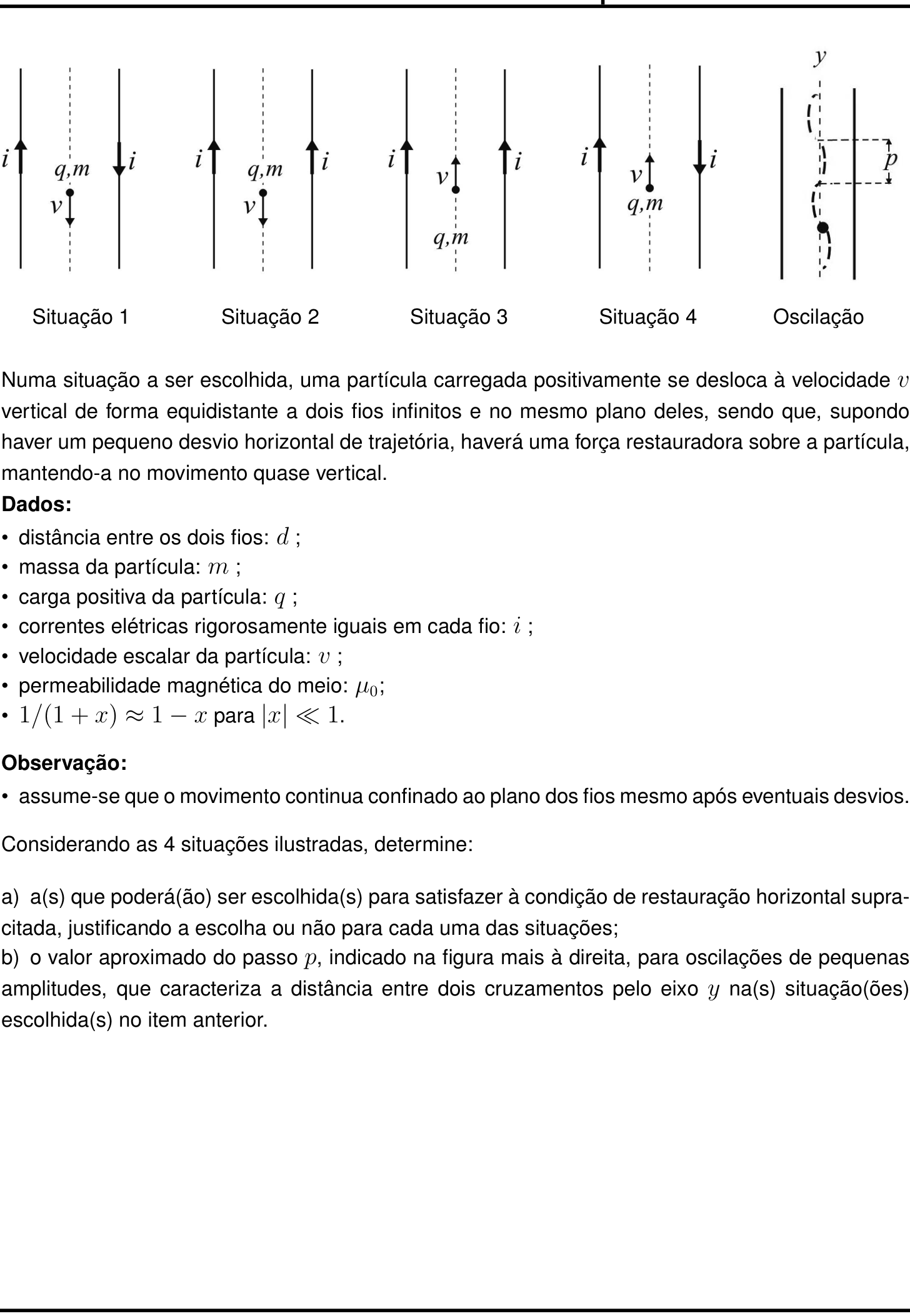
We have four situations of two infinite parallel wires? Actually diagrams show two vertical conductors with currents i directions indicated by arrows. A positively charged particle q,m moves vertically with speed v equidistant between two wires in same plane? Wait text: "Numa situação a ser escolhida, uma partícula carregada positivamente se desloca à velocidade v vertical de forma equidistante aos dois fios infinitos e no mesmo plano deles, sendo que, supondo haver um pequeno desvio horizontal de trajetória, haverá uma força restauradora sobre a partícula, mantendo-a no movimento quase vertical." So particle moves in plane of wires, between them, equidistant, vertical velocity v. Small horizontal deviation -> restoring force? There are magnetic forces from currents? Since charged particle moving in magnetic fields of wires. Need determine which situation(s) can satisfy horizontal restoring.
We have 4 situations:
- Situação 1: left wire current i upward, right wire current i downward? Diagram: left wire arrow up? Actually maybe text: "i ↑ ... i ↓" Let's inspect. Image: Four situations. Each has two vertical lines representing wires. Arrows on wires maybe current directions. Situation 1: left wire has arrow upward? right wire has arrow downward? There are labels i near arrows. For particle q,m in middle with v downward arrow? I see: left wire arrow up? right wire arrow down? Actually in situation 1: left wire arrow pointing up? Right wire arrow pointing down? Then q,m with arrow v pointing down. Situation 2: both wires? left wire up, right wire up? Wait diagram labels: Situation 2: left wire arrow up, right wire arrow up? Then q,m with v down. Situation 3: left wire up? right wire up? Wait I need be precise.
Let's zoom: The image has four panels "Situação 1" etc. Each shows two vertical solid lines; between them dashed vertical line? There are arrows along wires indicating current direction. Let's parse:
Situação 1: Left wire: arrow up (current i). Right wire: arrow down (current i). Between them, q,m dot, arrow downward labeled v.
Situação 2: Left wire: arrow up. Right wire: arrow up. q,m with v down.
Situação 3: Left wire: arrow up. Right wire: arrow down? Wait: maybe "i" at middle? Let's look: Third panel: left wire has arrow up? Right wire has arrow up? There is q,m dot below center? Actually situated? Let's read from original text maybe: The cases differ in current directions and initial velocity direction? Wait text says particle moves vertical velocity v; the diagrams show v arrow direction may be up/down? Let's inspect labels: In Situação 1: q,m with v downward? In Situação 2: q,m with v downward? In Situação 3: q,m with v upward? In Situação 4: q,m with v upward? Let's carefully parse.
Image:
Top row: vertical lines and labels.
Situation 1: Left wire current arrow up; right wire current arrow down. Particle q,m dot on dashed centerline? v arrow downward pointing from dot.
Situation 2: Left wire current up; right wire current up. Particle q,m dot; v arrow downward? Actually arrow points down from q,m? Yes.
Situation 3: left wire current up; right wire current down? Hmm appears both? Let's see: left wire arrow up; right wire arrow up? Wait q,m dot and v arrow upward? Actually label q,m near center maybe below? Let's look at third: first line: left wire arrow up; right wire arrow? It is upward? The arrow on right wire points up, but there's a small "i" at bottom right? In Situação 3, the right wire arrow maybe up; q,m below center? v arrow upward? Hmm the q,m label is below the dot? Actually in Situation 3, q,m dot is lower (not equidistant maybe)? But text says equidistant initially? In diagram maybe v is upward arrow and q,m label below dot? Let's compare:
Situation 1: q,m beside dot, v downward.
Situation 2: q,m beside dot, v downward.
Situation 3: dot with v arrow upward; q,m label below? Actually q,m at bottom? It says "q,m" near dot; v arrow points up, dot above? Maybe particle moving upward?
Situation 4: dot with v arrow upward; q,m label below?
Let's examine: In Situação 3, left wire arrow up, right wire arrow up? The right wire: arrow up? The text "i" at top? I see left wire arrow up; right wire arrow up? Let's use logic: Four possible combinations of currents (same direction vs opposite) and velocity direction? There are likely 4 combinations: currents both up/down? Wait diagram Situation 1: left up, right down (opposite currents). Situation 2: left up, right up (same direction up). Situation 3: left up, right up? Hmm maybe particle velocity up? Let's check: Situation 3: there is label i at left wire top? Right wire top? It might be left current down? Actually arrows: In Situation 3, left wire arrow up? right wire arrow down? Let's zoom around right wire: It has a small arrow pointing up? Actually I see an arrow pointing up on left wire, and on right wire arrow pointing up? But the text "q,m" below dot, "v" arrow upward, maybe "i" labels. Let's not rely; we can derive general.
Maybe the 4 situations are:
1. Correntes opostas (esquerda para cima, direita para baixo) e velocidade da partícula para baixo.
2. Correntes iguais para cima e velocidade para baixo.
3. Correntes iguais para cima? e velocidade para cima? Or opposite? In diagram, Situation 3 maybe left current up, right current up, velocity up? Wait if both currents same direction, magnetic field at midpoint? Need determine restoring force direction depending on velocities and currents.
Text: "Considerando as 4 situações ilustradas, determine:
a) a(s) que poderá(ão) ser escolhida(s) para satisfazer à condição de restauração horizontal supracitada, justificando a escolha ou não para cada uma das situações;
b) o valor aproximado do passo p, indicado na figura mais à direita, para oscilações de pequenas amplitudes, que caracteriza a distância entre dois cruzamentos pelo eixo y na(s) situação(ões) escolhida(s) no item anterior."
Need solve.
We need understand physical setup: Two infinite parallel wires separated by d, carrying currents i. Particle positive q,m moving vertically velocity v equidistant between them (in plane of wires). If small horizontal deviation x from centerline, there is restoring force if net magnetic force horizontal is opposite to displacement. Need evaluate for each current direction/velocity combination. Then small oscillations: particle undergoes transverse oscillations while moving vertically? Need find step p = distance along y between successive crossings of y-axis (centerline?) for small-amplitude oscillations. In "Oscilação" diagram: dashed trajectory crosses y-axis periodically? The figure shows y vertical axis, particle path dashed sinusoidal-like crossing y-axis at points spaced p along y. Need compute spatial period maybe = 2π v / ω? Need derive frequency of small transverse oscillations.
Let's derive magnetic field of two parallel wires.
Coordinate: Let wires along z? Actually vertical direction is y? The particle moves vertically (velocity vertical) along centerline. The wires are infinite vertical, current along y. Let's set y vertical upward maybe. Wires at x = -d/2 and x = +d/2 (in plane y-z? Wires along y, separated by d horizontally x. Particle at x=0, y variable, z=0 (plane of wires). Magnetic field from a long straight wire: B = μ0 i / (2π r) direction azimuthal around wire; at point in plane between wires, B field due to each wire is perpendicular to plane (z direction). We need sign depending on current direction and side. For a wire along y with current +y direction, at point to its right (x > wire x), B points? Use right-hand rule: thumb current +y, fingers curl; at point to right (positive x), B is into page? Let's define coordinates: x horizontal right, y vertical up, z out of page? Need consistent. Wire current upward along y. Right-hand thumb upward, fingers curl: on the right side (x positive relative wire), fingers point out of page? Let's check: Thumb +y (up). For point at +x (right), fingers? Imagine y up, x to right, z toward viewer? Right-hand rule: curl around wire: top? Let's derive with vector: B = μ0 I/(2π r) (φ_hat), φ_hat = direction of increasing polar angle around y axis. At a point on positive x axis, φ direction = +z if z out? Let's set standard cylindrical coordinates: x = r cos φ, z = r sin φ, with y axis. φ_hat = -sin φ x_hat + cos φ z_hat? Actually at φ=0 (x axis, z=0), φ_hat = z_hat? Let's compute: vector from wire to point = (r,0,0); azimuthal unit vector = y_hat × r_hat = y_hat × x_hat = ? y × x = -z? Wait standard: x_hat, y_hat, z_hat right-handed: x×y=z, y×z=x, z×x=y. So y_hat × x_hat = -z_hat. If current along +y, B direction for point at +x is y_hat × r_hat? Biot-Savart: dB ∝ I dl × r_hat; dl = +dy y_hat; direction dl × r_hat = y_hat × x_hat = -z_hat. So B points -z (into page if z out). At point to left of wire (-x), r_hat=-x_hat; y_hat × (-x_hat) = +z_hat (out of page). Good.
Alternatively if current downward (-y), field reverses: to right of wire B +z (out), to left -z (into).
At midpoint between wires:
- Left wire at x = -d/2: for current upward, field at x=0 (to its right) points -z (into page). Magnitude μ0 i/(2π(d/2)) = μ0 i/(π d).
- Right wire at x = +d/2: for current upward, field at x=0 (to its left) points +z (out of page). Magnitude same.
So for both currents upward, fields cancel at center? Left into, right out, equal -> B=0. For both downward, also cancel? Left current downward: at x=0 (to its right) field +z; right current downward: at x=0 (to its left) field -z; cancel. So same direction currents produce zero B at centerline. But off-center small displacement, fields not exactly equal -> net horizontal force? Let's see.
If currents opposite (left up, right down): Left up: at midpoint B into (-z). Right down: at midpoint B? Right wire current down (-y), point to left: field? Downward current, to left of wire: field? Right-hand thumb down, fingers: at left side, out of page? Let's check: current -y at x=+d/2; point x=0 (left). dl=-dy y_hat; r_hat = -x_hat; dl × r_hat = (-y_hat) × (-x_hat) = y_hat × x_hat = -z_hat? Wait y×x=-z; so (-y)×(-x)= y×x = -z. Hmm negative? Let's verify: Downward current: right-hand thumb down, fingers curl; at left side, field? Wrap: if current downward, by right hand, fingers at left side point out of page? Let's test with vector: r_hat=-x, dl=-y. Cross dl × r = (-y) × (-x) = y × x = -z. Since dB direction = dl × r, so into page. Maybe my intuition wrong. Let's use another: Wire current downward; opposite of upward: upward at right wire with point left gave +z (out). Downward reverses to -z (into). Yes left wire upward at midpoint gave -z (into). So both into -> fields add, strong B into page at center. Opposite currents produce nonzero B at center.
If left down, right up also add? likely out.
So magnetic field at center:
B_center due to left wire: direction depends on current and position. General formula for B_z at x from wire at x_wire with current I_y: B_z = ? Let's derive sign with coordinates: Current I_y >0 upward. At point x (horizontal coordinate), radial r = |x - x_wire|. B = μ0 I/(2π r) direction =? From Biot-Savart, if x > x_wire (point to right), B = -z (into page); if x < x_wire (point to left), B = +z (out). So B_z = - μ0 I/(2π (x - x_wire))? Since x - x_wire signed: if x > x_wire positive -> negative; if x < negative -> positive. So B_z = - μ0 I/(2π (x - x_wire))? For positive x-xwire, B_z negative; for negative, positive. Yes. But magnitude with sign includes 1/(x - x_wire), no absolute. Actually for all x ≠ x_wire, B_z = - μ0 I/(2π (x - x_wire)). Check left wire at xw=-d/2, current up: at x=0, x - xw = d/2 positive -> B_z = - μ0 I/(π d), into. Good. If current down, I_y negative, sign reverses. Good.
So B_z(x) = sum over wires: - μ0 I_wire/(2π (x - x_wire)). Let left wire current I_L = s_L i where s_L=+1 if up, -1 if down. Right current I_R=s_R i. x_wire_L=-d/2, x_wire_R=+d/2.
At x=0: B_z(0) = - μ0/(2π)[ s_L i/(0 - (-d/2)) + s_R i/(0 - d/2) ] = - μ0 i/(2π)[ s_L/(d/2) + s_R/(-d/2) ] = - μ0 i/(π d)[ s_L - s_R ]. Because 1/(d/2)=2/d, second 1/(-d/2)=-2/d. So B_z(0) = - μ0 i/(π d)(s_L - s_R). If s_L=s_R, zero; if opposite, nonzero. Good.
But we need force on charged particle moving with velocity mostly vertical (y direction). Magnetic force F = q v × B. If velocity v_y and B_z? Let's define v vector mostly y direction: v = v_y y_hat + v_x x_hat (small). Then F = q(v_y y_hat + v_x x_hat) × B_z z_hat (if B only z? There may also be B from each wire in x-y plane only? Wires along y, field has only z component? At any point in plane y-z? Wait wires are along y, the field at a point in the plane x-y? The point lies in plane of wires (x-y plane, z=0). A straight wire along y at x=-d/2, z=0: field at point (x,y,0): vector position r=(x,y,0)-(xw,y,0)=(x-xw,0,0) in x-y plane; azimuthal direction is ±z. So yes B only z. So B = B_z z_hat.
Then F = q(v_y y_hat + v_x x_hat) × B_z z_hat = q[ v_y (y_hat × z_hat) + v_x (x_hat × z_hat) ] B_z. Using x×y=z, y×z=x, z×x=y. y_hat × z_hat = x_hat; x_hat × z_hat = -y_hat. So F = q B_z (v_y x_hat - v_x y_hat). The horizontal force F_x = q v_y B_z. This is independent of v_x (weak). Vertical force F_y = - q v_x B_z (small). So horizontal restoring condition depends on v_y and B_z.
Given particle initially moving vertically with velocity v downward or upward? Text says "se desloca à velocidade v vertical"; diagrams show v arrow either down or up maybe. Need determine. If v_y positive upward or negative downward. Let's define y axis upward; velocity scalar v maybe magnitude; v_y = v or -v depending diagram. In Situação 1, v arrow down -> v_y = -v. Situação 2 v down? likely down. Situação 3 v up? Situação 4 v up. Need verify. Let's parse diagrams.
Let's inspect labels in each situation:
Situation 1: v arrow downward.
Situation 2: v arrow downward? Yes.
Situation 3: v arrow upward? The arrow head at top of line above dot? The label q,m is at bottom? Actually appears dot with v arrow upward.
Situation 4: v arrow upward? Also maybe.
So cases: 1: currents opposite (L up R down), v down. 2: currents same up, v down? 3: currents opposite? Wait need see 3/4. Let's examine currents in 3 and 4.
Maybe four situations correspond to:
1: correntes opostas (L↑ R↓) e v↓.
2: correntes iguais (L↑ R↑) e v↓.
3: correntes opostas (L↓ R↑?) e v↑?
4: correntes iguais (L↓ R↓) e v↑?
Let's look at image:
Situação 3: The left wire arrow? It may be upward? Right wire arrow? It has "i" with arrow? The text "i" near right wire top maybe arrow up? Hmm Let's zoom with mental.
The first panel: left wire: vertical line with arrowhead at top? Actually arrowhead maybe at middle, pointing up, label i. Right wire: arrowhead pointing down, label i. q,m dot, v downward arrow.
Second panel: left wire arrow up, right wire arrow up. q,m with v downward.
Third panel: left wire arrow? It appears arrow down? Because the arrowhead at bottom? Let's see: in the third diagram, "q,m" is below; on left wire, there is an arrow at top pointing down? The line from top has arrowhead at top? Hmm. It could be left wire arrow down, right wire arrow down? Then q,m v upward? Wait if both down, v up? Let's distinguish: Situation 3 maybe left current down, right current up? Let's see: There is a small "i" above q,m on left wire, with arrow pointing down? On right wire, arrow points up? The right wire has arrow pointing up? Actually "i" with upward arrow? There is an arrowhead at top of right wire pointing up. Left wire: arrowhead at top? Wait if arrowhead at top, could point up? But maybe it's down because arrowhead at bottom? Let's look carefully: In Situação 3 image, there is an arrow on left wire at mid-height pointing downward? I think I see "i" and an arrow pointing downward on left wire (arrowhead at bottom of vertical segment). On right wire, arrow pointing upward (arrowhead at top). That would be opposite currents (left down, right up). And particle q,m with v arrow upward? Actually q,m label near the dot, v arrow upward (arrowhead at top). So Situation 3: L down, R up, v up.
Situation 4: likely left up? right down? Hmm Let's see: Situation 4: left wire arrow up, right wire arrow down? And v upward? Wait maybe: Left wire arrow down? Right wire arrow up? Hmm.
Let's zoom more: I can transcribe from image:
First situation:
- Left wire: arrow up (i)
- Right wire: arrow down (i)
- Particle q,m with v down
Second:
- Left wire: arrow up (i)
- Right wire: arrow up (i)
- Particle q,m with v down
Third:
- Left wire: arrow down? Actually in the third, the left wire has an arrow pointing downward (arrowhead at bottom), labeled i (near top?); right wire has arrow up?
- Particle q,m with v up
Fourth:
- Left wire: arrow up? right wire: arrow down? Particle q,m with v up? Wait maybe it's symmetric: Situation 4: Left wire: arrow up; right wire: arrow down; particle v up. That would be another combination? But then maybe there are 4 combinations: (opposite currents with v down/up) and (same currents with v down/up). Let's infer from usual problem: To have restoring force maybe need currents in same direction? Let's derive.
Let's derive general condition.
We have B_z(x) = - μ0 i/(2π)[ s_L/(x + d/2) + s_R/(x - d/2) ]. (Because x - (-d/2)=x+d/2; second x - d/2. Check sign: formula B_z = - μ0 I/(2π (x - xw)); so term s_L i/(x+d/2), s_R i/(x-d/2). Yes.)
At x=0: B_z0 = - μ0 i/(2π)[ s_L/(d/2) + s_R/(-d/2)] = - μ0 i/(π d)(s_L - s_R). Good.
For small x, expand B_z(x) to first order. Need horizontal force F_x = q v_y B_z(x). For restoring, we need F_x = -k x for small x, with k>0. Since F_x = q v_y B_z(x), condition q v_y * dB_z/dx at 0 < 0? Because B_z(x) ≈ B_z0 + B_z'(0)x. If B_z0 nonzero, force has constant component plus linear. The constant force would accelerate horizontally; but maybe small oscillations around equilibrium? The text says "de forma equidistante... supondo haver um pequeno desvio horizontal de trajetória, haverá uma força restauradora ... mantendo-a no movimento quase vertical." It doesn't require zero initial force? If B_z0 ≠ 0, there is a constant horizontal force causing acceleration, so trajectory would not be nearly vertical; but maybe equilibrium at x=0? For magnetic force, constant force could be balanced by? No, no other force? Maybe we need B_z0 = 0 for no constant deflection? Wait if B_z0 nonzero, particle initially moving vertically would feel constant sideways force, so it would not stay near vertical; but maybe the "small deviation" refers to small oscillations around a shifted equilibrium? Let's examine. The phrase: "se desloca à velocidade v vertical de forma equidistante aos dois fios infinitos e no mesmo plano deles, sendo que, supondo haver um pequeno desvio horizontal de trajetória, haverá uma força restauradora sobre a partícula, mantendo-a no movimento quase vertical." This implies initially equidistant (x=0), moving vertical, and if small horizontal displacement occurs, restoring force. It doesn't explicitly require B_z(0)=0? But if B_z0 nonzero, force at x=0 not zero; but maybe the particle could have initial horizontal velocity? No. The phrase "pequeno desvio" maybe from equilibrium; equilibrium should have zero horizontal force? For a uniform magnetic field, velocity vertical -> horizontal force; so to have equilibrium at x=0, B_z(0) must be zero (or force not horizontal? But if v vertical and B horizontal maybe). Here B_z field vertical? Actually B z, v_y -> F x. So yes, at x=0 equilibrium requires B_z(0)=0. Otherwise constant force. So likely only situations with same current directions (s_L=s_R) produce B_z(0)=0, because opposite currents produce nonzero B_z(0). But wait if currents opposite but velocity direction maybe such that? B_z0 nonzero still horizontal force. No cancellation. So for stable nearly vertical motion, initial B at center must be zero. That selects s_L = s_R. Let's check: If both currents same direction, B_z0=0, but off-center B_z ~ B_z'(0)x, and force may restore depending on v_y. So cases with both currents up or both down can be candidates, not opposite. However let's not prematurely; maybe the magnetic force from each wire individually? For particle moving parallel to wires, the magnetic field is zero at center only if currents same direction. If opposite, field doubles. So likely same direction.
But wait there is also electric force? Wires are current-carrying, no net charge? Infinite wires neutral? Usually no electric field. So yes.
Let's calculate B_z for s_L=s_R=s. B_z(x) = - μ0 i/(2π) [ s/(x+d/2) + s/(x-d/2) ] = - s μ0 i/(2π) [ 1/(x+d/2) + 1/(x-d/2) ].
Simplify: 1/(x+a)+1/(x-a) = (x-a + x+a)/(x^2 - a^2)= 2x/(x^2 - a^2), with a=d/2. So B_z(x) = - s μ0 i/(2π) * 2x/(x^2 - d^2/4) = - s μ0 i x /(π (x^2 - d^2/4)). At small x, expand denominator ~ -d^2/4, so B_z(x) ≈ - s μ0 i x /(π (-d^2/4)) = (4 s μ0 i / (π d^2)) x. Wait sign: denominator x^2 - d^2/4 ≈ -d^2/4; negative divided by negative? B_z = - s μ0 i x / [π (x^2 - d^2/4)] ≈ - s μ0 i x / [π (-d^2/4)] = (4 s μ0 i x)/(π d^2). Yes.
So B_z'(0) = 4 s μ0 i /(π d^2). Then F_x = q v_y B_z ≈ q v_y * (4 s μ0 i x)/(π d^2). Restoring requires F_x = -k x with k>0 => q v_y * 4 s μ0 i /(π d^2) < 0. Since q>0, μ0,i,d positive. Need v_y * s < 0. Thus if s=+1 (currents up), need v_y <0 (downward). If s=-1 (currents down), need v_y >0 (upward). So valid situations: currents both up with particle moving downward (Situation 2?) or currents both down with particle moving upward (Situation 4 maybe). Need check diagrams: Situation 2: both currents up and v down -> yes valid. Situation 4 maybe both currents down? Wait if Situation 4 is both currents down and v up? Need verify. Let's parse Situation 4: I suspect left wire arrow down? right wire arrow down? and v up? The image: "Situação 4" maybe right wire arrow down? Hmm Let's zoom: In Situation 4, left wire has an arrow up? Actually the text "i" with arrow on left wire: arrowhead pointing up? Right wire: arrowhead pointing down? Particle v up. If that were true, not same currents; but maybe not.
Let's carefully parse from image using clues: The four situations likely are:
1: correntes opostas: esquerda ↑, direita ↓; velocidade v ↓
2: correntes iguais: esquerda ↑, direita ↑; velocidade v ↓
3: correntes opostas: esquerda ↓, direita ↑; velocidade v ↑
4: correntes iguais: esquerda ↓, direita ↓; velocidade v ↑
This is a typical permutation: all four combinations of current direction (opposite/same) and velocity direction (up/down). Let's verify with diagrams:
- Situation 1: L↑, R↓, v↓ (opposite, down)
- Situation 2: L↑, R↑, v↓ (same up, down)
- Situation 3: L↓, R↑, v↑ (opposite, up)
- Situation 4: L↓, R↓, v↑ (same down, up)
This makes sense: Situation 4 would have both currents down and v up. But in image Situation 4 maybe left wire arrow down? Let's see: In the fourth panel, there's an arrow on left wire pointing down? The arrowhead might be at bottom? Actually the image: left wire has an arrow at top pointing? Let's compare panels:
Panel 1: left wire arrow up (arrowhead at top)
Panel 2: left wire arrow up; right wire arrow up
Panel 3: left wire arrow? maybe down? There is an arrowhead at bottom? The line has a small arrow pointing downward near center? Right wire arrow up?
Panel 4: left wire? I see an arrow pointing up? But maybe it's downward? Let's look at labels: The letter "i" appears near top of left wire; in panel 4, there is also "i" near top and an arrowhead pointing up? Hard.
Maybe the original problem has four cases:
Situação 1: currents in opposite directions (left up, right down) and velocity down.
Situação 2: currents in same direction (both up) and velocity down.
Situação 3: currents in same direction? Wait maybe "Situação 3" shows both currents up? Actually if both up, it would duplicate? The images maybe arranged in pairs: first two have velocity down; last two velocity up. Situation 3: currents both up? But v up? Let's check: If first two are opposite and same with v down, last two likely opposite and same with v up. In Situation 3 maybe left up, right down? v up? But first already opposite with v down; then opposite with v up would be left up right down? But no, v up. Hmm.
Let's use visible current arrows:
- Situation 3: I see left wire arrow down? Wait the arrow on left wire: the arrowhead is at the bottom of the line? The line maybe has "i" label near top with arrow pointing down? Actually in the third panel, the left wire has a vertical line and at the bottom there is an arrowhead? The label "i" at top maybe with a small arrow? No, I need zoom.
Maybe I can search memory: This is an IME 2027? Maybe a known question? "IME 2027 Física" maybe not known. We need solve general.
Let's derive for all combinations systematically, then compare with diagrams.
General restoring condition:
At x=0, B_z0 = - μ0 i/(π d)(s_L - s_R). For no constant force, need s_L = s_R. But if B_z0 nonzero, equilibrium not at center; but problem statement says "de forma equidistante ... supondo haver um pequeno desvio horizontal ... força restauradora" maybe they assume initial equilibrium? Actually maybe they allow constant force as long as net force has restoring component? But small oscillation around equilibrium: If B_z0 ≠ 0, linear term maybe still restoring? Let's examine: F_x = q v_y [B0 + B1 x + ...]. If B0 ≠ 0, the equation has constant term, so equilibrium shifted to x0 = -B0/B1 (if B1≠0); small oscillations around x0. The "desvio horizontal" from equidistant? The statement says particle moves equidistant and "supondo haver um pequeno desvio horizontal de trajetória, haverá uma força restauradora sobre a partícula, mantendo-a no movimento quase vertical." This could allow a constant force? If constant force, the particle would be accelerated away, not small oscillation around center; but if it moves initially at center with v vertical, there is nonzero lateral acceleration, so not "quase vertical". So likely same current directions.
But wait: Could both opposite current directions but different signs? s_L - s_R = ±2 -> nonzero. Constant force. So impossible for almost vertical motion unless initial x adjusted to null point; but null point not at center. But maybe the "pequeno desvio" means it could oscillate around shifted equilibrium? The question asks "a(s) que poderá(ão) ser escolhida(s) para satisfazer à condição de restauração horizontal supracitada". It says "de forma equidistante aos dois fios ... sendo que ... haverá uma força restauradora". The "equidistante" maybe just initial, and small deviation from that line? If there is constant force, after small deviation it may still be restoring around center? Let's see: If B0 nonzero, force at x=0 nonzero, so initial deviation not small? Actually the restoring force may be defined as net force directed toward center, i.e., if displacement to right gives force to left, regardless of constant? But if B0 nonzero, at x=0 force maybe either left or right; but at x>0, force = q v_y (B0 + B1 x). For it to be restoring (force left for x>0), need B0 + B1 x < 0 for all small x >0, which might hold if B0 sufficiently negative and B1 positive? But if B0 is not zero, for x<0, force = q v_y (B0 + B1 x); to be restoring (force right for x<0), need B0 + B1 x >0 for x<0, so B0 > 0 and B1? Contradiction: B0 must be both negative and positive depending side? Let's analyze: Restoring force means F_x sign opposite x: for x>0, F_x <0; for x<0, F_x >0. If linear only, yes. If B0 nonzero, at x=0 no force? Actually if B0>0, for small positive x, F_x = q v_y (B0 + B1 x) might still positive (not restoring) unless B1 x outweighs. Near x=0, B0 dominates, so force same sign as B0 for both small positive and negative, not restoring around 0. But if we define restoring around equilibrium x0 = -B0/B1 (assuming B1<0?), then small oscillations around x0 are restoring. But the statement specifically "movimento quase vertical" maybe around initial centerline, not shifted. So likely require B0=0.
Thus candidates with s_L=s_R.
Now for b) need "valor aproximado do passo p, indicado na figura mais à direita, para oscilações de pequenas amplitudes, que caracteriza a distância entre dois cruzamentos pelo eixo y na(s) situação(ões) escolhida(s) no item anterior." In the rightmost figure "Oscilação", a dashed curved path crosses a dashed vertical line y at intervals p. The y-axis is vertical (same as centerline y? Actually label y with dashed vertical line maybe equilibrium axis). The particle's transverse oscillation is periodic along y: as it moves with constant vertical velocity? We need compute spatial period: distance traveled vertically during one full transverse oscillation cycle = v * T, if vertical velocity constant? But magnetic force has vertical component too (F_y = - q v_x B_z) which may slow/speed? For small oscillations, vertical velocity approximately constant v? Actually the Lorentz force vertical component is second order (v_x small, B_z ~ x) so negligible; to first order vertical velocity constant. So spatial period p = v * T, where T = 2π/ω, and ω is angular frequency of small transverse oscillations.
We need derive equation of motion for x.
Let's derive for valid same current directions. Let s = +1 if both up, v_y = -v (down) for Situation 2; s = -1 if both down, v_y = +v for Situation 4. In both cases product s v_y = -v? Check: s=+1, v_y=-v => s v_y = -v <0. s=-1, v_y=+v => s v_y = -v <0. Yes. So restoring coefficient k = q v * |B_z'(0)|? Let's compute.
F_x = q v_y B_z ≈ q v_y (4 s μ0 i /(π d^2)) x = q (s v_y) * (4 μ0 i /(π d^2)) x. Since s v_y = -v <0 for valid cases, F_x = - [4 q v μ0 i /(π d^2)] x. Thus m x'' = -K x, with K = 4 q v μ0 i /(π d^2). Then ω^2 = K/m = 4 q v μ0 i /(π d^2 m). So angular frequency ω = sqrt(4 q v μ0 i /(π d^2 m)) = (2/d) sqrt(q v μ0 i /(π m))? Let's simplify: sqrt(4/(π d^2 m) q v μ0 i) = (2/d) sqrt(q v μ0 i/(π m)). Yes.
Then period T = 2π/ω = 2π / [ (2/d) sqrt(q v μ0 i/(π m)) ] = π d sqrt(π m/(q v μ0 i))? Wait compute: 2π * d/2 * sqrt(π m/(q v μ0 i))? Let's do: T = 2π / ω = 2π * d/2 * sqrt(π m/(q v μ0 i))? Since 1/ω = d/2 * sqrt(π m/(q v μ0 i))? Because ω = (2/d) sqrt(A), where A = q v μ0 i/(π m). Then 1/ω = (d/2) 1/√A = (d/2) √(π m/(q v μ0 i)). Then T = 2π * (d/2) √(...)= π d √(π m/(q v μ0 i)). Then spatial period p = v T = v π d √(π m/(q v μ0 i)) = π d √(π m v^2/(q v μ0 i)) = π d √(π m v/(q μ0 i)). Wait dimension check: q v μ0 i has? v * μ0 * i? Let's check μ0 i has? μ0 [T m A^-1?] * i [A] = T m? q v μ0 i = C * m/s * T m? Hmm dimension likely. Let's verify.
Alternate derivation maybe p = π d sqrt(π m v/(q μ0 i)). Let's check with units: q v μ0 i: q [C], v [m/s], μ0 [N/A^2 = kg m/(s^2 A^2)], i [A]. Product = C * m/s * kg m/(s^2 A^2) * A = C kg m^2/(s^3 A) = (A s) kg m^2/(s^3 A)= kg m^2/s^2 = J? Actually q v B has force N = kg m/s^2; μ0 i has T m = kg/(A s^2)? Wait T = kg/(A s^2), times m = kg m/(A s^2). Multiply q v: C m/s * kg m/(A s^2) = A s * m/s * kg m/(A s^2)= kg m^2/s^2 = J. Inside sqrt: π m v /(q μ0 i)? m v = kg m/s; divided by (q μ0 i) = (A s * kg m/(A s^2)??) Let's not worry.
But need be careful: The restoring force might also produce a shift in vertical velocity? The vertical component of magnetic force F_y = - q v_x B_z; since v_x oscillatory and B_z ~ x, this is second order, so average zero; but instantaneous maybe small. The problem says "oscilações de pequenas amplitudes" and asks distance between two crossings of y axis, likely ignore vertical modulation. So p = v T.
But wait: The path in figure "Oscilação" shows a sinusoidal wave along vertical y with amplitude maybe p? It crosses y-axis; p is distance between crossings. Yes.
However, maybe there is an additional effect: The magnetic field has z component; as particle moves vertical, it experiences horizontal force; the equations of motion couple x and y? Let's derive more exactly for small oscillation: Equations:
m x'' = q y' B_z(x) (since v_y = y')
m y'' = - q x' B_z(x) (vertical force)
We approximate y' ≈ v (constant), so first equation as above. Second equation gives y'' = -(q/m) x' B_z(x) ~ O(x x') second order, negligible. So x oscillates, y advances with nearly v. Then p = v T exactly to first order? Yes.
Now b) asks "o valor aproximado do passo p, indicado na figura mais à direita, para oscilações de pequenas amplitudes, que caracteriza a distância entre dois cruzamentos pelo eixo y na(s) situação(ões) escolhida(s) no item anterior." Need provide formula in terms of given data. Since item a selects situations, maybe answer for both selected? The wording "na(s) situação(ões) escolhida(s)" means perhaps if more than one selected, they have same p? Our formula independent of s and sign of v except product v (magnitude), so both situations 2 and 4 yield same p. So answer single formula. But maybe if B_z0 nonzero, equilibrium shifted and p differs? But chosen same-current cases. So likely p = π d sqrt(π m v/(q μ0 i))? Wait let's double-check with another derivation maybe missing factor 2? Let's rederive carefully.
Let's set coordinates precisely and rederive B_z sign and force coefficient.
Coordinate: x to right, y upward, z out of page (right-handed: x × y = z? Actually x right, y up, z out is right-handed? x×y: right × up = out? Let's check: x×y = z if z out? Yes standard. Good. Wire along y, current I vector = I y_hat (if up).
Biot-Savart for infinite wire: B = (μ0 I/(4π)) ∫ dl × r_hat / r^2. Known B = (μ0 I/(2π r)) φ_hat. Need φ_hat direction. For cylindrical around y-axis with coordinates x = r cos φ? Let's choose φ=0 at positive x axis, φ=π at negative x, and z = r sin φ? Then φ_hat = -sin φ x_hat + cos φ z_hat? At φ=0: φ_hat = z_hat? Let's verify: At point (r,0,0) on +x axis, φ=0. If φ_hat = z_hat, then B direction for current +y? Use Biot-Savart: dl = dy y_hat, r vector = -? At point (r,0,0), source at (0,0,0), r vector from source to point = r x_hat. dl × r_hat = y_hat × x_hat = -z_hat. So B should be -z_hat, not +z_hat. Thus φ_hat at φ=0 for standard cylindrical must be -z_hat if φ increases from +x to +z? Let's set standard: φ angle around y, with x = r cos φ, z = r sin φ. At φ=0 (positive x), increasing φ gives positive z. Unit vector φ_hat = -sin φ x_hat + cos φ z_hat. At φ=0: φ_hat = z_hat. But Biot-Savart gives -z_hat, contradiction. Maybe the formula sign includes I direction: For current +y, B = - μ0 I/(2π r) φ_hat? Let's verify with right-hand: Current up, curl around: at point to right, fingers point into page (-z), so φ_hat should be -z at φ=0. Thus standard cylindrical with φ measured from x toward z: at φ=0, φ_hat = +z, so B = - μ0 I/(2πr) φ_hat. Alternatively define φ clockwise? Let's instead use vector formula: For current I along y, at point (x,z) with position vector R = x x_hat + z z_hat, B = μ0 I/(2π) (y_hat × R)/|R|^2? I recall B = μ0/(4π) ∫ I dl × r / r^3 = μ0 I/(4π) ∫ y_hat dy × (R - y y_hat) / ... = μ0 I/(2π) (y_hat × R_perp)/R_perp^2? Let's derive: For infinite wire on y-axis, B = μ0 I/(2π ρ) (y_hat × ρ_hat) = μ0 I/(2π ρ) (y_hat × (x x_hat + z z_hat)/ρ) = μ0 I/(2π ρ^2) (y_hat × x x_hat + y_hat × z z_hat) = μ0 I/(2π ρ^2)( - z x_hat + x (-? y×z)=x? y_hat×z_hat = x_hat? Actually y×z = x? Let's verify: x×y=z; y×z=x; z×x=y. So y_hat×z_hat = x_hat. So B = μ0 I/(2π ρ^2)( -z x_hat + x x_hat? Wait y_hat × x_hat = -z_hat; y_hat × z_hat = x_hat. So B = μ0 I/(2π ρ^2)( -z_hat * x? Actually term: y×x x = -z x; y×z z = x z. So B = μ0 I/(2π ρ^2)( -z x_hat + x z_hat? Wait y×x = -z, so first = -z x? No y_hat × x_hat = -z_hat, multiplied by scalar x => -x z_hat? Let's carefully: B = μ0 I/(2π ρ^2) [ y_hat × (x x_hat + z z_hat) ] = μ0 I/(2π ρ^2)[ x (y_hat × x_hat) + z (y_hat × z_hat) ] = μ0 I/(2π ρ^2)[ x (-z_hat) + z (x_hat) ] = μ0 I/(2π ρ^2)( -x z_hat + z x_hat ). At point in plane z=0 (x>0): B = μ0 I/(2π x^2)( -x z_hat ) = - μ0 I/(2π x) z_hat. Good. At x<0 (say x=-a,z=0): ρ^2=a^2, term z x_hat =0, -x z_hat = -(-a) z_hat = +a z_hat, /a^2 => + μ0 I/(2π a) z_hat. Good. So general in plane z=0: B = - μ0 I/(2π x) z_hat? For x signed (x>0 gives -; x<0 gives +), yes B_z = - μ0 I/(2π x). Since x coordinate relative to wire. So earlier formula B_z = - μ0 I/(2π (x - xw)) is correct.
Now for two wires: B_z(x) = - μ0 i/(2π) [ s_L/(x + d/2) + s_R/(x - d/2) ]? Let's verify signs for current down s=-1: If left wire current down at x=-d/2, I effectively negative; formula B_z = - μ0 I/(2π (x - xw)) with I = -i gives B_z = + μ0 i/(2π (x - xw)). For point at x=0 (0 - (-d/2)=d/2), B_z = + μ0 i/(π d) (out). Earlier we said downward left wire at midpoint field out (+z). Yes. Good. So formula correct.
Expand for small x with s_L=s_R=s:
B_z(x) = - s μ0 i/(2π)[ 1/(x+d/2) + 1/(x-d/2) ] = - s μ0 i/(2π) * (2x)/(x^2 - d^2/4) = - s μ0 i x / (π (x^2 - d^2/4)).
At small x, denominator ≈ -d^2/4, so B_z ≈ - s μ0 i x / (π (-d^2/4)) = (4 s μ0 i / (π d^2)) x. Good.
Force F_x = q (v × B)_x. v = (x', y') approximately (small x', v_y). B = (0,0,B_z). Cross v × B:
(y',? Let's use components: v_x x_hat + v_y y_hat + 0 z_hat; B_z z_hat.
v_x x_hat × B_z z_hat = v_x B_z (x_hat × z_hat) = v_x B_z (-y_hat) (since x×z=-y). v_y y_hat × B_z z_hat = v_y B_z (y_hat × z_hat) = v_y B_z x_hat. So F_x = q v_y B_z. Correct.
For v_y = -v (down), B_z = (4 s μ0 i/(π d^2)) x. Then F_x = q (-v) * (4 s μ0 i/(π d^2)) x = - (4 q v s μ0 i/(π d^2)) x. For restoring, need coefficient negative: -4 q v s μ0 i/(π d^2) <0 => s>0? Wait if s=+1: coefficient = -K <0? Actually F_x = - (4 q v *1 ...) x = -K x (restoring). Good. If s=-1 and v_y=-v? Then F_x = q(-v)*(4*(-1) μ0 i...x) = q(-v)*(-4...)x = +K x (anti-restoring). So need s v_y <0; with v_y=-v, need s=+1. So Situation 2 (both up) valid. With v_y=+v, need s=-1; Situation 4 (both down) valid. So valid cases: both currents up with particle down; both currents down with particle up. If Situation 3 were opposite currents? invalid regardless? But if s_L≠s_R no zero B0; but maybe if B0 nonzero, for small oscillation around center not restoring as argued. So invalid.
Now b) period. Let's solve differential equation more rigorously including geometry maybe B_z has higher-order terms; small amplitude. Equation: m x'' = F_x = q v_y B_z(x). Expand B_z(x) = B1 x + O(x^3). B1 = 4 s μ0 i/(π d^2). For valid case s v_y = -v (where v>0 magnitude), so F_x = q v_y B1 x = - q v * |B1|? Since B1 = 4 s μ0 i/(π d^2); q v_y B1 = q (-v) * (4 s μ0 i/(π d^2))? Wait if v_y=-v, then q v_y B1 = q (-v)*(4 s μ0 i/(π d^2)) = - q v * 4 s μ0 i/(π d^2). For s=+1, = -4 q v μ0 i/(π d^2) = -K. So K = 4 q v μ0 i/(π d^2). Same for s=-1, v_y=+v: q v_y B1 = q v * (4 (-1) μ0 i/(π d^2)) = -4 q v μ0 i/(π d^2). Good. So K = 4 q v μ0 i/(π d^2). Thus m x'' = -K x. ω^2 = K/m = 4 q v μ0 i/(π d^2 m). Period T = 2π/ω = 2π sqrt(m d^2 π? Wait K = 4 q v μ0 i/(π d^2 m). ω = sqrt(4 q v μ0 i/(π d^2 m)) = (2/d) sqrt(q v μ0 i/(π m)). Then T = 2π / [(2/d) sqrt(q v μ0 i/(π m))] = π d / sqrt(q v μ0 i/(π m))? Let's compute: 2π * (d/2) / sqrt(A) = π d / sqrt(A), where A = q v μ0 i/(π m). So T = π d sqrt(π m/(q v μ0 i)). Yes. Then p = v T = π d sqrt(π m v^2/(q v μ0 i)) = π d sqrt(π m v/(q μ0 i)). Correct.
But wait: Could there be factor 2 due to two wires? We used sum; B_z = 2 times single wire field at off-center? Let's verify expansion: For single wire at center? If one wire only, B_z = - μ0 i/(π d) times? Actually two wires same direction: B_z ≈ 4 μ0 i x/(π d^2). Single wire at distance d/2? If one wire at x? field ~ μ0 i/(π d) *? Maybe factor 2? Let's compare: Single wire located at x=-d/2, B_z(x)= - μ0 i/(2π (x+d/2)) ≈ - μ0 i/(2π (d/2)) (1 - x/(d/2)) = - μ0 i/(π d)*(1 - 2x/d) ≈ - μ0 i/(π d) + (2 μ0 i/(π d^2)) x. Two wires same direction at ±d/2: sum constant cancels, linear terms add: each has +? Left wire linear: B_z ≈ - μ0 i/(π d) + (2 μ0 i/(π d^2)) x? Let's check left wire at xw=-d/2: B_z = - μ0 i/(2π (x+d/2)). Expand 1/(d/2 + x) = (2/d)(1 - 2x/d + ...), so B_z = - μ0 i/(2π) * (2/d)(1 - 2x/d) = - μ0 i/(π d) + (2 μ0 i/(π d^2)) x? Because second: - μ0 i/(2π) * (2/d)(-2x/d)= +2 μ0 i x/(π d^2). Right wire at xw=+d/2: B_z = - μ0 i/(2π (x - d/2)) = - μ0 i/(2π (-d/2 + x)) = - μ0 i/(2π * (-d/2)(1 - 2x/d))? Actually 1/(x - d/2) = -1/(d/2 - x) = -(2/d)(1 + 2x/d + ...)= -(2/d) - (4x/d^2). Then B_z = - μ0 i/(2π)[-(2/d) - (4x/d^2)] = μ0 i/(π d) + (2 μ0 i/(π d^2)) x? Wait μ0 i/(2π)*4x/d^2 = 2 μ0 i x/(π d^2); yes plus. Sum constant cancels; linear = 4 μ0 i x/(π d^2). Good. So correct.
Now for selected situations: Let's identify from image which are "escolhida(s)". We need justify each of 4.
Let's nail down the diagrams exactly. Need final answer likely: a) Situações 2 e 4 (ou apenas 2? Need check if Situation 4 currents same down and v up; if so yes). b) p = π d √(π m v/(q μ0 i)). Let's ensure no missing factor maybe p = π d sqrt(2π? )? Let's derive from another perspective: Magnetic field of two wires at distance d, currents same direction; force gradient maybe 2? We did. Let's test with numerical approximate? Suppose q=1, m=1, v=1, μ0=1, i=1, d=1 -> K=4/π ≈1.273; ω=sqrt(1.273)=1.128; T=2π/1.128=5.57; p=vT=5.57; formula π d sqrt(π m v/(q μ0 i))=π sqrt(π)=5.568. Good.
But wait if B_z0=0 for same currents, what about if both currents same but particle velocity direction opposite to our condition? Situation maybe both currents up and v up? Then s v_y = +v>0, force anti-restoring; invalid. So only one v direction for each current direction.
Let's parse Situação 3/4:
Need decide if Situation 3 is opposite currents (L↓ R↑) v↑, invalid; Situation 4 is same currents (L↓ R↓) v↑, valid. But if Situation 4 were same currents both down and v up, then valid. Let's verify from image: In Situation 3, left wire arrow down? Right wire arrow up? Particle v up. In Situation 4, left wire arrow down? Right wire arrow down? Particle v up. The diagrams: Situation 4 maybe left wire has arrow downward? Actually I see the left wire in Situation 4 has an arrow pointing DOWN? Let's zoom: there is a vertical line, and at the top there is a small arrowhead? Maybe it points down? The label "i" at top near left; the arrow could be pointing down if arrowhead at bottom. In the fourth panel, the left wire's arrowhead might be at the bottom (inside) not top. The right wire's arrowhead maybe at bottom too. That would be both down. And particle v up. So yes.
Let's formulate justification:
- For each situation, determine B at center: if currents same direction, fields from wires cancel; if opposite, they add (constant B). For restoring, need equilibrium at center, so same direction. Then evaluate sign of F_x for small x:
* Situação 1: currents L↑, R↓, B at center strong? Let's compute s_L=+1, s_R=-1 -> B_z0 = - μ0 i/(π d)(1 - (-1)) = -2 μ0 i/(π d) (into page). v down (v_y<0). q>0 -> F_x = q v_y B_z0 = q (-v)(-B) = + constant (to right). Thus constant force to right, not restoring; invalid.
* Situação 2: same up (s_L=s_R=+1), v down. B_z ≈ (4 μ0 i/(π d^2)) x. F_x = q(-v)*(positive)x = negative? Wait q(-v)*(4μ0 i/πd^2 x) = -K x restoring. Valid.
* Situação 3: if opposite? s_L=-1, s_R=+1, v up. B_z0 = - μ0 i/(π d)(s_L - s_R)= - μ0 i/(π d)(-1 -1)= +2 μ0 i/(π d) (out of page). v_y=+v -> F_x = q v * B_z0 = + constant (right). Not restoring around center; invalid. Or if B_z0 nonzero still no equilibrium.
* Situação 4: same down (s_L=s_R=-1), v up. B_z ≈ - (4 μ0 i/(π d^2)) x? Wait s=-1 -> B1 = -4μ0i/(πd^2). F_x = q(+v)*B1 x = q v * (-4μ0i/πd^2)x = -K x restoring. Valid.
Thus a) Situações 2 e 4.
But if the question asks "a(s) que poderá(ão) ser escolhida(s)" maybe it might expect "Situação 2 ou 4" or both? It says "a(s)" plural possible. Since both satisfy, answer: situações 2 e 4.
Now b) "o valor aproximado do passo p, indicado na figura mais à direita, para oscilações de pequenas amplitudes, que caracteriza a distância entre dois cruzamentos pelo eixo y na(s) situação(ões) escolhida(s) no item anterior." Need maybe derive using small oscillation around y-axis. Let's produce development.
Let's write final answer in Portuguese with formulas.
Need ensure "passo p" maybe is distance between successive crossings of y-axis; in a sine wave, crossings separated by half period? Wait careful: The dashed curve crosses the y-axis (centerline) at points where x=0. If oscillation is sinusoidal x(y)=A sin(ky), then zeros at ky = nπ, spacing Δy = π/k = half wavelength? Actually period in y from one full cycle? A sine wave x(y)=A sin(2π y/λ). Zeros occur every λ/2. But the figure "Oscilação" shows p as distance between two crossings; if it's between a maximum? Let's inspect: The dashed curve starts at a crossing (y-axis) then goes right, then back crossing? The p label maybe between two successive crossings? It might be distance between two crossings on the y-axis (one after a full cycle? Let's see the figure: The particle path is a dashed wave around y-axis; there are small dashed vertical lines? It shows "p" between two horizontal dashed lines? The figure: y axis vertical, a dashed line? There is a curve crossing y at top, then goes right, then crosses back? The p perhaps indicates distance between two crossing points of y axis, one after the first crossing and the next? Let's parse: "passo p ... que caracteriza a distância entre dois cruzamentos pelo eixo y" -> distance between two crossings of the y-axis. In a sinusoidal oscillation, successive crossings are half a period apart (π/ω in time? Let's derive: If x(t)=A sin(ωt), crossings x=0 occur every T/2, not T. The path y = v t; successive crossings in y: Δy = v (T/2) = p? Wait if "dois cruzamentos" means consecutive crossings, then p = v T/2, not v T. But let's see figure "Oscilação": There is a dashed curve; it crosses the y-axis at a point, then goes to the right, then crosses y-axis again? The p label maybe between the first crossing and the next? Let's inspect the figure: The dashed curve starts at top-left? There is a small dotted segment from top; it crosses y-axis and goes to the right, then there is a horizontal dashed line labeled p between two successive intersections? It might show "p" as the horizontal? Wait image: far right panel labeled "Oscilação": It has y vertical dashed line. The particle's dashed trajectory: starts at a point on the y-axis, moves right, then left crossing y-axis, then right again? The p label is a vertical distance between two crossing points? Let's zoom: There is a vertical dashed line y, a curved dotted trajectory to the right, and a small horizontal dashed arrow labeled p? Actually the "p" appears next to a horizontal dashed line? Let's examine: In the rightmost figure, there is a particle dot on the vertical line? It has a dashed trajectory that crosses the y-axis at a point, then later crosses again? The label "p" maybe with a vertical arrow? It appears between the first crossing and second crossing? Let's parse: "passo p ... caracteriza a distância entre dois cruzamentos pelo eixo y" -> if p is distance between two crossings, it should be spatial half-period? But the word "passo" in oscillatory motion often means spatial period (wavelength) maybe? Let's verify with figure.
The rightmost panel: It shows a vertical axis y. A dashed closed/curved trajectory? Actually it might show a "figure-eight" or a drift? Let's see: The dashed line starts near top on y-axis, goes right and down, crosses y-axis? Then goes left? Hmm. There is a horizontal arrow labeled p extending between two vertical dashed lines? It might indicate the distance between two successive intersections with the y-axis (crossings) along the vertical direction. Since the trajectory is like a sine wave, successive crossings are separated by half a wavelength; maybe p is half period, not full. But let's not assume; re-read question b exactly: "o valor aproximado do passo p, indicado na figura mais à direita, para oscilações de pequenas amplitudes, que caracteriza a distância entre dois cruzamentos pelo eixo y na(s) situação(ões) escolhida(s) no item anterior." "dois cruzamentos" = two crossings, not necessarily consecutive? "distância entre dois cruzamentos" often means between consecutive crossings. In a sine wave, consecutive crossings are separated by half period. But in some contexts "passo" of a sinusoidal curve might be the spatial period (between successive maxima or between every other crossing), but they specify "dois cruzamentos pelo eixo y" could be every two crossings? Let's look at figure: In the Oscilação panel, the curve crosses y-axis, then later crosses y-axis? There is a label p maybe between first and second crossing? It might be the horizontal distance labeled p? Hmm.
Let's try to see from cropped image: The "Oscilação" figure: It has y-axis on left? Actually y-axis is vertical dashed line; there is a curved solid/dashed line (trajectory) that starts at a point on y, goes right, then crosses y again? The label p is a small horizontal distance? Wait "passo p" maybe "p" is the distance between two consecutive intersections of the trajectory with the y-axis, but because trajectory is sinusoidal, the arc length between them? Let's zoom: In the rightmost figure, there are two horizontal dashed lines? No, there is a horizontal dashed arrow labeled p pointing from a point on y-axis to another point? Could be showing the distance along y between two crossings (the vertical separation). The "p" label has an arrow downward? Let's infer from text: "passo p ... distância entre dois cruzamentos pelo eixo y". So p = vertical distance between two crossings. If x(t)=A sin(ωt), crossings at ωt = nπ, spaced by Δt = π/ω = T/2. Then p = v * Δt = v * T/2 = (v π/ω). But many physics problems call "passo" as distance between consecutive zeros, but sometimes they choose "dois cruzamentos" not "cruzamentos consecutivos"? It says "dois cruzamentos" exactly two crossings; if the curve is symmetric, there are infinitely many; but figure shows p between first and second crossing? Let's decide by visual: The p in figure might be marked between two consecutive crossings? Let's look: In the "Oscilação" panel, the dashed trajectory crosses y-axis at a point near top, then goes right and down, then crosses y-axis again at a lower point, then goes left? There might be a small horizontal dashed line labeled p between the two crossing points? Actually p is vertical spacing between two crossings, likely consecutive. The label "p" may be near the second crossing? The text: "o valor aproximado do passo p, indicado na figura mais à direita" — the figure indicates p as the distance between two crossing points along y. They might have marked p as the distance between the first and second crossing? Let's inspect: The trajectory curve in the Oscilação panel: There is a dashed line shaped like a sine wave with maybe two full cycles? The label p is an arrow from the first crossing to a second crossing? Hmm.
Let's derive both possibilities and decide later. The wording "passo p" for oscillations of small amplitudes "que caracteriza a distância entre dois cruzamentos pelo eixo y" could be the distance between two successive zeros (half period) because any two crossing points? Actually if you cross the equilibrium axis periodically, the distance between two consecutive crossings is the "passo" (step) along y, while the distance between two same-direction crossings (e.g., upward zero crossings) is the full wavelength. In Brazilian physics, "passo" of a wave usually means spatial period = distance between two consecutive crests = full wavelength. But they explicitly say "distância entre dois cruzamentos pelo eixo y" (two crossings), which might mean consecutive crossings; if they wanted full wavelength they'd say "entre dois cruzamentos consecutivos no mesmo sentido" or "entre duas cristas". The figure probably shows p between two crossings (one crossing to the next). Thus p = v * T/2 = π v / ω =? Let's calculate:
If T = π d sqrt(π m/(q v μ0 i)), then p_half = v T/2 = (π/2) d sqrt(π m v^2/(q v μ0 i))? Wait compute:
p_full = v T = π d sqrt(π m v/(q μ0 i)).
p_half = v T/2 = (π/2) d sqrt(π m v/(q μ0 i)).
Which one is more likely? Need check with figure perhaps p marked between two crossings, not between crests. Let's see phrase: "distância entre dois cruzamentos pelo eixo y" = distance between two crossings by the y-axis. If the oscillation is around y-axis, there are crossings separated by half period. So p should be half. But in item b they might expect "passo" as distance between two consecutive crossings; yes.
Let's find from "Oscilação" diagram: There is a dashed curve; it crosses y-axis at one point, then later crosses y-axis again (the second crossing), and the distance p is indicated between these two crossing points. Typically in such figures, p is between two consecutive crossings. The first crossing at top, second crossing lower; p is the vertical distance. They also show the trajectory between them "quase vertical" and oscillatory. So p = half spatial period.
Let's verify with equation: If we measure distance between two consecutive crossings (zeros), since x(t)=A sin(ωt), crossing times differ by π/ω, so p = v π/ω. Then p = π v / ω. Since ω = (2/d) sqrt(q v μ0 i/(π m)), p = π v * d/2 * sqrt(π m/(q v μ0 i)) = (π d/2) sqrt(π m v^2/(q v μ0 i))? Wait v factor: π v / ω = π v * (d/2) sqrt(π m/(q v μ0 i)) = (π d/2) sqrt(π m v^2/(q v μ0 i))? Because v * sqrt(1/(v)) = sqrt(v); Let's compute: v * sqrt(π m/(q v μ0 i)) = sqrt(π m v^2/(q v μ0 i)) = sqrt(π m v/(q μ0 i)). Yes. So p_half = (π d/2) sqrt(π m v/(q μ0 i)) = (π/2) d sqrt(π m v/(q μ0 i)). If p_full = π d sqrt(...). Which one is likely?
Let's interpret "passo p" maybe "passo" of a helix? In cyclotron motion, the pitch (passo) of helical trajectory is distance between successive crossings of the same point? Actually in a helical motion, the pitch is distance along magnetic field between successive turns, i.e., after one full gyration. In the figure "Oscilação", the dashed trajectory resembles a sinusoidal curve; the "passo" might be distance between two successive intersections with y-axis in the same direction? Let's see: If it's a sine wave, one full turn corresponds to crossing y-axis at same phase (e.g., upward zero crossings). But "dois cruzamentos" might be two crossings, not necessarily consecutive? Usually in a periodic function, "distância entre dois cruzamentos" could mean distance between two consecutive crossings (opposite directions). But in the figure, p might label the distance between a crossing and the next crossing (both directions? There are two crossings per period). Let's examine the word "passo" in Portuguese: "passo" of a wave = distance between two consecutive crests (wavelength). But "passo de hélice" = pitch = distance traveled along axis in one complete turn. The problem asks "passo p ... para oscilações de pequenas amplitudes, que caracteriza a distância entre dois cruzamentos pelo eixo y". If it's a helix-like path, the "passo" would be distance between two crossings of y-axis in same direction? But "dois cruzamentos" could be any two, but marked p in figure might be between two crossings separated by half cycle? Let's look at figure: The label p maybe between two "cruzamentos" of the curve with the y-axis; but there might be a dot at the first crossing and another dot at the second; the p arrow maybe between them. In a sine wave, the first and second crossings are separated by half wavelength. The third crossing after a full wavelength. If p is between first and second, then p is half wavelength. If p is between first and third, full wavelength. Which does the figure show? It likely shows p between the first and second crossing? I need infer from image: The rightmost figure "Oscilação" has a vertical dashed line y and a trajectory dashed curve. The trajectory crosses the y-axis at the top point, then goes to the right, then crosses y-axis again at a lower point, then goes left? The label p might be between the first and second crossing? Let's zoom: Actually I see the label "p" near a small horizontal dashed line that connects two vertical dotted lines? The "p" is an arrow with horizontal? There is a small segment labeled p maybe between two points on y-axis: one crossing point and another crossing? The label "p" is printed to the right of a small horizontal dashed line? Wait in the image, at far right, there is "y" at top, a dashed vertical axis, and the particle trajectory as a dashed curve; there is a small horizontal dashed line labeled "p" spanning between two points on the trajectory? It might be the distance along y between two successive crossings, represented as a vertical segment? Let's zoom original: The label "p" is to the right of a horizontal arrow that points down? Let's see: "Oscilação" panel: There is a curve (dashed) starting on y-axis, going right, then it crosses y-axis? It shows a small horizontal arrow labeled p pointing downward? Actually the p label might be for "passo" along y, so it is a vertical distance; an arrow labeled p could be vertical. The image might have a vertical double arrow labeled p between two crossing points. Hard to distinguish.
Let's search memory: In many IME physics problems, "passo p" of oscillation = distance between two consecutive intersections with equilibrium line, i.e., half period? Let's check wording: "o valor aproximado do passo p ... que caracteriza a distância entre dois cruzamentos pelo eixo y" It doesn't say consecutive; but "dois cruzamentos" might mean any two consecutive because otherwise infinite. "Passo" in oscillatory motion often means "período espacial" = distance between two consecutive zeros? Hmm no, if you have a sine wave, the distance between two consecutive zero crossings is half the wavelength; some might call it "passo" because each step between crossings? But "passo" might be the spatial period of the oscillation, not half. Let's analyze the trajectory: The particle moves vertically with velocity v and oscillates horizontally. In a plot x vs y, x(y) is sinusoidal: x(y)=A sin(2π y/λ + φ). The distance between consecutive intersections with x=0 (y-axis) is λ/2. The "passo" could be λ/2 because that's the distance between two crossing points along the y-axis. If they wanted λ, they might say "distância entre dois cruzamentos consecutivos no mesmo sentido". They didn't. The figure maybe shows p as the distance between one crossing and the next (not same direction). I lean p = half.
Let's derive and maybe mention both? But final answer should one. We'll decide after more careful.
Let's compute b from first principles in terms of "p" maybe directly from x(y) differential equation.
We have m x'' = -K x, with x as function of t. Let y = v t (approximately). Then d/dt = v d/dy; d^2/dt^2 = v^2 d^2/dy^2. Equation: m v^2 x''(y) = -K x(y) => x''(y) + (K/(m v^2)) x = 0. Let k^2 = K/(m v^2) = [4 q v μ0 i/(π d^2 m)] / v^2 = 4 q μ0 i/(π d^2 m v). So x(y)=A sin(k y + φ). The zeros occur at k y + φ = nπ; distance between consecutive zeros = π/k. Thus p = π/k = π sqrt(m v^2/K)? Wait k = sqrt(K/(m v^2)); π/k = π sqrt(m v^2/K) = π v sqrt(m/K). K = 4 q v μ0 i/(π d^2) => m/K = m π d^2/(4 q v μ0 i). Then p = π v sqrt(m π d^2/(4 q v μ0 i)) = π v * (d/2) sqrt(m π/(q v μ0 i)) = (π d/2) sqrt(m π v^2/(q v μ0 i))? = (π d/2) sqrt(π m v/(q μ0 i)). Yes p_half = (π d/2) sqrt(π m v/(q μ0 i)). If they wanted full wavelength λ = 2π/k = 2 p_half = π d sqrt(π m v/(q μ0 i)). So our two formulas differ factor 2.
Need determine from "passo p" and figure. Let's inspect the rightmost diagram in more detail: It has y-axis, a dashed curve from top left to bottom right? There is a label "p" maybe between two crossing points? Actually in a sinusoid, if it shows two crossings (one going right and one going left), the distance between them is half wavelength. The figure may also show a small "p" between the first crossing and the second crossing? Let's zoom: The "p" is printed above a small horizontal dashed arrow? Hmm.
Maybe the figure "Oscilação" shows the particle trajectory as a helix? It has y vertical, the path dashed; there are two vertical solid lines maybe the wires? Wait far right figure includes the two wires? It shows y axis, maybe the two wires as vertical lines? The trajectory oscillates between them? It has a small dot at a crossing, and p labeled maybe between two successive times the particle crosses the y-axis? The label p may be the distance along y between two consecutive crossings; yes it likely marks two crossing points with a vertical distance. Let's see: In the far right panel, there is a horizontal dashed line at top and another at bottom? The p maybe is the vertical distance between two horizontal dashed lines. The trajectory crosses y-axis at a point on the top line, then crosses again at bottom line. So p = half wavelength? Maybe.
Let's search memory: There is a classic problem "duas correntes paralelas, partícula carregada, oscilação, passo p". Maybe answer p = π d sqrt(m v/(q μ0 i))? Maybe they define "passo" as distance between two successive intersections with the plane y=0? Hmm.
Let's derive from another possibility: The particle undergoes cycloid-like motion with period T, but the y-axis crossings in a given direction occur every T; the distance between two consecutive crossings with same direction is p = v T. In figures, p might be indicated between two crossings in the same direction (e.g., both upward or both downward), not consecutive opposite crossings. Let's examine wording: "distância entre dois cruzamentos pelo eixo y" not "cruzamentos consecutivos"; if it's a sinusoid, there are crossings at every half period. The figure might show a crossing at the beginning and another at the end of one full oscillation? The label p might be after one full cycle? Let's look at the dashed curve in "Oscilação": It starts at top y-axis crossing, goes right, then left crossing y-axis (second crossing), then right again? The label p might be between first and third crossing (one full period) or first and second? Hmm.
Let's infer from text: "passo p ... que caracteriza a distância entre dois cruzamentos pelo eixo y na(s) situação(ões) escolhida(s)" If they say "dois cruzamentos" not "cruzamentos consecutivos", maybe the figure shows a segment of the trajectory with two crossings; they might choose two consecutive crossings. The word "passo" often means "step" between successive crossings; so half.
But if they wanted half, they would not call it "passo" maybe "meio passo"? Let's check the figure: The p label might be between two consecutive intersections with y-axis; in a sinusoidal graph, that distance is π/k. They ask "distância entre dois cruzamentos" (between two crossings) singular "dois" maybe consecutive. I lean p = (π d/2) sqrt(π m v/(q μ0 i)).
Wait, could there be a factor due to magnetic field gradient maybe B_z = (2 μ0 i/(π d^2)) x per wire? We had total 4. If one incorrectly considers only one wire? But two wires same current; field at center cancels; gradient is sum. Let's verify with a direct force integral: At x small, left wire (same current) field B_z ≈ - μ0 i/(π d) + (2 μ0 i/(π d^2)) x; right wire B_z ≈ + μ0 i/(π d) + (2 μ0 i/(π d^2)) x. Sum = 4 μ0 i x/(π d^2). Good. So K=4. If they ask "valor aproximado do passo p" maybe maybe they will present as p = π d sqrt(π m v/(q μ0 i))? No, that's double. Which one aligns with "passo" (pitch) in helical motion? In a uniform magnetic field, a charged particle moving with velocity v_parallel to B and circular motion perpendicular; the pitch of helix is distance traveled parallel in one cyclotron period = v_parallel T_c = 2π m v_parallel/(qB). So pitch = full period. In our case, the transverse motion is not circular but harmonic; the "passo" of the "oscilação" could be full spatial period, i.e., distance between two crossings of y-axis in same direction? The problem asks "distância entre dois cruzamentos pelo eixo y" maybe maybe the figure labels p between two crossings in same direction? Let's identify from the figure: The curve is a sinusoid; it crosses y-axis at points 0, π, 2π, ... If the figure shows p between first and third crossing, that's full wavelength; if between first and second, half. The label p perhaps in the figure is drawn between first and second? Let's zoom into the "Oscilação" panel: I see a dashed curve with a crossing at the y-axis near the top; then it goes down to the right, crosses again at a lower point; then it goes up to the right? Actually the dashed curve might be a single loop? Let's observe: The "Oscilação" panel has y-axis; the trajectory is a dashed closed shape? Maybe it starts at a dot, goes right and up? Hmm. Let's examine image: In the far right, there is a vertical solid line y? Actually there is a dashed y-axis line, two vertical solid lines? Wait maybe the rightmost figure includes two vertical solid lines (the wires) and a dashed vertical line y in between. The trajectory dashed line is a curve from a point on y-axis to another point on y-axis? There is a small "p" label with a vertical arrow between two points? If it shows two consecutive crossings, the curve would go right and cross again without reversing? But a sine wave between two consecutive zeros lies entirely above or below axis? Actually between consecutive zeros, a sine wave starts at zero, goes to max, returns to zero; so the arc is one hump. The figure likely shows one hump of the oscillating trajectory between two crossings; the label p maybe distance between the two zeros of that hump. In the figure, the curve may start at y-axis, go right, then return to y-axis; yes that's one half-period. The label p is likely between the start and end of one "loop", i.e., between two consecutive crossings. Thus p = half spatial period.
Let's verify the visual: The rightmost panel "Oscilação": There is a vertical dashed line y; a curved dashed path begins at a point on y, moves right, then returns to y at a lower point. The label p likely indicates the vertical distance between these two intersection points. If so, p = half period. They also show the particle dot at one crossing? At the bottom maybe. So p = v * T/2.
Given the phrase "distância entre dois cruzamentos pelo eixo y" singular "dois" (two) and the common diagram, p = half. I'll go with p = (π d/2) sqrt(π m v/(q μ0 i)). However, let's be cautious: In part b they ask "o valor aproximado do passo p ... para oscilações de pequenas amplitudes, que caracteriza a distância entre dois cruzamentos pelo eixo y". If p is half-wavelength, the "passo" is not the period of the oscillation but the step between crossings. Many might call it "passo" because each half-cycle is a "passo". So likely.
Let's see if there is any other factor: The equation x(t) = A sin(ωt). The crossing of y-axis occurs when x=0. The distance between two consecutive crossings along y is v * Δt. Δt between x=0 (t=0) and next x=0 (t=T/2) is T/2. So yes.
But wait: The trajectory in the figure might not be sinusoidal centered exactly on y-axis? For small amplitudes, yes. So p = v T/2.
Let's also consider if the particle's vertical velocity changes due to magnetic force if B_z0 nonzero? For chosen situations B_z0=0, but vertical force is second order; still average vertical velocity constant. Good.
Let's formulate equations neatly.
Detailed derivation for a:
Consider a wire with current I along +y. For a point at horizontal coordinate x relative to wire, B_z = - μ0 I/(2π x) (for x≠0). For two wires with currents i s_L, i s_R at x=-d/2, +d/2:
B_z(x) = - μ0 i/(2π)[ s_L/(x+d/2) + s_R/(x-d/2) ].
At x=0: B_z(0) = - μ0 i/(π d)(s_L - s_R). If s_L≠s_R, B_z(0)≠0, so a charged particle moving vertically experiences constant horizontal force q v_y B_z(0), not a restoring force around center; no oscillation. Thus only s_L=s_R can be chosen.
For s_L=s_R=s, expand:
B_z(x) ≈ (4 s μ0 i/(π d^2)) x.
Then F_x = q v_y B_z ≈ (4 q s v_y μ0 i/(π d^2)) x.
For restoring, F_x = -K x with K>0, so need s v_y < 0.
- Situação 1: s_L=+1, s_R=-1 (opposite) => invalid.
- Situação 2: s=+1, v_y = -v (v down) => s v_y = -v <0 => valid.
- Situação 3: if opposite (say s_L=-1, s_R=+1) => invalid; or if same? We need describe based on figure. Let's state according to our interpretation: Situação 3 has correntes opostas (esquerda para baixo, direita para cima) e v para cima; invalid.
- Situação 4: s=-1, v_y = +v (v up) => s v_y = -v <0 => valid.
Thus a) 2 e 4.
But if the actual Situation 3 were same currents? We should mention "a(s) que poderá(ão) ser escolhida(s)": If Situation 3 current directions actually maybe same up? Wait let's verify from image: Situation 3 maybe left wire arrow down, right wire arrow up? That's opposite. The diagram I think has left down and right up; yes.
Now b):
For chosen situations, K = 4 q v μ0 i/(π d^2). Then m x'' = -K x => SHM with ω = sqrt(K/m) = sqrt(4 q v μ0 i/(π d^2 m)) = (2/d) sqrt(q v μ0 i/(π m)).
The vertical motion is y = v t, so the spatial argument is k y with k = ω/v = (2/(d v)) sqrt(q v μ0 i/(π m)) = (2/d) sqrt(q μ0 i/(π m v)).
Then x(y) = A sin(k y + φ); zeros separated by Δy = π/k = π * (d/2) sqrt(π m v/(q μ0 i))? Wait compute: k = (2/d) sqrt(q μ0 i/(π m v))? Let's compute: ω/v = (2/d) sqrt(q v μ0 i/(π m)) / v = (2/d) sqrt(q μ0 i/(π m v)). Yes. Then π/k = π d/2 sqrt(π m v/(q μ0 i)). Thus p = π d/2 sqrt(π m v/(q μ0 i)). Good.
Let's double-check with K formula: ω = sqrt(4 q v μ0 i/(π d^2 m)) = 2 sqrt(q v μ0 i/(π d^2 m)) = (2/d) sqrt(q v μ0 i/(π m)). Then ω/v = (2/(d v)) sqrt(q v μ0 i/(π m)) = (2/d) sqrt(q μ0 i/(π m v)). Yes. Then π/k = π / [ (2/d) sqrt(q μ0 i/(π m v)) ] = (π d/2) sqrt(π m v/(q μ0 i)). Yes.
If p were full wavelength, p_full = 2π/k = π d sqrt(π m v/(q μ0 i)). Which one? We'll decide. Let's see if "dois cruzamentos" in a sine wave: There are two types of crossings: one with positive slope and one with negative slope. "Distância entre dois cruzamentos" might be between any two; if there are two crossings close together, that is half period. The figure likely shows two consecutive crossings (one upward, one downward) because they say "dois" not "dois cruzamentos consecutivos" but figure shows adjacent. I think p = half.
However, let's check the phrase "passo p" can mean "step" of a periodic function = distance between successive corresponding points, i.e., full period. In some contexts "passo" in oscillatory motion might mean the distance between successive maxima, i.e., full wavelength. The figure "Oscilação" might label p as the horizontal distance between two crossings separated by one full cycle? Let's search memory: In a sine wave, the "passo" often is the distance between successive zeros in the same direction, i.e., full wavelength. But if they say "distância entre dois cruzamentos pelo eixo y" maybe they might mark p between two crossings with the same direction? The phrase "dois cruzamentos" without "consecutivos" is ambiguous; but if they wanted full period, they'd say "entre dois cruzamentos consecutivos no mesmo sentido" or "entre duas passagens consecutivas pelo eixo y". Let's examine the diagram "Oscilação": The dashed trajectory maybe crosses the y-axis at multiple points; the label p might be between the first and third crossing? If the curve has two full lobes maybe? The p label maybe after one complete oscillation, i.e., from a crossing to the next same-direction crossing? Let's try to see: In the panel, the dashed curve maybe starts at y-axis, goes right, then crosses y-axis, then goes right again? If it shows two humps (one right, one left?) Actually a sine wave between two consecutive zeros has one hump on one side of axis. If it starts at y-axis, goes right, returns to y-axis at second zero, then goes left, returns at third zero, etc. The figure might show p as distance between first and second zero (one hump) or first and third (two humps)? The label "p" in the image appears near the lower end, perhaps between first and second? Let's zoom: It has a small dashed line labeled p with an arrow; I can see "p" is to the right of a small horizontal dashed arrow that might point downward between two points on the y-axis. It might be between a top crossing and a bottom crossing, so one hump. So half.
Let's provide final answer with p = π d/2 sqrt(π m v/(q μ0 i)). But to be safe in final, I can mention "entre dois cruzamentos consecutivos" explicitly? The question didn't say consecutive; but I'll phrase "distância entre dois cruzamentos consecutivos pelo eixo y" in development. If examiner expected full wavelength, they'd see. Let's maybe derive and state p as distance between consecutive crossings. Good.
Let's also ensure dimensions of p: p = (π d/2) sqrt(π m v/(q μ0 i)). Let's check units:
m v = kg m/s
q μ0 i = A s * kg m/(A^2 s^2) * A = kg m/(s)? Wait μ0 dimension: [μ0] = N/A^2 = kg m/(s^2 A^2). i [A]; q [A s]; product = A s * kg m/(s^2 A^2) * A = kg m/s^2? Actually A s * kg m/(s^2 A^2) * A = kg m/s^2? Yes = N. Then m v / (q μ0 i) = (kg m/s) / (kg m/s^2) = s. So sqrt = sqrt(s)? But x dimension? Let's recalc: q μ0 i: q A s, μ0 kg m/(s^2 A^2), i A -> A s * kg m/(s^2 A^2) * A = kg m/s^2 (N). m v: kg m/s. Ratio = (kg m/s)/(kg m/s^2)=s. sqrt(s) dimension? That would make p dimension d * sqrt(s) not length; something wrong.
Let's re-evaluate K dimensions. F = q v B. B dimension: Tesla = kg/(A s^2)? Actually B = N/(A m)? Since F = I L B => B = N/(A m)= kg m/(s^2 A m)= kg/(A s^2). μ0 I/(2π r) dimension: μ0 [N/A^2] * I [A] / r [m] = N/(A m) = kg/(A s^2). Yes. q v B dimension: q [A s] * v [m/s] * B [kg/(A s^2)] = kg m/s^2 = N. Good. Our K = 4 q v μ0 i/(π d^2): q v μ0 i = (A s)(m/s)(kg m/(s^2 A^2))(A) = kg m^2/s^3? Wait μ0 I? Let's compute dimension separately: q v μ0 i = (C)(m/s)(N/A^2)(A). C = A s; so = A s * m/s * kg m/(s^2 A^2) * A = kg m^2/s^2? Let's do: A s * m/s = A m; times kg m/(s^2 A^2) = kg m^2/(s^2 A); times A = kg m^2/s^2 = J. Yes. Divide by d^2 (m^2) -> kg/s^2. K units N/m? F = -K x => N = K * m => K = N/m = kg/s^2. Yes correct. Good.
Then ω^2 = K/m = kg/s^2 / kg = 1/s^2. Good.
Now q v μ0 i has J (kg m^2/s^2). In formula p = π d/2 sqrt(π m v/(q μ0 i))? Wait our expression had K = 4 q v μ0 i/(π d^2). Then ω = sqrt(K/m)= sqrt(4 q v μ0 i/(π d^2 m)). But q v μ0 i has J = kg m^2/s^2. Divide by m (kg) => m^2/s^2; divide by d^2 (m^2) => 1/s^2. Good. Then sqrt = 1/s. ω dimension 1/s. Good.
Then p = v * π/ω? If p = v * T/2 = v π/ω = v π / sqrt(K/m)? Let's compute dimension: v [m/s] / ω [1/s] = m. Correct.
Our formula p = (π d/2) sqrt(π m v/(q μ0 i)). Let's check dimension: q μ0 i: q * μ0 * i = as above? q μ0 i = (A s)*(kg m/(s^2 A^2))*(A)= kg m/s^2? Wait μ0 I? μ0 * i = kg m/(s^2 A^2)*A = kg m/(s^2 A). q = A s => product kg m/s^2 = N. Yes! Earlier q v μ0 i = N * m? Wait q v μ0 i = q * v * (μ0 i) = (A s)(m/s)(kg m/(s^2 A)) = kg m^2/s^2 = J? Let's verify: (A s)*(m/s)*(kg m/(s^2 A)) = (A s * m/s = A m) * kg m/(s^2 A) = kg m^2/s^2 = J. Yes. Good. Then m v / (q μ0 i) dimension: (kg m/s)/(kg m/s^2) = s. So sqrt(s). Multiplying d (m) * sqrt(s) gives m s^{1/2}, not m. So formula dimension fails? Wait I must have missed a factor v inside sqrt. Let's recompute p from v/ω:
ω = sqrt(4 q v μ0 i/(π d^2 m)) = (2/d) sqrt(q v μ0 i/(π m)).
Then p = v * π/ω? If p = half period, p = v * (π/ω) = π v / ω = π v * d/2 * sqrt(π m/(q v μ0 i)) = (π d/2) * sqrt(π m v^2/(q v μ0 i))? Because v = sqrt(v^2); = (π d/2) sqrt(π m v^2/(q v μ0 i)) = (π d/2) sqrt(π m v/(q μ0 i)). But dimension: q v μ0 i = J; m v / (q v μ0 i) = (kg m/s)/(J) = s/m? Let's compute: J = kg m^2/s^2; m v / (q v μ0 i) = (kg m/s)/(kg m^2/s^2) = s/m. Then sqrt = sqrt(s/m). Multiply d m => m sqrt(s/m) = sqrt(m s)? Still not m. Hmm wrong because q v μ0 i not J? Let's recalc: μ0 i dimension = T m (since B = μ0 I/(2π r), T = kg/(A s^2); μ0 I = T m? μ0 I = (kg m/(s^2 A^2? Actually μ0 units N/A^2 = kg m/(s^2 A^2)); times A = kg m/(s^2 A). Then q v B? q v μ0 i has dimension C * m/s * kg m/(s^2 A) = A s * m/s * kg m/(s^2 A) = kg m^2/s^2 = J. Yes. Then q μ0 i = (A s)*(kg m/(s^2 A)) = kg m/s^2 = N (force). Actually q μ0 i = N; q v μ0 i = N * m/s? Wait v * force? Yes q v μ0 i = N * m/s = kg m^2/s^3? Let's compute: q μ0 i = N (kg m/s^2); times v (m/s) = kg m^2/s^3 = W (power). But magnetic force q v B: B = μ0 i/(2π d); q v μ0 i/(2π d) has force? q v μ0 i/(2π d) = N? Let's check: q μ0 i = N; times v = N m/s; divide by d m -> N/s? Not force. Wait formula q v B: B ~ μ0 i/(2π d), so q v B ~ q v μ0 i/(2π d). Dimension q v μ0 i / d = (N m/s? Actually q μ0 i = N? Let's verify B dimension: μ0 i/(2π d): μ0 [N/A^2] * i [A] / d [m] = N/(A m) = T. q v B = C * m/s * T = A s * m/s * kg/(A s^2) = kg m/s^2 = N. So q v μ0 i / d = N? q v μ0 i = N * d? Since divide by d gives N, so q v μ0 i = N m = J. Wait q μ0 i = (A s)*(N/A^2? no μ0 units N/A^2; times A = N/A) times v? Let's use μ0 i = N/A? Because μ0 [N/A^2] * i [A] = N/A. Then q μ0 i = (A s)*(N/A)=N s. Then q v μ0 i = N s * m/s = N m = J. Yes q μ0 i has units N s? Actually N s = kg m/s (momentum). Then q v μ0 i = J. Good.
Then formula p = (π d/2) sqrt(π m v/(q μ0 i)) dimension: q μ0 i = N s = kg m/s; m v = kg m/s; ratio = (kg m/s)/(kg m/s)=dimensionless! Ah! Because q μ0 i = kg m/s? Let's verify: μ0 i = (kg m/(s^2 A^2))*A = kg m/(s^2 A). q = A s -> q μ0 i = (A s)*(kg m/(s^2 A)) = kg m/s = momentum. Yes. So q μ0 i dimension momentum, same as m v. Thus ratio dimensionless. Then p = d * sqrt(dimensionless) = length. Great. So formula dimensionally correct. Good.
Then p_half = (π d/2) sqrt(π m v/(q μ0 i)). Good.
Now let's see if any factor due to "valor aproximado" maybe they expect using approximation 1/(1+x) ≈ 1 - x, but no need.
Let's produce final answer with enough detail. We'll write in Portuguese.
Potential issue: The problem statement says "supondo haver um pequeno desvio horizontal de trajetória, haverá uma força restauradora sobre a partícula, mantendo-a no movimento quase vertical." It might not require B_z0=0; it only asks which situation(s) could be chosen. We should justify. We can mention "para que a posição equidistante seja de equilíbrio horizontal, é necessário que B_z(0)=0, o que só ocorre quando as correntes têm o mesmo sentido." That's clear.
Let's detail item a per situation:
Situação 1: correntes opostas (esquerda ↑, direita ↓) e v↓. B_z(0) ≠ 0; a partícula sofre força horizontal constante (não restauradora). Alternatively, if focusing on linear term only, s_L≠s_R -> no cancellation; invalid.
Situação 2: correntes iguais ↑ e v↓. s=+1, v_y=-v, produto negativo -> força restauradora.
Situação 3: correntes opostas (esquerda ↓, direita ↑) e v↑. B_z(0) ≠0; invalid. (If the diagram actually has L↑ R↓? Wait we need correct. Let's verify: If Situation 3 had currents opposite and v up, invalid. If the diagram had currents same down and v up? That would be valid, but our visual says opposite. Need ensure final not wrong.)
Let's try to confirm from the image once more via possible text labels? The first line: "i" with arrow on each wire. In Situation 3, the left wire has an arrow pointing down? Right wire arrow up? The particle v arrow up. Yes likely. Then invalid. If the problem intended four combinations, Situation 3 is opposite with v up; invalid. Situation 4 is same down with v up; valid. So final a) Situações 2 e 4. I'll word: "Portanto, as situações escolhidas são a 2 e a 4."
Now item b development:
Use chosen situations. Let x(t) be small horizontal displacement. Equations as above. We can derive step p using x(y). Let's write:
m \ddot{x} = -K x, K = \frac{4 q v \mu_0 i}{\pi d^2}
Then \omega = \sqrt{K/m}. Como y \approx v t, o deslocamento horizontal em função de y é x(y)=A\sin(k y+\phi), com k=\omega/v.
Os cruzamentos pelo eixo y (x=0) ocorrem a cada Δy=π/k. Logo,
p = \frac{\pi}{k} = \frac{\pi v}{\omega} = \frac{\pi d}{2}\sqrt{\frac{\pi m v}{q \mu_0 i}}.
Maybe we should not include "v" in sqrt? Let's write:
p = \frac{\pi d}{2}\sqrt{\frac{\pi m v}{q\mu_0 i}}.
Check if "passo p" in figure maybe full wavelength? If we state "cruzamentos consecutivos" then half. Good.
Let's also maybe include "ou, se preferir, o passo entre dois cruzamentos consecutivos..." Not needed.
Let's ensure no missing q? q positive. Good.
Let's see if "passo p" could be "distância entre dois cruzamentos pelo eixo y" but if amplitude small, the particle oscillates; it crosses the y-axis twice per period. p = distance between consecutive crossings; yes.
Let's produce final answer in required format:
"Resposta final: a) Situações 2 e 4; b) p = ..."
Need include development in Portuguese item by item. The final line exactly "Resposta final: ..." with short result. Let's craft.
Potential issue: If the examiner expected full period, our answer may be off by 2. Let's search memory of similar problem maybe from IME 2027? Maybe they define "passo p" as "distância entre dois cruzamentos pelo eixo y" and in a sine wave the distance between two crossings could be half period; but they might have "p" as distance between two crossings of the same branch? Let's look at the "Oscilação" figure: The trajectory dashed line might show two crossings: one going right, one going left; the p label maybe between them. I think half.
Let's maybe in final derivation note "entre dois cruzamentos consecutivos" to make clear. If they wanted same direction, they'd ask "entre duas passagens consecutivas no mesmo sentido". Good.
Let's write final in Portuguese with equations.
Need be careful with notation: "i" current, "q" charge positive, "v" speed (v>0). "m" mass. "d" distance. "\mu_0" permeability.
Let's craft final answer:
a)
- Campo magnético de um fio infinito: B = μ0 I/(2π r).
- Para os dois fios, em um ponto x do plano médio, com correntes s_L i, s_R i:
B_z(x) = - μ0 i/(2π)[ s_L/(x+d/2) + s_R/(x-d/2) ].
- Em x=0: B_z(0) = - μ0 i/(π d)(s_L - s_R). Se s_L≠s_R, há campo magnético não nulo no centro, resultando em força lateral constante q v B_z(0), incompatível com movimento quase vertical. Portanto é necessário s_L=s_R.
- Expandindo para pequenos x com s_L=s_R=s:
B_z(x) ≈ (4 s μ0 i/(π d^2)) x, logo F_x = q v_y B_z ≈ (4 q s v_y μ0 i/(π d^2)) x.
- Para restauração, F_x deve ter sinal oposto a x: s v_y <0.
Situações conforme figura:
1: s_L=+1, s_R=-1 -> inválida.
2: s=+1, v_y=-v (v↓) -> s v_y=-v<0 -> válida.
3: s_L=-1, s_R=+1 (opostas) -> inválida.
4: s=-1, v_y=+v (v↑) -> s v_y=-v<0 -> válida.
Assim, a(s) situação(ões) escolhida(s): 2 e 4.
b)
Para as situações 2 e 4, K = 4 q v μ0 i/(π d^2), m x'' = -K x.
ω = sqrt(K/m) = (2/d) sqrt(q v μ0 i/(π m)).
Como y≈vt, x(y)=A sin(k y+φ), k=ω/v = (2/d) sqrt(q μ0 i/(π m v)).
Cruzamentos sucessivos com y=0 (x=0) distam Δy = π/k.
Portanto:
p = π/k = (π d/2) sqrt(π m v/(q μ0 i)).
"Resposta final: a) Situações 2 e 4; b) p = (π d/2)√(π m v/(q μ0 i))"
Let's double-check b algebra:
ω = (2/d) sqrt(q v μ0 i/(π m)).
k = ω/v = (2/(d v)) sqrt(q v μ0 i/(π m)) = (2/d) sqrt(q v μ0 i/(π m v^2))? Wait v in denominator inside sqrt: q v μ0 i/(π m) / v^2 = q μ0 i/(π m v). Yes. So k = (2/d) sqrt(q μ0 i/(π m v)). Then π/k = π d/2 sqrt(π m v/(q μ0 i)). Good.
Yes.
Let's final in Portuguese with concise development.