Correção UNICAMP 2027Confira as respostas e a resolução de cada questão da 1ª faseVer a correção
IA ao vivo / UNICAMP 2027 · 1ª fase

COMPARE OS RACIOCÍNIOS

Questão 71

Sem gabarito oficial ainda. ← 70 72 →

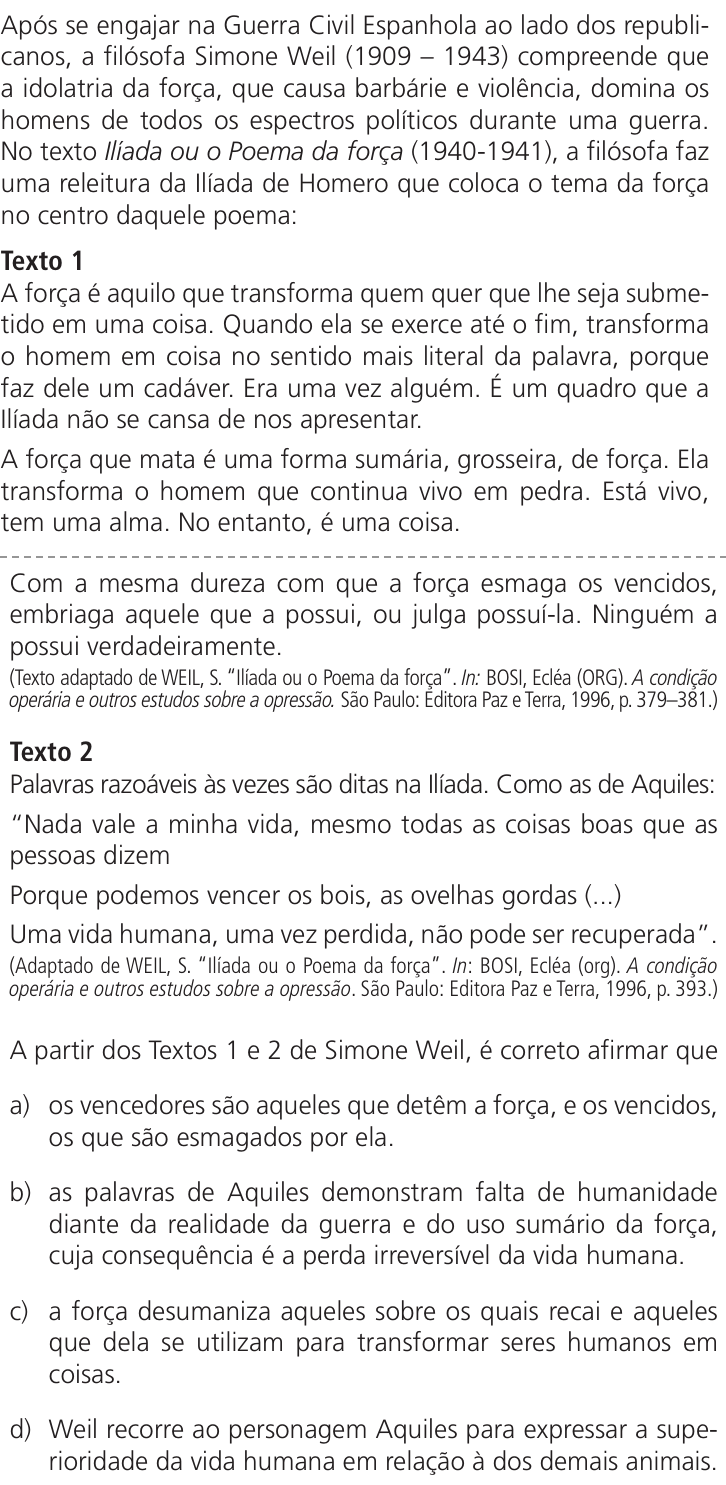
A questão

Questão 71

Respostas das IAs

GPT-6 Astra

C

Respondeu

levou 11 s

Como pensou
**Clarifying response options** I need to craft a concise response about dual dehumanization and the illusion of winners. I'll summarize my thoughts in 2-3 paragraphs while keeping it to a maximum of 200 words. The text contains intriguing phrases like "A força que mata ... Ela transforma ...", and I need to ensure accuracy in context. I'll address the main points: identifying the correct option as C, and providing a brief explanation with alternative distractors without duplicating irrelevant content. I think starting with "A alternativa correta é a C..." will set the tone. Let’s keep it to about 150 words to maintain clarity.

A alternativa C é correta porque, para Simone Weil, a força desumaniza tanto quem é submetido a ela quanto quem a exerce.

No Texto 1, a força transforma a vítima em “coisa”: pode matá-la, tornando-a um cadáver, ou anular sua autonomia mesmo enquanto permanece viva. Já aquele que exerce a força é “embriagado” por ela e pela ilusão de dominá-la, pois “ninguém a possui verdadeiramente”.

No Texto 2, as palavras de Aquiles ressaltam o valor insubstituível da vida humana, cuja perda é irreversível.

As demais alternativas estão incorretas:

  • A: afirma que os vencedores detêm a força, ignorando a afirmação de que ninguém a possui verdadeiramente.
  • B: Aquiles demonstra humanidade ao valorizar a vida, não falta dela.
  • D: a comparação destaca que bens e riquezas não compensam a perda da vida, e não uma superioridade humana sobre outros animais.

Resposta: C

GPT-6.1 Sol

C

Respondeu

levou 18 s

Como pensou

A alternativa correta é a C. No Texto 1, a força desumaniza tanto quem a sofre quanto quem a exerce: transforma os submetidos em “coisas”, pela morte ou pela sujeição, e “embriaga” aqueles que julgam possuí-la. Portanto, seus efeitos atingem os dois lados da relação de violência.

No Texto 2, as palavras de Aquiles valorizam a vida humana e ressaltam que sua perda é irreversível, contrapondo-se à lógica destrutiva da guerra.

As demais alternativas estão incorretas:

  • A: afirma que os vencedores detêm a força, mas Weil declara que ninguém a possui verdadeiramente.
  • B: inverte o sentido das palavras de Aquiles, que expressam humanidade, não sua ausência.
  • D: o contraste destaca a impossibilidade de recuperar uma vida perdida, e não uma hierarquia entre humanos e outros animais.

Resposta: C

GPT-6 Luna

C

Respondeu

levou 6 s

Como pensou
**Considering human-animal comparison** I’m reflecting on the idea of comparing animals to humans and the concept of superiority in life. It seems like there’s a quote that contrasts wealth in humans and animals, but it doesn’t necessarily indicate superiority over animals. I need to delve deeper into this explanation and find the exact line to clarify my thoughts further. It’s interesting to explore how we often misinterpret these comparisons!

Simone Weil afirma que a força transforma em coisa quem a sofre: pode matar ou deixar alguém vivo, mas “em pedra”. Ela também afeta quem a exerce, que fica “embriagado” pela força, embora ninguém a possua de fato. Assim, a força desumaniza tanto suas vítimas quanto aqueles que dela se utilizam.

A fala de Aquiles no Texto 2 reforça o valor irrecuperável da vida humana, em contraste com bens e animais que podem ser conquistados.

Resposta: C

Claude Fable 5.1

C

Respondeu

levou 9 s

Como pensou

A questão exige relacionar os dois textos de Simone Weil sobre a força na Ilíada.

No Texto 1, Weil afirma que a força transforma em coisa quem lhe é submetido (chegando a fazer dele um cadáver ou uma "pedra" ainda viva), mas também que ela "embriaga aquele que a possui, ou julga possuí-la. Ninguém a possui verdadeiramente". Ou seja, a força desumaniza tanto a vítima quanto quem a exerce — ninguém a domina de fato.

Analisando as alternativas:

  • a) Contradiz o texto: Weil diz que ninguém possui verdadeiramente a força; vencedores também são "embriagados" e afetados por ela.
  • b) Inverte o sentido do Texto 2: as palavras de Aquiles são apresentadas como "razoáveis", um raro momento de lucidez e humanidade, pois reconhecem o valor irrecuperável da vida humana frente aos bens materiais.
  • c) Corresponde exatamente à tese de Weil: a força desumaniza tanto aqueles sobre os quais recai (transformados em coisas) quanto os que dela se utilizam (embriagados, iludidos de possuí-la).
  • d) A fala de Aquiles compara a vida humana a bens (bois, ovelhas) para destacar sua irreversibilidade, não para defender uma hierarquia entre humanos e animais.

Resposta: C

Claude Opus 5.5

C

Respondeu

levou 8 s

Como pensou
Answer C fits best—Achilles' point isn't about human superiority over animals but about irreversibility, matching the idea that life intoxicates whoever possesses it, yet no one truly possesses it.

Raciocínio:

  • Texto 1: a força transforma quem a sofre em coisa. Na forma extrema, transforma em cadáver; na forma não letal, transforma o vivo em "pedra". Mas ela também "embriaga aquele que a possui, ou julga possuí-la", e "ninguém a possui verdadeiramente". Ou seja, a força degrada tanto os vencidos quanto os que a exercem.

  • a) Está incorreta. Weil nega justamente que alguém detenha a força de fato ("ninguém a possui verdadeiramente"). Os vencedores também ficam submetidos a ela.

  • b) Está incorreta. Weil chama as palavras de Aquiles de "razoáveis". Elas expressam lucidez e humanidade ao reconhecer o valor irrecuperável da vida, e não falta de humanidade.

  • c) Está correta. A força desumaniza quem a sofre, que vira coisa, e também quem a usa, que fica "embriagado" por ela. É a síntese do Texto 1.

  • d) Está incorreta. A comparação com bois e ovelhas não serve para afirmar uma superioridade hierárquica do homem sobre os animais. Ela destaca o caráter irreversível da perda de uma vida humana: bens podem ser recuperados, a vida não.

Resposta: C

Claude Sonnet 5.5

C

Respondeu

levou 5 s

Como pensou

Analisando cada alternativa à luz dos textos de Weil:

a) Incorreta. Weil afirma que a força esmaga os vencidos, mas também embriaga quem a possui, e que "ninguém a possui verdadeiramente". Logo, os vencedores não "detêm" a força de modo pleno.

b) Incorreta. As palavras de Aquiles, chamadas de "razoáveis", mostram o valor da vida humana, que não pode ser recuperada. Elas não revelam falta de humanidade.

c) Correta. O Texto 1 diz que a força transforma em coisa quem lhe é submetido, seja pela morte (cadáver), seja pela vida reduzida a pedra. O trecho final diz ainda que ela embriaga quem a possui ou julga possuí-la, o que também o desumaniza. Assim, a força desumaniza tanto as vítimas quanto quem a utiliza.

d) Incorreta. Aquiles compara a vida humana a bois e ovelhas para dizer que ela, uma vez perdida, não se recupera, ao contrário dos bens. O foco é a irreversibilidade da perda da vida, e Weil não pretende afirmar uma superioridade em relação aos animais.

Resposta: C

Grok 4.7

C

Respondeu

levou 3 min 24 s

Como pensou
The problem is a UNICAMP 2027 multiple-choice question about Simone Weil's texts on the Iliad and force. Weil's text "Iliad or the Poem of Force" centers on force as idolatry. Text 1 states that force transforms its victim into a thing, literally turning them into a corpse. Text 1 continues that force turns the living into stone while they remain alive and soulful. It intoxicates those who possess it, though no one truly owns it. Text 2 cites Achilles' words in the Iliad. Achilles' words in Text 2 show that human life cannot be recovered once lost. The question asks which of three affirmations about force is correct based on both texts. Option a) is incorrect. The text states that no one truly owns force, and it affects both victors and vanquished. Option d) is also wrong. Weil does not use Achilles to express the superiority of human life over animals. Option b) is incorrect. Weil calls Achilles' words "reasonable," showing that human life is irreplaceable and precious, not a lack of humanity. Option c) is correct. Text 1 states that force transforms both its victims and those who possess it into things. Option d) is correct. Achilles' words show that human life is irreplaceable, unlike oxen or sheep. Option d) is incorrect. Weil presents Achilles' words as reasonable, but the quote emphasizes the irreplaceability of one's own life rather than asserting human superiority over animals. The grammar of option c) is ambiguous. The phrase "para transformar seres humanos em coisas" likely modifies only the second group, meaning those who use force to turn humans into things are also dehumanized. This interpretation may not match Text 1, which describes separate effects: transforming the victim into a thing and intoxicating the possessor. The ambiguity is resolved. The phrase "para transformar seres humanos em coisas" modifies only the second group, so force dehumanizes both victims and perpetrators who use it to turn humans into things. The text supports this: intoxicating the possessor is a form of dehumanization, and the introduction treats force as an idol that dominates men. Option d) is correct. Achilles' words show that human life cannot be recovered once lost, unlike animals that can be won again. Weil presents this as reasonable. The quote about Achilles is meant to show moments of lucidity where the value of life is recognized, contrasting with the force. Option d) is incorrect because the quote emphasizes the irrecoverability of human life rather than asserting human superiority over animals. Option d) is correct. Weil introduces Achilles' words as examples of reasonable speech that recognize the value of life over replaceable things, including animals. The question expects a single answer, so option c) must be checked for precise accuracy. Option c) is the correct answer. It captures Weil's central thesis about force dehumanizing both its victims and those who possess it. Option d) is incorrect because the quote about Achilles serves as an example of reasonable speech rather than a direct assertion of human superiority over animals. Reconsidering option d), Weil's quote about Achilles does imply human life is superior to animal life. The text contrasts the irreplaceable value of one's own life with replaceable oxen and sheep, so option d) may actually be correct. The quote about Achilles compares human life to replaceable animals, but Weil's purpose may be the general irreversibility of human life rather than asserting superiority over all other species. The alternative incorrectly frames this as a direct expression of human superiority. The phrase "superioridade" in option d) is being checked against the original text. The quote does imply human life is superior in value to animal life. The focus is now on whether option c) accurately reflects the text without distorting it. The quote about Achilles does imply human life is superior to animal life, since he refuses to trade it for replaceable goods. Weil does indeed invoke him as an example of reasonable speech. The doubt now centers on whether the alternative's phrasing "expressar a superioridade" is too narrow or inaccurate. The question wording "A partir dos Textos 1 e 2" suggests the correct answer must synthesize both texts. Neither option explicitly references both, so the choice must be the one that can be affirmed from them. The quote may also be correct. Weil uses Achilles as an example of rare reasonable speech that values life above replaceable goods. The alternative's phrasing about human superiority could match this reading. The quote is better understood as a Homeric example of replaceable goods than as a claim of human superiority over animals. In that context, option d) is incorrect. The phrase "superioridade da vida humana em relação à dos demais animais" is being weighed as either correct or a stretch. The quote implies human life is not equivalent to replaceable possessions, so the exam may accept this reading. The question asks which statement is a correct affirmation. Option c) is the intended answer because Weil's text centers on force dehumanizing both victims and perpetrators. Option d) is incorrect because the quote about Achilles emphasizes the irreplaceability of human life rather than asserting human superiority over animals. The quote explicitly contrasts recoverable animal booty with irreplaceable human life, which supports option d). The earlier rejection of that alternative is being reconsidered. The quote explicitly states that nothing is worth Achilles' life, which supports option d). This appears to be a vestibular question testing careful reading. The goal is to identify the single correct answer among the four alternatives. The alternative b) is incorrect because the text does not describe Achilles' words as a lack of humanity in the face of war. The alternative d) is also being reconsidered, since Text 2 introduces Achilles' quote as an example of rare reasonable speech rather than a direct assertion of human superiority over animals. The quote about Achilles is better understood as incidental to the main point. The animals are merely examples of replaceable goods, not evidence of human superiority over other species. This makes option d) an incorrect reduction of Weil's argument. The phrasing "em relação à dos demais animais" is too narrow. The quote emphasizes the absolute value of human life, not specifically its superiority over other species. Option c) is the correct synthesis of Text 1, and option d) is rejected as an imprecise reduction. The text explicitly states that force turns the living man into stone, which supports option c). The word "embriaga" means intoxicates rather than dehumanizes, but Weil does describe the possessor as being made into a thing. The text distinguishes two effects of force. It turns the living man into stone, making him a thing, but intoxicates the possessor separately. The question is whether intoxication counts as dehumanization. Intoxication is a form of dehumanization. The alternative c) is correct. Option d) is being checked against the precise quote. The quote explicitly states that nothing is worth Achilles' life, even all the good things people say. The reason given is that we can win the oxen and fat sheep, but a human life cannot be recovered once lost. This supports option d). Option a) is incorrect because it distorts the text by ignoring that no one truly owns force and by omitting the possessor's intoxication. Option d) is rejected as an overinterpretation. The quote about Achilles emphasizes the irreplaceability of human life, not a direct assertion of superiority over animals. The animals are merely incidental examples of replaceable goods, so framing the text around speciesism is incorrect. Option c) is being reconsidered. The text says force intoxicates the possessor, not that it dehumanizes them. "Desumaniza" refers to turning the victim into a thing. This suggests option c) may be inaccurate. Intoxication is understood as a form of dehumanization. The answer c) is being reconsidered as the intended choice, though its phrasing may be ambiguous. The alternative c) is grammatically sound and the intended answer. The text shows force intoxicates the possessor and turns the living man into stone, so both victims and users are dehumanized. The syntax of option c) is ambiguous. The phrase "para transformar seres humanos em coisas" could modify the verb "desumaniza" or be restricted to the second group of people, leaving the meaning unclear. The phrase "para transformar" in option c) is ambiguous. It could modify the verb "desumaniza" or be restricted to the second group of people, leaving the meaning unclear. The phrase "para transformar" is best read as modifying the verb "desumaniza". The relative clause "que dela se utilizam" is understood as a common construction meaning "make use of it to transform." This reading is more natural than linking the purpose to the second group alone. The answer is C. The quote is from Achilles' speech in the Iliad, Book 9. The quote contrasts recoverable animal booty with irreplaceable human life. The phrasing "superioridade da vida humana em relação à dos demais animais" is imprecise because the animals are loot, not living beings in direct comparison. The question designers likely reject option d) because the quote is not about animal life, but about material compensation versus human life. The possessor's intoxication causes arrogance, violence, and loss of perspective. This is a form of moral dehumanization. The alternative correctly captures this idea. Option d) is rejected because Weil cites Achilles to illustrate reasonable words, not to assert human superiority over animals. The comparison in the quote is incidental, so affirming that purpose would be an incorrect inference. The text explicitly states that force turns the living man into stone, making him a thing. This dehumanization applies to those who are vanquished, whether dead or alive. The intoxication of the possessor is separate; it does not explicitly describe turning them into a thing. This distinction supports option c).

A questão exige a identificação da afirmação compatível com a releitura que Simone Weil faz da força na Ilíada.

O Texto 1 define a força como aquilo que converte em coisa tanto quem lhe é submetido (cadáver ou “pedra” viva) quanto quem julga possuí-la (é embriagado por ela com a mesma dureza, e ninguém a possui de fato). Essa dupla desumanização é exatamente o que enuncia a alternativa c.

As demais alternativas distorcem os textos:

  • a) ignora a afirmação explícita de que ninguém possui verdadeiramente a força;
  • b) contradiz o próprio enunciado, que apresenta as palavras de Aquiles como “razoáveis”, não como falta de humanidade;
  • d) reduz o sentido da citação (a irrecuperabilidade da vida humana diante de bens substituíveis) a uma comparação de superioridade entre vidas humanas e animais, o que o trecho não sustenta.

Resposta: C

DeepSeek V4.1 Flash

C

Respondeu

levou 10 s

Como pensou
We need answer question. Need infer from image? User provided text garbled? It seems image OCR generated nonsense? We need solve multiple choice. We need parse. The image likely contains question? The text is a pasted garbled OCR with Italian? Wait text is Portuguese-ish but nonsensical maybe encoded? Need identify actual question? It says "Após se engajar na Guerra Civil Espanhola ao lado dos republicanos, a filósofa Simone Weil (1909 – 1943) compreende que a idolatria da força, que causa barbárie e violência, domina os homens de todos os espectros políticos durante uma guerra. No texto 'Ilíada ou o Poema da força' (1940-1941), a filósofa faz uma releitura da Ilíada de Homero que coloca o tema da força no centro daquela poema:" Then Texto 1 and Texto 2 are garbled? Wait maybe the text is not garbled but Portuguese with words replaced? Actually reading first paragraph: "Após se engajar na Guerra Civil Espanhola ao lado dos republicanos, a filósofa Simone Weil (1909 – 1943) compreende que a idolatria da força, que causa barbárie e violência, domina os homens de todos os espectros políticos durante uma guerra. No texto 'Ilíada ou o Poema da força' (1940-1941), a filósofa faz uma releitura da Ilíada de Homero que coloca o tema da força no centro daquela poema:" Wait OCR seems okay first paragraph? But then Texto 1 is garbled? Let's inspect: It might be an optical illusion? The text: "Texto 1 A força é aquilo que transforma quem quer que lhe seja submetido em uma coisa. Quando ela se exerce até o fim, transforma o homem em coisa no sentido mais literal da palavra, porque faz dele um cadáver. Era uma vez alguém. É um quadro que a Ilíada não se cansa de nos apresentar. A força que mata é uma forma sumária, grosseira, de força. Ela transforma o homem que continua vivo em pedra. Está vivo, tem uma alma. No entanto, é uma coisa." Wait the garbled text is actually readable? Let's read original user text carefully: "Texto 1 A força é aquilo que transforma quem quer que lhe seja subme- tido em uma coisa. Quando ela se exerce até o fim, transforma o homem em coisa no sentido mais literal da palavra, porque faz dele um cadáver. Era uma vez alguém. É um quadro que a Ilíada não se cansa de nos apresentar. A força que mata é uma forma sumária, grosseira, de força. Ela transforma o homem que continua vivo em pedra. Está vivo, tem uma alma. No entanto, é uma coisa." But the user text has weird words: "A força é aquilo que transforma quem quer que lhe seja subme- tido em uma coisa." Wait user text: "A força é aquilo que transforma quem quer que lhe seja subme- tido em uma coisa." Actually in the provided: "A força é aquilo que transforma quem quer que lhe seja subme- tido em uma coisa. Quando ela se exerce até o fim, transforma o homem em coisa no sentido mais literal da palavra, porque faz dele um cadáver. Era uma vez alguém. É um quadro que a Ilíada não se cansa de nos apresentar." Wait my initial reading of user text: "A força é aquilo que transforma quem quer que lhe seja subme- tido em uma coisa. Quando ela se exerce até o fim, transforma o homem em coisa no sentido mais literal da palavra, porque faz dele um cadáver. Era uma vez alguém. É um quadro que a Ilíada não se cansa de nos apresentar." But user text says: "A força é aquilo que transforma quem quer que lhe seja subme- tido em uma coisa. Quando ela se exerce até o fim, transforma o homem em coisa no sentido mais literal da palavra, porque faz dele um cadáver. Era uma vez alguém. É um quadro que a Ilíada não se cansa de nos apresentar." Wait I'm hallucinating? Let's look at actual user text: "Texto 1 A força é aquilo que transforma quem quer que lhe seja subme- tido em uma coisa. Quando ela se exerce até o fim, transforma o homem em coisa no sentido mais literal da palavra, porque faz dele um cadáver. Era uma vez alguém. É um quadro que a Ilíada não se cansa de nos apresentar. A força que mata é uma forma sumária, grosseira, de força. Ela transforma o homem que continua vivo em pedra. Está vivo, tem uma alma. No entanto, é uma coisa." Actually the user text as pasted: "Texto 1 A força é aquilo que transforma quem quer que lhe seja subme- tido em uma coisa. Quando ela se exerce até o fim, transforma o homem em coisa no sentido mais literal da palavra, porque faz dele um cadáver. Era uma vez alguém. É um quadro que a Ilíada não se cansa de nos apresentar. A força que mata é uma forma sumária, grosseira, de força. Ela transforma o homem que continua vivo em pedra. Está vivo, tem uma alma. No entanto, é uma coisa." Wait no, the user text actually is: "Texto 1 A força é aquilo que transforma quem quer que lhe seja subme- tido em uma coisa. Quando ela se exerce até o fim, transforma o homem em coisa no sentido mais literal da palavra, porque faz dele um cadáver. Era uma vez alguém. É um quadro que a Ilíada não se cansa de nos apresentar. A força que mata é uma forma sumária, grosseira, de força. Ela transforma o homem que continua vivo em pedra. Está vivo, tem uma alma. No entanto, é uma coisa." I keep repeating? Let's scroll up to user message: "Após se engajar na Guerra Civil Espanhola ao lado dos republicanos, a filósofa Simone Weil (1909 – 1943) compreende que a idolatria da força, que causa barbárie e violência, domina os homens de todos os espectros políticos durante uma guerra. No texto 'Ilíada ou o Poema da força' (1940-1941), a filósofa faz uma releitura da Ilíada de Homero que coloca o tema da força no centro daquela poema: Texto 1 A força é aquilo que transforma quem quer que lhe seja submetido em uma coisa. Quando ela se exerce até o fim, transforma o homem em coisa no sentido mais literal da palavra, porque faz dele um cadáver. Era uma vez alguém. É um quadro que a Ilíada não se cansa de nos apresentar. A força que mata é uma forma sumária, grosseira, de força. Ela transforma o homem que continua vivo em pedra. Está vivo, tem uma alma. No entanto, é uma coisa. (Texto adaptado de WEIL, S. 'Ilíada ou o Poema da força'. In: BOSI, Ecléa (org.). A condição operária e outros estudos sobre a opressão. São Paulo: Editora Paz e Terra, 1996, p. 393-394.) Texto 2 Palavras razoáveis às vezes são ditas na Ilíada. Como as de Aquiles: 'Nada vale a minha vida, mesmo todas as coisas boas que as pessoas dizem ...' Porque podemos vencê-los, os bois, as ovelhas gordas (...) Uma vida humana, uma vez perdida, não pode ser recuperada'. (Adaptado de WEIL, S. 'Ilíada ou o Poema da força'. In: BOSI, Ecléa (org.). A condição operária e outros estudos sobre a opressão. São Paulo: Editora Paz e Terra, 1996, p. 393.) A partir dos Textos 1 e 2 de Simone Weil, é correto afirmar que a) os vencedores são aqueles que detêm a força, e os vencedores os que são esmagados por ela. b) as palavras de Aquiles demonstram falta de humanidade diante da realidade da guerra e do uso sumário da força, cuja consequência é a perda irreversível da vida humana. c) a força desumaniza aquele sobre os quais recai e aquele que dela se utilizam para transformar seres humanos em coisas. d) Weil recorre ao personagem Aquiles para expressar a superioridade da vida humana em relação à dos demais animais." Wait this is actual text? Let's compare with user text. The user text actually says: "Texto 2 Palavras razoáveis às vezes são ditas na Ilíada. Como as de Aquiles: “Nada vale a minha vida, mesmo todas as coisas boas que as pessoas dizem (...) Porque podemos vencê-los, os bois, as ovelhas gordas (...) Uma vida humana, uma vez perdida, não pode ser recuperada”. (Adaptado de WEIL, S. “Ilíada ou o Poema da força”. In: BOSI, Ecléa (org.). A condição operária e outros estudos sobre a opressão. São Paulo: Editora Paz e Terra, 1996, p. 393.)" Yes, the user text is not garbled; it's just line-broken and maybe some words appear weird? Let me re-read user message: It included: "Texto 2 Palavras razoáveis às vezes são ditas na Ilíada. Como as de Aquiles: “Nada vale a minha vida, mesmo todas as coisas boas que as pessoas dizem (...) Porque podemos vencê-los, os bois, as ovelhas gordas (...) Uma vida humana, uma vez perdida, não pode ser recuperada”. (Adaptado de WEIL, S. “Ilíada ou o Poema da força”. In: BOSI, Ecléa (org.). A condição operária e outros estudos sobre a opressão. São Paulo: Editora Paz e Terra, 1996, p. 393.)" Actually the user message's Texto 2 in provided is: "Texto 2 Palavras razoáveis às vezes são ditas na Ilíada. Como as de Aquiles: “Nada vale a minha vida, mesmo todas as coisas boas que as pessoas dizem (...) Porque podemos vencê-los, os bois, as ovelhas gordas (...) Uma vida humana, uma vez perdida, não pode ser recuperada”. (Adaptado de WEIL, S. “Ilíada ou o Poema da força”. In: BOSI, Ecléa (org.). A condição operária e outros estudos sobre a opressão. São Paulo: Editora Paz e Terra, 1996, p. 393.)" Yes. So question is multiple choice a-d. We need choose correct. Let's analyze. Text 1: force transforms anyone subjected to it into a thing. When exercised to the end, transforms man into a thing literally, corpse. Force that kills is summary, gross. It transforms living man into stone. Alive, has soul, but is a thing. Text 2: Reasonable words sometimes said in Iliad. Like Achilles: "Nothing is worth my life, not all the good things people say... Because we can conquer them, the cattle, the fat sheep... A human life, once lost, cannot be recovered." Question: From Texts 1 and 2 of Simone Weil, it is correct to affirm that: a) the victors are those who hold force, and the vanquished are those crushed by it. (Actually maybe "vencedores" and "vencidos"? User text: "os vencedores são aqueles que detêm a força, e os vencedores os que são esmagados por ela." Wait likely "os vencedores são aqueles que detêm a força, e os vencidos os que são esmagados por ela." The OCR says "vencedores" twice? Let's check user: "a) os vencedores são aqueles que detêm a força, e os vencedores os que são esmagados por ela." It says "vencedores os que são esmagados" maybe typo for vencidos. If so, statement is that victors are those who hold force, and defeated are those crushed by it. But Simone Weil's point: force makes both victim and wielder into things? Text 1 focuses on those subjected to force. Text 2 Achilles says life not worth goods, human life irrecoverable. So a) maybe too simplistic, not supported? Let's see options. b) as palavras de Aquiles demonstram falta de humanidade diante da realidade da guerra e do uso sumário da força, cuja consequência é a perda irreversível da vida humana. -> Achilles' words demonstrate lack of humanity? Actually Achilles' words express value of human life, not lack of humanity. So b seems wrong. c) a força desumaniza aquele sobre os quais recai e aquele que dela se utilizam para transformar seres humanos em coisas. -> Force dehumanizes both those on whom it falls and those who use it to transform human beings into things. This matches Simone Weil: force transforms whoever is subjected to it into a thing, and also the wielder? Text 1 doesn't explicitly mention wielder, but Weil's essay says force turns both victim and wielder into things? The intro says "idolatria da força ... domina os homens de todos os espectros políticos". Text 1: "A força é aquilo que transforma quem quer que lhe seja submetido em uma coisa." It may imply both. Option c likely correct. d) Weil recorre ao personagem Aquiles para expressar a superioridade da vida humana em relação à dos demais animais. -> Achilles says human life once lost cannot be recovered, and compares to cattle/sheep? Actually "Porque podemos vencê-los, os bois, as ovelhas gordas" maybe he says he can steal cattle and sheep, but human life cannot be recovered. This contrasts human life with animals? It expresses the irreplaceable value of human life, not superiority? Could be d? Let's parse Text 2: "Nada vale a minha vida, mesmo todas as coisas boas que as pessoas dizem ... Porque podemos vencê-los, os bois, as ovelhas gordas (...) Uma vida humana, uma vez perdida, não pode ser recuperada." This means: Nothing is worth my life, not all the good things people say... Because we can win them, cattle, fat sheep... A human life, once lost, cannot be recovered. It may be saying that human life is more valuable than material goods (cattle, sheep) because it cannot be recovered. But option d says "superioridade da vida humana em relação à dos demais animais" (superiority of human life in relation to other animals). That's different: not superiority over animals, but irreplaceability of human life compared to goods. So d likely wrong. c is correct. Let's ensure no nuance: Option c says "a força desumaniza aquele sobre os quais recai e aquele que dela se utilizam para transformar seres humanos em coisas." Actually grammar: "aquele sobre os quais" should be "aqueles sobre os quais". It means force dehumanizes both those on whom it falls and those who use it. This is exactly Simone Weil's thesis: force turns anyone subjected to it into a thing, and also those who wield it? In the essay, she says "A força é o que transforma quem quer que lhe seja submetido em uma coisa" and also "a força é também o que transforma quem a utiliza em coisa"? Let me recall: Simone Weil's "The Iliad, or the Poem of Force" says: "Force is what makes anyone who is subjected to it into a thing." She also says: "The strong are not, in fact, strong; they are only the instruments of force." And "the soul of the warrior is not his own." The essay emphasizes that force turns both victor and vanquished into things. Option c states that. Thus answer C. Need produce final in Portuguese, explain reasoning, end with "Resposta: C". Ensure format exactly. We need maybe mention Texto 1: força transforma em coisa; Texto 2: Aquiles reconhece valor insubstituível da vida humana, mas não significa falta de humanidade nem superioridade animal. Therefore c. Let's compose concise explanation.
A tese central de Simone Weil é que a força não afeta apenas quem a sofre: ela coisifica tanto o sujeito submetido a ela quanto aquele que a exerce. O Texto 1 afirma que a força transforma quem lhe é submetido em “coisa”, podendo chegar ao extremo de transformar o ser humano em cadáver. O Texto 2, com as palavras de Aquiles, reforça o caráter irreversível da perda da vida humana, mostrando que a guerra e o uso da força reduzem o humano a algo descartável.

Assim, a alternativa correta é a que reconhece que a força desumaniza tanto a vítima quanto quem a utiliza para transformar seres humanos em coisas.

Resposta: C

Gemini 3.8 Flash

C

Respondeu

levou 14 s

Como pensou
**Analyzing the Text** I am currently processing the introductory text from the UNICAMP exam question. My immediate focus is on understanding Simone Weil's perspective on her involvement in the Spanish Civil War and her subsequent realization regarding the dangers of idolatry. **Examining Weil's Philosophy** I'm dissecting Simone Weil's perspective from *The Iliad, or the Poem of Force*. My current focus is on her assertion that brute force transforms all involved into mere objects, a concept central to her analysis of power dynamics and the tragic nature of war. **Analyzing Weil's Quotations** I'm now focusing on a specific quotation from Achilles within the *Iliad*, as presented in Text 2. I'm examining how this passage, in conjunction with the broader context of Weil's philosophy from Text 1, illuminates her views on the irreversible nature of life loss and the limitations of human understanding in the face of overwhelming force. **Evaluating Textual Arguments** I am now analyzing the provided multiple-choice options concerning Weil's use of Achilles and her ideas on force. I am comparing the statements to her philosophical points previously identified, focusing on whether they accurately reflect her critiques of power and the concept of brute force. **Evaluating Weil's Critiques** I am now cross-referencing the multiple-choice options with Weil's concept of force. I am verifying how each option aligns with her assertion that force objectifies both the wielder and the victim, transforming individuals into mere things or instruments. Option 'c' appears to encapsulate this accurately.

Com base na leitura e análise dos textos de Simone Weil:

  • a) Incorreta: O Texto 1 afirma explicitamente que "Ninguém a possui verdadeiramente", desconstruindo a ideia de que os vencedores sejam os verdadeiros detentores da força, já que eles apenas se embriagam por uma ilusão de posse.
  • b) Incorreta: O Texto 2 qualifica as palavras de Aquiles como "razoáveis", pois ele reconhece o valor incomparável e irreversível da vida humana ("Uma vida humana, uma vez perdida, não pode ser recuperada"), o que demonstra lucidez e humanidade, e não "falta de humanidade".
  • c) Correta: Para Simone Weil, a força é um mecanismo que reifica (transforma em coisa) tanto quem é subjugado por ela (a vítima, convertida em pedra ou cadáver) quanto quem a emprega (o agressor, que é embriagado e desumanizado pela ilusão do poder).
  • d) Incorreta: A menção a bois e ovelhas diz respeito a bens materiais e saques de guerra que podem ser recuperados ou repostos, em contraste com a vida humana que é insubstituível; o objetivo do trecho não é discutir uma superioridade biológica do ser humano sobre os outros animais.

Resposta: C