Respondeu
levou 7 s
Como pensou
**Clarifying auxin and growth**
I need to read an image discussing auxin in shaded versus lit conditions and how it affects photo growth. I want to explain that elongation happens, not just at the apical meristem, and auxin synthesized at the apex can cause growth. I could mention how roots respond to auxin too, but that might not be necessary. I’ll make sure the arrows are correctly placed. My aim is to keep the answer clear, with a focus on the light and growth patterns. I have enough information.
A alternativa correta é C.
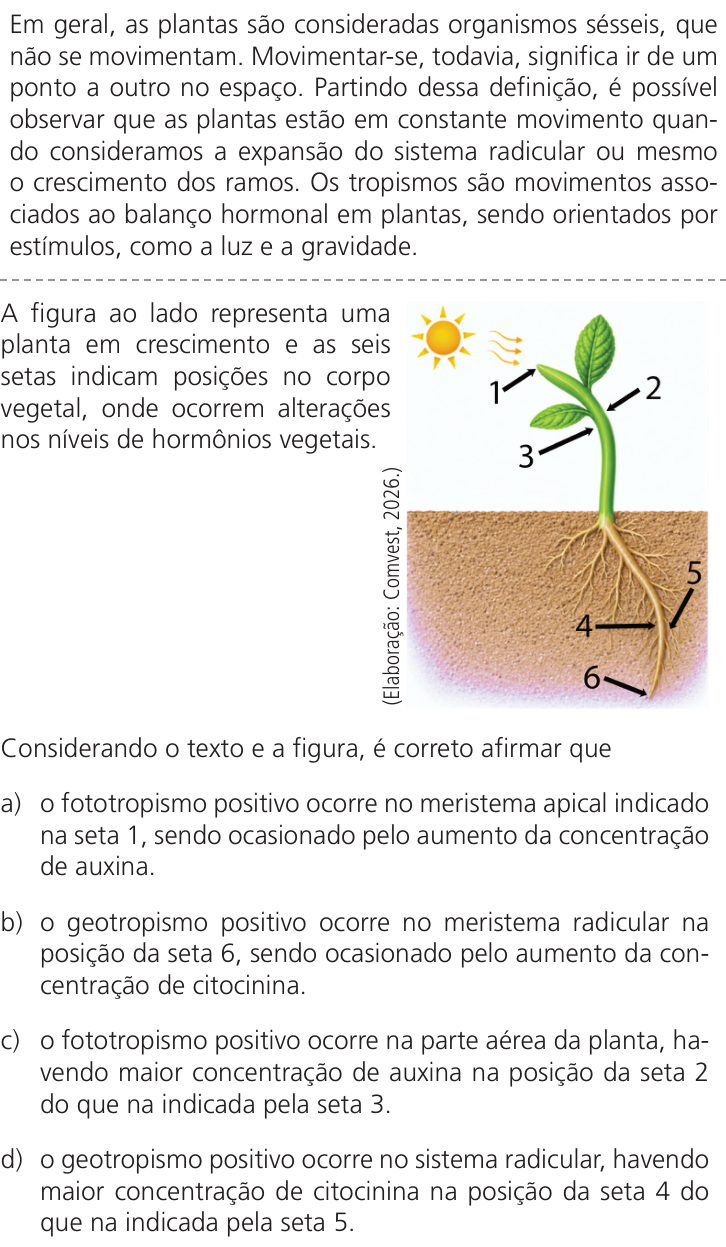
No fototropismo positivo, o caule cresce em direção à luz. A iluminação lateral provoca maior concentração de auxina no lado sombreado, indicado pela seta 2, do que no lado iluminado, indicado pela seta 3. No caule, a auxina estimula o alongamento celular; assim, o lado sombreado se alonga mais, curvando a planta em direção à fonte luminosa.
A alternativa A está incorreta porque a curvatura ocorre na região de alongamento, abaixo do meristema apical, e depende da distribuição desigual de auxina. As alternativas B e D estão incorretas porque o geotropismo radicular está associado principalmente à redistribuição de auxina, não de citocinina.
Resposta: C
Respondeu
levou 14 s
Como pensou
**Analyzing plant hormones**
I think I could mention that auxin is produced in the apex, but elongation isn't the main response area. There’s some confusion about the auxin production location versus the elongation region where curvature happens. I see that option B and D attribute root gravitropic response to cytokinins, but classical mechanisms actually involve auxin redistribution. Overall, I'm processing these points for clarity!
A luz incide pela esquerda, e a auxina se acumula no lado menos iluminado do caule, indicado pela seta 2. No caule, esse hormônio estimula o alongamento celular. Assim, esse lado cresce mais que o lado iluminado, indicado pela seta 3, fazendo a parte aérea se curvar em direção à luz — fototropismo positivo.
- A está incorreta: a curvatura ocorre pelo crescimento diferencial na região de alongamento do caule, e não no meristema apical.
- B e D estão incorretas: o mecanismo clássico do gravitropismo das raízes envolve a redistribuição de auxina, não de citocinina.
Portanto, a concentração de auxina é maior na posição 2 do que na posição 3, como afirma a alternativa C.
Resposta: C
Respondeu
levou 8 s
Como pensou
**Explaining phototropism and auxin**
I need to explain phototropism in Portuguese. I'm inspecting how auxin distributes in the plant, particularly its effect on shoot bending toward light — a positive response due to auxin accumulating on the shaded side, stimulating elongation. I should clarify the labels too. Label 2 likely points to the right side, while label 3 might indicate the direction the shoot curves. I also want to identify the mechanisms behind these responses and consider any alternatives in the explanations given.**Examining auxin and tropism**
I’m analyzing auxin distribution in the plant. With light coming from the left, auxin should accumulate on the right side of the shoot, promoting growth towards the light. So, arrow 2 is likely on the right. In contrast, I must clarify that auxin in roots inhibits elongation, causing a downward bend. It looks like there’s a confusion in labeling hormones since I pointed out positions for cytokinin incorrectly. I need to finish the explanation accurately regarding these hormone roles in tropism.
No fototropismo positivo, o caule cresce em direção à luz. A luz incide pela esquerda, então a auxina se acumula mais no lado sombreado do caule, indicado pela seta 2, do que no lado indicado pela seta 3. Nas partes aéreas, essa maior concentração de auxina estimula o alongamento celular e causa a curvatura em direção à luz.
As demais alternativas atribuem o movimento ao meristema apical ou à citocinina, em vez de relacioná-lo à distribuição desigual de auxina.
Resposta: C
Respondeu
levou 13 s
Como pensou
Looking at the figure, the plant bends toward the sun, with arrow 2 marking the shaded side of the stem and arrow 3 the lit side. Since auxin accumulates on the shaded side causing greater elongation there and bending toward light, option c (more auxin at position 2 than 3) looks correct. Now I need to check what option a claims about where phototropism occurs.
Option a attributes bending to increased auxin at the apical meristem, but auxin is produced there while the actual bending happens in the elongation zone due to differential distribution, not an overall increase—so that's not right. Option b wrongly credits positive root geotropism to cytokinin instead of auxin, and option d also incorrectly names cytokinin when it should be auxin, since higher auxin on the lower root side inhibits growth there and causes downward curving. That confirms c as the answer.
Análise da figura e do texto
O texto fala de tropismos como movimentos orientados por estímulos (luz e gravidade), controlados pelo balanço hormonal. O hormônio central nesses movimentos é a auxina, produzida no meristema apical do caule e distribuída de modo desigual pelo corpo vegetal em resposta aos estímulos.
Na figura, o Sol está no canto superior esquerdo e a parte aérea da planta se curva em direção a ele (fototropismo positivo). As setas 2 e 3 marcam os dois lados do caule na região de alongamento: a seta 2 está no lado oposto à luz (lado sombreado) e a seta 3 no lado iluminado.
Mecanismo do fototropismo positivo: a luz unilateral faz a auxina migrar para o lado sombreado do caule. Ali, em maior concentração, ela estimula o alongamento celular; o lado sombreado cresce mais que o lado iluminado, e o caule se curva em direção à luz. Logo, há mais auxina na posição 2 do que na posição 3 — exatamente o que afirma a alternativa c.
Por que as outras estão erradas:
- a) A auxina é produzida no ápice (seta 1), mas a curvatura (o fototropismo em si) ocorre na zona de alongamento, logo abaixo, e resulta da distribuição desigual do hormônio entre os lados, não de um simples "aumento" no meristema apical.
- b) O geotropismo positivo das raízes é controlado pela auxina (que, nas raízes, em maior concentração na face inferior, inibe o alongamento dessas células, curvando a raiz para baixo), não pela citocinina.
- d) Mesmo erro: atribui o geotropismo à citocinina, quando o hormônio envolvido é a auxina.
Resposta: C
Respondeu
levou 7 s
Como pensou
Looking at the figure, the sun is upper left with light coming from that side, and the stem bends toward it. Arrow 1 seems to point near the apex on the lit side, while arrow 2 points to the shaded right side where auxin is accumulating, driving the bending response.
This confirms option C: more auxin accumulates at position 2 than at position 3, since 3 is on the lit side. Option D is wrong because root geotropism involves auxin rather than cytokinin, and option A is incorrect since phototropism happens in the elongation zone, not the meristem, through auxin redistribution -- so C is the right answer.
Raciocínio:
-
Direção da luz: o sol está à esquerda da planta, e o caule se curva em direção a ele. Isso caracteriza fototropismo positivo da parte aérea.
-
Distribuição da auxina: a luz unilateral faz a auxina migrar para o lado sombreado do caule. Nesse lado as células se alongam mais, e o caule se curva para o lado iluminado.
-
Posições no caule: a seta 2 indica o lado sombreado, oposto ao sol. A seta 3 indica o lado iluminado. Portanto, há mais auxina na posição 2 do que na posição 3. Isso confirma a alternativa C.
Análise das demais alternativas:
- A: a curvatura não ocorre no meristema apical em si, mas na zona de alongamento. Também não depende de um simples "aumento" de auxina, e sim da sua redistribuição lateral para o lado sombreado.
- B: o geotropismo positivo da raiz é controlado pela redistribuição da auxina, não pela citocinina.
- D: também atribui o geotropismo radicular à citocinina, o que está incorreto. O hormônio envolvido é a auxina, que se acumula no lado inferior da raiz e inibe ali o alongamento.
Resposta: C
Respondeu
levou 5 s
Como pensou
Na figura, a luz vem da esquerda, de modo que o lado esquerdo do caule é o iluminado e o direito é o sombreado.
Caule (fototropismo positivo):
- A auxina migra para o lado sombreado, onde estimula o alongamento celular. Esse lado cresce mais e o caule se curva em direção à luz.
- A seta 1 aponta para o ápice, no lado iluminado. A seta 2 está no lado sombreado, à direita, e a seta 3 está no lado iluminado, à esquerda, na região abaixo do ápice.
- Pela posição das setas, a seta 2 fica no lado oposto à luz, com mais auxina, e a seta 3 fica no lado da luz, com menos auxina. Logo, a concentração de auxina na seta 2 é maior que na seta 3.
Raiz (geotropismo positivo):
- A raiz cresce em direção à gravidade. A auxina se acumula no lado inferior da raiz, onde inibe o alongamento. O lado superior cresce mais, e a raiz se curva para baixo.
- O texto da alternativa d fala em citocinina, que não é o hormônio envolvido nesse processo. A alternativa d está errada.
- A alternativa b também está errada, porque atribui o geotropismo à citocinina.
Alternativa a: o fototropismo ocorre na região de alongamento, abaixo do meristema apical, e não no meristema em si. Além disso, a auxina aumenta no lado sombreado, e não no lado iluminado, onde está a seta 1. A alternativa está errada.
Alternativa c: o fototropismo positivo ocorre na parte aérea, e a auxina é maior na seta 2 (lado sombreado) que na seta 3 (lado iluminado). A alternativa está correta.
Resposta: C
Respondeu
levou 1 min 11 s
Como pensou
This appears to be a biology question about plant tropisms from a UNICAMP exam.
The question involves a plant growing toward light, indicating phototropism. Arrows 1 through 6 mark positions where hormone levels change. Arrow 1 appears to point to the apical meristem at the stem tip.
Arrow 1 is on the upper left of the stem tip. Arrow 2 is on the right side of the upper stem. Arrow 3 is on the left side of the lower stem.
Arrow 3 points rightward toward the stem middle-left. The plant is bending left toward the light, so the right side is shaded and should have higher auxin levels causing more growth. This follows the standard phototropism mechanism.
Arrow 2 likely marks the shaded side and arrow 3 the illuminated side. The stem tip curves left-up. Roots grow downward via gravitropism. Auxin accumulates on the lower root side, where it suppresses elongation, causing the upper side to grow faster and bend down.
The options mention cytokinin. Option a states that positive phototropism occurs in the apical meristem indicated by arrow 1 and is caused by increased auxin concentration. This seems incorrect because phototropism results from differential auxin distribution rather than a simple increase in auxin levels.
Option b also seems incorrect. Gravitropism in roots is primarily caused by auxin redistribution, not cytokinin. Cytokinins mainly promote cell division rather than root growth direction.
Options c and d are now being evaluated. Option c suggests higher auxin concentration at arrow 2 than at arrow 3 in the aerial part. Option d suggests higher cytokinin concentration at arrow 4 than at arrow 5 in the root system. The exact side each arrow represents still needs to be determined.
Arrow 2 appears to mark the shaded side and arrow 3 the illuminated side. This would make option c correct, since auxin concentration should be higher on the shaded side than on the illuminated side.
Arrow 2 marks the shaded side with higher auxin, confirming option c. Now checking arrows 4, 5, and 6 for root tropism.
Option d is also incorrect. Gravitropism in roots depends on auxin redistribution, not cytokinin. Arrows 4 and 5 likely mark lateral root positions.
O caule apresenta fototropismo positivo (crescimento em direção à luz). A auxina se redistribui e se acumula no lado sombreado, que alonga mais e provoca a curvatura. Na figura, a luz incide pela esquerda e o caule se curva para esse lado; assim, a seta 2 indica o flanco sombreado (maior teor de auxina) e a seta 3 o flanco iluminado (menor teor). Isso torna a alternativa c correta.
As demais estão incorretas: o fototropismo não é causado por simples aumento de auxina no meristema apical (a); o geotropismo positivo da raiz depende da redistribuição de auxina, não de citocinina (b e d).
Resposta: C
Respondeu
levou 10 s
Como pensou
We need answer. Need parse image. The text appears garbled? It's Portuguese but seems like pseudo-language? Need solve multiple choice. Need infer from image. The OCR text is nonsensical but maybe due to generated "Lorem ipsum" style? We need identify correct alternative based on diagram labels 1-6? Let's inspect image carefully.
Image contains two panels:
Left text paragraph in Portuguese but word salad? It says:
"Em geral, as plantas são consideradas organismos sésseis, que não se movimentam. Movimentar-se, todavia, significa ir de um ponto a outro no espaço. Partindo dessa definição, é possível observar que as plantas estão em constante movimento quando consideramos a expansão do sistema radicular ou mesmo o crescimento dos ramos. Os tropismos são movimentos associados ao balanço hormonal em plantas, sendo orientados por estímulos, como a luz e a gravidade."
This is actually coherent. Right panel: illustration with sun and plant, labels 1-6. Caption: "(Elaboração: Comvest, 2026)."
Below question: "Considerando o texto e a figura, é correto afirmar que"
Alternatives:
a) o fototropismo positivo ocorre no meristema apical indicado na seta 1, sendo ocasionado pelo aumento da concentração de auxina.
b) o geotropismo positivo ocorre no meristema radicular na posição da seta 6, sendo ocasionado pelo aumento da concentração de citocinina.
c) o fototropismo positivo ocorre na parte aérea da planta, havendo maior concentração de auxina na posição da seta 2 do que na indicada pela seta 3.
d) o geotropismo positivo ocorre no sistema radicular, havendo maior concentração de citocinina na posição da seta 4 do que na indicada pela seta 5.
Need determine correct. Need know plant tropisms. Label 1 likely apical bud? 2 and 3 maybe stem bending? 4,5,6 roots? Let's parse figure.
Figure: sun top left shining on plant. Plant stem with leaves. Label 1 points to apical bud/top. Label 2 points to upper part of stem? Label 3 points to lower/middle stem? Label 4 points to upper root? Label 5 points to root tip? Label 6 points to lower root? Need visualize.
The text: plants move, tropisms oriented by light/gravity, associated with hormonal balance. Question asks correct statement.
Let's recall plant hormones:
- Auxin: promotes cell elongation, involved in phototropism and geotropism. In phototropism, auxin redistributes to shaded side (lateral transport) causing more elongation on shaded side, bending toward light. In roots, high auxin inhibits elongation; in shoots, high auxin promotes elongation.
- Cytokinin: promotes cell division, shoot initiation, delays senescence; not typically involved in tropisms (geotropism/phototropism). So alternatives mentioning cytokinin likely wrong: b and d maybe wrong because geotropism ocasionado by auxin, not cytokinin. But d says greater concentration of cytokinin in root position 4 than 5 - likely wrong.
- a: phototropism positive occurs in apical meristem indicated by arrow 1, caused by increased auxin concentration. But phototropism is bending response; if arrow 1 is apical bud, auxin is produced there? Phototropism positive is shoot growing toward light; auxin concentration higher on shaded side, not at apical meristem necessarily. The statement "ocorre no meristema apical indicado na seta 1" maybe incorrect because phototropism occurs in elongation zone, not apical meristem. Also positive phototropism is caused by auxin concentration higher on shaded side, not simply increased at apex.
- c: phototropism positive occurs in aerial part, having greater auxin concentration at position 2 than 3. If 2 is shaded side and 3 is illuminated side? Need figure. Sun from top left. Plant stem may lean toward sun? Labels 2 and 3: maybe 2 points to the left side of stem (shaded? Actually sun top left, so left side is illuminated, right side shaded). If plant is bending toward light, shaded side (right) elongates more, so auxin concentration greater on shaded side. Which side is 2? Need see. In image, sun top left, plant stem slightly curved? Labels 2 and 3 point to stem: 2 maybe on right (shaded) and 3 on left (illuminated)? Or vice versa. Let's examine.
The figure: Sun at top left. Plant stem with leaves: top leaf pair, bottom leaf pair. The stem seems straight vertical? Labels: 1 points to top bud. 2 points to right side of stem near top? 3 points to left side of stem below? Actually need zoom. The image:
- "1" with arrow points to top apical bud.
- "2" with arrow points to upper part of stem, maybe right side?
- "3" with arrow points to lower part of stem, maybe left side?
- "4" with arrow points to upper root (near soil line) maybe right side?
- "5" with arrow points to root tip?
- "6" with arrow points to lower root? Hmm.
Let's infer from alternatives.
Alternative a: seta 1 apical meristem, fototropismo positivo. Could be plausible if 1 is shoot apex.
Alternative b: seta 6 meristema radicular, geotropismo positivo, ocasionado by citocinina. But geotropism positive in roots is caused by auxin (high concentration inhibits root growth on lower side, causing root to bend downward). Cytokinin not main. So b likely wrong.
Alternative c: seta 2 vs 3, phototropism positive, greater auxin at 2 than 3. If 2 is shaded side, correct. Need determine labels.
Alternative d: seta 4 vs 5, geotropism positive, greater cytokinin at 4 than 5. Wrong hormone.
So likely c is correct, assuming 2 is shaded side. But need be sure. Let's analyze figure to identify 2 and 3 sides.
Sun is top left. Light comes from upper left. For positive phototropism, stem bends toward light, i.e., toward upper left. So the left side of stem is illuminated, right side is shaded. Auxin migrates to shaded side (right side), causing greater elongation on right side, bending stem left. Therefore auxin concentration higher on right side (shaded). If label 2 points to right side and 3 to left side, then c is correct. In figure, label 2 arrow points from right to stem? It appears "2" on right side of stem, arrow pointing left to stem. Label 3 is on left side, arrow pointing right to stem. So 2 = right side (shaded), 3 = left side (illuminated). Thus greater auxin at 2 than 3. That matches c.
What about a? "fototropismo positivo ocorre no meristema apical indicado na seta 1" – phototropism is not in apical meristem but in subapical elongation zone. Also if auxin increases at apex? Not quite. So a likely wrong.
Check b: geotropismo positivo in root meristem at seta 6? Root grows downward (positive geotropism). Auxin concentration higher on lower side of root, inhibiting elongation, so root bends downward. Cytokinin is not responsible. Wrong.
Check d: geotropismo positive in root system, greater cytokinin at 4 than 5. Wrong.
Thus answer C.
Need produce explanation in Portuguese. Must end with "Resposta: C". Ensure correct format. Let's craft concise explanation.
But need be careful: The question asks "Considerando o texto e a figura, é correto afirmar que". Let's read all alternatives:
a) o fototropismo positivo ocorre no meristema apical indicado na seta 1, sendo ocasionado pelo aumento da concentração de auxina.
b) o geotropismo positivo ocorre no meristema radicular na posição da seta 6, sendo ocasionado pelo aumento da concentração de citocinina.
c) o fototropismo positivo ocorre na parte aérea da planta, havendo maior concentração de auxina na posição da seta 2 do que na indicada pela seta 3.
d) o geotropismo positivo ocorre no sistema radicular, havendo maior concentração de citocinina na posição da seta 4 do que na indicada pela seta 5.
Yes.
Let's formulate: Fototropismo positivo é o crescimento da parte aérea em direção à luz. A auxina é redistribuída para o lado sombreado, onde promove maior alongamento celular, curvando o caule em direção à luz. Na figura, a luz vem da esquerda; o lado 2 é o lado sombreado (direito) e o lado 3 é o iluminado (esquerdo). Portanto, há mais auxina em 2 que em 3. Geotropismo é mediado principalmente por auxina, não citocinina; portanto alternativas com citocinina estão incorretas. A alternativa A erra ao localizar o fototropismo no meristema apical (a curvatura ocorre na zona de alongamento) e ao não considerar a distribuição lateral.
Answer C.
Need final in Portuguese. End with Resposta: C. Ensure no extra after.
A figura mostra uma planta iluminada pela esquerda (Sol). No fototropismo positivo, o caule cresce em direção à luz. Isso ocorre porque a auxina é redistribuída para o lado sombreado, promovendo maior alongamento celular nesse lado e curvando a parte aérea em direção à luz.
Na figura, a seta 2 aponta para o lado direito do caule, que é o lado sombreado, enquanto a seta 3 aponta para o lado esquerdo, iluminado. Portanto, há maior concentração de auxina na posição 2 do que na posição 3.
As alternativas que citam citocinina como responsável pelo geotropismo estão incorretas, pois o geotropismo é mediado principalmente pela auxina. A alternativa A também erra ao localizar o fototropismo no meristema apical, quando a curvatura ocorre principalmente na zona de alongamento.
Resposta: C
Respondeu
levou 13 s
Como pensou
**Analyzing Plant Movement**
I'm currently focused on understanding the user's request to solve a UNICAMP multiple-choice question related to tropisms. My immediate task is to analyze the provided text and any accompanying images to extract relevant information about plant phototropism and other tropisms mentioned.
**Examining Tropism Mechanisms**
I'm now delving into the specifics of phototropism. I've identified key areas of interest in the diagram: the apical region, the lit side, and the shaded side of the stem. My current focus is on understanding the significance of arrows 1, 2, and 3 in relation to hormonal distribution and growth on these different sides.
**Analyzing Auxin's Role**
I'm dissecting the options, scrutinizing the roles of auxin and cytokinin in tropisms. My analysis confirms auxin's primary involvement in both phototropism and geotropism, particularly concerning cell elongation. The provided options mention cytokinin, which seems incorrect for these specific tropistic responses.
**Confirming Auxin's Role**
I've confirmed that auxin is indeed the primary hormone driving tropisms like phototropism. My analysis of option C aligns perfectly with established scientific understanding: auxin accumulates on the shaded side, promoting differential growth and causing the stem to bend towards light.
**Confirming Auxin's Distribution**
I've thoroughly reviewed option C and confirmed its biological accuracy regarding positive phototropism and auxin concentration on the shaded side (arrow 2) versus the illuminated side (arrow 3). The other options are demonstrably incorrect based on established principles of plant hormone action.
Com base nos conhecimentos sobre os tropismos e a ação dos hormônios vegetais:
- Fototropismo positivo: É o crescimento orientado da parte aérea da planta em direção à fonte luminosa.
- Mecanismo da auxina: A luz unilateral (vinda do sol, à esquerda) provoca a migração lateral da auxina para o lado não iluminado (lado sombreado, indicado pela seta 2).
- Alongamento celular: Com maior concentração de auxina no lado sombreado (seta 2) em relação ao lado iluminado (seta 3), as células do caule da região 2 se alongam mais rapidamente do que as da região 3, provocando a curvatura do caule em direção à luz.
- As alternativas (b) e (d) estão incorretas, pois o gravitropismo (ou geotropismo) também é controlado principalmente pela redistribuição de auxinas, e não de citocininas. A alternativa (a) está incorreta porque o fototropismo não ocorre simplesmente pelo aumento de auxina no meristema apical, mas sim pelo alongamento diferencial das células do caule decorrente da assimetria na distribuição de auxina.
Portanto, a alternativa correta é a C.
Resposta: C