Como pensou
We need answer question. Need solve. Let's parse. The image contains text in Portuguese? It seems weird: "Os MOFs (Metal-Organic Frameworks, ou Estruturas Metal-Orgânicas) são materiais porosos formados por centros metálicos e ligantes orgânicos, cujas propriedades — como acidez, interação molecular e polaridade — dependem diretamente da natureza desses ligantes. O impacto dessa classe de materiais foi reconhecido com o Prêmio Nobel de Química de 2025. Os laureados mostraram que esses materiais podem ser aplicados na captação de água do ar em regiões áridas, na captura de dióxido de carbono, no armazenamento de gases tóxicos e na catálise de reações químicas. Os ligantes orgânicos que formam as estruturas de três importantes MOFs — MIL-101-SO3H (A), UiO-66 (B) e ZIF-8 (C) — estão apresentados na figura a seguir."
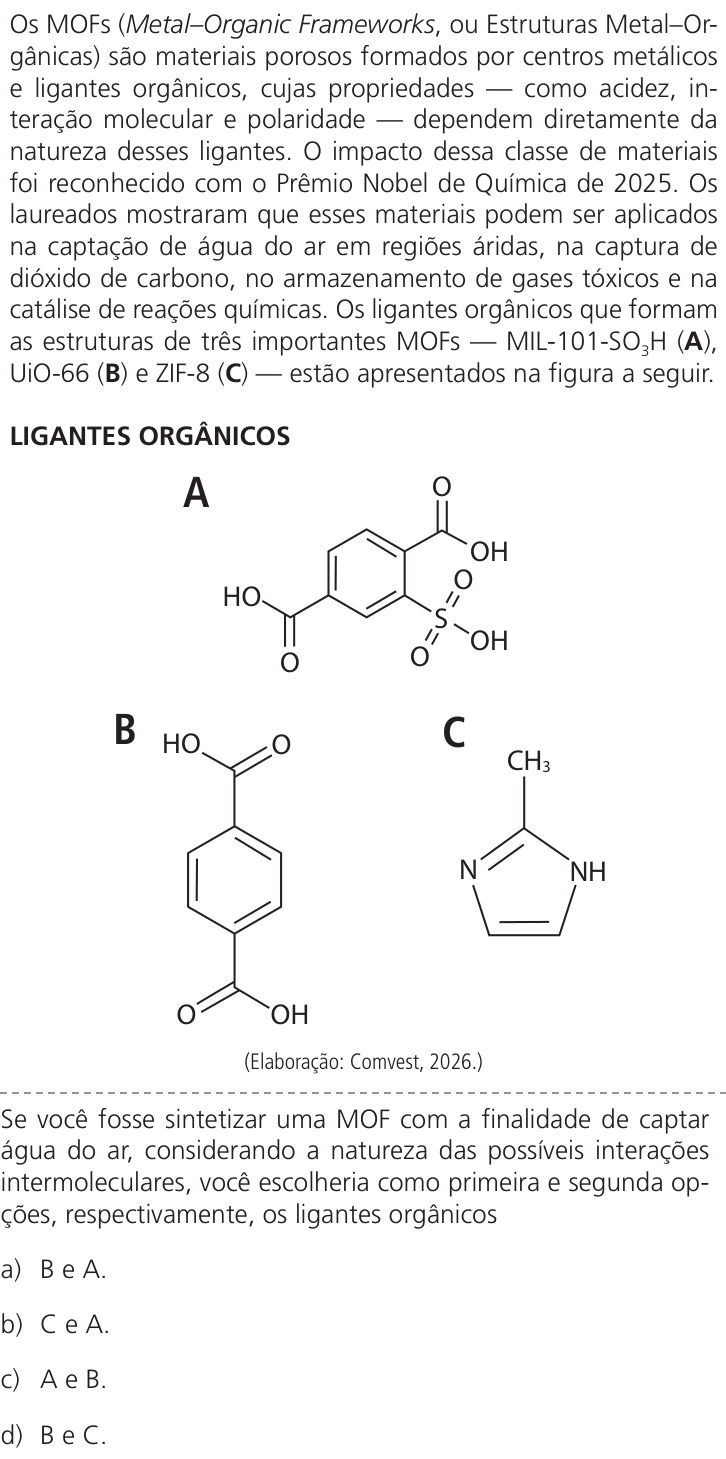
Then title LIGANTES ORGÂNICOS. Figure A, B, C chemical structures. Then text: "(Elaboração: Comvest, 2026.)" maybe.
Then question: "Se você fosse sintetizar uma MOF com a finalidade de captar água do ar, considerando a natureza das possíveis interações intermoleculares, você escolheria como primeiro e segundo opções, respectivamente, os ligantes orgânicos
a) B e A.
b) C e A.
c) A e B.
d) B e C."
Need choose based on interactions for capturing water from air. Need identify chemical structures and properties: acidez, interação molecular e polaridade. To capture water from air (water vapor), need polar/hydrophilic interactions, hydrogen bonding. Ligands: A, B, C.
Let's inspect image: A structure: likely benzene-1,4-dicarboxylic acid? Wait A has "HO" and "O" groups? Let's read. Top A: central benzene ring? It shows a benzene ring with substituents? Actually A: "HO" and "O" maybe two carboxylic acid groups? Wait let's zoom mentally. The image has A: structure maybe 1,4-benzenedicarboxylic acid? It shows "HO" on left, "O" on right? Actually text: "MIL-101-SO3H (A)" so A should be ligand with sulfonic acid? MIL-101-SO3H has sulfonated terephthalate? Wait MIL-101-SO3H is a MOF with sulfonic acid groups. The ligand likely benzene dicarboxylate with sulfonic acid? The structure A in figure maybe a benzene ring with two carboxylate groups and one sulfonic acid group? Let's inspect: It has "HO" and "O" maybe carboxylic acid. But text says MIL-101-SO3H: -SO3H group. The drawn structure maybe includes -SO3H? The image: A has central six-member ring. Top? There is "O=S=O" maybe? Let's parse.
Let's read the image text more carefully. It is garbled due to OCR? Actually it's Portuguese with many "dimetil" etc? Wait the first paragraph seems distorted? Let's read: "Os MOFs (Metal–Organic Frameworks, ou Estruturas Metal–Orgânicas) são materiais porosos formados por centros metálicos e ligantes orgânicos, cujas propriedades — como acidez, interação molecular e polaridade — dependem diretamente da natureza desses ligantes. O impacto dessa classe de materiais foi reconhecido com o Prêmio Nobel de Química de 2025. Os laureados mostraram que esses materiais podem ser aplicados na captação de água do ar em regiões áridas, na captura de dióxido de carbono, no armazenamento de gases tóxicos e na catálise de reações químicas. Os ligantes orgânicos que formam as estruturas de três importantes MOFs — MIL-101-SO3H (A), UiO-66 (B) e ZIF-8 (C) — estão apresentados na figura a seguir."
The image top text maybe "Os MOFs ...". Yes. Then "LIGANTES ORGÂNICOS" and figure. Then question below.
Need analyze structures:
A: MIL-101-SO3H ligand. It likely is benzene-1,4-dicarboxylate with a sulfonic acid group? Actually MIL-101-SO3H is synthesized from 2-sulfoterephthalic acid (or monosodium 2-sulfoterephthalate). The ligand is 2-sulfobenzene-1,4-dicarboxylic acid: benzene ring with two carboxylic acid groups and one sulfonic acid group. In figure A maybe shows three substituents: two -COOH and one -SO3H? Let's see: A has central benzene ring; top right maybe "-SO3H"? The image: A: "HO" on left attached to C=O? There is "O" double bond above? Let's decipher from image: A: it looks like a benzene ring with three substituents:
- left: HO-C(=O)-? Actually "HO" and "O" maybe carboxylic acid: -COOH represented as HO-C(=O)-.
- right: another -COOH? It shows "O" at bottom right? Wait.
Let's zoom into A: There is a central benzene ring (hexagon with alternating double bonds? Actually drawn as hexagon with a circle? Hmm). It has a substituent at position? On left: "HO" connected to "C(=O)"? It shows "HO" and below "O" maybe carboxyl group. On top: "O=S=O" and "OH"? Wait A shows "O" at top and "S" with "O" double bonds, "OH"? Maybe sulfonic acid group. Let's recall MIL-101-SO3H ligand structure: 2-sulfoterephthalic acid. It has a benzene ring with two carboxylic acids at 1,4 positions and a sulfonic acid at 2 position. In the image A, maybe it's drawn with a central ring, top substituent is sulfonic acid (-SO3H), and left/right are carboxylic acid? But the image is small. It has "HO" on left, "O" below maybe carboxyl; top has "O=S=O" and "OH" maybe; right has "O" and "OH"? Actually it might be a benzene ring with three substituents: -SO3H, -COOH, -COOH.
B: UiO-66 ligand is terephthalic acid (benzene-1,4-dicarboxylic acid). The figure B likely shows a benzene ring with two -COOH groups at para positions. It shows "HO" top left and "O" bottom right? The image B: central benzene ring, top left "HO" with "O" maybe C=O? bottom right "O" with "OH"? It's a benzene-1,4-dicarboxylic acid (terephthalic acid). So B has two carboxylic acid groups, no sulfonic acid. It is polar, can hydrogen bond, but not strongly acidic? It has H-bond donors/acceptors.
C: ZIF-8 ligand is 2-methylimidazole. The figure C shows a five-membered ring with two nitrogen atoms and a methyl group. It is an imidazole derivative. It is less polar? It has N-H? Wait 2-methylimidazole has an N-H group? Actually imidazole has two nitrogens: one pyrrole-like (N-H) and one pyridine-like (C=N). 2-methylimidazole: methyl at C2, N-H at N1, C=N at N3. In the figure C, it shows "CH3" at top, "N" and "NH" maybe? It likely shows imidazole ring with N and NH and CH3. This ligand can participate in hydrogen bonding (N-H donor, N acceptor), but is it more or less polar than carboxylic acids? For capturing water from air, we want hydrophilic MOF that strongly interacts with water. MIL-101-SO3H has sulfonic acid groups, very hydrophilic, strong acidity, excellent water adsorption. UiO-66 has carboxylic acid groups, also hydrophilic but less acidic and less water uptake than sulfonated. ZIF-8 is hydrophobic? Actually ZIF-8 is known to be hydrophobic and stable in water, used for water treatment? It has imidazole linkers, not hydrophilic? ZIF-8 is relatively hydrophobic due to methyl groups and lack of polar functional groups; water contact angle > 100°? Actually ZIF-8 is hydrophobic. So for capturing water from air, best ligand would be A (sulfonic acid) then B (carboxylic acid) perhaps. Option c) A e B. But question asks: "você escolheria como primeiro e segundo opções, respectivamente, os ligantes orgânicos" meaning first and second choices respectively. So first = A, second = B? That's option c. Need verify if A is indeed more hydrophilic than B. Yes, sulfonic acid is more acidic and polar, stronger interaction with water. B has carboxylic acid, also polar but less. C has imidazole, less polar/hydrophobic. So answer c) A e B.
Let's double-check alternatives: a) B e A; b) C e A; c) A e B; d) B e C. So c.
Need provide explanation in Portuguese. Let's formulate. We need solve and explain. Mention water capture from air requires hydrophilic material with polar groups capable of hydrogen bonding. Ligand A (MIL-101-SO3H) has sulfonic acid groups (-SO3H), very polar and acidic, strong H-bond donor/acceptor, great affinity for water. Ligand B (UiO-66) has two carboxylic acid groups (-COOH), also polar and capable of H-bonding, but less acidic/polar than sulfonic. Ligand C (ZIF-8) is 2-methylimidazole, with methyl group and imidazole ring, less polar, more hydrophobic, weaker interaction with water. Therefore first choice A, second B. Answer c.
Need final line exactly "Resposta: C" maybe uppercase? The options are lowercase letters: a) B e A. etc. Format says X is letter of alternative. Use "Resposta: C". Good.
Let's ensure no other trick. The text: "Se você fosse sintetizar uma MOF com a finalidade de captar água do ar, considerando a natureza das possíveis interações intermoleculares, você escolheria como primeiro e segundo opções, respectivamente, os ligantes orgânicos" "captar água do ar" = capture water from air. The MOF should have high affinity for water. The ligand with sulfonic acid (A) is best because it can form strong hydrogen bonds. Then carboxylic acid (B) is second. C is methylimidazole, less polar. So c.
Need maybe mention "primeiro e segundo opções, respectivamente" = first and second. A then B. Option c) A e B. Correct.
Let's produce final with concise explanation.