a) 450\text{ K}; b) 90\text{ kW}; c) Não são realistas, pois a primeira lei limita P_B\le 105\text{ kW}, inferior aos 116{,}7\text{ kW} necessários, e o aquecimento de água reduziria ainda mais a potência disponível.
Como pensou
We need answer in Portuguese, solve. Need analyze thermodynamics. Let's restate.
We have two companies.
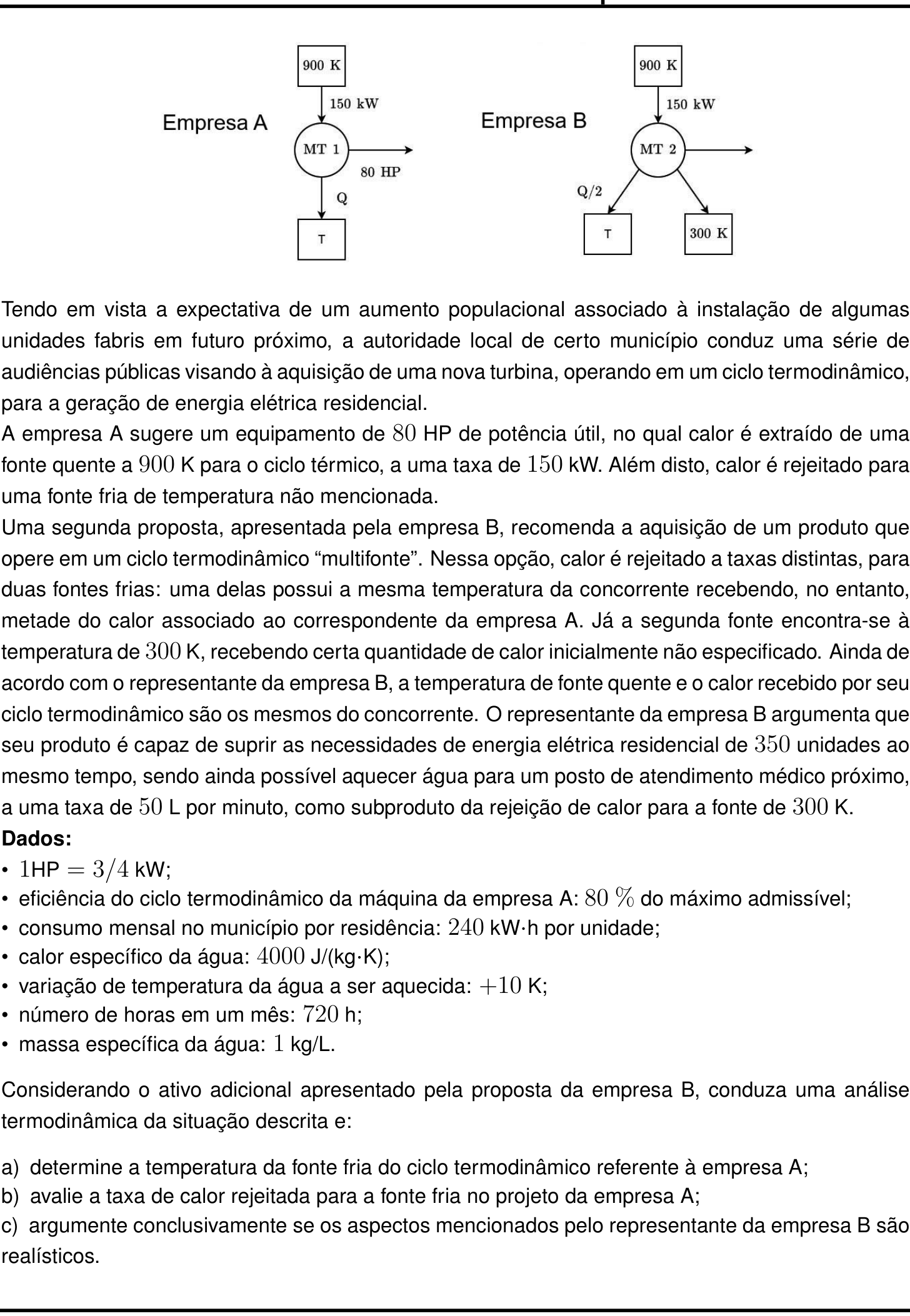
Empresa A: turbine/heat engine MT1. Heat from hot source at 900 K at rate 150 kW. Useful power output 80 HP. Rejects heat Q to cold sink at unspecified temperature T. Efficiency is 80% of maximum admissible (Carnot) between 900 K and T. Need determine T (cold source temp), and heat rejection rate.
Dados: 1 HP = 3/4 kW. So 80 HP = 80 * 0.75 = 60 kW. Useful power W_dot = 60 kW. Heat input Q_H_dot = 150 kW. Efficiency eta_A = W_dot / Q_H_dot = 60/150 = 0.4 = 40%. It says efficiency of cycle of A: 80% of maximum admissible. Maximum admissible Carnot = 1 - T_L/T_H = 1 - T/900. So eta_A = 0.8 * eta_Carnot = 0.8*(1 - T/900) = 0.4. Thus 1 - T/900 = 0.5 => T/900 = 0.5 => T = 450 K. Part a: 450 K.
Part b: heat rejected rate = Q_H_dot - W_dot = 150 - 60 = 90 kW (or Q_C = Q_H*(1-eta)=150*0.6=90 kW). Part b: 90 kW.
Empresa B: "multifonte" cycle. Same hot source temp and heat received: T_H=900 K, Q_H_dot = 150 kW same? The text: "a temperatura de fonte quente e o calor recebido por seu ciclo termodinâmico são os mesmos do concorrente." So Q_H=150 kW, T_H=900K. It rejects heat to two cold sources: one has same temperature as competitor receiving, however half of heat associated with corresponding of company A. Wait: "calor é rejeitado a taxas distintas, para duas fontes frias: uma delas possui a mesma temperatura da concorrente recebendo, no entanto, metade do calor associado ao correspondente da empresa A. Já a segunda fonte encontra-se à temperatura de 300 K, recebendo certa quantidade de calor inicialmente não especificado." Need parse.
"uma delas possui a mesma temperatura da concorrente recebendo" = one cold source has same temperature as the competitor (A) receives? The competitor receives? Actually "fonte fria da concorrente" maybe T=450K? "recebendo, no entanto, metade do calor associado ao correspondente da empresa A." So the first cold source at T=450K receives Q/2? Or "metade do calor associado ao correspondente da empresa A" = half of the heat rejected by A (90 kW)? Let's parse: It rejects heat at different rates to two cold reservoirs: one has same temperature as the competitor [A's cold source] receiving, however, half of the heat associated with the corresponding of company A. Could mean the heat rejected to the 450 K reservoir is half of A's rejected heat, i.e., Q1 = Q_A/2 = 45 kW. The second source at 300 K receives certain amount initially unspecified. Also representative B argues product can supply 350 residential units at same time, and heat water for medical post at 50 L/min as byproduct of heat rejection to 300K source. Need assess realistic? Not enough; need use thermodynamics (first/second law? entropy? Maybe determine if claimed hot water heating possible from rejection to 300K plus power output? Need compute.
Part c asks argument conclusively if aspects mentioned by representative B are realistic. Need evaluate claims: It can supply 350 units of energy AND heat water at 50 L/min to ΔT=10K as byproduct of heat rejection to 300 K, with same heat input and hot source. It maybe violates first law or second law if too low heat rejection to 300K? We need compute required heat for water heating and energy for 350 units, compare with available heat rejected to 300K and total heat rejected, and maybe check cycle efficiency/entropy.
Let's identify all data.
Empresa A efficiency 40%, W=60 kW, Q_H=150 kW, Q_C=90 kW to T=450 K.
Empresa B: Same Q_H=150 kW, T_H=900 K. Rejects Q1 to 450 K = half of A's Q_C = 45 kW? It says "metade do calor associado ao correspondente da empresa A" = half of heat associated with A's corresponding cold source = 90/2 = 45 kW. So Q2 to 300 K = Q_H - W_B - Q1. But W_B? The text doesn't explicitly state useful power of B? It says representative argues product capable of supplying needs ... maybe we can compute W_B from first law: W_B = Q_H - Q1 - Q2. Need determine Q2 maybe from claim/realism? Or maybe there is maximum efficiency? Need inspect cycle.
"produto que opere em um ciclo termodinâmico 'multifonte'. Nessa opção, calor é rejeitado a taxas distintas, para duas fontes frias...". This is a heat engine rejecting heat to two reservoirs at different temperatures. The cycle may be reversible? It says "multifonte" maybe to improve efficiency? Need analyze.
Need evaluate if representative B's claims realistic: "seu produto é capaz de suprir as necessidades de energia elétrica residencial de 350 unidades ao mesmo tempo, sendo ainda possível aquecer água para um posto de atendimento médico próximo, a uma taxa de 50 L por minuto, como subproduto da rejeição de calor para a fonte de 300 K." That is: Useful power output enough for 350 residential units; and it can heat water at 50 L/min by heat rejected to 300K source. Need check if thermodynamic constraints allow both.
We need compute energy consumption of 350 units: "consumo mensal no município por residência: 240 kW·h por unidade; número de horas em um mês: 720 h." So average power per unit = 240 kWh / 720 h = 1/3 kW? 240/720 = 1/3 kW ≈ 0.333 kW. For 350 units, total power = 350 * 1/3 = 116.666... kW = 350/3 kW ≈ 116.7 kW. But B's hot source input is 150 kW. If output power to electricity is ~? Let's compute: To supply 116.7 kW, W_B must be at least 116.7 kW. But Q_H=150 kW, so efficiency at least 116.7/150 = 0.777... = 77.8%. That's very high for 900K and cold reservoirs 450K/300K? Maximum possible efficiency for a heat engine with two sinks? If it uses only 300K sink, Carnot efficiency = 1 - 300/900 = 66.7%, so impossible. But it rejects heat to 450K and 300K; using both sinks could maybe increase efficiency? Actually rejecting heat at higher temperature reduces Carnot efficiency? Wait, for a heat engine with multiple heat rejection reservoirs, the maximum work output for given heat input and given sink temperatures might be obtained by rejecting heat reversibly at a range of temperatures? The maximum efficiency is still 1 - T0/T_H if all heat rejected at lowest temperature T0=300K? Actually if heat is rejected at 450K and 300K, reversible engine would reject all heat at the lowest available temperature? Let's recall: For a heat engine operating between hot reservoir T_H and cold reservoir T_C, maximum efficiency = 1 - T_C/T_H. If there are multiple cold reservoirs, the maximum work for fixed Q_H is when all heat is rejected to the lowest temperature? But here first cold source at 450K receives fixed 45 kW? Maybe the cycle is irreversible? Need infer.
Wait representative B says "calor é rejeitado a taxas distintas, para duas fontes frias: uma delas possui a mesma temperatura da concorrente recebendo, no entanto, metade do calor associado ao correspondente da empresa A." This might mean in B's cycle, the heat rejection to the 450 K source is fixed at 45 kW (half of A's 90 kW). The second source at 300 K receives unspecified. So W_B = 150 - 45 - Q2 = 105 - Q2 kW. To supply 116.7 kW, need Q2 negative, impossible. Therefore not realistic. But maybe "suprir as necessidades" refers to 350 units over month? Let's check: 350 units * 240 kWh/month = 84,000 kWh/month. B's engine operates at 150 kW heat input. In 720 h/month, if electric output maybe 150 kW? max output <150 kW, energy < 108,000 kWh; could be enough if output > 84,000/720 = 116.7 kW. Still need W>116.7 kW, impossible because Q_H 150 kW and heat rejection fixed at 45 kW to 450K, so W <=105 kW (if Q2>=0). Thus not enough. But maybe B's engine output? Let's parse carefully: "O representante da empresa B argumenta que seu produto é capaz de suprir as necessidades de energia elétrica residencial de 350 unidades ao mesmo tempo..." That may mean output power 350 * (240 kWh/month / 720 h) = 116.7 kW. That is impossible due first law: if Q_H=150 kW and Q1=45 kW, max W=105 kW. So unrealistic. But maybe the water heating is extra byproduct: heat rejected to 300K can heat water: Q_water = m_dot c ΔT = 50 L/min * 1 kg/L * 4000 J/(kg·K) * 10 K = 50*4000*10 = 2,000,000 J/min = 33,333.33 J/s = 33.33 kW. This heat is "subproduto da rejeição de calor para a fonte de 300 K"; i.e., the heat Q2 to 300K is used to heat water. If Q2 = 33.33 kW, then B's electric output W = 150 - 45 - 33.33 = 71.67 kW, not 116.7. If also need supply 350 units, impossible. But maybe water heating load could be provided by Q2 plus additional? It says "como subproduto da rejeição de calor para a fonte de 300 K", so Q2 must be at least 33.33 kW to heat water; then W max 71.67 kW, much less than 116.7. So claim impossible. But need be rigorous: maybe B can reject more heat to 300K and use only part for water? But total Q_H fixed 150, Q1 fixed 45, so Q2 + W = 105. To produce W≥116.7, Q2 negative, impossible. To heat water Q2≥33.33, so W≤71.67. So cannot both. Conclusion not realistic.
However, must consider possible thermodynamic limits: For B's "multifonte" cycle, maybe it can produce work while rejecting heat to both reservoirs, and maybe there is a maximum efficiency depending on fraction rejected to 450K? Let's derive maybe from second law / entropy generation? If the cycle is reversible? It could have multiple heat rejections at different temperatures; maybe to maximize work, it could use the 300K sink for all heat rejection, but if it rejects Q1=45 kW to 450K, then it's irreversible? But if it's a "multifonte" maybe it uses a Carnot-like with finite heat capacity? Let's not need; first law enough.
But let's check other parts: a) T=450 K; b) Q_rej=90 kW. c) Need analyze realistic? We must "conduza uma análise termodinâmica da situação descrita e: a) determine a temperatura da fonte fria do ciclo termodinâmico referente à empresa A; b) avalie a taxa de calor rejeitada para a fonte fria no projeto da empresa A; c) argumente conclusivamente se os aspectos mencionados pelo representante da empresa B são realistas."
So final answer should include calculations. Need maybe mention first law and impossibility. But maybe there is nuance: They may ask to assess "aspectos mencionados" including "suprir as necessidades de energia elétrica residencial de 350 unidades" and "aquecer água a 50 L/min". Need compute.
Let's do full solution.
First convert units:
1 HP = 3/4 kW. 80 HP = 60 kW.
Q_H_dot = 150 kW.
η_A = W/Q_H = 60/150 = 0.4 = 40%.
η_Carnot = 1 - T_F/T_Q = 1 - T/900.
Since η_A = 80% of η_Carnot:
0.4 = 0.8 (1 - T/900)
=> 0.5 = 1 - T/900
=> T/900 = 0.5
=> T = 450 K.
Second: heat rejected rate:
Q_C_dot = Q_H_dot - W_dot = 150 - 60 = 90 kW.
Alternatively from definition: Q_C = Q_H(1-η) = 150*(0.6)=90 kW.
Then B: Q_H=150 kW, T_H=900K. First cold source at same T=450K receives "metade do calor associado ao correspondente da empresa A." Could be "metade do calor associado ao correspondente da empresa A" = half of heat A rejects to its cold source = Q1 = 90/2 = 45 kW. So Q1=45 kW.
Second cold source at 300 K receives Q2 unspecified.
By first law for B's cycle:
W_B = Q_H - Q1 - Q2 = 150 - 45 - Q2 = 105 - Q2 (kW).
To supply 350 residential units: average power per unit = 240 kWh/month / 720 h/month = 1/3 kW. Thus P_res = 350 / 3 ≈ 116.67 kW. (Actually 350 * (240/720) = 116.67 kW.)
For B to supply that, need W_B ≥ 116.67 kW. But from first law, W_B = 105 - Q2 ≤ 105 kW because Q2 ≥ 0. Contradiction. So it cannot supply 350 units. Even before considering water heating.
Additionally, water heating: Q_dot_agua = m_dot c ΔT, with m_dot = 50 L/min = 50 kg/min = 50/60 kg/s = 5/6 kg/s. c=4000 J/(kg·K). ΔT=10 K. So Q = (5/6)*4000*10 = 200000/6? Wait 5/6*4000=3333.33; *10=33333.33 J/s = 33.33 kW. Yes. This heat must come from Q2 (rejection to 300K). If Q2 = 33.33 kW, then W_B ≤ 71.67 kW. Still below 116.67. If B's output is less, cannot meet residential demand. Conversely if W_B ≥116.67 then Q2 would need to be negative, impossible. Also if Q2 is at least 33.33 kW, max W=71.67 kW.
But wait, maybe the water heating is "como subproduto da rejeição de calor para a fonte de 300 K." It could be that Q2 is not only used for water; it rejects to 300K, and part of that heat goes to water. But if Q2 >33.33, more heat to 300K, less work. If Q2 = 33.33, max work 71.67; if Q2 larger, less work. To supply 350 units need W≥116.67, so Q2 = 105 - W ≤ -11.67? No, W=105 - Q2. For W≥116.67, Q2 ≤ -11.67, impossible. So no.
Maybe there is a second-law maximum? Let's consider if B's cycle is claimed "multifonte" maybe it can output W while rejecting heat to 450 K and 300 K. The first law alone shows W ≤ 105 kW because Q1 fixed 45 kW and Q2 nonnegative. So sufficient. But maybe the "calor rejeitado a taxas distintas" means Q1 is not half of A's Q_C? Let's verify.
Original text: "uma delas possui a mesma temperatura da concorrente recebendo, no entanto, metade do calor associado ao correspondente da empresa A." The phrase: "metade do calor associado ao correspondente da empresa A" could mean "half of the heat [rejected] associated with the corresponding one of company A"? I.e., the first cold source receives half of the heat that the corresponding source of company A receives. Company A rejects Q=90 kW to its cold source. So yes Q1=45 kW. Good.
But "a segunda fonte encontra-se à temperatura de 300 K, recebendo certa quantidade de calor inicialmente não especificado." It doesn't say Q2 fixed; we can choose. But for water heating, Q2 must be enough.
Need maybe "aspectos mencionados pelo representante da empresa B são realistas?" Could also include the claim "produto é capaz de suprir as necessidades de energia elétrica residencial de 350 unidades ao mesmo tempo, sendo ainda possível aquecer água..." So both.
Let's solve in a formal way.
Potential issue: Efficiency of A: "80% do máximo admissível" maybe maximum admissible = Carnot. Yes likely.
Potential issue: 1 HP = 3/4 kW; 80 HP = 60 kW. If they maybe use metric HP? But given 1HP=3/4 kW.
Let's produce final with item by item.
Need ensure "b) avalie a taxa de calor rejeitada para a fonte fria no projeto da empresa A": 90 kW = 90 kJ/s. Could also compute as Q_out = 150 - 60 = 90 kW.
Part c: We need "argumente conclusivamente se os aspectos mencionados... são realistas." Need maybe mention that from first law, B's work output maximum if second cold source receives zero heat: W_max = Q_H - Q1 = 150 - 45 = 105 kW. But required residential power = 116.7 kW, so impossible. Also water heating requires at least 33.3 kW of heat rejection to 300 K; then W_B ≤150 - 45 - 33.3 = 71.7 kW, even more insufficient. Therefore claims are not realistic. Maybe also note second law? Let's see.
Maybe there is additional second law constraint: If B were a reversible engine operating between 900K and 300K and 450K? Let's compute maximum possible work with given Q_H and given Q1? But first law already. Maybe someone could argue B could produce 116.7 kW by rejecting less to 450K? But Q1 is fixed by "metade do calor associado..."? Actually Q1 is specified by representative's own statement, not necessarily required by cycle. But we take statement as claim; if they claim Q1=45 kW, then W max is 105. So impossible.
But could "metade do calor associado ao correspondente da empresa A" mean maybe "half of Q_H"? No, "calor associado ao correspondente" likely rejected heat. We assumed.
Let's check alternative interpretations: The first cold source receives "metade do calor associado ao correspondente da empresa A" could mean half of A's heat rejection "Q" = 45 kW. The second at 300K receives unspecified. The representative says product can supply 350 units and heat water. If Q1=45 and water heating needs 33.33, then Q2=33.33, W=71.67. If not heating water, maybe Q2=0, W=105. Still less than 116.67. So no.
Maybe "consumo mensal no município por residência: 240 kWh por unidade; número de horas em um mês: 720 h" maybe the 350 units' consumption is 350 * 240 = 84000 kWh per month. The engine's maximum energy output in a month = 105 kW * 720 h = 75600 kWh, less. So also energy shortfall. Good to mention.
Let's also maybe check "energia elétrica residencial de 350 unidades ao mesmo tempo" means instantaneous power? "ao mesmo tempo" may mean simultaneously; yes average power 116.7 kW.
Maybe there is need to compute "suprir as necessidades" maybe using monthly energy: Required monthly = 350 * 240 = 84000 kWh. Available from B if W=105 kW over 720h = 75600 kWh, short by 8400 kWh (10%). If W=71.67, much short. Good.
But wait, B's cycle heat input 150 kW is "taxa" maybe continuous; yes.
Let's think if there is any possibility of using the rejected heat to 300 K for water heating AND also generating electricity? The rejected heat is after generating work, so cannot generate work from same heat. It can heat water. The claim says "como subproduto da rejeição de calor para a fonte de 300 K", so yes.
Let's craft final response in Portuguese, with equations.
Potential final:
a) \(P_u = 80\,HP \times \frac{3}{4}\,kW/HP = 60\,kW\). \(Q_q = 150\,kW\). \(\eta_A = P_u/Q_q = 60/150 = 0{,}40 = 40\%\). Sendo \(\eta_A = 0{,}8\,\eta_{Carnot}=0{,}8(1 - T_f/900)\), temos \(0{,}40 = 0{,}8(1 - T_f/900) \Rightarrow 1 - T_f/900 = 0{,}5 \Rightarrow T_f = 450\,K\).
b) \(Q_f = Q_q - P_u = 150 - 60 = 90\,kW\). (ou 90 kJ/s)
c) Empresa B: \(Q_q=150\,kW\), \(T_q=900\,K\). Fonte fria 1: \(T=450\,K\), recebe \(Q_1 = Q_{f,A}/2 = 45\,kW\). Fonte fria 2: \(T=300\,K\), recebe \(Q_2\). Primeira lei: \(P_B = 150 - 45 - Q_2 = 105 - Q_2\) kW. Necessidade das 350 residências: \(P_{res} = 350 \times \frac{240\,kWh/mês}{720\,h/mês} = 350 \times \frac{1}{3}\,kW = 116{,}7\,kW\). Para atender, seria preciso \(P_B \ge 116{,}7\,kW\), mas \(P_B \le 105\,kW\), pois \(Q_2 \ge 0\). Logo, nem sem aquecimento de água é possível. Além disso, o aquecimento de água a 50 L/min com \(\Delta T=10K\) exige \(\dot Q_{água} = 50\,kg/min \times 4000\,J/(kgK) \times 10K = 2\,000\,000\,J/min = 33{,}3\,kW\). Esse calor tem de sair de \(Q_2\). Se \(Q_2 \ge 33{,}3\,kW\), então \(P_B \le 150 - 45 - 33{,}3 = 71{,}7\,kW\), muito menor que 116,7 kW. Portanto, as alegações não são realistas; violam a primeira lei da termodinâmica (e a limitação de Carnot para a operação com as fontes disponíveis).
Should I mention second law? Maybe not necessary; first law suffices. But "análise termodinâmica" maybe include entropy? Could add second law: The proposed operation would be impossible even before considering irreversibilities because first law. If they try to reject Q2=0 and output 116.7, then Q_H=150, Q1=45, W=116.7 implies Q2=-11.7, impossible. Good.
Let's verify numbers: 350 units * 240 kWh/month / 720 h = 350*(1/3) = 116.666... kW. Yes.
Maybe they want "taxa de calor rejeitada para a fonte fria no projeto A" could be computed as "Q = 90 kW". Need item b.
Let's final with "Resposta final: a) 450 K; b) 90 kW; c) não são realistas..." But instruction says "Termine com uma linha neste formato: Resposta final: <o resultado de cada item...>". So final line.
Need include development in Portuguese. The final answer can be moderate. Include equations. Since final should be in Portuguese.
Let's craft final with proper formatting.
Potential nuance: In item c, the text says "argumente conclusivamente se os aspectos mencionados pelo representante da empresa B são realistas." Maybe they expect "Não, pois o trabalho máximo possível é 105 kW e a necessidade é 116,7 kW; além disso, o aquecimento de água exigiria 33,3 kW, reduzindo o trabalho máximo a 71,7 kW." Good.
Let's finalize.
a) Cálculo da temperatura da fonte fria da empresa A:
A potência útil é
P_u=80\text{ HP}=80\cdot\frac34\text{ kW}=60\text{ kW}
e o calor recebido da fonte quente é
Q_q=150\text{ kW}.
Assim, o rendimento da máquina A é
\eta_A=\frac{P_u}{Q_q}=\frac{60}{150}=0{,}40=40\%.
Como esse rendimento é 80% do máximo admissível (Carnot) entre 900 K e T_f:
0{,}40=0{,}8\left(1-\frac{T_f}{900}\right)
1-\frac{T_f}{900}=0{,}5
\frac{T_f}{900}=0{,}5
T_f=450\text{ K}.
b) Taxa de calor rejeitada pela empresa A:
Q_f=Q_q-P_u=150-60=90\text{ kW}.
c) Análise da empresa B:
A empresa B também recebe
Q_q=150\text{ kW},\quad T_q=900\text{ K}.
Ela rejeita para uma fonte fria a 450 K metade do calor rejeitado por A:
Q_1=\frac{90}{2}=45\text{ kW}.
Para a fonte de 300 K, seja Q_2 a taxa de calor rejeitada. Pela primeira lei:
P_B=Q_q-Q_1-Q_2=150-45-Q_2=105-Q_2.
Como Q_2\ge 0,
P_B\le 105\text{ kW}.
A necessidade elétrica das 350 unidades residenciais é:
P_{res}=350\cdot\frac{240\text{ kWh/mês}}{720\text{ h/mês}}
=350\cdot\frac13\text{ kW}
\approx 116{,}7\text{ kW}.
Logo, mesmo sem aquecimento de água, seria necessário P_B\ge 116{,}7\text{ kW}, mas a primeira lei permite no máximo 105 kW. Portanto, a alegação já é impossível.
Além disso, o aquecimento de água a 50\text{ L/min} com \Delta T=10\text{ K} exige:
\dot Q_{\text{água}}=\dot m c\Delta T
=\left(\frac{50}{60}\text{ kg/s}\right)(4000\text{ J/(kg·K)})(10\text{ K})
\approx 33{,}3\text{ kW}.
Esse calor teria de vir da rejeição Q_2 para a fonte de 300 K. Se Q_2\ge 33{,}3\text{ kW}, então
P_B\le 150-45-33{,}3=71{,}7\text{ kW},
muito abaixo dos 116,7 kW necessários. Assim, os aspectos mencionados pelo representante da empresa B não são realistas termodinamicamente.
Resposta final: a) 450\text{ K}; b) 90\text{ kW}; c) Não são realistas, pois a primeira lei limita P_B\le 105\text{ kW}, inferior aos 116{,}7\text{ kW} necessários, e o aquecimento de água reduziria ainda mais a potência disponível.