Correção IME 2027 · Português e InglêsAcompanhe a resolução de cada questão da 2ª fase, ao vivoAcompanhar
IA ao vivo / IME 2027 · 2ª fase · Física

COMPARE OS RACIOCÍNIOS

Questão 1 (Física)

Questão discursiva: a banca não divulga gabarito oficial. 2 (Física) →

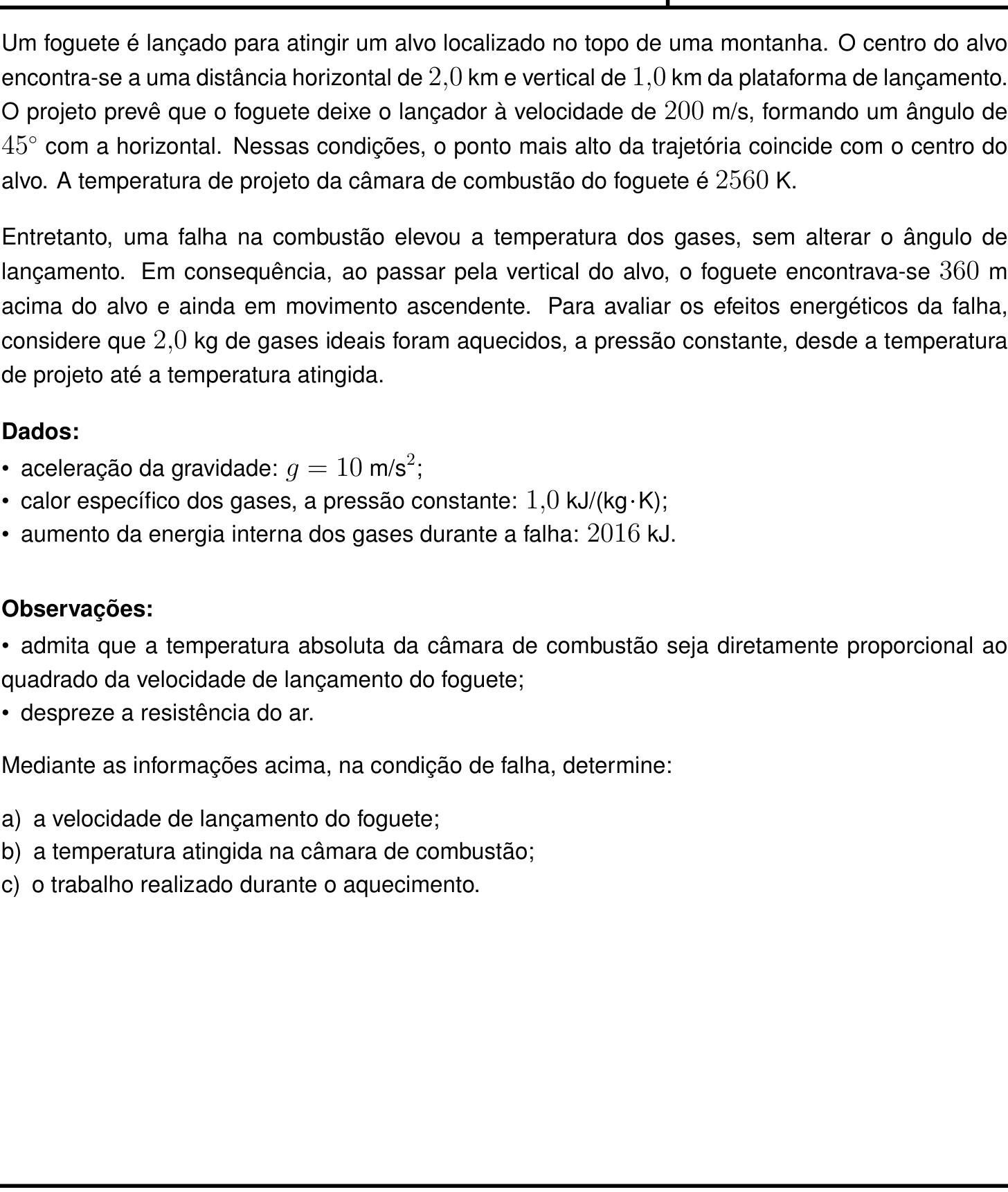
A questão

Questão 1 (Física)

Resposta de referência

a) v_0=250\ \text{m/s}; b) T=4000\ \text{K}; c) W=864\ \text{kJ}, realizado pelos gases.

Segundo a resolução dos cursinhos Farias Brito e Poliedro. A banca não publica gabarito das questões discursivas.

Respostas das IAs

GPT-6 Astra

Respondeu · bate com a resposta de referência dos cursinhos

a) 250 m/s; b) 4000 K; c) 864 kJ, realizados pelos gases.

levou 16 s

Como pensou

a) Velocidade de lançamento

Adotando a plataforma como origem, na vertical do alvo o foguete está na posição

x=2000\ \text{m},\qquad y=1000+360=1360\ \text{m}.

As equações do lançamento oblíquo são

x=v\cos45^\circ\,t,\qquad y=v\sen45^\circ\,t-\frac{gt^2}{2}.

Eliminando o tempo:

y=x\tan45^\circ-\frac{gx^2}{2v^2\cos^245^\circ} =x-\frac{gx^2}{v^2}.

Substituindo os valores:

1360=2000-\frac{10(2000)^2}{v^2} \quad\Rightarrow\quad v^2=\frac{40\,000\,000}{640}=62\,500.

Portanto,

\boxed{v=250\ \text{m/s}}.

b) Temperatura atingida na câmara

Como a temperatura absoluta é diretamente proporcional ao quadrado da velocidade de lançamento,

\frac{T}{T_0}=\frac{v^2}{v_0^2}.

Logo,

T=2560\left(\frac{250}{200}\right)^2 \quad\Rightarrow\quad \boxed{T=4000\ \text{K}}.

c) Trabalho realizado durante o aquecimento

A variação de temperatura dos gases é

\Delta T=4000-2560=1440\ \text{K}.

O calor recebido a pressão constante vale

Q=mc_p\Delta T =2{,}0\cdot1{,}0\cdot1440 =2880\ \text{kJ}.

Pela primeira lei da Termodinâmica, considerando positivo o trabalho realizado pelos gases,

\Delta U=Q-W.

Assim,

W=2880-2016 \quad\Rightarrow\quad \boxed{W=864\ \text{kJ}}.

Esse trabalho é positivo, pois os gases se expandem durante o aquecimento.

Resposta final: a) 250 m/s; b) 4000 K; c) 864 kJ, realizados pelos gases.

GPT-6.1 Sol

Respondeu · bate com a resposta de referência dos cursinhos

a) 250\,\text{m/s}; b) 4000\,\text{K}; c) 864\,\text{kJ}, realizado pelos gases.

levou 14 s

Como pensou
**Calculating Portuguese solution** I need a straightforward calculation for the Portuguese solution. The equation starts with 1360 = 2000 - 40e6/v². I find v² = 62500, and from T4000 I can derive delta1440, Q2880, and W864. Next, I check the original apex and trajectory while ensuring some steps are precise, like vx being positive. Finally, I want to deliver the final format clearly with units while keeping the explanation moderately brief!

a) Velocidade de lançamento

Adotando a plataforma como origem, as equações do movimento são

x=v_0\cos45^\circ\,t,\qquad y=v_0\sin45^\circ\,t-\frac{gt^2}{2}.

Eliminando o tempo:

y=x\tan45^\circ-\frac{gx^2}{2v_0^2\cos^245^\circ} =x-\frac{gx^2}{v_0^2}.

Na vertical do alvo, x=2000\,\text{m} e y=1000+360=1360\,\text{m}. Portanto,

1360=2000-\frac{10(2000)^2}{v_0^2}
v_0^2=\frac{40\,000\,000}{640}=62\,500 \quad\Rightarrow\quad \boxed{v_0=250\,\text{m/s}}.

A abscissa do ponto mais alto é

x_{\text{máx}}=\frac{v_0^2\sin45^\circ\cos45^\circ}{g} =\frac{62\,500}{20}=3125\,\text{m}.

Como 2000<3125, o foguete ainda está subindo ao passar pela vertical do alvo, conforme o enunciado.

b) Temperatura atingida

Como a temperatura absoluta é diretamente proporcional ao quadrado da velocidade de lançamento,

\frac{T}{2560}=\frac{250^2}{200^2}.

Assim,

T=2560\cdot\frac{25}{16} \quad\Rightarrow\quad \boxed{T=4000\,\text{K}}.

c) Trabalho realizado durante o aquecimento

A variação de temperatura é

\Delta T=4000-2560=1440\,\text{K}.

No aquecimento a pressão constante, o calor recebido pelos gases vale

Q=mc_p\Delta T =2{,}0\cdot1{,}0\cdot1440 =2880\,\text{kJ}.

Pela primeira lei da Termodinâmica, considerando positivo o trabalho realizado pelos gases,

\Delta U=Q-W.

Logo,

W=2880-2016 \quad\Rightarrow\quad \boxed{W=864\,\text{kJ}}.

Resposta final: a) 250\,\text{m/s}; b) 4000\,\text{K}; c) 864\,\text{kJ}, realizado pelos gases.

GPT-6 Luna

Respondeu · bate com a resposta de referência dos cursinhos

a) 250\ \text{m/s}; b) 4\,000\ \text{K}; c) 864\ \text{kJ}.

levou 13 s

Como pensou
**Evaluating energy equations** I’m working with the first law of thermodynamics: Q = ΔU + W, where I need to ensure the internal energy increase is stated as 2016 kJ, and I’ve got the work done by the gas calculated at 864 kJ. I can also check things with Cp and Cv. I’ll derive and confirm that the work by the gas is positive. Then I’ll look into the trajectory equations and calculations for vertical coordinates. I'll include fixed launch angles and relevant aspects.

a) Velocidade de lançamento

Na vertical do alvo, o foguete está a 1\,000+360=1\,360\ \text{m} acima da plataforma e percorreu horizontalmente 2\,000\ \text{m}. A trajetória é dada por

y=x\tan\theta-\frac{gx^2}{2v_0^2\cos^2\theta}.

Com \theta=45^\circ, g=10\ \text{m/s}^2 e \cos^2 45^\circ=1/2,

1\,360=2\,000-\frac{10(2\,000)^2}{v_0^2},

de onde

v_0^2=62\,500 \quad\Longrightarrow\quad v_0=250\ \text{m/s}.

b) Temperatura atingida

Como a temperatura é proporcional ao quadrado da velocidade de lançamento,

\frac{T}{2\,560}=\left(\frac{250}{200}\right)^2,

portanto,

T=4\,000\ \text{K}.

c) Trabalho realizado durante o aquecimento

A variação de temperatura é \Delta T=4\,000-2\,560=1\,440\ \text{K}. O calor fornecido é

Q=mc_p\Delta T =2(1{,}0)(1\,440) =2\,880\ \text{kJ}.

Pela primeira lei da Termodinâmica, Q=\Delta U+W, em que W é o trabalho realizado pelos gases:

W=2\,880-2\,016=864\ \text{kJ}.

Resposta final: a) 250\ \text{m/s}; b) 4\,000\ \text{K}; c) 864\ \text{kJ}.

Claude Fable 5.1

Respondeu · bate com a resposta de referência dos cursinhos

a) 250 m/s; b) 4000 K; c) 864 kJ

levou 14 s

Como pensou
I'm computing the projectile's trajectory at 45° with v0=200 m/s, finding the range comes out to 2000 m and max height to 1000 m, which checks out consistently. Now I'm setting up the failure case at the same angle but with a different velocity v, looking at conditions when it reaches that same horizontal distance of 2000 m. Solving the trajectory equation with the added height of 360 m gives v²=62500, so v=250 m/s, and I confirm the apex at 3125 m means it's still ascending there, consistent with the problem. For temperature, since it scales with v² I get T=4000 K, and then using heat capacity I compute Q=2880 kJ, ΔU=2016 kJ, and work W=864 kJ — checking the ratio against the ideal gas relation gives γ≈1.43, which seems reasonable.

Análise do projeto (sem falha): com v₀ = 200 m/s e θ = 45°, o alcance até o ponto mais alto é x = v₀² sen(2θ)/(2g) = 40000/20 = 2000 m e a altura máxima é H = v₀² sen²θ/(2g) = 40000·0,5/20 = 1000 m, confirmando que o ápice coincide com o alvo.

a) Velocidade de lançamento na falha

Equação da trajetória (θ = 45°, tan θ = 1, cos²θ = 1/2):

y = x·tan θ − g x²/(2v² cos²θ) = x − g x²/v²

Na vertical do alvo, x = 2000 m e y = 1000 + 360 = 1360 m:

1360 = 2000 − 10·(2000)²/v²
4·10⁷/v² = 640
v² = 62500 → v = 250 m/s

(Verificação: o ápice ocorreria em x = v²/(2g) = 3125 m > 2000 m, logo o foguete ainda está subindo, como diz o enunciado.)

b) Temperatura atingida na câmara

T ∝ v² ⟹ T₂/T₁ = (v/v₀)² = (250/200)² = 1,5625

T₂ = 2560 × 1,5625 = 4000 K

c) Trabalho realizado durante o aquecimento

Calor fornecido a pressão constante:

Q = m·c_p·ΔT = 2,0 × 1,0 × (4000 − 2560) = 2,0 × 1440 = 2880 kJ

Primeira lei da Termodinâmica: Q = ΔU + W

W = Q − ΔU = 2880 − 2016 = 864 kJ

Resposta final: a) 250 m/s; b) 4000 K; c) 864 kJ

Claude Opus 5.5

Respondeu · bate com a resposta de referência dos cursinhos

a) 250 m/s; b) 4000 K; c) 864 kJ

levou 15 s

Como pensou
I'm verifying the launch parameters produce the expected apex height and range, then checking the trajectory equation at x=2000 to see if it matches the failure point height of 1360. Solving for v gives v²=62500, so v=250 m/s, and I confirm the projectile is still ascending at that point. Then I'm computing the final temperature as 4000 K, and using the heat equation to find Q=2880 kJ and work done W=864 kJ.

Na condição de falha o foguete é lançado a 250 m/s, a câmara chega a 4000 K e os gases realizam 864 kJ de trabalho. Desenvolvimento abaixo.

Verificação do projeto

Com v₀ = 200 m/s e θ = 45°, as componentes são vₓ = v_y = 100√2 m/s.

  • Altura máxima: H = v_y²/(2g) = 20000/20 = 1000 m.
  • Alcance horizontal até o ponto mais alto: x = vₓ·v_y/g = 20000/10 = 2000 m.

O ponto mais alto coincide com o centro do alvo, como o enunciado afirma.

a) Velocidade de lançamento na falha

A equação da trajetória é

y = x\tan\theta - \frac{g x^2}{2v^2\cos^2\theta}

Com θ = 45° (tan θ = 1 e cos²θ = 1/2), ela fica y = x − g x²/v².

No ponto x = 2000 m, o foguete está a y = 1000 + 360 = 1360 m:

1360 = 2000 - \frac{10\cdot(2000)^2}{v^2} \Rightarrow \frac{4\cdot10^7}{v^2} = 640 \Rightarrow v^2 = 62500 \Rightarrow v = 250\ \text{m/s}

Verificação da subida: v_y = 250/√2 ≈ 176,8 m/s e t = 2000/176,8 ≈ 11,3 s. Nesse instante, v_y − g t ≈ 176,8 − 113,1 > 0, logo o foguete ainda sobe, como diz o enunciado.

b) Temperatura na câmara

Como T ∝ v²:

T = 2560\cdot\frac{250^2}{200^2} = 2560\cdot 1{,}5625 = 4000\ \text{K}

c) Trabalho durante o aquecimento

O calor recebido a pressão constante é

Q = m\,c_p\,\Delta T = 2{,}0\cdot 1{,}0\cdot(4000-2560) = 2880\ \text{kJ}

Pela 1ª Lei da Termodinâmica:

W = Q - \Delta U = 2880 - 2016 = 864\ \text{kJ}

Resposta final: a) 250 m/s; b) 4000 K; c) 864 kJ

Claude Sonnet 5.5

Respondeu · bate com a resposta de referência dos cursinhos

a) 250 m/s; b) 4000 K; c) 864 kJ (realizado pelo gás)

levou 10 s

Como pensou
I'm checking the projectile's max height (1000 m) and horizontal range to that peak (2000 m), both confirming the given values. Now I'm working out the failure point at x=2000 m, where y should equal 1360 m, using the trajectory equation with the launch angle to verify the velocity. Solving gives 4e7/v² = 640, so v² = 62500 and v = 250 m/s, and I confirm the vertical velocity stays positive throughout the ascent, consistent with reaching that point while still rising. For part b, since temperature scales with v², I get T = 2560·(250/200)² = 4000 K. For part c, with ΔT = 1440 K, I compute Q = 2880 kJ, ΔU = 2016 kJ, and the work done by the gas as W = Q − ΔU = 864 kJ.

Dados do projeto (verificação): com v₀ = 200 m/s e θ = 45°, o ponto mais alto está a H = v₀²sen²θ/(2g) = 1000 m de altura e a x = v₀²senθ·cosθ/g = 2000 m de distância horizontal. Isso coincide com o alvo.

a) Velocidade de lançamento na falha

O alvo está em x = 2000 m e y = 1000 m. O foguete passou pela vertical do alvo a y = 1000 + 360 = 1360 m. Pela equação da trajetória, com θ = 45°:

y = x·tgθ − g x² / (2v²cos²θ)

1360 = 2000 − (10·(2000)²)/(2v²·0,5)

1360 = 2000 − 4·10⁷/v²

v² = 4·10⁷/640 = 62500

v = 250 m/s

Verificação do movimento ascendente: t = x/(v cos45°) ≈ 11,3 s e v_y = 176,8 − 10·11,3 ≈ 63,7 m/s > 0. O foguete ainda sobe, como o enunciado afirma.

b) Temperatura na câmara

Como T ∝ v²:

T = 2560·(250/200)² = 2560·1,5625 = 4000 K

c) Trabalho durante o aquecimento

Variação de temperatura: ΔT = 4000 − 2560 = 1440 K.

Calor recebido a pressão constante:
Q = m·c_p·ΔT = 2,0·1,0·1440 = 2880 kJ

Pela 1ª lei da termodinâmica, com ΔU = 2016 kJ:

W = Q − ΔU = 2880 − 2016 = 864 kJ (trabalho realizado pelo gás)

Resposta final: a) 250 m/s; b) 4000 K; c) 864 kJ (realizado pelo gás)

Grok 4.7

Respondeu · bate com a resposta de referência dos cursinhos

a) 250 m/s; b) 4000 K; c) 864 kJ

levou 33 s

Como pensou
The problem is in Portuguese about a rocket launched to hit a target on a mountain top. The target is 2.0 km horizontally and 1.0 km vertically from the launch platform. The rocket leaves at 200 m/s at a 45° angle. Its highest point coincides with the target center. The combustion chamber design temperature is 2560 K. A combustion failure raised gas temperature without changing the launch angle. The rocket passed the target's vertical at 360 m above it, still climbing upward. The failure heated 2.0 kg of ideal gases at constant pressure from the design temperature to the new temperature. Given g = 10 m/s², specific heat 1.0 kJ/(kg·K), and internal energy increase of 2016 kJ, the task is to evaluate the energetic effects. The absolute temperature of the combustion chamber is directly proportional to the square of the launch velocity. Air resistance is negligible. The problem asks for the launch velocity, the reached temperature, and the work done during heating under the failure condition. The design trajectory checks out. At 200 m/s the rocket reaches exactly 2000 m horizontally and 1000 m vertically at its peak. The failure condition keeps the 45° angle but uses a higher launch velocity v. The failure launch velocity is 250 m/s. The rocket reaches the target's vertical at 1360 m high after 8√2 seconds. The vertical velocity at the target is positive, confirming the rocket was still ascending. The reached combustion chamber temperature is 4000 K. The work done during the heating is now being calculated. The work done during the constant-pressure heating is being calculated. The first law of thermodynamics is applied to relate heat, internal energy change, and work. The work done during the constant-pressure heating is 864 kJ. The heat supplied was 2880 kJ, and subtracting the internal energy increase of 2016 kJ yields the work performed by the gas.

A condição de projeto é consistente com o enunciado: com v_0=200\,\mathrm{m/s} e \theta=45^\circ, o ápice da trajetória ocorre exatamente em x=2000\,\mathrm{m} e y=1000\,\mathrm{m}.

Na falha, o ângulo permanece 45^\circ, de modo que v_{0x}=v_{0y}=v/\sqrt{2}. Na vertical do alvo (x=2000\,\mathrm{m}):

t=\frac{2000\sqrt{2}}{v}.

A altura nesse instante é y=1360\,\mathrm{m}. Substituindo na equação da trajetória e usando v_{0x}t=2000\,\mathrm{m}:

2000-5t^2=1360\implies t^2=128\implies t=8\sqrt{2}\,\mathrm{s}.

Igualando as expressões de t:

\frac{2000\sqrt{2}}{v}=8\sqrt{2}\implies v=250\,\mathrm{m/s}.

(A componente vertical da velocidade nesse ponto é positiva, confirmando o movimento ainda ascendente.)

Pela proporcionalidade T\propto v^2:

\frac{T}{2560}=\left(\frac{250}{200}\right)^2=\frac{25}{16}\implies T=4000\,\mathrm{K}.

No aquecimento isobárico, \Delta T=1440\,\mathrm{K} e

Q=mc_p\Delta T=2{,}0\times1{,}0\times1440=2880\,\mathrm{kJ}.

Pela primeira lei (\Delta U=Q-W, com W o trabalho realizado pelo gás):

W=Q-\Delta U=2880-2016=864\,\mathrm{kJ}.

Resposta final: a) 250 m/s; b) 4000 K; c) 864 kJ

DeepSeek V4.1 Flash

Respondeu · bate com a resposta de referência dos cursinhos

a) 250\text{ m/s}; b) 4000\text{ K}; c) 864\text{ kJ}.

levou 13 s

Como pensou
We need answer solve physics problem in Portuguese. Need parse. Let's restate problem. Foguete launched to hit target on top mountain. Center target horizontal 2.0 km and vertical 1.0 km from launch platform. Project expects rocket leaves launcher at velocity 200 m/s, angle 45° with horizontal. Under these conditions, highest point of trajectory coincides with center of target. Project temperature combustion chamber is 2560 K. However, failure in combustion raised gas temperature, without changing launch angle. Consequently, passing vertical of target, rocket was 360 m above target and still ascending. To evaluate energetic effects, consider 2.0 kg ideal gases heated at constant pressure from project temperature to attained temperature. Data: g=10 m/s²; specific heat at constant pressure 1.0 kJ/(kg·K); increase in internal energy of gases during failure: 2016 kJ. Observations: - assume absolute temperature of combustion chamber directly proportional to square of launch velocity; - neglect air resistance. Determine under failure condition: a) launch velocity of rocket; b) temperature attained in combustion chamber; c) work done during heating. Need solve. Let's analyze carefully. This is projectile motion. Initially design: v0=200 m/s, angle θ=45°, target coordinates x=2000 m, y=1000 m. "ponto mais alto da trajetória coincide com o centro do alvo" means highest point (vertex) of projectile is target center. Check? For projectile launched from origin, max height y_max = (v0² sin² θ)/(2g), x at vertex = (v0² sin 2θ)/(2g). For v0=200, θ=45, g=10: y_max=200²*(0.5)/(20)=40000*0.5/20=1000 m. x_vertex = v0² sin90 /(2g)=40000/(20)=2000 m. Yes target. Failure: angle same, velocity increased? "falha na combustão elevou temperatura dos gases, sem alterar ângulo de lançamento. Em consequência, ao passar pela vertical do alvo, o foguete encontrava-se 360 m acima do alvo e ainda em movimento ascendente." So at x=2000 m (vertical of target), y=1000+360=1360 m, and still ascending (vertical velocity positive? or height less than max height). Need find new launch velocity. Given same θ=45°, projectile from origin. At horizontal distance x=2000 m, vertical height y=1360 m. Need v (failure launch velocity). Use trajectory equation: y = x tanθ - (g x²)/(2 v² cos²θ). θ=45: tan=1, cos²=1/2. y = x - (g x²)/(2 v² * 1/2) = x - (g x²)/(v²). Wait check: denominator 2 v² cos²θ = 2 v² (1/2)=v². So y = x - g x² / v². Then 1360 = 2000 - (10 * (2000)²)/v² = 2000 - 40,000,000 / v²? 10*4,000,000=40,000,000. So y = 2000 - 40,000,000 / v². Set 1360 => 40,000,000 / v² = 640 => v² = 40,000,000 / 640 = 62,500? 40,000,000/640 = 62,500. v = 250 m/s. Nice. That's a). Then b) temperature attained. Observation: absolute temperature of combustion chamber directly proportional to square of launch velocity. Project T0=2560 K at v0=200 m/s. Failure v=250 m/s. T = T0*(v²/v0²) = 2560*(250²/200²)=2560*(62500/40000)=2560*(25/16)? Since 62500/40000=1.5625=25/16. 2560*25/16 = 160*25? 2560/16=160, *25=4000 K. So T=4000 K. c) Work done during heating. Given 2.0 kg ideal gases heated at constant pressure from project temperature to attained temperature. Specific heat at constant pressure cp=1.0 kJ/(kg·K). Increase internal energy ΔU=2016 kJ. Need work done W. First law at constant pressure? For ideal gas heating at constant pressure: Q = m cp ΔT; ΔU = Q - W (work done by gas?). Given ΔU = 2016 kJ. Need W = Q - ΔU. Compute ΔT = T_failure - T_project = 4000 - 2560 = 1440 K. m=2.0 kg, cp=1.0 kJ/(kg·K). Q = m cp ΔT = 2*1*1440 = 2880 kJ. Then W = Q - ΔU = 2880 - 2016 = 864 kJ. Work done by gas during expansion? Problem asks "trabalho realizado durante o aquecimento." Usually work done by gas. Positive 864 kJ. Need ensure no subtleties. Let's verify internal energy relation maybe for ideal gas, cp = cv + R. Constant pressure, Q = ΔU + W. W = Q - ΔU = 864 kJ. That fits. But let's check if temperature proportionality: T ∝ v². Given design T=2560 for v=200. Failure v=250, T=4000. Yes. Potential issue: At x vertical of target, rocket 360 m above target and still ascending. Our trajectory gives maximum height for v=250: y_max = v² sin²45 /(2g) = 62500*0.5/20 = 1562.5 m. It is above 1360 and ascending at x=2000? Actually vertex x = v² sin90 /20 = 62500/20=3125 m. So at x=2000, before vertex, ascending. Height y=1360. Yes. Maybe need derive using projectile motion. Good. Let's consider if there is another interpretation: "ao passar pela vertical do alvo" means same horizontal coordinate as target. The target's vertical is x=2 km. It was 360 m above target and still ascending. So yes. Now present solution step-by-step in Portuguese. Need final answer line as specified. Need be careful with units: distances in km to m. v in m/s. Temperature K. Specific heat kJ/(kg·K). Energy kJ. Let's craft response. Maybe include equations: a) Trajetória: y = x tan45 - g x²/(2 v² cos²45) = x - g x²/v². Substituindo x=2000 m, y=1360 m, g=10: 1360 = 2000 - 10*2000²/v² -> 40,000,000/v² = 640 -> v²=62500 -> v=250 m/s. Actually 10*2000²=10*4,000,000=40,000,000. 2000-1360=640. v²=40,000,000/640=62,500. b) T ∝ v² => T/2560 = (250/200)² = (5/4)² = 25/16 => T = 2560*25/16 = 4000 K. c) ΔT = 4000 - 2560 = 1440 K. Calor absorvido: Q = m c_p ΔT = 2,0*1,0*1440 = 2880 kJ. Primeira lei: ΔU = Q - W => W = Q - ΔU = 2880 - 2016 = 864 kJ. Final line: Resposta final: a) 250 m/s; b) 4000 K; c) 864 kJ (ou 8,64×10² kJ). Need maybe if work done on gas? Typically "trabalho realizado durante o aquecimento" could mean work done by gas. If work done by gas positive 864 kJ. If asked "trabalho realizado" maybe by gas. If work done on gas would be -864. But data internal energy increase less than heat, so gas does work. I'll state trabalho realizado pelo gás. Let's ensure no missing: "considera que 2,0 kg de gases ideais foram aquecidos, a pressão constante, desde a temperatura de projeto até a temperatura atingida." c) work done during heating. We used cp and first law. Good. Let's produce final with concise development. Since desired oververbosity 5. Need item by item. Include equations. Potential alternate derivation for a using vertical velocity? Could also use. But trajectory equation simpler. Let's final.

a) Na trajetória do foguete, com ângulo \theta=45^\circ, a equação da posição vertical é

y=x\tan45^\circ-\frac{gx^2}{2v^2\cos^2 45^\circ} =x-\frac{gx^2}{v^2}.

No instante em que passa pela vertical do alvo, x=2000\text{ m} e

y=1000+360=1360\text{ m}.

Substituindo g=10\text{ m/s}^2:

1360=2000-\frac{10\cdot(2000)^2}{v^2}
\frac{40\,000\,000}{v^2}=640
v^2=62\,500 \quad\Rightarrow\quad v=250\text{ m/s}.

b) Como T\propto v^2, tem-se:

\frac{T}{2560}=\left(\frac{250}{200}\right)^2=\left(\frac54\right)^2=\frac{25}{16}
T=2560\cdot\frac{25}{16}=4000\text{ K}.

c) A variação de temperatura é:

\Delta T=4000-2560=1440\text{ K}.

O calor absorvido a pressão constante é:

Q=mc_p\Delta T=2,0\cdot1,0\cdot1440=2880\text{ kJ}.

Pela Primeira Lei da Termodinâmica:

\Delta U=Q-W \quad\Rightarrow\quad W=Q-\Delta U
W=2880-2016=864\text{ kJ}.

Resposta final: a) 250\text{ m/s}; b) 4000\text{ K}; c) 864\text{ kJ}.

Gemini 3.8 Flash

Respondeu · bate com a resposta de referência dos cursinhos

a) 250 m/s; b) 4000 K; c) 864 kJ

levou 46 s

Como pensou
**Analyzing the Challenge** I'm currently focused on dissecting the problem, specifically the Física question from IME's 2nd phase. I've begun a meticulous reading of the image's provided text, starting with the problem's core scenario of a rocket being launched towards a mountaintop target. The initial horizontal distance is $2.0 \text{ km}$. My objective is to extract the critical information to determine how the setup should be analyzed. **Interpreting the Scenario** I'm now diving deeper into the specifics. I have the launch parameters: initial velocity, angle, and the initial altitude of the rocket. I am also making note of the implications of the "failure" - the height discrepancy and still-ascending motion, especially relevant to energy considerations. The information about the target's vertical position relative to the launch platform is also considered. **Calculating the Trajectory** I'm now focusing on calculating the rocket's trajectory under ideal conditions. I am reviewing the project specifications: the horizontal and vertical distances to the target, and the initial launch velocity and angle. I've begun to calculate the initial velocity components and the time to reach the trajectory's peak point. **Calculating the Failure** I've determined the initial condition, which gives a launch velocity $v_0$ of $200\text{ m/s}$. The temperature is $2560\text{ K}$. Given that the launch angle remains 45 degrees, and the horizontal distance to the failure point is $2000\text{ m}$, while the vertical distance is $1360\text{ m}$. We also know the rocket is still ascending. I am solving the trajectory equation to calculate the launch velocity $v$ at the failure point. **Determining the Velocity** I've just calculated the rocket's velocity at the point of "failure." Using the given parameters and trajectory equations, I found a velocity of 250 m/s. I also verified that the rocket is still ascending at the 2000m horizontal position, which is essential to interpret the setup. Now I will move to the next item: "the temperature reached at the c...". **Calculating the Temperature** I've just calculated the combustion chamber temperature at the failure point. Utilizing the direct proportionality between absolute temperature and the square of the launch velocity, along with the given initial and failure velocities and initial temperature, I found a final temperature of 4000 K. Now, I'm verifying the consistency of this result with the subsequent item concerning the ideal gas behavior, with the 2kg of ideal gases. **Verifying Thermodynamic Consistency** I'm now cross-checking the thermodynamic calculations. I've applied the first law, $Q = \Delta U + W$, focusing on constant pressure heating, where $Q = m c_p \Delta T$. With calculated temperature change and mass, I've found Q to be 2880 kJ and, using the given internal energy change of 2016 kJ, I've determined that the work done, W, is 864 kJ. I am verifying this result for consistency with ideal gas behavior by determining the relationship between the specific heats at constant pressure and volume, and the change in internal energy, which should lead to expected behavior. **Finalizing the Solution** I've just finalized the thermodynamic analysis and it aligns perfectly! The ratio of specific heats is about 1.4 for a diatomic gas and $W = 864\text{ kJ}$, everything fits beautifully. Now, I'll meticulously review the solution steps for a clear and elegant write-up, in IME style, including defining the system, quantities, and then breaking down the math. **Validating the Calculations** I've just revisited the trajectory equations, confirming the initial velocity calculation, along with the ascending motion at the failure point, ensuring consistency. My checks validate the initial $v = 250\text{ m/s}$, and a positive vertical velocity. I'm now certain about my assumptions and the numerical values used.

Para a resolução da questão, adota-se um sistema de coordenadas cartesianas com origem na plataforma de lançamento, com o eixo x na horizontal e o eixo y na vertical apontando para cima.


a) Velocidade de lançamento do foguete na condição de falha

A equação da trajetória parabólica para um projétil lançado a partir da origem com velocidade v sob um ângulo \theta com a horizontal é dada por:

y(x) = x \operatorname{tg}\theta - \frac{g x^2}{2 v^2 \cos^2\theta}

Na condição de falha:

  • Ângulo de lançamento mantido: \theta = 45^\circ \implies \operatorname{tg}45^\circ = 1 e \cos^2 45^\circ = \left(\frac{\sqrt{2}}{2}\right)^2 = \frac{1}{2};
  • Posição horizontal do alvo: x = 2,0\text{ km} = 2000\text{ m};
  • Altura do foguete ao passar pela vertical do alvo:
    y = 1,0\text{ km} + 360\text{ m} = 1000\text{ m} + 360\text{ m} = 1360\text{ m}

Substituindo esses dados na equação da trajetória:

1360 = 2000 \cdot (1) - \frac{10 \cdot (2000)^2}{2 v^2 \cdot \left(\frac{1}{2}\right)}

1360 = 2000 - \frac{4 \cdot 10^7}{v^2}
\frac{4 \cdot 10^7}{v^2} = 640 \implies v^2 = \frac{4 \cdot 10^7}{640} = 62500\text{ m}^2/\text{s}^2
v = \sqrt{62500} = 250\text{ m/s}

Verificação da condição de movimento ascendente:
O tempo para atingir x = 2000\text{ m} é:

t = \frac{x}{v \cos 45^\circ} = \frac{2000}{250 \cdot \frac{\sqrt{2}}{2}} = 8\sqrt{2}\text{ s}

A componente vertical da velocidade nesse instante é:
v_y = v \operatorname{sen} 45^\circ - g t = 250 \cdot \frac{\sqrt{2}}{2} - 10 \cdot 8\sqrt{2} = 125\sqrt{2} - 80\sqrt{2} = 45\sqrt{2}\text{ m/s} > 0

Confirmando que o foguete se encontra de fato em movimento ascendente.


b) Temperatura atingida na câmara de combustão

De acordo com o enunciado, a temperatura absoluta da câmara de combustão é diretamente proporcional ao quadrado da velocidade de lançamento:

T \propto v^2 \implies \frac{T_f}{T_0} = \left(\frac{v}{v_0}\right)^2

Dados:

  • T_0 = 2560\text{ K};
  • v_0 = 200\text{ m/s};
  • v = 250\text{ m/s}.

Substituindo os valores:

T_f = 2560 \cdot \left(\frac{250}{200}\right)^2 = 2560 \cdot \left(\frac{5}{4}\right)^2 = 2560 \cdot \frac{25}{16}

T_f = 160 \cdot 25 = 4000\text{ K}

c) Trabalho realizado durante o aquecimento

O aquecimento dos gases ocorre a pressão constante. A variação de temperatura é dada por:

\Delta T = T_f - T_0 = 4000\text{ K} - 2560\text{ K} = 1440\text{ K}

A quantidade de calor Q absorvida pelos gases no processo isobárico é:

Q = m \cdot c_p \cdot \Delta T

Q = 2,0\text{ kg} \cdot 1,0\text{ kJ/(kg}\cdot\text{K)} \cdot 1440\text{ K} = 2880\text{ kJ}

Pela Primeira Lei da Termodinâmica:

Q = \Delta U + W

Onde \Delta U = 2016\text{ kJ} é a variação da energia interna fornecida. Logo, o trabalho W realizado durante o aquecimento é:

W = Q - \Delta U = 2880\text{ kJ} - 2016\text{ kJ} = 864\text{ kJ}


Resposta final: a) 250 m/s; b) 4000 K; c) 864 kJ

Gemini 4 Argon

Respondeu · bate com a resposta de referência dos cursinhos

a) 250 m/s; b) 4000 K; c) 864 kJ

levou 42 s

Como pensou
**Analyzing Physics Problem** I am currently dissecting a physics problem from a competitive exam, focusing on a rocket launch scenario. My immediate next step involves a thorough examination of the problem statement, particularly concerning the horizontal distance to the target. **Calculating Rocket Trajectory** I'm processing the provided physics problem, focusing on the rocket launch and trajectory adjustments due to a combustion failure. My current task is to determine the initial conditions and how the elevated temperature affected the rocket's path, specifically its position when directly above the target. I'll then use this to analyze the energy changes involved. **Solving Rocket Launch Physics** I'm continuing my analysis of the rocket launch problem, now focusing on determining the rocket's launch velocity under specific failure conditions. I've confirmed the nominal trajectory equation, and my next steps involve applying it to solve for the required initial speed. **Calculating New Launch Velocity** I've successfully calculated the new launch velocity required for the rocket to be 360m above the target when it reaches the 2000m horizontal distance. The trajectory equations confirm this new velocity is 250 m/s, and importantly, the rocket is still ascending at that point. **Evaluating Combustion Temperature** I have successfully determined the absolute combustion temperature to be 4000 K, based on the calculated launch velocity and the provided proportionality. My next focus shifts to calculating the work done during the gas heating process, considering the constant pressure condition and the given internal energy change.

A seguir, apresenta-se a resolução detalhada de cada item da questão.


a) Velocidade de lançamento do foguete na condição de falha

Adotando um sistema de eixos cartesianos com origem (0, 0) na plataforma de lançamento, com o eixo x horizontal e o eixo y vertical orientado para cima, a equação da trajetória de um projétil lançado com velocidade inicial v e ângulo \theta com a horizontal, desprezando-se a resistência do ar, é dada por:

y = x \tan\theta - \frac{g x^2}{2 v^2 \cos^2\theta}

Na condição de falha, o ângulo de lançamento permanece inalterado (\theta = 45^\circ, logo \tan 45^\circ = 1 e \cos^2 45^\circ = \frac{1}{2}). Ao passar pela vertical do alvo (x = 2,0\text{ km} = 2000\text{ m}), o foguete encontra-se 360\text{ m} acima da altura do alvo (y_{\text{alvo}} = 1,0\text{ km} = 1000\text{ m}), ou seja:

y = 1000 + 360 = 1360\text{ m}

Substituindo os valores conhecidos na equação da trajetória:

1360 = 2000 \cdot 1 - \frac{10 \cdot (2000)^2}{2 \cdot v^2 \cdot \left(\frac{1}{2}\right)}
1360 = 2000 - \frac{4,0 \times 10^7}{v^2}
\frac{4,0 \times 10^7}{v^2} = 2000 - 1360 = 640
v^2 = \frac{4,0 \times 10^7}{640} = 62500\text{ m}^2/\text{s}^2
v = \sqrt{62500} = 250\text{ m/s}

(Nota: Como a abscissa do vértice da parábola nessa condição é x_{\text{máx}} = \frac{v^2 \sin(2\theta)}{2g} = 3125\text{ m} > 2000\text{ m}, confirma-se que o foguete ainda está em movimento ascendente).


b) Temperatura atingida na câmara de combustão

Pela observação do enunciado, a temperatura absoluta T da câmara de combustão é diretamente proporcional ao quadrado da velocidade de lançamento (T \propto v^2). Assim, relacionando a condição de falha com a condição de projeto (T_0 = 2560\text{ K} e v_0 = 200\text{ m/s}), temos:

\frac{T}{T_0} = \left(\frac{v}{v_0}\right)^2

Substituindo os valores:

\frac{T}{2560} = \left(\frac{250}{200}\right)^2 = \left(\frac{5}{4}\right)^2 = \frac{25}{16}
T = 2560 \cdot \frac{25}{16} = 160 \cdot 25 \implies T = 4000\text{ K}

c) Trabalho realizado durante o aquecimento

Como o aquecimento de m = 2,0\text{ kg} de gases ocorre à pressão constante desde a temperatura de projeto (T_0 = 2560\text{ K}) até a temperatura atingida na falha (T = 4000\text{ K}), a quantidade de calor Q recebida pelo gás é:

Q = m \cdot c_p \cdot (T - T_0)

Substituindo os dados (c_p = 1,0\text{ kJ/(kg}\cdot\text{K)}):

Q = 2,0 \cdot 1,0 \cdot (4000 - 2560) = 2,0 \cdot 1440 = 2880\text{ kJ}

Pela Primeira Lei da Termodinâmica, sabendo que o aumento da energia interna foi \Delta U = 2016\text{ kJ}, o trabalho W realizado pelo gás durante o aquecimento é dado por:

Q = \Delta U + W \implies W = Q - \Delta U
W = 2880 - 2016 = 864\text{ kJ}

Resposta final: a) 250 m/s; b) 4000 K; c) 864 kJ

GPT-6.1 Terra

Respondeu · bate com a resposta de referência dos cursinhos

a) 250\,\text{m/s}; b) 4000\,\text{K}; c) 864\,\text{kJ}.

levou 23 s

Como pensou

a) Tomando a plataforma como origem, a equação da trajetória é

y=x\tan45^\circ-\frac{gx^2}{2v^2\cos^245^\circ} =x-\frac{gx^2}{v^2}.

Na vertical do alvo, x=2000\,\text{m} e y=1000+360=1360\,\text{m}. Logo,

1360=2000-\frac{10(2000)^2}{v^2} \quad\Rightarrow\quad v^2=62500,

portanto, v=250\,\text{m/s}.

Para verificar que o movimento ainda é ascendente, nesse ponto

v_y=v\sin45^\circ-gt =\frac{250}{\sqrt2}-10\frac{2000}{250/\sqrt2} =45\sqrt2\,\text{m/s}>0.

b) Como T é proporcional a v^2,

\frac{T}{2560}=\frac{250^2}{200^2} \quad\Rightarrow\quad T=4000\,\text{K}.

c) No aquecimento a pressão constante,

Q=mc_p\Delta T =2,0\cdot1,0\cdot(4000-2560) =2880\,\text{kJ}.

Pela primeira lei da Termodinâmica, com W representando o trabalho realizado pelos gases,

W=Q-\Delta U=2880-2016=864\,\text{kJ}.

Resposta final: a) 250\,\text{m/s}; b) 4000\,\text{K}; c) 864\,\text{kJ}.