Correção ITA 2027 · QuímicaAcompanhe a resolução de cada questão da 2ª fase, ao vivoAcompanhar
IA ao vivo / ITA 2027 · 2ª fase · Química

COMPARE OS RACIOCÍNIOS

Questão 4 (Química)

Questão discursiva: a banca não divulga gabarito oficial. ← 3 (Química) 5 (Química) →

A questão

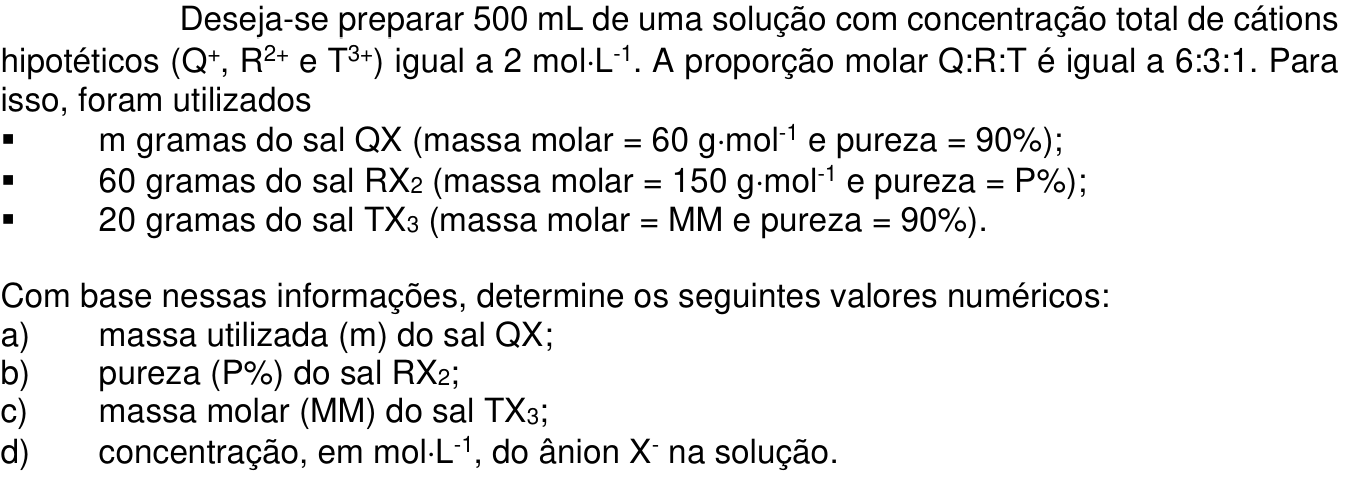
Texto de apoio da questão 4 (Química) Questão 4 (Química)

Respostas das IAs

GPT-6 Astra

Respondeu · mesma resposta final de outras 9 IAs

a) 40 g; b) 75%; c) 180 g·mol⁻¹; d) 3,0 mol·L⁻¹.

levou 21 s

Como pensou
**Calculating item development** I need to work on developing a straightforward item in Portuguese that involves fractions like .6, .3, and .1 related to mass and purity values. I should clarify my assumptions about impurities and check if they contribute ions. I’ll compute the total cations and consider their dissociation. I seem to need around 250-450 words for this answer without excess definitions, focusing instead on the final consistent line that summarizes all salts involving one cation.

A quantidade total de cátions na solução deve ser:

n_{\text{total}}=CV=2\cdot0{,}500=1{,}00\ \text{mol}.

Como a proporção molar Q:R:T é 6:3:1, temos:

n_{Q^+}=\frac{6}{10}\cdot1=0{,}60\ \text{mol}, \qquad n_{R^{2+}}=0{,}30\ \text{mol}, \qquad n_{T^{3+}}=0{,}10\ \text{mol}.

Cada mol dos respectivos sais fornece um mol do cátion correspondente.

a) Massa utilizada do sal QX

A massa de QX puro necessária é:

m_{\text{puro}}=nM=0{,}60\cdot60=36\ \text{g}.

Considerando a pureza de 90\%:

0{,}90m=36 \quad\Rightarrow\quad \boxed{m=40\ \text{g}}.

b) Pureza do sal RX₂

A massa de RX₂ puro necessária é:

m_{\text{puro}}=0{,}30\cdot150=45\ \text{g}.

Como foram utilizados 60\ \text{g} da amostra:

P\%=\frac{45}{60}\cdot100\% \quad\Rightarrow\quad \boxed{P\%=75\%}.

c) Massa molar do sal TX₃

A massa de TX₃ puro utilizada foi:

m_{\text{puro}}=20\cdot0{,}90=18\ \text{g}.

Portanto:

MM=\frac{m_{\text{puro}}}{n} =\frac{18}{0{,}10} \quad\Rightarrow\quad \boxed{MM=180\ \text{g·mol}^{-1}}.

d) Concentração do ânion X⁻

Cada mol de QX, RX₂ e TX₃ fornece, respectivamente, 1, 2 e 3 mol de X^-. Assim:

n_{X^-}=0{,}60+2(0{,}30)+3(0{,}10)=1{,}50\ \text{mol}.

Logo:

[X^-]=\frac{1{,}50}{0{,}500} =\boxed{3{,}0\ \text{mol·L}^{-1}}.

Resposta final: a) 40 g; b) 75%; c) 180 g·mol⁻¹; d) 3,0 mol·L⁻¹.

GPT-6.1 Sol

Respondeu · mesma resposta final de outras 9 IAs

a) 40 g; b) 75%; c) 180 g·mol⁻¹; d) 3,0 mol·L⁻¹.

levou 18 s

Como pensou
**Working through a calculation** I need to solve a straightforward Portuguese problem step by step, starting with numbers like 1.6, 0.3, 0.1, m40, P75, and MM180. I’ll divide by X1.5 and 0.5 to get 3. I’m assuming there are no impurities or ions since salts dissociate as expected. It’s important to provide the total concentration sum and not just equivalents. I wonder if I’ll need around 300 to 500 words to explain this properly. I’ll make sure everything is accurate before delivering it!

A quantidade total de cátions na solução deve ser:

n_{\text{total}}=C_{\text{total}}V=2\cdot0{,}500=1{,}00\ \text{mol}.

Como a proporção molar é Q:R:T=6:3:1, temos:

n(Q^+)=0{,}60\ \text{mol},\qquad n(R^{2+})=0{,}30\ \text{mol},\qquad n(T^{3+})=0{,}10\ \text{mol}.

Cada mol de sal fornece um mol de seu respectivo cátion.

a) Massa utilizada do sal QX

A massa de QX puro necessária é:

m_{\text{puro}}=0{,}60\cdot60=36\ \text{g}.

Como a pureza é de 90\%:

0{,}90m=36 \quad\Rightarrow\quad \boxed{m=40\ \text{g}}.

b) Pureza do sal \mathrm{RX_2}

A massa de \mathrm{RX_2} puro necessária é:

m_{\text{puro}}=0{,}30\cdot150=45\ \text{g}.

Foram utilizados 60\ \text{g} da amostra, portanto:

P=\frac{45}{60}\cdot100 \quad\Rightarrow\quad \boxed{P=75\%}.

c) Massa molar do sal \mathrm{TX_3}

A massa de sal puro nos 20\ \text{g} da amostra é:

m_{\text{puro}}=20\cdot0{,}90=18\ \text{g}.

Logo:

MM=\frac{m_{\text{puro}}}{n(\mathrm{TX_3})} =\frac{18}{0{,}10} \quad\Rightarrow\quad \boxed{MM=180\ \text{g·mol}^{-1}}.

d) Concentração do ânion X^-

Pela dissociação dos sais:

\mathrm{QX\rightarrow Q^++X^-},
\mathrm{RX_2\rightarrow R^{2+}+2X^-},
\mathrm{TX_3\rightarrow T^{3+}+3X^-}.

Assim:

n(X^-)=0{,}60+2(0{,}30)+3(0{,}10)=1{,}50\ \text{mol}.

No volume final de 0{,}500\ \text{L}:

[X^-]=\frac{1{,}50}{0{,}500} =\boxed{3{,}0\ \text{mol·L}^{-1}}.

Resposta final: a) 40 g; b) 75%; c) 180 g·mol⁻¹; d) 3,0 mol·L⁻¹.

GPT-6 Luna

Respondeu · mesma resposta final de outras 9 IAs

a) 40\ \mathrm{g}; b) 75\%; c) 180\ \mathrm{g\,mol^{-1}}; d) 3{,}0\ \mathrm{mol\,L^{-1}}.

levou 10 s

Como pensou
**Interpreting cation concentrations** I need to interpret the total cation concentration of 2 M, with molar proportions of Q:R:T being 6:3:1, in a 500 mL solution. This results in total cation moles equaling 1 mol, leading to ratios of 0.6, 0.3, and 0.1 mol for each cation. The respective amounts for salts QX, RX2, and TX3 are calculated to be 0.6, 0.3, and 0.1 mol, respectively. Now, I should verify the charge balance and explain the concentration ratios in Portuguese too!**Calculating salt ratios** I’m looking at a total of 10 units, where Q is 0.6. Then, I need to consider the salts. However, I think there might be a potential issue with the calculation for part c. For TX3, if I have a mass of 20g with 90% purity, that gives me 0.1 moles and a molar mass of 180. It looks correct. I’ll make sure to format that final line properly for clarity.

A quantidade total de cátions na solução é

n_{\text{cátions}}=2\ \mathrm{mol\,L^{-1}}\times 0{,}500\ \mathrm{L}=1{,}0\ \mathrm{mol}.

Como a proporção molar Q:R:T é 6:3:1, há 10 partes ao todo:

n(Q^+)=0{,}6\ \mathrm{mol},\qquad n(R^{2+})=0{,}3\ \mathrm{mol},\qquad n(T^{3+})=0{,}1\ \mathrm{mol}.

Cada sal contém um cátion por unidade de fórmula; portanto, essas também são as quantidades de matéria dos respectivos sais.

a) Para QX, a massa de sal puro necessária é

m_{\text{puro}}=0{,}6\times60=36\ \mathrm{g}.

Com pureza de 90%:

0{,}90m=36 \quad\Rightarrow\quad m=40\ \mathrm{g}.

b) Para RX_2, são necessários

m_{\text{puro}}=0{,}3\times150=45\ \mathrm{g}.

Logo, a pureza da amostra de 60 g é

P=\frac{45}{60}\times100\%=75\%.

c) A massa de TX_3 puro na amostra é 0{,}90\times20=18\ \mathrm{g}. Assim,

MM=\frac{18}{0{,}1}=180\ \mathrm{g\,mol^{-1}}.

d) Cada mol de QX, RX_2 e TX_3 fornece, respectivamente, 1, 2 e 3 mol de X^-. Portanto,

n(X^-)=0{,}6+2(0{,}3)+3(0{,}1)=1{,}5\ \mathrm{mol},

e

[X^-]=\frac{1{,}5}{0{,}500}=3{,}0\ \mathrm{mol\,L^{-1}}.

Resposta final: a) 40\ \mathrm{g}; b) 75\%; c) 180\ \mathrm{g\,mol^{-1}}; d) 3{,}0\ \mathrm{mol\,L^{-1}}.

Claude Fable 5.1

Respondeu · mesma resposta final de outras 9 IAs

a) m = 40 g; b) P = 75%; c) MM = 180 g·mol⁻¹; d) [X⁻] = 3,0 mol·L⁻¹

levou 11 s

Como pensou
With total cations at 1 mol split 6:3:1, I get Q=0.6 mol, R=0.3 mol, T=0.1 mol. For QX: 0.6 mol × 60 g/mol = 36 g pure, giving 40 g impure sample at 0.9 purity. For RX2: 0.3 mol × 150 g/mol = 45 g pure, giving 75% purity when divided by 60 g total. Now moving to part T. For TX3, 20 g sample × 0.9 purity = 18 g pure, which equals 0.1 mol, so molar mass = 180 g/mol. For the anion X⁻ concentration, I sum charge contributions: 0.6 + 2(0.3) + 3(0.1) = 1.5 mol total in 0.5 L, giving 3 mol/L.

Cálculo preliminar – quantidade de cada cátion

Quantidade total de cátions:
n = C·V = 2 mol·L⁻¹ × 0,500 L = 1,0 mol

Proporção Q:R:T = 6:3:1 (soma = 10 partes):

  • n(Q⁺) = 6/10 × 1,0 = 0,60 mol
  • n(R²⁺) = 3/10 × 1,0 = 0,30 mol
  • n(T³⁺) = 1/10 × 1,0 = 0,10 mol

Cada sal fornece 1 mol de cátion por mol de sal, então n(sal) = n(cátion).

a) Massa do sal QX

Massa pura necessária: 0,60 mol × 60 g·mol⁻¹ = 36 g
Com pureza 90%: m = 36 / 0,90 = 40 g

b) Pureza do RX₂

Massa pura necessária: 0,30 mol × 150 g·mol⁻¹ = 45 g
Massa utilizada: 60 g
P = 45/60 × 100% = 75%

c) Massa molar do TX₃

Massa pura: 20 g × 0,90 = 18 g, que corresponde a 0,10 mol de TX₃
MM = 18 g / 0,10 mol = 180 g·mol⁻¹

d) Concentração de X⁻

n(X⁻) = 1×n(QX) + 2×n(RX₂) + 3×n(TX₃)
n(X⁻) = 0,60 + 2(0,30) + 3(0,10) = 0,60 + 0,60 + 0,30 = 1,50 mol

[X⁻] = 1,50 mol / 0,500 L = 3,0 mol·L⁻¹

Resposta final: a) m = 40 g; b) P = 75%; c) MM = 180 g·mol⁻¹; d) [X⁻] = 3,0 mol·L⁻¹

Claude Opus 5.5

Respondeu · mesma resposta final de outras 9 IAs

a) m = 40 g; b) P = 75%; c) MM = 180 g·mol⁻¹; d) [X⁻] = 3 mol·L⁻¹

levou 12 s

Como pensou
With total cations at 1 mol split 6:3:1, I get 0.6 mol Q, 0.3 mol R, and 0.1 mol T. For QX I calculate 36 g pure salt giving 40 g impure sample, and for RX2 I get 45 g pure salt giving 75% purity; now I'm working out the TX calculation similarly. For TX3, 18 g pure corresponds to 0.1 mol, giving a molar mass of 180 g/mol. Then for X- concentration, I'm summing contributions from all three salts (0.6+0.6+0.3=1.5 mol) in 0.5 L to get 3 mol/L, assuming the impurities are free of X-.

Os três sais se dissociam totalmente. Considero que as impurezas não contêm os cátions nem o ânion X⁻.

Quantidade de cátions

n(total de cátions) = 2 mol·L⁻¹ × 0,500 L = 1,0 mol

A proporção Q:R:T = 6:3:1 soma 10 partes. Logo:

  • n(Q⁺) = 6/10 × 1,0 = 0,6 mol
  • n(R²⁺) = 3/10 × 1,0 = 0,3 mol
  • n(T³⁺) = 1/10 × 1,0 = 0,1 mol

Cada fórmula de sal fornece um cátion. Portanto n(QX) = 0,6 mol, n(RX₂) = 0,3 mol e n(TX₃) = 0,1 mol.

a) Massa m do sal QX

Massa de QX puro = 0,6 mol × 60 g·mol⁻¹ = 36 g

Como a pureza é 90%: m = 36 / 0,90 = 40 g

b) Pureza P do sal RX₂

Massa de RX₂ puro = 0,3 mol × 150 g·mol⁻¹ = 45 g

P = 45 / 60 × 100% = 75%

c) Massa molar MM do sal TX₃

Massa de TX₃ puro = 0,90 × 20 g = 18 g

Essa massa corresponde a 0,1 mol, então MM = 18 g / 0,1 mol = 180 g·mol⁻¹

d) Concentração de X⁻

  • QX fornece 0,6 × 1 = 0,6 mol de X⁻.
  • RX₂ fornece 0,3 × 2 = 0,6 mol de X⁻.
  • TX₃ fornece 0,1 × 3 = 0,3 mol de X⁻.

O total é 1,5 mol de X⁻ em 0,500 L, logo [X⁻] = 1,5 / 0,5 = 3 mol·L⁻¹.

A eletroneutralidade confirma o resultado. As cargas positivas somam 0,6 + 2(0,3) + 3(0,1) = 1,5 mol, igual à quantidade de X⁻.

Resposta final: a) m = 40 g; b) P = 75%; c) MM = 180 g·mol⁻¹; d) [X⁻] = 3 mol·L⁻¹

Claude Sonnet 5.5

Respondeu · mesma resposta final de outras 9 IAs

a) 40 g; b) 75%; c) 180 g/mol; d) 3 mol/L

levou 6 s

Como pensou

Interpretação: a concentração total de cátions é 2 mol/L em 500 mL, ou seja, 1,0 mol de cátions no total (Q⁺ + R²⁺ + T³⁺). Com proporção 6:3:1, o total corresponde a 10 partes.

  • n(Q⁺) = 0,6 mol
  • n(R²⁺) = 0,3 mol
  • n(T³⁺) = 0,1 mol

a) Massa de QX

Cada mol de QX fornece 1 mol de Q⁺, então são necessários 0,6 mol de QX puro.

Massa pura = 0,6 × 60 = 36 g.

Com pureza de 90%: m = 36/0,9 = 40 g.

b) Pureza de RX₂

São necessários 0,3 mol de RX₂ puro, o que dá 0,3 × 150 = 45 g.

P = 45/60 = 0,75, ou seja, 75%.

c) Massa molar de TX₃

São necessários 0,1 mol de TX₃ puro. A massa pura é 0,9 × 20 = 18 g.

MM = 18/0,1 = 180 g/mol.

d) Concentração de X⁻

  • QX: 0,6 mol de X⁻
  • RX₂: 0,3 × 2 = 0,6 mol de X⁻
  • TX₃: 0,1 × 3 = 0,3 mol de X⁻

Total = 1,5 mol de X⁻ em 0,5 L, logo [X⁻] = 1,5/0,5 = 3 mol/L.

Resposta final: a) 40 g; b) 75%; c) 180 g/mol; d) 3 mol/L

Grok 4.7

Respondeu · mesma resposta final de outras 9 IAs

a) 40; b) 75; c) 180; d) 3

levou 24 s

Como pensou
The problem is in Portuguese about preparing a solution with hypothetical cations. The solution contains 500 mL with total cation concentration of 2 mol·L⁻¹ and molar ratio Q:R:T = 6:3:1. It uses m grams of QX (60 g·mol⁻¹, 90% purity), 60 g of RX₂ (150 g·mol⁻¹, P% purity), and 20 g of TX₃ (MM g·mol⁻¹, 90% purity). The goal is to find the mass of QX, the purity of RX₂, the molar mass of TX₃, and the concentration of anion X⁻. The total moles of cations in the solution is 1 mol. The molar ratio Q:R:T = 6:3:1 yields 0.6 mol of Q⁺, 0.3 mol of R²⁺, and 0.1 mol of T³⁺. The salts QX, RX₂, and TX₃ provide one, two, and three X⁻ anions per formula unit respectively. For part a), the mass of salt QX is being calculated from its 90% purity and 60 g·mol⁻¹ molar mass. The mass of salt QX is 40 g. The purity of salt RX₂ is 75%. The molar mass of salt TX₃ is 180 g·mol⁻¹. The total moles of anion X⁻ are 1.5 mol. The concentration of anion X⁻ is 3 mol·L⁻¹.

A concentração total de cátions é 2\,\mathrm{mol\,L^{-1}} em 0{,}500\,\mathrm{L}, o que corresponde a 1{,}00\,\mathrm{mol} de cátions. Na proporção molar Q:R:T=6:3:1, obtêm-se

n(Q^+)=0{,}60\,\mathrm{mol},\quad n(R^{2+})=0{,}30\,\mathrm{mol},\quad n(T^{3+})=0{,}10\,\mathrm{mol}.

a) O sal QX fornece 0{,}60\,\mathrm{mol} de Q^+. A massa de sal puro é 0{,}60\times60=36\,\mathrm{g}. Com pureza de 90\%,

m=\frac{36}{0{,}90}=40\,\mathrm{g}.

b) O sal RX_2 fornece 0{,}30\,\mathrm{mol} de R^{2+}. A massa de sal puro é 0{,}30\times150=45\,\mathrm{g}. Logo,

P=\frac{45}{60}\times100=75.

c) O sal TX_3 fornece 0{,}10\,\mathrm{mol} de T^{3+}. A massa de sal puro presente nos 20\,\mathrm{g} (pureza 90\%) é 18\,\mathrm{g}, de modo que

MM=\frac{18}{0{,}10}=180\,\mathrm{g\,mol^{-1}}.

d) Os ânions X^- provêm dos três sais:

n(X^-)=0{,}60+2\times0{,}30+3\times0{,}10=1{,}50\,\mathrm{mol}.

Assim,

[X^-]=\frac{1{,}50}{0{,}500}=3{,}0\,\mathrm{mol\,L^{-1}}.

Resposta final: a) 40; b) 75; c) 180; d) 3

DeepSeek V4.1 Flash

Respondeu · mesma resposta final de outras 9 IAs

a) 40 g; b) 75%; c) 180 g·mol⁻¹; d) 3 mol·L⁻¹

levou 16 s

Como pensou
We need solve chemistry problem. Need provide final answer in Portuguese. Let's parse. We have prepare 500 mL solution with total concentration of hypothetical cations (Q+, R2+, T3+) equal 2 mol·L^-1. Proportion molar Q:R:T = 6:3:1. Salts used: - m grams of salt QX (molar mass=60 g/mol, purity=90%); - 60 grams salt RX2 (molar mass=150 g/mol, purity=P%); - 20 grams salt TX3 (molar mass=MM, purity=90%). Determine: a) mass m of salt QX; b) purity P% of salt RX2; c) molar mass MM of salt TX3; d) concentration in mol/L of anion X- in solution. Need solve carefully. Let's denote volume V = 0.500 L. Total cation concentration (Q+ + R2+ + T3+) = 2 mol/L. Total moles of cations? But note concentration total cations only sum of cations molarities, not charges. It says "concentração total de cátions ... igual a 2 mol·L^-1". So [Q+] + [R2+] + [T3+] = 2 mol/L. Since volume 0.5 L, total moles cations = 1.0 mol. Proportion molar Q:R:T = 6:3:1. Let moles Q+ = 6x, R2+ = 3x, T3+ = x. Total moles cations = 10x = 1.0 mol => x=0.1 mol. Thus: moles Q+ = 0.6 mol moles R2+ = 0.3 mol moles T3+ = 0.1 mol Check total 1.0 mol. Concentrations: Q+ 1.2 M, R2+ 0.6 M, T3+ 0.2 M total 2 M. Now salts: QX -> Q+ + X- (assuming 1:1). So moles QX needed = moles Q+ = 0.6 mol if pure? But salt purity 90%, so actual mass m = moles pure / purity? Need consider purity: m grams of salt QX with purity 90% means 90% of m is QX, 10% impurities. Moles of QX provided = (m * 0.90) / 60. Need equal 0.6 mol? Since each QX gives one Q+. So 0.90 m / 60 = 0.6 mol => m = 0.6*60/0.90 = 36/0.9 = 40 g. So a) 40 g. Check: m grams of salt QX (mass molar 60, purity 90%). Yes. RX2 -> R2+ + 2 X- (assuming 1:2). Moles R2+ = 0.3 mol. Moles RX2 needed pure = 0.3 mol. Mass pure = 0.3*150 = 45 g. But 60 grams of salt RX2 with purity P%: available pure mass = 60 * (P/100). Set equal 45 => P/100 = 45/60 = 0.75 => P = 75%. So b) P=75%. TX3 -> T3+ + 3 X- (assuming 1:3). Moles T3+ = 0.1 mol. Moles TX3 needed pure = 0.1 mol. Mass pure = 0.1 * MM = 0.1 MM g. 20 g of salt with purity 90%: pure mass = 20*0.90 = 18 g. So 0.1 MM = 18 => MM = 180 g/mol. So c) 180 g/mol. d) concentration of anion X- in solution. Need total moles X- from all salts divided by volume 0.5 L. From QX: each QX gives 1 X-; moles QX pure = 0.6 mol => X- = 0.6 mol. From RX2: each RX2 gives 2 X-; moles RX2 pure = 0.3 mol => X- = 0.6 mol. From TX3: each TX3 gives 3 X-; moles TX3 pure = 0.1 mol => X- = 0.3 mol. Total X- moles = 0.6+0.6+0.3 = 1.5 mol. Volume 0.5 L => concentration = 3.0 mol/L. So d) 3 mol/L. Need ensure no hidden issue: "concentração total de cátions" maybe could mean total positive charge concentration? Usually "concentração total de cátions" means sum of concentrations of cations, not charge. But maybe "total de cátions" = sum of molar concentrations. If it were total positive charge, then would be 2 mol/L charge? But they specify Q+, R2+, T3+ concentrations? Let's check wording: "concentração total de cátions (Q+, R2+ e T3+) igual a 2 mol·L−1". Cations are species, concentration of cations in mol/L. Typically yes sum of concentrations. The proportion molar Q:R:T is 6:3:1. So our assumption likely. But let's consider if purity affects moles of salt: Salt QX purity 90%, meaning 90% is QX by mass. We used. Good. Let's craft final answer with calculations. Need present step-by-step. Maybe include equations. Need maybe note "cátions hipotéticos" and "sais" with anions. We should show all. Let's verify if any possible issue: "m gramas do sal QX (massa molar = 60 g/mol e pureza = 90%)". Purity could be mass fraction, yes. RX2: 60 grams salt, purity P%, mass molar=150 g/mol. We solved P=75. If purity defined as percentage of pure salt by mass. Good. TX3: 20 grams salt, purity 90%, molar mass MM. We solved MM=180. Maybe if purity not mass but content? Usually mass percentage. d) concentration of anion X- in solution: Need include from all salts. We got 3 M. The total cations concentration 2 M. Charge balance: positive charges = [Q+] + 2[R2+] + 3[T3+] = 1.2 + 1.2 + 0.6 = 3.0 eq/L. Negative charge = [X-] = 3.0 eq/L. Charge balance gives 3.0 M. This confirms. Let's produce final in desired format. Include item-by-item. But must be careful: The problem says "Para isso, foram utilizados m gramas do sal QX... 60 gramas do sal RX2... 20 gramas do sal TX3...". If total cations = 2 mol/L, and proportion Q:R:T = 6:3:1. Let's compute total moles cations: 2 mol/L * 0.5 L = 1 mol. Let n_Q=6k, n_R=3k, n_T=k. Total 10k=1 => k=0.1. n_Q=0.6, n_R=0.3, n_T=0.1. Correct. But wait: The salts are "QX", "RX2", "TX3". If they are salts, each formula unit has one cation and one/two/three anions. But are they fully dissociated? In solution yes. But "concentração total de cátions" includes all cations from salts, regardless of hydrolysis? For hypothetical likely full dissociation. Purity: For QX, 90% pure, so mass of pure QX = 0.9 m. Moles QX = 0.9m / 60. This equals n_Q = 0.6 => m=40. Good. RX2: mass pure = 60*P/100 =0.6P grams. Moles RX2 = 0.6P / 150. This equals n_R =0.3 => 0.6P/150=0.3 => 0.6P=45 => P=75. Good. TX3: mass pure=20*0.9=18 g. Moles TX3=18/MM = 0.1 => MM=180. Good. Anion X-: For QX, moles X- = moles QX pure = 0.6. For RX2, moles X- =2*0.3=0.6. For TX3, moles X-=3*0.1=0.3. Total=1.5 mol /0.5L =3 mol/L. Good. Now final response. Need include development in Portuguese. Final line exactly "Resposta final: a) 40 g; b) 75%; c) 180 g·mol⁻¹; d) 3 mol·L⁻¹". Ensure units consistent. The problem asks "massa utilizada (m) do sal QX" -> g; "pureza (P%)" -> percent; "massa molar (MM)" -> g/mol; "concentração ... do ânion X⁻" -> mol/L. Use "mol·L⁻¹" maybe. Let's write in final with equations. Use "n" etc. Since final answer desired oververbosity 5. We'll provide concise but complete. Potential hidden issue: The total cation concentration "2 mol·L⁻¹" might include all cations, including H+? No, hypothetical. Fine. Let's formulate final.

Dados:
V = 500\ \text{mL}=0,500\ \text{L}
Concentração total de cátions: 2\ \text{mol·L}^{-1}
Moles totais de cátions:

n_{\text{cátions}}=2\times0,500=1,0\ \text{mol}

Proporção molar Q:R:T = 6:3:1. Seja n_Q=6x, n_R=3x, n_T=x.

6x+3x+x=10x=1,0 \Rightarrow x=0,10\ \text{mol}
n_Q=0,60\ \text{mol};\quad n_R=0,30\ \text{mol};\quad n_T=0,10\ \text{mol}

a) Massa m do sal QX

O sal QX fornece 1 cátion Q^+. Sua pureza é 90%.

n_Q=\frac{m\cdot 0,90}{60}=0,60
m=\frac{0,60\times60}{0,90}=40\ \text{g}

b) Pureza P\% do sal RX₂

O sal RX₂ fornece 1 cátion R^{2+}, então n_{RX_2}=n_R=0,30\ \text{mol}.

n_{RX_2}=\frac{60\cdot P/100}{150}=0,30
\frac{0,60P}{150}=0,30 \Rightarrow 0,60P=45 \Rightarrow P=75\%

c) Massa molar MM do sal TX₃

O sal TX₃ fornece 1 cátion T^{3+}, então n_{TX_3}=n_T=0,10\ \text{mol}.
Purezza 90%: massa pura = 20\times0,90=18\ \text{g}.

n_{TX_3}=\frac{18}{MM}=0,10 \Rightarrow MM=180\ \text{g·mol}^{-1}

d) Concentração de X^-

QX: 0,60\ \text{mol de }X^-
RX_2: 0,30\times2=0,60\ \text{mol de }X^-
TX_3: 0,10\times3=0,30\ \text{mol de }X^-
n_{X^-}=0,60+0,60+0,30=1,50\ \text{mol}
[X^-]=\frac{1,50}{0,500}=3,0\ \text{mol·L}^{-1}

Resposta final: a) 40 g; b) 75%; c) 180 g·mol⁻¹; d) 3 mol·L⁻¹

Gemini 3.8 Flash

Respondeu · mesma resposta final de outras 9 IAs

a) 40 g; b) 75%; c) 180 g·mol⁻¹; d) 3,0 mol·L⁻¹

levou 25 s

Como pensou
**Analyzing Chemistry Problem** I am currently processing the details of a Chemistry exam question from the ITA, second phase. The specific problem involves preparing $500\text{ mL}$ of a solution with a total concentration of hypothetical cations, $\text{Q}^+$ and $\text{R}^{2+}$. **Calculating Cation Masses** I'm working through the cation concentrations. I've established the total moles of cations based on the given volume and total cation concentration. Next, I'll use the molar ratio to break down the moles of each specific cation. **Determining Salt Quantities** I've successfully calculated the moles of each cation, Q+, R2+, and T3+, based on the total cation concentration and given molar ratios. My focus now is on determining the precise mass of salt QX needed, accounting for its 90% purity. **Calculating Salt Purity** I've successfully determined the mass of QX needed, considering its purity. My current focus is on calculating the purity percentage for RX2, which I've found to be 75%. Next, I'll be analyzing the TX3 salt. **Calculating Anion Concentration** I have now determined the moles of the X- anion contributed by each salt based on the cation moles. By summing these contributions and considering the solution volume, I have calculated the final molar concentration of X- in the solution.

Para a resolução da questão, determinamos inicialmente a quantidade de matéria (em mol) de cada cátion presente na solução final:

  1. Volume da solução: V = 500\text{ mL} = 0,5\text{ L}
  2. Concentração total de cátions: [\text{cátions}]_{\text{total}} = 2\text{ mol}\cdot\text{L}^{-1}
  3. Número total de mols de cátions:
    n_{\text{total}} = [\text{cátions}]_{\text{total}} \cdot V = 2\text{ mol}\cdot\text{L}^{-1} \times 0,5\text{ L} = 1,0\text{ mol}

Sendo a proporção molar \text{Q}^+ : \text{R}^{2+} : \text{T}^{3+} = 6 : 3 : 1, a soma das partes é 6 + 3 + 1 = 10. Logo:

  • n(\text{Q}^+) = \dfrac{6}{10} \times 1,0\text{ mol} = 0,6\text{ mol}
  • n(\text{R}^{2+}) = \dfrac{3}{10} \times 1,0\text{ mol} = 0,3\text{ mol}
  • n(\text{T}^{3+}) = \dfrac{1}{10} \times 1,0\text{ mol} = 0,1\text{ mol}

a) Massa utilizada (m) do sal \text{QX}

A dissociação do sal \text{QX} é dada por:

\text{QX}_{(s)} \xrightarrow{\text{H}_2\text{O}} \text{Q}^+_{(aq)} + \text{X}^-_{(aq)}

Como 1\text{ mol} de \text{QX} gera 1\text{ mol} de \text{Q}^+, são necessários 0,6\text{ mol} de \text{QX} puro.

  • Massa pura de \text{QX}:
    m_{\text{puro}} = n \cdot M = 0,6\text{ mol} \times 60\text{ g}\cdot\text{mol}^{-1} = 36\text{ g}
  • Considerando a pureza de 90\% (0,90):
    m = \frac{m_{\text{puro}}}{0,90} = \frac{36\text{ g}}{0,90} = 40\text{ g}

b) Pureza (P\%) do sal \text{RX}_2

A dissociação do sal \text{RX}_2 é dada por:

\text{RX}_{2(s)} \xrightarrow{\text{H}_2\text{O}} \text{R}^{2+}_{(aq)} + 2\,\text{X}^-_{(aq)}

Como 1\text{ mol} de \text{RX}_2 gera 1\text{ mol} de \text{R}^{2+}, são necessários 0,3\text{ mol} de \text{RX}_2 puro.

  • Massa pura de \text{RX}_2:
    m_{\text{puro}} = n \cdot M = 0,3\text{ mol} \times 150\text{ g}\cdot\text{mol}^{-1} = 45\text{ g}
  • Sendo a massa da amostra igual a 60\text{ g}, a pureza é:
    P\% = \left(\frac{45\text{ g}}{60\text{ g}}\right) \times 100\% = 75\%

c) Massa molar (\text{MM}) do sal \text{TX}_3

A dissociação do sal \text{TX}_3 é dada por:

\text{TX}_{3(s)} \xrightarrow{\text{H}_2\text{O}} \text{T}^{3+}_{(aq)} + 3\,\text{X}^-_{(aq)}

Como 1\text{ mol} de \text{TX}_3 gera 1\text{ mol} de \text{T}^{3+}, são necessários 0,1\text{ mol} de \text{TX}_3 puro.

  • A massa de sal \text{TX}_3 utilizada foi de 20\text{ g} com pureza de 90\%:
    m_{\text{puro}} = 20\text{ g} \times 0,90 = 18\text{ g}
  • A massa molar (\text{MM}) é dada por:
    \text{MM} = \frac{m_{\text{puro}}}{n} = \frac{18\text{ g}}{0,1\text{ mol}} = 180\text{ g}\cdot\text{mol}^{-1}

d) Concentração do ânion \text{X}^- na solução

Pelo princípio da eletroneutralidade da solução (ou somando a quantidade de matéria de \text{X}^- proveniente da dissociação de cada sal):

n(\text{X}^-) = 1 \cdot n(\text{Q}^+) + 2 \cdot n(\text{R}^{2+}) + 3 \cdot n(\text{T}^{3+})

n(\text{X}^-) = (1 \times 0,6) + (2 \times 0,3) + (3 \times 0,1) = 0,6 + 0,6 + 0,3 = 1,5\text{ mol}

A concentração molar do ânion \text{X}^- é:

[\text{X}^-] = \frac{n(\text{X}^-)}{V} = \frac{1,5\text{ mol}}{0,5\text{ L}} = 3,0\text{ mol}\cdot\text{L}^{-1}


Resposta final: a) 40 g; b) 75%; c) 180 g·mol⁻¹; d) 3,0 mol·L⁻¹

Gemini 4 Argon

Respondeu · mesma resposta final de outras 9 IAs

a) 40 g; b) 75%; c) 180 g·mol⁻¹; d) 3 mol·L⁻¹

levou 39 s

Como pensou
**Analyzing Chemistry Problem** I am currently analyzing the provided chemistry problem from the ITA exam, focusing on understanding the requirements for preparing a solution with a specified total cation concentration of 2 mol/L for 500 mL. **Calculating Cation Amounts** I'm now breaking down the cation molar ratio to determine the individual moles of $Q^+$, $R^{2+}$, and $T^{3+}$ that sum up to the required 1 mole of total cations for the solution. **Determining Salt Masses** I've successfully calculated the required moles for each cation ($Q^+$, $R^{2+}$, $T^{3+}$) and their corresponding salt masses, taking into account the purity of the $QX$ and $RX_2$ salts to meet the 40g and 45g requirements respectively. **Calculating Purity and Molar Mass** I've determined the purity of the $RX_2$ salt to be 75% based on the given masses. Furthermore, I've calculated the molar mass of the $TX_3$ salt to be 180 g/mol, utilizing its purity and the required moles. Finally, I've found the concentration of the anion $X^-$ to be 3.0 mol/L.

Para determinar os valores solicitados, calculamos inicialmente a quantidade total de matéria (em mol) dos cátions presentes nos 500\text{ mL} (0,5\text{ L}) de solução:

n_{\text{total de cátions}} = C_{\text{total}} \times V = 2\text{ mol}\cdot\text{L}^{-1} \times 0,5\text{ L} = 1,0\text{ mol}

Sabendo que a proporção molar entre os cátions \text{Q}^+ : \text{R}^{2+} : \text{T}^{3+} é de 6 : 3 : 1, a soma das partes da proporção é 6 + 3 + 1 = 10. Assim, o número de mols de cada cátion na solução é:

n(\text{Q}^+) = \frac{6}{10} \times 1,0\text{ mol} = 0,6\text{ mol}

n(\text{R}^{2+}) = \frac{3}{10} \times 1,0\text{ mol} = 0,3\text{ mol}

n(\text{T}^{3+}) = \frac{1}{10} \times 1,0\text{ mol} = 0,1\text{ mol}

Considerando a dissociação completa dos sais e que as impurezas são inertes e não contêm os íons em questão:

a) Pela estequiometria de dissociação do sal \text{QX} (\text{QX} \rightarrow \text{Q}^+ + \text{X}^-), temos:

n(\text{QX}) = n(\text{Q}^+) = 0,6\text{ mol}

A massa de \text{QX} puro necessária é:

m_{\text{puro}}(\text{QX}) = n(\text{QX}) \times MM(\text{QX}) = 0,6\text{ mol} \times 60\text{ g}\cdot\text{mol}^{-1} = 36\text{ g}

Como o sal apresenta 90\% de pureza, a massa total m utilizada é:

m = \frac{36\text{ g}}{0,90} = 40\text{ g}


b) Pela estequiometria de dissociação do sal \text{RX}_2 (\text{RX}_2 \rightarrow \text{R}^{2+} + 2\text{X}^-), temos:

n(\text{RX}_2) = n(\text{R}^{2+}) = 0,3\text{ mol}

A massa de \text{RX}_2 puro correspondente é:

m_{\text{puro}}(\text{RX}_2) = n(\text{RX}_2) \times MM(\text{RX}_2) = 0,3\text{ mol} \times 150\text{ g}\cdot\text{mol}^{-1} = 45\text{ g}

Como foram utilizados 60\text{ g} do sal impuro, a pureza P\% é dada por:

P\% = \frac{45\text{ g}}{60\text{ g}} \times 100\% = 75\%


c) Pela estequiometria de dissociação do sal \text{TX}_3 (\text{TX}_3 \rightarrow \text{T}^{3+} + 3\text{X}^-), temos:

n(\text{TX}_3) = n(\text{T}^{3+}) = 0,1\text{ mol}

Sabendo que foram utilizados 20\text{ g} do sal com 90\% de pureza, a massa de \text{TX}_3 puro é:

m_{\text{puro}}(\text{TX}_3) = 20\text{ g} \times 0,90 = 18\text{ g}

Logo, a massa molar (MM) do sal \text{TX}_3 é:

MM = \frac{m_{\text{puro}}(\text{TX}_3)}{n(\text{TX}_3)} = \frac{18\text{ g}}{0,1\text{ mol}} = 180\text{ g}\cdot\text{mol}^{-1}


d) Pela condição de eletroneutralidade da solução (ou pela soma estequiométrica da dissociação dos três sais), a quantidade total de matéria do ânion \text{X}^- é:

n(\text{X}^-) = 1 \cdot n(\text{Q}^+) + 2 \cdot n(\text{R}^{2+}) + 3 \cdot n(\text{T}^{3+})

n(\text{X}^-) = 1(0,6\text{ mol}) + 2(0,3\text{ mol}) + 3(0,1\text{ mol}) = 0,6 + 0,6 + 0,3 = 1,5\text{ mol}

Portanto, a concentração molar de \text{X}^- na solução de 0,5\text{ L} é:

[\text{X}^-] = \frac{n(\text{X}^-)}{V} = \frac{1,5\text{ mol}}{0,5\text{ L}} = 3\text{ mol}\cdot\text{L}^{-1}

Resposta final: a) 40 g; b) 75%; c) 180 g·mol⁻¹; d) 3 mol·L⁻¹