Como pensou
We need answer chemistry question. Need solve reactions. Need provide structures for X, Z, G, J. Need read images. First image constants periodic table. Second image reactions. Need solve.
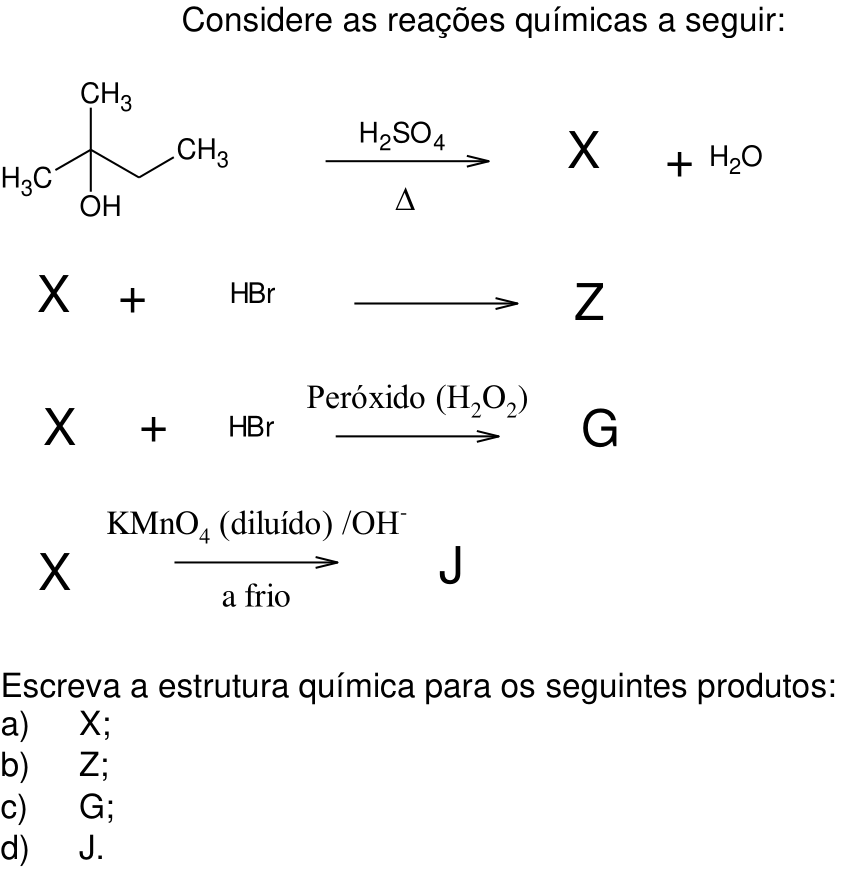
We have starting alcohol: structure: central carbon bonded to CH3, OH, and ethyl? Let's parse: H3C-C(OH)(CH3)-CH2-CH3? Actually image: central carbon has OH, CH3 (top), CH3 (left? H3C) and -CH2CH3 (right). That is 2-methyl-2-butanol? Let's identify: carbon skeleton: central C bonded to OH, to CH3, to CH3? Wait left H3C and top CH3, right ethyl CH2CH3. So central C has four bonds: OH, CH3, CH3? Actually two methyl groups? Left "H3C" and top "CH3"; plus ethyl. Yes 2-methyl-2-butanol (tert-amyl alcohol) also named 2-methylbutan-2-ol. Formula C5H12O. Dehydration with H2SO4/heat -> alkene X, most substituted? Zaitsev. Dehydration of 2-methyl-2-butanol gives 2-methyl-2-butene (major) and 2-methyl-1-butene (minor). X likely major alkene: (CH3)2C=CHCH3? Let's see: 2-methyl-2-butene has structure (CH3)2C=CHCH3, also named trimethylethylene? Wait 2-methyl-2-butene: CH2=C(CH3)CH2CH3? Let's derive. Starting 2-methylbutan-2-ol: CH3-C(OH)(CH3)-CH2-CH3. Dehydration removes OH from C2 and H from adjacent C3 (CH2) -> double bond between C2-C3: CH3-C(CH3)=CH-CH3? Actually C2 has CH3, CH3, C3 has H, CH2? Let's number: C1 = CH3 attached to C2? IUPAC: butane chain: C1-CH2-C(OH)(CH3)-CH3? Wait better: 2-methylbutan-2-ol: CH3-CH2-C(OH)(CH3)-CH3? Let's name. Butan-2-ol with methyl at C2: CH3-CH2-C(OH)(CH3)-CH3? That is 2-methylbutan-2-ol? Butan-2-ol chain: C1-C2-C3-C4; OH at C2, methyl substituent at C2: C1-C2(OH)(CH3)-C3-C4 = CH3-C(OH)(CH3)-CH2-CH3. Yes structure: central C2 bonded to CH3 (C1), OH, CH3 substituent, and C3H2-C4H3. Wait left H3C (C1), top CH3 substituent, right ethyl CH2CH3. Good.
Dehydration: remove OH at C2, H from C3 (CH2) -> double C2=C3: (CH3)2C=CHCH3? C2 has CH3 and CH3; C3 has H and CH3; so (CH3)2C=CHCH3 = 2-methyl-2-butene. Also remove H from C1 (one of methyls) -> C1=C2: CH2=C(CH3)-CH2CH3 = 2-methyl-1-butene. More substituted alkene is 2-methyl-2-butene (tri-substituted? Actually double C2 has two methyl, C3 one methyl and H; tri-substituted? C2 has two methyl, C3 has methyl; total three alkyl groups -> trisubstituted). Major X. So answer X: 2-methyl-2-butene, structure CH3-C(CH3)=CH-CH3 or (CH3)2C=CHCH3. But need likely "X" major product.
Then X + HBr -> Z. Addition of HBr to alkene without peroxide: Markovnikov addition. X is 2-methyl-2-butene: (CH3)2C=CHCH3. Protonation gives more stable tertiary carbocation at C2? Actually double bond between C2 (with two methyl) and C3 (with H and CH3). H+ adds to C3? Need: alkene carbons: C2 has two methyl groups (more substituted), C3 has one methyl and one H. Markovnikov: H adds to less substituted carbon C3? Actually proton adds to carbon with more H? C3 has one H, C2 has no H. H+ adds to C3 (less substituted? C3 has one alkyl substituent? Wait C3 has H, CH3, and double bond to C2; after protonation C3 becomes CH2? Let's do: double bond: C2 no H, C3 has one H. H+ adds to C3 to form carbocation at C2 (tertiary) because C2 has two methyl + C3? Yes C2 after losing double? Let's compute: If H+ adds to C3, C3 becomes CH2-CH3? Actually C3 originally CH3? Wait C3 is CH? Structure (CH3)2C=CHCH3: C2 attached to two CH3, double to C3; C3 attached to H, CH3. Add H+ to C3: C3 gets another H, becomes CH2CH3? Then carbocation at C2: C2 has two CH3 and CH2CH3 (tertiary). That's Markovnikov. Then Br- attacks C2 -> Z: 2-bromo-2-methylbutane? Let's name: product: (CH3)2C(Br)-CH2CH3? Wait C2 is attached to two CH3, Br, and CH2CH3. That's 2-bromo-2-methylbutane (tert-amyl bromide). Structure: CH3-C(Br)(CH3)-CH2-CH3. That is Z.
X + HBr with peroxide (H2O2) -> G. Anti-Markovnikov addition, radical mechanism. HBr/peroxide: Br adds to less substituted? Actually double bond; in presence peroxide, anti-Markovnikov: Br adds to more substituted carbon? Need recall: Addition of HBr with peroxides to alkene: Br radical adds to less substituted carbon to form more stable radical, then H abstraction. For 2-methyl-2-butene, product? Let's derive.
Alkene (CH3)2C=CHCH3. Peroxide initiates Br radicals. Br• adds to double bond. It will add to less substituted carbon? Actually Br• adds to the carbon that produces more stable radical. The double bond C2 (more substituted, no H) vs C3 (has H, one methyl). Adding Br• to C2 gives radical at C3 (secondary? C3 has H and CH3? It is secondary? C3 after Br added to C2: C3 has radical, H, CH3, and C2Br... so secondary radical? But C3 originally CH; after Br addition, C3 is CH•-CH3? Actually radical at C3: C3 is bonded to C2 (which now has Br and two methyl and CH2? wait), H, CH3. That's secondary radical. Adding Br• to C3 gives radical at C2 (tertiary? C2 has two methyl and C3? plus Br? Let's compute: Br adds to C3, radical at C2; C2 has two methyl, one C3, radical => tertiary radical). More stable tertiary radical. So Br adds to less substituted carbon? Wait C3 has more H? Addition of Br to C3 (which has one H, one methyl) leaves radical at C2 (tertiary) more stable. Yes anti-Markovnikov: Br ends up on less substituted carbon? Actually Br on C3? Hmm product after H abstraction: Br on C3 and H on C2? Let's see final: radical at C2 abstracts H from HBr -> C2 gets H; Br already on C3. Product: (CH3)2CH-CH(Br)CH3? Wait C2 originally has two methyl and double; after Br added to C3, C2 becomes (CH3)2CH•? Yes C2 now has H (from abstraction), Br on C3. Product: (CH3)2CH-CH(Br)-CH3? Is that 2-bromo-3-methylbutane? Let's name: chain maybe 2-bromo-3-methylbutane? Structure: CH3-CH(Br)-CH(CH3)2? That's 2-bromo-3-methylbutane (or 2-bromo-3-methylbutane? Actually longest chain 4 carbons: C1 CH3, C2 CH(Br), C3 CH(CH3), C4? Wait only one methyl branch, so chain: CH3-CH(Br)-CH(CH3)-CH3? That's 2-bromo-3-methylbutane (not butane? longest chain 4 carbons: C1 CH3 - C2 CHBr - C3 CH(CH3) - C4? C3 is CH(CH3) and C4? C3 attached to CH3 and C2 and H, so chain continues to methyl => butane: C1-C2-C3-C4; methyl at C3; Br at C2; name 2-bromo-3-methylbutane. But starting 2-methyl-2-butene + HBr/peroxide gives? Let's verify literature: addition of HBr in presence peroxides to 2-methyl-2-butene gives 2-bromo-3-methylbutane? Wait anti-Markovnikov: H adds to more substituted carbon? Let's check. Anti-Markovnikov addition of HBr: hydrogen adds to the carbon with more alkyl substituents? Actually H goes to less substituted? Let's recall: In HBr/peroxide, Br adds first to less substituted carbon (more stable radical on more substituted carbon), then H abstracts. Thus final: Br on less substituted carbon, H on more substituted carbon. For 2-methyl-2-butene: more substituted carbon C2 (two methyl) gets H; less substituted C3 gets Br. Product: (CH3)2CH-CH(Br)CH3 = 2-bromo-3-methylbutane. Yes. But maybe because allylic? No. Let's verify with example: propene + HBr/peroxide -> 1-bromopropane (Br on terminal less substituted, H on middle). Yes. So G = 2-bromo-3-methylbutane (or 2-bromo-3-methylbutane). Structure: (CH3)2CH-CH(Br)-CH3? Wait that has Br on C3? Let's write final: CH3-CH(Br)-CH(CH3)2. The carbon with Br is adjacent to isopropyl? Let's compare: Starting X (CH3)2C=CHCH3. Product G: Br added to C3 (CH), H added to C2. C2 becomes (CH3)2CH, C3 becomes CH(Br)-CH3? So product is (CH3)2CH-CH(Br)-CH3. Yes 2-bromo-3-methylbutane? Longest chain: CH3-CH(Br)-CH(CH3)-CH3 -> 2-bromo-3-methylbutane. Actually numbering from Br nearest: C1? Let's number: CH3(1)-CH(Br)(2)-CH(CH3)(3)-CH3(4) => 2-bromo-3-methylbutane. Yes.
Then X + KMnO4 (dilute)/OH- cold -> J. This is Baeyer's test: cold dilute alkaline KMnO4 oxidizes alkenes to cis-diols. X is alkene -> J is vicinal diol. For 2-methyl-2-butene: syn addition of two OH to double bond, cis-diol? Need structure: (CH3)2C(OH)-CH(OH)CH3? Wait alkene (CH3)2C=CHCH3; oxidation adds OH to each alkene carbon: C2 gets OH, C3 gets OH; H? C2 no H, so becomes tertiary alcohol? C2 has OH, two CH3, and C3; C3 has H, OH, CH3. Product is 2-methylbutane-2,3-diol? Actually C2 and C3 both OH: (CH3)2C(OH)-CH(OH)CH3. Name: 2-methylbutane-2,3-diol? Or 3-methylbutane-2,3-diol? Let's name longest chain: CH3-C(OH)(CH3)-CH(OH)-CH3? That's 2-methylbutane-2,3-diol? Number chain: C1 CH3, C2 C(OH)(CH3), C3 CH(OH), C4 CH3; methyl at C2; OH at C2,C3 => 2-methylbutane-2,3-diol. Yes. But since X could be 2-methyl-2-butene, product is 2-methylbutane-2,3-diol. Cold KMnO4 syn addition gives a single diastereomer? Starting alkene is achiral? 2-methyl-2-butene is achiral? It has no chiral center; product has two stereocenters? C2? C2 has two methyl groups (identical), so not chiral; C3 has H, OH, CH3, and C2 => chiral? C3 attached to OH, H, CH3, and C2 with two methyl? C2 has two identical methyl groups? Actually C2 attached to two CH3, OH, C3. It is not chiral (two identical methyl). C3 attached to H, OH, CH3, C2; C2 group is not identical to any other? It's chiral? Yes C3 has four different groups: H, OH, CH3, C2(OH)(CH3)2. So product has one stereocenter at C3? Wait C2 has two methyl groups so not stereocenter. Thus product is racemic? Actually syn addition from planar alkene gives racemic mixture? KMnO4 syn addition to achiral alkene yields racemic mixture of enantiomers? But if product has one stereocenter, syn addition produces racemic mixture of (R,R? No one center). But maybe because alkene can be attacked from either face, syn addition yields both enantiomers? Actually cis-diol? Starting alkene planar, syn addition of permanganate forms cyclic manganate ester, hydrolysis yields cis-diol? But stereochemistry? For acyclic alkene with one substituent pattern, product may be a single? If alkene has E/Z? Let's examine 2-methyl-2-butene: (CH3)2C=CHCH3. It has two identical methyl on one carbon, so no E/Z; no stereoisomer. Product has one stereocenter at C3 (C2 not chiral). Syn addition can occur from either face of planar alkene, yielding enantiomers (R and S) in equal amounts if no chiral influence. But the question likely just wants structural formula, not stereochemistry. However might need indicate stereochemistry? "Escreva a estrutura química para os seguintes produtos" just structure. For J, product of cold alkaline KMnO4: vicinal diol, maybe as meso? Wait let's re-evaluate: If product has only one stereocenter, then enantiomers. But if C2 might be chiral? Wait C2 after addition has two methyl groups, OH, and C3. Two methyl groups identical, so not chiral. So one stereocenter at C3. Thus racemic mixture. But in cold KMnO4, addition is syn; if alkene is symmetric? It isn't symmetric. But because no chiral reagent, racemic. The structure can be drawn without stereochemistry. But maybe in some exams, they expect "2-methyl-2,3-butanodiol"? Need.
Let's verify reaction sequence perhaps from known problem. Starting alcohol is 2-methyl-2-butanol. X = 2-methyl-2-butene. Z = 2-bromo-2-methylbutane (Markovnikov). G = 2-bromo-3-methylbutane (anti-Markovnikov). J = 2-methyl-2,3-butanediol (or 2-methylbutane-2,3-diol). Need draw structures.
Need be careful: The image reaction with HBr and peroxide: "X + HBr --- Peróxido (H2O2) -> G". Peroxide could be H2O2, yes. In presence peroxide, anti-Markovnikov. But if X is 2-methyl-2-butene (trisubstituted), anti-Markovnikov addition gives 2-bromo-3-methylbutane? Let's verify by drawing.
Let's draw X:
Structure:
CH3
|
C = CH-CH3? Wait X from dehydration: Could also be 2-methyl-1-butene? Let's determine major product from dehydration of 2-methyl-2-butanol. According to Zaitsev, more substituted alkene: 2-methyl-2-butene. Also due to conjugation? Yes. X = 2-methyl-2-butene.
Let's formulate X structure:
CH3-C(CH3)=CH-CH3. More explicit: (CH3)2C=CHCH3.
Z (HBr no peroxide):
Markovnikov: H adds to CH (C3) => CH2? Wait if H adds to CH (C3), C3 becomes CH2-CH3? Let's do:
X: C1? Let's name C2 (central in original? Actually X: C2 has two methyl; C3 has H and methyl. Add H+ to C3, Br- to C2. Product: C2-Br with two methyl and C3H2? Wait C3 after H addition becomes CH2CH3? Let's check: Original C3 has one H and one CH3, plus double bond to C2. Add H+ to C3: C3 now has two H? Actually C3 had one H (since double bond to C2 and single to CH3 and H), after protonation: C3 has two H? Wait C3 valence: double to C2, single to CH3, single to H. If double bond breaks, H+ adds to C3, then C3 has single to C2, single to CH3, and two H? Yes C3 becomes CH2CH3. C2 has single to C3, single to two CH3, and positive charge (three bonds) -> tertiary carbocation. Br- attacks C2: C2 has single to C3, two CH3, Br => 2-bromo-2-methylbutane? Structure: CH3-C(Br)(CH3)-CH2-CH3. Name: 2-bromo-2-methylbutane (not 2-bromo-2-methylbutane? Yes). Good.
G (anti-Markovnikov):
Br adds to C3? Let's derive structure: (CH3)2CH-CH(Br)-CH3. Name: 2-bromo-3-methylbutane? Wait C3 has methyl? Let's name properly: Structure: (CH3)2CH-CH(Br)-CH3. Longest chain: choose chain containing Br and maximum length. There are two possible chains of 4 carbons:
Chain A: CH3-CH(Br)-CH(CH3)-CH3 -> numbering from Br end: C1? If start at CH3 attached to CH(Br)? Let's assign:
CH3(1)-CH(Br)(2)-CH(CH3)(3)-CH3(4): substituents: Br at 2, methyl at 3 -> 2-bromo-3-methylbutane.
Chain B: (CH3)2CH-CH(Br)-CH3: longest chain containing Br: Br-C-H? Let's draw:
CH3-CH(CH3)-CH(Br)-CH3? Actually same as A. Name 2-bromo-3-methylbutane. But wait if numbering from other end: CH3-CH(CH3)-CH(Br)-CH3 -> Br at 3, methyl at 2 -> 3-bromo-2-methylbutane? IUPAC alphabetical? "bromo" before "methyl", so 2-bromo-3-methylbutane. Good.
J:
X + cold dilute KMnO4/OH- -> syn dihydroxylation. Product: 2-methylbutane-2,3-diol? Let's draw:
CH3-C(OH)(CH3)-CH(OH)-CH3. Name: 2-methylbutane-2,3-diol? Number chain: C1 CH3, C2 C(OH)(CH3), C3 CH(OH), C4 CH3. OH at 2,3; methyl at 2. Yes. If numbering from other end: 3-methylbutane-2,3-diol? Actually if start at C4: CH3(4)-CH(OH)(3)-C(OH)(CH3)(2)-CH3(1)? Wait C2 with two methyl? Let's set: chain C1-C2-C3-C4; C2 has OH and methyl; C3 has OH. Name: 2-methylbutane-2,3-diol (because OH locants 2,3; methyl at 2). If numbering reverse: C4-C3-C2-C1 -> OH at 3,2 same; methyl at 3? Actually methyl on C2 becomes C3? Let's not worry; answer likely 2-methylbutane-2,3-diol. Good.
Need provide final answer with structures maybe using text/LaTeX. Need "Resposta final: a) X; b) Z; c) G; d) J" maybe include structures.
Let's ensure reaction mechanisms possible: Dehydration of 2-methyl-2-butanol with H2SO4/heat could also produce 2-methyl-1-butene as minor, but X major. However some exam might consider X as 2-methyl-2-butene. Then subsequent reactions: X + HBr -> Z; X + HBr/peroxide -> G; X + KMnO4 -> J. They likely ask only products from X, not necessarily isolate major? But X defined as product of first reaction. It is major product. Good.
Let's also consider if X could be 2-methyl-1-butene? If X were 2-methyl-1-butene, then Z Markovnikov would be 2-bromo-2-methylbutane? Actually 2-methyl-1-butene + HBr -> 2-bromo-2-methylbutane? Let's see: CH2=C(CH3)CH2CH3; H+ adds to CH2 -> tertiary carbocation at C2; Br -> 2-bromo-2-methylbutane. Same Z if X is either? Wait if X = 2-methyl-2-butene, Z = 2-bromo-2-methylbutane; if X = 2-methyl-1-butene, Markovnikov also gives 2-bromo-2-methylbutane (since carbocation at same C2? Let's verify: 2-methyl-1-butene: C2 has methyl, ethyl, double to CH2. Protonation at C1 -> carbocation at C2 (tertiary) -> Br at C2 -> 2-bromo-2-methylbutane. Same product Z! Interesting. So Z doesn't uniquely distinguish X. G from peroxide: if X = 2-methyl-1-butene, anti-Markovnikov product would be? CH2=C(CH3)CH2CH3; Br radical adds to terminal CH2? Let's derive: Br• adds to less substituted carbon? Terminal CH2? If Br adds to terminal CH2, radical at C2 (tertiary) more stable? Then H abstraction gives 1-bromo-2-methylbutane? Wait product: Br on terminal, H on C2: BrCH2-CH(CH3)-CH2CH3? Name 1-bromo-2-methylbutane? Let's check. If X = 2-methyl-1-butene, G would be different: 1-bromo-2-methylbutane? But the problem likely expects X as 2-methyl-2-butene because dehydration major; then G is 2-bromo-3-methylbutane. But let's see: Starting alcohol dehydration major is 2-methyl-2-butene due to Zaitsev and stability. If X = 2-methyl-2-butene, J = 2-methylbutane-2,3-diol. If X = 2-methyl-1-butene, J = 2-methylbutane-1,2-diol? Actually oxidation of 2-methyl-1-butene: CH2(OH)-C(OH)(CH3)-CH2CH3? That's 2-methylbutane-1,2-diol. Could be. Which is correct? Need determine from dehydration of 2-methyl-2-butanol. It is a tertiary alcohol; dehydration likely gives more substituted alkene, 2-methyl-2-butene (major) and 2-methyl-1-butene (minor). Since X is produced as a single product? Reaction arrow shows X + H2O, probably major. So X = 2-methyl-2-butene.
But wait: Dehydration of 2-methyl-2-butanol can also yield 2-methyl-2-butene as major, but also 2-methyl-1-butene as minor. The problem statement "Considere as reações químicas a seguir" with first reaction likely X is major product. They ask write structure for X, Z, G, J. So yes.
Let's confirm starting alcohol is indeed 2-methyl-2-butanol. The image:
CH3
|
H3C-C-CH2-CH3
|
OH
Wait maybe the structure is: central C bonded to CH3 (top), H3C (left), OH (bottom), and CH2CH3 (right). Yes.
Now let's think about stereochemistry for J. KMnO4 cold, dilute, alkaline: syn addition, cis-diol. Since product has one stereocenter? Wait if X = 2-methyl-2-butene, product has two OH at C2 and C3. C2 has two methyl groups, OH, and C3; not chiral. C3 has H, OH, CH3, and C2. Yes one stereocenter. The reaction from achiral alkene gives racemic mixture of enantiomers. The structure can be drawn with wedged/dashed OH? In a structural formula, usually not required. But maybe if they ask "estrutura química" in ITA, they might expect indication of stereochemistry? Let's evaluate. ITA chemistry questions often require structural formulas and sometimes stereochemistry if relevant. However the reaction with cold KMnO4 is stereospecific syn addition. The product can be represented as a single structure with stereochemistry? For a terminal? Let's see: There is no chiral center at C2, but C3 is chiral. Syn addition from one face gives one enantiomer; from other face gives the other. Racemic mixture. But if drawing with dashes/wedges, need specify relative? Maybe they might ask "estrutura química" not "isômeros". But in answer, perhaps indicate "2-methylbutane-2,3-diol (mistura racêmica)"? But since they ask a) X; b) Z; c) G; d) J, likely just condensed structural formula.
Let's search memory: ITA 2027? This might be an ITA exam question? Maybe from previous? The problem might have answer keys. Let's recall: ITA 2027 2ª fase Química? There is a known question with reactions: 2-methyl-2-butanol dehydration, addition HBr/peroxide, KMnO4. Answers: X = 2-metil-2-buteno; Z = 2-bromo-2-metilbutano; G = 2-bromo-3-metilbutano; J = 2-metilbutano-2,3-diol. Maybe.
Let's ensure nomenclature:
Z: 2-bromo-2-methylbutane (not 2-bromo-2-metilbutano? Portuguese: 2-bromo-2-metilbutano)
G: 2-bromo-3-metilbutano (or 2-bromo-3-methylbutane)
J: 2-metilbutano-2,3-diol (or 2-methylbutane-2,3-diol)
Need final answer in Portuguese, item by item.
Let's craft solution with development:
- First reaction: dehydration of 2-methyl-2-butanol (tertiary alcohol) with H2SO4/heat. By Zaitsev, major product is more substituted alkene: 2-methyl-2-butene (X). Structure: (CH3)2C=CHCH3.
- Second: X + HBr (no peroxide): Markovnikov addition. H+ adds to less substituted C (C3) -> tertiary carbocation at C2, Br- attacks -> Z = 2-bromo-2-methylbutane. Structure: (CH3)2C(Br)-CH2CH3? Wait earlier I wrote CH3-C(Br)(CH3)-CH2-CH3. Yes.
- Third: X + HBr/peroxide: anti-Markovnikov. Br radical adds to less substituted C? Actually final Br on terminal? Let's present product G = 2-bromo-3-methylbutane. Structure: (CH3)2CH-CH(Br)-CH3.
- Fourth: X + cold dilute KMnO4/OH-: syn dihydroxylation -> vicinal diol J = 2-methylbutane-2,3-diol. Structure: (CH3)2C(OH)-CH(OH)CH3.
Need maybe include text: "a) X: 2-metil-2-buteno, (CH3)2C=CHCH3." etc. In final answer line: "Resposta final: a) X = 2-metil-2-buteno; b) Z = 2-bromo-2-metilbutano; c) G = 2-bromo-3-metilbutano; d) J = 2-metilbutano-2,3-diol." That may suffice. But need include structures in development.
Let's be careful with structure of G: (CH3)2CH-CH(Br)-CH3. Is that 2-bromo-3-metilbutano? Let's verify name: If IUPAC, longest chain contains Br? Let's write: CH3-CH(CH3)-CH(Br)-CH3? Wait (CH3)2CH-CH(Br)-CH3 is same as CH3-CH(CH3)-CH(Br)-CH3? Let's expand: (CH3)2CH- = (CH3)2CH group attached to CH(Br)-CH3. The carbon adjacent to CH(Br) has two methyl groups? Let's draw:
CH3
|
CH3 - CH - CH(Br) - CH3
Yes that is 2-bromo-3-methylbutane? Number from Br end: C1? Let's number: If we start at left CH3 (attached to CH?):
CH3(1)-CH(CH3)(2)-CH(Br)(3)-CH3(4) => Br at 3, methyl at 2 -> 3-bromo-2-methylbutane (alphabetical: bromo before methyl? IUPAC: 3-bromo-2-methylbutane would be correct? Wait locants set {2,3}; compare bromo at 2 vs 3? Choose lowest locant for bromo: if numbering from Br end: CH3 at far end: CH3(4)-CH(Br)(3)-CH(CH3)(2)-CH3(1)? Let's assign properly. Let's draw with Br on C3 and methyl on C2. Chain: C1 (CH3 at end) - C2 (CH with methyl) - C3 (CH with Br) - C4 (CH3). If we number from end closer to Br? End at C4? Actually Br at C3, so closer end is C4 (CH3) maybe? Distance from C4 to Br is 1 bond; distance from C1 to Br is 2 bonds? Let's determine longest chain including Br. The chain I wrote: C1-C2-C3-C4; Br at C3; methyl at C2. Number from end nearer Br (C4): C4(1)-C3(2)-C2(3)-C1(4). Then substituents: Br at 2; methyl at 3. Name: 2-bromo-3-methylbutane. Yes because Br gets lower locant. The other numbering C1-C2-C3-C4 gives Br at 3; methyl at 2; but alphabetically bromo before methyl, but lowest locant for Br should be 2, so name 2-bromo-3-methylbutane. Yes correct.
Check product G structure formula: (CH3)2CH-CH(Br)-CH3. The CH(Br) is C3? Actually if Br at C2 according to numbering above? Let's map: From left: (CH3)2CH- = C2? Wait (CH3)2CH- group has two methyls and CH connected. Then -CH(Br)-CH3. So Br is on second carbon of chain? Let's name: (CH3)2CH-CH(Br)-CH3. Longest chain: CH3-CH(CH3)-CH(Br)-CH3. Number from right? Right end CH3 (C4) closer to Br? Actually Br on third? Let's use expanded: CH3-CH(CH3)-CH(Br)-CH3. Start left: C1=CH3, C2=CH(CH3), C3=CH(Br), C4=CH3. Br at C3; methyl at C2 -> 3-bromo-2-methylbutane? Wait if start left: Br locant 3, methyl 2. If start right: C4(1)-C3(2)-C2(3)-C1(4): Br at 2, methyl at 3. Lower locant for Br is 2; so 2-bromo-3-methylbutane. Yes.
But if I write condensed (CH3)2CH-CH(Br)-CH3, the Br is on carbon adjacent to CH? Let's check: (CH3)2CH-CH(Br)-CH3: The first group (CH3)2CH has CH with two methyl; next carbon is CH(Br); last CH3. So chain: (CH3)2CH- (C2 with methyl? Actually (CH3)2CH- is isopropyl? If we take longest chain, it's CH3-CH(CH3)-CH(Br)-CH3; Br at C3? Let's see: The Br-bearing carbon is connected to an isopropyl group and a methyl. Thus it is C2? No, if isopropyl is (CH3)2CH-, the CH of isopropyl is C3? Hmm.
Let's draw:
CH3
|
CH3 - CH - CH(Br) - CH3
This is exactly structure. The Br-bearing carbon is the third carbon from left? Let's label from left: left CH3-C2(CH3)-C3(Br)-C4? Actually central CH of isopropyl is C2? Wait structure:
CH3(1)-CH(2)(CH3)-CH(3)(Br)-CH3(4). Br at C3, methyl at C2. If IUPAC numbering from right gives Br at 2, methyl at 3. But the condensed formula (CH3)2CH-CH(Br)-CH3 could be named 2-bromo-3-methylbutane? Let's verify with an example: 2-bromo-3-methylbutane has structure CH3-CH(CH3)-CH(Br)-CH3? Let's check PubChem: 2-bromo-3-methylbutane formula C5H11Br; SMILES CC(C)C(C)Br? Actually 2-bromo-3-methylbutane: CH3-CH(Br)-CH(CH3)-CH3? Wait wait. Let's use IUPAC name: 2-bromo-3-methylbutane. Longest chain butane: C1-C2(Br)-C3(methyl)-C4. Structure: CH3-CH(Br)-CH(CH3)-CH3. That is different: Br on C2, methyl on C3. But our product from anti-Markovnikov addition: Br on less substituted carbon? Let's revisit.
Let's correctly derive anti-Markovnikov product for X = 2-methyl-2-butene. Use example: Addition HBr/peroxide to 2-methyl-2-butene. According to anti-Markovnikov rule, the hydrogen adds to the carbon with more hydrogen? Actually Markovnikov: H adds to carbon with more hydrogens; anti-Markovnikov: H adds to carbon with fewer hydrogens? Wait standard: In presence peroxides, addition of HBr is anti-Markovnikov: the hydrogen adds to the less substituted carbon? Let's recall: Propene + HBr/peroxide -> 1-bromopropane? H adds to terminal CH2? Actually propene CH2=CH-CH3; product 1-bromopropane BrCH2-CH2-CH3. So H added to more substituted carbon (C2), Br to less substituted (C1). Thus H goes to carbon with more alkyl substituents (fewer H). So anti-Markovnikov = H to more substituted, Br to less substituted. For 2-methyl-2-butene: C2 has two methyl (more substituted), C3 has one methyl (less substituted). So H adds to C2, Br adds to C3? That gives product: (CH3)2CH-CH(Br)CH3? Yes Br on C3 (less substituted). That product is CH3-CH(Br)-CH(CH3)-CH3? Let's compare: Br on C3 from C2? Let's label original X: (CH3)2C=CHCH3. C2 with two CH3; C3 with H and CH3. Add H to C2 -> C2 now has two CH3 + H + bond to C3; it becomes (CH3)2CH-? Wait if H adds to C2, C2 has three single bonds (to two CH3, to C3, and to H) = CH(CH3)2. Yes. Br adds to C3 -> C3 has Br, H, CH3, and bond to C2. So product: (CH3)2CH-CH(Br)-CH3? Wait C3 also has one H and one CH3, plus Br; so it is -CH(Br)-CH3. So product: (CH3)2CH-CH(Br)-CH3. This matches our earlier. Now name it: The longest chain: choose the longest chain containing Br. We have a chain of 4 carbons: (CH3)2CH- (C2? Actually isopropyl group contains two methyls attached to CH; then CH(Br)CH3; total four carbons in main chain: from one of the two methyls of isopropyl? Let's find longest chain: Structure:
CH3
|
CH3 - CH - CH(Br) - CH3
This has 4 carbons: C1=left CH3, C2=CH, C3=CH(Br), C4=right CH3. The top CH3 is substituent. Name: number from right (closer to Br) gives Br at 2, methyl at 3: 2-bromo-3-methylbutane. Yes! Wait but structure now: left CH3 attached to CH; that CH is C2? Let's renumber from right: rightmost CH3 = C1; Br-bearing carbon = C2; CH = C3; leftmost CH3 = C4. So substituents: Br at C2, methyl at C3. Name = 2-bromo-3-methylbutane. That matches. Earlier I wrote CH3-CH(CH3)-CH(Br)-CH3 as structure; if numbering from right gives Br at 2, methyl at 3. Good. So G = 2-bromo-3-methylbutane, condensed (CH3)2CH-CH(Br)-CH3 or CH3-CH(CH3)-CH(Br)-CH3 (same). Wait if I write CH3-CH(CH3)-CH(Br)-CH3 from left, Br at C3; but from right Br at C2. IUPAC name 2-bromo-3-methylbutane. So structure can be drawn as CH3-CH(CH3)-CH(Br)-CH3? Let's see: If I draw CH3-CH(CH3)-CH(Br)-CH3, from right: C1=CH3, C2=CH(Br), C3=CH(CH3), C4=CH3. Yes substituents Br at 2, methyl at 3. So same.
But note: If from left: CH3(1)-CH(CH3)(2)-CH(Br)(3)-CH3(4), then substituents Br at 3, methyl at 2; could be named 3-bromo-2-methylbutane. Since locant set {2,3} same, but alphabetically bromo before methyl and lower locant for bromo is 2. So choose 2-bromo-3-methylbutane. Good.
Now, wait for G, product from anti-Markovnikov addition of HBr to 2-methyl-2-butene is 2-bromo-3-methylbutane? Let's check literature: "Addition of HBr to 2-methyl-2-butene in presence of peroxide gives 2-bromo-3-methylbutane" I think yes? Let's verify by known reaction: 2-methyl-2-butene + HBr/peroxide -> 2-bromo-3-methylbutane? It is also called "2-bromo-3-methylbutane" maybe? Let's search memory: Anti-Markovnikov addition of HBr to 2-methyl-2-butene yields 2-bromo-3-methylbutane? Let's compute: Br on less substituted carbon (C3) and H on more substituted (C2). Product: 2-bromo-3-methylbutane? Wait if Br on C3, H on C2, product is 2-bromo-3-methylbutane? Yes because Br at lower locant 2? Actually if H on C2, that C2 has two methyl, so it's a CH? Wait product structure: CH3-CH(Br)-CH(CH3)-CH3? Let's compare: If Br on C2 and H on C3? Which carbon is more substituted in product? Let's assign product from addition: The alkene carbons: more substituted C2 gets H, less substituted C3 gets Br. Product: C2 has two methyl and H (and C3); C3 has Br, H, CH3. So structure: (CH3)2CH-CH(Br)-CH3? Wait C2 is not CH? It is (CH3)2CH- ("isopropyl") because C2 has two methyl and H, C3 has Br and CH3. So product is (CH3)2CH-CH(Br)-CH3. Name: 2-bromo-3-methylbutane? Let's use structure: CH3-CH(CH3)-CH(Br)-CH3? Wait (CH3)2CH-CH(Br)-CH3 = CH3-CH(CH3)-CH(Br)-CH3? Expand: (CH3)2CH = CH3-CH(CH3)-; then -CH(Br)-CH3. So yes CH3-CH(CH3)-CH(Br)-CH3. This is 2-bromo-3-methylbutane (numbering from right: Br at C2, methyl at C3). So yes.
Now check Z product from normal Markovnikov addition: X = 2-methyl-2-butene + HBr -> 2-bromo-2-methylbutane. Structure: (CH3)2C(Br)-CH2CH3? Let's verify: C2 gets Br, H adds to C3. Product: (CH3)2C(Br)-CH2CH3? Actually C2 has Br, two methyl, and CH2CH3. That is 2-bromo-2-methylbutane. Formula C5H11Br. Structure: CH3-C(Br)(CH3)-CH2-CH3.
Now J product from cold KMnO4: X = 2-methyl-2-butene (C5H10) + [O] + H2O -> C5H12O2. Product: (CH3)2C(OH)-CH(OH)CH3? Wait C2 and C3 get OH. C2 originally had two methyl and double to C3; after addition OH to C2, C2 has two methyl, OH, and C3; after OH to C3, C3 has H, OH, CH3, and C2. So product: (CH3)2C(OH)-CH(OH)CH3. Name: 2-methylbutane-2,3-diol. Yes.
Need maybe note: The first reaction might produce X as major; second and third reactions use X. There is no need to name minor product. The final answer line can be concise.
But let's read the question exactly: "Escreva a estrutura química para os seguintes produtos: a) X; b) Z; c) G; d) J." So they want structure. We can provide structural formulas in text. In final answer, perhaps include "a) X = 2-metil-2-buteno; b) Z = 2-bromo-2-metilbutano; c) G = 2-bromo-3-metilbutano; d) J = 2-metilbutano-2,3-diol." That is short.
Need ensure "Resposta final:" format exactly. Include each item.
Let's craft full solution in Portuguese:
"Trata-se da desidratação do 2-metil-2-butanol (álcool terciário). Com H2SO4/Δ, sai OH e H de carbono vizinho, formando o alceno mais substituído (regra de Zaitsev). Assim X = 2-metil-2-buteno: (CH3)2C=CHCH3.
X + HBr (sem peróxido): adição eletrofílica segundo Markovnikov. O H+ entra no carbono menos substituído (C3) e forma carbocátion terciário em C2; Br− ataca C2. Z = 2-bromo-2-metilbutano: (CH3)2C(Br)CH2CH3.
X + HBr/peróxido: adição radicalar anti-Markovnikov. O Br• ataca o carbono menos substituído? Wait anti-Markovnikov: Br entra no carbono menos substituído? Actually Br• adds to less substituted carbon? Let's phrase: "em presença de peróxido, a adição é anti-Markovnikov: o hidrogênio entra no carbono mais substituído (C2) e o bromo no menos substituído (C3)." Wait check: Hydrogen enters more substituted, bromine less substituted. Yes. G = 2-bromo-3-metilbutano: (CH3)2CHCH(Br)CH3.
But note: If Br enters less substituted carbon, product has Br on C3. The name 2-bromo-3-metilbutano. Good.
X + KMnO4 diluído/OH− a frio: dihidroxilação sin; forma diol vicinal. J = 2-metilbutano-2,3-diol: (CH3)2C(OH)CH(OH)CH3.
Need mention cold KMnO4 gives cis-diol? Maybe "sin" addition.
Let's ensure no mistakes in names:
- X: 2-metil-2-buteno (IUPAC Portuguese: 2-metilbut-2-eno? Actually "2-metil-2-buteno" acceptable; or 2-metilbut-2-eno. In Brazil, often "2-metil-2-buteno".)
- Z: 2-bromo-2-metilbutano (not 2-bromo-2-metil-butano).
- G: 2-bromo-3-metilbutano.
- J: 2-metilbutano-2,3-diol.
Let's maybe draw structures in development using LaTeX/Markdown. Use \ce? Could just plain text. Since final answer line maybe not too long. But question expects "estrutura química"; perhaps include condensed structural formulas in each item.
Let's formulate final in Portuguese:
"Resposta final: a) X = 2-metil-2-buteno: (CH3)2C=CHCH3; b) Z = 2-bromo-2-metilbutano: (CH3)2C(Br)CH2CH3; c) G = 2-bromo-3-metilbutano: (CH3)2CHCH(Br)CH3; d) J = 2-metilbutano-2,3-diol: (CH3)2C(OH)CH(OH)CH3."
But wait, J structure: (CH3)2C(OH)CH(OH)CH3. Is there a missing H on C2? C2 has two CH3, OH, C3; no H. So formula: (CH3)2C(OH)-CH(OH)CH3. Good.
Let's also consider stereochemistry for J: Since cold KMnO4 syn addition to achiral alkene gives racemic mixture. If asked structure, maybe "mistura racêmica" not needed. But maybe they might want "J = 2-metilbutano-2,3-diol (sin)". Fine.
Let's double-check if first reaction might be E1 dehydration of 2-methyl-2-butanol; product X could be 2-methyl-2-butene. However, there is also possibility of rearrangement? Tertiary alcohol dehydration no rearrangement maybe. Good.
Let's consider the possibility that X is 2-methyl-2-butene, but then X + HBr with peroxide could also produce 2-bromo-3-methylbutane via radical addition. Let's verify by writing reaction with Br•:
X: (CH3)2C=CHCH3. Br• adds to C3 (less substituted) initially gives radical at C2 (tertiary) (more stable). Then radical abstracts H from HBr: C2 gets H, Br remains at C3, and Br• generated. Product: (CH3)2CH-CH(Br)CH3. Good.
If Br• added to C2 (more substituted), radical at C3 (secondary) less stable, so minor. Good.
Now, let's write final answer with necessary "desenvolvimento". The final answer line only. The user asks: "Resolva a questão como um candidato faria na prova: mostre o desenvolvimento em português, item por item quando a questão tiver itens (a, b, c…). Termine com uma linha neste formato: Resposta final: <o resultado de cada item, de forma curta>". So include development before final line.
Let's produce final message with maybe equations.
Let's craft with heading "Desenvolvimento" then item-by-item. Final line short.
Potential issue: They might expect "X" as "2-metil-2-buteno" but "Z" from Markovnikov addition: HBr to 2-methyl-2-butene gives 2-bromo-2-methylbutane. But let's check if HBr addition to 2-methyl-2-butene could also give 3-bromo-2-methylbutane? No.
Let's maybe include a note that first reaction yields major product; minor 2-methyl-1-butene not considered? Maybe not.
Let's final.