Correção ITA 2027 · QuímicaAcompanhe a resolução de cada questão da 2ª fase, ao vivoAcompanhar
IA ao vivo / ITA 2027 · 2ª fase · Química

COMPARE OS RACIOCÍNIOS

Questão 5 (Química)

Questão discursiva: a banca não divulga gabarito oficial. ← 4 (Química) 6 (Química) →

A questão

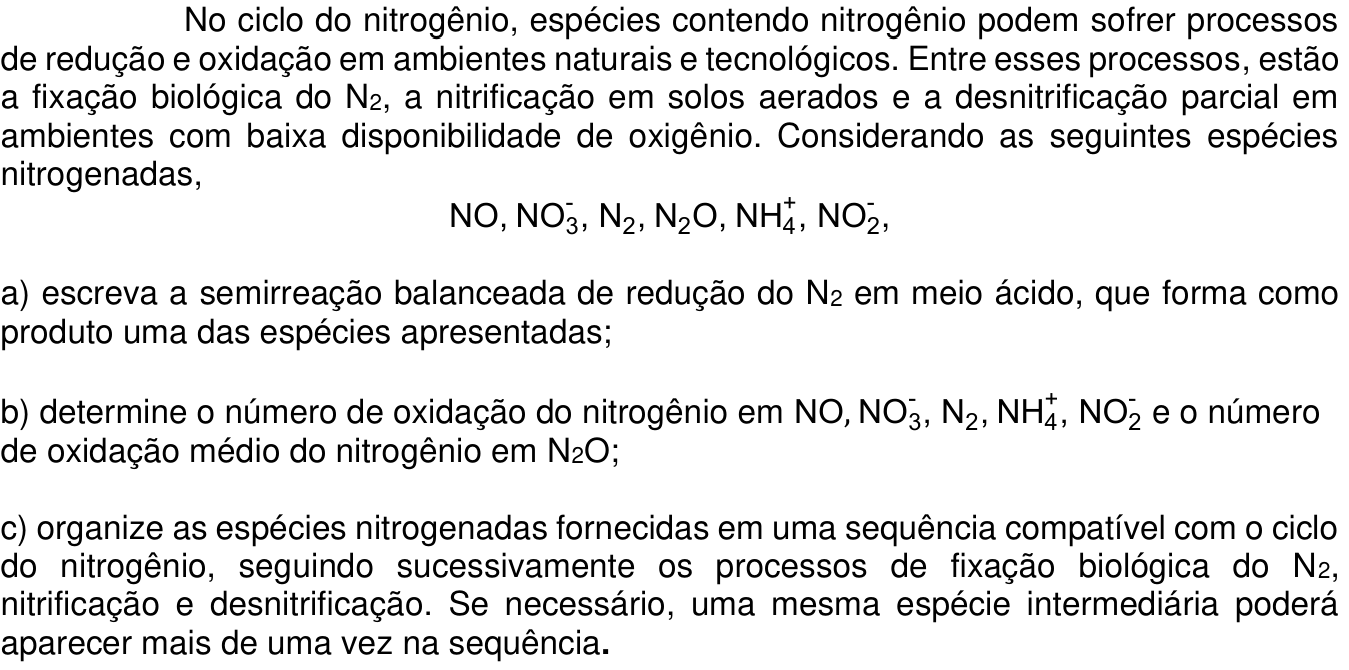
Texto de apoio da questão 5 (Química) Questão 5 (Química)

Respostas das IAs

GPT-6 Astra

Respondeu · mesma resposta final de outras 6 IAs

a) \mathrm{N_2+8H^++6e^-\rightarrow2NH_4^+}; b) NO: +2, NO₃⁻: +5, N₂: 0, NH₄⁺: -3, NO₂⁻: +3, N₂O: +1 (médio); c) \mathrm{N_2\rightarrow NH_4^+\rightarrow NO_2^-\rightarrow NO_3^-\rightarrow NO_2^-\rightarrow NO\rightarrow N_2O\rightarrow N_2}.

levou 28 s

Como pensou

a) Semirreação de redução do \mathrm{N_2}

Entre as espécies apresentadas, somente o \mathrm{NH_4^+} possui nitrogênio com número de oxidação inferior a zero. Na redução, cada átomo de N passa de 0 para -3, recebendo três elétrons. Portanto, em meio ácido:

\boxed{\mathrm{N_2+8H^++6e^-\longrightarrow 2NH_4^+}}

Os átomos estão balanceados e a carga total de cada membro é +2.

b) Números de oxidação

Considerando \mathrm{O}=-2, \mathrm{H}=+1 e a soma dos números de oxidação igual à carga da espécie:

Espécie Cálculo NOX do nitrogênio
\mathrm{NO} x-2=0 +2
\mathrm{NO_3^-} x+3(-2)=-1 +5
\mathrm{N_2} Substância simples 0
\mathrm{NH_4^+} x+4(+1)=+1 -3
\mathrm{NO_2^-} x+2(-2)=-1 +3
\mathrm{N_2O} 2x-2=0 +1 (médio)

c) Sequência no ciclo do nitrogênio

A fixação biológica reduz o nitrogênio molecular a nitrogênio amoniacal:

\mathrm{N_2\longrightarrow NH_4^+}.

A nitrificação oxida o amônio a nitrito e, depois, a nitrato:

\mathrm{NH_4^+\longrightarrow NO_2^-\longrightarrow NO_3^-}.

A desnitrificação reduz sucessivamente o nitrato, podendo chegar ao nitrogênio molecular:

\mathrm{NO_3^-\longrightarrow NO_2^-\longrightarrow NO \longrightarrow N_2O\longrightarrow N_2}.

Assim, a sequência completa é:

\boxed{\mathrm{N_2\longrightarrow NH_4^+\longrightarrow NO_2^- \longrightarrow NO_3^-\longrightarrow NO_2^-\longrightarrow NO \longrightarrow N_2O\longrightarrow N_2}}.

Resposta final: a) \mathrm{N_2+8H^++6e^-\rightarrow2NH_4^+}; b) NO: +2, NO₃⁻: +5, N₂: 0, NH₄⁺: -3, NO₂⁻: +3, N₂O: +1 (médio); c) \mathrm{N_2\rightarrow NH_4^+\rightarrow NO_2^-\rightarrow NO_3^-\rightarrow NO_2^-\rightarrow NO\rightarrow N_2O\rightarrow N_2}.

GPT-6.1 Sol

Respondeu · mesma resposta final de outras 6 IAs

a) \mathrm{N_2+8H^++6e^-\rightarrow2NH_4^+}; b) NO: +2, \mathrm{NO_3^-}: +5, \mathrm{N_2}: 0, \mathrm{NH_4^+}: -3, \mathrm{NO_2^-}: +3, \mathrm{N_2O}: +1 (médio); c) \mathrm{N_2\rightarrow NH_4^+\rightarrow NO_2^-\rightarrow NO_3^-\rightarrow NO_2^-\rightarrow NO\rightarrow N_2O\rightarrow N_2}.

levou 19 s

Como pensou
**Solving nitrogen equations** I'm tasked with solving a straightforward equation regarding nitrogen. For part a, the focus is on balancing the reaction with ammonium ions. In part b, I'll determine the calculations for various nitrogen species. Part c involves explaining processes like nitrogen fixation and nitrification, and I need to clarify the concept of denitrification. I'll make sure each equation balances correctly. It’s essential to present my findings in a concise format while providing adequate annotations throughout.

a) Semirreação de redução do \mathrm{N_2}

No \mathrm{N_2}, o nitrogênio apresenta NOX zero. Entre as espécies fornecidas, a única com NOX negativo é o \mathrm{NH_4^+}, em que o nitrogênio tem NOX -3.

Cada átomo de nitrogênio recebe três elétrons. Balanceando também os hidrogênios e as cargas em meio ácido:

\boxed{\mathrm{N_2+8H^++6e^-\longrightarrow 2NH_4^+}}

b) Números de oxidação

Considerando o oxigênio com NOX -2 e o hidrogênio com NOX +1, a soma dos números de oxidação deve ser igual à carga da espécie:

Espécie Cálculo NOX do nitrogênio
\mathrm{NO} x-2=0 +2
\mathrm{NO_3^-} x-6=-1 +5
\mathrm{N_2} Substância simples 0
\mathrm{NH_4^+} x+4=+1 -3
\mathrm{NO_2^-} x-4=-1 +3
\mathrm{N_2O} 2\bar{x}-2=0 +1, em média

c) Sequência no ciclo do nitrogênio

Na fixação biológica, o \mathrm{N_2} é reduzido a nitrogênio amoniacal, representado pelo \mathrm{NH_4^+}. Na nitrificação, ocorre oxidação sucessiva a nitrito e nitrato. Na desnitrificação, o nitrato é reduzido sucessivamente, passando por nitrito, NO e \mathrm{N_2O}, até \mathrm{N_2}.

Assim, a sequência é:

\boxed{ \mathrm{N_2} \xrightarrow{\text{fixação}} \mathrm{NH_4^+} \xrightarrow{\text{nitrificação}} \mathrm{NO_2^-} \xrightarrow{\text{nitrificação}} \mathrm{NO_3^-} \xrightarrow{\text{desnitrificação}} \mathrm{NO_2^-} \longrightarrow \mathrm{NO} \longrightarrow \mathrm{N_2O} \longrightarrow \mathrm{N_2} }

As três últimas transformações também pertencem à desnitrificação.

Resposta final: a) \mathrm{N_2+8H^++6e^-\rightarrow2NH_4^+}; b) NO: +2, \mathrm{NO_3^-}: +5, \mathrm{N_2}: 0, \mathrm{NH_4^+}: -3, \mathrm{NO_2^-}: +3, \mathrm{N_2O}: +1 (médio); c) \mathrm{N_2\rightarrow NH_4^+\rightarrow NO_2^-\rightarrow NO_3^-\rightarrow NO_2^-\rightarrow NO\rightarrow N_2O\rightarrow N_2}.

GPT-6 Luna

Respondeu · mesma resposta final de outra IA

a) N_2+8H^++6e^-\rightarrow2NH_4^+; b) NO: +2, NO_3^-: +5, N_2: 0, NH_4^+: -3, NO_2^-: +3, N_2O: NOX médio +1; c) N_2\rightarrow NH_4^+\rightarrow NO_2^-\rightarrow NO_3^-\rightarrow NO_2^-\rightarrow NO\rightarrow N_2O.

levou 17 s

Como pensou
**Understanding nitrogen processes** I'm thinking about how sequence processes like fixation, nitrification, and denitrification occur partially and successively. It really highlights the interconnectedness of these processes in the nitrogen cycle. Each step seems crucial for maintaining the balance in ecosystems. I wonder about the implications of these processes on soil health and plant growth. This way of looking at nitrogen transformations is fascinating, and I want to explore it further.**Analyzing nitrogen sequence** I'm exploring a potential nitrogen sequence: N2 -> NH4+ -> NO2- -> NO3- -> NO2- -> NO -> N2O -> N2. This suggests that full denitrification reaches N2, which seems contradictory for partial denitrification. It’s interesting they mention that the same intermediate can appear more than once. I wonder if they want me to list all species provided, including N2 and N2O, and if NO2- needs to repeat during both nitrification and denitrification stages. That might add clarity.**Evaluating nitrogen denitrification** I'm thinking about a sequence where N2 indicates complete denitrification rather than just a partial process, which could lead to N2O but not N2 itself. I wonder if N2 could only serve as a starting feedstock in this case, with N2O as the final product. If N2 only appears once in this sequence, that could actually make sense and be appropriate for how it fits into the overall process. It’s a fascinating topic!**Exploring denitrification processes** I’m examining low oxygen nitrate denitrification and noting that it can produce N2O. That’s interesting! I’ve also considered reducing nitrogen from N2 to NH4+ in an acidic medium. I need to ensure that the reduction has enough electrons. It sounds like I should focus on crafting a concise derivation of this process. I’ll aim to summarize all the results clearly in the final line.

a) Escolhendo o íon amônio como produto, cada átomo de nitrogênio passa de NOX 0 em N_2 para -3 em NH_4^+, consumindo três elétrons. Balanceando em meio ácido:

\boxed{N_2+8H^++6e^- \longrightarrow 2NH_4^+}

b) Aplicando as regras de NOX:

  • Em NO: x-2=0, portanto N=+2.
  • Em NO_3^-: x-6=-1, portanto N=+5.
  • Em N_2, substância simples: N=0.
  • Em NH_4^+: x+4=+1, portanto N=-3.
  • Em NO_2^-: x-4=-1, portanto N=+3.
  • Em N_2O, o oxigênio tem NOX -2; assim, o NOX médio do nitrogênio é +1.

c) Na fixação biológica, o N_2 é convertido em amônio. A nitrificação forma nitrito e depois nitrato; na desnitrificação parcial, o nitrato pode ser reduzido a nitrito, NO e N_2O:

N_2 \xrightarrow{\text{fixação}} NH_4^+ \xrightarrow{\text{nitrificação}} NO_2^- \rightarrow NO_3^- \xrightarrow{\text{desnitrificação parcial}} NO_2^- \rightarrow NO \rightarrow N_2O

Resposta final: a) N_2+8H^++6e^-\rightarrow2NH_4^+; b) NO: +2, NO_3^-: +5, N_2: 0, NH_4^+: -3, NO_2^-: +3, N_2O: NOX médio +1; c) N_2\rightarrow NH_4^+\rightarrow NO_2^-\rightarrow NO_3^-\rightarrow NO_2^-\rightarrow NO\rightarrow N_2O.

Claude Fable 5.1

Respondeu · mesma resposta final de outras 6 IAs

a) N₂ + 8 H⁺ + 6 e⁻ → 2 NH₄⁺; b) NO: +2; NO₃⁻: +5; N₂: 0; NH₄⁺: −3; NO₂⁻: +3; N₂O: +1 (médio); c) N₂ → NH₄⁺ → NO₂⁻ → NO₃⁻ → NO₂⁻ → NO → N₂O → N₂

levou 10 s

Como pensou

Item a) Semirreação de redução do N₂ em meio ácido

Na fixação biológica, o N₂ é reduzido a amônio (NH₄⁺), única espécie da lista em que o N tem Nox menor que zero.

Balanceamento em meio ácido:

  • N: N₂ → 2 NH₄⁺
  • H: 8 H⁺ no lado dos reagentes
  • Carga: lado esquerdo +8, lado direito +2 → 6 elétrons nos reagentes
\mathrm{N_2 + 8\,H^+ + 6\,e^- \longrightarrow 2\,NH_4^+}

(Cada N vai de 0 para −3: 2 × 3 = 6 elétrons recebidos.)

Item b) Números de oxidação do nitrogênio

  • NO: x + (−2) = 0 → x = +2
  • NO₃⁻: x + 3(−2) = −1 → x = +5
  • N₂: substância simples → 0
  • NH₄⁺: x + 4(+1) = +1 → x = −3
  • NO₂⁻: x + 2(−2) = −1 → x = +3
  • N₂O: 2x + (−2) = 0 → x = +1 (Nox médio)

Item c) Sequência compatível com o ciclo do nitrogênio

  • Fixação biológica: N₂ (0) é reduzido a NH₄⁺ (−3).
  • Nitrificação (solos aerados): NH₄⁺ é oxidado a NO₂⁻ (+3) e depois a NO₃⁻ (+5).
  • Desnitrificação (baixa disponibilidade de O₂): NO₃⁻ é reduzido sucessivamente a NO₂⁻ (+3), NO (+2), N₂O (+1) e, finalmente, N₂ (0), que retorna à atmosfera (fechando o ciclo).

Sequência:

N₂ → NH₄⁺ → NO₂⁻ → NO₃⁻ → NO₂⁻ → NO → N₂O → N₂

(Nox: 0 → −3 → +3 → +5 → +3 → +2 → +1 → 0)

Resposta final: a) N₂ + 8 H⁺ + 6 e⁻ → 2 NH₄⁺; b) NO: +2; NO₃⁻: +5; N₂: 0; NH₄⁺: −3; NO₂⁻: +3; N₂O: +1 (médio); c) N₂ → NH₄⁺ → NO₂⁻ → NO₃⁻ → NO₂⁻ → NO → N₂O → N₂

Claude Opus 5.5

Respondeu · mesma resposta final de outras 6 IAs

a) N₂ + 8 H⁺ + 6 e⁻ → 2 NH₄⁺; b) NO: +2; NO₃⁻: +5; N₂: 0; NH₄⁺: –3; NO₂⁻: +3; N₂O (médio): +1; c) N₂ → NH₄⁺ → NO₂⁻ → NO₃⁻ → NO₂⁻ → NO → N₂O → N₂

levou 10 s

Como pensou
I'm balancing the fixation equation, confirming the charge works out to +2 on both sides. Then I assign oxidation states to each nitrogen species and trace the full nitrogen cycle pathway from fixation through nitrification to denitrification back to N2.

a) Semirreação de redução do N₂ em meio ácido

Na fixação biológica, o N₂ (Nox 0) é reduzido a NH₄⁺ (Nox –3). São 3 elétrons por átomo de N, portanto 6 elétrons para os 2 átomos:

N₂(g) + 8 H⁺(aq) + 6 e⁻ → 2 NH₄⁺(aq)

Verificação: há 2 N e 8 H em cada lado. A carga é 8 – 6 = +2 à esquerda e +2 à direita.

b) Números de oxidação do nitrogênio

  • NO: x – 2 = 0, logo x = +2
  • NO₃⁻: x – 6 = –1, logo x = +5
  • N₂: substância simples, logo x = 0
  • NH₄⁺: x + 4 = +1, logo x = –3
  • NO₂⁻: x – 4 = –1, logo x = +3
  • N₂O (Nox médio): 2x – 2 = 0, logo x = +1

c) Sequência no ciclo do nitrogênio

  • Fixação biológica: N₂ (0) → NH₄⁺ (–3)
  • Nitrificação (oxidação, solo aerado): NH₄⁺ (–3) → NO₂⁻ (+3) → NO₃⁻ (+5)
  • Desnitrificação (redução, pouco O₂): NO₃⁻ (+5) → NO₂⁻ (+3) → NO (+2) → N₂O (+1) → N₂ (0)

Sequência completa:

N₂ → NH₄⁺ → NO₂⁻ → NO₃⁻ → NO₂⁻ → NO → N₂O → N₂

O NO₂⁻ aparece duas vezes porque é intermediário tanto da nitrificação quanto da desnitrificação.

Resposta final: a) N₂ + 8 H⁺ + 6 e⁻ → 2 NH₄⁺; b) NO: +2; NO₃⁻: +5; N₂: 0; NH₄⁺: –3; NO₂⁻: +3; N₂O (médio): +1; c) N₂ → NH₄⁺ → NO₂⁻ → NO₃⁻ → NO₂⁻ → NO → N₂O → N₂

Claude Sonnet 5.5

Respondeu · mesma resposta final de outras 6 IAs

a) N₂ + 8 H⁺ + 6 e⁻ → 2 NH₄⁺; b) NO: +2; NO₃⁻: +5; N₂: 0; NH₄⁺: −3; NO₂⁻: +3; N₂O: +1 (médio); c) N₂ → NH₄⁺ → NO₂⁻ → NO₃⁻ → NO₂⁻ → NO → N₂O → N₂

levou 7 s

Como pensou

a) Em meio ácido, o único produto da redução do N₂ entre as espécies apresentadas é o NH₄⁺:

N₂ + 8 H⁺ + 6 e⁻ → 2 NH₄⁺

Conferindo o balanço: há 2 N em cada lado e 8 H em cada lado. A carga é +8 − 6 = +2 nos reagentes e 2(+1) = +2 nos produtos.

b) Números de oxidação do nitrogênio:

  • NO: O = −2, logo N = +2.
  • NO₃⁻: x + 3(−2) = −1, logo N = +5.
  • N₂: substância simples, N = 0.
  • NH₄⁺: x + 4(+1) = +1, logo N = −3.
  • NO₂⁻: x + 2(−2) = −1, logo N = +3.
  • N₂O: 2x − 2 = 0, logo o número de oxidação médio do N é +1.

c) O ciclo começa com a fixação biológica, que reduz o N₂ a NH₄⁺. Em seguida vem a nitrificação em solo aerado, que oxida NH₄⁺ a NO₂⁻ e depois a NO₃⁻. Por fim, a desnitrificação parcial em baixo oxigênio reduz NO₃⁻ a NO₂⁻, depois a NO, depois a N₂O e, por fim, a N₂.

Sequência (com N₂ aparecendo no início e no fim, e NO₂⁻ aparecendo duas vezes):

N₂ → NH₄⁺ → NO₂⁻ → NO₃⁻ → NO₂⁻ → NO → N₂O → N₂

Os números de oxidação ao longo da sequência são: 0 → −3 → +3 → +5 → +3 → +2 → +1 → 0.

Resposta final: a) N₂ + 8 H⁺ + 6 e⁻ → 2 NH₄⁺; b) NO: +2; NO₃⁻: +5; N₂: 0; NH₄⁺: −3; NO₂⁻: +3; N₂O: +1 (médio); c) N₂ → NH₄⁺ → NO₂⁻ → NO₃⁻ → NO₂⁻ → NO → N₂O → N₂

Grok 4.7

Respondeu · mesma resposta final de outra IA

a) \mathrm{N_2 + 8\,H^+ + 6\,e^- \rightarrow 2\,NH_4^+}; b) +2, +5, 0, -3, +3, +1; c) \mathrm{N_2,\ NH_4^+,\ NO_2^-,\ NO_3^-,\ NO_2^-,\ NO,\ N_2O}

levou 1 min 07 s

Como pensou
The problem is from the ITA 2027 chemistry exam, second phase. The question concerns the nitrogen cycle and six species: NO, NO₃⁻, N₂, N₂O, NH₄⁺, and NO₂⁻. It asks for a balanced half-reaction of N₂ reduction in acidic medium, the oxidation numbers of nitrogen in each species, and the sequence of biological fixation, nitrification, and denitrification. The balanced half-reaction for N₂ reduction in acidic medium is N₂ + 8H⁺ + 6e⁻ → 2NH₄⁺. The NH₄⁺ product is the most logical choice for the reduction half-reaction, since it corresponds to biological nitrogen fixation. The next step is calculating the oxidation numbers of nitrogen in each of the six species. The oxidation numbers are: N in NO is +2, in NO₃⁻ is +5, in N₂ is 0, in NH₄⁺ is -3, and in NO₂⁻ is +3. The average oxidation number of nitrogen in N₂O is +1. The sequence compatible with the nitrogen cycle is: - Biological fixation: N₂ → NH₄⁺ - Nitrification: NH₄⁺ → NO₂⁻ → NO₃⁻ - Denitrification: NO₃⁻ → NO₂⁻ → NO → N₂O → N₂ The partial denitrification step likely ends at N₂O rather than completing to N₂. All six provided species must appear in the sequence, with intermediates allowed to repeat. The question wording uses "desnitrificação" rather than "parcial". The sequence may therefore end at N₂ instead of N₂O. N₂ is the starting species, not an intermediate, so repeating it is acceptable. The question's wording uses "desnitrificação" without the word "parcial," which conflicts with the introduction. The sequence should likely end at N₂O rather than regenerate N₂.

A redução do \mathrm{N_2} em meio ácido só pode formar, entre as espécies dadas, o \mathrm{NH_4^+} (único com número de oxidação do nitrogênio menor que zero). O balanceamento de átomos e cargas fornece a semirreação

\mathrm{N_2 + 8\,H^+ + 6\,e^- \rightarrow 2\,NH_4^+}.

Os números de oxidação são obtidos pelas regras usuais (O = -2, H = +1, carga do íon e, no \mathrm{N_2O}, a média dos dois nitrogênios):

  • \mathrm{NO}: +2
  • \mathrm{NO_3^-}: +5
  • \mathrm{N_2}: 0
  • \mathrm{NH_4^+}: -3
  • \mathrm{NO_2^-}: +3
  • \mathrm{N_2O}: +1

A sequência que percorre sucessivamente a fixação biológica (\mathrm{N_2\rightarrow NH_4^+}), a nitrificação (\mathrm{NH_4^+\rightarrow NO_2^-\rightarrow NO_3^-}) e a desnitrificação parcial (\mathrm{NO_3^-\rightarrow NO_2^-\rightarrow NO\rightarrow N_2O}) é

\mathrm{N_2,\ NH_4^+,\ NO_2^-,\ NO_3^-,\ NO_2^-,\ NO,\ N_2O}.

Resposta final: a) \mathrm{N_2 + 8\,H^+ + 6\,e^- \rightarrow 2\,NH_4^+}; b) +2, +5, 0, -3, +3, +1; c) \mathrm{N_2,\ NH_4^+,\ NO_2^-,\ NO_3^-,\ NO_2^-,\ NO,\ N_2O}

DeepSeek V4.1 Flash

Respondeu · mesma resposta final de outras 6 IAs

a) N2 + 8H+ + 6e− → 2NH4+; b) NO: +2; NO3−: +5; N2: 0; NH4+: −3; NO2−: +3; N2O: +1 (médio); c) N2 → NH4+ → NO2− → NO3− → NO2− → NO → N2O → N2.

levou 40 s

Como pensou
We need answer question in Portuguese, as ITA exam. Need solve. Need parse images. First image constants table. Second question text. Need answer a,b,c. We need reason thoroughly. Let's restate question: "No ciclo do nitrogênio, espécies contendo nitrogênio podem sofrer processos de redução e oxidação em ambientes naturais e tecnológicos. Entre esses processos, estão a fixação biológica do N2, a nitrificação em solos aerados e a desnitrificação parcial em ambientes com baixa disponibilidade de oxigênio. Considerando as seguintes espécies nitrogenadas, NO, NO3−, N2, N2O, NH4+, NO2−, a) escreva a semirreação balanceada de redução do N2 em meio ácido, que forma como produto uma das espécies apresentadas; b) determine o número de oxidação do nitrogênio em NO, NO3−, N2, NH4+, NO2− e o número de oxidação médio do nitrogênio em N2O; c) organize as espécies nitrogenadas fornecidas em uma sequência compatível com o ciclo do nitrogênio, seguindo sucessivamente os processos de fixação biológica do N2, nitrificação e desnitrificação. Se necessário, uma mesma espécie intermediária poderá aparecer mais de uma vez na sequência." Need solve. Part a: Reduction of N2 in acid medium forming product one of species presented. Need write balanced half-reaction. N2 reduction: N2 + ? e- + ? H+ -> product. Product likely NH4+? Or N2H? Among species: NO, NO3-, N2O, NH4+, NO2-. Biological fixation of N2 forms ammonia/ammonium NH4+ (or NH3). In acid medium, product NH4+. Half-reaction: N2 + 8 H+ + 6 e- -> 2 NH4+ (since N2 oxidation state 0 to -3 each N, gain 6 e-). Balance: N2 + 8H+ + 6e- -> 2NH4+. Check charges: left 8+ -6 = +2; right +2. OK. Mass: N2, 8H -> 2NH4+ (8 H, 2 N). OK. But "forma como produto uma das espécies apresentadas" - could form NH4+. But maybe also N2H? no. Another possible product: N2O? Reduction? N2 to N2O would be oxidation? N2 (0) to N2O (+1 average) not reduction. N2 to NH4+ reduction. NO2-? N2 to NO2- is oxidation. So a) semirreação balanceada de redução do N2 em meio ácido, que forma como produto uma das espécies apresentadas: N2 + 8H+ + 6e− → 2NH4+ (or with H2O? acid medium). Need perhaps include H2O? No, H+ and e-. Since N2 gas and NH4+ soluble. Balanced. But wait, "redução do N2 em meio ácido" maybe "fixação biológica do N2" product NH3/NH4+, but in acid medium escrever semirreação balanceada: N2 + 8H+ + 6e− -> 2NH4+. That's fine. Part b: Determine oxidation number of N in NO, NO3−, N2, NH4+, NO2− and average oxidation number in N2O. Need calculate. NO: O -2, total 0 -> N +2. NO3−: O -2 each total -6, charge -1 -> N +5. N2: 0. NH4+: H +1 each total +4, charge +1 -> N -3. NO2−: O -2 each total -4, charge -1 -> N +3. N2O: O -2, total 0 -> 2N + (-2)=0 -> N average +1. Actually N2O has two N oxidation states? Average +1. Question asks "o número de oxidação médio do nitrogênio em N2O" so +1. Maybe individual N? In N2O one N central +1? Actually N2O structure is N≡N+-O−? Formal charges: terminal N +1? Let's not need. Average +1. Answer: NO +2, NO3− +5, N2 0, NH4+ -3, NO2− +3, N2O +1. Part c: Organize species in sequence compatible with nitrogen cycle, following successively processos: fixação biológica do N2, nitrificação e desnitrificação. If necessary same intermediate species can appear more than once. Need know nitrogen cycle processes: - Fixação biológica do N2: N2 -> NH4+ (or organic N). In given species: N2 converted to NH4+ (ammonium). - Nitrificação: two-step aerobic process: NH4+ oxidized to NO2− (nitritation), then NO2− oxidized to NO3− (nitratation). So sequence: NH4+ -> NO2− -> NO3−. - Desnitrificação: under low O2, nitrate/nitrite reduced to gaseous N oxides and N2. Usually: NO3− -> NO2− -> NO -> N2O -> N2. So sequence: NO3− -> NO2− -> NO -> N2O -> N2. Need combine all species. Initial N2 fixation -> NH4+. Nitrification -> NO2−, NO3−. Desnitrification -> NO3− -> NO2− -> NO -> N2O -> N2. But note NH4+ may not be directly nitrified? Yes nitrification begins with NH4+ -> NH2OH? -> NO2−. In given species, NH4+ to NO2−; NO3− final. Then denitrification: NO3− -> NO2− -> NO -> N2O -> N2. Need organize "espécies nitrogenadas fornecidas" in a sequence compatible with cycle. Could be: N2 → NH4+ → NO2− → NO3− → NO2− → NO → N2O → N2. Note same NO2− appears twice? Actually nitrification produces NO2− then NO3−; denitrification consumes NO3− and produces NO2− then NO then N2O then N2. So sequence includes NO2− twice (once after NH4+, once after NO3−). That's allowed: "Se necessário, uma mesma espécie intermediária poderá aparecer mais de uma vez na sequência." So answer: N2 → NH4+ → NO2− → NO3− → NO2− → NO → N2O → N2. But maybe need include "NO" in nitrification? Nitrification doesn't produce NO? Some pathways maybe NO as intermediate in nitrifier denitrification? But standard: ammonia -> hydroxylamine -> nitrite -> nitrate. NO not intermediate. So as above. Need consider "fixação biológica do N2" product can be NH4+ (ammonium) but in acid? We have NH4+ given. OK. Potential nuance: In nitrogen cycle, fixation can produce NH3/NH4+; nitrification: NH4+ -> NO2− -> NO3−; denitrification: NO3− -> NO2− -> NO -> N2O -> N2. The sequence could start with N2, then NH4+, NO2−, NO3−, then NO2−, NO, N2O, N2. But "organize as espécies nitrogenadas fornecidas em uma sequência compatível com o ciclo do nitrogênio, seguindo sucessivamente os processos de fixação biológica do N2, nitrificação e desnitrificação." They might expect one line with all species. Could list: N2 → NH4+ → NO2− → NO3− → NO2− → NO → N2O → N2. Or perhaps "N2, NH4+, NO2−, NO3−, NO2−, NO, N2O, N2." Need be careful: "desnitrificação parcial em ambientes com baixa disponibilidade de oxigênio" in text. "parcial" maybe incomplete denitrification? In partial denitrification, nitrate reduced to nitrite, NO, N2O, N2? But sequence as above. The inclusion of N2O and NO suggests denitrification intermediates. Also "nitrificação em solos aerados" includes NO? Actually nitrification can produce NO as intermediate? These are "espécies nitrogenadas" including NO. The question likely expects sequence from fixation to nitrification to denitrification. Let's inspect possible order based on oxidation states: N2 (0) -> NH4+ (-3) fixation (reduction) Nitrification: NH4+ (-3) -> NO2− (+3) -> NO3− (+5) (oxidation) Denitrification: NO3− (+5) -> NO2− (+3) -> NO (+2) -> N2O (+1) -> N2 (0) (reduction). This sequence uses all species except maybe N2 initial and final? N2 appears start and end, same species can appear more than once? It says same intermediate species can appear more than once, N2 can appear at start and end. So OK. Alternative sequence: N2 -> NH4+ -> NO2− -> NO3− -> NO2− -> NO -> N2O -> N2. Note N2O average +1, NO +2, NO2− +3, NO3− +5. Denitrification from NO3− to N2 goes through NO2− (+3), NO (+2), N2O (+1), N2 (0). Yes. Could also include NO as product of nitrification? Partial nitrification? There is "nitrifier denitrification" but not standard. But question says "nitrificação em solos aerados e a desnitrificação parcial". It lists NO, so maybe NO appears in both? Let's think. Nitrogen cycle: - Fixation: N2 → NH3/NH4+ - Nitrification: NH4+ → NO2− → NO3− (by Nitrosomonas, Nitrobacter) - Denitrification: NO3− → NO2− → NO → N2O → N2 Thus sequence as above. Need answer item a: semirreação balanceada de redução do N2 em meio ácido, que forma como produto uma das espécies apresentadas. Since N2 fixation product NH4+, but "redução do N2 em meio ácido" maybe if product is NH4+. Let's confirm half-reaction in acid: N2 + 8 H+ + 6 e− → 2 NH4+ Is this "semirreação balanceada" yes. But could also be N2 + 6H+ + 6e− -> 2NH3? In acid medium, NH3 + H+ -> NH4+, so NH4+ product. They ask "em meio ácido". Yes. Maybe there is another possible product: N2O? Wait reduction of N2 forming N2O? N2 to N2O: N oxidation 0 to +1 average, not reduction (oxidation). So no. NO2−: +3, oxidation. NO3−: +5, oxidation. NO: +2, oxidation. NH4+: -3, reduction. So product must be NH4+. Need maybe write "N2 + 8H+ + 6e− → 2NH4+" but also could include water? Let's verify mass/charge. Left: N 2, H 8, charge +8 -6 = +2. Right: N 2, H 8, charge +2. OK. No O. So no water. Part b: We need maybe show calculations: NO: x + (-2)=0 -> x=+2. NO3−: x + 3(-2)= -1 -> x -6 = -1 -> x=+5. N2: 0. NH4+: x + 4(+1)=+1 -> x+4=+1 -> x=-3. NO2−: x + 2(-2)= -1 -> x -4 = -1 -> x=+3. N2O: 2x + (-2)=0 -> 2x=2 -> x=+1 (médio). Part c: maybe explain briefly: Fixação biológica: N2 → NH4+ (redução) Nitrificação: NH4+ → NO2− → NO3− (oxidação) Desnitrificação: NO3− → NO2− → NO → N2O → N2 (redução) Logo sequência: N2 → NH4+ → NO2− → NO3− → NO2− → NO → N2O → N2. Need maybe specify "NO2−" appears twice. Good. Potential issue: Nitrificação includes NH4+ -> NH2OH -> NO2-; but given species only NH4+ and NO2-. It's okay. Potential issue: Denitrification order: NO3− → NO2− → NO → N2O → N2, but in some pathways NO2− → NO → N2O → N2; yes. Need be cautious: "desnitrificação parcial em ambientes com baixa disponibilidade de oxigênio" maybe partial denitrification produces N2O, not N2? But question says "fixação biológica do N2, a nitrificação em solos aerados e a desnitrificação parcial" and lists species including N2, N2O, NO, NO2-, NO3-, NH4+. If partial denitrification stops at N2O? But sequence following "desnitrificação" maybe includes N2O then N2 if complete. "parcial" maybe because in low oxygen, denitrification can be partial, producing N2O and N2. The text says "dessnitrificação parcial em ambientes com baixa disponibilidade de oxigênio" not "desnitrificação completa". But they ask "organize ... seguindo sucessivamente os processos de fixação biológica do N2, nitrificação e desnitrificação." So likely include complete to N2. The phrase "parcial" maybe because N2O is intermediate. We should include N2O and N2. Let's look at original question from ITA? Maybe known? It asks a) semirreação balanceada de redução do N2 em meio ácido, que forma como produto uma das espécies apresentadas; b) determine NOx; c) organize sequence. It might be from ITA 2027? Actually ITA 2027? Maybe future? Could be from ITA 2024? But no matter. Let's ensure part a "semirreação balanceada de redução do N2 em meio ácido" maybe they expect product NH4+ and balanced with H+ and e-. However if "redução do N2 em meio ácido" maybe could also be "N2 + 6H+ + 6e− → 2NH3" but in acid, NH3 protonated. They gave NH4+ in species, so product is NH4+. Let's write with phases? They gave (g), (aq) etc. N2(g) + 8H+(aq) + 6e− → 2NH4+(aq). Include phases? In semirreaction, maybe yes. We can include: N2(g) + 8H+(aq) + 6e− → 2NH4+(aq). That's balanced. Good. Need final "Resposta final: <resultado>" format. The prompt says "Termine com uma linha neste formato: Resposta final: <o resultado de cada item, de forma curta>". So final line must include each item result short. Need likely include all. Could be: "Resposta final: a) N2 + 8H+ + 6e− → 2NH4+; b) NO +2, NO3− +5, N2 0, NH4+ −3, NO2− +3, N2O +1; c) N2 → NH4+ → NO2− → NO3− → NO2− → NO → N2O → N2." Need maybe not too verbose. But user asks "Resolva a questão como um candidato faria na prova: mostre o desenvolvimento em português, item por item quando a questão tiver itens (a, b, c…). Termine com uma linha neste formato". So final answer should have development and final line. We need produce answer in Portuguese. Let's craft final with explanation. Potential corrections: - Item b: "número de oxidação do nitrogênio em NO, NO3−, N2, NH4+, NO2− e o número de oxidação médio do nitrogênio em N2O". They want maybe "NO: +2; NO3−: +5; N2: 0; NH4+: -3; NO2−: +3; N2O: +1 (médio)." Good. - Item a: Could also be "2NO + ..."? No. - Item c: Maybe sequence should have "N2" at beginning and end. But is N2 from fixation "N2" consumed, then produced in denitrification. Yes. Let's consider if "fixação biológica do N2" produces NH4+ rather than NO? No, fixation is N2 -> NH4+. Then nitrification: NH4+ -> NO2- -> NO3-. Then denitrification: NO3- -> NO2- -> NO -> N2O -> N2. But if "dessnitrificação parcial" maybe stops at N2O? The phrase "desnitrificação parcial" could mean incomplete denitrification where N2O is final product? But "parcial" in text: "a desnitrificação parcial em ambientes com baixa disponibilidade de oxigênio." Actually in environment low oxygen, denitrification can be partial, producing N2O instead of N2. But they ask in c "seguindo sucessivamente os processos de fixação biológica do N2, nitrificação e desnitrificação." If process is "desnitrificação parcial", maybe the sequence for denitrification could be NO3− → NO2− → NO → N2O (not to N2)? But question gives N2O and N2, and asks "Se necessário, uma mesma espécie intermediária poderá aparecer mais de uma vez". The text says "Entre esses processos, estão a fixação biológica do N2, a nitrificação em solos aerados e a desnitrificação parcial em ambientes com baixa disponibilidade de oxigênio." "parcial" might indicate not complete to N2? Let's parse: "desnitrificação parcial" maybe means "partial denitrification" as a process, not necessarily complete to N2. But the list of species includes N2, which is product of complete denitrification. They ask "organize as espécies nitrogenadas fornecidas em uma sequência compatível com o ciclo do nitrogênio, seguindo sucessivamente os processos de fixação biológica do N2, nitrificação e desnitrificação." The sequence should be compatible with nitrogen cycle. The complete nitrogen cycle includes N2 fixation to NH4+, nitrification to NO3-, denitrification to N2. So final N2. "parcial" maybe because NO and N2O are intermediates, and "parcial" means if oxygen low, denitrification can be partial, but still some N2? I think include N2. Let's look at possible official answer: It might be: a) N2 + 8H+ + 6e− → 2NH4+ b) NO: +2; NO3−: +5; N2: 0; NH4+: -3; NO2−: +3; N2O: +1 c) N2 → NH4+ → NO2− → NO3− → NO2− → NO → N2O → N2 But wait, nitrification order: NH4+ → NO2− → NO3−. Denitrification order: NO3− → NO2− → NO → N2O → N2. So combined sequence: N2 → NH4+ → NO2− → NO3− → NO2− → NO → N2O → N2. Yes. Could there be an alternative: N2 → NH4+ → NO2− → NO3− → NO2− → NO → N2O → N2. Note NO2− appears twice: one after NH4+ (nitrification) and one after NO3− (denitrification). Good. Need maybe mention "a mesma espécie NO2− aparece duas vezes". OK. Now final answer in Portuguese. We'll write step-by-step. Need be careful with "NO3−" notation; use Unicode maybe. In final line, include. Let's draft: "a) A redução do N2 em meio ácido, formando NH4+, envolve ganho de 6 elétrons por N2 (cada N passa de 0 a -3). Balanceando: N2 + 8H+ + 6e− → 2NH4+ Verificação: cargas +8−6=+2; direita +2; massa N e H iguais." "b) Sendo x o NOx do N: NO: x + (-2)=0 => x=+2 NO3−: x + 3(-2) = -1 => x=+5 N2: x=0 NH4+: x + 4(+1) = +1 => x=-3 NO2−: x + 2(-2) = -1 => x=+3 N2O: 2x + (-2)=0 => x=+1 (valor médio)" "c) Fixação biológica: N2 → NH4+ (redução) Nitrification: NH4+ → NO2− → NO3− (oxidação) Desnitrificação: NO3− → NO2− → NO → N2O → N2 (redução) Assim, a sequência é: N2 → NH4+ → NO2− → NO3− → NO2− → NO → N2O → N2." Final line: "Resposta final: a) N2 + 8H+ + 6e− → 2NH4+; b) NO: +2, NO3−: +5, N2: 0, NH4+: −3, NO2−: +3, N2O: +1 (médio); c) N2 → NH4+ → NO2− → NO3− → NO2− → NO → N2O → N2." Need maybe include phases? In final line, no phases; ok. Let's think if part a could require "semirreação balanceada de redução do N2" maybe if product is not NH4+ but N2H4? Not in list. So no. Potential subtlety: In acid medium, N2 reduction to NH4+ has standard potential? Not asked. No. Potential subtlety: "N2O" average oxidation number: In N2O, the two N atoms are not equivalent; one is +1? Actually formal oxidation state of central N is +1 and terminal N is +1? Wait, let's calculate with Lewis structure: N2O has resonance: :N≡N+-O−: and :N=N+=O: etc. Oxidation state of N assigned by electronegativity: O -2; for N2O, total oxidation state of two N = +2; average +1. But if considering individual: terminal N (bonded to N) might be -1? Let's recall oxidation state in N2O: Because O is more electronegative than N, O gets -2. The two N atoms: one central bonded to O and terminal N; terminal N bonded only to central N. Since N and N same electronegativity, no polarity. Central N bonded to O: O is more electronegative, so central N has +1? Terminal N? Hmm formal oxidation states in N2O: N2O: O -2, central N +1, terminal N 0? Wait average +1 would require sum of N oxidation states +2. If central N +1 and terminal N +1? But terminal N bonded to N, equal electronegativity, so contribution 0 from N-N bond; but terminal N has lone pair? Let's use oxidation state rules: N2O: O -2, total 0 => N2 total +2. But because N atoms are not equivalent, oxidation numbers might be +1 for central and +1 for terminal? Actually in N2O, terminal N has oxidation state 0? Let's check known: In N2O, oxidation state of N is +1 (average). But individual: N2O is nitrous oxide, N has +1. Many sources say N2O has N in +1 oxidation state. The question asks "número de oxidação médio do nitrogênio em N2O" so average +1, not individual. Good. Let's verify if part b asks "determine o número de oxidação do nitrogênio em NO, NO3−, N2, NH4+, NO2− e o número de oxidação médio do nitrogênio em N2O". They might expect for N2O "NOx médio = +1" not N2O average. Good. Need final answer in Portuguese. Use "NOx" maybe. Let's produce final with moderate detail. Potential issue: In final answer line, "Resposta final: a) N2 + 8H+ + 6e− → 2NH4+; b) NO: +2; NO3−: +5; N2: 0; NH4+: −3; NO2−: +3; N2O: +1; c) N2 → NH4+ → NO2− → NO3− → NO2− → NO → N2O → N2." Good. Let's ensure "Resposta final:" exactly. No extra after. Now final.
a) A redução do N_2 em meio ácido formando NH_4^+ envolve ganho de 6 elétrons por molécula de N_2, pois cada nitrogênio passa de NOx 0 para -3. A semirreação balanceada é:

N_2 + 8H^+ + 6e^- \rightarrow 2NH_4^+

Verificação: cargas à esquerda = +8 - 6 = +2; à direita = 2(+1)=+2. Massa: 2 N e 8 H em ambos os lados.

b) Cálculo do NOx do nitrogênio:

  • NO: x + (-2)=0 \Rightarrow x=+2
  • NO_3^-: x + 3(-2)=-1 \Rightarrow x=+5
  • N_2: x=0
  • NH_4^+: x + 4(+1)=+1 \Rightarrow x=-3
  • NO_2^-: x + 2(-2)=-1 \Rightarrow x=+3
  • N_2O: 2x + (-2)=0 \Rightarrow 2x=+2 \Rightarrow x=+1 (NOx médio)

c) Sequência compatível com o ciclo do nitrogênio:

  • Fixação biológica: N_2 \rightarrow NH_4^+
  • Nitrificação: NH_4^+ \rightarrow NO_2^- \rightarrow NO_3^-
  • Desnitrificação: NO_3^- \rightarrow NO_2^- \rightarrow NO \rightarrow N_2O \rightarrow N_2

Assim, a sequência completa é:

N_2 \rightarrow NH_4^+ \rightarrow NO_2^- \rightarrow NO_3^- \rightarrow NO_2^- \rightarrow NO \rightarrow N_2O \rightarrow N_2

Resposta final: a) N2 + 8H+ + 6e− → 2NH4+; b) NO: +2; NO3−: +5; N2: 0; NH4+: −3; NO2−: +3; N2O: +1 (médio); c) N2 → NH4+ → NO2− → NO3− → NO2− → NO → N2O → N2.

Gemini 3.8 Flash

Respondeu · nenhuma outra IA chegou a esta resposta

a) \text{N}_2\text{(g)} + 8\text{H}^+\text{(aq)} + 6\text{e}^- \longrightarrow 2\text{NH}_4^+\text{(aq)}; b) \text{NO}: +2;\ \text{NO}_3^-: +5;\ \text{N}_2: 0;\ \text{NH}_4^+: -3;\ \text{NO}_2^-: +3;\ \text{N}_2\text{O}: +1; c) $\text{N}_2 \longrightarrow \text{NH}_4^+ \longrightarrow \text{NO}_2^- \longrightarrow \text{NO}_3^- \longrightarrow \text{NO}_2^- \longrightarrow \text{NO} \longright

levou 22 s

Como pensou
**Analyzing Nitrogen Cycle** I'm currently examining the text regarding the nitrogen cycle, focusing on the reduction and oxidation processes that nitrogen-containing species undergo. My attention is particularly drawn to the initial mention of biological fixation. **Processing Nitrogen Species** I am now focusing on the specific reduction and oxidation reactions within the nitrogen cycle. My current task involves writing the balanced half-reaction for the reduction of N2 in acidic conditions, and determining the oxidation states of various nitrogen species, including the average oxidation state in N2O. **Balancing Reactions** I have successfully formulated the balanced half-reaction for the reduction of N2 in acidic solution, leading to the formation of ammonium ions. This involved a careful consideration of oxidation states and charge balance. **Determining Oxidation States** My current focus is on calculating the oxidation states of nitrogen in various compounds, including the average oxidation state within N2O. I am systematically analyzing each species to ensure accuracy in these calculations. **Calculating Oxidation States** I have completed the calculation of individual oxidation states for nitrogen in various species and the average oxidation state in N2O. The process involved applying standard rules for assigning oxidation numbers, ensuring accuracy for each compound. **Ordering Nitrogen Species** I am now arranging the nitrogenous species in a sequence that reflects the natural nitrogen cycle, focusing on biological fixation, nitrification, and denitrification. I'm ensuring that any intermediate species are placed logically as they appear in these processes. **Sequencing Nitrogen Cycle** I'm now ordering the nitrogen species through fixation, nitrification, and denitrification. I've mapped out the reduction steps from nitrate back to nitrogen gas, noting the specific enzymes involved in each transition. **Refining Nitrogen Sequence** I am now refining the nitrogen cycle sequence, confirming that intermediate species can indeed repeat as per the provided explanation. This validates the inclusion of $\text{NO}_2^-$ and $\text{N}_2$ multiple times, reflecting the complete biological denitrification pathway. **Validating Nitrogen Pathways** I've confirmed the inclusion of all six specified nitrogen species within the denitrification pathway. I am now detailing the biological fixation, nitrification, and denitrification steps, emphasizing the reduction of nitrate back to nitrogen gas. **Verifying Nitrogen Species** I've confirmed the accurate inclusion of all six designated nitrogen species within the denitrification pathway. My current focus is on elaborating the distinct biological fixation, nitrification, and denitrification stages, specifically highlighting the reduction of nitrate back to gaseous nitrogen.

a)
Entre as espécies fornecidas (\text{NO}, \text{NO}_3^-, \text{N}_2, \text{N}_2\text{O}, \text{NH}_4^+, \text{NO}_2^-), a única na qual o nitrogênio se encontra em estado de oxidação inferior ao do \text{N}_2 (\text{Nox} = 0) é o cátion amônio, \text{NH}_4^+ (\text{Nox} = -3). Portanto, a semirreação de redução em meio ácido é:

\text{N}_2\text{(g)} + 8\text{H}^+\text{(aq)} + 6\text{e}^- \longrightarrow 2\text{NH}_4^+\text{(aq)}

b)
Determinando o número de oxidação (\text{Nox}) do nitrogênio em cada espécie:

  • \text{NO}: considerando \text{Nox(O)} = -2, temos:

    \text{Nox(N)} + (-2) = 0 \implies \text{Nox(N)} = +2

  • \text{NO}_3^-: considerando \text{Nox(O)} = -2, temos:

    \text{Nox(N)} + 3(-2) = -1 \implies \text{Nox(N)} = +5

  • \text{N}_2: substância simples:

    \text{Nox(N)} = 0

  • \text{NH}_4^+: considerando \text{Nox(H)} = +1, temos:

    \text{Nox(N)} + 4(+1) = +1 \implies \text{Nox(N)} = -3

  • \text{NO}_2^-: considerando \text{Nox(O)} = -2, temos:

    \text{Nox(N)} + 2(-2) = -1 \implies \text{Nox(N)} = +3

  • \text{N}_2\text{O} (número de oxidação médio): considerando \text{Nox(O)} = -2, temos:

    2 \times \text{Nox}_{\text{médio}}\text{(N)} + (-2) = 0 \implies \text{Nox}_{\text{médio}}\text{(N)} = +1


c)
Seguindo as etapas fundamentais do ciclo do nitrogênio:

  1. Fixação biológica do \text{N}_2: o nitrogênio atmosférico (\text{N}_2) é reduzido a amônio:

    \text{N}_2 \longrightarrow \text{NH}_4^+

  2. Nitrificação: oxidação do amônio a nitrito (nitrosação) e, posteriormente, do nitrito a nitrato (nitratação):

    \text{NH}_4^+ \longrightarrow \text{NO}_2^- \longrightarrow \text{NO}_3^-

  3. Desnitrificação: redução sucessiva do nitrato a nitrito, monóxido de nitrogênio, óxido nitroso e gás nitrogênio:

    \text{NO}_3^- \longrightarrow \text{NO}_2^- \longrightarrow \text{NO} \longrightarrow \text{N}_2\text{O} \longrightarrow \text{N}_2

Assim, a sequência completa é:

\text{N}_2 \longrightarrow \text{NH}_4^+ \longrightarrow \text{NO}_2^- \longrightarrow \text{NO}_3^- \longrightarrow \text{NO}_2^- \longrightarrow \text{NO} \longrightarrow \text{N}_2\text{O} \longrightarrow \text{N}_2


Resposta final:
a) \text{N}_2\text{(g)} + 8\text{H}^+\text{(aq)} + 6\text{e}^- \longrightarrow 2\text{NH}_4^+\text{(aq)};
b) \text{NO}: +2;\ \text{NO}_3^-: +5;\ \text{N}_2: 0;\ \text{NH}_4^+: -3;\ \text{NO}_2^-: +3;\ \text{N}_2\text{O}: +1;
c) \text{N}_2 \longrightarrow \text{NH}_4^+ \longrightarrow \text{NO}_2^- \longrightarrow \text{NO}_3^- \longrightarrow \text{NO}_2^- \longrightarrow \text{NO} \longrightarrow \text{N}_2\text{O} \longrightarrow \text{N}_2

Gemini 4 Argon

Respondeu · mesma resposta final de outras 6 IAs

a) N₂ + 8H⁺ + 6e⁻ → 2NH₄⁺; b) NO: +2, NO₃⁻: +5, N₂: 0, NH₄⁺: -3, NO₂⁻: +3, N₂O: +1; c) N₂ → NH₄⁺ → NO₂⁻ → NO₃⁻ → NO₂⁻ → NO → N₂O → N₂

levou 31 s

Como pensou
**Analyzing Chemical Processes** I am currently analyzing the provided chemistry problem, focusing on understanding the core concepts of nitrogen cycling, reduction, and oxidation as they apply to biological and technological environments. My immediate goal is to fully grasp the context of the ITA exam question and the specific nitrogen compounds involved. **Formulating Chemical Reactions** I'm now focusing on item (a) of the problem. My current task is to write the balanced half-reaction for the reduction of $\text{N}_2$ in acidic solution, aiming to produce one of the specified nitrogen species. I'll then proceed to calculate oxidation states for item (b). **Determining Nitrogen Species** I've identified $\text{NH}_4^+$ as the reduction product of $\text{N}_2$ in an acidic medium because it's the only species with a lower nitrogen oxidation state. I've now balanced the half-reaction for this transformation and am ready to proceed with calculating oxidation states for the next part. **Calculating Nitrogen Oxidation States** I have successfully determined the oxidation states for each nitrogen-containing species, confirming $\text{NH}_4^+$ as the reduction product of $\text{N}_2$. My focus now shifts to item (c), organizing these species to reflect the progression of the nitrogen cycle.

a) Dentre as espécies apresentadas, a única em que o nitrogênio apresenta número de oxidação inferior ao do \text{N}_2 (\text{NOX} = 0) é o íon amônio, \text{NH}_4^+ (\text{NOX} = -3). Portanto, a redução do \text{N}_2 forma \text{NH}_4^+.

Fazendo o balanceamento de massa e de carga em meio ácido (\text{H}^+):

  1. Balanceamento dos átomos de nitrogênio:

    \text{N}_2 \rightarrow 2\text{NH}_4^+

  2. Balanceamento dos átomos de hidrogênio com íons \text{H}^+:

    \text{N}_2 + 8\text{H}^+ \rightarrow 2\text{NH}_4^+

  3. Balanceamento de cargas com elétrons (\text{e}^-):

    \text{N}_2\text{(g)} + 8\text{H}^+\text{(aq)} + 6\text{e}^- \rightarrow 2\text{NH}_4^+\text{(aq)}


b) Sabendo que, nos compostos oxigenados e hidrogenados listados, o oxigênio possui número de oxidação igual a -2 e o hidrogênio possui número de oxidação igual a +1, determinamos o número de oxidação (x) do nitrogênio em cada espécie a partir do somatório das cargas:

  • \text{NO}: x + (-2) = 0 \implies x = +2
  • \text{NO}_3^-: x + 3\cdot(-2) = -1 \implies x - 6 = -1 \implies x = +5
  • \text{N}_2: substância simples \implies x = 0
  • \text{NH}_4^+: x + 4\cdot(+1) = +1 \implies x + 4 = +1 \implies x = -3
  • \text{NO}_2^-: x + 2\cdot(-2) = -1 \implies x - 4 = -1 \implies x = +3
  • \text{N}_2\text{O} (NOX médio): 2x + (-2) = 0 \implies 2x = +2 \implies x = +1

c) No ciclo do nitrogênio, os processos citados ocorrem na seguinte ordem de transformações redox:

  1. Fixação biológica do \text{N}_2: redução do nitrogênio molecular a íon amônio:

    \text{N}_2 \rightarrow \text{NH}_4^+

  2. Nitrificação: oxidação aeróbia do amônio a nitrito (nitrosação) e, em seguida, a nitrato (nitratação):

    \text{NH}_4^+ \rightarrow \text{NO}_2^- \rightarrow \text{NO}_3^-

  3. Desnitrificação: redução sequencial do nitrato de volta a gás nitrogênio em ambientes com baixa disponibilidade de \text{O}_2, passando pelos intermediários em ordem decrescente de número de oxidação (+5 \rightarrow +3 \rightarrow +2 \rightarrow +1 \rightarrow 0):

    \text{NO}_3^- \rightarrow \text{NO}_2^- \rightarrow \text{NO} \rightarrow \text{N}_2\text{O} \rightarrow \text{N}_2

Unindo as etapas sucessivamente, obtém-se a sequência completa do ciclo:

\text{N}_2 \rightarrow \text{NH}_4^+ \rightarrow \text{NO}_2^- \rightarrow \text{NO}_3^- \rightarrow \text{NO}_2^- \rightarrow \text{NO} \rightarrow \text{N}_2\text{O} \rightarrow \text{N}_2

Resposta final: a) N₂ + 8H⁺ + 6e⁻ → 2NH₄⁺; b) NO: +2, NO₃⁻: +5, N₂: 0, NH₄⁺: -3, NO₂⁻: +3, N₂O: +1; c) N₂ → NH₄⁺ → NO₂⁻ → NO₃⁻ → NO₂⁻ → NO → N₂O → N₂