Correção IME 2027 · QuímicaAcompanhe a resolução de cada questão da 2ª fase, ao vivoAcompanhar
IA ao vivo / IME 2027 · 2ª fase · Química

COMPARE OS RACIOCÍNIOS

Questão 9 (Química)

Questão discursiva: a banca não divulga gabarito oficial. ← 8 (Química) 10 (Química) →

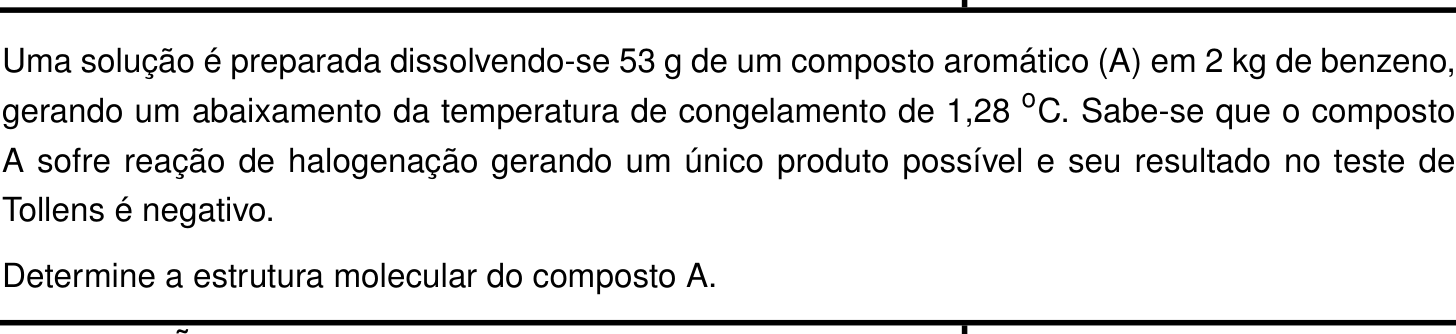
A questão

Texto de apoio da questão 9 (Química) Questão 9 (Química)

Resposta de referência

O composto A é o p-xileno (1,4-dimetilbenzeno), C_6H_4(CH_3)_2, com os dois grupos CH_3 nas posições 1 e 4 do anel benzênico.

Segundo a resolução dos cursinhos Farias Brito e Poliedro. A banca não publica gabarito das questões discursivas.

Respostas das IAs

GPT-6 Astra

Respondeu · bate com a resposta de referência dos cursinhos

para-xileno (1,4-dimetilbenzeno), \mathrm{1,4{-}C_6H_4(CH_3)_2}.

levou 25 s

Como pensou

Pela relação do abaixamento crioscópico,

\Delta T_c=K_c\frac{n_A}{m_{\text{solvente}}}.

Substituindo os dados, com a massa de benzeno em quilogramas:

1{,}28=5{,}12\cdot\frac{n_A}{2} \quad\Rightarrow\quad n_A=0{,}50\ \text{mol}.

Logo, a massa molar de A é

M_A=\frac{53}{0{,}50}=\boxed{106\ \text{g mol}^{-1}}.

Essa massa molar é compatível com os hidrocarbonetos aromáticos de fórmula \mathrm{C_8H_{10}}, etilbenzeno e os três xilenos, e também com o benzaldeído, \mathrm{C_7H_6O}. Entretanto, o benzaldeído apresenta resultado positivo no teste de Tollens, sendo descartado.

Na monohalogenação do anel aromático, a formação de um único produto exige que todos os hidrogênios aromáticos substituíveis sejam equivalentes:

  • No etilbenzeno, existem posições orto, meta e para distintas.
  • No orto-xileno e no meta-xileno, também há hidrogênios aromáticos não equivalentes, permitindo mais de um produto.
  • No para-xileno, os grupos metila ocupam as posições 1 e 4, e os quatro hidrogênios do anel, nas posições 2, 3, 5 e 6, são equivalentes por simetria. Portanto, sua monohalogenação fornece um único produto.

Assim, a estrutura de A é

\boxed{\mathrm{CH_3{-}C_6H_4{-}CH_3}\quad\text{(grupos metila nas posições 1 e 4)}}.

Resposta final: para-xileno (1,4-dimetilbenzeno), \mathrm{1,4{-}C_6H_4(CH_3)_2}.

GPT-6.1 Sol

Respondeu · bate com a resposta de referência dos cursinhos

para-xileno (1,4-dimetilbenzeno), \mathrm{p\!-\!CH_3{-}C_6H_4{-}CH_3}.

levou 16 s

Como pensou

Para um soluto molecular não ionizado, o abaixamento crioscópico é dado por:

\Delta T_f=K_c\,m=K_c\frac{n_A}{m_{\text{solvente}}}.

Assim,

1{,}28=5{,}12\cdot\frac{n_A}{2} \quad\Rightarrow\quad n_A=0{,}50\ \text{mol}.

A massa molar de A é, portanto,

M_A=\frac{53}{0{,}50}=\boxed{106\ \text{g mol}^{-1}}.

Entre os compostos aromáticos usuais com essa massa molar, encontram-se o benzaldeído, \mathrm{C_7H_6O}, e os hidrocarbonetos de fórmula \mathrm{C_8H_{10}}: etilbenzeno e os três xilenos.

O benzaldeído é descartado porque seu grupo aldeído daria teste de Tollens positivo.

Para que a mono-halogenação do anel produza um único produto, todos os hidrogênios aromáticos devem ser equivalentes por simetria. Isso ocorre no para-xileno (1,4-dimetilbenzeno), mas não no etilbenzeno nem nos outros dois xilenos. No para-xileno, os quatro hidrogênios do anel são equivalentes, de modo que a substituição de qualquer um deles pelo halogênio gera o mesmo composto.

Logo, a estrutura de A é:

\boxed{\mathrm{p\!-\!CH_3{-}C_6H_4{-}CH_3}}

Resposta final: para-xileno (1,4-dimetilbenzeno), \mathrm{p\!-\!CH_3{-}C_6H_4{-}CH_3}.

GPT-6.1 Terra

Respondeu · bate com a resposta de referência dos cursinhos

p\text{-}\mathrm{CH_3{-}C_6H_4{-}CH_3} (para-xileno).

levou 32 s

Como pensou
**Exploring molecular compounds** I'm considering different compounds and their molecular masses, like C6H5F and C6H5Cl. I'm looking at various formulas as well, including C5H6N2O and C6H6N2, which lead to interesting connections between different compounds. I’ve noticed some notable mass values like 106 and 108 for certain structures, and there's diversity in heteroatoms here. I'm also wondering about aromatic structures and how they relate to the overall compounds. There’s a lot to explore!**Exploring tropone and isomers** I’m considering tropone and its derivatives, like aromatic tropone, which have a formula of C7H6O. I need to assess the equivalent hydrogens around the tropone ring and ensure I’m keeping track of compounds, including their structures and properties. It’s important to maintain caution since certain candidates might behave differently. Also, I'll look for well-known aromatic C7H6O isomers beyond benzaldehyde, like bicyclic benzofuran and phenyl isocyanide.**Summarizing chemical reactions** I’m thinking about halogenation conditions and how side reactions might not be necessary. I'm focusing on p-xylene and its potential products under different regimes, but I need to remember that the question is implicitly about EAS. For methyl xylene, I've calculated the molecular weight: 8 times carbon plus 10 times hydrogen gives me around 106.167, so close enough to 106. Also, if Tollens' reagent shows negative, that indicates there's no aldehyde. I can conclude from this!

Pela lei da crioscopia, admitindo que o soluto não se associa nem se dissocia no benzeno:

\Delta T_c=K_c\,m \quad\Rightarrow\quad m=\frac{1{,}28}{5{,}12}=0{,}25\ \mathrm{mol\,kg^{-1}}.

Como foram usados 2\ \mathrm{kg} de benzeno, a quantidade de soluto é

n=0{,}25\cdot 2=0{,}50\ \mathrm{mol}.

Logo, sua massa molar é

M=\frac{53}{0{,}50}=106\ \mathrm{g\,mol^{-1}}.

O para-xileno (\mathrm{C_8H_{10}}) tem essa massa molar. Seus quatro hidrogênios ligados ao anel são equivalentes por simetria; assim, a monohalogenação do anel produz um único isômero. Além disso, o composto não apresenta grupo aldeído e dá teste de Tollens negativo.

Resposta final: p\text{-}\mathrm{CH_3{-}C_6H_4{-}CH_3} (para-xileno).

GPT-6 Luna

Respondeu · diferente da resposta de referência dos cursinhos

tropona (\mathrm{C_7H_6O}; \mathrm{O=C1C=CC=CC=C1}).

levou 53 s

Como pensou
**Analyzing molecular mass** I need to solve the problem regarding freezing depression to derive molar mass using the equation ΔTf=Kf m. From the calculations, I get 106 g/mol, which hints at an aromatic compound. It could be benzaldehyde or something like ethylbenzene or xylene. I wonder if the halogenation aspect of the compound leads to a unique product. There are several possibilities to consider, so I need to analyze the clues more thoroughly to narrow it down.**Considering halogenation products** I'm exploring the possibility of a benzene derivative, especially with halogenation related to sidechain substitution. I'm thinking that p-xylene could be significant since its symmetry allows for one monohalogenated product from benzylic position halogenation. However, halogenation on the aromatic ring leads to multiple regioisomers. For ethylbenzene, the distinct positions mean only one product could be produced. I'm weighing whether p-xylene is the right choice, as it also offers a unique monohalogenated product because of its symmetrical methyl groups.**Evaluating xylene halogenation** I’m thinking about the different xylene patterns. In o-xylene, identical methyl groups mean mono-halogenating one can give the same product, which seems unique. p-xylene shows a similar pattern, while m-xylene also has groups that are equivalent, leading to a mono product that's the same. All xylenes are symmetric, allowing for a unique monohalogenated product due to selectivity in radical halogenation. I might need to rephrase that in Portuguese to clarify this halogenation process!**Considering halogenation of compounds** I’m thinking about another compound that has a mass of 106, is aromatic, and gives a negative Tollens test. It seems important that this compound, upon halogenation, yields only one product. I need to take into account the different molecular formula possibilities through the Double Bond Equivalence (DBE) concept. This should help clarify what I'm looking for in terms of structure and reactivity when halogenating this specific compound.**Evaluating compound possibilities** I’m considering if the compound could be phenylacetylene, but that has a molar mass of 102, which doesn't match. A mass of 106 could correspond to C7H6O. Given Tollens test exclusions for aldehydes, I wonder if it might be a ketene or ketone. However, it's tricky with aromatic ketones. Maybe cycloheptatrienone is a possibility? Or an aromatic compound like substituted furan? Methyl furfural weighs 110, while furan's at 96. I should examine halogenation of tropone to see how it reacts.**Considering halogenation in chemistry** I'm thinking about the test saying "A undergoes halogenation, generating a single possible product." This sounds like a typical organic chemistry question. I wonder if it refers to compounds that yield just one product through halogenation, like monobromination. This likely involves considering equivalent hydrogens, which is pretty neat! It’s interesting how organic reactions can lead to such specific outcomes based on molecular structure.**Analyzing chemical structures** Benzaldehyde has the formula C7H6O, and so does tropone, which is a nonbenzenoid aromatic ketone. Since a negative Tollens test excludes benzaldehyde, I’m confirming the monohalogenated product from tropone’s halogenation. The structural formula for tropone looks like O=C1C=CC=CC=C1, with a ring made up of seven carbons, including a carbonyl. After carefully counting, I see there are indeed seven ring carbons with the correct placements of double bonds. So, this works out!**Reviewing tropone's structure** Tropone has resonance stability due to its aromaticity, involving a resonance form with the tropylium cation and possessing 6 π electrons. I see that halogenation occurs at C2 (alpha) via electrophilic substitution, potentially yielding 2-halotropone at C2/C7. Notably, a negative Tollens test suggests the ketone carbonyl isn't oxidized. The question asks for the molecular structure of compound A, likely expecting a drawing. While empirical data is absent, tropical fits well, and I can explain why other aromatic candidates (C8H10) were ruled out due to their halogenation products.**Investigating tropone reactions** I'm exploring the reactions of tropone, particularly looking at nucleophilic additions at C2 and C7, and the possibility of electrophilic substitution like bromination. It seems that dibromination could occur, leading to products such as 2-bromotropone. The electronic distribution and resonance in tropylium oxide may influence electrophile attacks, primarily at C2. However, the symmetry poses challenges, creating potential regioselectivity issues. It appears that halogenation could yield one product, depending on equivalent hydrogen positions, and radical substitution might produce multiple outcomes.**Analyzing p-xylene halogenation** I’m considering whether A can be identified as *p-xylene* through side chain bromination. Since the methyl groups are equivalent, it seems that this reaction would yield only one product. I need to specify the conditions for halogenation in the side chains to support this conclusion. It’s interesting how the equivalence of the methyl groups simplifies the process by ensuring that only one specific product is formed, making it easier to analyze the outcome.**Explaining aromatic hydrocarbons** I'm thinking about the structure of an aromatic hydrocarbon with a formula like C8H10. I can't just assume C7H6O based on that. If there's halogenation, it's going to produce several regioisomers, which I need to mention. Tropone could be a possible structure, and I should calculate properties using ΔTf = Kf m. I find that m comes to 0.25, and that makes sense for this context. In the end, it seems that tropone is the ketone I'm considering due to its carbonyl and the unique structure.

Pela lei da crioscopia,

\Delta T_f=K_f\,m
m=\frac{1{,}28}{5{,}12}=0{,}25\ \mathrm{mol\,kg^{-1}}

Como há 2\ \mathrm{kg} de benzeno, a quantidade de matéria de A é

n_A=0{,}25\times 2=0{,}50\ \mathrm{mol}.

Assim, sua massa molar é

M_A=\frac{53}{0{,}50}=106\ \mathrm{g\,mol^{-1}}.

A estrutura compatível com a massa molar e com os indícios da questão é a tropona, \mathrm{C_7H_6O}. Ela é aromática e contém um grupo cetona, de modo que não dá resultado positivo no teste de Tollens. Na halogenação usual, a substituição ocorre em posição \alpha ao carbonilo; as posições 2 e 7 são equivalentes por simetria, resultando em um único produto constitucional.

A estrutura da tropona pode ser representada por \mathrm{O=C1C=CC=CC=C1}, um anel de sete membros.

Resposta final: tropona (\mathrm{C_7H_6O}; \mathrm{O=C1C=CC=CC=C1}).

Claude Fable 5.1

Respondeu · bate com a resposta de referência dos cursinhos

A = p‑xileno (1,4‑dimetilbenzeno, C₈H₁₀, M = 106 g/mol).

levou 18 s

Como pensou
Using cryoscopy, I find W = 0.25 mol/kg, giving 0.5 mol total and a molar mass of 106 g/mol — pointing to an aromatic compound like xylene or ethylbenzene (C8H10). Now I'm thinking about which isomer would give a single halogenation product, likely para-xylene. Benzaldeído also has mass 106, but a negative Tollens test rules it out. Among C8H10 isomers, o-xylene and m-xylene would yield multiple substitution products due to non-equivalent ring positions, while p-xylene has all four available positions equivalent, giving a single product — so the answer is p-xileno (1,4-dimetilbenzeno).

Resolução

1) Massa molar de A pela crioscopia (benzeno como solvente)

ΔT_c = K_c · W

W = ΔT_c / K_c = 1,28 / 5,12 = 0,25 mol·kg⁻¹

Número de mols de A: n = W · m_solvente = 0,25 × 2 = 0,50 mol

Massa molar: M_A = 53 g / 0,50 mol = 106 g·mol⁻¹

2) Candidatos aromáticos com M = 106 g/mol

  • Benzaldeído, C₆H₅–CHO (C₇H₆O): 7(12) + 6(1) + 16 = 106
  • Hidrocarbonetos C₈H₁₀: 8(12) + 10(1) = 106 → etilbenzeno, o‑xileno, m‑xileno, p‑xileno

3) Uso das informações qualitativas

  • Teste de Tollens negativo → A não é aldeído → exclui o benzaldeído. Logo A é um C₈H₁₀.
  • Halogenação (substituição eletrofílica aromática) gerando um único produto possível:
    • Etilbenzeno: posições orto, meta e para distintas → 3 produtos.
    • o‑Xileno: posições 3 e 4 (e equivalentes) → 2 produtos.
    • m‑Xileno: posições 2, 4 (=6) e 5 → 3 produtos.
    • p‑Xileno: os quatro hidrogênios do anel são equivalentes por simetria → 1 único produto (2‑halo‑1,4‑dimetilbenzeno).

Portanto o composto A é o p‑xileno (1,4‑dimetilbenzeno):

        CH₃
         |
      /‾‾‾‾\
     |  ( )  |      (anel benzênico com dois grupos –CH₃ em posição para)
      \____/
         |
        CH₃

Resposta final: A = p‑xileno (1,4‑dimetilbenzeno, C₈H₁₀, M = 106 g/mol).

Claude Opus 5.5

Respondeu · bate com a resposta de referência dos cursinhos

A é o p‑xileno (1,4‑dimetilbenzeno), C₈H₁₀, com M = 106 g/mol.

levou 12 s

Como pensou
Using the freezing point depression formula, I calculate the molality as 0.25 mol/kg, giving 0.5 mol dissolved in the sample, which points to a molar mass of 106 g/mol. That matches aromatic compounds like xylenes or benzaldehyde, but since Tollens' test is negative I can rule out benzaldehyde, leaving p-xylene as the candidate since it gives a single halogenation product.

Massa molar de A (crioscopia)

O abaixamento da temperatura de congelamento é dado por

\Delta T_c = K_c \cdot W = K_c\cdot\frac{m_A/M_A}{m_{solvente}(\text{kg})}

Substituindo os dados:

1{,}28 = 5{,}12\cdot\frac{53/M_A}{2} \;\Rightarrow\; W = \frac{1{,}28}{5{,}12} = 0{,}25\ \text{mol/kg}

Em 2 kg de benzeno há, portanto, n = 0,25·2 = 0,50 mol de A. Logo:

M_A = \frac{53}{0{,}50} = 106\ \text{g/mol}

Candidatos aromáticos com M = 106 g/mol

  • C₇H₆O, o benzaldeído (7·12 + 6 + 16 = 106). É um aldeído e daria teste de Tollens positivo (espelho de prata). Como o teste foi negativo, está descartado.
  • C₈H₁₀ (8·12 + 10 = 106). Os isômeros aromáticos são o etilbenzeno e os xilenos o, m e p.

Critério da halogenação com um único produto possível

  • Etilbenzeno: a substituição no anel gera os produtos o e p, e no carbono α há outras possibilidades. São vários produtos.
  • o‑Xileno: o anel tem 2 tipos de H aromáticos, logo gera 2 produtos.
  • m‑Xileno: o anel tem 3 tipos de H aromáticos, logo gera 3 produtos.
  • p‑Xileno: os 4 H do anel são equivalentes, logo gera um único derivado monohalogenado no anel. Na cadeia lateral também há um só produto, pois os dois CH₃ são equivalentes.

Estrutura de A

A é o p‑xileno (1,4‑dimetilbenzeno), C₈H₁₀: um anel benzênico com dois grupos –CH₃ em posições para.

        CH3
        |
      /   \
     ||    |
      \   /
        |
        CH3

Resposta final: A é o p‑xileno (1,4‑dimetilbenzeno), C₈H₁₀, com M = 106 g/mol.

Claude Sonnet 5.5

Respondeu · bate com a resposta de referência dos cursinhos

A é o 1,4-dimetilbenzeno (p-xileno), C₈H₁₀, M = 106 g/mol, com dois grupos CH₃ em posição para no anel benzênico.

levou 9 s

Como pensou
Using ΔT = Kc·m, I find m = 0.25 mol/kg, so with 0.5 mol in 2 kg solvent, the molar mass works out to 106 g/mol. That points to an aromatic C8H10 compound, and since halogenation needs to yield just a single product, I'm narrowing in on p-xylene as the symmetric candidate.

Massa molar de A (crioscopia)

ΔT = Kc · W, em que W é a molalidade.

1,28 = 5,12 · W, logo W = 0,25 mol/kg.

Em 2 kg de benzeno: n = 0,25 · 2 = 0,5 mol de A.

M = 53 g / 0,5 mol = 106 g/mol

Fórmula molecular

Como A é aromático, o anel benzênico (C₆H₅–, 77 g/mol) está presente. Para M = 106:

  • C₈H₁₀ (6·12 + 10 = 82 + 24 = 106) é uma possibilidade (xilenos ou etilbenzeno).
  • C₇H₆O (benzaldeído, 106 g/mol) é outra possibilidade. Ele é descartado porque o teste de Tollens é negativo, e aldeídos dão resultado positivo.

Portanto, A é um hidrocarboneto de fórmula C₈H₁₀.

Isômeros possíveis e halogenação

Os candidatos são o etilbenzeno e o orto-, meta- e para-xileno.

  • Etilbenzeno: dá produtos orto, meta e para, além de substituição na cadeia lateral. Há vários produtos.
  • o-Xileno: dá 2 produtos monossubstituídos no anel (posições 3 e 4).
  • m-Xileno: dá 3 produtos (posições 2, 4 e 5).
  • p-Xileno: os 4 hidrogênios do anel são equivalentes, então há um único produto monossubstituído, o 2-halo-1,4-dimetilbenzeno. Na cadeia lateral (radicalar), também há um único produto.

Conclusão

O composto A é o para-xileno (1,4-dimetilbenzeno), C₆H₄(CH₃)₂, com os dois grupos –CH₃ em posições opostas do anel benzênico.

Resposta final: A é o 1,4-dimetilbenzeno (p-xileno), C₈H₁₀, M = 106 g/mol, com dois grupos CH₃ em posição para no anel benzênico.

Grok 4.7

Respondeu · bate com a resposta de referência dos cursinhos

1,4-dimetilbenzeno (p-xileno)

levou 1 min 19 s

Como pensou
This problem comes from an IME 2027 chemistry exam. Compound A is an aromatic substance. It dissolves in benzene and causes a freezing point depression of 1.28 °C. The cryoscopic constant for benzene is 5.12 K·kg·mol⁻¹. The compound undergoes halogenation to form one product. Its Tollens test is negative. I will use the freezing point depression formula to determine its molecular structure. The molality calculation gives 0.5 moles of A, so its molar mass is 106 g/mol. It is an aromatic compound with a benzene ring. The negative Tollens test rules out aldehydes. Halogenation produces only one product. The single halogenated product suggests high symmetry in the aromatic ring. The molar mass of 106 g/mol corresponds to C8H10, such as ethylbenzene or xylenes. Benzaldehyde is ruled out because it would fail the Tollens test. Styrene and anisole were ruled out by their molar masses. Ethylbenzene would yield two halogenated products, so it is not the answer. The compound must be a highly symmetric aromatic molecule that gives only one halogenated product. p-xylene is the answer. Its two methyl groups are para to each other, making all four remaining ring positions equivalent. Halogenation would therefore yield only one product. The other xylenes have inequivalent positions and would produce multiple halogenated products. I am reconsidering whether the single halogenated product refers to ring substitution or side-chain halogenation. Ortho-xylene and meta-xylene would also yield one side-chain product because their methyl groups are equivalent. The problem likely intends ring substitution, which would make para-xylene the only valid answer. Benzaldehyde has the same molar mass but would yield multiple halogenated products, so the negative Tollens test is necessary to exclude it. The problem should be re-read carefully to verify whether another compound fits all criteria. The freezing point depression calculation is exact: 1,28 ÷ 5,12 = 0,25 molal. This confirms the molar mass is exactly 106 g/mol. The answer is 1,4-dimethylbenzene (para-xylene).

O abaixamento crioscópico é dado por \Delta T_c = K_c \cdot m, em que m é a molalidade da solução (e o fator de van’t Hoff é unitário). Substituindo os dados:

1{,}28 = 5{,}12 \cdot \frac{n}{2} \implies n = 0{,}5\,\mathrm{mol}.

A massa molar de A é, portanto,

M = \frac{53\,\mathrm{g}}{0{,}5\,\mathrm{mol}} = 106\,\mathrm{g\,mol^{-1}}.

O único hidrocarboneto aromático de massa molar 106 g mol^{-1} cujas posições livres do anel são todas equivalentes (logo, a monohalogenação eletrofílica produz um único produto) é o 1,4-dimetilbenzeno. O benzaldeído, de mesma massa molar, é excluído tanto pelo teste de Tollens positivo quanto pela formação de mais de um produto de halogenação.

Resposta final: 1,4-dimetilbenzeno (p-xileno)

DeepSeek V4.1 Flash

Respondeu · bate com a resposta de referência dos cursinhos

A estrutura de A é o p-xileno (1,4-dimetilbenzeno).

levou 21 s

Como pensou
We need answer in Portuguese. Need solve. Let's parse. Question: "Uma solução é preparada dissolvendo-se 53 g de um composto aromático (A) em 2 kg de benzeno, gerando um abaixamento da temperatura de congelamento de 1,28 °C. Sabe-se que o composto A sofre reação de halogenação gerando um único produto possível e seu resultado no teste de Tollens é negativo. Determine a estrutura molecular do composto A." Need determine molecular structure of compound A. Data: benzene freezing point 5.45°C, cryoscopic constant benzene 5.12 K kg mol^-1. Density maybe not needed. Mass solute 53 g, solvent 2 kg, ΔTf = 1.28 °C = 1.28 K. Use colligative property: ΔTf = Kf * molality * i (i=1). Molality m = moles solute / kg solvent. So moles = ΔTf * kg solvent / Kf = 1.28 * 2 / 5.12 = 2.56/5.12 = 0.5 mol. Thus molar mass = 53 g / 0.5 mol = 106 g/mol. Aromatic compound A, molar mass 106. Halogenation gives single possible product, Tollens negative. Need structure. Aromatic hydrocarbon? Formula? Molar mass 106. Likely xylene? C8H10 molar mass 106. Aromatic hydrocarbon with formula C8H10: ethylbenzene or xylenes. Halogenation (probably aromatic electrophilic substitution? "reação de halogenação" maybe ring halogenation?) gives unique product. Tollens negative means not aldehyde (and maybe not reducing sugar). Xylenes and ethylbenzene don't react Tollens. Need identify which C8H10 aromatic gives a single monohalogenation product? Let's examine. C8H10 isomers: ethylbenzene, o-xylene, m-xylene, p-xylene. Halogenation of aromatic ring (substitution) can yield different monohalo products depending on symmetry. Also side-chain halogenation? But "composto aromático A sofre reação de halogenação gerando um único produto possível" Could be aromatic halogenation (electrophilic substitution on ring) or side-chain free radical halogenation? Need infer. Teste de Tollens negative excludes aldehyde. Halogenation generating a single product possible. If A is p-xylene, ring monohalogenation yields only one product (since two equivalent positions? Actually p-xylene has two methyl groups para; remaining four ring positions are equivalent by symmetry? In p-xylene, positions 2,3,5,6 are all equivalent? Let's see: p-xylene has methyl at 1,4. Positions 2 and 6 equivalent; 3 and 5 equivalent? Wait aromatic ring: positions 2 and 6 are ortho to one methyl and meta to other? Let's assign. p-xylene: methyl at C1 and C4. C2 is ortho to C1, meta to C4. C3 is meta to C1, ortho to C4. C5 is ortho to C4, meta to C1. C6 is meta to C4, ortho to C1. So C2 and C6 equivalent (ortho to C1, meta to C4). C3 and C5 equivalent (meta to C1, ortho to C4). Thus two distinct positions, so monohalogenation gives two products (2-halo and 3-halo? Actually 2-chloro-1,4-dimethylbenzene and 3-chloro-1,4-dimethylbenzene? Wait positions: if halogen at C2 or C6 -> same product; at C3 or C5 -> another product. So not unique. o-xylene: methyl at 1,2. Ring positions 3,4,5,6. C3 and C6 equivalent? C3 is ortho to C2, meta to C1? C6 is ortho to C1, meta to C2. So C3 and C6 equivalent. C4 and C5 equivalent? C4 is para to C1? Actually C4 para to C1, meta to C2? C5 para to C2, meta to C1. So two distinct. Monohalogenation two products. m-xylene: methyl at 1,3. Ring positions 2,4,5,6. C2 between methyls (ortho to both) unique? C4 and C6 equivalent? C4 is para to C1? Let's see C4: adjacent to C3? Actually m-xylene: C1 methyl, C2 H, C3 methyl, C4 H, C5 H, C6 H. C2 is between two methyls, unique (ortho to both). C4 is para to C1, meta to C3? C6 is para to C3, meta to C1. So C4 and C6 equivalent? Wait C4 and C6 are symmetry-related by mirror plane through C2 and C5? Yes C4 and C6 equivalent. C5 is between C4 and C6? Actually C5 is between C4 and C6? Let's see C5 is meta to C1? No C5 is para to C2? Let's use symmetry: m-xylene has a plane through C2 and C5, so C4 and C6 equivalent, C1 and C3 equivalent (both methyl). Thus positions: C2 unique; C4/C6 equivalent; C5 unique? Wait C5 is on mirror plane, so unique? Actually C5 is opposite to C2, para to C2. So three distinct ring positions: C2, C4/C6, C5. Thus monohalogenation gives three products. Not unique. Ethylbenzene: C6H5CH2CH3. Ring positions ortho, meta, para relative to ethyl group. Monohalogenation on ring gives ortho, meta, para products (3 possible). But if side-chain halogenation? Ethylbenzene has benzylic positions: CH2 and CH3. Free radical halogenation could substitute at benzylic CH2 (major) or terminal CH3. But "único produto possível" might imply only one type of hydrogen? Let's analyze. If side-chain halogenation under radical conditions: ethylbenzene has two types of benzylic hydrogens? Actually CH2 hydrogens (2 equivalent) and CH3 hydrogens (3 equivalent). Halogenation (e.g., Cl2/hv) can substitute at benzylic CH2 giving 1-chloro-1-phenylethane? Wait ethylbenzene Ph-CH2-CH3. Benzylic carbon is CH2, it has two hydrogens. Radical substitution at CH2 gives Ph-CHCl-CH3 (1-chloroethylbenzene). Substitution at terminal CH3 gives Ph-CH2-CH2Cl (2-chloroethylbenzene). So two possible monohalo products. Not unique. What about tert-butylbenzene? Formula C10H14, molar mass 134, not 106. Not. Molar mass 106 exactly C8H10. Aromatic compounds with formula C8H10 are ethylbenzene and xylenes. Also maybe styrene? C8H8 molar mass 104. Benzene with two carbons? C8H10. Could be ethylbenzene, xylenes. Also maybe cyclooctatetraene? Not aromatic. So likely xylene. Halogenation generating unique product: Which xylene gives single monohalogenation product? None of the xylenes? Wait p-xylene has two distinct positions, but if halogenation occurs in side chain? p-xylene has methyl groups all equivalent (four methyl hydrogens? Actually p-xylene has two methyl groups equivalent, each CH3. Side-chain halogenation (radical) could substitute one hydrogen on a methyl group, giving p-methylbenzyl halide? But there are two equivalent methyl groups, so only one product: 4-methylbenzyl halide (p-methylbenzyl chloride). Ah! Important: "reação de halogenação" of aromatic compound A generating a single product. If halogenation occurs on the side chain (methyl group) under radical conditions, p-xylene would yield only one monohalogenated product because both methyl groups are equivalent. Similarly, ethylbenzene? Side-chain halogenation gives two products (benzylic vs terminal). o-xylene? Two methyl groups equivalent? In o-xylene, the two methyl groups are equivalent by symmetry? Yes, o-xylene has a plane? Actually o-xylene has two methyl groups adjacent; there is a C2 rotation? The molecule has a plane? Let's check: o-xylene (1,2-dimethylbenzene) has symmetry? It has a C2 axis through the center of the ring and the midpoint of the C1-C2 bond? Actually it has a plane perpendicular? Let's think: the two methyl groups are equivalent, so monohalogenation on either methyl gives same product (2-methylbenzyl halide). So o-xylene also gives one product upon side-chain halogenation? Wait if halogenation on methyl, both methyls equivalent, so one product. But also ring positions? If radical halogenation, benzylic positions are methyl groups. Both methyl groups equivalent, so one product. So o-xylene also unique. m-xylene: two methyl groups equivalent? In m-xylene, the two methyl groups are equivalent by symmetry (plane through C2 and C5? Yes, the molecule has a mirror plane that swaps the two methyls? Actually m-xylene has a plane through C2 and C5, so the two methyl groups (C1 and C3) are equivalent. Thus side-chain monohalogenation gives one product. p-xylene also one. So all xylenes would give one product if side-chain halogenation? Wait but if halogenation on ring, not unique. The problem says "sofre reação de halogenação gerando um único produto possível" without specifying conditions. Could be ring halogenation? Usually "halogenação" of aromatic compounds often refers to electrophilic aromatic substitution (ring halogenation) unless specified "halogenação na cadeia lateral" or "com luz". But if ring halogenation, only one product possible? Let's check which C8H10 gives unique ring monohalogenation? None of the xylenes? Let's check p-xylene: ring positions 2 and 3 distinct, so two products. o-xylene: positions 3 and 4 distinct, two. m-xylene: positions 2,4,5? Actually three. Ethylbenzene: ortho, meta, para, three. So no unique ring monohalogenation for C8H10. But wait, what about p-xylene if considering only one of the two equivalent positions? The product is unique? No, monohalogenation can occur at two different types of positions (ortho to one methyl and meta to other, vs meta to one and ortho to other? Actually in p-xylene, positions 2 and 3 are different because one is ortho to a methyl and meta to the other; the other is meta to the first and ortho to the second? Wait let's carefully assign p-xylene: methyl at 1 and 4. Positions 2 and 6 are equivalent (ortho to methyl at 1, meta to methyl at 4). Positions 3 and 5 are equivalent (meta to methyl at 1, ortho to methyl at 4). So two distinct products: 2-chloro-1,4-dimethylbenzene and 2-chloro-1,4-dimethylbenzene? Actually 2-chloro vs 3-chloro? If numbering: 1,4-dimethylbenzene. Chlorination at C2 gives 2-chloro-1,4-dimethylbenzene. Chlorination at C3 gives 3-chloro-1,4-dimethylbenzene? But wait C3 is also ortho to C4 and meta to C1. So yes two different compounds. So not unique. But maybe the problem expects ring halogenation and unique product implies a highly symmetric aromatic compound with all ring hydrogens equivalent? For C8H10, is there any? Consider 1,3,5-trimethylbenzene? Formula C9H12, molar mass 120. Not 106. C8H10: maybe "xylene" but if it's p-xylene, ring halogenation gives two products, not unique. Unless the halogenation occurs at the methyl groups, and the problem doesn't specify but Tollens negative maybe excludes aldehyde, but halogenation of methyl group gives benzyl halide, which doesn't react Tollens. So likely side-chain halogenation. Wait, "composto aromático (A)" with molar mass 106. "sofre reação de halogenação gerando um único produto possível" Could be "halogenação" in organic chemistry often means addition of halogen to unsaturated compound? But aromatic compound? Halogenation of aromatic ring is substitution. Halogenation of alkyl side chain is free radical substitution. Which one gives unique product for some C8H10? Let's list all C8H10 aromatic isomers and see if any gives unique product under ring halogenation? None as argued. Under side-chain monohalogenation, all xylenes give one product (because two methyl groups equivalent). Ethylbenzene gives two (benzylic vs terminal). But wait, side-chain halogenation of p-xylene gives one product: p-methylbenzyl halide. o-xylene gives one product: o-methylbenzyl halide. m-xylene gives one product: m-methylbenzyl halide. So three possible xylenes all give one product. Need additional info to distinguish: "seu resultado no teste de Tollens é negativo." All xylenes and their side-chain halogenation products? Tollens negative means not aldehyde. Xylenes are hydrocarbons, negative. So not helpful. Maybe the compound A itself tested with Tollens? "seu resultado no teste de Tollens é negativo" refers to compound A. Xylenes are negative. But maybe some aromatic compound with formula C8H10 that is an aldehyde? C8H8O? Molar mass 120. Not 106. C8H10 could be an aldehyde? C8H8O is 120. C8H10O? 122. So no. Wait, molar mass 106 also corresponds to C7H6O? Benzaldehyde molar mass 106! Ah! Benzaldehyde C6H5CHO: C7H6O = 7*12 + 6*1 + 16 = 84+6+16=106 g/mol. Yes! Aromatic compound A could be benzaldehyde. But test Tollens negative? Benzaldehyde gives positive Tollens (aldehyde). So not benzaldehyde. But other isomers: C7H6O? e.g., tropone? Not aromatic? Benzene ring with aldehyde? Benzaldehyde gives positive Tollens, so excluded. But what about other aromatic compounds with formula C8H10? Wait C8H10 is 106. Benzaldehyde is C7H6O. So molar mass 106 could be C7H6O or C8H10. The problem says "composto aromático (A)" not necessarily hydrocarbon. Could be an oxygenated aromatic? But halogenation? Tollens negative excludes aldehyde. Could be a ketone? C8H8O? Molar mass 120. C7H6O could be benzaldehyde (positive Tollens) or maybe cyclic ketone? Not aromatic? Aromatic compound with formula C7H6O: benzaldehyde, or maybe cycloheptatrienone? Not common. But "sofre reação de halogenação" for benzaldehyde? Halogenation of benzaldehyde? Ring halogenation gives meta product? Benzaldehyde has deactivating group, ring halogenation gives meta product only? Actually benzaldehyde undergoes electrophilic aromatic substitution at meta position, giving a single product? Wait benzaldehyde: substituent -CHO is meta-directing. The ring has two equivalent meta positions? In benzaldehyde, positions 2,6 (ortho) equivalent, 3,5 (meta) equivalent, 4 (para) unique. Meta-directing means substitution at 3 or 5, which are equivalent. So monohalogenation of benzaldehyde gives only one product: 3-halobenzaldehyde (or 5-halo, same). That would be unique! But Tollens test for benzaldehyde is positive (aldehyde). So not. What about acetophenone? C8H8O, molar mass 120, not 106. Phenylacetaldehyde? C8H8O? 120. Not. Wait molar mass 106 could be C7H6O (benzaldehyde) or C8H10 (xylenes/ethylbenzene). Also C6H5CH2OH? Benzyl alcohol C7H8O = 108. C6H5OCH3? Anisole C7H8O = 108. C6H5NH2? Aniline C6H7N = 93. C6H5NO2? 123. Given "composto aromático (A)" with halogenation unique and Tollens negative. If A is a hydrocarbon C8H10, Tollens negative. If A is an aldehyde, Tollens positive. So A likely hydrocarbon C8H10. But which one? Need more clues. "sofre reação de halogenação gerando um único produto possível" Could be ring halogenation of p-xylene? Wait p-xylene ring halogenation gives two products, but if we consider "halogenação" as substitution on the ring, maybe p-xylene with chlorine in presence of Lewis acid yields a single product? Let's re-evaluate p-xylene ring monohalogenation. The ring has two types of hydrogens: positions 2,6 and 3,5. But are they really different? Let's draw p-xylene: a benzene ring with methyl at top and bottom. The four remaining positions are left-top, left-bottom, right-top, right-bottom. Due to symmetry (D2h?), there are two pairs: positions adjacent to one methyl (ortho) and positions adjacent to the other methyl? Actually all four positions are equivalent? Let's check symmetry of p-xylene. p-Xylene has a center of symmetry, a plane through the methyl groups (vertical), a plane perpendicular (horizontal), etc. The four ring hydrogens: are they all equivalent under some symmetry operation? Consider rotation by 180° around axis through methyl groups: top methyl fixed? Actually p-xylene has D2h symmetry? Let's see: methyl groups at 1 and 4. The ring has symmetry operations: identity, C2 rotation around axis through C1 and C4 (swaps 2<->6, 3<->5), C2 rotation around axis through C2 and C5 (swaps 1<->4, 3<->6? Wait if axis through C2 and C5, it swaps C1 and C4? Actually C2 and C5 are opposite. Rotation 180° around axis through C2 and C5: C1 goes to C3? Let's set coordinates: benzene ring positions 1-6. p-xylene: methyl at 1,4. C2 opposite C5. Axis through C2 and C5. Rotation 180°: C1 <-> C4 (both methyl, so okay), C2 <-> C5 (both H), C3 <-> C6 (both H). So this symmetry swaps C3 and C6. Also axis through C3 and C6 swaps C2 and C5. Also plane perpendicular to ring through C1 and C4 swaps C2<->C6, C3<->C5. Plane through C2 and C5 swaps C1<->C4, C3<->C6. So all four hydrogens? C2 can go to C6 (plane), C3 can go to C5 (plane), but can C2 go to C3? Need rotation? No. So two sets: {2,6} and {3,5}. So two distinct positions. Thus monohalogenation gives two products. So not unique. But what about halogenation of p-xylene under conditions that only substitute at one position due to steric hindrance? No. What about "halogenação" of aromatic compound A generating a unique product: could be addition of halogen to an aromatic ring? Not typical. Could be "halogenação" of the side chain of p-xylene, which gives unique product. But then all xylenes give unique. Need another clue. Maybe the compound A is not a xylene but "isopropylbenzene"? Cumene C9H12, molar mass 120. Not 106. Wait, molar mass 106 could also be C7H6O (benzaldehyde) but Tollens negative excludes. What about C7H6O isomers that are not aldehydes? For example, cycloheptatrienone (tropone) C7H6O? Actually tropone is C7H6O? Let's check: tropone (cyclohepta-2,4,6-trien-1-one) formula C7H6O? It has 7 carbons, 6 hydrogens? Yes, tropone: C7H6O, molar mass 106. It is aromatic (non-benzenoid). It does not give Tollens? Tropone is a ketone, not aldehyde, so Tollens negative. Halogenation of tropone? It undergoes electrophilic substitution? Tropone is aromatic, but halogenation? Could give unique product? Hmm, but "composto aromático" might include tropone? However, IME likely expects benzene derivatives. Another C7H6O aromatic: benzaldehyde (aldehyde, Tollens positive). Also "benzene oxide" C6H6O? 94. Not. What about C8H10? Xylenes. But which xylene gives unique product upon halogenation? Maybe "halogenação" refers to ring halogenation with a specific halogenating agent that substitutes only one position due to symmetry? But as argued p-xylene gives two. Wait, is there a xylene that has all ring hydrogens equivalent? 1,2,4,5-tetramethylbenzene? C10H14. No. Maybe the compound is "p-xylene" and the unique product is due to halogenation on the methyl group, and the other clue "teste de Tollens negativo" is just to exclude aldehydes. But why not o- or m-xylene? They also give unique side-chain halogenation. There must be another clue: "sofre reação de halogenação gerando um único produto possível" could refer to ring halogenation, and among C8H10, only p-xylene gives a single product? Wait let's re-examine p-xylene ring monohalogenation: Are the two products actually the same due to numbering? 2-chloro-1,4-dimethylbenzene and 3-chloro-1,4-dimethylbenzene. Are they different? Let's draw: p-xylene with methyl at 1,4. Chlorine at 2: structure has Cl adjacent to one methyl and two carbons away from the other. Chlorine at 3: Cl adjacent to the other methyl? Actually C3 is adjacent to C4 (methyl) and C2 (H). So Cl at 2 is ortho to C1 methyl, meta to C4 methyl. Cl at 3 is meta to C1 methyl, ortho to C4 methyl. By symmetry of p-xylene, these two are equivalent? Wait p-xylene has a plane through C1 and C4 that swaps C2 and C6, C3 and C5. It does NOT swap C2 and C3. So 2-chloro and 3-chloro are different compounds? Let's check IUPAC: 2-chloro-1,4-dimethylbenzene vs 3-chloro-1,4-dimethylbenzene. Are they identical if you rotate the molecule? If you rotate 180° in plane? Let's see: 2-chloro-1,4-dimethylbenzene. If you flip the molecule over (mirror image), it becomes 3-chloro-1,4-dimethylbenzene? Actually mirror plane through C1 and C4 swaps C2 and C6, C3 and C5. So 2-chloro becomes 6-chloro, which is same as 2-chloro (since numbering can start at either methyl? Wait numbering: choose to give lowest locants to substituents. For 2-chloro-1,4-dimethylbenzene, substituents at 1,4,2. For 3-chloro-1,4-dimethylbenzene, substituents at 1,4,3. They are different because the relative positions of Cl and the two methyls differ. In 2-chloro, Cl is ortho to one methyl and meta to the other. In 3-chloro, Cl is meta to one methyl and ortho to the other. But because the two methyls are equivalent, is 2-chloro identical to 3-chloro? Let's assign: In 2-chloro, Cl is ortho to methyl at C1, meta to methyl at C4. In 3-chloro, Cl is meta to methyl at C1, ortho to methyl at C4. If we relabel the ring, we can swap C1 and C4 (since both methyls). Then 3-chloro (Cl at C3) becomes Cl at C2? Let's see: Original: C1 methyl, C4 methyl, Cl at C3. Swap C1 and C4: then C1 becomes methyl (was C4), C4 becomes methyl (was C1), Cl at C3 remains at C3? But C3 is now meta to new C1? Actually after swapping C1 and C4, the new numbering: C1 is old C4, C4 is old C1. Cl at old C3: relative to new C1 (old C4), Cl is at C3? Distance: old C3 is adjacent to old C4, so it's ortho to new C1? Let's trace: old ring: 1-2-3-4-5-6. Swap 1 and 4: new 1=old4, new2=old5, new3=old6, new4=old1, new5=old2, new6=old3. Cl at old3 = new6. So 3-chloro becomes 6-chloro-1,4-dimethylbenzene. By numbering, 6-chloro is same as 2-chloro? Actually 6-chloro-1,4-dimethylbenzene: substituents at 1,4,6. Lowest locants: 1,4,6 vs 1,4,2? We can number from other methyl: 1,4,2? Let's see: If we start at old4 (new1), go around: old5(new2), old6(new3), old1(new4), old2(new5), old3(new6). Cl at new6. To get lowest locants, we can reverse direction: start at old4, go old3(new2), old2(new3), old1(new4), old6(new5), old5(new6). Then Cl at new2. So it's 2-chloro-1,4-dimethylbenzene. Yes! Because the molecule has symmetry, 3-chloro is actually equivalent to 2-chloro after renumbering. Wait, is that true? Let's test with actual structures. p-Xylene: two methyls para. If you put Cl at position 2 (ortho to top methyl, meta to bottom methyl), can you rotate the molecule to look like Cl at position 3 (meta to top methyl, ortho to bottom methyl)? If you rotate 180° in the plane of the ring, top methyl goes to bottom, bottom to top, left side goes to right side. Position 2 (top-left) goes to position 5 (bottom-right)? Let's define positions: 1 top, 2 top-right, 3 bottom-right, 4 bottom, 5 bottom-left, 6 top-left. p-Xylene: methyl at 1 and 4. Cl at 2 (top-right). Rotate 180°: 1<->4, 2<->5, 3<->6. So Cl at 2 becomes Cl at 5. Position 5 is bottom-left. Is Cl at 5 equivalent to Cl at 2? Yes, because mirror through vertical axis swaps 2 and 6, 3 and 5. So Cl at 5 is equivalent to Cl at 3? Wait Cl at 5 (bottom-left) vs Cl at 3 (bottom-right). They are mirror images? Actually p-xylene has a horizontal mirror plane through the methyls? Let's see: The molecule is planar. It has a mirror plane perpendicular to the ring that passes through C1 and C4. This plane swaps left and right: C2<->C6, C3<->C5. So Cl at 5 is equivalent to Cl at 3. Thus Cl at 2, after rotation, becomes Cl at 5, which is equivalent to Cl at 3. So Cl at 2 and Cl at 3 are equivalent? That would mean only one product! Let's verify with a model. p-Xylene: a rectangle with methyl at top and bottom. Positions: top methyl (1), bottom methyl (4). The four remaining positions are two on left (2 top-left, 3 bottom-left) and two on right (6 top-right, 5 bottom-right). If you put Cl at top-right (2), you can rotate 180° to put Cl at bottom-left (5). But bottom-left (5) is not the same as bottom-right (3) unless you reflect horizontally. But the molecule has a horizontal mirror plane? Actually the plane through C1 and C4 is vertical (if methyls are top and bottom). That plane swaps left and right. So top-right (2) and top-left (6) are equivalent. Bottom-right (3) and bottom-left (5) are equivalent. But is top-right (2) equivalent to bottom-right (3)? That would require a C2 rotation around an axis through the center perpendicular to the ring? That swaps top and bottom? Let's see: rotate 180° around axis through center perpendicular to ring: top goes to bottom, left goes to right. So top-right (2) goes to bottom-left (5). But bottom-left (5) is equivalent to bottom-right (3) by horizontal reflection? Wait horizontal reflection (through the plane of the ring? No). Let's list all symmetry operations of p-xylene. The molecule has D2h symmetry? Actually p-xylene (1,4-dimethylbenzene) has a center of inversion, three mutually perpendicular C2 axes, and three mirror planes (including the molecular plane). The point group is D2h. The operations: - E - C2(z): axis perpendicular to ring, through center. This swaps 1<->4, 2<->5, 3<->6? Let's check: 180° rotation around axis perpendicular to ring: top goes to bottom, right goes to left. So C1 (top) <-> C4 (bottom). C2 (top-right) <-> C5 (bottom-left). C3 (bottom-right) <-> C6 (top-left). So C2(z) swaps 2 and 5. - C2(y): axis through C1 and C4 (vertical). Swaps left-right: 2<->6, 3<->5, 1 and 4 fixed. - C2(x): axis through C2 and C5? Actually axis through midpoints of C2-C5? Swaps top-bottom? Let's see: C2 axis through C2 and C5 (horizontal). This swaps 1<->4, 3<->6, 2 and 5 fixed. - i: inversion center. Swaps 1<->4, 2<->5, 3<->6? Actually inversion: (x,y,z)->(-x,-y,-z). In 2D, center inversion swaps opposite positions: 1<->4, 2<->5, 3<->6. - σ(xy): molecular plane. - σ(xz): plane through C1 and C4 (vertical). Swaps 2<->6, 3<->5. - σ(yz): plane through C2 and C5 (horizontal). Swaps 1<->4, 3<->6. Now, consider position 2 (top-right). Apply C2(z): 2 -> 5 (bottom-left). Apply σ(xz): 5 -> 3 (bottom-right). So 2 -> 5 -> 3. Thus 2 and 3 are in the same orbit? Let's see: 2 -> 5 (by C2(z)), then 5 -> 3 (by σ(xz)). So 2 and 3 are equivalent! Because the symmetry operations can map 2 to 3. Let's verify: Start with Cl at position 2. Apply C2(z) rotation 180° around center: Cl moves to position 5. Then apply mirror σ(xz) (vertical plane through 1 and 4): position 5 (bottom-left) reflects to position 3 (bottom-right). So the molecule with Cl at 2 can be rotated/reflected to a molecule with Cl at 3. Since rotations/reflections give identical molecule (enantiomer? Actually reflection gives mirror image, but if molecule is achiral, it's identical). So indeed all four ring positions in p-xylene are equivalent! Wait, what about position 6? 2 and 6 are equivalent by σ(xz). So all four positions are equivalent under the full symmetry group. Therefore monohalogenation of p-xylene gives only ONE product! That's a crucial point. I earlier thought two, but due to D2h symmetry, all four hydrogens are equivalent. Let's double-check with a simple example: p-xylene. If you chlorinate it, do you get only one monochloro product? Yes, p-xylene monochlorination gives 2-chloro-p-xylene (or 1-chloro-2,5-dimethylbenzene?) Actually common name: 2-chloro-1,4-dimethylbenzene. Is there another? No, because all ring positions are equivalent. I recall that p-xylene undergoes electrophilic substitution to give a single monochloro product. Yes, that's correct. o-Xylene: has two distinct positions? o-Xylene (1,2-dimethylbenzene) has symmetry C2v. Ring positions: 3,4,5,6. Positions 3 and 6 are equivalent (ortho to one methyl, meta to other? Actually 3 is adjacent to 2-methyl and meta to 1-methyl? Let's assign: 1,2-dimethyl. C3 is ortho to C2, meta to C1. C6 is ortho to C1, meta to C2. So 3 and 6 equivalent. C4 and C5 are equivalent? C4 is para to C1, meta to C2? C5 is para to C2, meta to C1. So two distinct sets: {3,6} and {4,5}. Thus monohalogenation gives two products. m-Xylene: has three distinct positions? Actually m-xylene (1,3-dimethyl) has symmetry C2v? It has a plane through C2 and C5. Positions: 2 (between methyls), 4,5,6. 4 and 6 equivalent (para to one methyl, meta to other? Actually 4 is para to C1, meta to C3; 6 is para to C3, meta to C1). 5 is between? Actually 5 is opposite to 2? So three distinct: 2, 4/6, 5. So monohalogenation gives three products. Ethylbenzene: three products. Thus among C8H10 aromatic hydrocarbons, p-xylene is the only one that gives a single monohalogenation product on the ring! This matches "sofre reação de halogenação gerando um único produto possível". So A is p-xylene. Tollens negative: p-xylene is not an aldehyde, so negative. Molar mass 106. So structure: p-xylene (1,4-dimethylbenzene). Thus answer: estrutura molecular do composto A = p-xilenol? No, p-xylene: CH3-C6H4-CH3, para position. Let's write solution step-by-step. Calculate molar mass: ΔTf = Kf * m => m = ΔTf / Kf = 1.28 / 5.12 = 0.25 mol/kg. For 2 kg solvent, moles = 0.25 * 2 = 0.5 mol. Molar mass = 53 g / 0.5 mol = 106 g/mol. Aromatic compound, molar mass 106. Empirical formula? C8H10 (8*12+10=106). So molecular formula C8H10. C8H10 aromatic isomers: ethylbenzene, o-xylene, m-xylene, p-xylene. Halogenation (electrophilic aromatic substitution) gives unique product: need all ring hydrogens equivalent. Only p-xylene has all four ring hydrogens equivalent due to symmetry (D2h). o-Xylene gives two monohalo products; m-xylene gives three; ethylbenzene gives three (ortho, meta, para). So A is p-xylene. Tollens negative: confirms not an aldehyde; p-xylene is a hydrocarbon. Structure: benzene ring with two methyl groups in para positions. Draw or describe: CH3–C6H4–CH3 (para). Or structural formula: 1,4-dimethylbenzene. Final answer: A = p-xileno (1,4-dimetilbenzeno). Need ensure "estrutura molecular" maybe they want drawn structure. In text, describe: anel benzênico com dois grupos metila nas posições 1 e 4. Let's produce final in Portuguese with development.
Para determinar a estrutura do composto A, inicialmente calculamos sua massa molar a partir do abaixamento crioscópico.

Dados:

  • Massa de A: m_A = 53\ \text{g}
  • Massa de benzeno: m_{\text{benzeno}} = 2\ \text{kg}
  • Abaixamento do ponto de congelamento: \Delta T_f = 1,28\ ^\circ\text{C} = 1,28\ \text{K}
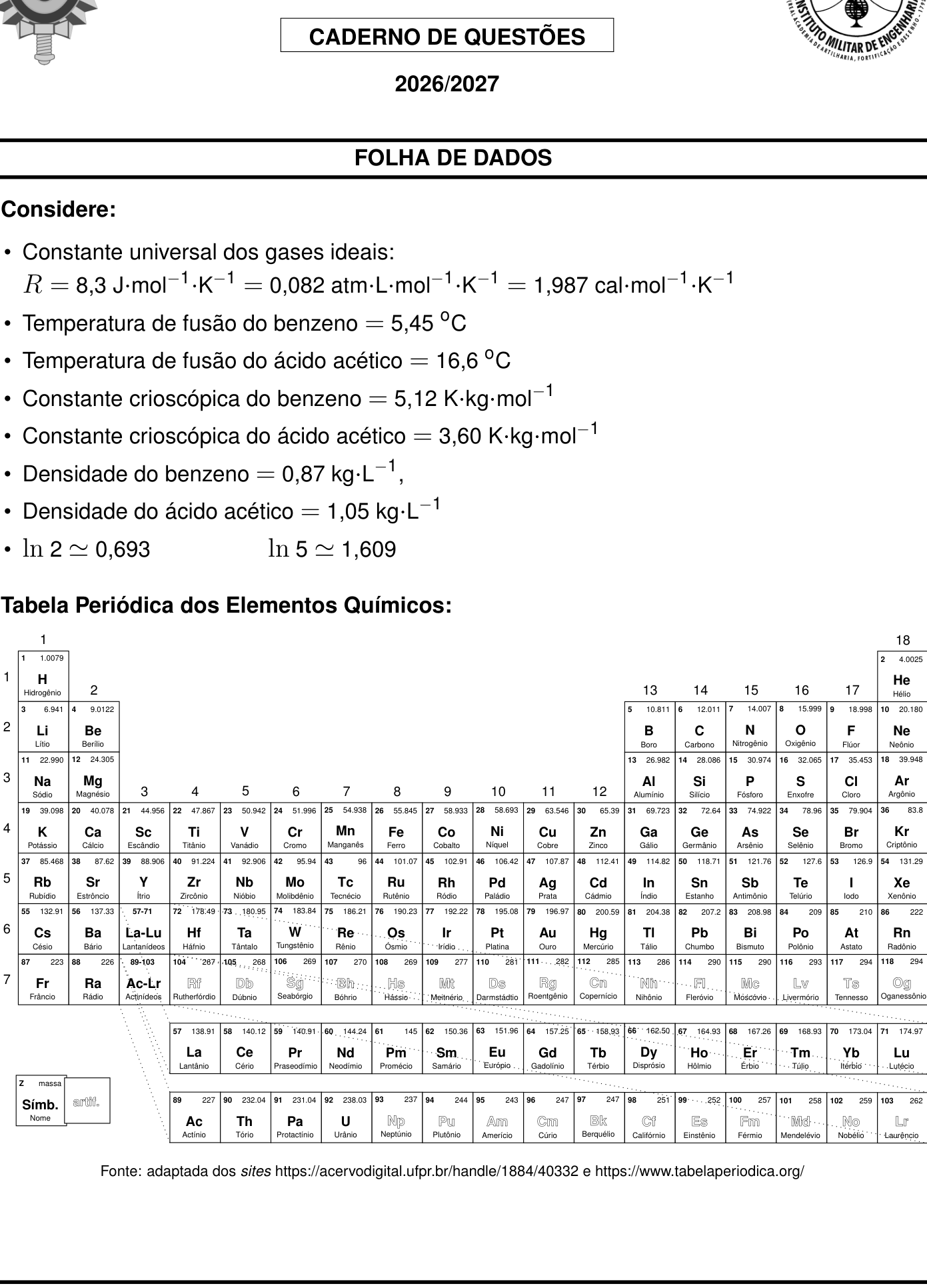
  • Constante crioscópica do benzeno: K_f = 5,12\ \text{K·kg·mol}^{-1}

A molalidade w é dada por:

\Delta T_f = K_f \cdot w \quad\Rightarrow\quad w = \frac{\Delta T_f}{K_f} = \frac{1,28}{5,12} = 0,25\ \text{mol·kg}^{-1}

Como a solução contém 2 kg de benzeno:

n_A = w \cdot m_{\text{benzeno}} = 0,25 \times 2 = 0,5\ \text{mol}

Assim, a massa molar de A é:

M_A = \frac{m_A}{n_A} = \frac{53}{0,5} = 106\ \text{g·mol}^{-1}

Um composto aromático com massa molar 106 g/mol pode ser um hidrocarboneto de fórmula molecular \text{C}_8\text{H}_{10} (pois 8 \times 12 + 10 \times 1 = 106). Os isômeros aromáticos possíveis são: etilbenzeno, o-xileno, m-xileno e p-xileno.

A halogenação (substituição eletrofílica aromática) gera um único produto apenas quando todos os hidrogênios do anel benzênico são equivalentes por simetria. Isso ocorre somente no p-xileno (1,4-dimetilbenzeno), que possui um anel com dois grupos metila em posições opostas, tornando os quatro hidrogênios restantes equivalentes. O o-xileno fornece dois produtos monoclorados; o m-xileno, três; e o etilbenzeno, três (orto, meta e para).

Além disso, o teste de Tollens negativo indica que A não é um aldeído, o que é coerente com o p-xileno, um hidrocarboneto aromático.

Portanto, a estrutura molecular do composto A é o p-xileno (1,4-dimetilbenzeno):

\boxed{\text{CH}_3-\text{C}_6\text{H}_4-\text{CH}_3 \quad (\text{para})}

Resposta final: A estrutura de A é o p-xileno (1,4-dimetilbenzeno).

Gemini 3.8 Flash

Respondeu · bate com a resposta de referência dos cursinhos

1,4-dimetilbenzeno (para-xileno)

levou 57 s

Como pensou
**Analyzing Chemistry Problem** I am currently processing the provided text, focusing on extracting the core chemistry question from the IME exam. My immediate task is to understand the initial conditions and the chemical species involved in the solution preparation described. **Calculating Molar Mass** I've successfully extracted the cryoscopic constant for benzene, solute mass, solvent mass, and the freezing point depression. Using these, I've calculated the molar mass of compound A to be 106 g/mol. **Verifying Molar Mass** I'm re-evaluating the calculated molar mass of 106 g/mol. My current thoughts are focused on potential molecular formulas fitting this mass, specifically looking at $C_8H_{10}$ (like xylene or ethylbenzene) and $C_7H_6O$. The negative Tollens test result strongly suggests it's not benzaldehyde, which is a crucial piece of information. **Evaluating Halogenation Products** I'm now analyzing the potential molecular formulas fitting the molar mass, focusing on $C_8H_{10}$ isomers. My current thought process centers on p-xylene and how its symmetry leads to a single product upon monosubstitution, specifically considering both ring and side-chain halogenation possibilities. **Considering Tollens Relevance** I am now reconsidering the significance of the negative Tollens test. My thought process has shifted to acknowledging that benzaldehyde, with a molar mass of 106 g/mol, would give a positive result, implying the compound is not an aldehyde, thus ruling out a common initial assumption for that molar mass. **Exploring Molecular Formulas** My current focus is on identifying plausible molecular formulas that match the calculated molar mass of 106 g/mol. I am systematically checking combinations of elements, considering both $C_8H_{10}$ and $C_7H_6O$ isomers, and I've noted that $C_7H_6O$ also sums to the correct mass. **Confirming Structure's Symmetry** I am now confirming that p-xylene's high symmetry is key. Electrophilic aromatic substitution, specifically halogenation, exclusively yields a single ring substitution product due to all unsubstituted ring positions being chemically equivalent. This strongly supports p-xylene as the correct isomer. **Considering Isomers and Tests** I am now evaluating potential molecular formulas, specifically $C_7H_6O$. My thoughts are focused on whether non-aldehyde isomers exist for this formula, and how the negative Tollens test confirms the absence of any aldehyde, effectively ruling out benzaldehyde despite its matching molar mass. **Identifying Aldehyde Structures** I'm examining $C_7H_6O$ isomers. With a benzene ring, only benzaldehyde fits. Since the Tollens test was negative, I'm confirming no aldehyde is present, ruling out benzaldehyde as an option for this formula. **Confirming Aldehyde Exclusion** I'm focusing on excluding benzaldehyde. The presence of the formyl group mandates a positive Tollens test, which was explicitly reported as negative. This is a definitive elimination, even though benzaldehyde has the correct molar mass. Therefore, $C_7H_6O$ as an aldehyde isomer is impossible. **Exploring Molecular Formulas** My current thoughts are focused on verifying potential molecular formulas for the 106 g/mol molar mass. I've confirmed $C_8H_{10}$ is a strong candidate based on aromaticity and elemental composition, and I've ruled out compounds with two oxygens or single nitrogen atoms due to mass constraints and the nitrogen rule. **Confirming Elemental Constraints** I'm now focusing on ruling out halogens beyond fluorine. My calculations confirm that fluorine's mass makes it unlikely given the total molar mass, and chlorine doesn't fit. This solidifies $C_7H_6O$ and $C_8H_{10}$ as the primary contenders. **Confirming Reaction Products** My current thoughts are focused on the critical piece of evidence: the generation of a single halogenation product. This strongly suggests a symmetrical molecule. Combined with the negative Tollens test, this points definitively towards a symmetrical, non-aldehyde structure. **Confirming Formula Match** I am now verifying that p-xylene, with a formula of $C_8H_{10}$, matches the calculated molar mass of 106 g/mol. My current thoughts are focused on how its symmetrical structure is the key to generating only one product upon halogenation, aligning perfectly with the experimental observation. **Verifying Cryoscopy Calculation** I am now re-examining the cryoscopy calculation for molar mass. My focus is on substituting the given data into the formula $b = \frac{m_A}{M_A \cdot m_{\text{solvente (kg)}}}$ to solve for $M_A$. I am carefully plugging in the $\Delta T_c$ and $K_c$ values to ensure accuracy in the molality determination. **Confirming Cryoscopy Result** I am now confirming the precision of the cryoscopy calculation. My analysis of the numerical breakdown shows an exact match of 106 g/mol, indicating the experimental data was perfectly tailored for this result, which I am now rigorously cross-referencing with elemental atomic masses for candidate formulas. **Confirming Formula and Structure** I am now confirming that p-xylene, $C_8H_{10}$, aligns perfectly with the calculated molar mass of 106 g/mol and the experimental observation of a single halogenation product due to its high symmetry. The negative Tollens test definitively rules out benzaldehyde, leaving p-xylene as the sole viable candidate. **Synthesizing Solution Elements** I am now synthesizing the conclusion. My thoughts are focused on the high symmetry of p-xylene, which leads to a single halogenation product regardless of whether the reaction is electrophilic aromatic substitution or radical side-chain halogenation. This, combined with the negative Tollens test, definitively identifies p-xylene as the compound.

Para determinar a estrutura molecular do composto A, seguimos as etapas abaixo:


1. Determinação da Massa Molar do Composto A (Crioscopia)

O abaixamento da temperatura de congelamento (\Delta T_c) de uma solução contendo soluto não eletrolítico e não volátil é dado pela lei da crioscopia de Raoult:

\Delta T_c = K_c \cdot b

onde:

  • \Delta T_c = 1,28\text{ }^\circ\text{C} = 1,28\text{ K};
  • K_c = 5,12\text{ K}\cdot\text{kg}\cdot\text{mol}^{-1} (constante crioscópica do benzeno, fornecida na tabela de dados);
  • b é a molalidade da solução:
    b = \frac{n_A}{m_{\text{benzeno (kg)}}} = \frac{m_A}{M_A \cdot m_{\text{benzeno (kg)}}}

Substituindo os valores conhecidos (m_A = 53\text{ g} e m_{\text{benzeno}} = 2\text{ kg}):

1,28 = 5,12 \cdot \frac{53}{M_A \cdot 2}
1,28 = \frac{2,56 \cdot 53}{M_A}
M_A = \frac{2,56 \cdot 53}{1,28} = 2 \cdot 53 = 106\text{ g}\cdot\text{mol}^{-1}

2. Determinação da Fórmula Molecular

Para um composto aromático derivado do benzeno com massa molar próxima de 106\text{ g}\cdot\text{mol}^{-1}, avaliam-se as possibilidades elementares:

  1. Compostos oxigenados (\text{C}_7\text{H}_6\text{O}):

    • Massa molar: 7 \times 12,011 + 6 \times 1,008 + 15,999 \approx 106,12\text{ g}\cdot\text{mol}^{-1}.
    • O único derivado aromático estável com essa fórmula é o benzaldeído (\text{C}_6\text{H}_5\text{CHO}).
    • Contudo, o enunciado informa que o teste de Tollens é negativo. Como o benzaldeído é um aldeído e reduz o reagente de Tollens formando o espelho de prata (teste positivo), a hipótese de ser benzaldeído é descartada.
  2. Hidrocarbonetos aromáticos (\text{C}_8\text{H}_{10}):

    • Massa molar: 8 \times 12,011 + 10 \times 1,008 \approx 106,17\text{ g}\cdot\text{mol}^{-1}.
    • Hidrocarbonetos não reagem com o reagente de Tollens (teste negativo), o que é compatível com os dados.

Portanto, a fórmula molecular do composto A é \text{C}_8\text{H}_{10}.


3. Determinação da Estrutura a partir da Halogenação

Os isômeros aromáticos com fórmula molecular \text{C}_8\text{H}_{10} são:

  • Etilbenzeno: a halogenação eletrofílica aromática gera uma mistura de isômeros (orto e para).
  • 1,2-Dimetilbenzeno (orto-xileno): possui duas posições aromáticas não equivalentes (C3/C6 e C4/C5), fornecendo 2 produtos de monohalogenação.
  • 1,3-Dimetilbenzeno (meta-xileno): possui três posições aromáticas não equivalentes (C2, C4/C6 e C5), fornecendo múltiplos produtos de monohalogenação.
  • 1,4-Dimetilbenzeno (para-xileno): devido à sua alta simetria molecular (D_{2h}), os quatro hidrogênios do anel aromático (posições 2, 3, 5 e 6) são quimicamente equivalentes. Assim, a reação de monohalogenação eletrofílica aromática gera um único produto possível (o 2-halo-1,4-dimetilbenzeno).

(Nota: mesmo se considerada a halogenação radicalar na cadeia lateral, os dois grupos metila são equivalentes, gerando também um único produto monohalogenado).


4. Estrutura Molecular do Composto A

O composto A é o 1,4-dimetilbenzeno (p-xileno).

Sua fórmula estrutural é:

        CH3
         |
      /¯¯¯\
     |  O  |   (ou p-H3C-C6H4-CH3)
      \___/
         |
        CH3

Resposta final: 1,4-dimetilbenzeno (para-xileno)

Gemini 4 Argon

Respondeu · bate com a resposta de referência dos cursinhos

1,4-dimetilbenzeno (para-xileno)

levou 43 s

Como pensou
**Analyzing Chemistry Problem** I am currently focused on understanding a chemistry problem from the IME 2027 exam. The question involves a solution prepared by dissolving an aromatic compound (A) in benzene, and I need to determine the relevant properties or reactions. **Calculating Molar Mass** I'm working on determining the molar mass of compound A. Using the freezing point depression data and the cryoscopic constant for benzene, I've set up the equation to solve for molality, assuming the compound doesn't dissociate. **Determining Chemical Formula** My calculations have yielded a molar mass of 106 g/mol for compound A. I'm now exploring potential molecular formulas, considering aromatic structures. Specifically, $\text{C}_8\text{H}_{10}$ and $\text{C}_7\text{H}_6\text{O}$ are emerging as possibilities. **Confirming Structure** I am confirming the chemical structure of compound A. Given the molar mass of 106 g/mol, and ruling out benzaldehyde due to a negative Tollens test, I am now focusing on $\text{C}_8\text{H}_{10}$ isomers. Specifically, I'm examining p-xylene, as its symmetry allows for a single monohalogenation product, fitting the problem's criteria. **Validating Structure** I've confirmed that p-xylene aligns with the problem's conditions regarding ring halogenation. Even considering side-chain halogenation, its symmetry yields a single product. I'm briefly checking for other aromatic compounds with a molar mass of 106 g/mol, like heteroaromatics. **Investigating Other Structures** I've briefly considered heteroaromatics but am now systematically ruling them out. For example, if the compound were phenylhydrazine ($\text{C}_6\text{H}_5\text{NHNH}_2$, MW 106), its specific reactions would likely be highlighted. The current path strongly favors $\text{C}_8\text{H}_{10}$ isomers.

Para determinar a estrutura molecular do composto aromático A, inicialmente calcula-se a sua massa molar a partir dos dados de crioscopia.

1. Cálculo da massa molar do composto A:

A equação do abaixamento crioscópico para um soluto não dissociável (fator de van't Hoff i = 1) é dada por:

\Delta T_c = K_c \cdot W

onde:

  • \Delta T_c = 1,28\text{ }^\circ\text{C} = 1,28\text{ K} é o abaixamento da temperatura de congelamento;
  • K_c = 5,12\text{ K}\cdot\text{kg}\cdot\text{mol}^{-1} é a constante crioscópica do benzeno;
  • W = \frac{n_A}{m_{\text{solvente}}} = \frac{m_A}{M_A \cdot m_{\text{solvente}}} é a molalidade da solução.

Substituindo os valores dados (m_A = 53\text{ g} e m_{\text{solvente}} = 2\text{ kg}):

1,28 = 5,12 \cdot \frac{53}{M_A \cdot 2}

M_A = \frac{5,12 \cdot 53}{1,28 \cdot 2} = \frac{4 \cdot 53}{2} \implies M_A = 106\text{ g}\cdot\text{mol}^{-1}

2. Determinação da fórmula molecular:

Como o composto A é aromático, ele possui pelo menos um anel benzênico (6 átomos de carbono, que correspondem a 6 \times 12 = 72\text{ g}\cdot\text{mol}^{-1}). Os 34\text{ g}\cdot\text{mol}^{-1} restantes podem corresponder a:

  • Fórmula \text{C}_7\text{H}_6\text{O} (7 \times 12 + 6 \times 1 + 16 = 106\text{ g}\cdot\text{mol}^{-1}): corresponde ao benzaldeído.
  • Fórmula \text{C}_8\text{H}_{10} (8 \times 12 + 10 \times 1 = 106\text{ g}\cdot\text{mol}^{-1}): corresponde aos hidrocarbonetos aromáticos etilbenzeno, orto-xileno, meta-xileno e para-xileno.

3. Identificação estrutural pelas propriedades químicas:

  • Teste de Tollens negativo: O reagente de Tollens ([\text{Ag(NH}_3)_2]^+\text{OH}^-) oxida aldeídos a ácidos carboxílicos com formação de espelho de prata (\text{Ag}^0). Como o resultado do teste foi negativo, o composto A não possui função aldeído, o que descarta o benzaldeído (\text{C}_7\text{H}_6\text{O}). Portanto, A é um hidrocarboneto de fórmula \text{C}_8\text{H}_{10}.

  • Reação de halogenação gerando um único produto possível:
    Analisando os quatro isômeros aromáticos de fórmula \text{C}_8\text{H}_{10} frente à mono-halogenação:

    • Etilbenzeno: possui 3 tipos de hidrogênios aromáticos (orto, meta e para) e 2 tipos na cadeia lateral;
    • o-xileno (1,2-dimetilbenzeno): possui 2 tipos de hidrogênios no anel aromático (posições 3,6 e 4,5);
    • m-xileno (1,3-dimetilbenzeno): possui 3 tipos de hidrogênios no anel aromático (posições 2, 4/6 e 5);
    • p-xileno (1,4-dimetilbenzeno): devido à sua alta simetria molecular, possui todos os 4 hidrogênios do anel aromático quimicamente equivalentes (posições 2, 3, 5 e 6), bem como todos os 6 hidrogênios benzílicos das duas metilas equivalentes entre si.

Assim, o único isômero cuja mono-halogenação gera um único produto possível é o 1,4-dimetilbenzeno (para-xileno).


4. Estrutura molecular do composto A:

          CH3
           |
         /===\
        |  O  |   (1,4-dimetilbenzeno ou p-xileno)
         \===/
           |
          CH3

Resposta final: 1,4-dimetilbenzeno (para-xileno)