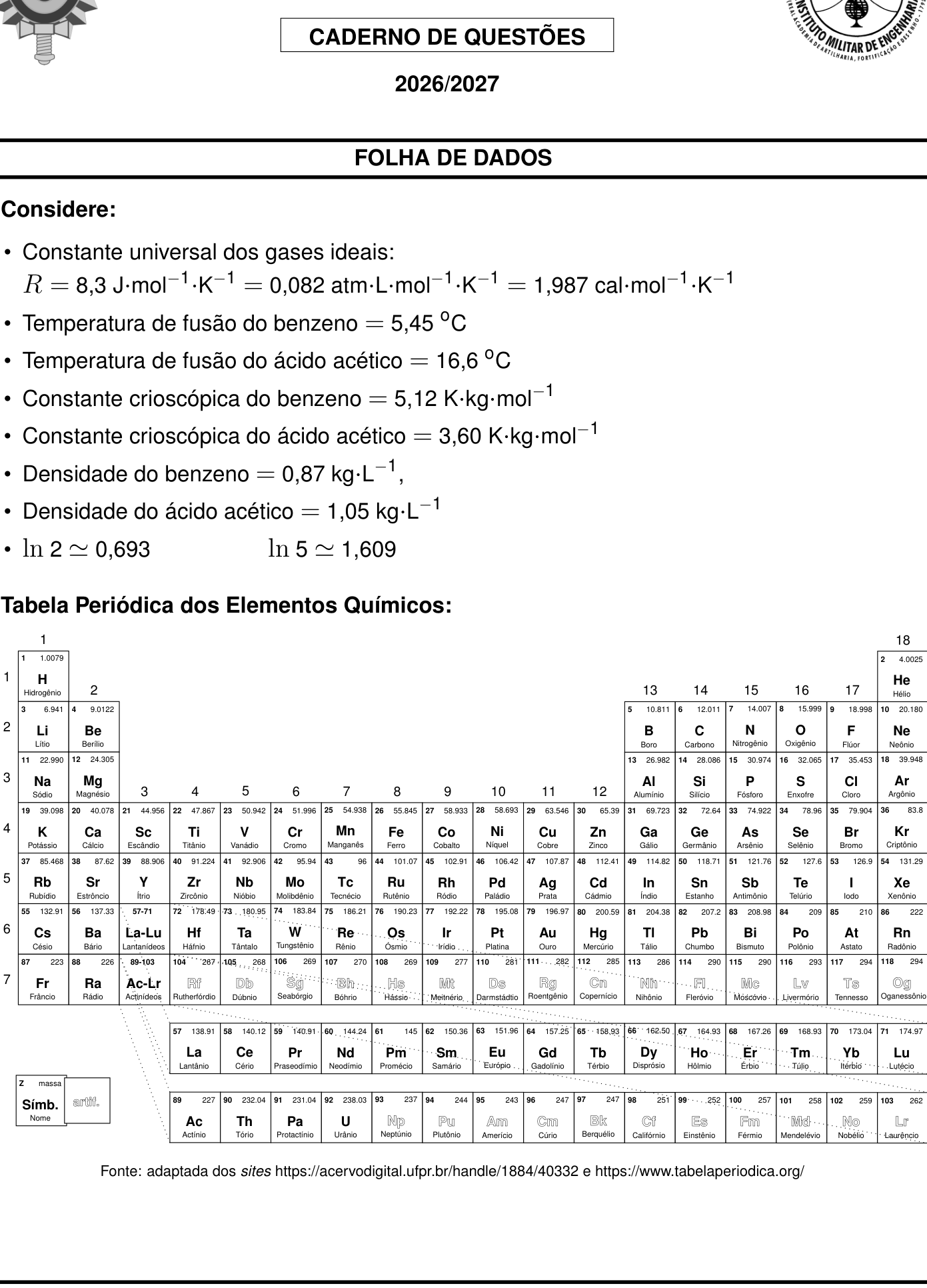
Como pensou
We need answer chemistry question in Portuguese. Need solve. Let's restate.
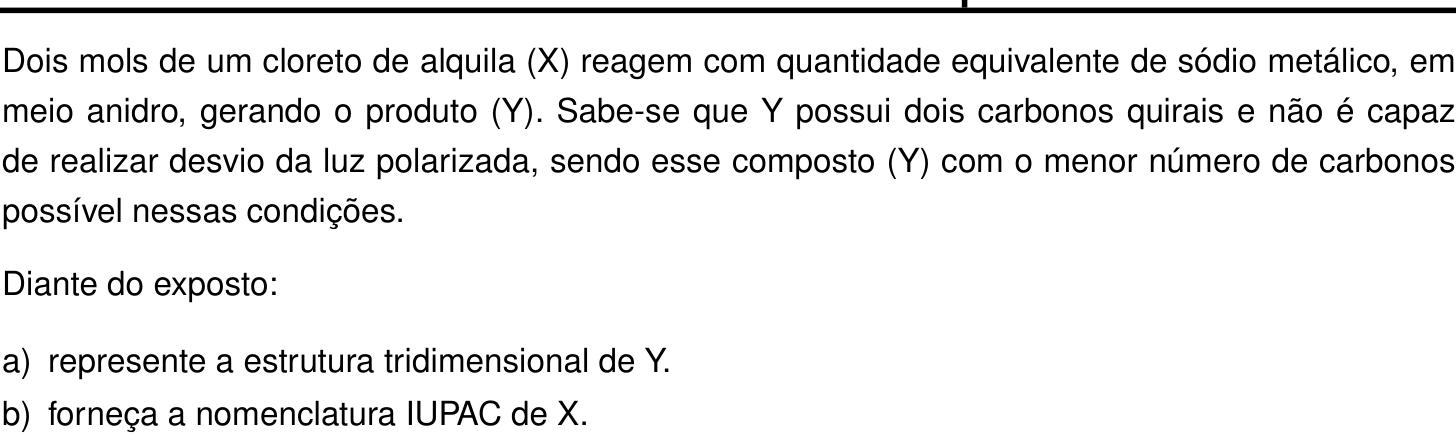
Question: "Dois mols de um cloreto de alquila (X) reagem com quantidade equivalente de sódio metálico, em meio anidro, gerando o produto (Y). Sabe-se que Y possui dois carbonos quirais e não é capaz de realizar desvio da luz polarizada, sendo esse composto (Y) com o menor número de carbonos possível nessas condições.
Diante do exposto:
a) represente a estrutura tridimensional de Y.
b) forneça a nomenclatura IUPAC de X."
Need parse. Reaction: alkyl chloride (X) reacts with sodium metal in anhydrous medium, equivalent amount? "Dois mols de um cloreto de alquila (X) reagem com quantidade equivalente de sódio metálico" This sounds Wurtz reaction: 2 R-Cl + 2 Na -> R-R + 2 NaCl. "quantidade equivalente de sódio metálico" = 2 mol Na per 2 mol X? Equivalent to 2 mol. Generates product Y (alkane dimer). Y has two chiral carbons and is not capable of rotating plane-polarized light (optical inactivity), and Y with the smallest possible number of carbons under these conditions. Need identify Y, then X.
Y has two chiral carbons, optically inactive, smallest possible number carbons. Could be meso compound? Two chiral carbons but achiral due to internal symmetry (meso). Smallest possible meso alkane from Wurtz coupling? We need consider Y is product of coupling two identical alkyl chlorides? Wurtz: 2 RCl + 2 Na -> R-R + 2 NaCl. Y = R-R. It has two chiral carbons? Actually if R group has one chiral carbon, dimer R-R has two chiral carbons (at former carbons). For optical inactivity, the two chiral centers may be opposite configurations (meso) or racemic mixture? The statement "não é capaz de realizar desvio da luz polarizada" could mean the compound itself is optically inactive; if racemic mixture, not pure? But "composto (Y)" maybe one compound, not mixture. "possui dois carbonos quirais e não é capaz de realizar desvio da luz polarizada" likely meso compound. Need smallest number of carbons.
We need find R such that R-R has two chiral carbons and is meso, minimal carbons. X is alkyl chloride with one chiral carbon? Let's analyze.
Wurtz coupling of secondary alkyl halide? For R-R to have two chiral centers, R must be a secondary alkyl group? Because the carbon bearing Cl becomes chiral after coupling if it is attached to two different groups and H? Wait in RCl, the carbon bearing Cl: if it is secondary (attached to two carbon groups and H? Actually secondary carbon attached to two carbons and H? Let's define: alkyl chloride R-Cl where R is alkyl group. The carbon attached to Cl (Cα) has Cl and R (which includes rest) and H? If R is primary alkyl (R-CH2-Cl), Cα is CH2Cl, not chiral. After coupling, the two Cα are CH2, not chiral. If R is secondary (R1R2CH-Cl), Cα is attached to R1, R2, Cl, H; chiral if R1 != R2. After coupling, Cα becomes attached to R1, R2, H, and the other Cα group; likely chiral. If R is tertiary (R1R2R3C-Cl), Cα no H, not chiral? Actually no H, attached to three carbons and Cl; after coupling no H, chiral if three groups different? But product has two quaternary carbons maybe. But "dois carbonos quirais" and "menor número de carbonos" maybe use secondary chlorides.
Smallest Y with two chiral carbons, meso. Let's enumerate possible alkanes from Wurtz of secondary chlorides.
Wurtz of isopropyl chloride (2-chloropropane): 2 (CH3)2CHCl + 2 Na -> 2,3-dimethylbutane? Let's see: (CH3)2CH-CH(CH3)2 = 2,3-dimethylbutane. Structure: CH3-CH(CH3)-CH(CH3)-CH3. This has two chiral centers at C2 and C3? Each carbon attached to CH3, H, and the other chiral carbon. The two chiral centers are equivalent; configurations can be (R,R), (S,S), or (R,S) meso? Wait 2,3-dimethylbutane has two identical chiral centers? Actually each C2 attached to CH3, H, C3 group, and? C2 attached to CH3, H, C3, and C1 (CH3). Since C1 and CH3? Let's label: C1H3 - C2H(CH3) - C3H(CH3) - C4H3. C2 attached to C1 (CH3), C3, CH3 (methyl substituent), H. C3 attached to C2, C4 (CH3), CH3, H. The molecule has a plane of symmetry? For meso, configurations at C2 and C3 opposite. Is meso 2,3-dimethylbutane optically inactive? Yes, (2R,3S)-2,3-dimethylbutane is meso. It has two chiral carbons, optically inactive. Number carbons = 6. Could there be smaller? Wurtz of secondary chloride with fewer carbons? Minimum secondary alkyl chloride: 2-chloropropane has 3 carbons, product 6 carbons. Is there any product with 5 carbons? Wurtz coupling of chloromethane (1C) -> ethane (2C) no chiral. chloroethane (2C) -> butane (4C) no chiral. 1-chloropropane (3C) -> hexane (6C) no chiral? n-hexane no chiral. 2-chloropropane -> 2,3-dimethylbutane (6C) chiral. 2-chlorobutane (4C) -> 3,4-dimethylhexane? Let's see: CH3-CH2-CH(Cl)-CH3 coupling gives CH3-CH2-CH(CH3)-CH(CH3)-CH2-CH3 = 3,4-dimethylhexane. Has 8 carbons? Actually two 4C units = 8C. Could have two chiral centers, meso possible. Larger. So smallest is 6C from isopropyl chloride.
But wait maybe Wurtz reaction with "quantidade equivalente de sódio metálico" maybe means 2 mol X with 2 mol Na? Yes.
Question asks: "a) represente a estrutura tridimensional de Y." Need draw 3D structure of meso-2,3-dimethylbutane? Need represent stereochemistry maybe with wedge/dash? In text, can describe? We need provide structure tridimensional. In final answer maybe use Fischer projection? Need be careful.
b) IUPAC name of X: 2-cloropropano (isopropyl chloride). Since X is alkyl chloride with 3 carbons, chlorine at C2. IUPAC: 2-cloropropano.
Need ensure "menor número de carbonos possível nessas condições": Y has two chiral carbons and no optical rotation. Could there be a 5-carbon product from Wurtz of a chlorinated cyclopropane? No, Wurtz of alkyl chlorides, smallest secondary chloride is 2-chloropropane -> 6C. What about coupling of chloromethyl methyl? Hmm maybe if X is 1-chloro-2-methylpropane? That's primary? Product 2,5-dimethylhexane? Let's see. 1-chloro-2-methylpropane (isobutyl chloride) is primary chloride; coupling gives 2,5-dimethylhexane? Structure: (CH3)2CH-CH2-CH2-CH(CH3)2. Has no chiral centers? Actually C2 and C5? Each attached to CH3, H, CH2, CH(CH3)2? The C2 maybe not chiral? Let's check: C2 in 2,5-dimethylhexane: CH3-CH(CH3)-CH2-CH2-CH(CH3)-CH3. C2 attached to CH3, H, CH2, and CH(CH3)2? That's four different groups? Wait C2 is CH attached to C1 (CH3), C3 (CH2), methyl substituent, H. C3 is CH2. So C2 attached to CH3, CH2, CH3 (substituent), H. Two methyl groups? One is C1 methyl, one is substituent methyl; are they identical? The molecule may have symmetry, but locally at C2, C1 methyl and substituent methyl are not identical because one is part of chain and one branch? Let's see if C2 is chiral? In 2,5-dimethylhexane, the two ends are isopropyl groups. C2 is attached to CH3, H, CH2, and CH(CH3)2? Actually the branch at C2 is methyl, so C2 is CH(CH3)-CH2... It has two methyl groups? C1 is CH3, and substituent is CH3. Are they enantiotopic or diastereotopic? The molecule has a plane of symmetry through center maybe; C2 and C5 equivalent. But is C2 stereogenic? A carbon with two identical substituents (two methyls) is not chiral. Wait C2 attached to C1 methyl, C3 methylene, methyl branch, H. C1 methyl and methyl branch are both CH3, so not chiral. So no.
What about 3-chloropentane? Coupling gives 3,4-diethylhexane? 8C. Larger.
Maybe there is a possibility with Wurtz of secondary chloride with 3 carbons but product 2,3-dimethylbutane has two chiral carbons and meso. That's smallest.
Need "estrutura tridimensional de Y": We can draw meso-2,3-dimethylbutane using Fischer projection or wedge/dash. In text, maybe use notation. Need represent "estrutura tridimensional" maybe with solid/dashed wedges. We can provide a Fischer projection:
CH3
|
H - C - CH3
|
H - C - CH3
|
CH3
But need correct meso? Let's derive Fischer projection for meso-2,3-dimethylbutane.
Meso-2,3-dimethylbutane has symmetry. Fischer projection: vertical carbon chain with C2 and C3. Each has H and CH3 horizontal. For meso, the two methyl groups on same side? Let's recall: (2R,3S)-2,3-dimethylbutane. In Fischer, if vertical chain is C2-C3, and at C2 OH? Here substituents: CH3 and H. For meso, the two identical substituents (CH3) on same side? Let's determine.
Use Fischer rules. For 2,3-dimethylbutane, draw carbon chain vertical: C1 (CH3) top, C2, C3, C4 (CH3) bottom. At C2, substituents: CH3 and H. At C3, substituents: CH3 and H. For meso, the molecule has plane of symmetry. If CH3 groups are on opposite sides? Let's test.
Fischer with C2: H left, CH3 right. C3: H left, CH3 right? Then mirror? Let's assign R/S. Fischer: vertical bonds away, horizontal bonds toward. At C2: priorities: 1 Br? Actually groups: CH3 (C3 group?) Need priorities. For C2: attached to C1 (CH3), C3, CH3 substituent, H. C3 group vs CH3? C3 is CH(CH3)2? Wait C3 attached to C2, C4, CH3, H. Compare C3 vs CH3: C3 has C attached to C,H,H? Actually C3 is carbon attached to C2, C4, H, CH3. The C3 group is -CH(CH3)2? Actually from C2 perspective, group C3 is -CH(CH3)-CH3? No, C3 is CH(CH3)-CH3? Let's define: C2 attached to C3; C3 attached to C4 (CH3), CH3 substituent, H. So C3 group is -CH(CH3)2? Wait C3 has three carbons? C3 attached to C2, C4, and CH3. So group is -CH(CH3)(CH3)? Actually C3 is CH, attached to C2, CH3 (C4), CH3 (substituent), H. So group is -CH(CH3)2? Yes isopropyl group. Compare with CH3 substituent at C2: isopropyl vs methyl. Isopropyl carbon attached to C, C, H; methyl carbon attached to H,H,H. So isopropyl higher priority than methyl. Thus at C2, priority: 1 = C3 group (isopropyl), 2 = CH3 substituent, 3 = H? Wait H lowest. Need compare CH3 vs H: CH3 higher. So 1 C3, 2 CH3, 3 H, 4? Actually only three groups plus H. So priorities: 1: C3 group, 2: CH3, 3: H. For Fischer, if H horizontal, determine R/S by orientation: 1->2->3 clockwise? Let's do.
Fischer C2: top vertical to C1? Actually C2 connected to C1 (top), C3 (bottom), CH3 (right), H (left). But for stereocenter, the four groups are C1 (CH3), C3, CH3, H. Wait C1 is CH3, same as substituent CH3? Are they identical? No, C1 is terminal methyl, substituent is methyl; but both are CH3. However in the molecule, are they identical? At C2, one CH3 is part of main chain (C1) and one is branch. Since the molecule has symmetry? But for stereocenter, if two groups are identical, it's not chiral. Wait 2,3-dimethylbutane: C2 attached to C1 (CH3), C3, CH3 branch, H. Are C1 and branch both CH3? Yes, but are they constitutionally identical? The molecule is symmetric: C2 and C3 equivalent; but at C2, the two methyl groups (C1 and branch) are enantiotopic? Actually if you replace one, you might get diastereomers? Let's think. In 2,3-dimethylbutane, C2 is attached to C1 (CH3), C3 (CH(CH3)2), CH3 (branch), H. The two methyl groups are not identical because one is connected to C2 only? Wait both are CH3 connected to C2; one is C1 (terminal), one is branch. But the rest of molecule from C2 is different: C3 group. So two methyl groups are constitutionally equivalent? They are both methyl groups attached to same carbon; but one is part of main chain and one branch. Actually in an alkane, there is no distinction between main chain and branch; the molecule has two equivalent methyl groups at each end? Let's check symmetry: 2,3-dimethylbutane has a C2 axis? The two central carbons C2 and C3 each have two methyl groups: one "left" and one "right". Are the two methyls on C2 equivalent? The molecule has a plane of symmetry perpendicular to C2-C3? Let's see: structure CH3-CH(CH3)-CH(CH3)-CH3. If you rotate around C2-C3? The two methyls on C2 are one attached to C1 (terminal) and one branch. Are they enantiotopic? They are actually homotopic? Let's test: replace one methyl with ethyl. If replace C1 methyl, get 2-ethyl-3-methylbutane? If replace branch methyl, get 3-ethyl-2-methylbutane? These may be same? Let's name: 2-ethyl-3-methylbutane vs 3-ethyl-2-methylbutane; both are 2-ethyl-3-methylbutane? Actually longest chain: 2-ethyl-3-methylbutane has chain butane with ethyl at C2 and methyl at C3. The other also same. So they are identical. Thus the two methyl groups on C2 are equivalent (homotopic?) Therefore C2 is not chiral? Wait if two groups are identical, then no chiral. But 2,3-dimethylbutane is known to have chiral centers? Let's verify.
Actually 2,3-dimethylbutane: C2 and C3 each have four different groups? Let's list for C2: attached to C1 (CH3), C3 (CH(CH3)2), CH3 (substituent), H. But C1 and substituent are both CH3; however are they different because one is part of main chain? In stereochemistry, if two ligands are identical, the carbon is not stereogenic. But wait, in 2,3-dimethylbutane, the two methyl groups on C2 are not identical because one is on the "left" and one on the "right"? But the molecule has symmetry; if you replace one, you get different? Let's use CIP: at C2, compare C1 vs substituent CH3. Both are carbon attached to H,H,H. They are identical. So C2 is not chiral? But I remember 2,3-dimethylbutane has two stereocenters? Let's check: 2,3-dimethylbutane has two tertiary? Actually it's a branched alkane. Are there stereoisomers? Yes, 2,3-dimethylbutane has meso and enantiomeric forms? Wait I think 2,3-dimethylbutane does have two chiral centers? Let's look up: 2,3-dimethylbutane has two stereocenters? The molecule CH3-CH(CH3)-CH(CH3)-CH3. Each central carbon is attached to two methyl groups? No, central carbon C2 attached to CH3 (C1), CH3 (branch), H, and C3. That's two methyl groups. But the two methyl groups are not identical because one is part of the main chain? Actually in a molecule, if a carbon is attached to two identical groups, it's not chiral. However, in 2,3-dimethylbutane, the two methyl groups on C2 are enantiotopic? Let's consider replacing one methyl with ethyl. If replace the methyl that is part of the main chain (C1), you get 2-ethyl-3-methylbutane? Structure: CH3-CH2-CH(CH3)-CH(CH3)-CH3? Wait replacing C1 CH3 with CH2CH3 gives CH3CH2-CH(CH3)-CH(CH3)-CH3. Longest chain 5? Actually name: 3,4-dimethylhexane? Let's see: C1-C2-C3-C4-C5? If C1 becomes ethyl, chain length 5? CH3CH2-C2H(CH3)-C3H(CH3)-CH3 = 2,3-dimethylpentane? Let's not. If replace branch methyl with ethyl, get CH3-CH(CH2CH3)-CH(CH3)-CH3 = 3-ethyl-2-methylbutane? Longest chain 5? That is 3-methylpentane? Let's name properly. Both replacements might give different compounds? Let's use symmetry. 2,3-dimethylbutane has a plane of symmetry between C2 and C3. The two methyls on C2 are related by a mirror plane? Actually there is a C2 rotation? The molecule has D3d? Hmm.
Let's check known fact: 2,3-dimethylbutane has two stereocenters? I recall 2,3-dimethylbutane has two chiral centers and exists as meso and enantiomeric pair? Wait I think 2,3-dimethylbutane is chiral? Let's search memory: 2,3-dimethylbutane has two tertiary carbons; each is attached to two methyl groups and a hydrogen, plus the other tertiary carbon. Since the two methyl groups on each carbon are identical, the carbon is not chiral. But the molecule may have conformational chirality? Actually 2,3-dimethylbutane in anti conformation has a center of symmetry? Let's test with molecular model: C2 has two methyls; if you swap them, the molecule is identical because the two methyls are equivalent by rotation? Wait the two methyls on C2 are not equivalent if the other carbon C3 has a specific configuration? But C3 also has two methyls. The molecule has symmetry: there is a C2 axis passing through midpoint of C2-C3? Let's visualize: central bond C2-C3. C2 has two methyls (C1 and branch) and H. C3 has two methyls (C4 and branch) and H. In a staggered conformation, if the two methyls on C2 are not equivalent? Actually the molecule has a plane of symmetry perpendicular to C2-C3? Let's assign: C2 has substituents: C1 (CH3), C3, H, CH3. The two CH3 are not equivalent because one is C1 (part of main chain) and one is branch, but in the molecule, if you rotate 180° around an axis perpendicular to C2-C3, C1 might swap with branch? Let's see. The molecule is CH3-CH(CH3)-CH(CH3)-CH3. If you rotate around C2-C3? No. The two methyls on C2 are both terminal? Actually one is attached to C2 and ends; the other is also attached to C2 and ends. They are equivalent because the rest of molecule is symmetric? But if you replace one, you might get same compound? Let's check by naming: replace one methyl on C2 with ethyl. If replace the methyl that is not part of the longest chain? But there is no distinction. The product is 2-ethyl-3-methylbutane? Let's name: parent chain: longest chain containing the ethyl and the other methyl? Structure: CH3-CH2-C(CH3)(H)-CH(CH3)-CH3? Wait if replace a methyl on C2 with ethyl, C2 becomes CH(CH2CH3) attached to C3, H, and the other methyl. So molecule: CH3-CH2-CH(CH3)-CH(CH3)-CH3? Actually C2 now has ethyl, methyl, H, C3. C3 has two methyls, H. So structure: CH3-CH2-CH(CH3)-CH(CH3)-CH3. Longest chain: from ethyl end to C3 to one methyl on C3? Let's find longest: CH3-CH2-CH(CH3)-CH(CH3)-CH3. The longest chain could be 5 carbons: CH3-CH2-CH(CH3)-CH(CH3)-CH3? Number from ethyl end: C1 CH3, C2 CH2, C3 CH(CH3), C4 CH(CH3), C5 CH3. So parent pentane with methyl at C3 and methyl at C4? That's 3,4-dimethylpentane. If replace the other methyl on C2 (the one that was branch), you get same? Let's see: replace branch methyl with ethyl: C2 attached to C1 (CH3), C3, H, CH2CH3. Structure: CH3-CH(CH2CH3)-CH(CH3)-CH3. Longest chain: choose chain through ethyl and C3 and C4? CH3-CH2-CH(CH3)-CH(CH3)-CH3? Actually C2 now has ethyl and C1 methyl. Longest chain: from ethyl end: CH3-CH2-C2H(CH3)-C3H(CH3)-CH3. Same 3,4-dimethylpentane. So replacing either methyl gives same product. Thus the two methyls on C2 are equivalent (homotopic). Therefore C2 is not a stereocenter. But wait, 2,3-dimethylbutane is known to have two stereocenters? Let's check online memory: 2,3-dimethylbutane has two stereocenters? I recall "2,3-dimethylbutane has two chiral centers" maybe because each C2 is attached to two different groups? Actually the two methyl groups on C2 are not identical because one is cis to something? But in constitution, they are identical. However, if the molecule has a stereocenter at C3, then the two methyls on C2 become diastereotopic? Let's analyze: Consider C2 with two methyls, but C3 has a configuration (R or S). Then the two methyls on C2 are diastereotopic because replacing one vs the other gives diastereomers? But for a carbon to be chiral, it must have four different groups. If two groups are constitutionally identical but stereochemically different (enantiotopic/diastereotopic), the carbon can be a stereocenter? In a molecule, a carbon attached to two identical groups is not chiral because there is a plane of symmetry? But if the molecule is already chiral at another center, the two groups might be diastereotopic and the carbon is a stereocenter? Let's recall: A carbon with two identical substituents is not a stereocenter unless the two substituents are enantiotopic? Actually if a molecule has a stereocenter elsewhere, a carbon with two identical groups can be a stereocenter if the two groups are diastereotopic? Example: 2,3-dichlorobutane has two chiral centers. In 2,3-dichlorobutane, each C has Cl, CH3, H, and the other C. The two methyl groups? No, each C has one CH3, one H, one Cl, one other C. So four different. In 2,3-dimethylbutane, each C has two CH3, H, other C. So only three different groups. It cannot be chiral. Wait, but the two methyl groups are not identical if the other carbon is chiral? But the carbon itself sees two methyl groups; are they truly identical? Let's check symmetry: In meso-2,3-dimethylbutane, there is a plane of symmetry. In (R,R)-2,3-dimethylbutane, is there a C2 axis? Let's model. If C2 has two methyls, one can be labeled pro-R and pro-S? Actually the two methyls are enantiotopic in a molecule with no other stereocenter. If C3 is chiral, they become diastereotopic. But for C2 to be a stereocenter, the two methyls must be different. But they are both CH3; however, one is "above" the plane and one "below"? In a tetrahedral carbon, if two substituents are identical, the carbon is not chiral because you can rotate the molecule to interchange them. Even if the rest of molecule is chiral, the carbon with two identical groups is not a stereocenter because swapping them gives a different conformation? Actually, consider 2,3-dimethylbutane with C3 fixed as R. At C2, the two methyls are diastereotopic; replacing one gives a diastereomer, replacing the other gives another diastereomer. But the carbon itself has two identical groups, so it is not a stereocenter? Let's test with CIP: For C2, list ligands: C1 (CH3), C3 (chiral), CH3 (other), H. Two CH3 are identical by constitution. In CIP, if two ligands are identical, the atom is not stereogenic. So 2,3-dimethylbutane should not have chiral centers. But wait, I remember "2,3-dimethylbutane" has two chiral centers? Let's verify by simple example: 2,3-dimethylpentane? Actually 2,3-dimethylbutane is not chiral. Let's search memory: "2,3-dimethylbutane chiral centers" I think it has no chiral centers because each tertiary carbon has two methyl groups. The meso/racemic forms? Wait, I recall "2,3-dimethylbutane has two stereocenters" from organic chemistry? Let's think of 2,3-dimethylbutane: structure (CH3)2CH-CH(CH3)2. It is isopropyl dimer. Each central carbon is attached to two methyl groups and a hydrogen and the other central carbon. Since the two methyl groups are identical, it's not chiral. But I have seen "2,3-dimethylbutane" in stereochemistry as an example of a molecule with two stereocenters? No, that's 2,3-dichlorobutane or 2,3-dibromobutane. 2,3-dimethylbutane might have conformational enantiomers? Actually, the anti conformation has a center of inversion; gauche conformations are chiral? But it rapidly interconverts. However, the molecule is not configurationally chiral. So no stereocenters.
Then the question's Y with two chiral carbons cannot be 2,3-dimethylbutane. Need reconsider.
Maybe Wurtz of secondary chloride gives product with two chiral carbons if the R group is such that the central bond connects two carbons each attached to two different groups and H. But in R-R, each former Cα is attached to: the other Cα, H, and two groups from R (if R is secondary, the Cα originally had two carbon groups and H and Cl; after coupling, it has two carbon groups, H, and the other Cα). For Cα to be chiral, the two carbon groups must be different. In 2-chloropropane, R = isopropyl, the two carbon groups on Cα are both CH3? Wait 2-chloropropane: Cα (C2) attached to CH3 (C1), CH3 (C3? Actually C3 is CH3? No, 2-chloropropane: CH3-CH(Cl)-CH3. The two groups attached to Cα are CH3 and CH3, identical. After coupling, Cα attached to CH3, CH3, H, and other Cα. Two CH3 identical -> not chiral. Ah! I earlier mistakenly thought C2 attached to C1 and C3; but both are CH3. So 2,3-dimethylbutane has no chiral centers. Correct! So my initial Y is wrong.
We need R such that at the chiral carbon in RCl, there are two different carbon groups. For example 2-chlorobutane: CH3-CH2-CH(Cl)-CH3. Cα attached to CH3 (C1? Actually C2 attached to C1 CH3, C3 CH2CH3, H, Cl). The two carbon groups are CH3 and CH2CH3, different. After coupling, product Y = 3,4-dimethylhexane? Let's see: 2 R-Cl -> R-R: CH3-CH2-CH(CH3)-CH(CH3)-CH2-CH3? Wait coupling two 2-chlorobutane molecules: each Cα becomes bonded to the other Cα. So product: CH3-CH2-CH(CH3)-CH(CH3)-CH2-CH3? Let's name: longest chain 6? Structure: CH3-CH2-CH(CH3)-CH(CH3)-CH2-CH3. That is 3,4-dimethylhexane? Let's number from left: C1 CH3, C2 CH2, C3 CH(CH3), C4 CH(CH3), C5 CH2, C6 CH3. Substituents methyl at C3 and C4. So 3,4-dimethylhexane. It has two chiral centers (C3 and C4). It can exist as meso (3R,4S) and enantiomeric pair. The meso form is optically inactive. Number of carbons = 8. But is there smaller? Maybe 2-chlorobutane has 4 carbons; product 8 carbons. What about 2-chloropropane gave 6 carbons but no chiral. Could there be a 7-carbon product? Wurtz coupling of two different alkyl chlorides? The problem says "Dois mols de um cloreto de alquila (X)" — same chloride. So symmetric product. Smallest with two chiral centers and optically inactive might be 3,4-dimethylhexane (8C). But wait, could there be a product with 7 carbons from coupling of a secondary chloride with 3.5 carbons? No.
But maybe Wurtz reaction of a secondary chloride with sodium gives not only dimer but also elimination? But "gerando o produto (Y)" likely Wurtz.
Let's examine "Y possui dois carbonos quirais e não é capaz de realizar desvio da luz polarizada, sendo esse composto (Y) com o menor número de carbonos possível nessas condições." This strongly suggests meso-2,3-dichlorobutane? Wait maybe the reaction is not Wurtz but something else? "cloreto de alquila (X) reagem com quantidade equivalente de sódio metálico, em meio anidro" This is Wurtz reaction. But "quantidade equivalente" maybe means 2 mol X with 2 mol Na. The product Y is an alkane. The phrase "menor número de carbonos possível" maybe among meso alkanes with two chiral carbons. Smallest meso alkane with two chiral carbons? Let's think: 2,3-dimethylbutane no chiral. 3,4-dimethylhexane has 8 carbons and is meso possible. But is there a 7-carbon meso alkane? For a meso alkane with two chiral carbons, need two identical stereocenters. Smallest alkane with two identical stereocenters and meso? Let's enumerate.
General formula for meso alkane with two chiral carbons: R1R2CH-CHR1R2, where the two ends identical, and each carbon has two different substituents (R1 ≠ R2) and H. The smallest such molecule? Let each chiral carbon be attached to H, CH3, and a group G, and the other chiral carbon. To be meso, the two chiral carbons have opposite configurations. The molecule has symmetry. What is smallest total carbons? Let R1 = CH3, R2 = ethyl? Then product is 3,4-dimethylhexane (8C). Could R2 = H? No, then carbon attached to two H, not chiral. Could R1 = CH3, R2 = isopropyl? Larger. Could use a ring? Wurtz of alkyl chloride gives open chain. Could use two different groups that are small? The smallest possible carbon groups are methyl and ethyl. If R1 = methyl, R2 = methyl, not chiral (2,3-dimethylbutane). If R1 = methyl, R2 = ethyl, total carbons: each chiral carbon has methyl, ethyl, H, and other chiral carbon. Count: two chiral carbons + two methyls + two ethyls = 2 + 2 + 4 = 8. If R1 = H? No. If R1 = methyl, R2 = isopropyl: 2 + 2 + 6 = 10. So 8 is minimum. Could there be a cyclic meso compound with fewer? Wurtz of alkyl chloride doesn't form rings. So Y likely 3,4-dimethylhexane.
But wait: "menor número de carbonos possível nessas condições" maybe considering that X has a chiral carbon? X is an alkyl chloride; if X has a chiral carbon, then Y has two chiral carbons. The smallest X with a chiral carbon is 2-chlorobutane? Let's see: 2-chlorobutane has 4 carbons and is chiral? C2 is attached to CH3, CH2CH3, Cl, H. Yes chiral. Its coupling gives 3,4-dimethylhexane (8C). But is there a smaller chiral alkyl chloride? 2-chloropropane: C2 attached to two CH3, Cl, H -> not chiral. 2-chlorobutane is smallest chiral alkyl chloride? What about 2-chloro-2-methylpropane? Tertiary, no chiral. 1-chloro-2-methylbutane? Primary, no chiral. 2-chlorobutane is smallest secondary chiral. So Y = 3,4-dimethylhexane. But the question says Y has two chiral carbons and no optical rotation, smallest number of carbons. 3,4-dimethylhexane has two chiral carbons. It has meso form (3R,4S) and racemic mixture? The pure meso form is optically inactive. If the reaction produces a racemic mixture, it would also be optically inactive (if equal amounts of enantiomers). But the statement "não é capaz de realizar desvio da luz polarizada" could be due to meso or racemic. However "sendo esse composto (Y) com o menor número de carbonos possível" suggests the compound itself is meso, not a mixture, because if racemic, it's a mixture. But a racemic mixture also has two chiral carbons and no net rotation. However, the smallest alkane with two chiral carbons that can be optically inactive as a single compound is meso. Racemic mixture of enantiomers also has two chiral carbons and no rotation, but it's a mixture. The problem likely expects meso-3,4-dimethylhexane? Let's check.
But wait, there is another possibility: Wurtz coupling of a chiral alkyl chloride (enantiomerically pure?) would give a mixture of diastereomers? If X is chiral and used as racemic mixture, product Y would be mixture of meso and racemic? Actually Wurtz of racemic 2-chlorobutane: coupling of two molecules can be R-R, S-S, or R-S. The R-R and S-S are enantiomers (racemic pair), R-S is meso. The product mixture would contain meso and racemic forms. The meso form is optically inactive; the racemic pair also optically inactive if 1:1. Overall mixture optically inactive. But the question says "Y possui dois carbonos quirais e não é capaz de realizar desvio da luz polarizada, sendo esse composto (Y) com o menor número de carbonos possível". It might refer to the meso compound specifically. They ask "represente a estrutura tridimensional de Y" — likely meso-3,4-dimethylhexane. Then X = 2-clorobutano.
But let's verify if there is any smaller chiral alkyl chloride that yields a meso product. What about 2-chlorobutane is 4 carbons; product 8. Could 2-chloropentane? 5 carbons; product 10. So 8 is smaller. Could 3-chloropentane? 5 carbons; product 10. Could 2-chloropropane? no chiral. Could 1-chloro-2-methylbutane? primary, no. So 2-chlorobutane is smallest chiral alkyl chloride. Therefore X = 2-chlorobutane. IUPAC: 2-clorobutano. But wait, is 2-chlorobutane chiral? Yes, C2 attached to CH3, CH2CH3, Cl, H. It has a stereocenter. But the problem says "Dois mols de um cloreto de alquila (X)" — X could be racemic or enantiopure? The product Y has two chiral carbons and is optically inactive. If X were enantiopure, Wurtz would give a mixture of meso and racemic? Actually coupling of two identical enantiopure molecules: if X is (R)-2-chlorobutane, coupling gives (R,R)-3,4-dimethylhexane (chiral) and maybe meso? Wait Wurtz radical coupling: two R radicals combine. If both are R, product is (R,R). If both S, (S,S). If one R and one S, (R,S) meso. Since the starting material is enantiopure R, you only get R-R, not S-S or R-S. So product would be optically active (chiral). To get optically inactive, X must be racemic or the product is meso from a racemic mixture? But if X is racemic, coupling gives statistical mixture: R-R (25%), S-S (25%), R-S (50%). The R-R and S-S form a racemic pair (optically inactive as mixture), and R-S is meso (optically inactive). Overall mixture optically inactive. But the problem states "Y possui dois carbonos quirais e não é capaz de realizar desvio da luz polarizada, sendo esse composto (Y) com o menor número de carbonos possível nessas condições." It doesn't specify X is racemic, but reaction with sodium metal likely gives racemic/meso mixture. However, "esse composto (Y)" singular might be the meso isomer, which is the only single compound with two chiral carbons and optically inactive. The racemic pair is two compounds. So Y is meso-3,4-dimethylhexane. Then X is 2-chlorobutane (racemic? But X itself must be racemic to produce meso? Actually if X is racemic, the product is mixture; but the question might just ask X's IUPAC name, which is 2-clorobutano, without stereochemistry. But if X were enantiopure, Y would be optically active. So to have Y optically inactive, X must be racemic? But the problem doesn't mention optical activity of X. It just says "um cloreto de alquila (X)" maybe unspecified stereochemistry. In organic reactions, unless specified, chiral compounds are racemic. So X = 2-clorobutano (racemic).
But wait, there is another candidate: Wurtz coupling of 2-chlorobutane gives 3,4-dimethylhexane. But 3,4-dimethylhexane has two chiral carbons. The meso form has a plane of symmetry. The question asks "represente a estrutura tridimensional de Y." We need draw meso-3,4-dimethylhexane. Could also be 2,5-dimethylhexane? Let's check if 2,5-dimethylhexane has two chiral carbons? Structure: (CH3)2CH-CH2-CH2-CH(CH3)2. Central carbons C2 and C5? Actually C2 attached to CH3, CH3, H, CH2? No, C2 is CH attached to two CH3, H, and CH2. Two CH3 identical -> not chiral. So no.
What about 3,4-dimethylhexane: structure CH3-CH2-CH(CH3)-CH(CH3)-CH2-CH3. Each chiral carbon C3 attached to H, CH3, CH2CH3, and the other chiral carbon. The two substituents on C3 are methyl and ethyl, different. So chiral. The molecule has symmetry: C3 and C4 equivalent. The meso form has configurations 3R,4S. The racemic form is 3R,4R and 3S,4S. Smallest meso alkane with two chiral carbons? Let's check 2,3-dimethylpentane? Structure: CH3-CH(CH3)-CH(CH3)-CH2-CH3? Actually 2,3-dimethylpentane: CH3-CH(CH3)-CH(CH3)-CH2-CH3. Chiral carbons? C2 attached to CH3, CH(CH3)CH2CH3, CH3, H? Wait C2 attached to C1 CH3, C3, CH3 substituent, H. Two CH3? C1 is CH3, substituent is CH3. Identical? Not necessarily if C3 chiral. But as discussed, if two groups are constitutionally identical, not stereocenter. So no.
What about 2,3-dimethylbutane? no.
What about 3,4-dimethylhexane is smallest? Let's enumerate all alkanes with two chiral carbons and meso. General meso alkane with two stereocenters: R1R2CH-CHR1R2. To minimize carbons, choose smallest R1, R2 such that R1 ≠ R2. Smallest alkyl groups: methyl (1C) and ethyl (2C). Total carbons = 2 (chiral) + 1 + 1 + 2 + 2 = 8. If choose methyl and methyl, not chiral. If choose ethyl and ethyl? Then each chiral carbon attached to two ethyl groups? That would be 3,4-diethylhexane? Actually R1=R2=ethyl gives 3,4-diethylhexane? Wait structure: (C2H5)2CH-CH(C2H5)2. That has 10 carbons? Let's count: two chiral carbons + four ethyl groups = 2 + 8 = 10. But each chiral carbon attached to two identical ethyl groups, so not chiral. So need different groups. Minimum is methyl and ethyl -> 8C. So 3,4-dimethylhexane is smallest meso alkane with two chiral carbons. Yes.
Now, could Wurtz of 2-chlorobutane yield 3,4-dimethylhexane? Yes.
But wait: "Dois mols de um cloreto de alquila (X) reagem com quantidade equivalente de sódio metálico" Could also be Wurtz-Fittig? No, sodium metal only.
Need provide structure tridimensional of Y. We need draw meso-3,4-dimethylhexane. How to represent in text? We can use a Fischer projection or wedge-dash. Since final answer is text, we can describe with a Fischer projection. Let's derive Fischer projection for meso-3,4-dimethylhexane.
Meso-3,4-dimethylhexane: CH3-CH2-CH(CH3)-CH(CH3)-CH2-CH3. The chiral carbons are C3 and C4. The molecule has symmetry. In Fischer projection, we typically put the main chain vertical. For 3,4-dimethylhexane, the longest chain is 6 carbons. Fischer projection: vertical chain from top to bottom: C1, C2, C3, C4, C5, C6. At C3, substituents: CH3 and H. At C4, substituents: CH3 and H. For meso, the two methyl groups should be on opposite sides? Let's determine.
Use Fischer rules. Draw vertical chain:
CH3
|
CH2
|
H-C-CH3 (C3)
|
H-C-CH3 (C4)
|
CH2
|
CH3
But this is not correct because the main chain should be vertical; at C3, the substituents are CH3 and H; at C4, CH3 and H. For meso, the molecule has a plane of symmetry. If we put both H on the same side (left) and both CH3 on the same side (right), is that meso or racemic? Let's test.
In Fischer projection, the vertical bonds go away from viewer; horizontal bonds come toward viewer. For a meso compound, there is an internal plane of symmetry. If the two chiral centers are identical and opposite configurations, the Fischer projection will have a plane of symmetry. For 3,4-dimethylhexane, the molecule can be drawn with both H on left and both CH3 on right? Let's check symmetry: If both H left, both CH3 right, then reflect horizontally: H and CH3 swap, not same. But if we rotate 180° in plane? Actually Fischer projection symmetry: a meso compound has a plane of symmetry that bisects the molecule horizontally? For 2,3-dichlorobutane meso, the Fischer projection has Cl on same side? Let's recall: meso-2,3-dichlorobutane:
CH3
|
Cl-C-H
|
H-C-Cl
|
CH3
Wait, for meso-2,3-dichlorobutane, the Fischer projection has Cl on opposite sides? Actually I remember meso-2,3-dichlorobutane:
CH3
|
H-C-Cl
|
H-C-Cl
|
CH3
This has Cl on same side? Let's check. For 2,3-dichlorobutane, the meso form has the two Cl on the same side? No, I think meso has Cl on opposite sides? Let's derive.
Take (2R,3S)-2,3-dichlorobutane. Use Fischer: vertical chain C1-C2-C3-C4. At C2, priorities: Cl (1), C3 (2), CH3 (3), H (4). At C3, priorities: Cl (1), C2 (2), CH3 (3), H (4). For meso, configurations opposite. In Fischer, if we place Cl on right at C2 and Cl on left at C3? Let's calculate.
Standard Fischer: If lowest priority (H) is horizontal, then if 1->2->3 clockwise, actual is S (since H horizontal). Let's assign.
At C2: groups: Cl (1), C3 (2), CH3 (3), H (4). Suppose Fischer: top C1, bottom C3, right Cl, left H? Wait Fischer has vertical C1 and C3, horizontal Cl and H. If H is horizontal (left), then 1 (Cl right) -> 2 (C3 bottom) -> 3 (CH3 top) is clockwise? Let's see: Cl at right, C3 at bottom, CH3 at top. Clockwise? From right to bottom to top: right -> bottom -> top is clockwise? Actually imagine clock: right (3 o'clock), bottom (6 o'clock), top (12 o'clock). Right to bottom to top is clockwise? 3->6->12 is clockwise? 3 to 6 is clockwise, 6 to 12 is clockwise? Yes, it goes 3->6->12, which is clockwise. So if H horizontal, actual is S. So C2 would be S. For meso, C3 must be R. At C3, to get R with H horizontal, 1->2->3 must be counterclockwise. Groups: Cl (1), C2 (2), CH3 (3), H (4). If we put Cl on right, C2 top, CH3 bottom, H left? Wait Fischer at C3: vertical C2 top, C4 bottom; horizontal Cl and H. If H left, Cl right. 1 (Cl right) -> 2 (C2 top) -> 3 (CH3 bottom) is counterclockwise? Right (3 o'clock) -> top (12 o'clock) -> bottom (6 o'clock): 3->12->6 is counterclockwise? 3 to 12 is counterclockwise (3->12 is -90°), 12 to 6 is clockwise? Actually 12 to 6 is 180°, ambiguous. Let's use standard: In Fischer, if H horizontal, the observed rotation is opposite to the direction 1->2->3. For R, 1->2->3 clockwise. So for R, with H horizontal, 1->2->3 must be counterclockwise. At C3, if Cl right, C2 top, CH3 bottom: right -> top -> bottom is? Right (3) to top (12) to bottom (6): 3->12 is counterclockwise (since 3 to 12 is -90°), 12->6 is clockwise? Actually 12 to 6 is 180°, not simple. Let's draw: positions: 1 at right (3 o'clock), 2 at top (12 o'clock), 3 at bottom (6 o'clock). The sequence 1->2->3: right to top to bottom. On a circle, right (3) to top (12) is counterclockwise; top (12) to bottom (6) is clockwise (since 12 to 6 goes through 9? Actually 12 to 6 can be either direction; but the shortest path is 180°, ambiguous). Need use standard method: For Fischer, if H is horizontal, the configuration is opposite to the direction of 1->2->3 if we consider the three groups in a circle. Let's assign priorities and use the "hand" rule. Better: Convert Fischer to wedge-dash. But maybe easier: Known meso-2,3-dichlorobutane Fischer has Cl on opposite sides? Let's search memory: Meso-2,3-dichlorobutane has a plane of symmetry. The Fischer projection is:
CH3
|
H-C-Cl
|
Cl-C-H
|
CH3
Wait, that has Cl on opposite sides? Actually C2 has H left, Cl right; C3 has Cl left, H right. That is symmetric by reflection? If you reflect horizontally, C2 H<->Cl, C3 Cl<->H, not same. But if you rotate 180° in plane, top and bottom swap, left/right swap. Let's check: Rotate 180° in plane of paper: top becomes bottom, left becomes right. Original: C2: H left, Cl right; C3: Cl left, H right. After 180° rotation: C2 becomes bottom? Actually the molecule has symmetry if you rotate 180° around an axis perpendicular to the plane? No, Fischer projection plane. A meso compound in Fischer has a plane of symmetry that is vertical? Actually for meso-2,3-dichlorobutane, the Fischer projection with Cl on opposite sides is symmetric by a vertical plane? Let's test: If you draw a vertical line between C2 and C3, the left side is H at C2, Cl at C3; right side is Cl at C2, H at C3. They are mirror images if you reflect across vertical line: H becomes Cl, Cl becomes H, but positions swap? Not identical. If you draw a horizontal line between C2 and C3, top half and bottom half? No.
Actually the meso form of 2,3-dichlorobutane has the two Cl on the same side in Fischer? Let's recall from textbooks: Meso-tartaric acid has OH on same side? Tartaric acid: HOOC-CH(OH)-CH(OH)-COOH. Meso-tartaric acid Fischer:
COOH
|
H-C-OH
|
H-C-OH
|
COOH
Yes, meso-tartaric acid has OH on same side (both right or both left). The racemic has one OH left, one right. So for 2,3-dichlorobutane, meso would have Cl on same side. Let's verify: Meso-2,3-dichlorobutane Fischer:
CH3
|
H-C-Cl
|
H-C-Cl
|
CH3
This has a plane of symmetry? If you draw a horizontal line between the two carbons, the top half is CH3-C(H)(Cl) and bottom half is C(H)(Cl)-CH3. They are mirror images? Actually the top half has H left, Cl right; bottom half has H left, Cl right. They are identical, so yes, there is a plane of symmetry perpendicular to the plane? Wait, if both have H left, Cl right, then the molecule is symmetric by a C2 rotation? Let's test: Reflect across horizontal line between C2 and C3: top CH3 and C2 become bottom? No. But if you rotate 180° around an axis perpendicular to the plane and passing through the midpoint of C2-C3, the top CH3 goes to bottom, H left goes to right? Actually rotation in plane: top->bottom, left->right. Original top: CH3, H left, Cl right. After 180° rotation: bottom becomes top? Let's do carefully: Fischer projection is a 2D representation. A meso compound has a plane of symmetry in 3D. In Fischer, a meso compound typically has a horizontal plane of symmetry? Actually for meso-tartaric acid, the Fischer projection has a horizontal plane of symmetry: the top half is mirror image of bottom half. In the drawing with both OH on right, if you reflect across horizontal line, top becomes bottom, but OH on right remains right? Reflection across horizontal line flips vertical but not horizontal. So top OH right becomes bottom OH right. That matches. So yes, meso has identical substituents on same side. So for 3,4-dimethylhexane, meso Fischer would have both methyl groups on same side (both right or both left), and H on the other side.
Let's confirm with (3R,4S)-3,4-dimethylhexane. Assign priorities at C3: attached to C2 (ethyl? Actually C2 is CH2CH3), C4, CH3, H. Priorities: 1 = C4 (because C4 attached to C3, C5, CH3, H? Compare C4 vs C2: both are carbon attached to C, H, H? Wait C2 is CH2CH3: carbon attached to C3, H, H? Actually C2 is CH2, attached to C3, C1, H, H. C4 is CH(CH3)CH2CH3? Actually C4 attached to C3, C5, CH3, H. Compare C4 vs C2: C4 carbon is attached to C, C, H (since C4 has C3, C5, CH3, H). C2 carbon attached to C, H, H (since C2 has C3, C1, H, H). So C4 has higher priority (more carbons). So 1 = C4, 2 = C2, 3 = CH3, 4 = H. At C3, if we put H left, CH3 right, then vertical: top C2, bottom C4? Wait Fischer vertical chain: top C1-C2-C3-C4-C5-C6. At C3, vertical bonds are to C2 (top) and C4 (bottom). So groups: top C2, bottom C4, right CH3, left H. Priorities: 1 = C4 (bottom), 2 = C2 (top), 3 = CH3 (right), 4 = H (left). Since H horizontal, the configuration is opposite to the direction 1->2->3. 1 (bottom) -> 2 (top) -> 3 (right): bottom (6) to top (12) to right (3). This is? 6->12 is clockwise? 6 to 12 is clockwise (if you go 6->9->12). Then 12->3 is clockwise. So 1->2->3 is clockwise. Therefore actual is S (since opposite). So C3 is S. For meso, C4 must be R. At C4, groups: top C3, bottom C5, right CH3, left H. Priorities: 1 = C3? Compare C3 vs C5: C3 attached to C2, C4, CH3, H? Actually C3 is CH(CH3)CH2CH3: carbon attached to C2, C4, CH3, H. C5 is CH2CH3: attached to C4, C6, H, H. C3 has more carbons, so 1 = C3 (top), 2 = C5 (bottom), 3 = CH3 (right), 4 = H (left). 1 (top) -> 2 (bottom) -> 3 (right): top (12) -> bottom (6) -> right (3). 12->6 is clockwise? 12 to 6 via 3 is clockwise? Actually 12->3->6 is clockwise. So 12->6->3 is? Let's do: top to bottom to right: 12 to 6 (180°), then 6 to 3 (counterclockwise? 6 to 3 is counterclockwise). Hard. Use standard: For H horizontal, if 1->2->3 clockwise, actual is S; if counterclockwise, R. Let's determine direction 1->2->3: 1 at top, 2 at bottom, 3 at right. Plot: top (0,1), bottom (0,-1), right (1,0). Vector 1->2 = (0,-2), 2->3 = (1,1). Cross product: (0,-2) x (1,1) = 0*1 - (-2)*1 = 2 >0 => counterclockwise? Actually positive cross product means counterclockwise. So 1->2->3 is counterclockwise. Therefore actual is R (since opposite). So C4 is R. Thus the Fischer with both CH3 on right gives C3=S, C4=R, which is meso. Yes! So meso-3,4-dimethylhexane Fischer projection:
CH3
|
CH2
|
H - C - CH3 (C3)
|
H - C - CH3 (C4)
|
CH2
|
CH3
But wait, the vertical chain should be continuous: C1 top, C2, C3, C4, C5, C6 bottom. In Fischer, we usually don't draw all carbons explicitly? We can write:
CH3
|
CH2
|
H-C-CH3
|
H-C-CH3
|
CH2
|
CH3
But this has H on left and CH3 on right at both C3 and C4. However, the main chain goes through C3 and C4; the substituent CH3 is on the right. This is correct for meso.
But wait, in Fischer projection, the vertical bonds are to the main chain. At C3, top is C2 (CH2), bottom is C4. At C4, top is C3, bottom is C5 (CH2). So the drawing above is correct. However, the two CH3 substituents are on the right, H on left. That is meso.
Alternatively, we can draw with wedge/dash:
CH3-CH2-C(H)(CH3)-C(H)(CH3)-CH2-CH3, with one chiral center having CH3 wedge, H dash, and the other having CH3 dash, H wedge (opposite). But Fischer is easier.
Now b) IUPAC name of X: 2-clorobutano. But wait, if X is 2-chlorobutane, its IUPAC name is 2-clorobutano. In Portuguese, "butano" not "butano"? IUPAC in Portuguese: 2-clorobutano. Or "2-cloro-butano"? Usually "2-clorobutano".
But let's double-check if there is any other possibility: Wurtz coupling of 2-chlorobutane gives 3,4-dimethylhexane. But what about Wurtz of 1-chloro-2-methylpropane? That's isobutyl chloride, primary. Coupling gives 2,5-dimethylhexane. Does 2,5-dimethylhexane have two chiral carbons? Let's analyze 2,5-dimethylhexane: CH3-CH(CH3)-CH2-CH2-CH(CH3)-CH3. The carbons at positions 2 and 5: each attached to two CH3 groups? At C2: attached to CH3 (C1), CH3 (branch), H, and CH2 (C3). Two CH3 groups? C1 is CH3, branch is CH3. They are identical? But if the molecule has symmetry, they might be enantiotopic? Actually in 2,5-dimethylhexane, C2 and C5 are equivalent. Each has two methyl groups. Are they chiral? No, because two identical groups. So no.
What about 3-chloro-2-methylpropane? No.
What about 2-chlorobutane is the smallest chiral alkyl chloride. But wait, 2-chlorobutane has 4 carbons. Its coupling product has 8 carbons. Could there be a smaller product from a chiral alkyl chloride with 3 carbons? Is there a chiral 3-carbon alkyl chloride? 2-chloropropane is not chiral. 1-chloropropane not chiral. So no.
Could the reaction be not Wurtz but something like formation of an alkene? "cloreto de alquila reagem com sódio metálico" is Wurtz. "quantidade equivalente" maybe 2 mol Na per 2 mol X. Yes.
But wait: "Dois mols de um cloreto de alquila (X) reagem com quantidade equivalente de sódio metálico" Could be "quantidade equivalente" meaning 2 mol Na (since 2 mol X needs 2 mol Na). The product Y is an alkane. The question asks "a) represente a estrutura tridimensional de Y." So Y is meso-3,4-dimethylhexane. "b) forneça a nomenclatura IUPAC de X." X is 2-clorobutano.
Let's ensure the number of chiral carbons in Y: 3,4-dimethylhexane has two chiral carbons. Yes. It is optically inactive if meso. Smallest possible? Let's check if 2,3-dimethylbutane has two chiral carbons? As argued, no. So 8 carbons is smallest.
But wait, could there be a meso alkane with two chiral carbons and 7 carbons? Let's systematically search for meso alkanes with two chiral carbons and minimum carbons. A meso alkane with two stereocenters must have the form R1R2CH-CHR1R2, where the two halves are identical. The smallest R1 and R2 that are different are methyl and ethyl. That gives 2 + 2*1 + 2*2 = 8 carbons. What if the chiral carbons are not adjacent? For example, 2,4-dimethylpentane? CH3-CH(CH3)-CH2-CH(CH3)-CH3. Chiral carbons? C2 attached to CH3, CH2, CH3, H? Two CH3? C2 attached to C1 CH3, C3 CH2, CH3 branch, H. Two CH3 identical -> not chiral. C4 similarly. So no. What about 2,3-dimethylpentane? C2 attached to CH3, C3, CH3, H; two CH3? C1 and branch? If C3 chiral, maybe? But as discussed, if two groups identical, not stereocenter. So no. What about 3-methylhexane? C3 attached to CH3, CH2CH3, CH2CH2CH3, H -> all different, so chiral. But only one chiral carbon. To have two chiral carbons, need two such centers. Smallest with two chiral carbons? 3,4-dimethylhexane is 8. What about 2,3-dimethylpentane? Actually 2,3-dimethylpentane: CH3-CH(CH3)-CH(CH3)-CH2-CH3. C2: attached to CH3 (C1), C3, CH3 (branch), H. Two CH3? C1 and branch are both CH3. But are they identical? The molecule may not be symmetric. At C2, the two CH3 groups are not equivalent because the rest of molecule is different (C3 has a methyl and ethyl). However, for a carbon to be chiral, it must have four different groups. If two groups are both CH3, they are identical by constitution, but in a chiral environment they can be diastereotopic. But the carbon itself: if you swap the two CH3 groups, you get a different diastereomer? Actually if C3 is chiral, then C2 has two CH3 groups that are diastereotopic. However, the carbon C2 is attached to two identical groups (CH3). In terms of stereochemistry, a carbon with two identical groups is not a stereocenter because there is a plane of symmetry through the two identical groups? Let's test with a known compound: 2,3-dimethylpentane. Does it have two chiral centers? I recall 2,3-dimethylpentane has two chiral centers? Let's check: Structure CH3-CH(CH3)-CH(CH3)-CH2-CH3. At C2, attached to CH3, H, CH3, and C3. Two CH3 groups. At C3, attached to H, CH3, C2, and CH2CH3. C3 has four different groups? C2 is CH(CH3)2, CH3, CH2CH3, H. Yes, C3 is chiral. C2: groups are CH3 (C1), CH3 (branch), H, C3. Since two CH3 are identical, C2 is not chiral. So only one chiral center. So 2,3-dimethylpentane has one chiral center. What about 2,4-dimethylpentane? C2 attached to two CH3? CH3-CH(CH3)-CH2-CH(CH3)-CH3. C2 attached to CH3, CH2, CH3, H -> two CH3, not chiral. So no.
What about 2,3,4-trimethylpentane? Larger.
Thus 3,4-dimethylhexane is likely smallest with two chiral carbons. But wait, consider 3,4-dimethylhexane: each chiral carbon attached to H, CH3, CH2CH3, and the other chiral carbon. That's four different groups. Yes.
Now, is there any meso alkane with two chiral carbons and 7 carbons? Let's try 2,3-dimethylpentane? Only one chiral. 3-methylhexane? one. 2,4-dimethylpentane? no. 2,2-dimethylpentane? no. 3-ethylpentane? CH3-CH2-CH(CH2CH3)-CH2-CH3? Actually 3-ethylpentane: (C2H5)3CH. One chiral? No, central carbon attached to three ethyl groups and H -> not chiral (three identical). So no.
What about 2,3-dimethylbutane? no.
So 8 carbons is minimum. Good.
Now, let's consider if the reaction could be Wurtz with a secondary chloride that has 4 carbons but branching? 2-chlorobutane is the only chiral 4-carbon chloride. 2-chloro-2-methylpropane is tertiary, not chiral. 1-chloro-2-methylpropane is primary, not chiral. So X = 2-chlorobutane.
Thus final answer: a) meso-3,4-dimethylhexane structure; b) 2-clorobutano.
Need represent structure tridimensional. In final answer, I can write a Fischer projection and mention it's the meso form. Since it's a text response, I can draw using characters. Let's format nicely.
For a) "represente a estrutura tridimensional de Y." I can provide a Fischer projection:
```
CH3
|
CH2
|
H — C — CH3
|
H — C — CH3
|
CH2
|
CH3
```
But this is not explicitly tridimensional? Fischer is a projection. Alternatively, use wedge/dash in a line drawing:
CH3–CH2–C(H)(CH3)–C(H)(CH3)–CH2–CH3
with one C having CH3 wedge and H dash, the other having CH3 dash and H wedge.
I can describe: "Y é o meso-3,4-dimetil-hexano. Estrutura tridimensional (projeção de Fischer): ..."
Need ensure IUPAC name of X: 2-clorobutano. In Portuguese, "clorobutano" or "cloro-butano"? IUPAC: 2-clorobutano. The question says "cloreto de alquila (X)" so X is an alkyl chloride. IUPAC name: 2-clorobutano.
Let's double-check if there is any alternative: What if X is 2-chlorobutane but the product is 3,4-dimethylhexane. But 3,4-dimethylhexane has two chiral centers. The meso form is optically inactive. The racemic form is also optically inactive if racemic. The question says "não é capaz de realizar desvio da luz polarizada, sendo esse composto (Y) com o menor número de carbonos possível nessas condições." It doesn't specify "meso" but "composto (Y)" singular. The smallest compound with two chiral carbons that is optically inactive as a single compound is meso-3,4-dimethylhexane. So yes.
Let's also consider if Y could be 2,3-dichlorobutane? No, Wurtz of alkyl chloride gives alkane, not alkyl chloride. The product Y is hydrocarbon.
Could the reaction be Wurtz with sodium metal and alkyl chloride, but "quantidade equivalente" maybe means 2 mol X with 2 mol Na, producing an alkane. Yes.
Now, let's craft final answer in Portuguese. Include development.
We need show reasoning:
- Reação de Wurtz: 2 R-Cl + 2 Na → R-R + 2 NaCl.
- Y tem 2 carbonos quirais e é opticamente inativo; menor número de carbonos → deve ser um alcano meso com dois carbonos quirais.
- O menor alcano assim é o 3,4-dimetil-hexano (meso).
- X é o cloreto de alquila que por acoplamento gera Y. Para Y = 3,4-dimetil-hexano, X = 2-clorobutano.
- Estrutura tridimensional: projeção de Fischer do meso-3,4-dimetil-hexano.
- Nomenclatura IUPAC de X: 2-clorobutano.
Let's write final answer with the Fischer projection. I can use a code block or simple text.
Fischer projection:
```
CH3
|
CH2
|
H - C - CH3
|
H - C - CH3
|
CH2
|
CH3
```
But this is not quite correct because the vertical chain should be continuous; the CH3 on right are substituents. The above is fine. However, in Fischer, the carbon chain is vertical, and the substituents are horizontal. At C3, top is C2 (CH2), bottom is C4. At C4, top is C3, bottom is C5 (CH2). So the drawing is correct. But the H and CH3 are on the same side for both? Yes, H left, CH3 right. That is meso. If both CH3 on right, then it's meso. If one CH3 right and one left, it's racemic.
Wait, let's verify with the actual meso-3,4-dimethylhexane. I recall that meso-3,4-dimethylhexane has a plane of symmetry. In Fischer, if both methyl groups are on the same side, it's meso. If on opposite sides, it's racemic. So my drawing is correct.
But note: In Fischer, the vertical bonds are going away. The main chain is vertical. At C3, the substituents are CH3 and H. At C4, CH3 and H. Both CH3 on right, H on left. This molecule has a plane of symmetry? If you draw a horizontal line between C3 and C4, the top half is CH3-CH2-C(H)(CH3) and bottom half is C(H)(CH3)-CH2-CH3. They are mirror images? Actually top half: C3 has H left, CH3 right. Bottom half: C4 has H left, CH3 right. They are identical, so there is a plane of symmetry perpendicular to the page? Yes, the molecule is meso.
Now, the IUPAC name of X: 2-clorobutano. In Portuguese, it's common to write "2-clorobutano". Or "2-cloro-butano"? IUPAC rules: no hyphen between chloro and butane? Actually "2-clorobutano" is correct. Some might write "2-cloro-butano". I'll use "2-clorobutano".
Let's also mention that X é o 2-clorobutano (racemic, pois deve gerar o meso). But the question just asks nomenclature, so no need.
Final answer format: "Resposta final: a) [estrutura]; b) 2-clorobutano". But the instruction says: "Termine com uma linha neste formato: Resposta final: <o resultado de cada item, de forma curta>". So I need put the final answer at the end. The development can be before.
Let's write in Portuguese.
Need ensure the Fischer projection is clear. I'll include it in the development and then in final answer maybe short.
Let's compose final response.
Potential issue: The question says "represente a estrutura tridimensional de Y". In a text answer, a Fischer projection is acceptable. I'll label it as projeção de Fischer.
Also, maybe they want the structure with wedges/dashes. I can also provide a wedge-dash description: "Y = meso-3,4-dimetil-hexano: CH3CH2C(H)(CH3)C(H)(CH3)CH2CH3, com um centro em R e outro em S." But "estrutura tridimensional" maybe they want a drawing. I'll provide Fischer.
Let's double-check the number of carbons in 3,4-dimethylhexane: 6 main chain + 2 methyl = 8. Yes.
Could there be a 7-carbon meso alkane with two chiral carbons? Let's try to construct: Need two chiral carbons. Each chiral carbon must have four different groups. The smallest groups are H, CH3, and something else. If the two chiral carbons are connected by a chain, the smallest total carbons? Consider 2,3-dimethylpentane: C2 attached to CH3, C3, CH3, H. Two CH3? But if C3 is chiral, the two CH3 on C2 are diastereotopic. However, is C2 considered a chiral center? In some definitions, a carbon with two identical groups is not a stereocenter even if they are diastereotopic. But in IUPAC, a stereocenter is an atom such that interchange of two ligands leads to a stereoisomer. For C2 in 2,3-dimethylpentane, if you interchange the two CH3 groups, do you get a different stereoisomer? Let's test: 2,3-dimethylpentane has configurations at C3 (R or S). At C2, there are two methyl groups: one is C1, one is branch. If you swap them, the molecule becomes a different diastereomer? Actually, consider (2R,3R)-2,3-dimethylpentane? But C2 has two CH3, so it cannot be R/S because two groups identical. However, if you label the two CH3 as pro-R and pro-S, swapping them might give the same molecule after rotation? Let's check with a model. 2,3-dimethylpentane: CH3-CH(CH3)-CH(CH3)-CH2-CH3. The two methyl groups on C2 are one attached to C2 and one attached to C2. They are constitutionally equivalent. But the molecule has a chiral center at C3. The two methyls on C2 are diastereotopic. If you replace one with ethyl, you get either 2-ethyl-3-methylpentane or 3-ethyl-2-methylpentane? Let's see: replace C1 methyl with ethyl: CH3CH2-CH(CH3)-CH(CH3)-CH2-CH3. That is 3,4-dimethylhexane? Actually chain: CH3CH2-C2H(CH3)-C3H(CH3)-CH2CH3. That is 3,4-dimethylhexane. Replace branch methyl with ethyl: CH3-CH(CH2CH3)-CH(CH3)-CH2-CH3. That is 3-ethyl-2-methylpentane? Longest chain: CH3-CH(CH2CH3)-CH(CH3)-CH2-CH3. The longest chain could be 6? Let's name: from ethyl end: CH3-CH2-CH(CH3)-CH(CH3)-CH2-CH3? Actually structure: CH3-CH(CH2CH3)-CH(CH3)-CH2-CH3. The longest chain: choose chain through ethyl and C2 and C3 and C4 and C5? That's 6 carbons: CH3-CH2-CH(CH3)-CH(CH3)-CH2-CH3? Wait, if you start from the ethyl end: CH3-CH2-C2H(CH3)-C3H(CH3)-CH2-CH3. That is exactly 3,4-dimethylhexane. So both replacements give 3,4-dimethylhexane! That means the two methyl groups on C2 are equivalent in terms of constitution, but if you replace one you get the same compound? Actually replacing C1 methyl or branch methyl both give 3,4-dimethylhexane? Let's check: Original 2,3-dimethylpentane: C1-C2-C3-C4-C5. C2 has methyl branch, C3 has methyl branch. Replace C1 methyl with ethyl: C1 becomes ethyl, so chain becomes C1-C2-C3-C4-C5 with ethyl at C1? That's 3,4-dimethylhexane? Let's number: CH3CH2-C2H(CH3)-C3H(CH3)-CH2-CH3. Longest chain: from ethyl end: C1' CH3, C2' CH2, C3' C2H(CH3), C4' C3H(CH3), C5' CH2, C6' CH3. That's 3,4-dimethylhexane. Replace branch methyl on C2 with ethyl: C2 becomes CH(CH2CH3)-CH(CH3)-CH2-CH3. Structure: CH3-CH(CH2CH3)-CH(CH3)-CH2-CH3. Longest chain: from the original C1: CH3-C2H(CH2CH3)-C3H(CH3)-CH2-CH3. To get longest chain, go through ethyl: CH3-CH2-C2H(CH3)-C3H(CH3)-CH2-CH3. Same 3,4-dimethylhexane. So the two methyls on C2 are homotopic? Actually they are equivalent because replacing either gives the same product. So C2 is not a stereocenter. Therefore 2,3-dimethylpentane has only one chiral center (C3). So no.
Thus 8 carbons is minimum. Good.
Now, final answer.
Let's write in Portuguese:
"Como a reação é de Wurtz, 2 R-Cl + 2 Na → R-R + 2 NaCl. O produto Y é um alcano. Para que Y tenha dois carbonos quirais e seja opticamente inativo, ele deve ser um composto meso. O menor alcano meso com dois carbonos quirais é o 3,4-dimetil-hexano (meso). Logo, R = 2-butila, e X = 2-clorobutano.
a) Estrutura tridimensional (projeção de Fischer) do meso-3,4-dimetil-hexano:
...
b) Nomenclatura IUPAC de X: 2-clorobutano."
Final line: "Resposta final: a) meso-3,4-dimetil-hexano (projeção de Fischer: ...); b) 2-clorobutano."
I'll include the Fischer in final answer.
Let's ensure the Fischer is correctly formatted. Use spaces.
```
CH3
|
CH2
|
H — C — CH3
|
H — C — CH3
|
CH2
|
CH3
```
But note: In Fischer, the vertical chain should be straight. The above has CH2 and CH3 above and below. It's okay.
Alternatively, I can draw a wedge-dash notation:
CH3–CH2–C(H)(CH3)–C(H)(CH3)–CH2–CH3, with one center having CH3 wedge and H dash, the other having CH3 dash and H wedge. That is more explicitly tridimensional. I can write: "Y = meso-3,4-dimetil-hexano: CH3CH2C(H)(CH3)C(H)(CH3)CH2CH3, onde um centro é R e o outro S (ou, em cunha/traço, CH3 e H opostos em cada centro)." But Fischer is standard.
I'll provide both description and Fischer.
Now, final.