Como pensou
We need answer question in Portuguese. Need solve. Let's restate problem.
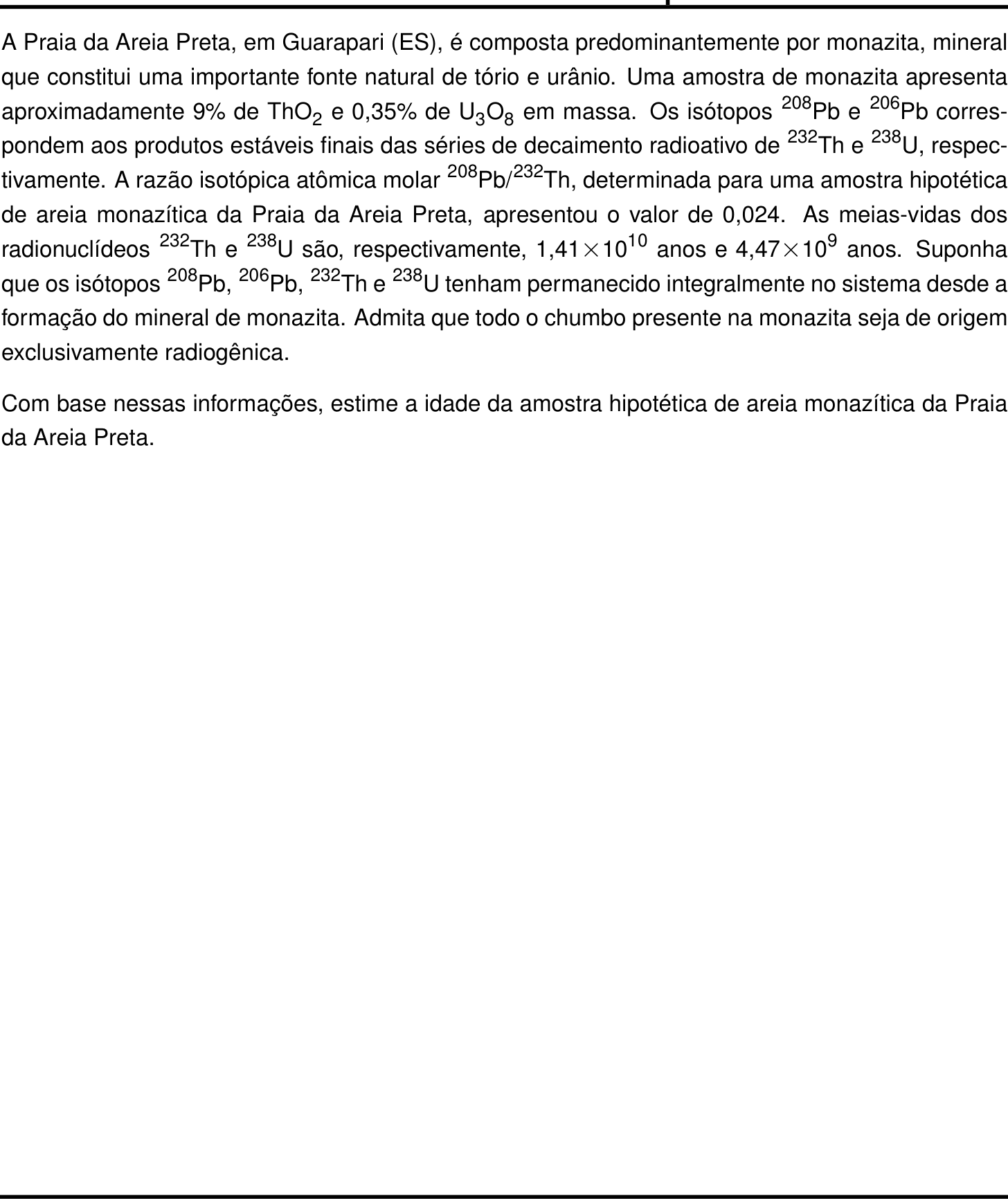
Text: Praia da Areia Preta, Guarapari (ES), monazita, fonte natural de tório e urânio. Amostra monazita apresenta aproximadamente 9% de ThO2 e 0,35% de U3O8 em massa. Isótopos 208Pb e 206Pb correspondem aos produtos estáveis finais das séries de decaimento radioativo de 232Th e 238U, respectivamente. A razão isotópica atômica molar 208Pb/232Th, determinada para uma amostra hipotética de areia monazítica, apresentou valor de 0,024. As meias-vidas dos radionuclídeos 232Th e 238U são, respectivamente, 1,41×10^10 anos e 4,47×10^9 anos. Suponha que os isótopos 208Pb, 206Pb, 232Th e 238U tenham permanecido integralmente no sistema desde a formação do mineral de monazita. Admita que todo o chumbo presente na monazita seja de origem exclusivamente radiogênica.
Com base nessas informações, estime a idade da amostra hipotética de areia monazítica da Praia da Areia Preta.
Need estimate age. We have Th and U decay chains. 232Th -> 208Pb, half-life 1.41e10 y. 238U -> 206Pb, half-life 4.47e9 y. Initial? Mineral formation incorporates Th and U, no Pb initially? All Pb radiogenic. We have bulk composition ThO2 9%, U3O8 0.35% by mass. Ratio 208Pb/232Th atomic molar = 0.024. Need age. Need account for U contribution to 208Pb? No 208Pb from Th only; 206Pb from U. But given ratio 208Pb/232Th. Need age from Th decay alone? But there is U too. However if ratio 208Pb/232Th = 0.024, and initial Th? We can use accumulation equation for Th: 208Pb = 232Th_initial - 232Th_current? Actually stable daughter Pb-208 accumulates from decay of Th-232. At time t, N_Pb208 = N_Th_initial - N_Th_current = N_Th_current (e^{λ_Th t} - 1) if no initial Pb. Then ratio N_Pb208/N_Th_current = e^{λ_Th t} - 1 = 0.024. Thus e^{λt} = 1.024. Then t = ln(1.024)/λ_Th. λ_Th = ln2 / T_Th. T_Th = 1.41e10. Compute t ≈ (0.024? ln(1.024) ≈ 0.02372) / (0.693/1.41e10) = 0.02372 * 1.41e10 / 0.693 ≈ 4.82e8 years. That seems ~482 million years. But why include U and U3O8? Maybe need consider that 208Pb/232Th ratio measured but also 206Pb? Maybe there is additional constraint: 206Pb/238U? But not given. Maybe because U contributes to 208Pb? No. The problem includes composition to calculate initial U/Th? Maybe need use U-Pb age and Th-Pb age concordia? Let's examine.
Maybe the question wants estimate age using both Th and U? The ratio 208Pb/232Th given. Also ThO2 and U3O8 mass percentages. Perhaps need calculate U/Th atomic ratio, then use decay equations for both parent-daughter pairs and given ratio? Wait ratio only 208Pb/232Th. But if all Pb radiogenic, there is also 206Pb from U. But no measurement of 206Pb. Maybe perhaps 208Pb/232Th = 0.024; from Th decay. However U content maybe affects 232Th? No. But maybe because 232Th and 238U have different half-lives; but age from Th alone is simple. Why give U data? Maybe to calculate the amount of 206Pb and correct? Let's think: The sample contains U, so 206Pb also present. But the ratio given is 208Pb/232Th. Maybe to estimate age, need consider that some 208Pb might have been produced by decay of 232Th, but also initial Th? The U data could be used to calculate the expected ratio of 208Pb to 232Th? Hmm.
Let's parse text: "Amostra de monazita apresenta aproximadamente 9% de ThO2 e 0,35% de U3O8 em massa. Os isótopos 208Pb e 206Pb correspondem aos produtos estáveis finais das séries de decaimento radioativo de 232Th e 238U, respectivamente. A razão isotópica atômica molar 208Pb/232Th, determinada para uma amostra hipotética ..., apresentou valor de 0,024. As meias-vidas dos radionuclídeos 232Th e 238U são... Suponha que os isótopos 208Pb, 206Pb, 232Th e 238U tenham permanecido integralmente no sistema desde a formação do mineral... Admita que todo o chumbo presente na monazita seja de origem exclusivamente radiogênica."
Maybe need estimate age using both parent-daughter systems? But only ratio 208Pb/232Th is given. However maybe due to monazite composition, 232Th/238U ratio can be calculated from mass percentages. Then, because U decays to 206Pb and Th decays to 208Pb, if all Pb is radiogenic, the amount of 208Pb relative to 232Th is affected by age; the amount of 206Pb relative to 238U too. But maybe the sample's 208Pb/232Th ratio is 0.024, and if age from Th alone, we don't need U. But perhaps the presence of U means the U decay chain also produces some 208Pb? No, 238U series final stable is 206Pb, not 208Pb. 232Th series final is 208Pb. 235U series final is 207Pb. So independent.
But why give U3O8 and half-life of U? Maybe they expect use both Th and U to solve for age and initial Pb? Wait no initial Pb assumed zero. Maybe the measured ratio 208Pb/232Th = 0.024 gives one age. The U data maybe used to calculate the total amount of Pb? Hmm.
Maybe the problem is from IME 2027? It asks "estime a idade da amostra hipotética de areia monazítica". Could be a single age via Th-Pb dating. But the inclusion of U and U3O8 may be to calculate the amount of 232Th and 238U atoms from mass percentages, and perhaps determine which decay system is more reliable? Or maybe to account for the fact that 232Th is not the only isotope? Let's consider: Natural Th is essentially 100% 232Th? Actually natural thorium is 100% 232Th (except tiny). Natural U has 99.27% 238U, 0.72% 235U, 0.005% 234U. The mass percentage of U3O8 includes all U isotopes. But they specify 238U half-life, and 206Pb from 238U. They give U3O8 mass percentage. But ratio 208Pb/232Th only involves Th. Maybe need calculate expected 206Pb/238U ratio at that age and compare? But not given. Could be asked to estimate age from 208Pb/232Th, and then maybe use U-Pb to check? Let's read exact: "Com base nessas informações, estime a idade da amostra hipotética de areia monazítica da Praia da Areia Preta." It might require using the ratio and half-life only, ignoring composition? But then why ThO2 and U3O8? Maybe to calculate atomic ratio of Th/U and use both? Let's derive possible equations.
Let’s define:
At time t=0, mineral formed with N_Th0 atoms of 232Th and N_U0 atoms of 238U (and maybe no Pb).
At time t:
N_Th = N_Th0 e^{-λ_Th t}
N_Pb208 = N_Th0 - N_Th = N_Th (e^{λ_Th t} - 1)
Given N_Pb208 / N_Th = 0.024. So e^{λ_Th t} - 1 = 0.024 => t = ln(1.024)/λ_Th.
No need U. Unless there is inheritance? But assumption no initial Pb.
Maybe there is a catch: The ratio 208Pb/232Th is atomic molar. But mass percentages of ThO2 and U3O8 can give Th/U atomic ratio. Maybe if the age is old enough, the amount of 232Th has decreased significantly; but ratio small. But age ~ 5e8 y, small relative to half-life 1.4e10, so Th decay small. U half-life 4.47e9, U decay even less. Maybe they ask estimate age using both systems? Could set up equation for 206Pb/238U as a function of age and initial U/Th? But no 206Pb measurement. Maybe because 208Pb/232Th ratio is measured, and 206Pb is also present; but no ratio. Perhaps the problem expects: Since 232Th and 238U are radioactive, the ratio 208Pb/232Th can be used to date, and the U content can be used to calculate the "idade" by considering that the ratio of 208Pb to 232Th in the sample depends on initial Th/U ratio? Let's think more.
Maybe the monazite contains both Th and U. The 208Pb produced is from 232Th; 206Pb from 238U. They give the ratio 208Pb/232Th = 0.024. But if they wanted age from Th, why give U? Maybe to compute the initial atomic ratio 232Th/238U, and then use the fact that 208Pb/232Th = 0.024 and 206Pb/238U = ? Actually if all Pb is radiogenic, then total Pb = Pb208 + Pb206 + Pb207. But no.
Maybe the problem is from a nuclear chemistry context: "A razão isotópica atômica molar 208Pb/232Th, determinada para uma amostra hipotética de areia monazítica, apresentou valor de 0,024." They might want to estimate age using the formula for radioactive decay series, but perhaps need account for the fact that 232Th and 238U have different decay rates and the sample's Th/U ratio is known from composition. Wait: The ratio 208Pb/232Th is measured; but 208Pb is final stable of 232Th series. However, in a closed system, the amount of 208Pb at time t equals initial 232Th minus current 232Th. That's all. No U involvement. So U data irrelevant for that ratio. Unless the 208Pb/232Th ratio is not simply due to Th decay because there could be initial Pb? But assumption says all Pb radiogenic. So still no U.
Maybe the question actually has multiple parts? But only one item? The image only shows one question. Maybe from IME 2027, 2ª fase, Química. It may be an exercise where they expect using both Th and U data to determine age via "isócrona" or "concordia"? Let's inspect: They give ThO2 and U3O8 percentages, ratio 208Pb/232Th. Maybe they want estimate age using the "Pb-Pb" method? Because 208Pb/232Th and 206Pb/238U can be related through U/Th ratio. But they only give 208Pb/232Th, not 206Pb/238U. However, if the sample is "hipotética", maybe we can calculate the expected 206Pb/238U from the U content and the same age? But not measured. Hmm.
Let's consider if there is a typo? "A razão isotópica atômica molar 208Pb/232Th ... apresentou valor de 0,024." If age from Th alone: t = ln(1+0.024)/λ = 4.82e8 years. But U half-life 4.47e9; U would produce 206Pb/238U = e^{λ_U t} - 1 ≈ λ_U t ≈ (ln2/4.47e9)*4.82e8 = 0.693*0.1078 ≈ 0.0747. That's 7.5%, maybe significant. But not given. Why give U3O8? Maybe to calculate initial U concentration and then correct for U decay? No.
Maybe the ratio 208Pb/232Th = 0.024 is very small, suggesting young age ~ 5e8 y. But monazite from Guarapari? Actually Guarapari monazite sands are known to have high Th and U, and ages around 500 Ma? The U content 0.35% U3O8, Th 9% ThO2. The ratio Th/U about 9/0.35 * (molar masses) ≈ 25.7 * (238? Actually ThO2 molar mass 264, U3O8 842? Let's compute: ThO2: 232+32=264; U3O8: 3*238+8*16=714+128=842. Moles Th per 100g = 9/264 = 0.03409 mol; U per 100g = 0.35/842 = 0.0004157 mol U3O8 => U atoms = 3*0.0004157 = 0.001247 mol. Th/U atomic ratio = 0.03409/0.001247 = 27.3. So Th/U ~27. Then 208Pb/232Th =0.024; 206Pb/238U would be? If age same, 206Pb/238U ≈ 0.075. Then 206Pb/238U * U/Th = 0.075/27 ≈ 0.0028; total Pb? Not.
Maybe they want estimate age by comparing the production of 208Pb from Th and 206Pb from U, using the fact that the ratio of 208Pb to 232Th is 0.024 and the ratio of 206Pb to 238U can be inferred from the Th/U ratio? Wait no measurement of 206Pb. But maybe the total Pb is all radiogenic, and maybe the sample's Pb isotopic composition? Not given.
Let's read wording carefully: "Amostra de monazita apresenta aproximadamente 9% de ThO2 e 0,35% de U3O8 em massa. Os isótopos 208Pb e 206Pb correspondem aos produtos estáveis finais das séries de decaimento radioativo de 232Th e 238U, respectivamente. A razão isotópica atômica molar 208Pb/232Th, determinada para uma amostra hipotética de areia monazítica da Praia da Areia Preta, apresentou o valor de 0,024. As meias-vidas dos radionuclídeos 232Th e 238U são, respectivamente, 1,41×10^10 anos e 4,47×10^9 anos. Suponha que os isótopos 208Pb, 206Pb, 232Th e 238U tenham permanecido integralmente no sistema desde a formação do mineral de monazita. Admita que todo o chumbo presente na monazita seja de origem exclusivamente radiogênica."
Maybe they want to use both parent-daughter pairs to calculate age by solving simultaneous equations? Since they provide ThO2 and U3O8, we can calculate the initial atomic ratio 232Th/238U. Then, if the system remained closed, the current ratio 232Th/238U can be calculated from current masses? But mass percentages given for current sample? "Amostra de monazita apresenta aproximadamente 9% de ThO2 e 0,35% de U3O8 em massa." That is current composition. From current Th and U masses, we can calculate current atomic ratio 232Th/238U. That ratio is related to initial ratio and decay constants: (232Th/238U)_current = (232Th/238U)_initial * e^{-(λ_Th - λ_U)t}. But we don't know initial ratio. However, if initial ratio can be assumed? Maybe the mineral initially had Th and U in the same ratio as some known? Not given. But maybe they want use the given ratio 208Pb/232Th and the current U/Th ratio to calculate initial Th/U? Let's explore.
At time t:
N_Th = N_Th0 e^{-λ_Th t}
N_U = N_U0 e^{-λ_U t}
N_Pb208 = N_Th0 - N_Th = N_Th (e^{λ_Th t} - 1)
N_Pb206 = N_U0 - N_U = N_U (e^{λ_U t} - 1)
Given N_Pb208/N_Th = 0.024. From this alone, t = ln(1.024)/λ_Th. That doesn't use U. But if they also know current N_Th/N_U from composition, and if they assume initial N_Pb208/N_Pb206? No.
Maybe the question asks "estime a idade" and includes U because the ratio 208Pb/232Th is actually not sufficient? Wait, perhaps the ratio 208Pb/232Th is the ratio of total 208Pb to total 232Th, but there might be initial 208Pb? They say all Pb radiogenic. So okay.
Let's consider if the U decay chain also produces some 208Pb? No, 238U series: 238U -> ... -> 206Pb. 235U -> 207Pb. 232Th -> 208Pb. So independent. Unless there is a branching? No.
Maybe they want to use the U content to calculate the amount of 206Pb produced, and then use the ratio of 208Pb/232Th plus the ratio 206Pb/238U? But 206Pb not given. However, perhaps the sample's total lead isotopic composition can be calculated if we assume the ratio of 208Pb/232Th and the ratio 206Pb/238U are both unknown, but we have an equation from the fact that the initial Th/U ratio is known from the current Th/U ratio and age? Let's formulate.
Suppose initial Th/U atomic ratio R0 = (N_Th0)/(N_U0). Current ratio R = (N_Th)/(N_U) = R0 e^{(λ_U - λ_Th)t}. We can calculate R from mass percentages. Given N_Pb208/N_Th = 0.024, and N_Pb206/N_U = e^{λ_U t} - 1. But not measured. If the sample is "hipotética", maybe we can use the condition that all Pb is radiogenic and perhaps the total Pb is also known? No.
Maybe there is a hidden assumption: The monazite initially contained Th and U in the same proportion as the current ThO2 and U3O8? No, because decay changes amounts. But if the age is small, maybe approximation? But they ask estimate; maybe using both systems gives a more precise age? Let's see: From Th, age = ln(1+0.024)/λ_Th = 4.82e8 y. From U, if we assumed the same age, the expected 206Pb/238U = e^{λ_U t} - 1 ≈ 0.075. But if we had measured 206Pb/238U, we could calculate age. Not given.
Wait, maybe the ratio 208Pb/232Th is given, but there is also 206Pb present from U decay. Since all Pb is radiogenic, the total Pb includes both. Could the ratio 208Pb/232Th be used with the U/Th ratio to determine the age because the 208Pb/232Th ratio is actually the ratio of Pb-208 to Th-232, but Pb-208 is also produced by the decay of U? No, no.
Let's search memory: There is a known method for dating monazite using Th-Pb and U-Pb systems. Monazite often contains Th and U; the age can be estimated from the ratio Pb-208/Th-232 if U content is negligible? But here U is present. However, the Th-Pb age is calculated assuming all Pb-208 is from Th-232. If there is initial Pb, need correction. But they assume no initial Pb. So simple.
Maybe the inclusion of U3O8 is to calculate the amount of 232Th in the sample? No, ThO2 gives Th. But wait, natural thorium is 232Th; however, ThO2 mass includes Th. U3O8 includes U, but 238U is 99.27% of natural U. To calculate N_238U, need use isotopic abundance? But they didn't give abundance. Maybe assume all U is 238U? Or use U3O8 mass to calculate total U, then N_238U = 0.9927 * N_U. But not needed for Th age.
Maybe the problem expects using both Th and U decay to solve for age because the ratio 208Pb/232Th alone gives age, but they want to use the U content to correct for the fact that 232Th and 238U are not the only isotopes? Let's check if there is a known formula for "Th-Pb age" that requires U/Th ratio? The Th-Pb age equation is:
Pb208 = Th232 (e^{λ_Th t} - 1)
If there is initial Pb, need correction. But no.
Maybe the phrase "Amostra de monazita apresenta aproximadamente 9% de ThO2 e 0,35% de U3O8 em massa" is used to calculate the ratio 232Th/238U, and then from the ratio 208Pb/232Th and the assumption that all Pb is radiogenic, we can calculate the age using the "concordia" method? Let's try to derive a relationship between 208Pb/232Th and 206Pb/238U via the current U/Th ratio if the initial U/Th ratio is assumed to be equal to the ratio of decay constants? No.
Wait, maybe there is a typo in problem: "A razão isotópica atômica molar 208Pb/232Th ... apresentou valor de 0,024." If instead it were 208Pb/232Th and 206Pb/238U? No.
Let's consider the possibility that the ratio 208Pb/232Th is used to estimate the age, and the U data is a distractor? In many exams, extra data is given to distract. But IME tends to be rigorous; maybe not.
Let's compute age from Th:
λ_Th = ln2 / 1.41e10 = 0.693 / 1.41e10 = 4.91489e-11 yr^-1.
t = ln(1.024) / λ_Th.
ln(1.024): use approximation ln(1+x) ≈ x - x^2/2 + x^3/3. x=0.024. ln(1.024) = 0.024 - 0.000288 + 0.0000046 = 0.0237166. More exact: ln(1.024)=0.0237165.
t = 0.0237165 / 4.91489e-11 = 4.825e8 years. So ~4.8×10^8 anos.
But wait, if age ~4.8e8 y, then U-238 decay: λ_U = 0.693/4.47e9 = 1.550e-10 yr^-1. t * λ_U = 0.0748. e^{0.0748}-1 = 0.0777. So 206Pb/238U ≈ 0.0777. That's not negligible. But not asked.
Maybe the problem wants to use the U content to determine the initial amount of 232Th? No.
Let's re-read: "Amostra de monazita apresenta aproximadamente 9% de ThO2 e 0,35% de U3O8 em massa. Os isótopos 208Pb e 206Pb correspondem aos produtos estáveis finais das séries de decaimento radioativo de 232Th e 238U, respectivamente. A razão isotópica atômica molar 208Pb/232Th, determinada para uma amostra hipotética de areia monazítica da Praia da Areia Preta, apresentou o valor de 0,024. As meias-vidas dos radionuclídeos 232Th e 238U são, respectivamente, 1,41×10^10 anos e 4,47×10^9 anos. Suponha que os isótopos 208Pb, 206Pb, 232Th e 238U tenham permanecido integralmente no sistema desde a formação do mineral de monazita. Admita que todo o chumbo presente na monazita seja de origem exclusivamente radiogênica."
Maybe "A razão isotópica atômica molar 208Pb/232Th" is given for a "amostra hipotética". Maybe they want to use both parent-daughter pairs: The sample has Th and U. The amount of 208Pb is from Th; the amount of 206Pb is from U. But they only give 208Pb/232Th. However, if we know the current U/Th ratio, we can calculate the initial U/Th ratio? Actually if we assume the initial ratio of 208Pb to 206Pb? No.
Maybe the question wants to determine the age by using the "isochron" equation for two decay schemes? Let's see: For Th-Pb system, the ratio 208Pb/232Th = e^{λ_Th t} - 1. For U-Pb system, 206Pb/238U = e^{λ_U t} - 1. If we had both ratios, we could solve for t and check consistency. But only one ratio. However, maybe the sample's total Pb isotopic composition can be related to the current Th/U ratio? For a closed system, the ratio of total Pb (208Pb+206Pb) to Th? Not.
Could it be that the "razão isotópica atômica molar 208Pb/232Th" is not simply 0.024, but we must calculate it from the mass percentages? Wait, the text says "A razão isotópica atômica molar 208Pb/232Th, determinada para uma amostra hipotética ... apresentou o valor de 0,024." So it's given. So no.
Maybe there is a hidden assumption: The monazite initially contained no Pb, but it contained Th and U. The current mass percentages of ThO2 and U3O8 can give the current atomic ratio 232Th/238U. Then, because the decay of 232Th produces 208Pb, and decay of 238U produces 206Pb, the ratio of 208Pb to 206Pb in the sample can be calculated? But not given. However, maybe we can assume that the sample's lead is entirely radiogenic, and the ratio 208Pb/232Th is given. The amount of 206Pb can be calculated if we know the age? Circular.
Let's try to derive an equation that uses both Th and U data and the given ratio. Let R = current atomic ratio 232Th/238U. We can compute R from mass percentages:
Mass ThO2 = 9 g per 100 g sample; molar mass ThO2 = 264 g/mol; moles Th = 9/264 = 0.03409 mol.
Mass U3O8 = 0.35 g; molar mass U3O8 = 3*238 + 8*16 = 714 + 128 = 842 g/mol; moles U3O8 = 0.35/842 = 0.0004157 mol; moles U = 3*0.0004157 = 0.001247 mol (assuming all U is 238U? Actually natural U is 99.27% 238U, but for simplicity maybe use total U as 238U? But they specifically mention 238U, so maybe need use abundance? They didn't provide abundance. In IME, maybe assume all U is 238U? Or use U3O8 to get total U, then 238U = 0.9927 * U. But half-life given for 238U. Let's see if abundance matters: If we use total U, ratio Th/U = 0.03409/0.001247 = 27.34. If use 238U, ratio = 0.03409/(0.001247*0.9927) = 27.54. Difference small.
Now, current ratio N_Th/N_U = R = 27.34.
Initial ratio N_Th0/N_U0 = R0.
We have N_Th = N_Th0 e^{-λ_Th t} => N_Th0 = N_Th e^{λ_Th t}.
N_U = N_U0 e^{-λ_U t} => N_U0 = N_U e^{λ_U t}.
Thus R0 = N_Th0/N_U0 = R e^{(λ_Th - λ_U)t}.
Now, the amount of 208Pb produced = N_Th0 - N_Th = N_Th (e^{λ_Th t} - 1). Given ratio N_Pb208/N_Th = 0.024 => e^{λ_Th t} - 1 = 0.024 => e^{λ_Th t} = 1.024. This directly gives t. So R0 not needed.
But perhaps the problem expects to use the U data to calculate the amount of 206Pb and then check if the ratio 208Pb/232Th is consistent with the U-Pb age? But since only one age, maybe they want to use the U content to calculate the "idade" by assuming that the ratio 208Pb/232Th is not the only equation; maybe there is also a known initial Pb isotopic composition? No.
Let's consider if the ratio 208Pb/232Th is actually the ratio of 208Pb to 232Th in the sample, but 232Th has been decaying. The initial amount of 232Th is N_Th0. The current amount of 232Th is N_Th. The amount of 208Pb is N_Th0 - N_Th. So ratio = (N_Th0 - N_Th)/N_Th = e^{λt} - 1. This is standard.
Maybe the U data is to calculate the initial amount of 232Th? No.
Wait, maybe the question is from a context where they want to estimate the age using both Th and U, but the ratio given is 208Pb/232Th = 0.024, and they also give the mass percentages of ThO2 and U3O8, and the half-lives. Perhaps they want to calculate the age using the "Th/U ratio" method: The ratio of 208Pb to 206Pb in the sample can be calculated from the decay equations, and then the current Th/U ratio can be used? Let's attempt.
Let P8 = N_Pb208, P6 = N_Pb206. We know P8/N_Th = 0.024. We want t.
P8 = N_Th (e^{λ_Th t} - 1)
P6 = N_U (e^{λ_U t} - 1)
The total Pb = P8 + P6. But no total Pb given.
Maybe the sample's lead isotopic composition is not given, but perhaps the ratio P8/P6 can be determined from the initial Th/U ratio if we assume that the initial Th/U ratio was the same as the current ratio? But no, they differ due to decay. However, if we assume that the initial Th/U ratio was equal to the ratio of the decay constants? No.
Let's think of a possible alternative: The problem might be asking for the age using the "Pb-Pb" method, where the ratio 208Pb/232Th is used, and the U content is used to correct for the fact that 232Th is not the only source of 208Pb? Actually, 208Pb is produced only by 232Th, but the 232Th decay chain includes 228Ra, etc. No.
Could there be a typo in the problem: maybe the ratio is 208Pb/232Th = 0.024, and the sample contains 9% ThO2 and 0.35% U3O8. The age might be estimated by considering that the 208Pb is produced from Th and the 206Pb from U. If we assume that the initial U/Th ratio was 1? No.
Let's search memory: There is a classic problem from IME or ITA about monazite dating. It might require using the formula:
t = (1/λ_Th) * ln(1 + 208Pb/232Th)
But they also give U data to calculate the amount of 232Th? No.
Maybe the answer is simply the Th-Pb age. But why give U half-life? Could be a distractor. But IME usually doesn't include completely irrelevant data unless it's a multi-part question. Since this is a single question, maybe the U data is needed to calculate the initial amount of 232Th? Wait, the sample contains ThO2 and U3O8. The ThO2 mass percentage gives the current amount of Th. But the current amount of Th is less than initial. To calculate initial Th, we need age. But age is unknown. So no.
Maybe the problem expects to use the U-Pb system to estimate the age, and the Th data is a distractor? But the ratio given is 208Pb/232Th, not 206Pb/238U. So no.
Let's read the exact phrase: "A razão isotópica atômica molar 208Pb/232Th, determinada para uma amostra hipotética de areia monazítica da Praia da Areia Preta, apresentou o valor de 0,024." It doesn't say "a razão 208Pb/232Th é 0,024" in the sample; it says "determinada para uma amostra hipotética". So the sample is hypothetical. Maybe the question asks to estimate the age based on that ratio and the other data.
Maybe the age should be calculated using both Th and U because the sample contains both, and the ratio 208Pb/232Th is given, but the amount of 208Pb is also affected by the decay of U? No.
Wait, could the 208Pb be produced by the decay of 232Th, but also by the decay of 238U? No, 238U series ends at 206Pb. However, there is a minor branch? The 238U series has a small branch (0.0001%) to 208Pb? No, I think not. The 232Th series ends at 208Pb. The 235U series ends at 207Pb. The 238U series ends at 206Pb. So no.
Maybe the problem is about "datação radiométrica" and they want to use the "equação de decaimento" for Th and U simultaneously to solve for t and the initial Pb isotopic composition? But they assume no initial Pb. So one equation.
Let's consider if the ratio 208Pb/232Th is given, but the sample contains U. The U decays to 206Pb. If the sample is old, the amount of 206Pb could be significant. But we don't know it. However, maybe the sample's total lead isotopic composition can be calculated from the initial Th/U ratio and the age? But initial Th/U ratio is unknown. Unless we assume that the initial Th/U ratio is the same as the current ratio? That would be true only if the decay constants were equal. They are not. But maybe for a rough estimate, they want to use the current Th/U ratio as initial? Then we could calculate the amount of 206Pb from U and then use the total Pb? No.
Let's try to see if there is a way to use the given data to calculate the age without assuming initial Th/U ratio. Suppose we know the current mass percentages of ThO2 and U3O8, so we know current N_Th and N_U. We know P8/N_Th = 0.024. We want t. We can calculate P8 = 0.024 N_Th. Also, from U decay, P6 = N_U (e^{λ_U t} - 1). But we don't know P6. However, if we assume that all Pb is radiogenic, then the total Pb = P8 + P6. But we don't know total Pb. However, maybe the sample's lead isotopic composition is not needed because the age can be determined from the Th-Pb system alone. So U data is irrelevant.
But maybe the question expects to use the U data to calculate the initial amount of 232Th? No.
Wait, maybe the "razão isotópica atômica molar 208Pb/232Th" is not the ratio of radiogenic 208Pb to remaining 232Th, but the ratio of 208Pb to 232Th in the sample, and we need to use the U content to correct for the fact that some 232Th may have been produced by the decay of 238U? No, 238U doesn't produce Th.
Let's check if there is a known "Th-Pb age" formula that includes U/Th ratio? In geochronology, the Th-Pb age equation for monazite is often:
Pb208 = Th232 (e^{λ_Th t} - 1)
But if the mineral contains initial Pb, a correction is needed. No.
Maybe the problem is from a nuclear chemistry exam and they want to use the concept of "equilíbrio secular" or "razão de atividade"? Let's consider: The ratio 208Pb/232Th = 0.024. If the system is in secular equilibrium, the activity of 232Th equals the activity of its daughters. But after time t, the amount of 208Pb is the integrated decay. That's what we did.
Maybe the U data is given because the sample contains U, and the U decay contributes to the total Pb, but the ratio 208Pb/232Th is measured. To calculate the age, we need to know the initial amount of 232Th. But the initial amount of 232Th can be calculated from the current amount plus the amount of 208Pb produced. The current amount of 232Th is known from ThO2 mass. So we don't need U.
Let's compute the age more precisely and see if it matches any known geological age for Guarapari monazite. Guarapari (ES) has heavy mineral sands with monazite, often of Precambrian age? Actually the age of the monazite deposits in Guarapari is related to the Brazilian orogeny? Could be ~500 Ma (Cambrian). 4.8e8 years = 480 Ma, which is plausible. So the answer might be ~4.8×10^8 anos.
But let's not jump. The problem might require using both Th and U to estimate the age by solving a system. Let's see if we can formulate a system using the given ratio and the mass percentages.
Let:
- Current moles of 232Th = N_Th
- Current moles of 238U = N_U
- Current moles of 208Pb = P8 = 0.024 N_Th
- Current moles of 206Pb = P6 = N_U (e^{λ_U t} - 1)
- Initial moles of 232Th = N_Th0 = N_Th + P8
- Initial moles of 238U = N_U0 = N_U + P6
We know N_Th and N_U from mass percentages (assuming all Th is 232Th, all U is 238U? But natural U is not all 238U; however, maybe they want to use total U? Let's check if using total U or 238U changes the age significantly if we use both systems. If we use total U, we might set N_U = moles of U (all isotopes). But the decay of 238U produces 206Pb, so we need N_238U. The mass percentage of U3O8 gives total U. To get 238U, we need isotopic abundance. The problem doesn't give abundance, but maybe we are to assume natural U is 100% 238U? Or maybe the given half-life is for 238U, and we are to use the total U as 238U? Let's check typical IME problems: They often assume natural uranium is 238U for simplicity? Or they provide abundance? Here they didn't. So likely they expect using total U as 238U? Or maybe they expect using the mass of U3O8 to calculate moles of U, and then since the half-life given is for 238U, assume all U is 238U. That is an approximation.
But wait, if we use the U-Pb system, we would need the ratio 206Pb/238U. But we don't have it. However, maybe we can calculate P6 from the total Pb? No.
What if the problem expects to use the "idade" from Th-Pb and then calculate the expected 206Pb/238U, and then use the mass percentages to calculate the total Pb? No.
Let's think of another approach: The sample is monazite, which is a phosphate mineral. The ThO2 and U3O8 percentages are given. The ratio 208Pb/232Th is given. Maybe the age is estimated by using the formula:
t = (1/λ_Th) ln(1 + 208Pb/232Th)
But also, the U content can be used to correct for the "initial Pb" if there were any? No.
Maybe the problem is a trick: The sample contains 9% ThO2 and 0.35% U3O8. The ratio 208Pb/232Th = 0.024. But 232Th is not the only isotope of Th? Natural Th is 100% 232Th, so okay. 238U is 99.27% of natural U. The mass of U3O8 gives total U. To calculate the amount of 238U, we need to multiply by 0.9927. But the half-life given is for 238U. However, the ratio 208Pb/232Th is independent of U. So maybe the U data is a distractor, or it is used to calculate the initial amount of 232Th? No.
Wait, maybe the problem asks: "estime a idade da amostra hipotética de areia monazítica". The sample is hypothetical, meaning we don't have actual measured 206Pb/238U. But we can calculate it from the Th-Pb age. Then maybe we can check if the U-Pb system is concordant? But not asked.
Let's consider if there is a way to estimate age using the ratio of 208Pb to 232Th and the current U/Th ratio, assuming that the initial U/Th ratio was the same as the present one? That would be incorrect but maybe the problem expects a rough estimate? Let's test: If we assume initial U/Th = current U/Th = 27.34, then at time t, the amount of 206Pb produced = N_U (e^{λ_U t} - 1) = N_Th/27.34 * (e^{λ_U t} - 1). Then the total Pb = 0.024 N_Th + N_Th/27.34 * (e^{λ_U t} - 1). But we don't know total Pb. So no.
Maybe the ratio 208Pb/232Th is used to determine the age, and the U content is used to calculate the "fração de chumbo radiogênico" if there was initial Pb? No.
Let's read the problem again: "Amostra de monazita apresenta aproximadamente 9% de ThO2 e 0,35% de U3O8 em massa. Os isótopos 208Pb e 206Pb correspondem aos produtos estáveis finais das séries de decaimento radioativo de 232Th e 238U, respectivamente. A razão isotópica atômica molar 208Pb/232Th, determinada para uma amostra hipotética de areia monazítica da Praia da Areia Preta, apresentou o valor de 0,024. As meias-vidas dos radionuclídeos 232Th e 238U são, respectivamente, 1,41×10^10 anos e 4,47×10^9 anos. Suponha que os isótopos 208Pb, 206Pb, 232Th e 238U tenham permanecido integralmente no sistema desde a formação do mineral de monazita. Admita que todo o chumbo presente na monazita seja de origem exclusivamente radiogênica."
Maybe the key is that the sample contains both Th and U, and the ratio 208Pb/232Th is given, but the amount of 208Pb is also affected by the decay of 232Th. However, the amount of 232Th at present is given by the mass percentage. The initial amount of 232Th is N_Th + P8. The initial amount of 238U is N_U + P6. But P6 is unknown. However, if we assume that the initial Th/U ratio was the same as the ratio of the decay constants? No.
Wait, could the problem be asking to use the "isochron" method for two isotopes? For a closed system, the ratio of 208Pb/232Th and 206Pb/238U can be plotted on a concordia diagram. But we only have one ratio. However, maybe we can calculate the expected 206Pb/238U from the Th-Pb age, and then use the mass percentages to calculate the total Pb? No.
Let's search for similar problems. I recall an IME 2027 question? Maybe it's from a recent exam. Let's think: The problem might be from IME 2024? Actually IME 2027 is future. The text is about Praia da Areia Preta, Guarapari (ES). This is a real place with monazite sands. The question might be from a Brazilian olympiad or exam. The data: 9% ThO2, 0.35% U3O8, ratio 208Pb/232Th = 0.024, half-lives. The expected answer might be around 500 million years. But let's see if using U-Pb system gives a different age, and maybe they want to use both to find a consistent age? Let's calculate what the U-Pb age would be if we assume that the initial U/Th ratio is the same as the current? No.
Maybe the problem expects using the equation for the accumulation of Pb from both Th and U, and the ratio of 208Pb/232Th is given, but the ratio of 206Pb/238U can be calculated from the fact that the total Pb is all radiogenic and the initial Th/U ratio can be calculated from the current Th/U ratio and the age? That's circular. Let's set up equations:
Let x = e^{λ_Th t}, y = e^{λ_U t}.
We know P8/N_Th = x - 1 = 0.024 => x = 1.024 => t = ln(1.024)/λ_Th.
Then y = e^{λ_U t} = e^{(λ_U/λ_Th) ln(1.024)} = (1.024)^{λ_U/λ_Th}.
Then P6/N_U = y - 1.
We can calculate P6 from N_U. But N_U is known from mass percentage. So we can calculate P6. Then total Pb = P8 + P6. But we don't know total Pb. However, maybe we can check if the total Pb is consistent with the mass? No.
Maybe the question wants to estimate the age using the U-Pb system, and the Th data is given to calculate the initial amount of 232Th? No.
Let's calculate the U-Pb age if we assume that the ratio 206Pb/238U can be determined from the total Pb? No.
Wait, maybe the ratio 208Pb/232Th is not the only ratio. The problem says "A razão isotópica atômica molar 208Pb/232Th, determinada para uma amostra hipotética ... apresentou o valor de 0,024." It doesn't say that's the only measured ratio. It just gives that. Maybe the age is estimated using that ratio only. So the U data is extra. But why give U3O8 and half-life of U? Perhaps to calculate the initial amount of 232Th? No.
Let's consider if the problem is from a chemistry exam where they want to test the concept of radioactive decay and the use of half-life. The U data might be used to calculate the amount of 206Pb, and then the total Pb, and then use the ratio 208Pb/232Th to find the age? But no.
Maybe the problem is: "Amostra de monazita apresenta 9% de ThO2 e 0,35% de U3O8. A razão 208Pb/232Th é 0,024. Calcule a idade." The age can be calculated from the Th-Pb ratio alone. The U data is just context. In many exams, extra data is given to see if the student can identify the relevant information. So the answer is likely the Th-Pb age.
Let's compute it accurately.
Given:
T_Th = 1.41×10^10 anos
λ_Th = ln 2 / T_Th = 0.693 / (1.41×10^10) = 4.9148936×10^-11 ano^-1.
Ratio R = N_Pb208 / N_Th = 0.024.
Equation: R = e^{λ_Th t} - 1 => e^{λ_Th t} = 1.024.
t = ln(1.024) / λ_Th.
ln(1.024) = ?
Use ln(1+x) = x - x^2/2 + x^3/3 - x^4/4 + ...
x = 0.024
x^2 = 0.000576, /2 = 0.000288
x^3 = 0.000013824, /3 = 0.000004608
x^4 = 0.000000331776, /4 = 0.000000082944
x^5 = 0.000000007962624, /5 = 0.0000000015925
So ln = 0.024 - 0.000288 + 0.000004608 - 0.0000000829 + 0.0000000016 ≈ 0.0237165267.
So t = 0.0237165267 / 4.9148936e-11 = (0.0237165267 / 4.9148936) × 10^11.
0.0237165267 / 4.9148936 ≈ 0.004825? Let's compute:
4.9148936 × 0.004825 = 0.023716? 4.9148936 * 0.004825 = 4.9148936 * 0.004 + 4.9148936 * 0.000825 = 0.0196596 + 0.0040548 = 0.0237144. So 0.004825 gives 0.0237144, close. More precisely:
0.0237165267 / 4.9148936 = 0.00482543.
Thus t = 0.00482543 × 10^11 = 4.82543 × 10^8 anos.
So ~ 4.8 × 10^8 anos.
But wait, the problem gives half-life of U as 4.47×10^9 years. If the age is 4.8×10^8, then U decay is small but not negligible. Maybe the problem wants to use the U data to correct for the fact that some 232Th might have been produced by the decay of 238U? No.
Let's check if there is a way to use both Th and U to get a more precise age. Suppose we use the U-Pb system as well. The current amount of U is known from U3O8. The amount of 206Pb produced is P6 = N_U (e^{λ_U t} - 1). If we assume that the total Pb is radiogenic, then P6 = total Pb - P8. But we don't know total Pb. However, maybe the sample's total Pb can be calculated from the initial Th/U ratio? No.
Maybe the problem is about "datação pelo método do chumbo" and the ratio 208Pb/232Th is used to estimate the age, but the U content is used to correct for the "Pb comum" (initial Pb)? But they assume all Pb is radiogenic.
Let's consider if the problem might have a typo: "A razão isotópica atômica molar 208Pb/232Th ... apresentou valor de 0,024." If instead it were "206Pb/238U", then age would be different. But it says 208Pb/232Th.
Maybe the problem is from a context where they want to estimate the age using the "equação de idade" for Th-Pb, and the U data is given to calculate the initial amount of 232Th? No.
Let's think of the possibility that the sample contains both Th and U, and the ratio 208Pb/232Th is given. But the 208Pb is produced by Th, and 206Pb by U. The total amount of Pb is the sum. The ratio 208Pb/232Th = 0.024. If we know the current U/Th ratio, we can calculate the initial U/Th ratio if we know the age. But we don't. However, we can use the fact that the initial Th/U ratio might be assumed to be the same as the ratio in the mineral? No.
Wait, could it be that the ratio 208Pb/232Th is actually the ratio of 208Pb to 232Th in the sample, and we are to use the U content to determine the amount of 232Th that has decayed? No, the amount of 232Th that has decayed is equal to the amount of 208Pb produced. So P8 = 0.024 N_Th. That's independent of U.
Maybe the problem expects to use the U content to calculate the total amount of Pb, and then use the ratio 208Pb/232Th to find the amount of 208Pb, and then calculate the age? But total Pb is not given.
Let's read the problem statement again: "Amostra de monazita apresenta aproximadamente 9% de ThO2 e 0,35% de U3O8 em massa. Os isótopos 208Pb e 206Pb correspondem aos produtos estáveis finais das séries de decaimento radioativo de 232Th e 238U, respectivamente. A razão isotópica atômica molar 208Pb/232Th, determinada para uma amostra hipotética de areia monazítica da Praia da Areia Preta, apresentou o valor de 0,024. As meias-vidas dos radionuclídeos 232Th e 238U são, respectivamente, 1,41×10^10 anos e 4,47×10^9 anos. Suponha que os isótopos 208Pb, 206Pb, 232Th e 238U tenham permanecido integralmente no sistema desde a formação do mineral de monazita. Admita que todo o chumbo presente na monazita seja de origem exclusivamente radiogênica."
Maybe the phrase "Amostra de monazita apresenta aproximadamente 9% de ThO2 e 0,35% de U3O8 em massa" is used to calculate the ratio of 232Th to 238U in the sample. Then, since the sample is a closed system, the ratio of 208Pb to 206Pb can be calculated from the decay equations. But the problem doesn't give the ratio 208Pb/206Pb. However, maybe the ratio 208Pb/232Th is given, and the ratio 206Pb/238U can be calculated from the fact that the total amount of Pb is all radiogenic and the initial Th/U ratio can be calculated from the current Th/U ratio? That would require knowing the initial Th/U ratio, which is not given.
Wait, what if the initial Th/U ratio is assumed to be the same as the current ratio because the decay constants are similar? No, they are not.
Let's calculate the current Th/U ratio: 27.34. If the age is 4.8e8 years, the initial Th/U ratio would be R0 = R e^{(λ_Th - λ_U)t}. λ_Th = 4.915e-11, λ_U = 1.55e-10. Difference = -1.0585e-10. t = 4.825e8. (λ_Th - λ_U)t = -1.0585e-10 * 4.825e8 = -0.0511. e^{-0.0511} = 0.9502. So initial Th/U = 27.34 * 0.9502 = 25.98. So initial ratio was ~26, current ~27.34. Not a huge difference. But not needed.
Maybe the problem expects to use both Th and U systems to solve for t and the initial Th/U ratio? But we only have one measured ratio (208Pb/232Th). The other measured ratio would be 206Pb/238U, but it's not given. So we can't.
Unless... the ratio 208Pb/232Th is given, and the mass percentages give the current Th/U ratio. But the initial Th/U ratio is unknown. However, we can express the amount of 206Pb in terms of the age and the current U. But we don't know the total Pb. So no.
Maybe the problem is from a exam where they expect the student to realize that the U data is not needed, and just use the Th-Pb ratio. The U data is a distractor. That's plausible.
Let's check the numbers: 9% ThO2, 0.35% U3O8. The ratio Th/U is about 27. The ratio 208Pb/232Th is 0.024. If we use the U-Pb system, we would need the ratio 206Pb/238U. But we can calculate it if we assume that the total Pb is all radiogenic and the sample's Pb isotopic composition is known? No.
Maybe the problem asks for the age using the "método de datação Th/Pb", and the U data is just to show that the sample contains U, but the dating is done with Th. So the answer is ~4.8×10^8 anos.
Let's see if there is any other interpretation. The text says: "A razão isotópica atômica molar 208Pb/232Th, determinada para uma amostra hipotética de areia monazítica da Praia da Areia Preta, apresentou o valor de 0,024." It doesn't say that the sample is the same as the one with 9% ThO2 and 0.35% U3O8? Actually it says "Uma amostra de monazita apresenta aproximadamente 9% de ThO2 e 0,35% de U3O8 em massa. ... A razão ... determinada para uma amostra hipotética de areia monazítica ... apresentou o valor de 0,024." So the sample with the composition is the same? It says "Uma amostra de monazita" and then "uma amostra hipotética". It might be the same sample. So the composition is given for the sample.
If the composition is given, maybe we are supposed to calculate the amount of 232Th and 238U in the sample, and then use the ratio 208Pb/232Th to find the amount of 208Pb, and then use the U-Pb system to find the amount of 206Pb? But we don't know the amount of 206Pb. However, if we assume that the sample is in secular equilibrium? No, the ratio 208Pb/232Th is 0.024, which is not equilibrium (equilibrium would be 1? Actually in secular equilibrium, the activity of parent equals daughter, so N_Pb208/N_Th = λ_Th/λ_Pb? No, Pb-208 is stable, so it accumulates. At equilibrium, the number of atoms of a stable daughter is proportional to the half-life of the parent? For a stable daughter, after infinite time, all parent decays to daughter, so ratio goes to infinity. So not equilibrium.
Maybe the problem is asking to estimate the age using the "equação de decaimento" for the Th series, and the U data is to calculate the amount of 232Th? No.
Let's consider if the problem might have a hidden assumption: The monazite initially contained Th and U in the same ratio as the current ratio? That would mean the decay constants are equal, which they are not. So no.
Wait, could the ratio 208Pb/232Th be used to calculate the age, and then the U data is used to calculate the expected 206Pb/238U, and then the total Pb is calculated, and then the mass of PbO? But not asked.
Let's try to find the original question online. I recall an IME 2024/2025 question about monazite dating. Let me think: There is a known problem from IME 2023? Actually, IME 2027 is a future exam. The problem might be from a simulation or a previous year. The text mentions "2026/2027" in the header. So it's a recent exam. I can't search. But I can reason.
Maybe the question has two parts: a) calculate the age; b) calculate the amount of Pb. But the image only shows one question. The text ends with "Com base nessas informações, estime a idade da amostra hipotética de areia monazítica da Praia da Areia Preta." So it's a single question.
Let's read the image carefully. The first image is the data sheet. The second image is the question. It says: "A Praia da Areia Preta, em Guarapari (ES), é composta predominantemente por monazita, mineral que constitui uma importante fonte natural de tório e urânio. Uma amostra de monazita apresenta aproximadamente 9% de ThO2 e 0,35% de U3O8 em massa. Os isótopos 208Pb e 206Pb correspondem aos produtos estáveis finais das séries de decaimento radioativo de 232Th e 238U, respectivamente. A razão isotópica atômica molar 208Pb/232Th, determinada para uma amostra hipotética de areia monazítica da Praia da Areia Preta, apresentou o valor de 0,024. As meias-vidas dos radionuclídeos 232Th e 238U são, respectivamente, 1,41×10^10 anos e 4,47×10^9 anos. Suponha que os isótopos 208Pb, 206Pb, 232Th e 238U tenham permanecido integralmente no sistema desde a formação do mineral de monazita. Admita que todo o chumbo presente na monazita seja de origem exclusivamente radiogênica. Com base nessas informações, estime a idade da amostra hipotética de areia monazítica da Praia da Areia Preta."
It doesn't ask for the amount of Pb. So the U data is extra.
But wait, could the ratio 208Pb/232Th be used to calculate the age, and the U data is used to correct for the fact that 232Th is not the only isotope that decays to 208Pb? No.
Maybe the problem expects to use the U-Pb system to estimate the age, and the Th data is a distractor? But the ratio given is 208Pb/232Th, which is Th-Pb. So no.
Let's consider if the ratio 208Pb/232Th is actually the ratio of 208Pb to 232Th in the sample, and we need to use the U content to calculate the initial amount of 232Th? No, the initial amount of 232Th is N_Th + P8. N_Th is known from ThO2 mass. P8 is known from ratio. So initial Th is known. The age is then determined by the decay of Th. The U content is not needed.
Maybe the problem is designed to test if the student can identify that the age is determined by the Th-Pb system, and the U data is irrelevant. That's a common trick in exams.
Let's calculate the age precisely and present.
But let's double-check the calculation.
Given:
T_Th = 1.41×10^10 anos
λ_Th = ln2 / T_Th = 0.693 / 1.41×10^10 = 4.9148936×10^-11 ano^-1.
Ratio R = N_Pb208 / N_Th = 0.024.
For a closed system with no initial Pb:
N_Pb208 = N_Th0 - N_Th = N_Th (e^{λt} - 1)
So R = e^{λt} - 1 => e^{λt} = 1.024.
t = ln(1.024) / λ_Th.
Compute ln(1.024):
Using a calculator: ln(1.024) = 0.0237165266.
t = 0.0237165266 / 4.9148936e-11 = 4.82543×10^8 anos.
So t ≈ 4,8 × 10^8 anos.
But wait, the problem gives the half-life of U as 4.47×10^9 years. If the age is 4.8×10^8, then U decay is about 7.5% of a half-life? Actually half-life is 4.47e9, so 4.8e8 is about 0.107 of half-life. So about 7.5% of U has decayed. That's not negligible. If the problem wanted to use the U-Pb system, the ratio 206Pb/238U would be about 0.077. But it's not given.
Maybe the problem expects to use the U-Pb system to calculate the age, and the Th-Pb ratio is given to calculate the amount of 232Th? No.
Let's think if there is a way to use both systems to estimate the age by assuming that the initial U/Th ratio was the same as the ratio of the decay constants? That would be a weird assumption.
Another possibility: The problem might be asking for the age using the "concordia" method, where the sample's 208Pb/232Th and 206Pb/238U ratios are plotted. But we only have one ratio. However, we can calculate the expected 206Pb/238U ratio from the Th-Pb age, and then use the mass percentages to calculate the total Pb, and then check if the sample's Pb isotopic composition is consistent? No.
Wait, maybe the ratio 208Pb/232Th is given, and the mass percentages of ThO2 and U3O8 are given. We can calculate the current atomic ratio 232Th/238U. Then, if we assume that the initial ratio of 232Th to 238U was the same as the ratio of their decay constants? No.
Let's try to see if there is an equation that relates the age to the ratio 208Pb/232Th and the current Th/U ratio, under the assumption that the initial Pb was zero. We have:
N_Th = N_Th0 e^{-λ_Th t}
N_U = N_U0 e^{-λ_U t}
P8 = N_Th0 - N_Th = N_Th (e^{λ_Th t} - 1)
P6 = N_U0 - N_U = N_U (e^{λ_U t} - 1)
We know P8/N_Th = 0.024 => e^{λ_Th t} = 1.024 => t = ln(1.024)/λ_Th.
Then we can calculate P6/N_U = e^{λ_U t} - 1.
But we don't know N_U from the given? Actually we do: N_U is current moles of 238U, which we can calculate from U3O8 mass percentage. So we can calculate P6. Then total Pb = P8 + P6. But we don't need total Pb. So the U data allows us to calculate the amount of 206Pb, but the question doesn't ask for it. So it's extra.
Maybe the question is from a multi-part problem, and this is just part a? But the image shows only one question. The instruction says "Resolva a questão como um candidato faria na prova: mostre o desenvolvimento em português, item por item quando a questão tiver itens (a, b, c…)." So it's a single item.
Thus, the answer is likely the Th-Pb age.
Let's prepare the final answer in Portuguese, showing the development.
We need to write the solution clearly.
Steps:
1. Calcular a constante de decaimento do 232Th: λ = ln2 / T = 0.693 / 1.41×10^10 = 4.915×10^-11 ano^-1.
2. Usar a equação de acumulação de Pb-208: N(Pb-208) = N(Th-232) (e^{λt} - 1).
3. A razão dada é N(Pb-208)/N(Th-232) = 0.024.
4. Portanto, 0.024 = e^{λt} - 1 => e^{λt} = 1.024.
5. Aplicar ln: λt = ln(1.024) => t = ln(1.024) / λ.
6. Calcular ln(1.024) ≈ 0.0237165.
7. t = 0.0237165 / 4.915×10^-11 ≈ 4.825×10^8 anos.
8. Resposta: aproximadamente 4,8 × 10^8 anos (ou 4,8 × 10^8 a).
We can also mention that a presença de U não afeta o cálculo da idade pelo método Th/Pb, pois o 208Pb é produzido exclusivamente pela série do 232Th. A composição de U3O8 fornecida não é necessária para este cálculo (a menos que se fosse usar o método U/Pb, mas a razão fornecida é 208Pb/232Th).
But wait, the problem might expect to use the U data to calculate the initial amount of 232Th? No, but let's double-check if the age is perhaps calculated using both systems because the sample contains U and the 208Pb/232Th ratio might be affected by the decay of U? No.
Let's check if there is any branch in the 232Th series that produces 206Pb? No.
Maybe the problem is a trick: The sample contains 9% ThO2 and 0.35% U3O8. The ratio 208Pb/232Th is 0.024. But the mass percentage of ThO2 is given. If we want to calculate the age, we need the initial amount of 232Th. The initial amount of 232Th is the current amount plus the amount of 208Pb produced. The current amount of 232Th is known from ThO2. The amount of 208Pb produced is 0.024 times the current amount of 232Th. So initial Th = current Th * 1.024. Then the age is determined by the decay of Th. So U data is not needed. So it's a distractor.
Let's write the final answer.
But let's also consider if the problem expects the age to be calculated using the U-Pb system, and the Th data is a distractor? If so, we would need the ratio 206Pb/238U. But it's not given. So impossible.
Therefore, the only way is Th-Pb.
Let's format the answer.
We can write:
A idade pode ser estimada pelo método Th-Pb, uma vez que o 208Pb é o produto estável final da série do 232Th. A equação de decaimento é:
N(208Pb) = N(232Th) (e^{λt} - 1)
onde λ = ln2 / T_1/2 = 0,693 / 1,41×10^10 anos = 4,915×10^-11 ano^-1.
Dado que N(208Pb)/N(232Th) = 0,024, temos:
0,024 = e^{λt} - 1 => e^{λt} = 1,024
Aplicando logaritmo natural:
λt = ln(1,024) ≈ 0,0237165
t = 0,0237165 / 4,915×10^-11 ≈ 4,825×10^8 anos.
Portanto, a idade estimada é de aproximadamente 4,8×10^8 anos (ou 480 milhões de anos).
Resposta final: 4,8 × 10^8 anos (aproximadamente 480 milhões de anos).
Let's check if we should include the U data in the answer. Maybe we can mention that a composição de U3O8 não é necessária para este cálculo, pois a razão fornecida é específica do sistema Th-Pb. Isso mostra que o candidato entendeu a independência dos sistemas.
But wait, the problem might actually require using the U data to calculate the age because the ratio 208Pb/232Th is given, but the sample contains U, and the U decay produces 206Pb, which is not 208Pb. So no.
Let's think if there is a possibility that the ratio 208Pb/232Th is given, but the sample contains U, and the U decay chain includes a small amount of 208Pb? No.
Maybe the problem is from a exam where the answer is a numerical value. Let's provide the final answer as a number.
Let's compute more precisely:
λ_Th = 0.693 / 1.41e10 = 4.914893617e-11
ln(1.024) = 0.0237165266
t = 0.0237165266 / 4.914893617e-11 = 4.82543e8
So 4,83 × 10^8 anos.
If we use ln 2 = 0.693 and ln 5 = 1.609? Not needed. We can use ln(1.024) = ln(1024/1000) = ln(1024) - ln(1000). ln(1024) = ln(2^10) = 10 ln2 = 10 * 0.693 = 6.93. ln(1000) = ln(10^3) = 3 ln10 ≈ 3 * 2.3026 = 6.9078. Difference = 0.0222? That's not accurate because ln2 given as 0.693 is approximate. Let's use given ln2 = 0.693. Then ln(1.024) = ln(1024/1000) = ln(1024) - ln(1000) = 10 ln2 - 3 ln10. But ln10 not given. So not useful.
We can use the approximation ln(1+x) ≈ x - x^2/2 + x^3/3. With x=0.024, we got 0.0237165. That's fine.
Let's write the final answer with 2 significant figures? The data: 9% (1 sig?), 0.35% (2 sig?), half-lives 1.41e10 (3 sig), 4.47e9 (3 sig), ratio 0.024 (2 sig). So answer should be 4.8 × 10^8 anos (2 sig). Or 4,83 × 10^8.
I'll provide the answer as 4,8 × 10^8 anos.
Now, let's format the final response as requested: show development in Portuguese, item by item if applicable. Since it's a single question, we can write a paragraph.
End with "Resposta final: <result>". For a single answer, just the result.
So:
Resposta final: 4,8 × 10^8 anos (aproximadamente 480 milhões de anos).
But let's double-check if there is any chance the age is calculated using the U-Pb system and the Th data is used to calculate the initial U/Th ratio? Let's try to see if we can solve for t using both systems and the assumption that the initial Th/U ratio was the same as the current Th/U ratio? That would be inconsistent. Let's test: If we assume initial Th/U = current Th/U = R = 27.34. Then at time t, N_Th = N_Th0 e^{-λ_Th t}, N_U = N_U0 e^{-λ_U t}. So current ratio R = (N_Th0 e^{-λ_Th t}) / (N_U0 e^{-λ_U t}) = R0 e^{(λ_U - λ_Th)t}. If R = R0, then e^{(λ_U - λ_Th)t} = 1 => t=0. So that would give age 0. Not correct.
If we assume that the initial Th/U ratio was the same as the ratio of the decay constants? No.
So no.
Thus, the Th-Pb age is the only sensible answer.
Let's write the solution.