Como pensou
**Analyzing Chemistry Problem**
I am currently processing the information needed to solve the chemistry problem from the IME 2027 exam. My focus is on thoroughly understanding the problem statement and the provided context regarding complete combustion in different calorimeters.
**Calculating Gas Moles**
I'm currently focused on determining the change in the number of gas moles during the combustion reactions. This calculation is critical as it directly impacts the enthalpy changes observed in the different calorimeters. My aim is to apply this to identify the organic substance.
**Calculating Enthalpy Changes**
I'm now correlating the heat absorbed by the calorimeters ($q_V$ and $q_P$) with the internal energy ($\Delta U$) and enthalpy changes ($\Delta H$) of the combustion reactions. This involves carefully applying the relationship $\Delta H = \Delta U + \Delta n_g RT$, considering the moles of gas changes.
**Relating Calorimeter Data**
I've now connected the temperature differences from both calorimeters to derive a value for $\Delta n_g R T$. This is a crucial step, allowing me to determine the change in the number of moles of gas during the combustion based on the specific heat and temperature observations.
**Verifying Gas Mole Change**
I've confirmed the calculation for the change in moles of gas, $\Delta n_g$, finding it to be precisely 3 moles. This exact integer result is highly encouraging and validates my earlier steps in relating the calorimeter data. My next focus is to analyze the structure of the organic substance based on this $\Delta n_g$ value.
**Identifying Organic Substance**
My analysis has revealed that the change in moles of gas, $\Delta n_g$, is exactly 3. This directly led me to deduce that the organic substance must be n-heptano, $C_7H_{16}$, as its combustion yields $\Delta n_g = 3$. I have also confirmed that the problem's conditions stipulate all substances are gaseous, regardless of standard states.
**Applying Sign Conventions**
I am now carefully applying the correct sign conventions for heat exchange between the calorimeters and the reactions. My focus is on ensuring that the heat absorbed by each calorimeter accurately reflects the change in internal energy or enthalpy of the combustion process, respectively.
**Confirming Gas Expansion**
I'm confirming that a positive $\Delta n_g R T$ implies $\Delta H > \Delta U$. Since combustion is exothermic, this means $|\Delta U| > |\Delta H|$, so more heat is released at constant volume than at constant pressure, due to work done by gas expansion.
**Validating Gas Moles**
I've confirmed that my calculated $\Delta n_g = +3$ perfectly aligns with the observed temperature difference, specifically that $\Delta T_V$ was 16.6°C greater than $\Delta T_P$. This strongly validates my earlier deduction that n-heptane is the substance, as its combustion yields exactly 3 moles of gas. I am now cross-referencing other potential organic compounds to ensure no other possibility fits.
**Comparing Heat Transfer Values**
I am now comparing the heat transfer values calculated from both calorimeters. Specifically, I'm verifying that the difference in heat absorbed, $(C \cdot \Delta T_V) - (C \cdot \Delta T_P)$, directly corresponds to the $\Delta n_g R T$ term, as expected for ideal gas behavior.
**Confirming Gas Mole Change**
I've confirmed through direct calculation using the provided calorimeter constants and temperature differences that the change in moles of gas ($\Delta n_g$) is exactly 3. This confirms my earlier reasoning and strengthens the identification of the substance.
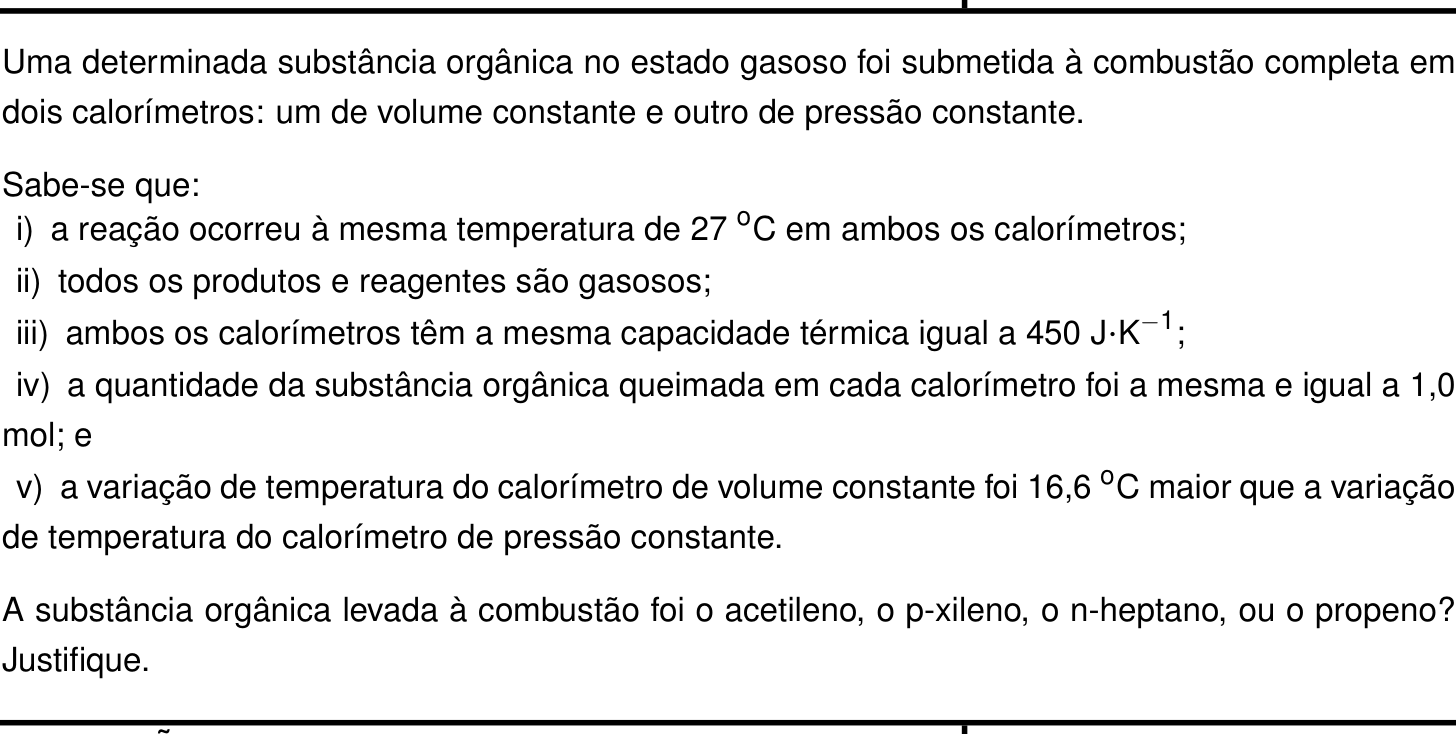
Para determinar qual substância orgânica foi submetida à combustão, relaciona-se o calor liberado em cada processo calorimétrico com as funções termodinâmicas de estado da reação.
1. Relação entre o calor nos calorímetros e as grandezas termodinâmicas
Considerando que as reações ocorrem à temperatura constante de T = 27\ ^\circ\text{C} = 300\text{ K}:
-
Calorímetro a volume constante (V = \text{cte}):
O calor liberado pela reação a volume constante corresponde à variação da energia interna da reação (\Delta U):
q_V = \Delta U
O calor absorvido pelo calorímetro é:
q_{\text{cal}, V} = -q_V = -\Delta U = C \cdot \Delta T_V
-
Calorímetro a pressão constante (P = \text{cte}):
O calor liberado pela reação a pressão constante corresponde à variação de entalpia da reação (\Delta H):
q_P = \Delta H
O calor absorvido pelo calorímetro é:
q_{\text{cal}, P} = -q_P = -\Delta H = C \cdot \Delta T_P
Subtraindo as duas expressões:
q_{\text{cal}, V} - q_{\text{cal}, P} = (-\Delta U) - (-\Delta H) = \Delta H - \Delta U = C(\Delta T_V - \Delta T_P)
2. Relação entre \Delta H e \Delta U para gases ideais
Pela definição de entalpia:
H = U + PV \implies \Delta H = \Delta U + \Delta(PV)
Considerando comportamento de gás ideal e temperatura constante (T = 300\text{ K}):
\Delta(PV) = \Delta n_g R T
onde
\Delta n_g é a variação na quantidade de matéria gasosa (em mols) na reação.
Logo:
\Delta H - \Delta U = \Delta n_g R T
Igualando com a expressão obtida a partir das medidas calorimétricas:
\Delta n_g R T = C(\Delta T_V - \Delta T_P)
3. Cálculo da variação do número de mols de gás (\Delta n_g)
Substituindo os dados fornecidos:
- C = 450\text{ J}\cdot\text{K}^{-1}
- \Delta T_V - \Delta T_P = 16{,}6\ ^\circ\text{C} = 16{,}6\text{ K}
- R = 8{,}3\text{ J}\cdot\text{mol}^{-1}\cdot\text{K}^{-1}
- T = 27 + 273 = 300\text{ K}
\Delta n_g R T = 450 \cdot 16{,}6 = 7470\text{ J}
Como R T = 8{,}3 \cdot 300 = 2490\text{ J}\cdot\text{mol}^{-1}:
\Delta n_g = \frac{7470\text{ J}}{2490\text{ J}\cdot\text{mol}^{-1}} = 3{,}0\text{ mol}
Para a queima de 1{,}0\text{ mol} do composto, a variação na quantidade de matéria de gás é de +3{,}0\text{ mol}.
4. Identificação do hidrocarboneto
A equação de combustão completa de 1{,}0\text{ mol} de um hidrocarboneto gasoso genérico \text{C}_x\text{H}_y, com todos os reagentes e produtos no estado gasoso, é dada por:
\text{C}_x\text{H}_y(g) + \left(x + \frac{y}{4}\right)\text{O}_2(g) \longrightarrow x\,\text{CO}_2(g) + \frac{y}{2}\,\text{H}_2\text{O}(g)
O balanço molar dos gases na reação é:
n_{\text{reagentes}} = 1 + x + \frac{y}{4}
n_{\text{produtos}} = x + \frac{y}{2}
Assim:
\Delta n_g = n_{\text{produtos}} - n_{\text{reagentes}} = \left(x + \frac{y}{2}\right) - \left(1 + x + \frac{y}{4}\right) = \frac{y}{4} - 1
Como \Delta n_g = 3:
\frac{y}{4} - 1 = 3 \implies \frac{y}{4} = 4 \implies y = 16
Analisando as substâncias fornecidas:
- Acetileno: \text{C}_2\text{H}_2 \implies y = 2 \implies \Delta n_g = \frac{2}{4} - 1 = -0{,}5
- p-Xileno: \text{C}_8\text{H}_{10} \implies y = 10 \implies \Delta n_g = \frac{10}{4} - 1 = +1{,}5
- n-Heptano: \text{C}_7\text{H}_{16} \implies y = 16 \implies \Delta n_g = \frac{16}{4} - 1 = +3{,}0
- Propeno: \text{C}_3\text{H}_6 \implies y = 6 \implies \Delta n_g = \frac{6}{4} - 1 = +0{,}5
Portanto, a substância que satisfaz a condição é o n-heptano.
Resposta final: n-heptano