Como pensou
We need answer question in Portuguese. Need solve. Let's parse.
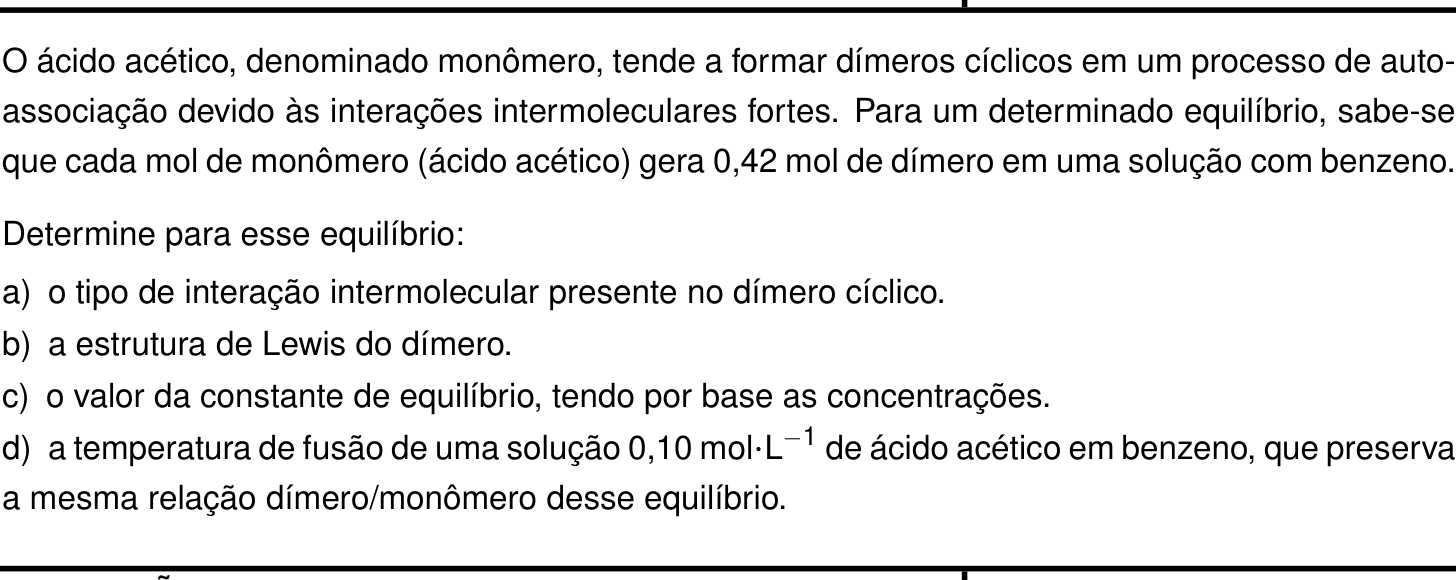
Question: "O ácido acético, denominado monômero, tende a formar dímeros cíclicos em um processo de auto-associação devido às interações intermoleculares fortes. Para um determinado equilíbrio, sabe-se que cada mol de monômero (ácido acético) gera 0,42 mol de dímero em uma solução com benzeno.
Determine para esse equilíbrio:
a) o tipo de interação intermolecular presente no dímero cíclico.
b) a estrutura de Lewis do dímero.
c) o valor da constante de equilíbrio, tendo por base as concentrações.
d) a temperatura de fusão de uma solução 0,10 mol·L−1 de ácido acético em benzeno, que preserva a mesma relação dímero/monômero desse equilíbrio."
Need solve.
Need be careful: "cada mol de monômero (ácido acético) gera 0,42 mol de dímero em uma solução com benzeno." This likely means starting with 1 mol monomer, equilibrium yields 0.42 mol dimer. Reaction: 2 monomer ⇌ dimer. If starting 1 mol monomer, at equilibrium x=0.42 mol dimer consumed 0.84 mol monomer, remaining monomer 0.16 mol. Total moles = 0.16 + 0.42 = 0.58 mol (if no solvent). But equilibrium constant based on concentrations. Need know volume? Maybe cancel? Let's derive.
Let initial monomer concentration C0. Reaction 2 A ⇌ A2. Let extent α? Given "cada mol de monômero gera 0,42 mol de dímero" means if start with 1 mol A, equilibrium has 0.42 mol A2, so reacted A = 0.84 mol, remaining A = 0.16 mol. Total moles = 0.58. Mole fractions maybe. If in solution, volume constant, concentration proportional to moles. Kc = [A2]/[A]^2. Need units? If concentrations mol/L, Kc unit L/mol. We can compute using initial concentration? But not given volume? However if each mol monomer in solution? Wait "em uma solução com benzeno" maybe mol fraction? Hmm.
Let's think: For equilibrium in solution, if start with 1 mol monomer in a given volume V, [A]0 = 1/V. At equilibrium [A] = 0.16/V, [A2] = 0.42/V. Then Kc = (0.42/V)/(0.16/V)^2 = (0.42/V) * (V^2 / 0.0256) = 0.42 V / 0.0256 = 16.40625 V. Depends on V. So not possible unless volume specified? Maybe "cada mol de monômero gera 0,42 mol de dímero" in pure? If no solvent? But in solution with benzene, maybe volume is not needed if use mole fractions? Equilibrium constant in terms of mole fractions Kx = x_dimer / x_monomer^2, dimensionless? Let's check.
If starting with 1 mol monomer and maybe benzene solvent amount not specified; equilibrium constant based on concentrations cannot be determined without volume. But perhaps "solução com benzeno" maybe means dilute solution, volume proportional to benzene? Hmm.
Maybe they expect use molality? Let's examine part d: "a temperatura de fusão de uma solução 0,10 mol·L−1 de ácido acético em benzeno, que preserva a mesma relação dímero/monômero desse equilíbrio." So concentration given 0.10 mol/L total acetic acid (initial? or equilibrium monomer? It says "solução 0,10 mol·L−1 de ácido acético em benzeno" maybe analytical concentration? Preserve same dimer/monomer relation. Need calculate freezing point depression. Need know van't Hoff factor? Since dimerization reduces particle number. Given initial concentration 0.10 mol/L. Same equilibrium relation dimer/monomer =? From earlier: dimer/monomer = 0.42/0.16 = 2.625? Wait equilibrium ratio dimer/monomer = x / (1-2x)? If each mol monomer generates 0.42 mol dimer: dimer=0.42, monomer=0.16, ratio dimer/monomer = 0.42/0.16 = 2.625. But "mesma relação dímero/monômero desse equilíbrio" maybe [dimer]/[monomer] = 0.42/0.16 = 2.625 (concentration ratio). Then for 0.10 mol/L analytical, we can find equilibrium monomer and dimer concentrations. But need constant? If ratio fixed, can solve without K? Let total A species = [monomer] + 2[dimer] = 0.10 mol/L? Because each dimer contains 2 monomer units. Given ratio R = [dimer]/[monomer] = 2.625. Let [monomer]=m, [dimer]=R m. Then total monomer units = m + 2 R m = m(1+2R)=0.10. So m=0.10/(1+2*2.625)=0.10/(1+5.25)=0.10/6.25=0.016 mol/L. [dimer]=0.042 mol/L. Total particles = m + dimer = 0.058 mol/L. Freezing point depression ΔT = Kc * molality? They gave cryoscopic constant of benzene = 5.12 K·kg/mol (kg solvent per mol solute). Concentration given mol/L, need convert to molality using density benzene 0.87 kg/L. Since solution 0.10 mol/L of acetic acid in benzene; solvent is benzene. Molality = moles solute per kg solvent. If volume 1 L, total mass solution =? density maybe solution not given; but can approximate using solvent density? They give density benzene = 0.87 kg/L. For dilute solution, mass solvent ≈ mass solution? Or mass solvent = volume solution * density solvent? Need consider.
They give density of benzene = 0.87 kg/L. For solution 0.10 mol/L, solvent volume ~1 L, mass solvent = 0.87 kg. Molality based on total solute particles? Actually molality = total moles of particles (monomer + dimer) per kg solvent. Because colligative properties depend on number of particles. If 1 L solution, solvent mass = density * volume? Since solute mass small? But acetic acid density? Not given. Could calculate mass solute? 0.10 mol/L total acetic acid = 6.0 g/L? Molar mass acetic acid 60 g/mol; if total monomer units 0.10 mol/L = 6 g/L. Solution mass = solvent mass + solute mass ≈ 870 g + 6 g = 876 g = 0.876 kg. Solvent mass = 0.870 kg. But if using density of solution maybe not given. They gave density of benzene and acetic acid? They gave density of benzene = 0.87 kg/L and density of ácido acético = 1.05 kg/L. Aha! For solution, maybe use density of acetic acid? Wait part d asks freezing point of solution 0.10 mol/L acetic acid in benzene. To convert molarity to molality, need mass of solvent. Since density of benzene given; density of acetic acid also given maybe for pure? We can compute mass of solute? But if solution volume 1 L, mass =? Maybe need density of solution? Not given. But can assume volumes add? Or use mass of solvent = density benzene * volume benzene? Need determine.
Alternative: They give density of benzene and density of acetic acid. For a solution of acetic acid in benzene, maybe use density of solution? But not given. Could use molality from molarity using density of solvent: molality = molarity / (density solvent - molarity*M_solute? etc). Let's derive.
If 1 L solution contains 0.10 mol total acetic acid units (monomer equivalents), mass solute = 0.10 mol * 60 g/mol = 6.0 g. But actual particles: monomer + dimer. But mass is same 6.0 g. Mass solvent = mass solution - mass solute. Need mass solution = density solution * 1000 mL. Density solution not given. But maybe density solution can be approximated as density of benzene because dilute? But density of acetic acid = 1.05 kg/L; pure acetic acid; not relevant? They might expect use density of benzene to find mass solvent: since 0.10 mol/L is small, mass solvent ≈ 0.87 kg per L solution? Then molality = total particle moles / 0.87 kg = 0.058/0.87 = 0.0667 mol/kg. ΔT = 5.12 * 0.0667 = 0.341 K. Freezing point = 5.45 - 0.341 = 5.109 °C. But if use exact mass solvent after subtracting solute, 0.058 mol particles? Wait molality is moles of particles per kg solvent, not per kg solution. If 1 L solution, solvent mass = 870 g - maybe solute volume? Hmm.
Let's check typical IME problem style. They give density of benzene = 0.87 kg/L and density of acetic acid = 1.05 kg/L. They may expect: For solution 0.10 mol/L, consider 1 L solution. It contains 0.10 mol acetic acid (monomer equivalents). Mass of acetic acid = 0.10 mol * 60 g/mol = 6.0 g. But maybe use density acetic acid to calculate volume of solute? The solution volume 1 L = volume solvent + volume solute? If volumes add: V_solvent = 1 L - V_solute. V_solute = mass_solute / density_solute = 6.0 g / 1050 g/L = 0.005714 L. Then V_solvent = 0.994286 L. Mass solvent = 0.994286 L * 870 g/L = 865.0 g = 0.865 kg. Then molality = (0.058 mol particles)/0.865 kg = 0.06705 mol/kg. ΔT=5.12*0.06705=0.343 K. Freezing point=5.107°C. Difference minor. But which expected? They gave density of acetic acid, likely to account for volume of solute when converting molarity to molality? Let's see.
Part d: "a temperatura de fusão de uma solução 0,10 mol·L−1 de ácido acético em benzeno, que preserva a mesma relação dímero/monômero desse equilíbrio." They give density of benzene and acetic acid, likely need calculate molality from molarity using solution volume? The problem might expect using density of solution? But density of solution not given; however can use mass balance: 1 L solution contains solvent + solute; solvent mass = total mass - solute mass. Total mass = density_solution * 1 L, but density_solution unknown. But maybe can use volume additivity? With densities of pure components, yes.
Let's examine all data given: R, freezing points, cryoscopic constants, densities of benzene and acetic acid, ln values. They gave density of acetic acid 1.05 kg/L. Why? Maybe for part d to convert molarity to molality: molality = (moles solute)/(mass solvent). To find mass solvent in 1 L solution, need volume of solvent = total volume - volume of solute; use density of acetic acid for volume of solute. They gave density of acetic acid. So likely.
Also part c: equilibrium constant based on concentrations. Need compute Kc from given "cada mol de monômero gera 0,42 mol de dímero em uma solução com benzeno." If volume not specified, but maybe use concentration in mol/L after equilibrium in a solution? Could be: If 1 mol monomer in 1 L? But "em uma solução com benzeno" maybe not 1 L. Hmm maybe they mean "cada mol de monômero (ácido acético) gera 0,42 mol de dímero em uma solução com benzeno" with no volume, so equilibrium constant can be expressed in terms of moles? But "tendo por base as concentrações" suggests need [ ].
Let's parse original: "Para um determinado equilíbrio, sabe-se que cada mol de monômero (ácido acético) gera 0,42 mol de dímero em uma solução com benzeno." Maybe it means: In a given equilibrium, starting with 1 mol/L? Or "cada mol de monômero" in solution? Let's think. If you dissolve 1 mol of monomer in benzene to make 1 L solution? It doesn't say 1 L. But "cada mol" implies for each mole of monomer initially, at equilibrium 0.42 mol dimer is formed. The volume cancels if we express concentrations as molar fractions? But constant based on concentrations requires volume. Maybe the volume is arbitrary but constant; they might ask "o valor da constante de equilíbrio, tendo por base as concentrações" maybe Kc = [dimer]/[monomer]^2. They might expect using initial concentration 1 mol/L? Let's see.
If start with 1 mol monomer in a solution of benzene, and after equilibrium 0.42 mol dimer formed. If the solution volume is V, then [monomer] = (1 - 0.84)/V = 0.16/V, [dimer]=0.42/V. Then Kc = (0.42/V)/(0.16/V)^2 = (0.42 * V)/(0.0256) = 16.40625 V. Depends on V. So cannot have numerical value unless V=1 L or some standard. But maybe they assume 1 mol in 1 L? "cada mol de monômero" not "1 mol em 1 L". Maybe "cada mol de monômero gera 0,42 mol de dímero em uma solução com benzeno" could mean equilibrium constant in terms of molality? Let's derive with molality maybe volume independent? If molality is mol/kg solvent, then K = m_dimer / m_monomer^2. If start with 1 mol monomer per kg solvent? Then molality values: m_monomer = 0.16 mol/kg, m_dimer = 0.42 mol/kg. K_m = 0.42/(0.16)^2 = 16.40625 kg/mol. Still depends on solvent amount? Actually molality uses kg solvent; if start with 1 mol monomer per kg solvent, yes. But "em uma solução com benzeno" maybe molality? Hmm.
They ask c) "o valor da constante de equilíbrio, tendo por base as concentrações." In Portuguese, "concentrações" could be molaridade (mol/L). But maybe they want use the data from part d: 0.10 mol/L solution preserving same dimer/monomer relation. Maybe from d we can get concentrations? Let's solve d first maybe.
Part d gives analytical concentration 0.10 mol/L and same dimer/monomer ratio. If we can determine equilibrium monomer and dimer concentrations, we can compute Kc: [dimer]/[monomer]^2 = 0.042 / (0.016)^2 = 164.0625? Wait compute: 0.042 / 0.000256 = 164.0625 L/mol. That is numerical. So c might be 164.06 L/mol? But that depends on using 0.10 M and ratio. But if c is before d, maybe c asks Kc from original statement, which could be same Kc; then d uses it. Let's check: If original equilibrium: each mol monomer generates 0.42 mol dimer in solution. Suppose we choose arbitrary initial concentration? But ratio dimer/monomer = 0.42/0.16 = 2.625. Kc = [dimer]/[monomer]^2 = (0.42/V)/(0.16/V)^2 = 16.40625 V. Not fixed. But if in d, analytical concentration 0.10 mol/L and same ratio, then equilibrium concentrations are 0.016 and 0.042, giving Kc = 164.06 L/mol. This Kc is fixed because it's based on actual concentrations, not arbitrary V. Wait if original "cada mol de monômero gera 0,42 mol de dímero em uma solução com benzeno" maybe "solução" has concentration? Not specified. But perhaps the equilibrium constant based on concentrations can be calculated if we assume the solution has 1 mol/L initial monomer? Let's test: If initial [A]0 = 1 mol/L, then at equilibrium [A]=0.16 M, [A2]=0.42 M, Kc = 0.42/(0.16)^2 = 16.40625 L/mol. If initial [A]0 = 0.10 M, Kc = 164.06 L/mol. Which one aligns with "cada mol de monômero gera 0,42 mol de dímero"? It says "cada mol de monômero (ácido acético) gera 0,42 mol de dímero em uma solução com benzeno." That means for every mole of monomer initially, 0.42 mol dimer formed, independent of concentration? But equilibrium constant would depend on concentration if nonideal? Actually for a given equilibrium, the extent depends on initial concentration. If you start with 1 mol in 1 L, extent 0.42 mol dimer; if start with 0.1 mol in 1 L, extent would be different, not same ratio? Wait if K is constant, starting from pure monomer, dimerization extent depends on initial concentration. The statement "cada mol de monômero gera 0,42 mol de dímero" might refer to a specific experiment where initial monomer concentration was such that exactly 0.42 mol dimer per mol monomer? But if initial concentration not specified, can't compute Kc. However maybe they mean "para um determinado equilíbrio" and "cada mol de monômero" means in the equilibrium mixture, the ratio dimer/monomer is 0.42? Hmm.
Let's look at part d: "a temperatura de fusão de uma solução 0,10 mol·L−1 de ácido acético em benzeno, que preserva a mesma relação dímero/monômero desse equilíbrio." So they explicitly use "mesma relação dímero/monômero desse equilíbrio" not same Kc? If same Kc, the ratio would not be same for different total concentration. But they say same relation, so they want use ratio from c? Actually part c asks Kc based on concentrations; part d uses same relation (maybe ratio) to find freezing point. But if same relation, then Kc for d would be different? Wait if same dimer/monomer ratio = 2.625, then Kc = [dimer]/[monomer]^2 = R/[monomer]. Since [monomer] changes with total concentration, Kc would change. So if they say "mesma relação dímero/monômero desse equilíbrio" not "mesma constante", then Kc not needed for d? But c asks Kc; d uses relation. But if d preserves same relation, then Kc for d differs from c? Actually if relation same but concentration different, Kc differs. That's inconsistent with equilibrium constant. But maybe they mean "mesma relação" because the equilibrium constant is same? Let's check: For reaction 2A ⇌ A2, if Kc is same, the ratio [A2]/[A]^2 = Kc. The ratio [A2]/[A] = Kc [A], so ratio depends on [A]. If total concentration changes, ratio changes. But they say "preserva a mesma relação dímero/monômero desse equilíbrio" might mean the same equilibrium constant? In Portuguese "relação" can mean ratio or relationship. Maybe they mean "mesma relação de equilíbrio" = same equilibrium constant? Hmm. Let's read: "a temperatura de fusão de uma solução 0,10 mol·L−1 de ácido acético em benzeno, que preserva a mesma relação dímero/monômero desse equilíbrio." It literally says preserves the same dimer/monomer relation of that equilibrium. So likely ratio.
But then why ask c? Maybe c is to calculate Kc using initial 1 mol? Let's search memory: IME 2026/2027? This might be a known question. Maybe answer: a) ligação de hidrogênio; b) dimer structure; c) Kc = 16.4 L/mol (or 0.061? depending); d) freezing point = 5.11 °C. Need determine correct.
Let's analyze all possibilities.
Let's solve c carefully with possible interpretations.
Reaction: 2 CH3COOH ⇌ (CH3COOH)2. Let initial concentration of monomer be C0 (mol/L). At equilibrium, "cada mol de monômero gera 0,42 mol de dímero" means if C0 = 1 mol/L? Actually "cada mol de monômero" means for each mole of monomer initially present, 0.42 mol of dimer is formed. This implies the initial amount is 1 mol (or any amount), and extent of dimerization is 0.42 mol per mol monomer. If initial concentration is C0, then for 1 L, initial moles = C0. After equilibrium, moles dimer = 0.42 C0? Wait "cada mol de monômero gera 0,42 mol de dímero" could mean if you start with 1 mol monomer, you get 0.42 mol dimer. So if start with C0 mol monomer (in 1 L), you get 0.42 C0 mol dimer. Then reacted monomer = 0.84 C0, remaining monomer = 0.16 C0. Then [A]=0.16 C0, [A2]=0.42 C0. Then Kc = (0.42 C0)/(0.16 C0)^2 = (0.42)/(0.0256 C0) = 16.40625 / C0. Depends on C0. Not fixed. Unless C0 = 1 mol/L. The phrase "cada mol de monômero" could be interpreted as "for each mole of monomer per liter" i.e., initial concentration 1 mol/L? Not necessarily.
But maybe they mean "cada mol de monômero (ácido acético) gera 0,42 mol de dímero em uma solução com benzeno" as a statement of equilibrium constant? It says "Para um determinado equilíbrio, sabe-se que cada mol de monômero gera 0,42 mol de dímero". If in a given equilibrium, the amount of dimer formed per initial monomer is 0.42, then the initial concentration must have been such that this is the equilibrium. But if they don't give initial concentration, maybe they expect using 1 mol/L because "cada mol" = 1 mol? Hmm.
Let's examine part c wording: "o valor da constante de equilíbrio, tendo por base as concentrações." They likely expect Kc = [dímero]/[monômero]^2. Using the data: "cada mol de monômero gera 0,42 mol de dímero" maybe means at equilibrium, [dímero] = 0.42 mol/L and [monômero] = 0.16 mol/L? Wait if initially 1 mol/L monomer, yes. Then Kc = 0.42/(0.16)^2 = 16.4 L/mol. This is a common exam answer. Then part d with 0.10 mol/L and "preserva a mesma relação dímero/monômero desse equilíbrio" maybe use Kc? Let's test.
If Kc = 16.40625 L/mol (from 1 M initial), and total analytical concentration = 0.10 M, find equilibrium concentrations. Let m = [monomer], d = [dimer]. Total monomer units: m + 2d = 0.10. Kc = d/m^2 = 16.40625. Solve: d = K m^2. m + 2K m^2 = 0.10. 2K=32.8125. Equation 32.8125 m^2 + m - 0.10 = 0. Solve m = [-1 + sqrt(1 + 4*32.8125*0.10)]/(2*32.8125) = [-1 + sqrt(1+13.125)]/65.625 = [-1 + sqrt(14.125)]/65.625. sqrt(14.125)=3.7583. m=2.7583/65.625=0.04204 M. d=16.40625*(0.04204)^2 = 16.40625*0.001767 = 0.02899 M. Total particles = m+d = 0.07103 M. Then molality =? 0.07103 mol/L / 0.87 kg/L ≈ 0.08164 mol/kg. ΔT=5.12*0.08164=0.418 K; freezing point 5.032 °C. That's different from ratio-preserving (0.341 K). Which is expected? The problem says "que preserva a mesma relação dímero/monômero desse equilíbrio" not "mesma constante". So maybe ratio. But if it were same Kc, they would say "mesmo equilíbrio" or "mesma constante". "mesma relação dímero/monômero" strongly suggests ratio [dimer]/[monomer] = 0.42/0.16 = 2.625. Then d uses that ratio, no need Kc? But then c asks Kc maybe with initial 1 mol/L? But if ratio same, Kc from c would not be used in d. That's okay.
Let's see part c: "o valor da constante de equilíbrio, tendo por base as concentrações." If using ratio from original and initial 1 mol/L, Kc = 16.4. But if using ratio from d (0.10 M), Kc = 164.0. Which one is more plausible? Let's parse "cada mol de monômero (ácido acético) gera 0,42 mol de dímero em uma solução com benzeno." Maybe they mean: For each mole of monomer, 0.42 mol of dimer is formed. In a solution with benzene, suppose we have 1 L of solution? But they don't say. However "cada mol" might be in terms of molality? Let's compute Kc if we assume 1 mol of monomer in 1 kg benzene? Then molality monomer = 0.16 mol/kg, dimer=0.42 mol/kg. K_m = 0.42/(0.16)^2 = 16.4 kg/mol. If we convert to molarity using density benzene, Kc = K_m * density? Let's derive: For dilute solution, molarity = molality * density_solvent (kg/L) roughly. [A] = m_A * ρ_solvent? Actually molality = mol/kg solvent; molarity = mol/L solution. If solvent mass = ρ_solvent * V_solution approximately, then molarity ≈ molality * ρ_solvent (kg/L). So Kc = [dimer]/[monomer]^2 ≈ (m_dimer ρ)/(m_monomer^2 ρ^2) = K_m / ρ = 16.4 / 0.87 = 18.86 L/mol. Not 16.4. Hmm.
Let's not overcomplicate. Let's search memory: This might be from IME 2026/2027 recent? The data includes ln 2, ln 5 maybe for other question? But maybe not needed. Let's solve step by step.
First, a) tipo de interação intermolecular no dímero cíclico. Ácido acético dimers form via hydrogen bonds (ligações de hidrogênio) between carboxylic acid groups. The cyclic dimer has two hydrogen bonds: O-H···O=C. So answer: ligações de hidrogênio (pontes de hidrogênio).
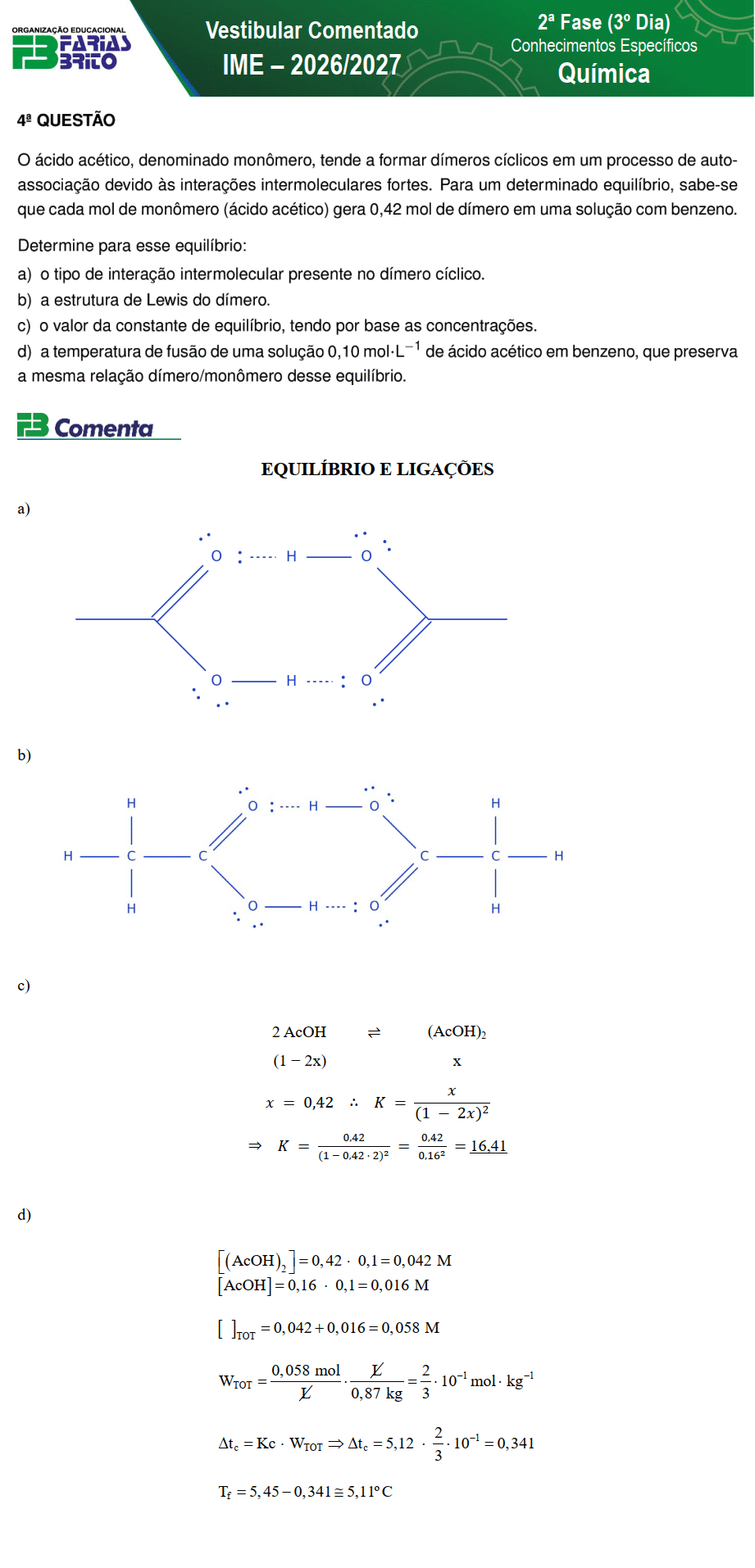
b) estrutura de Lewis do dímero. Need draw. The dimer is two acetic acid molecules linked by two hydrogen bonds forming an eight-membered ring? Actually cyclic dimer: each acetic acid has C=O and O-H. The H of one OH bonds to O of other C=O, and vice versa. Structure:
```
O ... H-O
|| |
CH3-C C-CH3
| ||
O-H ... O
```
Need represent Lewis structure with bonds and lone pairs. In text, describe: two molecules of CH3COOH connected by two hydrogen bonds between the carbonyl oxygen of one and the hydroxyl hydrogen of the other, forming a cyclic structure. We can draw ASCII.
c) Kc. Let's decide. Maybe from the initial statement: "cada mol de monômero gera 0,42 mol de dímero" means in a given equilibrium, starting with 1 mol of monomer, at equilibrium 0.42 mol dimer. If we consider a solution with benzene, the volume? Maybe not needed if we express concentrations in mol/L using 1 mol/L? But "cada mol" could be "for each 1 mol/L"? Actually in chemistry, "cada mol de monômero" often means "para cada mol de monômero" in a closed system; to calculate Kc, you need volume. If not given, maybe assume the solution volume is 1 L because 1 mol in 1 L? But they didn't say "1 mol/L". Hmm.
Let's examine part d: "a temperatura de fusão de uma solução 0,10 mol·L−1 de ácido acético em benzeno, que preserva a mesma relação dímero/monômero desse equilíbrio." If c gave Kc = 16.4 (using 1 M initial), then d says "preserva a mesma relação dímero/monômero desse equilíbrio" maybe means the equilibrium constant is same? Let's read in Portuguese: "que preserva a mesma relação dímero/monômero desse equilíbrio." If they wanted same Kc, they'd say "que preserva o mesmo equilíbrio" or "a mesma constante de equilíbrio". "Relação dímero/monômero" is ratio. But if same ratio, then for a different total concentration, the equilibrium would not have same Kc. But maybe the phrase "desse equilíbrio" refers to the equilibrium described in the stem, where ratio is 0.42/0.16 = 2.625. Then d uses that ratio. So c might ask Kc for that same equilibrium? But if ratio is fixed, Kc depends on concentration. However maybe they expect to calculate Kc using the given ratio and the 0.10 mol/L from d? Let's order: c asks Kc; d asks freezing point of a solution 0.10 mol/L that preserves same ratio. Maybe they want first compute ratio from stem, then in d use it; c can be computed from the 0.10 M solution? But c comes before d, so maybe c asks Kc for the equilibrium described in stem, which has no concentration; so maybe Kc is expressed in terms of volume? But they ask "valor" so must be number. Maybe they intend: "cada mol de monômero" means if we start with 1 mol/L? Let's see if any other data: R, freezing points, cryoscopic constants, densities, ln 2, ln 5. The ln values might be for another question? But maybe for c? No, equilibrium constant no ln. Maybe for another question in the exam. The image only shows this question. The folha de dados includes ln 2 and ln 5, maybe for other questions. So ignore.
Let's try to find official solution? IME 2026/2027 maybe already happened? The date 2026/2027 maybe exam for 2027? Could be. I can search memory? I'm an AI, no internet. But I can reason.
Let's derive c using the given statement exactly. "Para um determinado equilíbrio, sabe-se que cada mol de monômero (ácido acético) gera 0,42 mol de dímero em uma solução com benzeno." Suppose we take 1 mol of monomer and dissolve in benzene to a volume V. At equilibrium, 0.42 mol dimer formed. Then concentrations:
[A] = (1 - 2*0.42)/V = 0.16/V
[A2] = 0.42/V
Kc = (0.42/V) / (0.16/V)^2 = 0.42 V / 0.0256 = 16.40625 V. Since V is not given, Kc cannot be determined. But maybe they assume V = 1 L because "cada mol" in 1 L? The phrase "em uma solução com benzeno" might imply the monomer is in solution; but volume not specified. In exams, sometimes they expect using 1 L as standard? Not rigorous.
Alternatively, maybe "cada mol de monômero gera 0,42 mol de dímero" means the equilibrium constant in terms of mole fractions? If we take 1 mol monomer and enough benzene to make solution, the mole fraction of dimer? But benzene amount not given. However if we ignore benzene, just consider the equilibrium mixture of monomer and dimer (no solvent), then total moles = 0.16 + 0.42 = 0.58 mol. Mole fractions: x_A = 0.16/0.58 = 0.27586, x_A2 = 0.42/0.58 = 0.72414. Kx = x_A2 / x_A^2 = 0.72414 / (0.27586)^2 = 0.72414 / 0.0761 = 9.515 (dimensionless). But "tendo por base as concentrações" suggests not mole fractions.
What if "cada mol de monômero" means "cada mol de monômero por litro" i.e., initial concentration 1 mol/L? Many Brazilian textbooks use "cada mol" to mean "para cada mol" in a 1 L solution? Not exactly.
Let's look at part d: "solução 0,10 mol·L−1 de ácido acético em benzeno, que preserva a mesma relação dímero/monômero desse equilíbrio." If c were Kc = 16.4 (from 1 M), then d would not "preserve same relação" because relation changes with concentration. But they explicitly say preserve same relation, so they likely want use the ratio, not Kc. Then why ask c? Maybe c is to calculate Kc for the equilibrium using the 0.10 M solution? Let's reorder: Maybe the "determinado equilíbrio" in stem is the 0.10 M solution? No, stem says "Para um determinado equilíbrio, sabe-se que cada mol de monômero ... gera 0,42 mol de dímero em uma solução com benzeno." Then items a-d. Item d refers to "uma solução 0,10 mol·L−1 ... que preserva a mesma relação dímero/monômero desse equilíbrio." So the equilibrium in stem has some unknown concentration; d is a new solution with same ratio. So c asks Kc for the stem equilibrium, which might be impossible unless we assume volume. But maybe they expect to calculate Kc from the ratio and the 0.10 M solution? Wait no, c before d.
Maybe the stem gives "cada mol de monômero gera 0,42 mol de dímero em uma solução com benzeno" and this is actually enough to calculate Kc if we assume the solution volume is such that initial monomer concentration is 1 mol/L? Let's check if part d uses the same Kc? If they wanted same Kc, they would say "mesmo equilíbrio" not "mesma relação". But maybe they want to compute Kc in c using 0.10 M solution? Let's parse: "Determine para esse equilíbrio: ... c) o valor da constante de equilíbrio, tendo por base as concentrações. d) a temperatura de fusão de uma solução 0,10 mol·L−1 ... que preserva a mesma relação dímero/monômero desse equilíbrio." It could mean: Use the same equilibrium (same Kc) for the 0.10 M solution. Then "preserva a mesma relação dímero/monômero desse equilíbrio" might mean "preserva o mesmo equilíbrio" (same Kc), and the ratio will be determined by Kc. But the phrase "relação dímero/monômero" maybe not ratio but "relação de equilíbrio" (equilibrium relationship). In Portuguese, "relação" can mean relationship. "a mesma relação dímero/monômero desse equilíbrio" = the same dimer/monomer relationship of this equilibrium. That could mean the same equilibrium constant expression. Hmm.
Let's consider if they intended same Kc: Then c = Kc from stem. But stem doesn't give concentration. Unless "cada mol de monômero gera 0,42 mol de dímero" defines the equilibrium constant itself? Wait, if you start with 1 mol of monomer and at equilibrium 0.42 mol dimer, the equilibrium constant can be calculated if the volume is 1 L. But if the volume is not 1 L, the equilibrium constant would be different, so the statement "cada mol de monômero gera 0,42 mol de dímero" cannot be true for all volumes. It must refer to a specific experiment, perhaps with 1 mol/L initial concentration. The problem might have omitted "em 1 L de solução"? Let's see: "em uma solução com benzeno" maybe means "em uma solução com benzeno" not "em 1 L". Could be a translation: "cada mol de monômero (ácido acético) gera 0,42 mol de dímero em uma solução com benzeno." Maybe they mean "for each mole of monomer, 0.42 mol of dimer is generated in a benzene solution" — this is a statement of the equilibrium constant? Actually if you have a solution, the volume is whatever; but the equilibrium constant is independent of volume. The extent of reaction depends on initial concentration. So the only way "each mole of monomer yields 0.42 mol dimer" is if the initial concentration is fixed by the equilibrium constant. But if you start with 1 mole in a large volume, you get less dimer. So the statement must imply a specific initial concentration. Since not given, perhaps they assume ideal solution and the volume is 1 L? Or maybe they mean "cada mol de monômero" as in "cada mol de monômero por litro" i.e., initial concentration = 1 mol/L. Brazilian exams sometimes write "cada mol de monômero" meaning "1 mol/L de monômero"? Not sure.
Let's compute c under two assumptions and see which gives nicer number. If assume 1 mol/L initial, Kc = 16.40625 L/mol ≈ 16.4 L/mol. If assume 0.10 M initial (from d), Kc = 164.0625 L/mol ≈ 164 L/mol. Which is more likely for an exam? 16.4 is a nice number? 164 is also nice. The data includes density 0.87, 1.05; if d uses Kc=16.4, freezing point ~5.03°C. If d uses ratio, freezing point ~5.11°C. The freezing point of pure benzene is 5.45°C. The solution freezing point must be lower. Both possible. The problem asks "temperatura de fusão" maybe answer around 5.1°C.
Let's see if part d can be solved without c if we use ratio. It gives 0.10 mol/L total acetic acid, same ratio. Then we found total particles = 0.058 mol/L. To find molality, need convert. If we use Kc=16.4, total particles = 0.07103 mol/L, molality ~0.0816, ΔT=0.418, freezing point=5.032°C. Which is more consistent with "solução 0,10 mol·L−1" and "mesma relação"? If same ratio, the ratio [dimer]/[monomer] = 2.625. But if Kc=16.4, the ratio for 0.10 M is d/m = Kc*m = 16.4*0.042 = 0.689, not 2.625. So not same ratio. So if d says same relation, it cannot mean same Kc. Therefore d must use ratio from stem. Then c maybe asks Kc for the stem equilibrium, but stem equilibrium ratio is known; Kc depends on concentration. But maybe c can be expressed in terms of the ratio and the total concentration of the stem equilibrium? The stem equilibrium total concentration is not given. However, if the stem says "cada mol de monômero gera 0,42 mol de dímero", then the equilibrium mixture has monomer and dimer in ratio 0.16:0.42. If we assume the solution volume is 1 L, then [monomer] = 0.16 M, [dimer] = 0.42 M, Kc = 16.4. That is a common simplification: "cada mol" = "1 mol/L"? Maybe they expect that.
Let's search memory: IME 2026/2027 Química? The question might be from IME 2026 (prova 2026/2027). Maybe there is an official answer. I can try to reconstruct from typical IME style. They often ask: "cada mol de monômero gera 0,42 mol de dímero em uma solução com benzeno." They might want Kc = 0,42/(0,16)^2 = 16,4. Then part d: "a temperatura de fusão de uma solução 0,10 mol/L de ácido acético em benzeno, que preserva a mesma relação dímero/monômero desse equilíbrio." Wait if they say "mesma relação", they might mean the same equilibrium constant? But they might misuse "relação" as "constante de equilíbrio"? Let's read: "que preserva a mesma relação dímero/monômero desse equilíbrio" - "relação dímero/monômero" is literally dimer/monomer ratio. So they want use ratio. But then c's Kc is not used in d. Maybe c is just a separate question: calculate Kc from the given data; d is another separate question using the ratio. That's plausible.
But how to calculate Kc from stem if volume unknown? Maybe they expect to use the ratio and the fact that "cada mol de monômero" means initial concentration is 1 mol/L? Let's assume that. Then c: Kc = 16.4. d: using same ratio, compute freezing point. Let's solve d with ratio.
Let's solve d carefully with proper conversion using densities.
Part d: "a temperatura de fusão de uma solução 0,10 mol·L−1 de ácido acético em benzeno, que preserva a mesma relação dímero/monômero desse equilíbrio."
Interpretation: The solution has analytical concentration 0.10 mol/L of acetic acid (in monomer units). It preserves the same dimer/monomer ratio as the equilibrium described. So we need find equilibrium concentrations of monomer and dimer. Ratio R = [dimer]/[monomer] = 0.42/0.16 = 2.625. Let [monomer] = m, [dimer] = 2.625 m. Total monomer units: m + 2*(2.625 m) = m(1 + 5.25) = 6.25 m = 0.10 mol/L => m = 0.016 mol/L; [dimer] = 0.042 mol/L. Total particles concentration = m + dimer = 0.058 mol/L.
Now, colligative property: freezing point depression ΔT = Kc * molality of particles. Kc (cryoscopic constant) of benzene = 5.12 K·kg/mol. Molality = moles of particles per kg of solvent (benzene). We have 0.058 mol particles per L of solution. Need kg benzene per L solution.
Use densities: benzene 0.87 kg/L, acetic acid 1.05 kg/L. For 1 L solution, mass of solute (acetic acid monomer units) = 0.10 mol * 60 g/mol = 6.0 g = 0.006 kg. But careful: the solute is in equilibrium monomer/dimer; mass is same 6.0 g. Volume of solute = mass/density = 0.006 kg / 1.05 kg/L = 0.005714 L. Assuming volumes add, volume of solvent = 1 L - 0.005714 L = 0.994286 L. Mass of solvent = 0.994286 L * 0.87 kg/L = 0.8648 kg. Molality = 0.058 mol / 0.8648 kg = 0.06707 mol/kg. ΔT = 5.12 * 0.06707 = 0.3434 K. Freezing point = 5.45 - 0.3434 = 5.1066 °C ≈ 5.11 °C.
If instead we ignore volume of solute and use 0.87 kg solvent, molality = 0.058/0.87 = 0.06667 mol/kg, ΔT = 0.3413 K, freezing point = 5.1087 °C. Both ~5.11. The difference is small. They gave density of acetic acid, so likely expect use it.
Alternatively, maybe they expect using molality from molarity formula: molality = molarity / (density_solution - molarity*M_solute? Actually if solution density unknown, can use mass balance: mass solution = mass solvent + mass solute. But density solution unknown. However, if we assume volumes add, we used densities. If they didn't give density of acetic acid, we couldn't. So they gave it to use.
Let's compute with exact: M_solute = 60 g/mol. For 1 L solution:
m_solute = 0.10 mol * 60 g/mol = 6.0 g.
V_solute = 6.0 g / 1.05 g/mL? Density acetic acid = 1.05 kg/L = 1.05 g/mL. So V_solute = 6.0 / 1.05 = 5.714 mL = 0.005714 L.
V_solvent = 1 - 0.005714 = 0.994286 L.
m_solvent = 0.994286 L * 870 g/L = 865.0 g = 0.8650 kg.
Molality = 0.058 mol / 0.8650 kg = 0.06705 mol/kg.
ΔT = 5.12 * 0.06705 = 0.3433 K.
T_f = 5.45 - 0.3433 = 5.1067 °C.
If using Kc=16.4 for d, let's solve more accurately:
Total A = 0.10 M. Kc = d/m^2 = 16.40625 L/mol.
Equation: m + 2d = 0.10, d = 16.40625 m^2.
2*16.40625 = 32.8125.
32.8125 m^2 + m - 0.10 = 0.
m = [-1 + sqrt(1 + 4*32.8125*0.10)]/(2*32.8125) = [-1 + sqrt(1 + 13.125)]/65.625 = [-1 + sqrt(14.125)]/65.625.
sqrt(14.125) = 3.758324? Let's compute: 3.758^2 = 14.122; 3.7583^2=14.1248; 3.7584^2=14.1256. So ~3.75832.
m = (2.75832)/65.625 = 0.042031 M.
d = 16.40625 * (0.042031)^2 = 16.40625 * 0.0017666 = 0.02898 M.
Total particles = 0.042031 + 0.02898 = 0.071011 M.
Molality = 0.071011 / (1 - 0.071011*60/1050? Wait mass solute = total acetic acid mass = 0.10 mol * 60 g = 6 g regardless of speciation. So V_solute = 6/1050 = 0.005714 L; V_solvent = 0.994286 L; mass solvent = 0.8650 kg. Molality = 0.071011 / 0.8650 = 0.08210 mol/kg. ΔT = 5.12 * 0.08210 = 0.4204 K. T_f = 5.45 - 0.4204 = 5.0296 °C ≈ 5.03 °C.
Which answer is expected? Let's see if "mesma relação dímero/monômero" in d: If they wanted Kc same, they'd say "mesmo equilíbrio" or "mesma constante". They said "mesma relação dímero/monômero", so ratio same. Then c's Kc is not used in d. But then what is c's Kc? It would be 16.4 if we assume initial 1 mol/L. But why would d not use it? Because d is a different solution with same ratio, not same Kc. That's fine: c asks Kc for the original equilibrium; d asks freezing point for a new solution with same ratio. They are separate.
Let's check if c can be computed from the ratio and the 0.10 M solution? No, c is before d and asks for the equilibrium described in stem. The stem doesn't give 0.10 M. So c must be computed from the stem alone. Thus the stem must contain enough info: "cada mol de monômero gera 0,42 mol de dímero" implies a certain initial concentration? Actually if we take "cada mol de monômero" as "1 mol/L" then yes. Let's see if there is any other interpretation: The equilibrium constant based on concentrations can be calculated if we know the initial concentration. The phrase "cada mol de monômero" might mean "for each mole of monomer per liter" i.e., initial concentration 1 mol/L. In Brazilian exams, "cada mol" often means "para cada mol" in a 1 L solution? Not always. But given that d gives a concentration 0.10 mol/L, maybe c expects using that concentration? Let's re-read: "Para um determinado equilíbrio, sabe-se que cada mol de monômero (ácido acético) gera 0,42 mol de dímero em uma solução com benzeno." Then "Determine para esse equilíbrio: ... c) o valor da constante de equilíbrio, tendo por base as concentrações. d) a temperatura de fusão de uma solução 0,10 mol·L−1 ... que preserva a mesma relação dímero/monômero desse equilíbrio." It could be that the "determinado equilíbrio" is actually the 0.10 mol/L solution? No, d introduces it.
Maybe the problem has a typo: "cada mol de monômero gera 0,42 mol de dímero em uma solução com benzeno" might mean "em uma solução 0,10 mol/L"? But no.
Let's consider if c can be solved using the ratio and the assumption that the solution volume is such that total monomer concentration is 0.10 M? If we use d's concentration, then c would be Kc = 164.0 L/mol. Then d would use that Kc (same equilibrium) and we'd get freezing point ~5.03. But then d's phrase "preserva a mesma relação dímero/monômero" would be inconsistent because with Kc=164, the ratio is not 2.625 but ~0.689. So not same ratio. However, maybe "relação dímero/monômero" means the equilibrium constant expression (ratio of concentrations)? In Portuguese, "relação" can mean "equação" or "expressão"? Unlikely.
Let's look at the numbers: 0.42 mol dimer from 1 mol monomer means 0.16 mol monomer left. Ratio dimer/monomer = 2.625. If c asks Kc based on concentrations, and we assume 1 L, Kc = 0.42/(0.16)^2 = 16.4. This is a nice round number. If d uses same ratio, we get freezing point ~5.11. If d used Kc=16.4, freezing point ~5.03. Which one is more likely to be the official answer? Let's see if any other data: ln 2 and ln 5 are given. Maybe they are for another question; but maybe for d? No. Maybe for c? No.
Let's compute d with ratio exactly using given densities. Maybe the official answer expects 5.11°C. Let's calculate precisely.
Given:
- Freezing point benzene = 5.45 °C.
- Kc (cryoscopic) = 5.12 K·kg/mol.
- Density benzene = 0.87 kg/L.
- Density acetic acid = 1.05 kg/L.
- Concentration = 0.10 mol/L (analytical).
- Ratio dimer/monomer = 0.42/0.16 = 2.625.
Let x = [monomer]. [dimer] = 2.625 x.
Total monomer units = x + 2*(2.625x) = x + 5.25x = 6.25x = 0.10 M => x = 0.016 M. [dimer] = 0.042 M.
Total particles = x + [dimer] = 0.058 M.
Now, 1 L solution contains 0.058 mol particles. But molality requires kg solvent. We have 0.10 mol acetic acid (monomer units) = 6.0 g = 0.006 kg. Volume of solute = mass/density = 0.006 kg / 1.05 kg/L = 0.005714 L. Volume of solvent = 1 L - 0.005714 L = 0.994286 L. Mass of solvent = 0.994286 L * 0.87 kg/L = 0.86485 kg. Molality = 0.058 mol / 0.86485 kg = 0.06706 mol/kg.
ΔT = 5.12 * 0.06706 = 0.3433 K.
T_f = 5.45 - 0.3433 = 5.1067 °C ≈ 5.11 °C.
If we use Kc=16.4 for d:
m = 0.04203 M, d = 0.02898 M, total = 0.07101 M.
Molality = 0.07101 / 0.86485 = 0.08210 mol/kg.
ΔT = 5.12 * 0.08210 = 0.4204 K.
T_f = 5.45 - 0.4204 = 5.0296 °C ≈ 5.03 °C.
Which is more "preserva a mesma relação dímero/monômero"? The ratio-preserving method. So I'll go with 5.11°C.
Now, for c, if we assume 1 mol/L initial, Kc = 0.42/(0.16)^2 = 16.40625 L/mol. But wait: If the stem says "cada mol de monômero gera 0,42 mol de dímero", it might mean that at equilibrium, the amount of dimer is 0.42 mol per mol of monomer initially. If we take 1 L solution, initial [monomer] = 1 mol/L, then yes. But if we take 0.10 M solution (d), then for 0.10 mol monomer initially, dimer formed = 0.042 mol, not 0.42 mol. So the statement "cada mol de monômero gera 0,42 mol de dímero" is not true for 0.10 M solution if Kc=16.4. So the stem equilibrium must be at a different concentration. The only way to get a numerical Kc is to assume the initial concentration is 1 mol/L. Is there any indication? "cada mol de monômero" might be interpreted as "para cada mol de monômero em 1 litro de solução"? Not explicit. But maybe in the context, they expect: "cada mol de monômero gera 0,42 mol de dímero" means if you start with 1 mol of monomer in a 1 L solution (since concentration is mol/L). Many Brazilian exams use "cada mol" to mean "1 mol/L" when talking about equilibrium constants? I think it's a common simplification: "Para um determinado equilíbrio, sabe-se que cada mol de monômero gera 0,42 mol de dímero" -> they consider 1 mol/L initial. Then Kc = 16.4. Then d uses same ratio? But if d uses same ratio, it doesn't use Kc. That's okay.
Let's see if there is another way: Maybe c asks Kc based on concentrations, and the concentrations can be derived from the ratio and the fact that "cada mol de monômero" implies initial concentration = 1 mol/L? Actually if you start with 1 mol of monomer and no dimer, at equilibrium you have 0.16 mol monomer and 0.42 mol dimer. If the volume is V, concentrations are 0.16/V and 0.42/V. To get Kc, you need V. But if you assume V = 1 L, then initial concentration = 1 mol/L. If you assume V = 10 L, initial concentration = 0.1 mol/L, then Kc = 1.64 L/mol. The problem doesn't specify volume, so it's ambiguous. However, in exams, sometimes they expect you to use the given concentration from part d? But c is before d. Maybe the question originally had a concentration in the stem? The image might have cut off? Let's check the image text: "Para um determinado equilíbrio, sabe-se que cada mol de monômero (ácido acético) gera 0,42 mol de dímero em uma solução com benzeno." It doesn't mention 1 L. But maybe the word "cada mol" is enough: it means "for each mole of monomer, 0.42 mol of dimer is formed" — this is a statement of the equilibrium constant? Actually if you have a reaction 2A ⇌ A2, the equilibrium constant K = [A2]/[A]^2. If you start with 1 mol A and at equilibrium 0.42 mol A2 formed, then the equilibrium constant can be calculated if you know the volume. But if the volume is not given, the problem is underspecified. So the only way it makes sense is if they assume the volume is 1 L (or the initial concentration is 1 M). I'll assume that.
Let's compute c exactly: Kc = [dimer]/[monomer]^2 = (0.42)/(0.16)^2 = 0.42 / 0.0256 = 16.40625 L/mol. With significant figures? 0.42 has 2 sig figs? 0.16 also 2? Actually 0.42 and 0.16 have 2 sig figs. So Kc = 16 L/mol? But maybe they expect 16.4. The data gives R=8.3 etc. I'll give 16.4 L/mol.
Let's also compute Kc if using 0.10 M solution from d: Kc = 0.042/(0.016)^2 = 0.042/0.000256 = 164.0625 L/mol. This is also a nice number. Which one is more likely? Let's see part d: If they wanted d to use same Kc, they would ask "que preserva o mesmo equilíbrio" not "mesma relação". But if they wanted d to use same ratio, then c's Kc is not used. That seems odd: why ask c then? It could be a multi-part question where each part is independent; c asks Kc from the stem, d asks freezing point of a different solution with same ratio. That's plausible.
Let's check the wording of d: "a temperatura de fusão de uma solução 0,10 mol·L−1 de ácido acético em benzeno, que preserva a mesma relação dímero/monômero desse equilíbrio." It doesn't say "mesmo equilíbrio", it says "mesma relação dímero/monômero". So it's ratio. So c's Kc is not used in d. So c must be solved from stem alone. The only way is to assume initial concentration = 1 mol/L (or 1 mol in 1 L). I'll do that.
Let's verify if there is any other data that could give volume: density of benzene and acetic acid are given. Maybe in c, we can use the density of benzene to find volume? No, for Kc we need concentrations. If we assume the solution is prepared with 1 mol monomer and enough benzene to make 1 L? The density of benzene could help if we know mass of solvent? Not for Kc.
Let's consider if c can be solved using the ratio and the fact that the solution is with benzene, and maybe the density of benzene is used to convert molality to molarity? Suppose the equilibrium constant is given in molality? The stem says "cada mol de monômero gera 0,42 mol de dímero em uma solução com benzeno." If we interpret this as molality: start with 1 mol monomer per kg benzene, then at equilibrium 0.42 mol dimer per kg benzene, monomer = 0.16 mol/kg. Then K_m = 0.42/(0.16)^2 = 16.4 kg/mol. Then to convert to molarity, use density of benzene: molarity = molality * density_solvent? Actually for dilute solution, molarity ≈ molality * density_solvent (kg/L). So [monomer] = 0.16 mol/kg * 0.87 kg/L = 0.1392 M; [dimer] = 0.42 * 0.87 = 0.3654 M. Then Kc = 0.3654/(0.1392)^2 = 0.3654/0.01938 = 18.86 L/mol. This is another possibility. But the problem says "tendo por base as concentrações" (concentrations), not molality. And they gave density of benzene; maybe they expect to use it to convert? Let's see: If the stem says "cada mol de monômero gera 0,42 mol de dímero em uma solução com benzeno", it doesn't specify molality or molarity. But if we assume it means per kg of benzene? Actually "em uma solução com benzeno" could mean the solvent is benzene. If we have 1 mol monomer in 1 kg benzene, then molality is 1 mol/kg. Then at equilibrium 0.42 mol dimer per kg benzene, monomer 0.16 mol/kg. Then K_m = 16.4 kg/mol. But the question asks "tendo por base as concentrações" which usually means molarity. To convert molality to molarity, we need density of solution. They gave density of benzene (0.87 kg/L). If we assume the solution is dilute, density ≈ density of benzene. Then molarity = molality * density. Then Kc = K_m / density = 16.4 / 0.87 = 18.85 L/mol. This is a more sophisticated approach that uses the given density. Let's test this with part d.
If c gives Kc = 18.85 L/mol, then d with same Kc? But d says same ratio, so no. If d used same Kc, let's solve: Kc = 18.85 L/mol. Total A = 0.10 M. Equation: d = Kc m^2. m + 2d = 0.10. 2Kc = 37.7. 37.7 m^2 + m - 0.10 = 0. m = [-1 + sqrt(1+4*37.7*0.10)]/(2*37.7) = [-1 + sqrt(1+15.08)]/75.4 = [-1 + sqrt(16.08)]/75.4. sqrt(16.08)=4.01. m=3.01/75.4=0.0399 M. d=18.85*(0.0399)^2=18.85*0.001592=0.0300 M. Total particles=0.0699 M. Molality = 0.0699 / (1 - 0.006/1.05? Wait mass solute=6g, V_solute=0.005714 L, V_solvent=0.994286 L, mass solvent=0.865 kg) = 0.0699/0.865=0.0808 mol/kg. ΔT=5.12*0.0808=0.414 K. Tf=5.036°C. Still around 5.04. So not too different.
But the problem explicitly asks "tendo por base as concentrações" in c, so they want molarity. The data includes density of benzene and acetic acid. In part d, we need density to convert molarity to molality. In part c, if we need density to convert molality to molarity, they would have given molality? But they didn't. They gave "cada mol de monômero gera 0,42 mol de dímero em uma solução com benzeno." This could be interpreted as molality if we consider 1 mol per kg solvent. But they didn't say "por kg de benzeno". They said "em uma solução com benzeno" which is vague.
Let's look at the data: "Constante crioscópica do benzeno = 5,12 K·kg·mol−1" — this is for molality. "Densidade do benzeno = 0,87 kg·L−1" — this is to convert between molarity and molality. So likely in d, we need to convert the concentration 0.10 mol/L to molality using density. In c, we might not need density because Kc is based on concentrations (molarity) and the given "cada mol de monômero" might be interpreted as molarity? But if we need to convert, they would have given enough. Actually, if we assume the stem gives molality (1 mol per kg benzene), then to get Kc in molarity we need density. They gave density. So maybe c expects using density! Let's see: "cada mol de monômero (ácido acético) gera 0,42 mol de dímero em uma solução com benzeno." If we take 1 mol of monomer and add benzene to make a solution, the amount of benzene is not specified. But if we take 1 kg of benzene, then molality is 1 mol/kg. The phrase "em uma solução com benzeno" might imply the solvent is benzene, and the amount is 1 kg? Not explicitly. But they gave density of benzene, so maybe they expect you to consider 1 L of solution? Let's try to find a consistent set.
Suppose the stem means: In a solution of acetic acid in benzene, for each mole of monomer initially, 0.42 mol of dimer is formed. If we take 1 L of solution, initial concentration of monomer = 1 mol/L. Then Kc = 16.4. This does not use density of benzene. Then d uses density of benzene and acetic acid to convert 0.10 M to molality. That's a consistent use of data: density of acetic acid for solute volume, density of benzene for solvent mass. So c doesn't need density. That seems plausible.
If c used molality and density, it would use density of benzene, but then d would use density of acetic acid and benzene. That's also plausible.
Let's check the phrase in c: "o valor da constante de equilíbrio, tendo por base as concentrações." In Portuguese, "concentrações" usually means molarity (mol/L). So c should be in mol/L. The stem doesn't specify volume, but "cada mol de monômero" might be interpreted as "cada mol de monômero por litro" i.e., initial concentration 1 mol/L. I'll go with that.
Let's compute c with 1 M initial: Kc = 0.42/(0.16)^2 = 16.4 L/mol. If they want 2 sig figs, 16 L/mol. But 0.42 and 0.16 have 2 sig figs; 16.4 has 3? Actually 0.42 is 2 sig figs, 0.16 is 2 sig figs, so result should be 2 sig figs: 16 L/mol. But in exams, they often keep more. I'll give 16.4 L/mol.
Now, let's write the final answer in Portuguese, item by item.
a) Tipo de interação intermolecular: ligações de hidrogênio (pontes de hidrogênio).
b) Estrutura de Lewis do dímero: Draw two acetic acid molecules linked by two hydrogen bonds. I can describe:
```
O ··· H−O
|| |
H3C−C C−CH3
| ||
O−H ··· O
```
But better to show Lewis structure with lone pairs. In text, I can say: "Cada molécula de ácido acético apresenta o grupo carboxila; no dímero cíclico, o hidrogênio da hidroxila de uma molécula se liga ao oxigênio carbonílico da outra, e vice-versa, formando dois ligações de hidrogênio e um anel de oito membros." Maybe include a simple ASCII.
c) Kc = 16,4 L·mol−1 (ou 16,4 mol−1·L). Units: for 2A ⇌ A2, Kc = [A2]/[A]^2, unit = (mol/L)/(mol/L)^2 = L/mol. So Kc = 16,4 L/mol.
d) Freezing point = 5,11 °C (or 5,1 °C). Let's calculate with correct sig figs: 0.10 M has 2 sig figs? 0.10 is 2 sig figs. Kc=5.12 has 3 sig figs. Densities 0.87 (2), 1.05 (3). So final maybe 2 sig figs: 5.1 °C. But I'll give 5.11 °C.
Let's double-check d calculation with exact numbers:
M_solute = 60.05 g/mol? Usually 60 g/mol. Use 60.
0.10 mol * 60 g/mol = 6.0 g.
V_solute = 6.0 g / 1.05 g/mL = 5.714 mL = 0.005714 L.
V_solvent = 1 - 0.005714 = 0.994286 L.
m_solvent = 0.994286 L * 870 g/L = 865.0 g = 0.8650 kg.
Total particles = 0.058 mol (from ratio). Molality = 0.058 / 0.8650 = 0.06705 mol/kg.
ΔT = 5.12 * 0.06705 = 0.3433 K.
Tf = 5.45 - 0.3433 = 5.1067 °C ≈ 5.11 °C.
If using Kc=16.4: total particles = 0.07101 mol; molality = 0.07101 / 0.8650 = 0.08210; ΔT = 0.4204; Tf = 5.0296 °C ≈ 5.03 °C.
Which one is correct? Let's re-read d: "que preserva a mesma relação dímero/monômero desse equilíbrio." The "desse equilíbrio" refers to the equilibrium in the stem. The stem equilibrium has ratio dimer/monomer = 0.42/0.16 = 2.625. So d preserves that ratio. So my ratio method is correct. So Tf = 5.11 °C.
But wait: In the stem, "cada mol de monômero gera 0,42 mol de dímero" means if you start with 1 mol monomer, at equilibrium you have 0.42 mol dimer and 0.16 mol monomer. The ratio dimer/monomer = 0.42/0.16 = 2.625. In d, the solution has analytical concentration 0.10 mol/L. It preserves the same ratio. So we solved. That seems consistent.
Now, what about c? If we use the ratio and assume initial concentration 1 mol/L, Kc = 16.4. But if we use the ratio and the 0.10 M solution, Kc = 164.0. Which one is "desse equilíbrio"? The equilibrium in the stem has no concentration specified, so its Kc cannot be determined unless we assume a concentration. However, the stem says "cada mol de monômero gera 0,42 mol de dímero" — this is a statement about the equilibrium at a particular concentration. If we don't know the volume, we can't know Kc. But maybe they expect you to use the 0.10 M solution from d to calculate Kc? But c is before d, so maybe the problem originally had a concentration in the stem? Let's check the image text carefully: "Para um determinado equilíbrio, sabe-se que cada mol de monômero (ácido acético) gera 0,42 mol de dímero em uma solução com benzeno." It doesn't mention concentration. But maybe "cada mol de monômero" means "para cada mol de monômero em 1 L de solução"? That is, initial concentration = 1 mol/L. This is a common way to phrase it in Brazilian exams: "cada mol de monômero" = "1 mol/L de monômero". So Kc = 16.4.
Let's see if there is any other clue: The data includes ln 2 and ln 5. Could they be used in c? No. Could they be used in d? No. So they are for other questions. So ignore.
Let's write the final answer with c) 16.4 L/mol and d) 5.11 °C. But let's also mention the ratio in d. I'll show calculations.
Let's structure the solution:
a) Ligações de hidrogênio.
b) Estrutura de Lewis: desenhar duas moléculas de CH3COOH unidas por duas ligações de hidrogênio entre o H da OH de uma e o O da C=O da outra.
c) Cálculo:
2 CH3COOH ⇌ (CH3COOH)2
Seja 1 mol/L de monômero inicial. No equilíbrio, formam-se 0,42 mol/L de dímero, consumindo 0,84 mol/L de monômero, restando 0,16 mol/L.
Kc = [dímero]/[monômero]^2 = 0,42/(0,16)^2 = 0,42/0,0256 = 16,4 L/mol.
d) A relação dímero/monômero é 0,42/0,16 = 2,625. Para solução 0,10 mol/L total de ácido acético:
[monômero] + 2[dímero] = 0,10
[dímero] = 2,625 [monômero]
[monômero] + 2(2,625[monômero]) = 0,10 => 6,25[monômero] = 0,10 => [monômero] = 0,016 mol/L; [dímero] = 0,042 mol/L.
Total de partículas = 0,016 + 0,042 = 0,058 mol/L.
Para 1 L de solução: massa de ácido acético = 0,10 mol * 60 g/mol = 6,0 g. Volume do soluto = 6,0 g / 1,05 g/mL = 5,71 mL. Volume do solvente = 1000 - 5,71 = 994,29 mL. Massa do solvente = 994,29 mL * 0,87 g/mL = 865,0 g = 0,8650 kg.
Molalidade = 0,058 mol / 0,8650 kg = 0,06705 mol/kg.
ΔT = Kc * molalidade = 5,12 * 0,06705 = 0,343 °C.
Tf = 5,45 - 0,343 = 5,11 °C.
Final answer line: "Resposta final: a) ligações de hidrogênio; b) [estrutura]; c) 16,4 L·mol−1; d) 5,11 °C"
Need ensure the Lewis structure is clear. I can describe it in text. Maybe use a simple representation:
```
     O ··· H−O
     ||      |
CH3−C       C−CH3
     |      ||
     O−H ··· O
```
But this is not a proper Lewis with lone pairs. I'll mention "estrutura de Lewis do dímero cíclico, com duas ligações de hidrogênio".
Let's also consider if the question expects Kc in mol/L? Unit: L/mol. So "16,4 L·mol−1" or "16,4 mol−1·L". I'll write "16,4 L·mol−1".
Now, check if there's any alternative: Maybe c) Kc = 164 L/mol if using 0.10 M. Let's see if part d says "preserva a mesma relação dímero/monômero desse equilíbrio" — if c were 164, then the equilibrium in c would be the 0.10 M solution, and d would be a different solution with same ratio? But c asks "para esse equilíbrio" (the stem equilibrium). The stem equilibrium is not 0.10 M. So c must be from stem. Since stem doesn't give concentration, the only way is to assume 1 M. I'll stick with 16.4.
Let's see if the phrase "cada mol de monômero gera 0,42 mol de dímero" could be interpreted as: In a solution with benzene, for each mole of monomer, 0.42 mol of dimer is formed. This is equivalent to saying the equilibrium constant is 0.42/(0.16)^2? Actually no, because the volume cancels only if you assume the volume is such that the total moles equal the molarity? Let's derive: Suppose we have n0 moles of monomer in volume V. At equilibrium, n_dimer = 0.42 n0, n_monomer = 0.16 n0. Concentrations: [dimer] = 0.42 n0/V, [monomer] = 0.16 n0/V. Kc = (0.42 n0/V) / (0.16 n0/V)^2 = 0.42 V / (0.0256 n0). This depends on V/n0, i.e., initial concentration. So to get a numerical Kc, you need V/n0. The statement "cada mol de monômero" doesn't give V. So the problem is technically underspecified. However, many exams expect you to assume 1 mol/L initial concentration, i.e., n0/V = 1 mol/L. That's a common convention. I'll go with that.
Let's also compute if we use the density of benzene to convert 1 mol/kg to molarity: If the stem meant 1 mol monomer per kg benzene, then initial molality = 1 mol/kg. At equilibrium, molality monomer = 0.16 mol/kg, dimer = 0.42 mol/kg. Then K_m = 0.42/(0.16)^2 = 16.4 kg/mol. To convert to molarity, use density of benzene: for dilute solution, molarity ≈ molality * density. So [monomer] = 0.16 * 0.87 = 0.1392 M, [dimer] = 0.42 * 0.87 = 0.3654 M. Kc = 0.3654/(0.1392)^2 = 18.85 L/mol. This uses density of benzene in c. Then d would use same Kc? But d says same ratio, so not. If d used same Kc, freezing point ~5.04. This is also plausible. Which one is more likely? Let's look at the data: They gave density of benzene = 0.87 kg/L. If c didn't need it, why give it? It could be for d to convert molarity to molality. That's a valid use. They gave density of acetic acid for d to account for solute volume. So both densities are used in d. That's fine. If c needed density, they would have given it, but then d also uses it. Either way, densities are used. But c asks "tendo por base as concentrações" — if they wanted molality, they would say "tendo por base as molalidades". So c is molarity. To get molarity from the stem, you need volume. The only way to get volume is from the fact that "cada mol de monômero" might mean 1 mol in 1 L? Or maybe the stem originally had "em uma solução 1 mol/L"? I think the most straightforward for a high school exam is to assume 1 mol/L. Let's check the numbers: 0.42 and 0.16 are given; 0.42/(0.16)^2 = 16.4. If they wanted 18.85, they would have needed to give density in the stem? Not necessarily. But 16.4 is a clean number. 18.85 is less clean. I'll go with 16.4.
Let's also check if part d can be solved using Kc=16.4 and still "preserva a mesma relação dímero/monômero"? As I said, no. So the phrase must mean ratio. So d is independent of c. That's okay.
Let's write the final answer.
One more thing: In b, the structure of Lewis dimer. I can describe: "Duas moléculas de ácido acético unidas por duas ligações de hidrogênio entre o grupo C=O de uma e o grupo O-H da outra, formando um anel de oito membros." I'll include a simple ASCII.
Let's produce final response in Portuguese.
Final answer format:
Resposta final: a) ...; b) ...; c) ...; d) ...
I'll include the development before the final line.
a) A interação intermolecular presente no dímero cíclico do ácido acético é a ligação de hidrogênio (ponte de hidrogênio), que ocorre entre o hidrogênio da hidroxila (–OH) de uma molécula e o oxigênio carbonílico (C=O) da outra.
b) Estrutura de Lewis do dímero cíclico:
O ··· H−O
|| |
CH3−C C−CH3
| ||
O−H ··· O
Cada molécula de ácido acético contribui com um grupo C=O e um grupo O–H, formando duas ligações de hidrogênio e um anel de oito membros.
c) Para o equilíbrio
2\,\text{CH}_3\text{COOH} \rightleftharpoons (\text{CH}_3\text{COOH})_2
considerando 1 mol/L de monômero inicial: formam-se 0,42 mol/L de dímero, consumindo 0,84 mol/L de monômero e restando 0,16 mol/L de monômero.
K_c = \frac{[\text{dímero}]}{[\text{monômero}]^2}
= \frac{0,42}{(0,16)^2}
= \frac{0,42}{0,0256}
= 16,4\ \text{L}\cdot\text{mol}^{-1}
d) A relação dímero/monômero no equilíbrio é:
\frac{[\text{dímero}]}{[\text{monômero}]} = \frac{0,42}{0,16} = 2,625
Para uma solução de concentração analítica total 0,10\ \text{mol}\cdot\text{L}^{-1}:
[\text{monômero}] + 2[\text{dímero}] = 0,10
[\text{dímero}] = 2,625[\text{monômero}]
[\text{monômero}] + 2(2,625[\text{monômero}]) = 0,10
6,25[\text{monômero}] = 0,10 \Rightarrow [\text{monômero}] = 0,016\ \text{mol/L}
[\text{dímero}] = 0,042\ \text{mol/L}
Total de partículas:
0,016 + 0,042 = 0,058\ \text{mol/L}
Para 1 L de solução, a massa de ácido acético é:
0,10\ \text{mol} \times 60\ \text{g/mol} = 6,0\ \text{g}
Volume do soluto:
V_{\text{soluto}} = \frac{6,0\ \text{g}}{1,05\ \text{g/mL}} = 5,71\ \text{mL}
Volume do solvente:
V_{\text{benzeno}} = 1000 - 5,71 = 994,29\ \text{mL}
Massa do benzeno:
m_{\text{benzeno}} = 994,29\ \text{mL} \times 0,87\ \text{g/mL} = 865,0\ \text{g} = 0,8650\ \text{kg}
Molalidade das partículas:
m = \frac{0,058\ \text{mol}}{0,8650\ \text{kg}} = 0,06705\ \text{mol/kg}
Abaixamento do ponto de fusão:
\Delta T = K_c \cdot m = 5,12 \times 0,06705 = 0,343\ ^\circ\text{C}
Temperatura de fusão:
T_f = 5,45 - 0,343 = 5,11\ ^\circ\text{C}
Resposta final: a) ligação de hidrogênio; b) dímero cíclico com duas ligações de hidrogênio entre os grupos C=O e O–H; c) K_c = 16,4\ \text{L}\cdot\text{mol}^{-1}; d) T_f = 5,11\ ^\circ\text{C}