Respondeu · bate com a resposta de referência dos cursinhos
a) CH₃COOH + CH₃CH₂OH ⇌ CH₃COOCH₂CH₃ + H₂O; b) 40%; c) K_c=8/3\approx2,67.
levou 11 s
Como pensou
a) Equação estequiométrica
O ácido acético reage com o etanol em uma esterificação, produzindo acetato de etila e água:
\boxed{\mathrm{CH_3COOH_{(l)}+CH_3CH_2OH_{(l)}
\rightleftharpoons CH_3COOCH_2CH_3{}_{(l)}+H_2O_{(l)}}}
Todos os coeficientes estequiométricos são iguais a 1.
b) Grau de equilíbrio para o ácido acético
Adotando a massa molar do ácido acético como 60\ \mathrm{g\,mol^{-1}}, sua quantidade inicial é:
n_{0,\text{ácido}}=\frac{240}{60}=4,0\ \mathrm{mol}.
Pela proporção estequiométrica 1:1, a formação de 1,6\ \mathrm{mol} de cada produto corresponde ao consumo de 1,6\ \mathrm{mol} de ácido acético. Assim, seu grau de conversão no equilíbrio é:
\alpha=\frac{n_{\text{ácido consumido}}}{n_{0,\text{ácido}}}
=\frac{1,6}{4,0}=0,40.
\boxed{\alpha=40\%}
c) Constante de equilíbrio
A quantidade inicial de etanol, cuja massa molar é aproximadamente 46\ \mathrm{g\,mol^{-1}}, é:
n_{0,\text{etanol}}=\frac{92}{46}=2,0\ \mathrm{mol}.
O balanço das quantidades de matéria é:
| Situação |
Ácido acético |
Etanol |
Acetato de etila |
Água |
| Inicial (mol) |
4,0 |
2,0 |
0 |
0 |
| Equilíbrio (mol) |
2,4 |
0,4 |
1,6 |
1,6 |
Para a mistura líquida:
K_c=
\frac{[\mathrm{CH_3COOCH_2CH_3}][\mathrm{H_2O}]}
{[\mathrm{CH_3COOH}][\mathrm{CH_3CH_2OH}]}.
Sendo V o volume reacional, os fatores de volume se cancelam:
K_c=\frac{(1,6/V)(1,6/V)}{(2,4/V)(0,4/V)}
=\frac{2,56}{0,96}
=\boxed{\frac83\approx2,67}.
Resposta final: a) CH₃COOH + CH₃CH₂OH ⇌ CH₃COOCH₂CH₃ + H₂O; b) 40%; c) K_c=8/3\approx2,67.
Respondeu · bate com a resposta de referência dos cursinhos
a) \mathrm{CH_3COOH+CH_3CH_2OH\rightleftharpoons CH_3COOCH_2CH_3+H_2O}; b) 40\%; c) K_c=\dfrac83\approx2,67.
levou 11 s
Como pensou
**Solving Portuguese Show Problem**
I need to tackle a straightforward problem involving a formula in Portuguese. It involves an equilibrium represented by a fraction and constants. I must remember that every liquid, including water, needs to be accounted for in the mixture. I'll utilize atomic data accurately without skipping important details. My goal is to arrange this succinctly—500 words seems good, maybe a brief inclusion of product names as an option would help clarify things without complicating the main focus.
a) Equação estequiométrica
O ácido acético reage com o etanol, formando acetato de etila e água, em uma reação de esterificação:
\boxed{\mathrm{CH_3COOH_{(l)}+CH_3CH_2OH_{(l)}
\rightleftharpoons CH_3COOCH_2CH_3{}_{(l)}+H_2O_{(l)}}}
A equação está balanceada com todos os coeficientes iguais a 1.
b) Grau de equilíbrio para o ácido acético
As quantidades iniciais dos reagentes são:
n_{0,\text{ácido}}=\frac{240}{60}=4,0\ \mathrm{mol},
\qquad
n_{0,\text{etanol}}=\frac{92}{46}=2,0\ \mathrm{mol}.
Como foram formados 1,6\ \mathrm{mol} de cada produto, a estequiometria indica o consumo de 1,6\ \mathrm{mol} de ácido acético.
O grau de equilíbrio, isto é, a fração do ácido inicial que reagiu até o equilíbrio, é:
\alpha=\frac{n_{\text{ácido consumido}}}{n_{0,\text{ácido}}}
=\frac{1,6}{4,0}
=\boxed{0,40=40\%}.
c) Constante de equilíbrio
As quantidades de matéria no equilíbrio são:
| Substância |
Quantidade no equilíbrio (mol) |
| Ácido acético |
4,0-1,6=2,4 |
| Etanol |
2,0-1,6=0,4 |
| Acetato de etila |
1,6 |
| Água |
1,6 |
Para a mistura líquida:
K_c=
\frac{[\mathrm{CH_3COOCH_2CH_3}][\mathrm{H_2O}]}
{[\mathrm{CH_3COOH}][\mathrm{CH_3CH_2OH}]}.
Sendo V o volume reacional, os fatores de volume se cancelam:
K_c=\frac{(1,6/V)(1,6/V)}{(2,4/V)(0,4/V)}
=\frac{2,56}{0,96}
=\boxed{\frac83\approx2,67}.
Resposta final: a) \mathrm{CH_3COOH+CH_3CH_2OH\rightleftharpoons CH_3COOCH_2CH_3+H_2O}; b) 40\%; c) K_c=\dfrac83\approx2,67.
Respondeu · bate com a resposta de referência dos cursinhos
a) \mathrm{CH_3COOH+C_2H_5OH\rightleftharpoons CH_3COOC_2H_5+H_2O}; b) 40\%; c) K_c=8/3\approx2,67.
levou 8 s
Como pensou
a) A reação de esterificação, já balanceada, é:
\mathrm{CH_3COOH + C_2H_5OH \rightleftharpoons CH_3COOC_2H_5 + H_2O}
b) As quantidades iniciais de reagentes são:
n_{\text{ácido}}=\frac{240}{60}=4,0\ \text{mol},\qquad
n_{\text{etanol}}=\frac{92}{46}=2,0\ \text{mol}.
Pela estequiometria, a formação de 1,6 mol de cada produto corresponde ao consumo de 1,6 mol de ácido acético. Logo, seu grau de equilíbrio é:
\alpha=\frac{1,6}{4,0}=0,40=\boxed{40\%}.
c) No equilíbrio, as quantidades de ácido e etanol são, respectivamente, 2,4 mol e 0,4 mol. Como o volume V é constante:
K_c=\frac{[\text{éster}][\mathrm{H_2O}]}
{[\text{ácido}][\text{etanol}]}
=\frac{(1,6/V)(1,6/V)}{(2,4/V)(0,4/V)}
=\boxed{\frac{8}{3}\approx 2,67}.
Resposta final: a) \mathrm{CH_3COOH+C_2H_5OH\rightleftharpoons CH_3COOC_2H_5+H_2O}; b) 40\%; c) K_c=8/3\approx2,67.
Respondeu · bate com a resposta de referência dos cursinhos
a) \mathrm{CH_3COOH+C_2H_5OH\rightleftharpoons CH_3COOC_2H_5+H_2O}; b) 40\%; c) K_c=8/3\approx2{,}67.
levou 12 s
Como pensou
**Analyzing equilibrium in esterification**
Okay, I've got to solve the equilibrium problem for the reaction of acetic acid and ethanol producing ethyl acetate and water. Starting with 4 moles of acetic acid and 2 moles of ethanol, at equilibrium, we have 1.6 moles of each product. This leaves us with 2.4 moles of acetic acid and 0.4 moles of ethanol. The fraction converted for acetic acid is about 40%.
Now, calculating the equilibrium constant (Kc), it looks like I've got a bit of a mess but I'm aiming for clarity!**Clarifying conversion and equilibrium**
Wow, I'm diving into the calculations! Given 4 moles of acetic acid and 2 moles of ethanol, ethanol is the limiting reagent, causing a maximum reaction extent of 2 moles. For the degree of equilibrium for acetic acid, I can calculate the fraction converted, which is 1.6 reacted over 4 initial, resulting in 40%.
I’m also considering if I can use initial mass for density conversions, but it seems the volumes cancel out because of the stoichiometric relationship. Keeping it simple sounds best!
a) A esterificação do ácido acético pelo etanol é:
\mathrm{CH_3COOH + C_2H_5OH \rightleftharpoons CH_3COOC_2H_5 + H_2O}
A equação está balanceada na proporção 1:1:1:1.
b) As quantidades iniciais são:
n_{\mathrm{CH_3COOH}}=\frac{240}{60}=4{,}0\ \mathrm{mol},
\qquad
n_{\mathrm{C_2H_5OH}}=\frac{92}{46}=2{,}0\ \mathrm{mol}.
Como se formam 1{,}6\ \mathrm{mol} de cada produto, reagem 1{,}6\ \mathrm{mol} de ácido acético. Assim, o grau de equilíbrio para o ácido acético é:
\alpha=\frac{1{,}6}{4{,}0}=0{,}40=40\%.
c) No equilíbrio, há 2{,}4\ \mathrm{mol} de ácido acético e 0{,}4\ \mathrm{mol} de etanol. Sendo V o volume constante,
K_c=
\frac{[\mathrm{CH_3COOC_2H_5}][\mathrm{H_2O}]}
{[\mathrm{CH_3COOH}][\mathrm{C_2H_5OH}]}
=
\frac{(1{,}6/V)^2}{(2{,}4/V)(0{,}4/V)}
=\frac{2{,}56}{0{,}96}
=\frac{8}{3}\approx 2{,}67.
Resposta final: a) \mathrm{CH_3COOH+C_2H_5OH\rightleftharpoons CH_3COOC_2H_5+H_2O}; b) 40\%; c) K_c=8/3\approx2{,}67.
Respondeu · bate com a resposta de referência dos cursinhos
a) CH₃COOH + C₂H₅OH ⇌ CH₃COOC₂H₅ + H₂O; b) α = 0,40 (40 %); c) Kc = 8/3 ≈ 2,67
levou 10 s
Como pensou
Convertendo as massas: 240 g de ácido acético equivalem a 4 mol, e 92 g de etanol a 2 mol. Na reação de esterificação, formam-se 1,6 mol de éster e água no equilíbrio, restando 2,4 mol de ácido e esgotando o etanol.
O grau de conversão do ácido acético é 1,6/4 = 40%. Calculando Kc como a razão entre produtos e reagentes, obtenho (1,6×1,6)/(2,4×0,4) ≈ 2,67, já que o volume se cancela na expressão.
Dados:
- Ácido acético (CH₃COOH): M = 2(12) + 4(1) + 2(16) = 60 g/mol → n = 240/60 = 4,0 mol
- Etanol (C₂H₅OH): M = 2(12) + 6(1) + 16 = 46 g/mol → n = 92/46 = 2,0 mol
a) Equação estequiométrica (esterificação de Fischer):
CH₃COOH(l) + C₂H₅OH(l) ⇌ CH₃COOC₂H₅(l) + H₂O(l)
(ácido acético + etanol ⇌ acetato de etila + água), já balanceada com coeficientes 1:1:1:1.
b) Grau de equilíbrio do ácido acético:
Tabela (em mol):
|
CH₃COOH |
C₂H₅OH |
CH₃COOC₂H₅ |
H₂O |
| início |
4,0 |
2,0 |
0 |
0 |
| reage/forma |
−1,6 |
−1,6 |
+1,6 |
+1,6 |
| equilíbrio |
2,4 |
0,4 |
1,6 |
1,6 |
α = (mol de ácido consumido)/(mol inicial de ácido) = 1,6/4,0 = 0,40 → 40 %
c) Constante de equilíbrio:
Como o volume V é constante e a soma dos coeficientes é igual nos dois lados, o volume se cancela:
Kc = [éster][H₂O] / ([ácido][etanol]) = (1,6/V)(1,6/V) / [(2,4/V)(0,4/V)] = 2,56/0,96 = 8/3 ≈ 2,67
Resposta final: a) CH₃COOH + C₂H₅OH ⇌ CH₃COOC₂H₅ + H₂O; b) α = 0,40 (40 %); c) Kc = 8/3 ≈ 2,67
Respondeu · bate com a resposta de referência dos cursinhos
a) CH₃COOH + C₂H₅OH ⇌ CH₃COOC₂H₅ + H₂O; b) α = 0,40 (40 %); c) Kc = 8/3 ≈ 2,67
levou 8 s
Como pensou
Converting to moles: 240 g acetic acid is 4.0 mol, and 92 g ethanol is 2.0 mol. At equilibrium with 1.6 mol of each product formed, I'm left with 2.4 mol acid, 0.4 mol ethanol, 1.6 mol ester, and 1.6 mol water, giving a 40% conversion of acetic acid.
For K, I compute (1.6×1.6)/(2.4×0.4) = 2.56/0.96 ≈ 2.67, or 8/3.
a) Equação balanceada (esterificação de Fischer)
CH₃COOH(l) + CH₃CH₂OH(l) ⇌ CH₃COOCH₂CH₃(l) + H₂O(l)
São formados acetato de etila e água, na proporção 1 : 1 : 1 : 1.
b) Grau de equilíbrio do ácido acético
Massas molares:
- CH₃COOH: 2(12,011) + 4(1,0079) + 2(15,999) ≈ 60 g/mol, logo n = 240/60 = 4,0 mol.
- C₂H₅OH: 2(12,011) + 6(1,0079) + 15,999 ≈ 46 g/mol, logo n = 92/46 = 2,0 mol.
Quadro de equilíbrio (mol):
|
ácido |
álcool |
éster |
água |
| início |
4,0 |
2,0 |
0 |
0 |
| reage/forma |
−1,6 |
−1,6 |
+1,6 |
+1,6 |
| equilíbrio |
2,4 |
0,4 |
1,6 |
1,6 |
O grau de equilíbrio do ácido acético é a fração dele que reagiu:
α = 1,6 / 4,0 = 0,40, ou seja, 40 %.
c) Constante de equilíbrio
O volume é constante e todas as espécies estão na mesma fase líquida, com Δn = 0. Por isso o volume se cancela na expressão de Kc:
Kc = (n_éster · n_água) / (n_ácido · n_álcool)
Kc = (1,6 · 1,6) / (2,4 · 0,4)
Kc = 2,56 / 0,96 = 8/3 ≈ 2,67
Resposta final: a) CH₃COOH + C₂H₅OH ⇌ CH₃COOC₂H₅ + H₂O; b) α = 0,40 (40 %); c) Kc = 8/3 ≈ 2,67
Respondeu · bate com a resposta de referência dos cursinhos
a) CH₃COOH + C₂H₅OH ⇌ CH₃COOC₂H₅ + H₂O; b) α = 0,40 (40%); c) K_c = 8/3 ≈ 2,67
levou 5 s
Como pensou
a) Equação
CH₃COOH(l) + CH₃CH₂OH(l) ⇌ CH₃COOCH₂CH₃(l) + H₂O(l)
b) Grau de equilíbrio para o ácido acético
Massas molares: ácido acético (C₂H₄O₂) = 60 g/mol; etanol (C₂H₆O) = 46 g/mol.
- n(ácido) = 240/60 = 4 mol
- n(etanol) = 92/46 = 2 mol
No equilíbrio há 1,6 mol de cada produto, então reagiram 1,6 mol de ácido e 1,6 mol de etanol.
Grau de equilíbrio do ácido: α = 1,6/4 = 0,40, ou seja, 40%.
(Para o etanol seria 1,6/2 = 80%, mas o item pede o ácido.)
c) Constante de equilíbrio
Quantidades no equilíbrio:
- ácido: 4 − 1,6 = 2,4 mol
- etanol: 2 − 1,6 = 0,4 mol
- éster: 1,6 mol
- água: 1,6 mol
Como o volume é constante, K_c = ([éster][água]) / ([ácido][etanol]). O volume V se cancela, porque há o mesmo número de mols nos reagentes e nos produtos (Δn = 0).
K_c = (1,6 × 1,6)/(2,4 × 0,4) = 2,56/0,96 ≈ 2,67 (= 8/3)
Resposta final: a) CH₃COOH + C₂H₅OH ⇌ CH₃COOC₂H₅ + H₂O; b) α = 0,40 (40%); c) K_c = 8/3 ≈ 2,67
Respondeu · bate com a resposta de referência dos cursinhos
a) \mathrm{CH_3COOH + C_2H_5OH \rightleftharpoons CH_3COOC_2H_5 + H_2O}; b) 0{,}4; c) 8/3
levou 38 s
Como pensou
The problem is in Portuguese from an IME exam.
The problem involves the esterification of acetic acid and ethanol. Given the masses of reactants and the equilibrium amounts of products, I need to write the balanced equation, calculate the degree of equilibrium for acetic acid, and determine the equilibrium constant.
The balanced equation is CH3COOH + C2H5OH ⇌ CH3COOC2H5 + H2O. The reactants are 4 mol of acetic acid and 2 mol of ethanol. Ethanol is the limiting reactant. The extent of reaction is 1.6 mol.
The degree of equilibrium for acetic acid is the fraction converted. With 1.6 mol reacting out of 4 mol initially, the conversion is 0.4.
I need to verify the exact definition of "degree of equilibrium" in IME exam terminology. For the equilibrium constant, I notice the volume is constant but not given, and the data sheet provides densities that may be needed.
The equilibrium constant Kc is independent of volume because the change in moles is zero. The equilibrium amounts are 2.4 mol of acetic acid, 0.4 mol of ethanol, and 1.6 mol each of ethyl acetate and water. Kc = (1.6 × 1.6) / (2.4 × 0.4) = 8/3 ≈ 2.67.
The degree of equilibrium for acetic acid is 0.4. I will present the final answers in the requested format.
A reação correspondente é a esterificação do ácido acético pelo etanol, que produz acetato de etila e água.
a) A equação estequiométrica balanceada é:
\mathrm{CH_3COOH + C_2H_5OH \rightleftharpoons CH_3COOC_2H_5 + H_2O}
b) As massas molares são M(\mathrm{CH_3COOH}) = 60\,\mathrm{g\,mol^{-1}} e M(\mathrm{C_2H_5OH}) = 46\,\mathrm{g\,mol^{-1}}. Assim, as quantidades iniciais são
n_0(\mathrm{CH_3COOH}) = \frac{240}{60} = 4\,\mathrm{mol}, \qquad n_0(\mathrm{C_2H_5OH}) = \frac{92}{46} = 2\,\mathrm{mol}.
No equilíbrio formam-se 1{,}6\,\mathrm{mol} de cada produto, de modo que a quantidade de ácido acético que reagiu é 1{,}6\,\mathrm{mol}. O grau de equilíbrio do ácido acético é, portanto,
\alpha = \frac{1{,}6}{4} = 0{,}4.
c) As quantidades no equilíbrio são
\begin{align*}
n(\mathrm{CH_3COOH}) &= 4 - 1{,}6 = 2{,}4\,\mathrm{mol},\\
n(\mathrm{C_2H_5OH}) &= 2 - 1{,}6 = 0{,}4\,\mathrm{mol},\\
n(\mathrm{CH_3COOC_2H_5}) &= n(\mathrm{H_2O}) = 1{,}6\,\mathrm{mol}.
\end{align*}
Como \Delta n = 0 e o volume é constante, a constante de equilíbrio independe do volume:
K = \frac{(1{,}6)(1{,}6)}{(2{,}4)(0{,}4)} = \frac{8}{3}.
Resposta final: a) \mathrm{CH_3COOH + C_2H_5OH \rightleftharpoons CH_3COOC_2H_5 + H_2O}; b) 0{,}4; c) 8/3
Respondeu · bate com a resposta de referência dos cursinhos
a) \mathrm{CH_3COOH + C_2H_5OH \rightleftharpoons CH_3COOC_2H_5 + H_2O}; b) 0,40 ou 40\%; c) K_c=\frac{8}{3}\approx 2,67.
levou 12 s
Como pensou
We need answer chemistry question in Portuguese. Need solve. Let's parse.
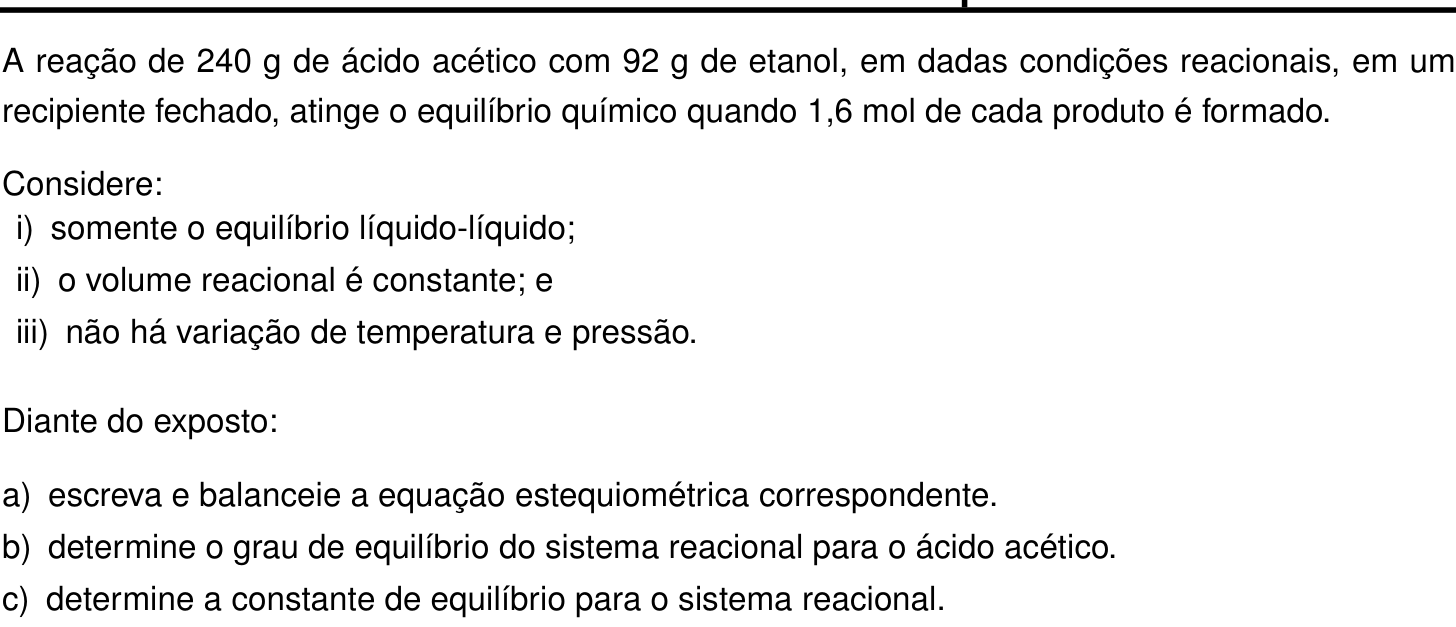
Question: "A reação de 240 g de ácido acético com 92 g de etanol, em dadas condições reacionais, em um recipiente fechado, atinge o equilíbrio químico quando 1,6 mol de cada produto é formado.
Considere:
i) somente o equilíbrio líquido-líquido;
ii) o volume reacional é constante; e
iii) não há variação de temperatura e pressão.
Diante do exposto:
a) escreva e balanceie a equação estequiométrica correspondente.
b) determine o grau de equilíbrio do sistema reacional para o ácido acético.
c) determine a constante de equilíbrio para o sistema reacional."
Need determine equilibrium constant. Need consider liquid-liquid equilibrium? Maybe reaction: acetic acid + ethanol ⇌ ethyl acetate + water. 1:1:1:1. Given 240 g acetic acid, 92 g ethanol. Molar masses: acetic acid CH3COOH = 60 g/mol? 2*12 + 4*1 + 2*16 = 60. Ethanol C2H5OH = 46 g/mol (2*12 +6*1 +16=46). Moles initial: acetic acid = 240/60 = 4 mol. Ethanol = 92/46 = 2 mol. At equilibrium 1.6 mol each product formed: ethyl acetate 1.6 mol, water 1.6 mol. So extent ξ = 1.6 mol. Initial: acid 4, ethanol 2, ester 0, water 0. Equilibrium: acid 4 - 1.6 = 2.4 mol; ethanol 2 - 1.6 = 0.4 mol; ester 1.6; water 1.6.
Degree of equilibrium for acetic acid: conversion/degree α = amount reacted / initial = 1.6 / 4 = 0.4 = 40%. For ethanol = 1.6/2 = 0.8, but asked for acetic acid.
Equilibrium constant. Since liquid-liquid, volume constant, but not given volume. Maybe concentrations? Equilibrium constant K_c = [ester][water]/([acid][ethanol]) in mol/L. Need volume. Maybe can express using moles because volume cancels if all species in same liquid phase? But "somente o equilíbrio líquido-líquido" implies two liquid phases? Hmm maybe in liquid phase reaction with volume constant and no volume data, but K can be calculated from mole fractions or molarities? Since volume same for all species, K_c = (n_ester n_water)/(n_acid n_ethanol) * 1/V? Wait if all in same phase and volume V, concentrations = n_i/V. K_c = ([ester][water])/([acid][ethanol]) = (n_ester/V * n_water/V)/(n_acid/V * n_ethanol/V) = (n_ester n_water)/(n_acid n_ethanol). Volume cancels. So K = (1.6*1.6)/(2.4*0.4) = 2.56 / 0.96 = 2.666... = 8/3? 2.56/(0.96)=256/96=64/24=8/3 ≈ 2.67. However maybe need K_x? Let's verify.
But wait: The reaction of 240 g acetic acid with 92 g ethanol, "em dadas condições reacionais, em um recipiente fechado, atinge o equilíbrio químico quando 1,6 mol de cada produto é formado." Could also involve water not initially? Yes.
But maybe there is a trick: "somente o equilíbrio líquido-líquido" maybe means two liquid phases? Actually esterification equilibrium: acetic acid + ethanol ⇌ ethyl acetate + water. At equilibrium, maybe all liquids? Water and ester partially miscible? But no density/volume? Maybe constant volume. K can be calculated using molar concentrations but volume cancels. But if only liquid-liquid equilibrium and volume constant, maybe equilibrium constant expressed in mole fractions? Let's inspect data: They provided densities of benzene and acetic acid? Wait folha de dados includes cryoscopic constants, melting points, densities of benzene and acetic acid. But question only uses? Maybe maybe the exam has multiple questions; this one may be part of thermochemistry? But given data includes densities, maybe for another question. Here no volume given. K_c from moles if volume constant but not needed. However "o volume reacional é constante" maybe means if volume constant, concentrations proportional to moles. But for K, volume cancels. But maybe they want Kc in terms of mol/L, and maybe we can calculate volume from masses and densities? Let's explore.
Reaction mixture contains acetic acid and ethanol initially, no water/ester. At equilibrium, mixture has acetic acid, ethanol, ethyl acetate, water. The volume is constant? They don't give densities of ethanol, ethyl acetate, water? Only benzene and acetic acid densities. Could maybe use volume of acetic acid? But ethanol density not given. Maybe not intended. The item b "grau de equilíbrio do sistema reacional para o ácido acético" asks degree of equilibrium; maybe "grau de equilíbrio" = extent? Actually "grau de equilíbrio" maybe "degree of equilibrium" maybe conversion? In Portuguese chemistry, "grau de equilíbrio" might be "grau de avanço" (extent) or "grau de conversão"? They ask "para o ácido acético" so likely conversion (α) or "grau de equilíbrio" as fraction reacted? Let's confirm terminology. In equilibrium, "grau de equilíbrio" may be "grau de conversão no equilíbrio" for a reactant. For acetic acid: α = (initial moles - equilibrium moles)/initial = 1.6/4 = 0.4 = 40%. If they ask "grau de equilíbrio do sistema reacional para o ácido acético" maybe "grau de equilíbrio" could be "número de mols que reagiram / número de mols inicial" = 0.4. We'll state.
Part a: equation: CH3COOH + C2H5OH ⇌ CH3COOC2H5 + H2O. Balanced 1:1:1:1. Maybe write molecular: ácido acético + etanol ⇌ acetato de etila + água.
Part c: Kc. Since volume cancels, Kc = [produtos]/[reagentes] = (1.6/V * 1.6/V) / ((2.4/V)*(0.4/V)) = (1.6*1.6)/(2.4*0.4)= 2.56/0.96 = 2.666... = 8/3. But if they expect K = 2.67. Need maybe use concentrations with volume? But no volume. Let's see if any density can determine volume. Initial mixture volume: 240 g acetic acid / 1.05 g/mL = 228.57 mL; ethanol volume = 92 g / 0.789 g/mL = 116.6 mL (density ethanol not given). Not given. Maybe volume of reaction constant maybe not needed. But they included densities of benzene and acetic acid in data. Maybe because other questions use them, not this one. The problem might be from a physical chemistry exam where Kc can be calculated using molar fractions? Hmm.
Let's read exact: "Considere: i) somente o equilíbrio líquido-líquido; ii) o volume reacional é constante; e iii) não há variação de temperatura e pressão." Why mention "somente o equilíbrio líquido-líquido"? Maybe because reaction occurs in liquid phase, no gas phase. "volume reacional constante" means no expansion/contraction? Actually esterification produces water, volume may change, but constant volume? They might want use concentrations. But without volume, impossible. Unless use "grau de equilíbrio" and "constante de equilíbrio" in terms of moles because volume cancels. "líquido-líquido" maybe indicates all species in liquid solution, so activities approximated by molar fractions? But Kc based on molarity with volume constant.
Maybe they expect Kc = (n_ester * n_water)/(n_acid * n_ethanol) because volume cancels, and this is dimensionless? But Kc normally concentration; if volume constant, it's not dimensionless if using molarities? Actually Kc has units? For this reaction, Δn = 0 (2 moles products - 2 moles reactants = 0), so Kc is dimensionless. So volume cancels. Good! Yes because total moles same, Δn=0, so Kc = K_n. So K = 8/3.
Let's ensure stoichiometry: Acetic acid + ethanol -> ethyl acetate + water. Balanced: C2H4O2 + C2H6O -> C4H8O2 + H2O. Coefficients all 1. Products: ethyl acetate (C4H8O2) and water. 1.6 mol each product.
Initial moles: acid = 240g / 60 g/mol = 4 mol. ethanol = 92g / 46 g/mol = 2 mol. At equilibrium: acid = 4 - 1.6 = 2.4 mol; ethanol = 2 - 1.6 = 0.4 mol; ester = 1.6 mol; water = 1.6 mol. Total moles = 2.4+0.4+1.6+1.6 = 6 mol (same as initial 4+2=6? Initial total 6 mol; yes Δn=0). So mole fractions: x_acid = 2.4/6=0.4; x_ethanol=0.4/6=0.0667; x_ester=1.6/6=0.2667; x_water=1.6/6=0.2667. K_x = (0.2667^2)/(0.4*0.0667) = 0.07111/0.02667=2.666. Same. So K = 8/3.
Need final answer: a) CH3COOH + C2H5OH ⇌ CH3COOC2H5 + H2O; b) 0,4 (40%); c) 8/3 ≈ 2,67. Need maybe include "grau de equilíbrio" for acetic acid = 0.4. "constante de equilíbrio" Kc = 8/3. Should show development in Portuguese. Let's craft final with steps.
But let's double-check if part b asks "grau de equilíbrio do sistema reacional para o ácido acético" maybe "grau de equilíbrio" could mean "grau de avanço" ξ = 1.6 mol? In Portuguese "grau de equilíbrio" sometimes "grau de conversão" but "para o ácido acético" indicates conversion. However in equilibrium, "grau de equilíbrio" maybe "α" (fraction dissociated/reacted). Let's search memory: In Portuguese chemistry, "grau de equilíbrio" is "grau de conversão no equilíbrio" or "fração em mols que reagiu". For example, if 1 mol initial and 0.5 reacts, α = 0.5. So b = 0.4 or 40%. Could also be "grau de equilíbrio" = "quociente de reação"? No, "grau de equilíbrio" maybe "extent of reaction" (grau de avanço) = 1.6 mol. But "para o ácido acético" maybe "grau de equilíbrio" as "número de mols de ácido que reagiram por mol inicial" = 0.4. The term "grau de equilíbrio" is sometimes used as "grau de conversão no equilíbrio". Let's see if they ask "determine o grau de equilíbrio do sistema reacional para o ácido acético." They might want "α = 1,6/4 = 0,4 ou 40%". I'll state as conversion and maybe also mention extent if needed? But final answer format short.
Potential issue: The equation might be written as:
CH3COOH + C2H5OH ⇌ CH3COOC2H5 + H2O
or using formulas: HAc + EtOH ⇌ AcOEt + H2O. Good.
Let's compute Kc precisely:
Kc = [CH3COOC2H5][H2O]/([CH3COOH][C2H5OH]).
At equilibrium:
n_HAc = 4 - 1.6 = 2.4 mol
n_EtOH = 2 - 1.6 = 0.4 mol
n_AcOEt = 1.6 mol
n_H2O = 1.6 mol
Since volume constant, Kc = (1.6*1.6)/(2.4*0.4) = 2.56/0.96 = 2.6667 = 8/3.
Let's consider if water produced may not be in same phase? "somente equilíbrio líquido-líquido" maybe two liquid phases, water and ester phase? If phases separate, equilibrium constant for reaction in each phase? But likely all in one liquid phase? Actually esterification is often biphasic? Water and ethyl acetate partially miscible; ethanol and acetic acid soluble. But problem states "somente o equilíbrio líquido-líquido" maybe there are two liquid phases (aqueous and organic). Then the equilibrium constant for the reaction in the organic phase? But not enough info. Wait "somente o equilíbrio líquido-líquido" might mean "consider only liquid-liquid equilibrium" as opposed to vapor-liquid? Maybe no gas phase, so all species in liquid phase. It might be a trick: Since volume constant, concentrations = moles/V, but if two liquid phases, total volume constant? The reaction occurs in liquid phase; no gas. Kc may still be based on total volume if all species in same phase? But if phase split, each species distributes; but they didn't provide partition coefficients, so assume single liquid phase. So Kc = 8/3.
Need maybe mention "Como Δn = 0, o volume não influencia no valor de Kc." Good.
Let's formulate final with item-by-item.
Potential final:
a) CH3COOH + C2H5OH ⇌ CH3COOC2H5 + H2O
b) n(ácido acético) inicial = 240/60 = 4 mol. Reagiram 1,6 mol. Grau de equilíbrio α = 1,6/4 = 0,40 = 40%.
c) No equilíbrio: n(ácido) = 4 - 1,6 = 2,4 mol; n(etanol) = 92/46 - 1,6 = 2 - 1,6 = 0,4 mol; n(acetato) = n(água) = 1,6 mol. Como V constante:
Kc = [CH3COOC2H5][H2O]/([CH3COOH][C2H5OH]) = (1,6/V * 1,6/V)/(2,4/V * 0,4/V) = (1,6*1,6)/(2,4*0,4) = 8/3 ≈ 2,67.
Resposta final: a) CH3COOH + C2H5OH ⇌ CH3COOC2H5 + H2O; b) 0,40 (40%); c) 8/3 ≈ 2,67.
Need ensure final line exactly "Resposta final: ..." with each item. Good.
But let's think if there is any other interpretation: "grau de equilíbrio do sistema reacional para o ácido acético" could be "grau de equilíbrio" = "número de mols de ácido acético que reagiram no equilíbrio" maybe 1.6 mol? In some contexts "grau de equilíbrio" is "quantidade de matéria que reagiu até o equilíbrio" (extent) not conversion. Let's check Portuguese terminology: "grau de equilíbrio" may be "grau de avanço da reação" (extent of reaction) denoted ξ (xi) measured in mol. However, "para o ácido acético" would then be "1,6 mol" because for each mole of reaction, 1 mol acid consumed. They might ask "determine o grau de equilíbrio do sistema reacional para o ácido acético" meaning "the degree of equilibrium (advancement) for acetic acid" = 1.6 mol. But "grau de equilíbrio" often "α" for a reactant? Let's search memory: In Portuguese, "grau de equilíbrio" is not common; "grau de conversão" is α. "Grau de avanço" is ξ. "Grau de equilíbrio" maybe "grau de dissociação" etc. The problem might be translated from "degree of equilibrium"? Hmm.
Let's read item b: "determine o grau de equilíbrio do sistema reacional para o ácido acético." It says "para o ácido acético" not "da reação". "Grau de equilíbrio" maybe "α" for that reactant. If they wanted extent, they'd say "grau de avanço". Also "grau de equilíbrio" in Brazilian textbooks? In chemical equilibrium, "grau de equilíbrio" is sometimes defined as the fraction of reactant that reacted: α = quantidade que reagiu / quantidade inicial. Example: "Grau de equilíbrio (α) de uma reação" maybe. The phrase "para o ácido acético" strongly indicates per acetic acid conversion. So b = 0.4.
Let's see if there is a possibility: The reaction is reversible and "1,6 mol de cada produto é formado" means at equilibrium, 1.6 mol of each product. Since stoichiometry 1:1:1:1, the amount of acetic acid consumed is 1.6 mol. Initial acetic acid = 4 mol. Degree of equilibrium = consumed/initial = 0.4. Good.
Let's also consider if "grau de equilíbrio do sistema reacional" might be "grau de equilíbrio" = "K"?? No, c asks constant. So b is conversion.
Now final answer with explanation in Portuguese. Need maybe include "como o volume é constante, as concentrações são proporcionais ao número de mols; como Δn=0, o volume cancela." Good.
Let's write final in desired format.
a) Equação balanceada:
\mathrm{CH_3COOH + C_2H_5OH \rightleftharpoons CH_3COOC_2H_5 + H_2O}
b) Cálculo do grau de equilíbrio para o ácido acético:
n_{\text{ácido acético inicial}}=\frac{240}{60}=4\ \text{mol}
Foram consumidos 1,6\ \text{mol} de ácido acético.
\alpha=\frac{1,6}{4}=0,40=40\%
c) No equilíbrio:
n_{\text{ácido acético}}=4-1,6=2,4\ \text{mol}
n_{\text{etanol}}=\frac{92}{46}-1,6=2-1,6=0,4\ \text{mol}
n_{\text{acetato de etila}}=1,6\ \text{mol},\qquad n_{\text{água}}=1,6\ \text{mol}
Como o volume é constante, a constante de equilíbrio em concentrações é:
K_c=\frac{[\mathrm{CH_3COOC_2H_5}][\mathrm{H_2O}]}{[\mathrm{CH_3COOH}][\mathrm{C_2H_5OH}]}
K_c=\frac{\left(\frac{1,6}{V}\right)\left(\frac{1,6}{V}\right)}
{\left(\frac{2,4}{V}\right)\left(\frac{0,4}{V}\right)}
=\frac{1,6\cdot 1,6}{2,4\cdot 0,4}
=\frac{2,56}{0,96}
=\frac{8}{3}\approx 2,67
Resposta final: a) \mathrm{CH_3COOH + C_2H_5OH \rightleftharpoons CH_3COOC_2H_5 + H_2O}; b) 0,40 ou 40\%; c) K_c=\frac{8}{3}\approx 2,67.
Respondeu · bate com a resposta de referência dos cursinhos
a) \text{CH}_3\text{COOH}_{(l)} + \text{C}_2\text{H}_5\text{OH}_{(l)} \rightleftharpoons \text{CH}_3\text{COOC}_2\text{H}_5_{(l)} + \text{H}_2\text{O}_{(l)}; b) 0,40 (ou 40%); c) 8/3 (ou aproximadamente 2,67)
levou 30 s
Como pensou
**Analyzing Equilibrium Conditions**
My current focus is on dissecting the chemical equilibrium scenario presented by the IME 2027 Chemistry exam. I'm evaluating the initial quantities of acetic acid and ethanol to determine how they will influence the equilibrium state of the esterification reaction.
**Calculating Initial Moles**
I've calculated the initial moles of acetic acid from the given mass, finding it to be 4 mol. The molar mass calculation for acetic acid is complete.
**Determining Stoichiometry**
I'm now working on writing and balancing the stoichiometric equation for the esterification reaction, which is the next step in analyzing the equilibrium.
**Confirming Reactant Moles**
I've confirmed my calculation for the initial moles of ethanol, determining it to be 2 mol based on the provided mass and calculated molar mass. The balanced esterification reaction equation has also been established.
**Calculating Equilibrium Moles**
I've completed the equilibrium mole calculations for all species, determining 2.4 mol of acetic acid, 0.4 mol of ethanol, 1.6 mol of ethyl acetate, and 1.6 mol of water.
**Deriving Kc Expression**
Given the constant volume and the nature of the homogeneous liquid-phase reaction, the volume terms cancel out in the Kc expression.
**Evaluating Equilibrium Constant**
I am now calculating the numerical value of Kc using the equilibrium mole quantities derived earlier.
**Calculating Equilibrium Constant**
I have successfully calculated the numerical value of Kc to be approximately 2.67. I am now focusing on determining the equilibrium conversion for acetic acid, which I will express as a fraction.
**Calculating Conversion Fraction**
I am currently calculating the equilibrium conversion for acetic acid. This involves determining the fraction of the initial moles of acetic acid that have reacted by the time equilibrium is reached, which appears to be 0.4.
**Confirming Conversion Calculation**
I've confirmed the equilibrium conversion for acetic acid, which is indeed 0.4 or 40%. I've also double-checked the molar masses using the provided periodic table data, finding the calculations for initial moles remain consistent. The balanced reaction is also confirmed.
**Verifying Equilibrium Calculations**
I am now verifying the equilibrium mole calculations using the balanced reaction and the previously determined Kc value. This step aims to confirm consistency across all calculated equilibrium parameters.
**Revising Kc Calculation**
I'm re-examining the Kc calculation, specifically the division $2.56 / 0.96$. I've simplified this fraction and found it to be precisely $8/3$, confirming the numerical value of approximately 2.67.
Para a resolução da questão, consideramos as massas molares aproximadas dos reagentes:
- Ácido acético (\text{CH}_3\text{COOH}): M = 2 \times 12 + 4 \times 1 + 2 \times 16 = 60\text{ g}\cdot\text{mol}^{-1}
- Etanol (\text{C}_2\text{H}_5\text{OH}): M = 2 \times 12 + 6 \times 1 + 1 \times 16 = 46\text{ g}\cdot\text{mol}^{-1}
Quantidades iniciais de matéria:
- Ácido acético: n_0(\text{ácido}) = \dfrac{240\text{ g}}{60\text{ g}\cdot\text{mol}^{-1}} = 4,0\text{ mol}
- Etanol: n_0(\text{etanol}) = \dfrac{92\text{ g}}{46\text{ g}\cdot\text{mol}^{-1}} = 2,0\text{ mol}
a) Equação estequiométrica balanceada
A reação entre o ácido acético e o etanol é uma esterificação (equilíbrio em fase líquida homogênea), que produz etanoato de etila (acetato de etila) e água:
\text{CH}_3\text{COOH}_{(l)} + \text{C}_2\text{H}_5\text{OH}_{(l)} \rightleftharpoons \text{CH}_3\text{COOC}_2\text{H}_5_{(l)} + \text{H}_2\text{O}_{(l)}
b) Grau de equilíbrio (\alpha) para o ácido acético
O grau de equilíbrio (grau de conversão no equilíbrio) para um dado reagente é definido como a razão entre a quantidade de matéria que reagiu até o equilíbrio e a sua quantidade de matéria inicial:
\alpha = \frac{n_{\text{reagido}}}{n_0}
Pela estequiometria 1:1, a formação de 1,6\text{ mol} de cada produto implica que foram consumidos 1,6\text{ mol} de ácido acético:
\alpha_{\text{ácido}} = \frac{1,6\text{ mol}}{4,0\text{ mol}} = 0,40 \quad (\text{ou } 40\%)
c) Constante de equilíbrio (K_c)
Montando a tabela de quantidades de matéria (em mol):
\begin{array}{lccccc}
& \text{CH}_3\text{COOH} & + & \text{C}_2\text{H}_5\text{OH} & \rightleftharpoons & \text{CH}_3\text{COOC}_2\text{H}_5 & + & \text{H}_2\text{O} \\
\hline
\text{Início} & 4,0 & & 2,0 & & 0 & & 0 \\
\text{Reage / Forma} & -1,6 & & -1,6 & & +1,6 & & +1,6 \\
\text{Equilíbrio} & 2,4 & & 0,4 & & 1,6 & & 1,6 \\
\end{array}
Por se tratar de um equilíbrio líquido homogêneo, a água participa da expressão da constante de equilíbrio. Sendo V o volume constante da mistura reacional:
K_c = \frac{[\text{CH}_3\text{COOC}_2\text{H}_5] \cdot [\text{H}_2\text{O}]}{[\text{CH}_3\text{COOH}] \cdot [\text{C}_2\text{H}_5\text{OH}]} = \frac{\left(\dfrac{1,6}{V}\right) \cdot \left(\dfrac{1,6}{V}\right)}{\left(\dfrac{2,4}{V}\right) \cdot \left(\dfrac{0,4}{V}\right)}
Cancelando o volume V:
K_c = \frac{1,6 \times 1,6}{2,4 \times 0,4} = \frac{2,56}{0,96} = \frac{8}{3} \approx 2,67
Resposta final: a) \text{CH}_3\text{COOH}_{(l)} + \text{C}_2\text{H}_5\text{OH}_{(l)} \rightleftharpoons \text{CH}_3\text{COOC}_2\text{H}_5_{(l)} + \text{H}_2\text{O}_{(l)}; b) 0,40 (ou 40%); c) 8/3 (ou aproximadamente 2,67)
Respondeu · bate com a resposta de referência dos cursinhos
a) CH3COOH(l) + CH3CH2OH(l) ⇌ CH3COOCH2CH3(l) + H2O(l); b) 0,40 (ou 40%); c) 8/3 (ou 2,67)
levou 37 s
Como pensou
**Analyzing Chemistry Problem**
I am currently processing the specifics of a chemistry problem from the IME 2027 2nd phase exam. My immediate focus is on dissecting the reaction involving acetic acid and ethanol, ensuring I grasp all quantitative details presented in the prompt.
**Formulating Reaction Equation**
I'm currently working on formulating the balanced stoichiometric equation for the esterification reaction between acetic acid and ethanol. My immediate goal is to represent this liquid-liquid equilibrium accurately.
**Calculating Equilibrium Moles**
I'm now calculating the initial moles for acetic acid and ethanol. I've determined their molar masses and used the provided masses to find the starting quantities, setting up the foundation for the ICE table.
**Calculating Degree of Equilibrium**
I have now calculated the moles of reactants and products at equilibrium based on the information that 1.6 mol of each product was formed. This allowed me to determine the degree of equilibrium for acetic acid, which is 0.40 or 40%.
**Determining Equilibrium Constant**
I am now focusing on determining the equilibrium constant, $K_c$, for the reaction. I recognize that all four species are involved in this homogeneous liquid-liquid equilibrium, and I will proceed with calculating $K_c$.
**Verifying Equilibrium Constant**
I am now confirming the inclusion of water in the $K_c$ expression for this esterification, as is standard for non-aqueous conditions. My calculations align with the expected $K_c = 4$, and the cancellation of volume ($V$) confirms its irrelevance to the result.
a) A reação entre o ácido acético (ácido etanoico) e o etanol é uma reação de esterificação, que produz acetato de etila (etanoato de etila) e água. Considerando que o sistema encontra-se em equilíbrio líquido-líquido, a equação química balanceada é:
\text{CH}_3\text{COOH}_{(l)} + \text{CH}_3\text{CH}_2\text{OH}_{(l)} \rightleftharpoons \text{CH}_3\text{COOCH}_2\text{CH}_{3(l)} + \text{H}_2\text{O}_{(l)}
b) Pelos dados da Tabela Periódica, calculam-se as massas molares dos reagentes (\text{H} = 1\text{ g}\cdot\text{mol}^{-1}; \text{C} = 12\text{ g}\cdot\text{mol}^{-1}; \text{O} = 16\text{ g}\cdot\text{mol}^{-1}):
- Ácido acético (\text{C}_2\text{H}_4\text{O}_2): M = 2 \times 12 + 4 \times 1 + 2 \times 16 = 60\text{ g}\cdot\text{mol}^{-1}
- Etanol (\text{C}_2\text{H}_6\text{O}): M = 2 \times 12 + 6 \times 1 + 1 \times 16 = 46\text{ g}\cdot\text{mol}^{-1}
Calculando o número de mols iniciais (n_0) de cada reagente:
n_0(\text{CH}_3\text{COOH}) = \frac{240\text{ g}}{60\text{ g}\cdot\text{mol}^{-1}} = 4,0\text{ mol}
n_0(\text{CH}_3\text{CH}_2\text{OH}) = \frac{92\text{ g}}{46\text{ g}\cdot\text{mol}^{-1}} = 2,0\text{ mol}
Pela proporção estequiométrica de 1:1:1:1, para a formação de 1,6\text{ mol} de cada produto no equilíbrio, devem reagir 1,6\text{ mol} de ácido acético e 1,6\text{ mol} de etanol.
O grau de equilíbrio (\alpha) para o ácido acético é dado pela razão entre a quantidade de matéria que reagiu e a quantidade de matéria inicial desse reagente:
\alpha = \frac{n_{\text{reagiu}}}{n_0} = \frac{1,6\text{ mol}}{4,0\text{ mol}} = 0,40 \text{ (ou } 40\%)
c) Montando o quadro de equilíbrio em termos do número de mols:
|
\text{CH}_3\text{COOH}_{(l)} |
+ |
\text{CH}_3\text{CH}_2\text{OH}_{(l)} |
\rightleftharpoons |
\text{CH}_3\text{COOCH}_2\text{CH}_{3(l)} |
+ |
\text{H}_2\text{O}_{(l)} |
| Início (mol) |
4,0 |
|
2,0 |
|
0 |
|
0 |
| Reage / Forma (mol) |
-1,6 |
|
-1,6 |
|
+1,6 |
|
+1,6 |
| Equilíbrio (mol) |
2,4 |
|
0,4 |
|
1,6 |
|
1,6 |
Como se trata de uma mistura líquida homogênea em que a água não atua como solvente em excesso, mas sim como produto em quantidade estequiométrica, todas as espécies entram na expressão da constante de equilíbrio (K_c). Sendo V o volume reacional constante:
K_c = \frac{[\text{CH}_3\text{COOCH}_2\text{CH}_3]\cdot[\text{H}_2\text{O}]}{[\text{CH}_3\text{COOH}]\cdot[\text{CH}_3\text{CH}_2\text{OH}]} = \frac{\left(\frac{1,6}{V}\right)\cdot\left(\frac{1,6}{V}\right)}{\left(\frac{2,4}{V}\right)\cdot\left(\frac{0,4}{V}\right)}
K_c = \frac{1,6 \times 1,6}{2,4 \times 0,4} = \frac{2,56}{0,96} = \frac{8}{3} \approx 2,67
Resposta final: a) CH3COOH(l) + CH3CH2OH(l) ⇌ CH3COOCH2CH3(l) + H2O(l); b) 0,40 (ou 40%); c) 8/3 (ou 2,67)