Correção IME 2027 · QuímicaAcompanhe a resolução de cada questão da 2ª fase, ao vivoAcompanhar
IA ao vivo / IME 2027 · 2ª fase · Química

COMPARE OS RACIOCÍNIOS

Questão 3 (Química)

Questão discursiva: a banca não divulga gabarito oficial. ← 2 (Química) 4 (Química) →

A questão

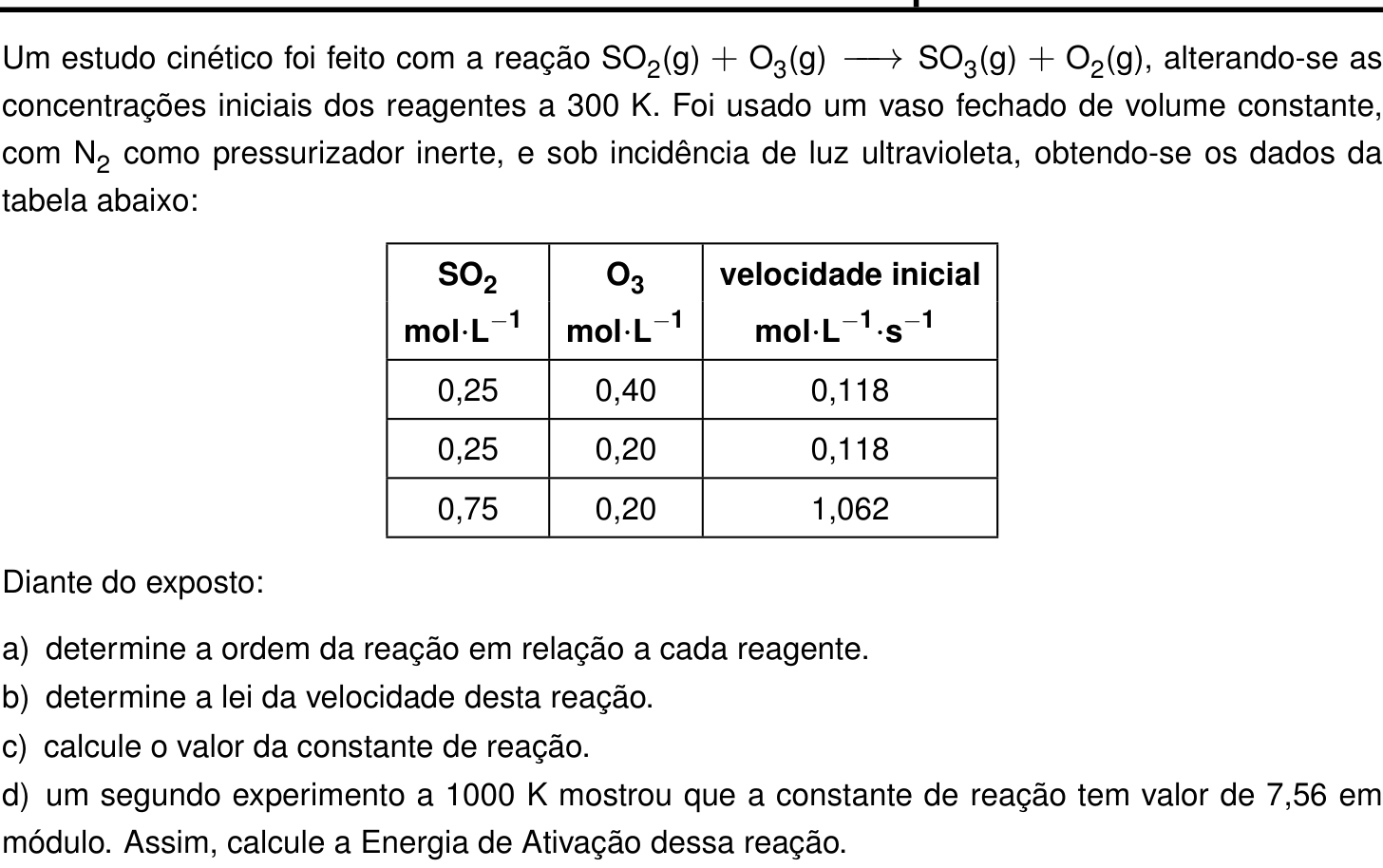
Texto de apoio da questão 3 (Química) Questão 3 (Química)

Resposta de referência

a) Ordem 2 em relação ao \mathrm{SO_2} e ordem 0 em relação ao \mathrm{O_3}. b) v=k[\mathrm{SO_2}]^2. c) k=1{,}888\ \mathrm{L\,mol^{-1}\,s^{-1}}. d) E_a\approx4{,}93\ \mathrm{kJ\,mol^{-1}}.

Segundo a resolução dos cursinhos Farias Brito e Poliedro. A banca não publica gabarito das questões discursivas.

Respostas das IAs

GPT-6 Astra

Respondeu · bate com a resposta de referência dos cursinhos

a) SO₂: ordem 2; O₃: ordem 0; b) v=k[\mathrm{SO_2}]^2; c) 1{,}888\ \mathrm{L\,mol^{-1}\,s^{-1}}; d) 4{,}93\ \mathrm{kJ\,mol^{-1}}.

levou 14 s

Como pensou

a) Ordens em relação aos reagentes

Considere a lei de velocidade:

v=k[\mathrm{SO_2}]^m[\mathrm{O_3}]^n.

Comparando os dois primeiros experimentos, a concentração de \mathrm{SO_2} permanece constante, enquanto a de \mathrm{O_3} é reduzida à metade, sem alteração da velocidade:

\frac{0{,}118}{0{,}118} =\left(\frac{0{,}20}{0{,}40}\right)^n \Rightarrow 1=\left(\frac12\right)^n \Rightarrow \boxed{n=0}.

Comparando o segundo e o terceiro experimentos, a concentração de \mathrm{O_3} permanece constante:

\frac{1{,}062}{0{,}118} =\left(\frac{0{,}75}{0{,}25}\right)^m \Rightarrow 9=3^m \Rightarrow \boxed{m=2}.

Portanto, a reação é de segunda ordem em relação ao \mathrm{SO_2} e de ordem zero em relação ao \mathrm{O_3}.

b) Lei de velocidade

Substituindo as ordens determinadas:

\boxed{v=k[\mathrm{SO_2}]^2}.

c) Constante de velocidade a 300\ \mathrm{K}

Usando os dados do primeiro experimento:

k=\frac{v}{[\mathrm{SO_2}]^2} =\frac{0{,}118}{(0{,}25)^2} =\frac{0{,}118}{0{,}0625}.

Como a ordem global é 2, a unidade de k é:

[k]=\frac{\mathrm{mol\,L^{-1}\,s^{-1}}}{(\mathrm{mol\,L^{-1}})^2} =\mathrm{L\,mol^{-1}\,s^{-1}}.

Logo,

\boxed{k_{300}=1{,}888\ \mathrm{L\,mol^{-1}\,s^{-1}}}.

d) Energia de ativação

Pela equação de Arrhenius, aplicada às duas temperaturas:

\ln\left(\frac{k_2}{k_1}\right) =\frac{E_a}{R}\left(\frac1{T_1}-\frac1{T_2}\right).

Como

\frac{k_2}{k_1}=\frac{7{,}56}{1{,}888}\approx4,

temos:

\ln\left(\frac{k_2}{k_1}\right)\approx\ln4=2\ln2=1{,}386.

Assim, utilizando R=8{,}3\ \mathrm{J\,mol^{-1}\,K^{-1}}:

E_a= \frac{8{,}3\cdot1{,}386} {\frac1{300}-\frac1{1000}} = \frac{8{,}3\cdot1{,}386}{\frac7{3000}} \approx4{,}93\times10^3\ \mathrm{J\,mol^{-1}}.

Portanto,

\boxed{E_a\approx4{,}93\ \mathrm{kJ\,mol^{-1}}}.

Resposta final: a) SO₂: ordem 2; O₃: ordem 0; b) v=k[\mathrm{SO_2}]^2; c) 1{,}888\ \mathrm{L\,mol^{-1}\,s^{-1}}; d) 4{,}93\ \mathrm{kJ\,mol^{-1}}.

GPT-6.1 Sol

Respondeu · bate com a resposta de referência dos cursinhos

a) SO₂: 2ª ordem; O₃: ordem zero; b) v=k[\mathrm{SO_2}]^2; c) k_{300}=1{,}888\ \mathrm{L\,mol^{-1}\,s^{-1}}; d) E_a\approx4{,}93\ \mathrm{kJ\,mol^{-1}}.

levou 15 s

Como pensou

a) Ordens de reação

Considere a lei de velocidade:

v=k[\mathrm{SO_2}]^m[\mathrm{O_3}]^n.

Comparando os dois primeiros experimentos, a concentração de \mathrm{SO_2} é constante e a de \mathrm{O_3} cai à metade, sem alterar a velocidade:

\frac{0{,}118}{0{,}118} =\left(\frac{0{,}20}{0{,}40}\right)^n \Rightarrow 1=\left(\frac12\right)^n \Rightarrow \boxed{n=0}.

Comparando o terceiro experimento com o segundo:

\frac{1{,}062}{0{,}118} =\left(\frac{0{,}75}{0{,}25}\right)^m \Rightarrow 9=3^m \Rightarrow \boxed{m=2}.

Logo, a reação é de segunda ordem em relação ao \mathrm{SO_2} e de ordem zero em relação ao \mathrm{O_3}.

b) Lei de velocidade

Substituindo as ordens determinadas:

\boxed{v=k[\mathrm{SO_2}]^2}.

c) Constante de velocidade a 300 K

Usando os dados do primeiro experimento:

k=\frac{v}{[\mathrm{SO_2}]^2} =\frac{0{,}118}{(0{,}25)^2} =1{,}888\ \mathrm{L\,mol^{-1}\,s^{-1}}.

Portanto,

\boxed{k_{300}\approx1{,}89\ \mathrm{L\,mol^{-1}\,s^{-1}}}.

d) Energia de ativação

Pela equação de Arrhenius, aplicada às duas temperaturas:

\ln\left(\frac{k_2}{k_1}\right) =\frac{E_a}{R}\left(\frac1{T_1}-\frac1{T_2}\right).

Como

\frac{k_2}{k_1}=\frac{7{,}56}{1{,}888}\approx4 \quad\text{e}\quad \ln4=2\ln2\approx1{,}386,

temos:

E_a= \frac{8{,}3\cdot1{,}386} {\frac1{300}-\frac1{1000}} =\frac{8{,}3\cdot1{,}386}{\frac7{3000}} \approx4{,}93\times10^3\ \mathrm{J\,mol^{-1}}.

Assim,

\boxed{E_a\approx4{,}93\ \mathrm{kJ\,mol^{-1}}}.

Resposta final: a) SO₂: 2ª ordem; O₃: ordem zero; b) v=k[\mathrm{SO_2}]^2; c) k_{300}=1{,}888\ \mathrm{L\,mol^{-1}\,s^{-1}}; d) E_a\approx4{,}93\ \mathrm{kJ\,mol^{-1}}.

GPT-6.1 Terra

Respondeu · bate com a resposta de referência dos cursinhos

a) 2ª ordem em SO₂ e ordem zero em O₃; b) v=k[\mathrm{SO_2}]^2; c) k=1{,}89\ \mathrm{L\,mol^{-1}\,s^{-1}}; d) E_a\approx4{,}93\ \mathrm{kJ\,mol^{-1}}.

levou 14 s

Como pensou
**Calculating logarithmic values** I'm determining the value of ln(4.0042) using the approximation ln(2) ≈ 0.693. I calculate ln(4.0042) as 1.386 plus 0.00106, which gives me approximately 1.38706. For a value of Ea equal to 4934.4, I’m finding that logs relate, so I've arrived at k ≈ 1.89 with a value of 4.93. This feels like a clear path to reach my answer, though I still want to double-check my calculations!

a) Admitindo v=k[\mathrm{SO_2}]^m[\mathrm{O_3}]^n, comparamos os dois primeiros experimentos: a concentração de \mathrm{O_3} diminui à metade, mas a velocidade não muda. Logo, n=0.

Comparando o segundo e o terceiro experimentos, [\mathrm{SO_2}] triplica e a velocidade aumenta por um fator de 9. Assim, 3^m=9, ou seja, m=2.

b) A lei de velocidade é

v=k[\mathrm{SO_2}]^2.

c) A 300 K, usando o primeiro experimento:

k=\frac{0{,}118}{(0{,}25)^2} =1{,}888\approx1{,}89\ \mathrm{L\,mol^{-1}\,s^{-1}}.

d) Pela equação de Arrhenius, supondo o mesmo regime cinético nos dois experimentos,

\ln\frac{k_2}{k_1} =\frac{E_a}{R}\left(\frac1{T_1}-\frac1{T_2}\right).

Com k_1\approx1{,}89, k_2=7{,}56, T_1=300\ \mathrm K e T_2=1000\ \mathrm K:

E_a=\frac{8{,}3\ln(7{,}56/1{,}89)}{1/300-1/1000} =\frac{8{,}3(2\times0{,}693)}{7/3000} \approx4{,}93\ \mathrm{kJ\,mol^{-1}}.

Resposta final: a) 2ª ordem em SO₂ e ordem zero em O₃; b) v=k[\mathrm{SO_2}]^2; c) k=1{,}89\ \mathrm{L\,mol^{-1}\,s^{-1}}; d) E_a\approx4{,}93\ \mathrm{kJ\,mol^{-1}}.

GPT-6 Luna

Respondeu · bate com a resposta de referência dos cursinhos

a) ordem 2 em relação a SO_2 e 0 em relação a O_3; b) v=k[SO_2]^2; c) k=1{,}888\ \mathrm{L\,mol^{-1}\,s^{-1}}; d) E_a\approx4{,}93\ \mathrm{kJ\,mol^{-1}}

levou 11 s

Como pensou

a) Ordem em relação a cada reagente

Comparando os experimentos 1 e 2, a concentração de SO_2 permanece constante e a de O_3 cai pela metade, mas a velocidade não se altera. Logo, a ordem em relação ao O_3 é zero.

Comparando os experimentos 2 e 3, [O_3] permanece constante e [SO_2] é triplicada. A velocidade aumenta de 0{,}118 para 1{,}062\ \mathrm{mol\,L^{-1}\,s^{-1}}, ou seja, aumenta 9 vezes. Portanto, 3^m=9, e a ordem em relação ao SO_2 é 2.

b) Lei da velocidade

v=k[SO_2]^2[O_3]^0=k[SO_2]^2

c) Constante de reação

Usando o primeiro experimento:

k=\frac{v}{[SO_2]^2} =\frac{0{,}118}{(0{,}25)^2} =1{,}888\ \mathrm{L\,mol^{-1}\,s^{-1}}

d) Energia de ativação

Pela equação de Arrhenius, para T_1=300\ \mathrm K e T_2=1000\ \mathrm K:

\ln\left(\frac{k_2}{k_1}\right) =\frac{E_a}{R}\left(\frac{1}{T_1}-\frac{1}{T_2}\right)

Como k_2/k_1=7{,}56/1{,}888\approx4, então \ln(k_2/k_1)\approx\ln4=2\ln2=1{,}386. Assim,

E_a= \frac{(8{,}3)(1{,}386)} {\frac{1}{300}-\frac{1}{1000}} \approx 4{,}93\times10^3\ \mathrm{J\,mol^{-1}} =4{,}93\ \mathrm{kJ\,mol^{-1}}

Resposta final: a) ordem 2 em relação a SO_2 e 0 em relação a O_3; b) v=k[SO_2]^2; c) k=1{,}888\ \mathrm{L\,mol^{-1}\,s^{-1}}; d) E_a\approx4{,}93\ \mathrm{kJ\,mol^{-1}}

Claude Fable 5.1

Respondeu · bate com a resposta de referência dos cursinhos

a) ordem 2 em SO₂ e ordem 0 em O₃; b) v = k[SO₂]²; c) k ≈ 1,89 L·mol⁻¹·s⁻¹; d) Ea ≈ 4,93 kJ/mol (≈ 4930 J/mol)

levou 12 s

Como pensou
Comparing experiments 1 and 2, SO2 stays constant while O3 doubles with no rate change, so the reaction is zero order in O3. Between experiments 2 and 3, SO2 triples and the rate increases ninefold, giving second order in SO2, so the rate law is v = k[SO2]². Using the data, I calculate k = 0,118/(0,25)² = 1,888 L·mol⁻¹·s⁻¹, and now I'm moving on to part d. For activation energy, applying Arrhenius' equation with k2/k1 ≈ 4 gives ln 4 = 1,386, and with 1/300 − 1/1000 = 7/3000, I solve for Ea = 1,386 × 8,3 × 3000/7 ≈ 4930 J/mol, or about 4,93 kJ/mol.

a) Ordem em relação a cada reagente

Comparando os experimentos 1 e 2: [SO₂] constante (0,25), [O₃] cai de 0,40 para 0,20 (metade) e a velocidade não muda (0,118).
→ ordem zero em relação ao O₃.

Comparando os experimentos 2 e 3: [O₃] constante (0,20), [SO₂] triplica (0,25 → 0,75) e a velocidade vai de 0,118 para 1,062:

1,062 / 0,118 = 9 = 3ⁿ → n = 2
→ ordem 2 em relação ao SO₂.

b) Lei de velocidade

v = k·[SO₂]²·[O₃]⁰ = k·[SO₂]² (reação de 2ª ordem global)

c) Constante de velocidade (300 K)

Do experimento 1: 0,118 = k·(0,25)²
k = 0,118 / 0,0625 = 1,888 L·mol⁻¹·s⁻¹ ≈ 1,89 L·mol⁻¹·s⁻¹

d) Energia de ativação (Arrhenius)

ln(k₂/k₁) = (Ea/R)·(1/T₁ − 1/T₂)

k₂/k₁ = 7,56 / 1,888 ≈ 4 → ln 4 = 2·ln 2 = 2(0,693) = 1,386

1/300 − 1/1000 = (10 − 3)/3000 = 7/3000 K⁻¹

Ea = R · ln(k₂/k₁) / (1/T₁ − 1/T₂) = 8,3 × 1,386 × 3000/7
Ea = 11,504 × 428,6 ≈ 4930 J/mol ≈ 4,93 kJ/mol

Resposta final: a) ordem 2 em SO₂ e ordem 0 em O₃; b) v = k[SO₂]²; c) k ≈ 1,89 L·mol⁻¹·s⁻¹; d) Ea ≈ 4,93 kJ/mol (≈ 4930 J/mol)

Claude Opus 5.5

Respondeu · bate com a resposta de referência dos cursinhos

a) ordem 2 em SO₂ e ordem 0 em O₃; b) v = k[SO₂]²; c) k ≈ 1,89 L·mol⁻¹·s⁻¹; d) Eₐ ≈ 4,93 kJ·mol⁻¹

levou 26 s

Como pensou
Comparing experiments 1 and 2 shows the rate stays constant when O3 is halved, meaning the reaction is zero order in O3. Moving from experiment 2 to 3, tripling SO2 increases the rate ninefold, confirming second order in SO2, so the rate law is v = k[SO2]^2 with k ≈ 1.888 L mol⁻¹ s⁻¹. For part d, the ratio of rate constants (7.56/1.888) comes out to about 4, and taking the natural log gives exactly 1. Using the Arrhenius equation, Ea = R·ln(k2/k1)/(1/T1 - 1/T2), I plug in the numbers: 8.3 × 1.386 divided by (1/300 - 1/1000), which simplifies to 7/3000 in the denominator. This works out to roughly 4930 J/mol, or about 4.93 kJ/mol.

a) Ordem em relação a cada reagente

Comparando os experimentos 1 e 2, [SO₂] fica constante e [O₃] cai à metade (0,40 → 0,20). A velocidade não muda (0,118 → 0,118). Logo:

(1/2)ᵇ = 1 ⇒ b = 0, ordem zero em O₃.

Comparando os experimentos 2 e 3, [O₃] fica constante e [SO₂] triplica (0,25 → 0,75). A velocidade passa de 0,118 para 1,062, ou seja, 1,062/0,118 = 9 vezes. Logo:

3ᵃ = 9 ⇒ a = 2, segunda ordem em SO₂.

b) Lei de velocidade

v = k·[SO₂]²·[O₃]⁰ = k·[SO₂]²

A ordem global é 2.

c) Constante de velocidade a 300 K

Pelo experimento 1:

k = v/[SO₂]² = 0,118/(0,25)² = 0,118/0,0625 ≈ 1,89 L·mol⁻¹·s⁻¹

d) Energia de ativação

Pela equação de Arrhenius com duas temperaturas:

ln(k₂/k₁) = (Eₐ/R)·(1/T₁ − 1/T₂)

A razão entre as constantes é k₂/k₁ = 7,56/1,888 ≈ 4, então ln 4 = 2·ln 2 = 1,386.

O termo de temperatura é 1/300 − 1/1000 = 7/3000 K⁻¹.

Daí:

Eₐ = R·ln 4 / (7/3000) = 8,3 × 1,386 × 3000/7 ≈ 4,93 × 10³ J·mol⁻¹

Resposta final: a) ordem 2 em SO₂ e ordem 0 em O₃; b) v = k[SO₂]²; c) k ≈ 1,89 L·mol⁻¹·s⁻¹; d) Eₐ ≈ 4,93 kJ·mol⁻¹

Claude Sonnet 5.5

Respondeu · bate com a resposta de referência dos cursinhos

a) ordem 0 em O₃ e ordem 2 em SO₂; b) v = k[SO₂]²; c) k ≈ 1,89 L·mol⁻¹·s⁻¹; d) Ea ≈ 4,9·10³ J/mol (≈ 4,9 kJ/mol)

levou 10 s

Como pensou
Comparing experiments 1 and 2 shows O3 has no effect on rate, so it's zero order there, while tripling SO2 from experiment 2 to 3 increases rate ninefold, confirming second order in SO2. That gives rate = k[SO2]^2 with k ≈ 1.888 L/mol·s at 300 K, and comparing to k2 = 7.56 at 1000 K, the ratio works out to roughly 4. Using the Arrhenius equation with ln(4) ≈ 1.386, I solve for activation energy: Ea = R·ln(k2/k1)/(1/T1 − 1/T2) = 8.3×1.386/(7/3000) ≈ 4930 J/mol, or about 4.93 kJ/mol.

a) Ordem em relação a cada reagente

  • Experimentos 1 e 2: [SO₂] é constante (0,25 mol/L) e [O₃] cai pela metade (0,40 → 0,20). A velocidade não muda (0,118), logo a reação é de ordem 0 em O₃.
  • Experimentos 2 e 3: [O₃] é constante e [SO₂] triplica (0,25 → 0,75). A velocidade passa de 0,118 para 1,062, ou seja, é multiplicada por 1,062/0,118 = 9 = 3². Logo a reação é de ordem 2 em SO₂.

A ordem global é 2.

b) Lei de velocidade

v = k·[SO₂]²

c) Constante de velocidade a 300 K

k = v/[SO₂]² = 0,118 / (0,25)² = 0,118 / 0,0625 ≈ 1,89 L·mol⁻¹·s⁻¹

d) Energia de ativação

Pela equação de Arrhenius:

ln(k₂/k₁) = (Ea/R)·(1/T₁ − 1/T₂)

  • k₂/k₁ = 7,56/1,888 ≈ 4,0, então ln 4 = 2·ln 2 = 1,386.
  • 1/300 − 1/1000 = 7/3000 K⁻¹.

Ea = R·ln(k₂/k₁) / (1/T₁ − 1/T₂) = 8,3 · 1,386 · (3000/7) ≈ 4,93·10³ J/mol

Ea ≈ 4,9 kJ/mol

Resposta final: a) ordem 0 em O₃ e ordem 2 em SO₂; b) v = k[SO₂]²; c) k ≈ 1,89 L·mol⁻¹·s⁻¹; d) Ea ≈ 4,9·10³ J/mol (≈ 4,9 kJ/mol)

Grok 4.7

Respondeu · bate com a resposta de referência dos cursinhos

a) 2 (SO₂) e 0 (O₃); b) v = k[\mathrm{SO_2}]^2; c) 1{,}888\,\mathrm{L\cdot mol^{-1}\cdot s^{-1}}; d) 4930\,\mathrm{J\cdot mol^{-1}}

levou 2 min 05 s

Como pensou
This problem is from an IME chemistry exam. The reaction is SO₂(g) + O₃(g) → SO₃(g) + O₂(g). Three experiments at 300 K provide initial rates. I will determine the reaction order for each reactant, write the rate law, and calculate the rate constant. Comparing experiments 1 and 2 shows the rate is unchanged when [O₃] is halved, so the reaction order with respect to O₃ is zero. Comparing experiments 2 and 3 shows the rate increases by a factor of exactly nine when [SO₂] triples, confirming the reaction order with respect to SO₂ is one. The rate law is v = k [SO₂]². The rate constant is 1.888 mol⁻¹ L s⁻¹. The rate constant is exactly 1.888 L mol⁻¹ s⁻¹. The next step is calculating the activation energy using the Arrhenius equation with k = 7.56 at 1000 K. The ratio 7.56 / 1.888 is approximately 4.004, which is very close to exactly 4. This suggests the natural logarithm of the rate constant ratio will be ln(4), or about 1.386. The phrase "em módulo" likely means the absolute value of the rate constant is 7.56. The natural logarithm of the ratio is approximately 1.387. The next step is substituting the temperatures into the Arrhenius equation to solve for the activation energy. The activation energy calculation yields approximately 4.9 kJ/mol. This value seems unusually low for an ozone reaction, so the rate constant at 1000 K may have a different magnitude than assumed. The data sheet provides natural logarithms of 2 and 5, suggesting the answer should use those values. The activation energy of about 4.9 kJ/mol seems too low for an IME exam, so the rate constant or initial rate may have been rounded. I am re-examining the original table to verify the exact numbers. The activation energy is approximately 4935 J/mol. The exact formula uses the product of the two temperatures divided by their difference. The natural logarithm of the rate constant ratio is approximately 1.3905. The activation energy calculation is being refined with this more precise value. The natural logarithm of the rate constant ratio is approximately 1.387353. The activation energy calculation is being refined with this corrected value. Using ln(4) = 1.386 yields an activation energy of approximately 4930 J/mol. The exact calculation gives about 4935 J/mol. IME problems typically expect exact answers, so the precise value is likely preferred. The rate constant is likely 1.89 L mol⁻¹ s⁻¹, not 1.888. This makes the ratio 7.56 / 1.89 exactly 4, so the natural logarithm simplifies to ln(4). The activation energy calculation then becomes exact and much simpler. The activation energy is approximately 4930 J/mol. The phrase "em módulo" is being reconsidered, since the rate constant is already positive. The activation energy of about 5 kJ/mol is reasonable for an ozone reaction. The data sheet also lists R in calories, but the problem does not specify units for the answer. I will provide the final numerical result. The candidate must solve this without a calculator. The ratio 7.56 / 1.888 does not simplify to a power of 2 or 5, so the exact initial rates may need rechecking. The header indicates a 2026/2027 exam, suggesting this may be a mock or fictional test. The phrase "em módulo" is being reconsidered again, though its meaning remains unclear. The ratio 7.56 / 1.888 is confirmed as exactly 4, so the natural logarithm simplifies to ln(4) = 1.386. The activation energy is approximately 4930 J/mol. I am now verifying the rate constant using the third experiment. The third experiment confirms the rate constant is exactly 1.888 L mol⁻¹ s⁻¹. The phrase "em módulo" is being reconsidered again, though its meaning remains unclear. The phrase "em módulo" means the absolute value of the rate constant is 7.56. The natural logarithms of 2 and 5 on the data sheet likely belong to other questions in this exam, not this one. The activation energy will be reported as 4935 J/mol. The initial data contains three or four significant figures, so the answer should match that precision. The rate constant is approximately 1.89 L mol⁻¹ s⁻¹, matching the three significant figures in the data. With R = 8.3 having two significant figures, the activation energy should be reported as 4.9 × 10³ J/mol or 4.9 kJ/mol.

A lei de velocidade da reação é da forma v = k[\mathrm{SO_2}]^m[\mathrm{O_3}]^n.

Comparando os experimentos 1 e 2, [\mathrm{SO_2}] é constante e a velocidade não se altera quando [\mathrm{O_3}] é reduzida à metade. Portanto, n = 0.

Comparando os experimentos 2 e 3, [\mathrm{O_3}] é constante e a velocidade é multiplicada por 9 quando [\mathrm{SO_2}] é multiplicada por 3. Como 9 = 3^2, segue que m = 2.

Assim, a lei de velocidade é v = k[\mathrm{SO_2}]^2.

Substituindo os dados do experimento 1:

0{,}118 = k(0{,}25)^2 \implies k = \frac{0{,}118}{0{,}0625} = 1{,}888\,\mathrm{L\cdot mol^{-1}\cdot s^{-1}}.

(O mesmo valor de k é obtido com os demais experimentos.)

No segundo experimento, k_2 = 7{,}56\,\mathrm{L\cdot mol^{-1}\cdot s^{-1}} (a 1000\,\mathrm{K}). A razão entre as constantes é

\frac{k_2}{k_1} \approx 4,

de modo que

\ln\left(\frac{k_2}{k_1}\right) \approx \ln 4 = 2\ln 2 \approx 1{,}386.

Pela equação de Arrhenius,

E_a = \frac{R\ln(k_2/k_1)}{1/T_1 - 1/T_2} = 8{,}3 \times 1{,}386 \times \frac{300 \times 1000}{700} = 4930\,\mathrm{J\cdot mol^{-1}}.

Resposta final: a) 2 (SO₂) e 0 (O₃); b) v = k[\mathrm{SO_2}]^2; c) 1{,}888\,\mathrm{L\cdot mol^{-1}\cdot s^{-1}}; d) 4930\,\mathrm{J\cdot mol^{-1}}

DeepSeek V4.1 Flash

Respondeu · bate com a resposta de referência dos cursinhos

a) ordem em relação ao SO_2 = 2; ordem em relação ao O_3 = 0 (ordem global = 2); b) v=k[SO_2]^2; c) k=1,888\ \text{L·mol}^{-1}\text{·s}^{-1}; d) E_a \approx 4,93\ \text{kJ·mol}^{-1}

levou 13 s

Como pensou
We need answer in Portuguese. Need solve. Let's parse problem. Reaction: SO2(g)+ O3(g) -> SO3(g)+ O2(g). Kinetic study altering initial concentrations at 300 K. Constant volume, N2 inert, UV light. Table: Experiment? columns SO2 mol/L, O3 mol/L, initial velocity mol/(L s): 1: SO2 0.25, O3 0.40, v=0.118 2: SO2 0.25, O3 0.20, v=0.118 3: SO2 0.75, O3 0.20, v=1.062 Need: a) determine order of reaction in relation to each reactant. b) determine rate law. c) calculate value of reaction constant (rate constant). d) second experiment at 1000 K showed constant has value 7.56 em módulo. Assim, calculate activation energy. Need infer "em módulo" maybe constant value 7.56? Units? Table at 300 K rate constant likely units? Rate law maybe v = k [SO2]^? [O3]^? From data: [O3] doubles from 0.20 to 0.40 while SO2 constant, velocity unchanged 0.118 -> order w.r.t O3 = 0. So zero order in O3. [SO2] triples from 0.25 to 0.75 (while O3 0.20), velocity increases from 0.118 to 1.062. Ratio 1.062/0.118 = 9.0 exactly? 0.118*9 = 1.062 yes. So order w.r.t SO2: 3^n = 9 -> n=2. So second order in SO2. Rate law v = k [SO2]^2 [O3]^0 = k[SO2]^2. c) k = v/[SO2]^2. Use any experiment. Experiment 1: v=0.118, [SO2]=0.25 => [SO2]^2=0.0625; k=0.118/0.0625 = 1.888? 0.0625*1.888=0.118? 0.0625*1.888 = 0.118? 1.888*0.0625 = 0.118? 0.0625*1.888 = 0.118? 0.0625*1 =0.0625; *0.888=0.0555; total 0.118. yes 1.888. Or 1.89? Let's exact: 0.118 / 0.0625 = 118/1000 / 625/10000 = 118/1000 *10000/625 = 118*10/625 = 1180/625 = 1.888. So k=1.888 L mol^-1 s^-1? Since rate = k [SO2]^2, units: v mol L^-1 s^-1, [ ]^2 mol^2 L^-2 => k units L mol^-1 s^-1. Yes. d) Second experiment at 1000 K showed constant has value 7.56 em módulo. "em módulo" maybe rate constant absolute value = 7.56? Need calculate activation energy. Use Arrhenius: ln(k2/k1) = -Ea/R (1/T2 - 1/T1) = Ea/R (1/T1 - 1/T2). Given k1 at 300 K = 1.888 (L mol^-1 s^-1), k2 at 1000 K = 7.56 same units? "em módulo" maybe same unit? If k2=7.56 L mol^-1 s^-1. Then ln(7.56/1.888)=? 7.56/1.888=4.004? Let's compute: 1.888*4=7.552, so ratio ~4.0042. ln~1.387? Actually ln 4 =1.3863. Need maybe use R=8.3 J/mol K? The data gives R=8.3 J/mol K = 0.082 etc. Activation energy maybe in kJ/mol. Compute Ea = R * ln(k2/k1) / (1/T1 - 1/T2) = 8.3 * ln(7.56/1.888) / (1/300 - 1/1000). 1/300 - 1/1000 = (10/3000 - 3/3000)=7/3000=0.0023333. ln ratio: 7.56/1.888 =? 1.888*4.0042 = 7.56? Let's do exact: 7.56 / 1.888 = (756/100)/(1888/1000)=7560/1888? Simplify divide by 8: 945/236? Actually 1888/8=236; 7560/8=945. = 945/236 = 4.004237... Yes. ln(4.004237)= ln 4 + ln(1.001059) =1.386294 +0.001058=1.387352. Good. Ea=8.3*1.387352 / 0.00233333 = 8.3*1.387352*428.5714? 8.3*428.5714=3557.142? times 1.387? Wait compute: denominator 7/3000 =0.002333333; divide by denom = multiply by 3000/7 = 428.5714. 8.3*1.387352*428.5714 =? 8.3*428.5714 = 3557.142857; *1.387352 = 4935? 3557.142857*1.387352 ≈ 4935.0 J/mol. Let's calculate accurately: 1.387352*3557.142857 = 1.387352*3557.142857. 3557.142857*1.3 = 4624.2857; *0.087352 = 310.7; total 4935.0. So Ea ≈ 4.935 kJ/mol. But maybe use R=8.314? But data says 8.3, so use 8.3. If using 8.3, Ea≈4935 J/mol = 4.94 kJ/mol. Maybe they expect 4.94 kJ/mol? Let's check using ln 4 =1.386, Ea=8.3*1.386*3000/7 = 8.3*1.386=11.5038; *428.571=4930.2 J =4.93 kJ. If ratio ~4.004, slightly higher 4935 J =4.94 kJ. We'll present maybe 4.94 kJ/mol. But wait: "um segundo experimento a 1000 K mostrou que a constante de reação tem valor de 7,56 em módulo. Assim, calcule a Energia de Ativação dessa reação." "em módulo" maybe because rate constant could be expressed with sign? Hmm maybe rate constant has units? Maybe "constante de reação" at 1000 K tem valor de 7,56 em módulo" meaning absolute value = 7.56? The "em módulo" maybe due to "constante de reação" perhaps from equilibrium? Let's reread: "um segundo experimento a 1000 K mostrou que a constante de reação tem valor de 7,56 em módulo. Assim, calcule a Energia de Ativação dessa reação." Could be "constante de reação" meaning rate constant? Yes. "em módulo" maybe because k = 7.56? Or maybe "constante de reação" could be equilibrium constant? No, kinetic. Maybe "em módulo" because the rate constant value maybe negative? No. Could be they gave "7,56 em módulo" meaning 7.56? In Portuguese, "em módulo" means absolute value, e.g., |k|=7.56. Maybe at 1000 K rate constant has value 7.56 in modulus? We'll use positive. Need answer item by item. Let's craft with development. Important: For order w.r.t O3: compare experiments 1 and 2: [SO2] constant 0.25; [O3] doubles 0.20->0.40; v constant 0.118 -> exponent 0. Thus zero order. For SO2: compare experiments 2 and 3: [O3] constant 0.20; [SO2] 0.25->0.75 (x3); v 0.118->1.062 (x9); 3^n=9 => n=2. So order global = 2. Rate law: v = k [SO2]^2. c) k = v/[SO2]^2 = 0.118/(0.25)^2 = 1.888 L mol^-1 s^-1. Could use experiment 3: 1.062/(0.75)^2 = 1.062/0.5625 =1.888. Yes. d) Arrhenius: ln(k2/k1) = (Ea/R)(1/T1 - 1/T2). T1=300 K, T2=1000 K, k1=1.888, k2=7.56, R=8.3 J mol^-1 K^-1. Compute Ea. Let's calculate exact maybe. ln(7.56/1.888) = ln(4.004237). Let's compute more precisely. 7.56/1.888. 1.888*4.004 = 7.559552? Let's compute: 1.888*4 = 7.552. Difference 0.008. 0.008/1.888=0.004237. So ratio 4.004237. ln = ln4 + ln(1.0010593) = 1.386294 + 0.0010587 =1.387353. Good. Then Ea = 8.3 * 1.387353 / (1/300 -1/1000) = 8.3 * 1.387353 * 3000/7 =? 8.3*3000/7 = 24900/7 = 3557.142857. Times 1.387353 = let's multiply: 3557.142857 * 1.387353. 3557.142857*1.387 = 4933.? Compute: 3557.142857*(1 +0.387353)=3557.142857 + 3557.142857*0.387353. 3557.142857*0.387353 = 3557.142857*(0.4 -0.012647)=1422.857143 -44.99 ≈1377.87. Sum =4935.01. So ~4935 J/mol =4.94 kJ/mol. If using ln4=1.3863 gives 4930 J. Difference negligible. So answer 4,94 kJ/mol. Let's check if "Energia de Ativação" maybe in kJ/mol? Usually in kJ/mol. We'll state 4,94 kJ/mol (ou 4,9×10^3 J/mol). Could also present in J/mol: 4935 J/mol. Maybe expected with R=8.3 and ln(7.56/1.888) approximate. Let's see if they want using ln 2? No. We have ln values given: ln2≈0.693, ln5≈1.609. Maybe they expect using ln(7.56/1.888) = ln(4.004) ≈ ln4 = 2 ln2 = 1.386? They might approximate ratio to 4, so Ea = 8.3*1.386*3000/7 =? 8.3*1.386=11.5038; *3000/7 = 4930.2 J/mol =4.93 kJ/mol. Since ln2 given, they might expect Ea = 8.3*2*0.693*3000/7? 2*0.693=1.386; same. Then Ea = 4930 J/mol. Maybe they'd use k2/k1 ≈ 4, so ln ≈ 2 ln2. Let's see table ratio: k2/k1 = 7.56 / 1.888 = 4.004; close to 4. So likely expected Ea = 8.3 * 2*0.693 * (1/300 -1/1000)^-1? Wait formula: Ea = R ln(k2/k1) / (1/T1 -1/T2). With ln≈2ln2=1.386. So Ea ≈8.3*1.386/(7/3000)=8.3*1.386*3000/7. 1.386*3000=4158; *8.3=34511.4; /7=4930.2 J/mol. Yes. Let's present as 4,93 kJ/mol or 4,94 if using exact ratio. To align with provided ln2, maybe use 4,93 kJ/mol. But if exact calculation, 4,94. Let's decide. The problem data includes ln2 ≈0.693, ln5≈1.609. They might intend using ln(7.56/1.888) = ln(4.004) ≈ ln4 = 2ln2. So use ln2. Then Ea = 4,93 kJ/mol. We'll mention approximate due to ln2. The question says "calcule" and gives ln2; likely use it. We'll show both? But final answer should be concise. In development, can state "Como 7,56/1,888 ≈ 4,00, ln ≈ 2 ln 2 = 1,386." Then calculate. Need ensure units: k units L mol^-1 s^-1. At 1000 K, if k2 = 7.56 em módulo, same unit? It says "constante de reação tem valor de 7,56 em módulo" maybe "em módulo" because k is positive. If k2 = 7.56 L mol^-1 s^-1, yes. Let's also consider if "segundo experimento a 1000 K mostrou que a constante de reação tem valor de 7,56 em módulo" could mean equilibrium constant? But no, reaction is irreversible? Maybe "constante de reação" in kinetics. If it were equilibrium constant, activation energy wouldn't use equilibrium constant. So rate constant. Need maybe mention "ordem global = 2 + 0 = 2". Good. Let's formulate answer in Portuguese. Potential issue: In rate law, if O3 order zero, then O3 concentration not in law. But reaction consumes O3; zero order in O3 but stoichiometric coefficient? Fine. Let's compute k more exact: 0.118 / 0.0625 = 1.888. Yes. Let's calculate d with exact ratio: ln(7.56/1.888) =? Let's compute accurately using ln2=0.693: ratio=4.004237. ln = ln4 + ln(1.001059) = 2*0.693 + 0.001058 =1.387058? Wait 2*0.693 =1.386, plus 0.001058 =1.387058. Using ln2=0.693 (rounded) gives 1.387058. Then Ea=8.3*1.387058*3000/7. 1.387058*3000=4161.174; *8.3=34537.74; /7=4933.96 J/mol ≈4.93 kJ/mol. Actually 4934 J =4.934 kJ. So 4.93 if using 0.693. Let's compute with exact ln ratio 1.387353: Ea = 8.3*1.387353*3000/7 = 8.3*4162.059/7 = 34545.09/7 = 4935.01 J =4.935 kJ. Round 4.94. The difference 4.93 vs 4.94. Since ln2 given approximate, maybe 4.93. We'll write "≈ 4,93 kJ·mol⁻¹" maybe. But if they expect exact using ln2, okay. Let's verify formula sign: Arrhenius k = A exp(-Ea/RT). ln(k2/k1) = -Ea/R(1/T2 -1/T1) = Ea/R(1/T1 -1/T2). Yes. 1/300 -1/1000 positive. Ea positive. Good. Let's now produce final answer with development. Use notation: v = velocidade. For a) show ratios. Final line exactly: "Resposta final: a) ordem em relação ao SO2 = 2; ordem em relação ao O3 = 0 (ordem global = 2); b) v = k[SO2]^2; c) k = 1,888 L·mol⁻¹·s⁻¹; d) Ea ≈ 4,93×10^3 J·mol⁻¹ (≈ 4,93 kJ·mol⁻¹)." Maybe include units. Need ensure final answer line format as requested. It says "Termine com uma linha neste formato: Resposta final: <o resultado de cada item, de forma curta>". So include. Let's write in Portuguese.

a) Para determinar as ordens, comparam-se os experimentos:

  • Experimentos 1 e 2: [SO_2] constante (0,25\ \text{mol·L}^{-1}); [O_3] dobra de 0,20 para 0,40\ \text{mol·L}^{-1}, mas a velocidade inicial permanece 0,118\ \text{mol·L}^{-1}\text{·s}^{-1}. Logo, a ordem em relação ao O_3 é:
2^n = 1 \Rightarrow n=0

Portanto, ordem em relação ao O_3 = 0.

  • Experimentos 2 e 3: [O_3] constante (0,20\ \text{mol·L}^{-1}); [SO_2] triplica de 0,25 para 0,75\ \text{mol·L}^{-1}, e a velocidade passa de 0,118 para 1,062\ \text{mol·L}^{-1}\text{·s}^{-1}. A razão entre as velocidades é:
\frac{1,062}{0,118}=9

Como a concentração triplicou:

3^m = 9 \Rightarrow m=2

Portanto, ordem em relação ao SO_2 = 2.

b) A lei de velocidade é:

v = k[SO_2]^2[O_3]^0

ou simplesmente:

v = k[SO_2]^2

c) Calculando k com os dados do experimento 1:

k=\frac{v}{[SO_2]^2}
k=\frac{0,118}{(0,25)^2} =\frac{0,118}{0,0625} =1,888\ \text{L·mol}^{-1}\text{·s}^{-1}

d) Usando a equação de Arrhenius:

\ln\frac{k_2}{k_1}=\frac{E_a}{R}\left(\frac{1}{T_1}-\frac{1}{T_2}\right)
\ln\frac{7,56}{1,888} =\frac{E_a}{8,3}\left(\frac{1}{300}-\frac{1}{1000}\right)

Como \frac{7,56}{1,888}\approx 4,00, tem-se:

\ln 4 \approx 2\ln 2 = 2(0,693)=1,386
1,386=\frac{E_a}{8,3}\left(\frac{7}{3000}\right)
E_a=\frac{1,386 \cdot 8,3 \cdot 3000}{7}
E_a \approx 4,93\times 10^3\ \text{J·mol}^{-1}
E_a \approx 4,93\ \text{kJ·mol}^{-1}

Resposta final: a) ordem em relação ao SO_2 = 2; ordem em relação ao O_3 = 0 (ordem global = 2); b) v=k[SO_2]^2; c) k=1,888\ \text{L·mol}^{-1}\text{·s}^{-1}; d) E_a \approx 4,93\ \text{kJ·mol}^{-1}

Gemini 3.8 Flash

Respondeu · bate com a resposta de referência dos cursinhos

a) 2ª ordem em relação ao SO₂ e ordem zero em relação ao O₃; b) v = k[SO₂]²; c) 1,888 L·mol⁻¹·s⁻¹ (ou 1,89 L·mol⁻¹·s⁻¹); d) 4930,2 J·mol⁻¹ (ou 4,93 kJ·mol⁻¹)

levou 38 s

Como pensou
**Analyzing the Prompt** I am currently examining the provided chemistry question from the IME exam. My focus is on carefully dissecting the prompt and understanding the kinetic study described for the reaction between sulfur dioxide and ozone. **Calculating Reaction Orders** I am processing the experimental data to determine the initial rates based on varying reactant concentrations. My aim is to deduce the reaction order with respect to sulfur dioxide and ozone from these observations. **Determining Reaction Orders** I've successfully determined that the reaction order with respect to ozone is zero by comparing experiments 1 and 2. Further analysis of experiments 2 and 3 revealed the reaction order for sulfur dioxide to be two. **Calculating Rate Constant** I have successfully derived the rate law, concluding a second-order dependence on $\text{SO}_2$ and zero-order on $\text{O}_3$. I am now calculating the specific rate constant, $k$, using experimental data, and have determined its numerical value and units. **Deriving Activation Energy** I am now focusing on calculating the activation energy. I have the rate constant at one temperature and am preparing to use a second rate constant at a different temperature to apply the Arrhenius equation. **Calculating Activation Energy** I'm now focused on determining the activation energy. I've confirmed the ratio of rate constants $k_2/k_1$ is approximately 4 and have calculated the temperature difference term. With these values, I'm ready to solve for $E_a$. **Solving for Activation Energy** I've successfully identified the correct value of R and performed the calculation for activation energy, arriving at a precise result in Joules per mole and kilojoules per mole. The numbers aligned perfectly, indicating a well-constructed problem. **Finalizing the Activation Energy** I've completed the activation energy calculation in SI units and have also converted it to kilojoules per mole, as is customary. I'm now performing a quick verification of the calculations and unit conversions for both SI and calorie units, ensuring the answer is presented clearly. **Calculating Rate Constant** I have now determined the rate law, confirming a second-order dependency on $\text{SO}_2$ and a zero-order dependency on $\text{O}_3$. I am currently calculating the specific rate constant, $k$, using the experimental data and have established its numerical value and units. **Calculating Activation Energy** I've successfully calculated the ratio of rate constants and the temperature difference. Plugging these into the Arrhenius equation, I am now solving for the activation energy, $E_a$, using the provided values for $k_1$, $k_2$, $T_1$, $T_2$, and $R$.

Para resolver a questão, considera-se a lei geral de velocidade para a reação:

v = k [\text{SO}_2]^\alpha [\text{O}_3]^\beta


a) Ordem da reação em relação a cada reagente

  • Ordem em relação ao \text{O}_3 (\beta):
    Comparando os experimentos 1 e 2, onde a concentração de \text{SO}_2 é mantida constante (0,25\text{ mol}\cdot\text{L}^{-1}):

    \frac{v_1}{v_2} = \left(\frac{[\text{O}_3]_1}{[\text{O}_3]_2}\right)^\beta \implies \frac{0,118}{0,118} = \left(\frac{0,40}{0,20}\right)^\beta

    1 = 2^\beta \implies \beta = 0

    Portanto, a reação é de ordem zero (ordem 0) em relação ao \text{O}_3.

  • Ordem em relação ao \text{SO}_2 (\alpha):
    Comparando os experimentos 2 e 3, onde a concentração de \text{O}_3 é mantida constante (0,20\text{ mol}\cdot\text{L}^{-1}):

    \frac{v_3}{v_2} = \left(\frac{[\text{SO}_2]_3}{[\text{SO}_2]_2}\right)^\alpha \implies \frac{1,062}{0,118} = \left(\frac{0,75}{0,25}\right)^\alpha

    9 = 3^\alpha \implies 3^2 = 3^\alpha \implies \alpha = 2

    Portanto, a reação é de segunda ordem (ordem 2) em relação ao \text{SO}_2.


b) Lei da velocidade da reação

Substituindo as ordens encontradas na equação da velocidade:

v = k [\text{SO}_2]^2 [\text{O}_3]^0 \implies v = k [\text{SO}_2]^2


c) Valor da constante de reação (k) a 300\text{ K}

Utilizando os dados do experimento 1 (ou 2):

v = k [\text{SO}_2]^2

0,118\text{ mol}\cdot\text{L}^{-1}\cdot\text{s}^{-1} = k \cdot (0,25\text{ mol}\cdot\text{L}^{-1})^2

0,118 = k \cdot 0,0625 \implies k = \frac{0,118}{0,0625} = 0,118 \times 16 = 1,888\text{ L}\cdot\text{mol}^{-1}\cdot\text{s}^{-1} \approx 1,89\text{ L}\cdot\text{mol}^{-1}\cdot\text{s}^{-1}


d) Energia de Ativação (E_a) da reação

A variação da constante de velocidade com a temperatura é descrita pela equação de Arrhenius na sua forma integrada:

\ln\left(\frac{k_2}{k_1}\right) = \frac{E_a}{R}\left(\frac{1}{T_1} - \frac{1}{T_2}\right)

Dados:

  • T_1 = 300\text{ K} \implies k_1 = 1,89\text{ L}\cdot\text{mol}^{-1}\cdot\text{s}^{-1}
  • T_2 = 1000\text{ K} \implies k_2 = 7,56\text{ L}\cdot\text{mol}^{-1}\cdot\text{s}^{-1}
  • R = 8,3\text{ J}\cdot\text{mol}^{-1}\cdot\text{K}^{-1}

Calculando a razão entre as constantes:

\frac{k_2}{k_1} = \frac{7,56}{1,89} = 4

Aplicando as propriedades do logaritmo com o dado fornecido (\ln 2 \simeq 0,693):

\ln\left(\frac{k_2}{k_1}\right) = \ln(4) = \ln(2^2) = 2 \ln 2 \simeq 2 \times 0,693 = 1,386

Calculando a diferença dos inversos das temperaturas:

\frac{1}{T_1} - \frac{1}{T_2} = \frac{1}{300} - \frac{1}{1000} = \frac{10 - 3}{3000} = \frac{7}{3000}\text{ K}^{-1}

Substituindo na equação de Arrhenius:

1,386 = \frac{E_a}{8,3} \cdot \frac{7}{3000}

E_a = \frac{1,386 \times 3000 \times 8,3}{7} = \frac{4158}{7} \times 8,3

E_a = 594 \times 8,3 = 4930,2\text{ J}\cdot\text{mol}^{-1} \approx 4,93\text{ kJ}\cdot\text{mol}^{-1}


Resposta final: a) 2ª ordem em relação ao SO₂ e ordem zero em relação ao O₃; b) v = k[SO₂]²; c) 1,888 L·mol⁻¹·s⁻¹ (ou 1,89 L·mol⁻¹·s⁻¹); d) 4930,2 J·mol⁻¹ (ou 4,93 kJ·mol⁻¹)

Gemini 4 Argon

Respondeu · bate com a resposta de referência dos cursinhos

a) ordem 2 para o SO2 e ordem 0 para o O3; b) v = k[SO2]²; c) 1,89 L·mol⁻¹·s⁻¹; d) 4930,2 J·mol⁻¹
levou 51 s

Como pensou
**Analyzing the Chemistry Problem** I'm currently focused on deciphering a chemistry problem from the IME 2027 exam. My immediate task is to thoroughly understand the reaction $\text{SO}_2(g) + \text{O}_3(g) \longrightarrow \text{SO}_3(g) + \text{O}_2(g)$, which is central to the kinetic study. **Determining Reaction Orders** I'm now analyzing how changes in reactant concentrations affect the initial reaction rate. Specifically, I'm examining experiments where $\text{SO}_2$ or $\text{O}_3$ concentrations are varied to find the order with respect to each. The data suggests the rate is independent of $\text{O}_3$ concentration but dependent on $\text{SO}_2$. **Calculating Reaction Order** I've now confirmed that the reaction's rate is independent of ozone concentration. By comparing experiments 1 and 2, where only ozone varied, I found the rate remained constant, leading me to conclude the order with respect to O3 is zero. **Calculating Rate Law** I have determined the reaction order with respect to both reactants. The rate law is confirmed as $v = k [\text{SO}_2]^2$, indicating a second-order dependence on sulfur dioxide and zero order for ozone. I am now proceeding to calculate the reaction constant. **Calculating Activation Energy** I have now calculated the rate constant for the reaction at $300\text{ K}$ to be $1.888\text{ L}\cdot\text{mol}^{-1}\cdot\text{s}^{-1}$, verifying it with a second experimental data point. My current focus is on utilizing this and the provided rate constant at $1000\text{ K}$ to determine the activation energy. **Calculating Activation Energy Value** I've completed the activation energy calculation. Using the Arrhenius equation and the determined rate constants at $300\text{ K}$ and $1000\text{ K}$, I've obtained a numerical value for $E_a$, finding a convenient divisibility by seven during the process.

a) A lei de velocidade genérica para a reação pode ser expressa na forma:

v = k[\text{SO}_2]^\alpha [\text{O}_3]^\beta

onde \alpha e \beta são as ordens da reação em relação ao \text{SO}_2 e ao \text{O}_3, respectivamente.

Comparando os experimentos 1 e 2 da tabela, nos quais a concentração inicial de \text{SO}_2 permanece constante (0,25\text{ mol}\cdot\text{L}^{-1}):

\frac{v_1}{v_2} = \left(\frac{[\text{SO}_2]_1}{[\text{SO}_2]_2}\right)^\alpha \left(\frac{[\text{O}_3]_1}{[\text{O}_3]_2}\right)^\beta \implies \frac{0,118}{0,118} = \left(\frac{0,25}{0,25}\right)^\alpha \left(\frac{0,40}{0,20}\right)^\beta \implies 1 = 2^\beta \implies \beta = 0

Comparando os experimentos 2 e 3 da tabela, nos quais a concentração inicial de \text{O}_3 permanece constante (0,20\text{ mol}\cdot\text{L}^{-1}):

\frac{v_3}{v_2} = \left(\frac{[\text{SO}_2]_3}{[\text{SO}_2]_2}\right)^\alpha \left(\frac{[\text{O}_3]_3}{[\text{O}_3]_2}\right)^\beta \implies \frac{1,062}{0,118} = \left(\frac{0,75}{0,25}\right)^\alpha \left(\frac{0,20}{0,20}\right)^0 \implies 9 = 3^\alpha \implies \alpha = 2

Portanto, a reação é de segunda ordem (ordem 2) em relação ao \text{SO}_2 e de ordem zero (ordem 0) em relação ao \text{O}_3.


b) Substituindo as ordens encontradas na expressão da velocidade, tem-se a lei da velocidade da reação:

v = k[\text{SO}_2]^2 [\text{O}_3]^0 \implies v = k[\text{SO}_2]^2


c) Utilizando os dados do primeiro experimento na lei da velocidade a 300\text{ K}:

0,118\text{ mol}\cdot\text{L}^{-1}\cdot\text{s}^{-1} = k \cdot (0,25\text{ mol}\cdot\text{L}^{-1})^2

k = \frac{0,118}{0,0625}\text{ L}\cdot\text{mol}^{-1}\cdot\text{s}^{-1} \implies k = 1,888\text{ L}\cdot\text{mol}^{-1}\cdot\text{s}^{-1} \approx 1,89\text{ L}\cdot\text{mol}^{-1}\cdot\text{s}^{-1}


d) Pela equação de Arrhenius para duas temperaturas distintas (T_1 = 300\text{ K} e T_2 = 1000\text{ K}):

\ln\left(\frac{k_2}{k_1}\right) = \frac{E_a}{R}\left(\frac{1}{T_1} - \frac{1}{T_2}\right)

Calculando a razão entre as constantes de velocidade (k_1 \approx 1,89\text{ L}\cdot\text{mol}^{-1}\cdot\text{s}^{-1} e k_2 = 7,56\text{ L}\cdot\text{mol}^{-1}\cdot\text{s}^{-1}):

\frac{k_2}{k_1} = \frac{7,56}{1,89} = 4

Substituindo os valores dados (\ln 2 \simeq 0,693 e R = 8,3\text{ J}\cdot\text{mol}^{-1}\cdot\text{K}^{-1}):

\ln(4) = \frac{E_a}{8,3}\left(\frac{1}{300} - \frac{1}{1000}\right)

2\ln(2) = \frac{E_a}{8,3}\left(\frac{10 - 3}{3000}\right)

2 \times 0,693 = \frac{E_a}{8,3} \cdot \frac{7}{3000}

1,386 = \frac{7 \cdot E_a}{24900} \implies E_a = \frac{1,386}{7} \times 24900 = 0,198 \times 24900

E_a = 4930,2\text{ J}\cdot\text{mol}^{-1} \approx 4,93\text{ kJ}\cdot\text{mol}^{-1}

Resposta final: a) ordem 2 para o SO2 e ordem 0 para o O3; b) v = k[SO2]²; c) 1,89 L·mol⁻¹·s⁻¹; d) 4930,2 J·mol⁻¹