Respondeu
levou 6 s
Como pensou
**Crafting concise explanations**
I need a clear Portuguese explanation for a clause referring to "act crossing C" while ensuring that it's not a noun phrase. I want to avoid unnecessary alternatives. I could mention that the "pronome relativo" relates to something mentioned in the previous sentence about crossing the Atlantic by plane.
For example, translating "o que ela realizou em 1928 como passageira" highlights the action rather than the person in the plane. I’ll wrap it up with two final paragraphs.
O pronome relativo “which” retoma o ato de atravessar o Atlântico, e não a mulher ou o avião.
O trecho “which she accomplished in 1928 as a passenger” significa “o que ela realizou em 1928 como passageira”. O verbo “accomplished” (“realizou”) confirma que a referência é ao feito mencionado anteriormente: a travessia do Atlântico.
Resposta: C
Respondeu
levou 5 s
Como pensou
**Clarifying Portuguese explanation**
I’m looking to provide a clear Portuguese explanation about an act of crossing the Atlantic, referencing the accomplishment from 1928. I might quote the translation that says, "o que ela realizou em 1928 como passageira." My goal is to keep it concise without overloading it into two long paragraphs. I really want to ensure the user gets a straightforward, understandable answer!
O pronome relativo which retoma o ato de atravessar o Atlântico, e não o avião ou a própria Amelia Earhart.
A oração “which she accomplished in 1928 as a passenger” significa “o que ela realizou em 1928 como passageira”. Portanto, ela explica quando e em que condição Earhart realizou essa travessia, correspondendo à alternativa C (the act of crossing the Atlantic).
Resposta: C
Respondeu
levou 3 s
Como pensou
O pronome relativo which retoma o feito mencionado anteriormente: atravessar o Atlântico de avião. A oração explica que Earhart realizou essa travessia em 1928 como passageira.
Resposta: C
Respondeu
levou 4 s
Como pensou
**Explaining antecedents in Portuguese**
I need to answer in Portuguese regarding the antecedent in the sentence: "first woman to cross the Atlantic in an airplane (which she accomplished in 1928 as a passenger because she wasn’t instrument rated)." The "which" refers to the act of crossing the Atlantic, not the woman or the airplane. I should explain that choice C is correct and confirm the grammar of the relative clause correctly refers to a prior event or infinitive phrase.
O pronome relativo which retoma a ação mencionada imediatamente antes: cross the Atlantic in an airplane (“atravessar o Atlântico de avião”). A oração entre parênteses esclarece que Earhart realizou essa travessia em 1928 como passageira.
Resposta: C
Respondeu
levou 4 s
Como pensou
A oração relativa "which she accomplished in 1928 as a passenger because she wasn't instrument rated" tem como antecedente a ação descrita imediatamente antes — "cross the Atlantic in an airplane". O verbo "accomplished" (realizou) exige como objeto um feito, uma ação, e não uma pessoa (o que elimina A e D) nem o avião (B). A menção à habilitação por instrumentos (E) é apenas a causa de ela ter ido como passageira, não o referente de "which". Portanto, o pronome "which" retoma o ato de cruzar o Atlântico, que Earhart realizou em 1928 como passageira.
Resposta: C
Respondeu
levou 4 s
Como pensou
She accomplished the Atlantic crossing in 1928, so the answer is C.
O pronome relativo which retoma o termo que funciona como objeto de accomplished. Na frase, Earhart "accomplished" (realizou, cumpriu) algo em 1928, como passageira.
Uma pessoa não "realiza" um avião (B), nem a si mesma ou "a mulher no avião" (D). Também não se realiza uma qualificação por instrumentos (E), que, aliás, ela não tinha. "The first woman" (A) é um título atribuído a ela, não um feito que se "accomplish". O que se realiza é uma ação: cruzar o Atlântico de avião, expresso por "to cross the Atlantic in an airplane", que vem logo antes dos parênteses. Assim, a oração introduzida por which refere-se ao ato de atravessar o Atlântico, feito em 1928 como passageira.
Resposta: C
Respondeu
levou 4 s
Como pensou
A oração "which she accomplished in 1928 as a passenger because she wasn't instrument rated" é uma oração relativa explicativa (entre parênteses). O pronome "which" retoma a ideia expressa imediatamente antes: o ato de atravessar o Atlântico de avião.
Verificando as alternativas:
- (A) "the first woman to cross the Atlantic" seria uma pessoa, e para pessoas se usaria "who". Além disso, o que ela "accomplished" (realizou) foi uma façanha, não uma pessoa.
- (B) O avião não foi realizado em 1928. O verbo "accomplish" se aplica a uma conquista, não a um objeto.
- (C) Correta: "accomplished" tem como objeto o feito de cruzar o Atlântico de avião, realizado como passageira em 1928.
- (D) A mulher no avião é uma pessoa, e "accomplish" não combina com ela.
- (E) O "instrument rating" aparece só na oração seguinte, como justificativa.
Resposta: C
Respondeu
levou 11 s
Como pensou
The question concerns a sentence about Amelia Earhart.
The relative clause "which she accomplished in 1928 as a passenger" is the focus. The task is to determine what "which" refers to among the five options.
"Accomplish" refers to an achievement or act. The clause describes the feat of crossing the Atlantic, not a person or an airplane.
The answer is option (C). "Which" refers to the act of crossing the Atlantic.
A oração introduzida por which tem como núcleo o verbo accomplished (“realizou”). O que Amelia realizou em 1928, ainda como passageira, foi a travessia do Atlântico — não a condição de ser a primeira mulher, nem o avião, nem a habilitação por instrumentos. Assim, which retoma o ato de cruzar o Atlântico descrito imediatamente antes.
Resposta: C
Respondeu
levou 6 s
Como pensou
We need answer question. Need solve. Let's restate. Text about Amelia Earhart. Question: In sentence, "[...] the first woman to cross the Atlantic in an airplane (which she accomplished in 1928 as a passenger because she wasn't instrument rated) [...]" (lines 9-11), the clause introduced by which refers to: options. Need identify antecedent of relative pronoun "which". Sentence: "By 1932, Earhart was known as the first woman to cross the Atlantic in an airplane (which she accomplished in 1928 as a passenger because she wasn't instrument rated) and as the first woman to fly an autogiro ..."
We need decide what "which" refers to. The relative clause "which she accomplished in 1928 as a passenger..." modifies something. "accomplished" verb: she accomplished what? The feat/act of being first woman to cross the Atlantic in airplane? Or crossing? Let's parse. "the first woman to cross the Atlantic in an airplane" is a noun phrase. The relative clause "which she accomplished..." likely refers to the entire achievement/feat: crossing the Atlantic in an airplane (the act). But options include "the act of crossing the Atlantic." Let's see grammar: "which" can refer to a preceding noun phrase or whole clause. Here "which" is immediately after "airplane"? The phrase: "the first woman to cross the Atlantic in an airplane (which she accomplished...)" Actually "in an airplane" is prepositional phrase; "which" could refer to "cross the Atlantic" or "to cross the Atlantic" (the crossing). It cannot refer to "airplane" because she didn't accomplish the airplane; she accomplished the crossing. "airplane" is object of preposition. It also cannot refer to "first woman" because she didn't accomplish herself. "the woman in the airplane" no. "her instrument rating" no. So likely C: the act of crossing the Atlantic. But check: "the first woman to cross the Atlantic in an airplane" is a noun phrase; the relative clause "which she accomplished in 1928 as a passenger" suggests "accomplished" the feat of crossing. So refers to the act/feat. Option C says "the act of crossing the Atlantic." That fits.
Need provide explanation in Portuguese. Final line "Resposta: C". Need maybe mention relative pronoun antecedent. Let's craft concise.
Need perhaps discuss "which" refers to the action/event described by the infinitive "to cross the Atlantic" or "crossing the Atlantic", not the airplane. Since "accomplished" takes as object an achievement/feat, and "the first woman to cross..." is a superlative/ordinal with infinitive; the relative clause refers to the action. Let's answer.
Need maybe mention: "which" could refer to "the act/feat of crossing the Atlantic in an airplane" not to "woman" nor "airplane". Options: A first woman: she didn't accomplish "the first woman"; B airplane: she didn't accomplish airplane; C act of crossing; D woman in airplane; E instrument rating. C correct.
Let's final with explanation and final line.
A palavra which introduz uma oração adjetiva explicativa e retoma o antecedente mais coerente com o verbo accomplished. No trecho:
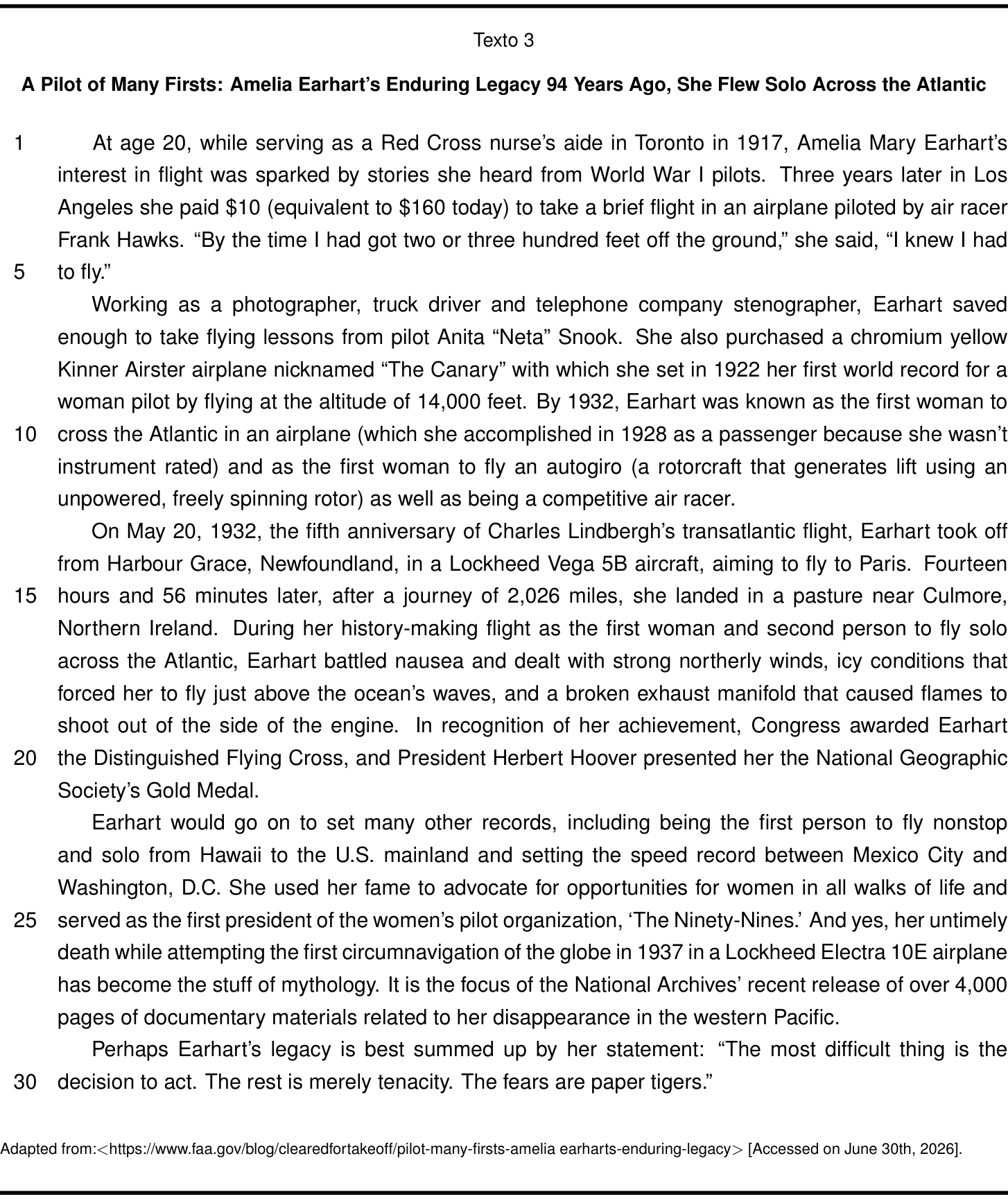
“the first woman to cross the Atlantic in an airplane (which she accomplished in 1928 as a passenger...)”
Ela não “realizou” a mulher, nem o avião, nem sua própria pessoa. O que ela realizou/consumou foi o ato de atravessar o Atlântico — inicialmente como passageira, em 1928. Portanto, which se refere à ação/feito de cruzar o Atlântico.
Resposta: C
Respondeu
levou 6 s
Como pensou
**Analyzing text for context**
I'm currently parsing Text 3, focusing on the Amelia Earhart article to extract details about her 1928 Atlantic flight. My aim is to precisely define the scope of "first woman to cross the Atlantic" as presented in that specific sentence.
**Deciphering pronoun antecedents**
I'm now examining the sentence structure surrounding the pronoun "which" in Text 3. My focus is on the verb "accomplished" to determine what specific action or event it refers to, clarifying whether it's the crossing itself or something else.
Para determinar ao que a oração introduzida pelo pronome relativo which se refere, analisamos o seguinte trecho:
“[...] the first woman to cross the Atlantic in an airplane (which she accomplished in 1928 as a passenger because she wasn’t instrument rated) [...]”
O verbo accomplish significa "realizar", "concluir" ou "alcançar com sucesso" um feito, uma tarefa ou uma ação. Portanto, o que Amelia Earhart realizou (accomplished) em 1928 na condição de passageira foi o ato de cruzar o Oceano Atlântico em um avião (the act of crossing the Atlantic). As outras alternativas referem-se a pessoas, objetos ou qualificações, que não são semanticamente compatíveis com o verbo accomplish nesse contexto.
Portanto, a alternativa correta é a (C).
Resposta: C
Respondeu
levou 16 s
Como pensou
**Analyzing the Question**
I am currently focused on dissecting the multiple-choice question, specifically zeroing in on the provided sentence about the first woman to cross the Atlantic by airplane. My aim is to accurately interpret the nuances of this sentence for a precise answer.
**Interpreting Relative Clauses**
I'm currently working through the sentence structure, specifically how the relative clause introduced by "which" relates to the preceding information. My current hypothesis is that "which" refers to the *act* of crossing the Atlantic, as that's the feat she accomplished.
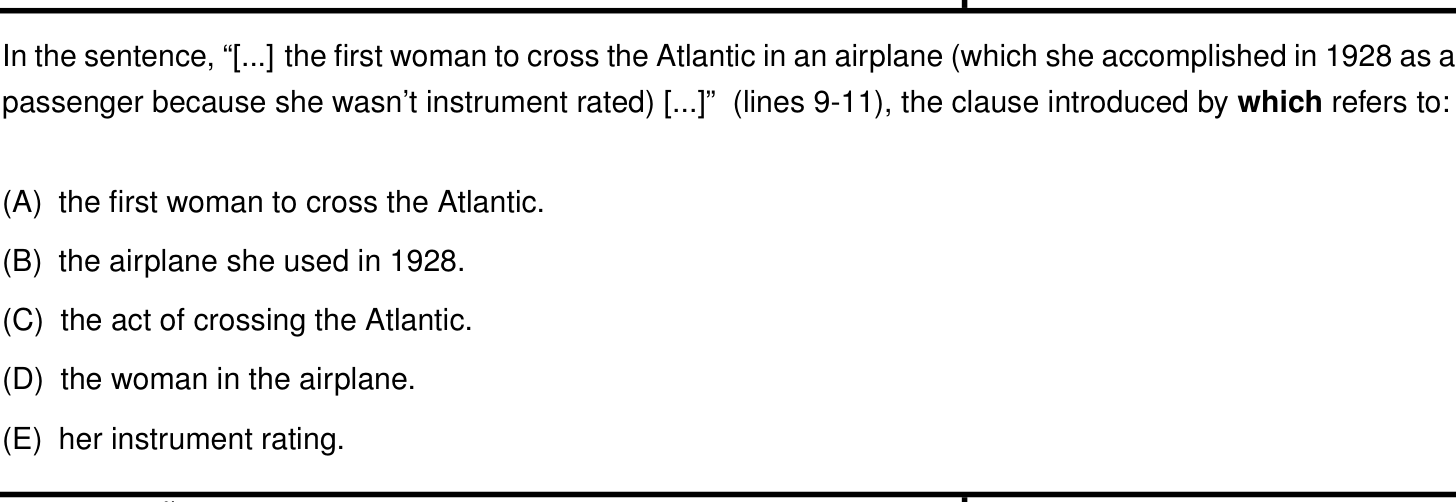
Para responder à questão, devemos analisar o significado e a função sintática do pronome relativo which na oração em destaque: "[...] the first woman to cross the Atlantic in an airplane (which she accomplished in 1928 as a passenger because she wasn’t instrument rated) [...]" (linhas 9-11).
Na oração subordinada introduzida por which, o verbo principal é accomplished (realizou, alcançou, cumpriu). Em inglês, o verbo to accomplish exige como objeto uma ação, uma meta ou um feito, e o pronome relativo which é utilizado para retomar coisas, ideias ou ações completas (nunca pessoas, para as quais se usaria who ou whom).
Portanto, aquilo que Amelia Earhart "realizou" (accomplished) em 1928 como passageira foi o feito/ato de atravessar o Oceano Atlântico de avião (to cross the Atlantic in an airplane).
Analisando as alternativas:
- (A) Incorreta: Refere-se a uma pessoa (the first woman), que não pode ser retomada por which nem ser objeto do verbo accomplish.
- (B) Incorreta: Não faz sentido semântico dizer que ela "realizou/cumpriu o avião" (accomplished the airplane).
- (C) Correta: A oração refere-se ao ato/feito de cruzar o Atlântico (the act of crossing the Atlantic).
- (D) Incorreta: Assim como na alternativa (A), refere-se a uma pessoa.
- (E) Incorreta: A expressão instrument rating (habilitação de voo por instrumentos) aparece dentro da própria oração subordinada como justificativa, não sendo o antecedente de which.
Resposta: C