Respondeu
levou 7 s
Como pensou
**Explaining icy conditions in Portuguese**
I need to provide a concise explanation in Portuguese about the antecedent icy conditions and their restrictive translation. I can say something like “oração relativa” which translates to “that forced her to fly…” modifying “icy conditions” as the antecedent. It’s like saying that the icy conditions caused her to fly just above the waves. Two paragraphs should be enough to cover this!
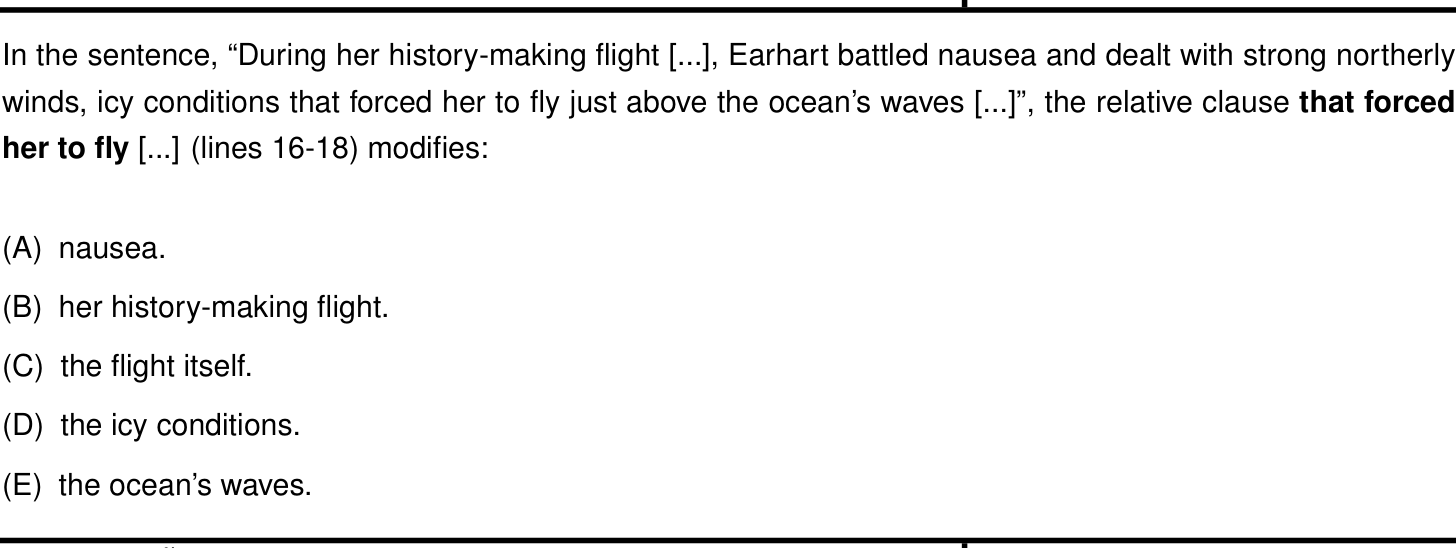
A oração relativa “that forced her to fly just above the ocean’s waves” modifica “icy conditions”, antecedente do pronome relativo “that”.
O trecho significa “condições de gelo que a obrigaram a voar logo acima das ondas do oceano”. Portanto, a oração caracteriza essas condições, indicando a consequência que tiveram para o voo de Earhart.
Resposta: D
Respondeu
levou 5 s
Como pensou
**Crafting a concise explanation**
I need to create a clear explanation in Portuguese regarding icy conditions, specifically focusing on what relates to "D." I can include a quotation translation and use restrictive syntax to keep the focus tight. There’s no need to include any distractions that could confuse the message. It's all about delivering a straightforward and effective explanation without unnecessary details, which might complicate things for the user. Let's keep it clean and concise!
A oração relativa “that forced her to fly just above the ocean’s waves” modifica “icy conditions” (condições de gelo), seu antecedente.
O trecho significa: “condições de gelo que a obrigaram a voar logo acima das ondas do oceano”. Assim, a oração especifica quais condições forçaram Earhart a voar tão baixo.
Resposta: D
Respondeu
levou 3 s
Como pensou
A oração relativa “that forced her to fly [...]” modifica “icy conditions”, seu antecedente imediato. O trecho indica que as condições de gelo a obrigaram a voar logo acima das ondas do oceano.
Resposta: D
Respondeu
levou 4 s
Como pensou
A oração relativa “that forced her to fly just above the ocean’s waves” descreve as “icy conditions” (condições geladas), que a obrigaram a voar rente às ondas. Portanto, modifica esse termo.
Resposta: D
Respondeu
levou 4 s
Como pensou
A oração relativa "that forced her to fly just above the ocean's waves" vem imediatamente após o sintagma nominal "icy conditions". Pela estrutura da frase, Earhart "dealt with strong northerly winds, icy conditions that forced her to fly just above the ocean's waves, and a broken exhaust manifold that caused flames...". Cada item da enumeração pode receber sua própria oração relativa: "icy conditions" é modificado por "that forced her to fly...", e "a broken exhaust manifold" por "that caused flames...". Assim, o antecedente de "that forced her to fly" é "icy conditions" — foram as condições de gelo que a obrigaram a voar rente às ondas.
"Nausea", "her history-making flight" e "the flight itself" não são os antecedentes imediatos, e "the ocean's waves" aparece dentro da própria oração relativa, não antes dela.
Resposta: D
Respondeu
levou 4 s
Como pensou
That relative clause describes the icy conditions, so D is the answer.
Resposta: D
A oração relativa "that forced her to fly just above the ocean's waves" vem logo depois de "icy conditions" e retoma esse termo. O pronome relativo "that" funciona como sujeito da oração: as condições geladas obrigaram Earhart a voar logo acima das ondas.
O sentido confirma a leitura. O gelo nas asas compromete a sustentação e impede o voo em altitude, por isso a piloto precisou voar baixo, rente ao mar.
As outras alternativas não se sustentam:
- (A) nausea: está distante na estrutura, e não faz sentido dizer que o enjoo a obrigou a voar baixo.
- (B) e (C) o voo: o voo é o contexto geral da frase, não o termo antecedente da oração relativa.
- (E) the ocean's waves: essa expressão faz parte da própria oração relativa, como complemento de "fly just above", e por isso não pode ser o termo que ela modifica.
Resposta: D
Respondeu
levou 4 s
Como pensou
A oração relativa "that forced her to fly just above the ocean's waves" vem logo depois de "icy conditions". Por isso, o antecedente mais natural do pronome relativo "that" é esse termo.
Há ainda um argumento semântico e outro gramatical:
- Semântico: condições de gelo podem obrigar a piloto a voar baixo. Já a náusea, o voo em si ou as ondas não fazem esse papel.
- Gramatical: o verbo "forced" está no passado e concorda com "conditions", que é plural. Como "that" é sujeito da oração relativa, o verbo não revela o número, mas o sentido confirma "conditions".
A estrutura "battled nausea and dealt with strong northerly winds, icy conditions that forced her…" lista as dificuldades enfrentadas. "Icy conditions" funciona como um item dessa lista, em aposição ou paralelo a "strong northerly winds", e a oração relativa o modifica.
Portanto, a relativa modifica "the icy conditions".
Resposta: D
Respondeu
levou 8 s
Como pensou
The question concerns a relative clause in an Amelia Earhart sentence.
The relative clause "that forced her to fly just above the ocean's waves" modifies the icy conditions.
A oração relativa restritiva “that forced her to fly just above the ocean’s waves” está diretamente ligada ao sintagma nominal que a precede. Na estrutura “dealt with strong northerly winds, icy conditions that forced…”, o pronome relativo “that” retoma “icy conditions”, e não os demais elementos da frase (náusea, voo ou ondas). Portanto, a oração modifica “the icy conditions”.
Resposta: D
Respondeu
levou 4 s
Como pensou
We need answer question. Need solve. Let's restate: Sentence: "During her history-making flight [...], Earhart battled nausea and dealt with strong northerly winds, icy conditions that forced her to fly just above the ocean's waves [...]", the relative clause "that forced her to fly [...]" (lines 16-18) modifies: options noun phrases. Need identify antecedent of relative clause "that forced her to fly just above the ocean's waves". Let's parse.
Sentence structure: "Earhart battled nausea and dealt with [strong northerly winds, icy conditions that forced her to fly just above the ocean's waves], and a broken exhaust manifold that caused flames..." The relative clause "that forced..." immediately follows "icy conditions" in list? Let's see: "strong northerly winds, icy conditions that forced her to fly just above the ocean's waves, and a broken exhaust manifold..." It is a restrictive relative clause modifying "icy conditions". The phrase "strong northerly winds, icy conditions that forced..." means "strong northerly winds and icy conditions that forced..." The "that" clause modifies "icy conditions" (or possibly "strong northerly winds and icy conditions" combined? Let's parse: "dealt with [strong northerly winds, icy conditions that forced her to fly just above the ocean's waves], and [a broken exhaust manifold that caused flames...]" The relative clause "that forced her..." is attached to "icy conditions" because nearest noun and semantically icy conditions force to fly just above waves (to avoid icing? Maybe). Option D: the icy conditions. Likely correct. Need explain. Answer D.
Need craft final in Portuguese, explain reasoning, end "Resposta: D". Ensure no extra.
Let's produce concise.
A frase original diz que Earhart enfrentou “strong northerly winds, icy conditions that forced her to fly just above the ocean’s waves”.
A oração relativa “that forced her to fly…” está ligada ao antecedente imediatamente anterior: icy conditions (condições de gelo). São essas condições de gelo que a forçaram a voar rente às ondas do oceano.
Portanto, a alternativa correta é a letra D.
Resposta: D
Respondeu
levou 6 s
Como pensou
**Analyzing Textual Nuances**
I'm currently dissecting the provided text, focusing on identifying the core elements of Amelia Earhart's transatlantic flight. My attention is drawn to the specific challenges she faced, such as nausea and adverse weather conditions.
**Identifying Antecedents**
My focus has shifted to pinpointing the precise antecedent for the relative clause "that forced her to fly just above the ocean’s waves." I'm analyzing the sentence structure, specifically how the restrictive clause functions in relation to the preceding elements and confirming its direct link to the "icy conditions."
O trecho em análise no texto é o seguinte:
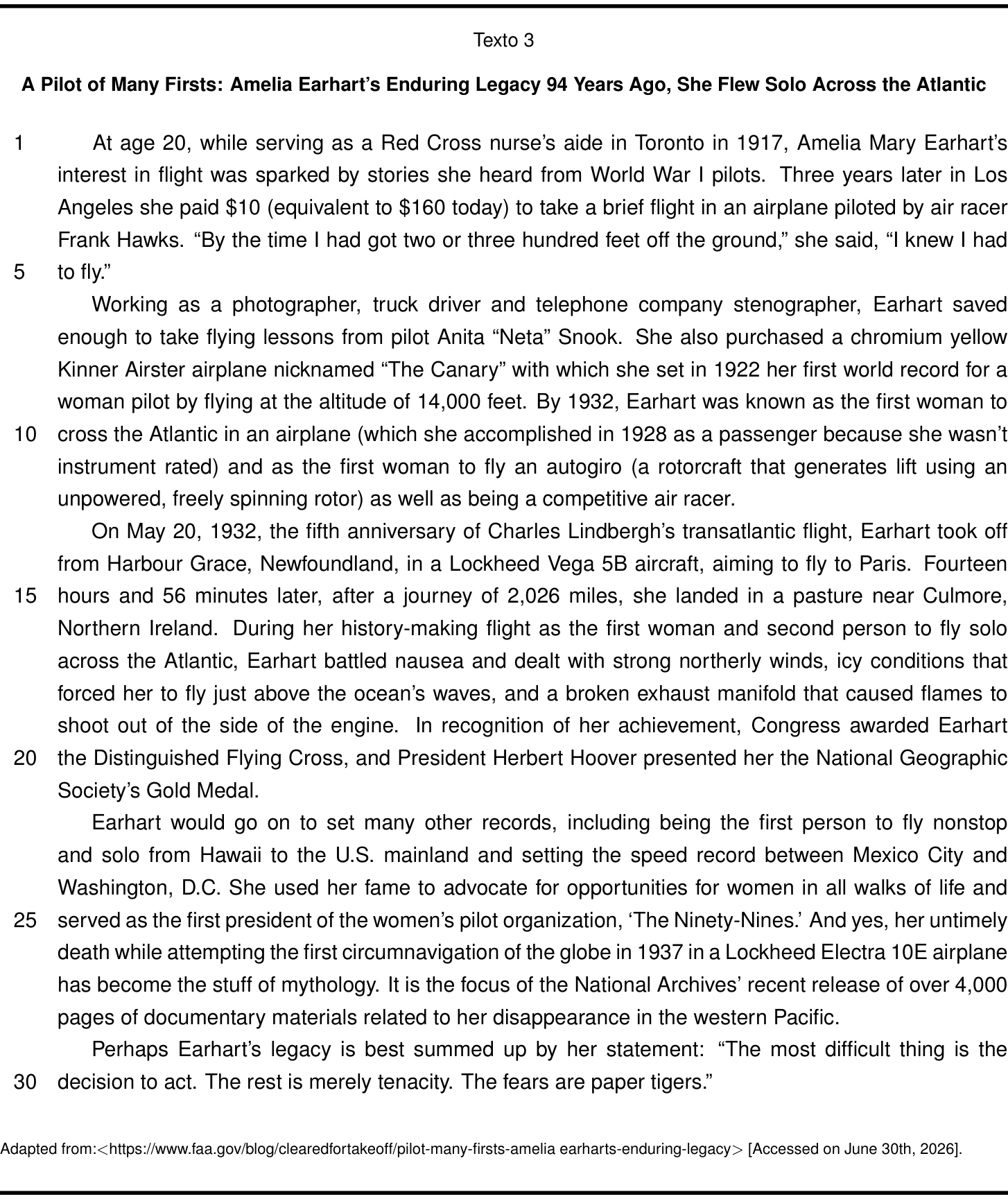
"[...] Earhart battled nausea and dealt with strong northerly winds, icy conditions that forced her to fly just above the ocean’s waves, and a broken exhaust manifold [...]" (linhas 16-18)
Na oração adjetiva restritiva iniciada pelo pronome relativo "that" (that forced her to fly just above the ocean's waves), o pronome refere-se diretamente ao antecedente imediato: "icy conditions" (as condições de gelo/congelamento).
Foram essas condições de congelamento que a forçaram a voar logo acima das ondas do oceano (para evitar o acúmulo de gelo nas asas em altitudes mais elevadas). Portanto, a oração modifica the icy conditions.
Resposta: D
Respondeu
levou 14 s
Como pensou
**Analyzing Earhart's Flight**
I'm currently focused on dissecting the provided sentence to extract the specific challenges Amelia Earhart faced during her flight, as per the user's multiple-choice question. My analysis is zeroing in on the elements directly preceding the interrupted phrase.
**Identifying Modifying Clauses**
I'm currently focused on pinpointing precisely what the relative clause "that forced her to fly" modifies within the sentence. My analysis confirms it directly relates to "icy conditions," as it elaborates on the consequence of those specific circumstances.
Para responder à questão, precisamos identificar a que termo (antecedente) a oração subordinada adjetiva (relative clause) "that forced her to fly just above the ocean’s waves" se refere e modifica no trecho destacado (linhas 16-19):
"During her history-making flight as the first woman and second person to fly solo across the Atlantic, Earhart battled nausea and dealt with strong northerly winds, icy conditions that forced her to fly just above the ocean’s waves, and a broken exhaust manifold that caused flames to shoot out of the side of the engine."
Analisando a estrutura sintática da frase, vemos que o verbo "dealt with" (lidou com) possui três complementos listados em sequência:
- strong northerly winds (fortes ventos do norte);
- icy conditions that forced her to fly just above the ocean’s waves (condições de congelamento/gelo que a forçaram a voar logo acima das ondas do oceano);
- a broken exhaust manifold that caused flames to shoot out of the side of the engine (um coletor de escape quebrado que fazia chamas saírem da lateral do motor).
O pronome relativo "that" retoma o substantivo imediatamente anterior a ele, que é "icy conditions". Além disso, pelo sentido do texto (e pela lógica da aviação, em que o acúmulo de gelo em grandes altitudes força o piloto a descer para altitudes mais baixas e menos frias, próximo ao nível do mar), fica evidente que foram as condições de gelo (the icy conditions) que a obrigaram a voar rente às ondas do oceano.
Portanto, a oração relativa modifica "the icy conditions".
Resposta: D