Como pensou
We need answer in Portuguese. Need solve chemistry. Let's restate.
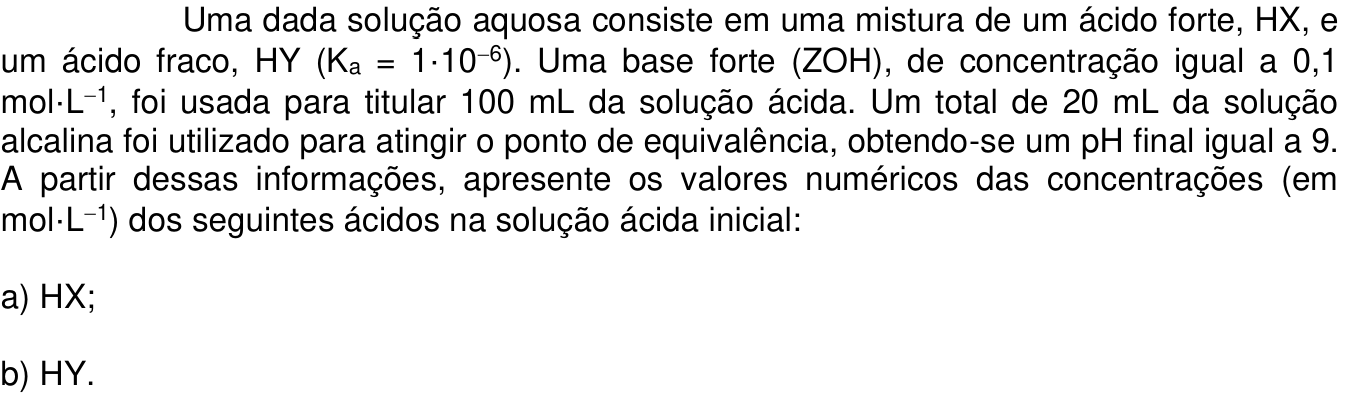
Problem: A given aqueous solution consists of a mixture of a strong acid HX and weak acid HY (Ka = 1e-6). A strong base ZOH concentration 0.1 mol/L titrates 100 mL acid solution. Total 20 mL alkaline solution used to reach equivalence point, obtaining final pH = 9. From info, present numeric concentrations (mol/L) of HX and HY in initial acid solution.
Need solve. Need be careful: At equivalence point, all acids neutralized by strong base: HX strong fully dissociated, HY weak. Total acid equivalents = base moles? Since strong acid and weak acid both monoprotic? HX strong acid monoprotic? Probably HX, HY monoprotic. Total volume base 20 mL of 0.1 M = 0.002 mol base. So total acid in 100 mL = 0.002 mol -> total concentration (HX + HY) = 0.002 mol / 0.100 L = 0.020 M. But final pH at equivalence point = 9. At equivalence point, solution contains salt ZX (from strong acid-strong base) neutral, and salt ZY (from weak acid-strong base) basic due to hydrolysis of Y-. pH = 9. Need determine concentrations of HX and HY separately using pH and Ka.
Let initial concentrations: C_HX, C_HY. Total C = C_HX + C_HY = 0.020 M. At equivalence point, both neutralized: HX + ZOH -> ZX + H2O; HY + ZOH -> ZY + H2O. The resulting solution has Z+ (from base) and X- and Y-. X- from strong acid is conjugate base of strong acid: neutral? Actually strong acid HX fully dissociated, X- is very weak base (conjugate of strong acid, no hydrolysis). Y- hydrolyzes: Y- + H2O ⇌ HY + OH-; Kb = Kw/Ka = 1e-14 / 1e-6 = 1e-8. Also Z+ from strong base no acidic hydrolysis. Ionic strength? ignore.
At equivalence point, total volume = 100 + 20 = 120 mL = 0.120 L. Concentration of Y- = C_HY * 0.100 / 0.120? Because moles HY = C_HY*0.100 mol; concentration after dilution = C_HY*0.100/0.120 = (5/6) C_HY? 0.100/0.120 = 5/6 ≈ 0.8333. Concentration of X- = C_HX*0.100/0.120 = (5/6) C_HX. But X- doesn't affect pH. Need pH=9 -> [OH-] = Kw/[H+] = 1e-14 / 1e-9 = 1e-5 M. (Assuming 25°C). Hydrolysis of Y-: Kb = [HY][OH-]/[Y-] = 1e-8. Let degree? Since Kb small and concentration maybe ~? solve.
Let C_Y_salt = [Y-]_initial after neutralization = (5/6) C_HY. Let x = [OH-] = 1e-5 M (from pH). For weak base hydrolysis: Y- + H2O ⇌ HY + OH-. Initially [Y-]=C_s, [HY]=0, [OH-] ~0 (but water auto). Change: -x, +x, +x. Equilibrium: [Y-]=C_s - x, [HY]=x, [OH-]=x. Kb = x^2 / (C_s - x) = 1e-8. x = 1e-5. Then x^2 = 1e-10. Kb = 1e-8 = 1e-10 / (C_s - x). So C_s - x = 1e-10 / 1e-8 = 0.01 M. Thus C_s = 0.01 + x = 0.01001 M ≈ 0.01 M? But x small 1e-5, C_s ≈ 0.01001 M. But C_s = (5/6) C_HY => C_HY = (6/5)*C_s = 1.2*0.01001 = 0.012012 M. Then C_HX = total - C_HY = 0.020 - 0.012012 = 0.007988 M. So answers ~ HX = 0.008 mol/L; HY = 0.012 mol/L.
But need check whether final pH = 9 maybe after adding 20 mL base to 100 mL acid mixture, not exactly equivalence? It says total 20 mL used to reach equivalence, final pH=9. So yes.
But wait: Need consider strong acid HX contribution to initial pH? Not needed. But perhaps at equivalence point, the strong acid's conjugate base X- is not basic, but there is also OH- from weak base hydrolysis; however, because HX strong, during titration, it neutralizes first? If mixture strong and weak acid, titration curve: strong acid neutralized first? Actually with strong base, strong acid reacts first, then weak acid? The equivalence point corresponds complete neutralization of both? Let's analyze titration of mixture of strong acid and weak acid with strong base. Since strong acid is fully dissociated, OH- added reacts with H+ from strong acid and also with weak acid? The weak acid dissociation equilibrium: HY ⇌ H+ + Y-. Initially strong acid HX provides H+; weak acid mostly undissociated due to common ion? Addition of OH- neutralizes free H+; as H+ decreases, weak acid dissociates to replenish? The titration curve may have only one equivalence point? Actually mixture strong acid + weak acid: strong acid neutralized first, then weak acid neutralized? The equivalence point for total acids? It says "Um total de 20 mL da solução alcalina foi utilizado para atingir o ponto de equivalência" maybe point of equivalence of total acids? If strong acid and weak acid mixture, there might be two equivalence points? But final pH=9 after 20 mL, so likely the equivalence point of both acids? Let's examine.
Titration of a strong acid and weak acid mixture with strong base: The strong acid (HX) is neutralized first; after that, weak acid (HY) is titrated. The first equivalence point might be for HX, with pH determined by weak acid? But "ponto de equivalência" singular? They might mean total neutralization of both acids. The final pH=9 corresponds after both are neutralized (excess base? no, just equivalence). The resulting solution contains ZX and ZY; pH=9 due to hydrolysis of Y-. This is plausible if both neutralized simultaneously? Actually since HY weak, some HY remains undissociated even before equivalence? During titration of strong acid first, the weak acid remains mostly undissociated because H+ from strong acid suppresses its dissociation. At first equivalence (HX neutralized), solution contains HY and ZX; pH is that of weak acid HY at concentration? Then further addition of base neutralizes HY. The final equivalence point (second) is when all HY neutralized; pH basic due to Y-. Total volume 20 mL could correspond to second equivalence. The problem says final pH=9 after 20 mL. So yes total acids.
But wait: Could the 20 mL represent only neutralization of HX? No weak acid? If HX strong + HY weak, if strong acid neutralized first, first equivalence point volume would be proportional to HX. But then pH at first equivalence? It would be acidic due to HY. Not 9. So 20 mL total likely total. We'll proceed.
But need be careful with pH=9 and concentration. There may be approximation involving [OH-] = 1e-5 M, and Kb = Kw/Ka = 1e-8. We solved.
Let's verify with exact calculations.
Total acid concentration = 0.1 M * 20 mL / 100 mL = 0.020 M. Let x = C_HX, y = C_HY. x+y=0.020. At final volume 120 mL, [Y-]0 = y*(100/120) = (5/6)y. Equilibrium: Y- + H2O ⇌ HY + OH-. Kb = Kw/Ka = 1.0e-14 / 1.0e-6 = 1.0e-8. [OH-] = 10^{-5} M. Hydrolysis equation: Kb = [HY][OH-]/[Y-] = (x? no call h)[OH-]/([Y-]0 - [OH-]) = (1e-5)^2 / ( (5/6)y - 1e-5 ) = 1e-8. So 1e-10 = 1e-8 * ((5/6)y - 1e-5) => (5/6)y - 1e-5 = 0.01 => (5/6)y = 0.01001 => y = 0.012012 M. x = 0.007988 M. If approximate y = 0.012 M, x=0.008 M.
But check significant figures? Constants Ka = 1·10^-6 (1 significant? maybe exact? pH final = 9 (maybe 1 sig). 20 mL maybe 2 sig? 0.1 mol/L maybe 1 sig? Use 2? Could answer with 2 sig? We'll see. But problem likely expects values: HX = 0.008 mol/L; HY = 0.012 mol/L. Maybe provide exact 0.007988 and 0.012012. Let's compute exactly using provided constants: Ka = 1e-6, Kw? Not explicitly given but can use pH=9 -> [H+]=1e-9 -> [OH-]=1e-5 assuming Kw=1e-14 (not in constants but standard; maybe Kw = 1e-14 at 25°C). They gave pH final = 9. Constants include? no Kw. But can infer.
Let's think if there is any other acid-base equilibrium: Strong acid HX also contributes X- which is conjugate base of strong acid; no hydrolysis. But strong base ZOH is strong; Z+ no hydrolysis. However, at equivalence point, total moles of base equal total moles of acids. Let's define initial concentrations C_HX and C_HY. At equivalence, moles HX + moles HY = moles ZOH. Moles ZOH = 0.1 mol/L * 0.020 L = 0.002 mol. Initial acid solution volume 0.100 L. Total acid concentration = 0.020 mol/L. Yes.
Now final pH = 9. The final solution contains Z+ (0.002 mol / 0.120 L = 0.01667 M), X- (C_HX*0.100/0.120), Y- (C_HY*0.100/0.120). The weak base Y- hydrolyzes. But also water autoionization. Since pH 9, [OH-] = 1e-5 M. Is it possible that the strong acid HX concentration is so low that its conjugate base X- not negligible? X- is chloride? no; strong acid maybe HCl, HBr, HI, HNO3, H2SO4? But HX generic strong acid. X- is extremely weak base, but still could be protonated? For HCl, Cl- has negligible basicity, but its concentration may be high; no effect.
Need maybe account that HY weak acid also initially contributes some H+? Not needed.
Let's examine if final pH=9 after "atingir o ponto de equivalência" maybe "obtendo-se um pH final igual a 9" could mean after equivalence, pH = 9, but perhaps not exactly at equivalence? Actually "Um total de 20 mL da solução alcalina foi utilizado para atingir o ponto de equivalência, obtendo-se um pH final igual a 9." Means at the equivalence point pH=9. So yes.
Let's consider alternative: At equivalence point, the strong acid HX has been neutralized, but due to weak acid HY, its salt hydrolyzes; but the presence of X- may affect ionic strength; ignored. Also, the dissociation of HY at equivalence might not be negligible? At equivalence, HY is converted to Y-, but Y- hydrolysis produces HY. Our Kb expression accounts.
Let's solve more rigorously: At equilibrium, charge balance: [Z+] + [H+] = [OH-] + [X-] + [Y-]. [Z+] = total base concentration = 0.01667 M. [X-] = total strong acid concentration after dilution = C_HX * 5/6. Since X- is conjugate base of strong acid, no protonation; [X-] equals total X. [Y-] + [HY] = total weak acid after dilution = C_HY * 5/6. Mass balance for weak acid: C_s = [Y-] + [HY] = 0.01001? Actually from hydrolysis: C_s = [Y-] + [HY]. Since [HY] = [OH-] - [H+] maybe? Proton condition: Initial species: Y-, Z+, X-, H2O. After hydrolysis: OH- produced; H+ from water; HY formed. Charge balance includes [H+] = 1e-9 negligible vs [OH-]=1e-5. [X-] = C_sX? Let's derive: At equivalence, all HX and HY neutralized. For every mole HX, one mole X- and one mole Z+; for HY, one mole Y- and one mole Z+. Base ZOH added exactly total acid; so [Z+] = [X-] + [Y-] + [HY]? Wait mass balance for Z+ = total base = total acid initial = [X-] + [Y-] + [HY] (since total acid = strong acid + weak acid). Charge balance: [Z+] + [H+] = [OH-] + [X-] + [Y-]. Substitute [Z+] = [X-] + [Y-] + [HY]: [X-] + [Y-] + [HY] + [H+] = [OH-] + [X-] + [Y-] => [HY] + [H+] = [OH-] => [HY] = [OH-] - [H+] ≈ 1e-5. Ah! This is important: from proton balance, [HY] = [OH-] (ignoring H+). Then Kb = [HY][OH-]/[Y-] = [OH-]^2/[Y-]? But [HY]=[OH-] = 1e-5, so Kb = (1e-5)^2 / [Y-] = 1e-8 => [Y-] = (1e-10)/(1e-8)=0.01 M. This is same as our C_s - x = 0.01 because [Y-] = C_s - [OH-]? Actually [Y-] = C_s - [HY] = C_s - 1e-5. But Kb = [HY][OH-]/[Y-] = x^2/(C_s - x). Set x=1e-5 => [Y-]= C_s - x = 0.01. Same. So [Y-] equilibrium = 0.01 M. Then total weak acid after dilution C_s = [Y-] + [HY] = 0.01001 M. So y = C_HY = C_s * (120/100) = 0.01001*1.2=0.012012 M. Good.
Wait earlier I used C_s = [Y-] + x = 0.01001; same.
Let's check if [HY] = [OH-] from proton condition. In hydrolysis of Y-, [HY] equals [OH-] produced (plus H+ from water but water OH-?). More exactly: weak acid HY is formed by hydrolysis: Y- + H2O ⇌ HY + OH-. The amount of HY equals amount of OH- produced; but water autoionization also produces OH- and H+. At pH 9, [OH-] = 1e-5, [H+] = 1e-9. The proton condition for solution of NaY: [HY] + [H+] = [OH-]. Since [H+] << [OH-], [HY] ≈ [OH-]. So yes.
Thus exact [Y-] = Kb? Wait Kb = [HY][OH-]/[Y-] = [OH-]^2 / [Y-] (since [HY]=[OH-]) -> [Y-] = [OH-]^2 / Kb = (1e-5)^2 / 1e-8 = 1e-10 / 1e-8 = 0.01 M exactly. Then total weak acid after dilution = [Y-] + [HY] = 0.01 + 1e-5 = 0.01001 M. Then initial C_HY = 0.01001 * (120 mL / 100 mL) = 0.01001 * 1.2 = 0.012012 M. C_HX = 0.020 - 0.012012 = 0.007988 M. If use [OH-] = 1e-5 and Kw=1e-14. If pH=9 exactly.
But let's see if they expect HX = 8.0 x 10^-3 mol/L; HY = 1.2 x 10^-2 mol/L. The exact values 7.99e-3 and 1.20e-2. Let's compute maybe with 2 sig figs: 0.0080 mol/L and 0.0120 mol/L? But 0.020 - 0.0120 = 0.0080. If approximate [Y-]=0.01, then y=0.012, x=0.008. Which one to present? In chemistry exams, they may expect approximate: HX = 0.008 mol/L, HY = 0.012 mol/L. But since they give Ka = 1·10^-6 and pH = 9, maybe the 1e-5 correction is small but could be included? Let's check significant figures. Constants: Ka = 1·10^-6 (one significant figure? The notation "1·10^-6" implies 1 sig? But in Brazil, "1·10^-6" maybe one algarismo significativo? However, concentration values maybe 0.1 mol/L (1 sig? Actually 0.1 could be 1 sig; 20 mL 1 sig? 100 mL maybe 1? pH 9 one sig). So answer with one sig? That would be HX=0.008? No 0.008 has one sig? 8e-3. HY=0.01? But they ask numeric values. In vestibulares, they usually expect answers with reasonable sig figs. Let's inspect: "0,1 mol·L^{-1}" could be 0.1 (1 sig) but often considered 2? "20 mL" maybe 2? "100 mL" maybe 3? "pH final igual a 9" maybe 1? Hmm. I'd present with 2 or 3 significant figures: HX = 8.0×10^-3 mol/L; HY = 1.2×10^-2 mol/L. If include correction: HX = 7.99×10^-3 mol/L; HY = 1.20×10^-2 mol/L. But approximate solution likely accepted.
Let's be thorough. Let's derive from charge balance with exact H+.
At equivalence, final volume V = 120 mL. Total acid moles n_total = 0.002 mol. Let n_HX = a, n_HY = b, a+b=0.002 mol. After dilution: C_X = a/V = a/0.120; C_Y_total = b/V = b/0.120.
Final pH=9 -> [H+] = 1e-9; [OH-] = 1e-5. Charge balance: [Z+] + [H+] = [X-] + [Y-] + [OH-]. Since Z+ from base = total base = 0.002/0.120 = 0.0166667 M. X- = a/V. Charge: 0.0166667 + 1e-9 = a/V + b? Wait [Y-] variable + 1e-5. Mass balance for Z+? Actually base cation concentration = total base concentration = a+b / V = 0.002/0.120 = 0.0166667. Charge balance: [Z+] = [X-] + [Y-] + [OH-] - [H+] (since [Z+] + [H+] = [X-]+[Y-]+[OH-]). But [X-] = a/V (since strong acid fully dissociated; no protonation). Thus a/V = [Z+] - [Y-] - [OH-] + [H+] = (0.002/V) - [Y-] - 1e-5 + 1e-9. So a = 0.002 - V([Y-] + ~1e-5). Then b = 0.002 - a = V([Y-] + 1e-5). Wait yes b = total weak acid moles = V([Y-] + [HY])? From mass balance: total Y = [Y-]+[HY] = b/V. And [HY] ≈ [OH-] = 1e-5 (from proton balance? Let's verify). Proton balance: H2O and HY? For solution of NaY and NaX? Proton condition for NaY: [HY] + [H+] = [OH-]. For NaX no proton. So [HY] = [OH-] - [H+] ≈ 1e-5 - 1e-9 ≈ 1e-5. So b/V = [Y-] + [HY] ≈ [Y-] + 1e-5. Then b = V([Y-]+1e-5). And Kb = [HY][OH-]/[Y-] = (1e-5)^2/[Y-] = 1e-8 => [Y-]=0.01 M. Then b = 0.120*(0.01+1e-5)=0.120*0.01001=0.0012012 mol. Thus C_HY initial = b/0.100 = 0.012012 M. a = 0.002 - 0.0012012 = 0.0007988 mol. C_HX = a/0.100 = 0.007988 M. Same.
Thus exact values are 7.988×10^-3 M and 1.2012×10^-2 M. If we use [H+] negligible, [HY]=[OH-]=1e-5, yes.
Could there be any contribution from strong acid in final pH? No.
Let's think if "ácido forte, HX" and "ácido fraco, HY (Ka = 1·10^-6)" maybe HX concentration is determined by difference in volume? The titration of a mixture of strong and weak acids has equivalence volume corresponding to total acids, but final pH=9. If the strong acid concentration were very high, the final pH might be governed by weak acid salt only because strong acid salt neutral. Yes.
Let's maybe consider if at equivalence point, the weak acid HY is not fully neutralized because pH=9? At pH=9, weak acid is mostly deprotonated: [Y-]/[HY] = Ka/[H+] = 1e-6 / 1e-9 = 1000, so 99.9% Y-. So total weak acid moles b ≈ V[Y-] (plus very little HY), so b ≈ 0.0012 mol. Good.
But wait: At final pH=9, the base ZOH added = total acid moles, but the weak acid HY might not have been completely neutralized? Actually to reach pH 9 at equivalence, yes.
Let's see if there is a possibility that pH 9 is not at equivalence but after adding 20 mL? "Um total de 20 mL da solução alcalina foi utilizado para atingir o ponto de equivalência, obtendo-se um pH final igual a 9." Could "ponto de equivalência" refers to equivalence of HX only? If strong acid HX is neutralized first, the volume 20 mL might be the first equivalence point? But if there is weak acid HY, the first equivalence point pH would be acidic (due to HY), not 9. So no.
Let's search memory: In mixture of strong acid and weak acid titration, there are two equivalence points: first strong acid, second weak acid. The pH at second equivalence point is basic due to weak base. The volume at second equivalence is total acid. The problem likely from ITA? They expect a more complex calculation: The strong base neutralizes HX and HY; at equivalence point, pH = 9. Need use initial concentration? Let's see if "ácido forte, HX" might be a strong monoprotic acid but its concentration maybe determined by the fact that at equivalence, pH = 9, and the total acid concentration 0.020 M; Ka HY = 1e-6. Our solution gives 0.008 and 0.012. But let's ensure if total acid concentration is indeed 0.020 M. 20 mL of 0.1 mol/L base = 2.0 mmol. 100 mL acid mixture. If both acids monoprotic, total acid = 2.0 mmol -> 0.020 M. yes.
Now, the final answer should be in Portuguese with development. Need show item a and b. The question asks "A partir dessas informações, apresente os valores numéricos das concentrações (em mol·L^{-1}) dos seguintes ácidos na solução ácida inicial: a) HX; b) HY."
We should provide calculations. Let's formulate.
Detailed solution:
1. Moles de ZOH no ponto de equivalência:
n_base = C_base * V_base = 0.1 mol/L * 0.020 L = 2.0×10^-3 mol.
Como ZOH é base forte e os ácidos são monopróticos, no ponto de equivalência:
n_HX + n_HY = n_base = 2.0×10^-3 mol.
Volume inicial da solução ácida = 0.100 L; então concentração total:
C_HX + C_HY = (2.0×10^-3 mol) / 0.100 L = 0.020 mol/L.
2. No ponto de equivalência, o volume final = 0.100 + 0.020 = 0.120 L.
O pH final = 9 -> [H+] = 1.0×10^-9 mol/L; [OH-] = Kw/[H+] = 1.0×10^-14 / 1.0×10^-9 = 1.0×10^-5 mol/L (considerando Kw=1.0×10^-14).
3. O sal do ácido fraco sofre hidrólise:
Y^- + H2O ⇌ HY + OH^-; Kb = Kw/Ka = 1.0×10^-14 / 1.0×10^-6 = 1.0×10^-8.
No equilíbrio, [HY] ≈ [OH-] = 1.0×10^-5 mol/L (o H+ é desprezível).
Kb = [HY][OH-]/[Y-] = (1.0×10^-5)^2 / [Y-] = 1.0×10^-8 -> [Y-] = 1.0×10^-10 / 1.0×10^-8 = 1.0×10^-2 mol/L.
4. Concentração total do sal de Y- no volume final? [Y-] + [HY] = 1.0×10^-2 + 1.0×10^-5 ≈ 1.001×10^-2 mol/L. Esse valor equivale à concentração analítica de HY após diluição:
C_HY_diluído = 1.001×10^-2 mol/L.
Como foi diluído de 100 mL para 120 mL:
C_HY_inicial = C_HY_diluído * (120/100) = 1.001×10^-2 * 1.2 = 0.012012 mol/L ≈ 1.2×10^-2 mol/L.
5. C_HX = 0.020 - 0.012012 = 0.007988 mol/L ≈ 8.0×10^-3 mol/L.
Then final answer: a) [HX] ≈ 8.0×10^-3 mol/L (ou 7.99×10^-3); b) [HY] ≈ 1.2×10^-2 mol/L (ou 1.20×10^-2). Need decide. The exact values: a) 8.0×10^-3; b) 1.2×10^-2. But if we include the 1e-5 correction, a = 7.988×10^-3, b = 1.2012×10^-2. The problem likely expects maybe 8.0×10^-3 and 1.2×10^-2. Let's see: If use exact from charge balance including [H+], [OH-] = 1e-5, [HY]=[OH-]-[H+] ≈ 1e-5, so [Y-]=0.01 exact if Kb=1e-8. Then C_HY_diluído = [Y-]+[HY] = 0.01001, initial = 0.012012. If they ignore [HY] compared to [Y-], they might write C_HY = 0.012 mol/L. The difference 0.000012 M is negligible. I'd present approximate with note "desprezando [HY] frente a [Y-]".
Let's verify if there is any issue with using Kb = Kw/Ka. They gave Ka = 1e-6. Kw not in constants but standard. They gave "Constantes" includes R etc not Kw. In many exams, Kw = 1.0×10^-14 at 25°C not listed; expected known. Also pH=9 gives [H+]=1e-9. Good.
Let's consider temperature? They mention "Condições ambiente: 25 °C e 1 atm" in definitions. So Kw=1.0e-14 at 25°C. Okay.
Let's think about the strong acid's anion X- possibly hydrolyzing? Strong acids like HCl, HBr, HI, HNO3, H2SO4 (first proton) have conjugate bases that are extremely weak, no hydrolysis. So ignore.
Let's also consider ionic strength? ITA sometimes expects activities? But this is likely simple.
Now final response in Portuguese. Need show item by item. The user asks "Resolva a questão como um candidato faria na prova: mostre o desenvolvimento em português, item por item quando a questão tiver itens (a, b, c…). Termine com uma linha neste formato:
Resposta final: <o resultado de cada item, de forma curta>". So final answer include development and final line.
Let's write.
Maybe use equations.
Let's formulate exactly:
- n_base = 0,1 mol/L × 0,020 L = 2,0×10^-3 mol.
- No ponto de equivalência: n(HX) + n(HY) = 2,0×10^-3 mol.
- Como V_ácido = 0,100 L: [HX] + [HY] = 0,020 mol/L.
No ponto de equivalência, [H+] = 10^-9 mol/L => [OH-] = 10^-5 mol/L.
Para o ânion Y^-:
Y^- + H2O ⇌ HY + OH^-; Kb = Kw/Ka = 1,0×10^-14 / 1,0×10^-6 = 1,0×10^-8.
Kb = [HY][OH-]/[Y-]. Do balanço de prótons, [HY] ≈ [OH-] = 1,0×10^-5 mol/L (desprezando [H+]).
Então:
1,0×10^-8 = (1,0×10^-5)^2 / [Y-] -> [Y-] = 1,0×10^-2 mol/L.
A concentração analítica total do ácido fraco após a diluição no ponto de equivalência é:
[HY]_diluído = [Y-] + [HY] ≈ 1,0×10^-2 + 1,0×10^-5 = 1,001×10^-2 mol/L.
Corrigindo para o volume inicial (100 mL) a partir do volume final (120 mL):
[HY]_inicial = 1,001×10^-2 × 120/100 = 1,2012×10^-2 mol/L ≈ 1,2×10^-2 mol/L.
Então:
[HX] = 0,020 - 1,2012×10^-2 = 7,988×10^-3 mol/L ≈ 8,0×10^-3 mol/L.
If we don't include 1e-5, [HY] = 1.0e-2*1.2=1.2e-2; [HX]=8.0e-3. Let's include both exact and approximate. In final answer maybe write "a) 8,0×10^-3 mol/L; b) 1,2×10^-2 mol/L". But maybe exact "7,99×10^-3" and "1,20×10^-2" better. Let's decide.
The exam likely expects numeric values. Since constants Ka=1e-6 maybe one significant figure, but asking numerical values maybe they want 8.0×10^-3 and 1.2×10^-2. Hmm.
Let's check if there is a possibility that total acid concentration is not 0.020 M because strong acid HX contributes two H+? They didn't specify monoprotic. Usually "ácido forte HX" monoprotic; "ácido fraco HY" monoprotic. If not, problem underspecified. So assume monoprotic.
Let's also check the wording: "Uma dada solução aquosa consiste em uma mistura de um ácido forte, HX, e um ácido fraco, HY (Ka = 1·10^-6)." "Uma base forte (ZOH), de concentração igual a 0,1 mol·L^-1, foi usada para titular 100 mL da solução ácida. Um total de 20 mL da solução alcalina foi utilizado para atingir o ponto de equivalência, obtendo-se um pH final igual a 9." They don't say the acids are monoprotic, but HX and HY formulas suggest monoprotic. Fine.
Now let's craft final response.
Potential nuance: The final pH = 9 at equivalence point. At equivalence point, the strong acid is neutralized; the weak acid is neutralized; but because HY is weak, its conjugate base hydrolyzes. The Kb = 1e-8. The concentration of Y- after dilution determined by pH. We did.
Let's maybe include "Como o ácido forte HX não contribui para o pH final (seu ânion não hidrolisa), todo o caráter básico deve-se ao ânion Y^-." Good.
Let's produce answer.
Need "Resposta final: a) ...; b) ...". The user says "Termine com uma linha neste formato: Resposta final: <o resultado de cada item, de forma curta>". So final line.
Let's write in Portuguese with math.
Let's ensure no mistakes in units:
0.020 mol/L total? Yes.
Kb = 1e-8.
[OH-] = 1e-5.
[Y-]=1e-2.
Volume ratio 120/100 = 1.2.
C_HY = 1.2e-2.
C_HX = 0.020 - 0.012 = 0.008. exact 0.007988.
If wanting exact:
[HY]_diluído = 0.01001 M -> initial = 0.012012 M.
[HX] = 0.020 - 0.007988? Wait C_HX = total - C_HY = 0.020 - 0.012012 = 0.007988 M.
If using approximate [HY]=0.012, C_HX=0.008. Both acceptable. Maybe include note: "Aproximadamente: a) 8,0·10^-3; b) 1,2·10^-2. Valores mais exatos: a) 7,99·10^-3; b) 1,20·10^-2."
Let's decide final answer line short: "a) [HX] ≈ 8,0×10^-3 mol/L; b) [HY] ≈ 1,2×10^-2 mol/L." Or "a) 8,0·10^-3 mol/L; b) 1,2·10^-2 mol/L." The question asks "apresente os valores numéricos"; likely fine.
But the final line should be concise. I'll include both approximate and maybe exact? The user said "o resultado de cada item, de forma curta". So final line: "Resposta final: a) [HX] = 8,0×10^-3 mol·L^-1 (exato: 7,99×10^-3); b) [HY] = 1,2×10^-2 mol·L^-1 (exato: 1,20×10^-2)." That's a bit long but okay. Maybe just approximate. Let's see.
In many ITA answer keys, they might use 0.008 and 0.012. Let's choose approximate with note. But to be precise, I'll write development with exact values, then final line with approximate.
Let's draft:
"Como a base é forte e os ácidos são monopróticos, no ponto de equivalência:
n_base = 0,1 × 0,020 = 2,0×10^-3 mol = n_HX + n_HY.
Logo, [HX] + [HY] = 2,0×10^-3 / 0,100 = 0,020 mol/L.
No ponto de equivalência o volume final é 0,120 L e pH=9, então [OH-]=1,0×10^-5 mol/L. O ânion Y- hidrolisa:
Y^- + H2O ⇌ HY + OH^-; Kb = Kw/Ka = 1,0×10^-8.
Pelo balanço de prótons, [HY] ≈ [OH-] = 1,0×10^-5 mol/L.
Assim:
1,0×10^-8 = (1,0×10^-5)^2 / [Y-] -> [Y-] = 1,0×10^-2 mol/L.
Portanto, a concentração analítica de HY após diluição é:
[HY]_diluído = [Y-] + [HY] ≈ 1,001×10^-2 mol/L.
Corrigindo para o volume inicial:
[HY]_inicial = 1,001×10^-2 × (120/100) = 1,2012×10^-2 mol/L ≈ 1,2×10^-2 mol/L.
Então:
[HX] = 0,020 - 0,012012 = 0,007988 mol/L ≈ 8,0×10^-3 mol/L."
Final line: "Resposta final: a) [HX] ≈ 8,0×10^-3 mol·L^-1; b) [HY] ≈ 1,2×10^-2 mol·L^-1."
Let's ensure "Kw" is not listed but standard. Maybe mention "considerando Kw = 1,0×10^-14 a 25 °C". Fine.
Let's also consider if final pH=9 is at equivalence point but maybe after adding 20 mL, not exactly neutralization of all HY? Let's verify with exact calculation for titration of weak acid HY alone with strong base: equivalence point pH = 1/2(14 + pKa + log C_s)? For weak acid salt, pH = 7 + 0.5(pKa + log C_s) at equivalence? Let's derive: [OH-] ≈ sqrt(Kb*C_s) if C_s >> OH-. Here Kb=1e-8, C_s=0.01 -> [OH-]=sqrt(1e-10)=1e-5 -> pOH=5 -> pH=9. Yes. So matches. Good.
Now, final answer.
Cálculo:
- Moles de ZOH no ponto de equivalência:
n_{\text{base}} = 0{,}1\ \text{mol/L} \times 0{,}020\ \text{L} = 2{,}0\times10^{-3}\ \text{mol}.
Como os ácidos são monopróticos, no ponto de equivalência:
n_{\text{HX}}+n_{\text{HY}}=2{,}0\times10^{-3}\ \text{mol}
[\text{HX}]+[\text{HY}]=\frac{2{,}0\times10^{-3}}{0{,}100}=0{,}020\ \text{mol/L}
No ponto de equivalência, o volume final é 100+20=120\ \text{mL}=0{,}120\ \text{L}.
pH final =9, então:
[\text{H}^+]=10^{-9}\ \text{mol/L}
[\text{OH}^-]=\frac{K_w}{[\text{H}^+]}=\frac{10^{-14}}{10^{-9}}=10^{-5}\ \text{mol/L}
O ânion \text{Y}^- do ácido fraco sofre hidrólise:
\text{Y}^-+\text{H}_2\text{O}\rightleftharpoons \text{HY}+\text{OH}^-
K_b=\frac{K_w}{K_a}=\frac{10^{-14}}{10^{-6}}=10^{-8}
Pelo balanço de prótons, [\text{HY}]\approx[\text{OH}^-]=10^{-5}\ \text{mol/L}.
Assim:
K_b=\frac{[\text{HY}][\text{OH}^-]}{[\text{Y}^-]}
10^{-8}=\frac{(10^{-5})^2}{[\text{Y}^-]}
[\text{Y}^-]=10^{-2}\ \text{mol/L}
Concentração analítica de HY após diluição:
[\text{HY}]_{\text{diluído}}=[\text{Y}^-]+[\text{HY}]
\approx10^{-2}+10^{-5}=1{,}001\times10^{-2}\ \text{mol/L}
Corrigindo para o volume inicial:
[\text{HY}]_{\text{inicial}}=1{,}001\times10^{-2}\times\frac{120}{100}
=1{,}2012\times10^{-2}\ \text{mol/L}
\approx1{,}2\times10^{-2}\ \text{mol/L}
Portanto:
[\text{HX}]=0{,}020-0{,}012012
=0{,}007988\ \text{mol/L}
\approx8{,}0\times10^{-3}\ \text{mol/L}
Resposta final: a) [\text{HX}]\approx 8{,}0\times10^{-3}\ \text{mol·L}^{-1}; b) [\text{HY}]\approx 1{,}2\times10^{-2}\ \text{mol·L}^{-1}.