Como pensou
We need answer question in Portuguese, with reasoning. Need solve. Let's parse images. We have constants. Main question: figures show iron pieces submerged in aqueous media with different concentrations of ions and/or oxygen. Four figures (1)-(4): each has an iron bar/plate? Diagram: a rectangular piece? Regions X upper? Let's examine.
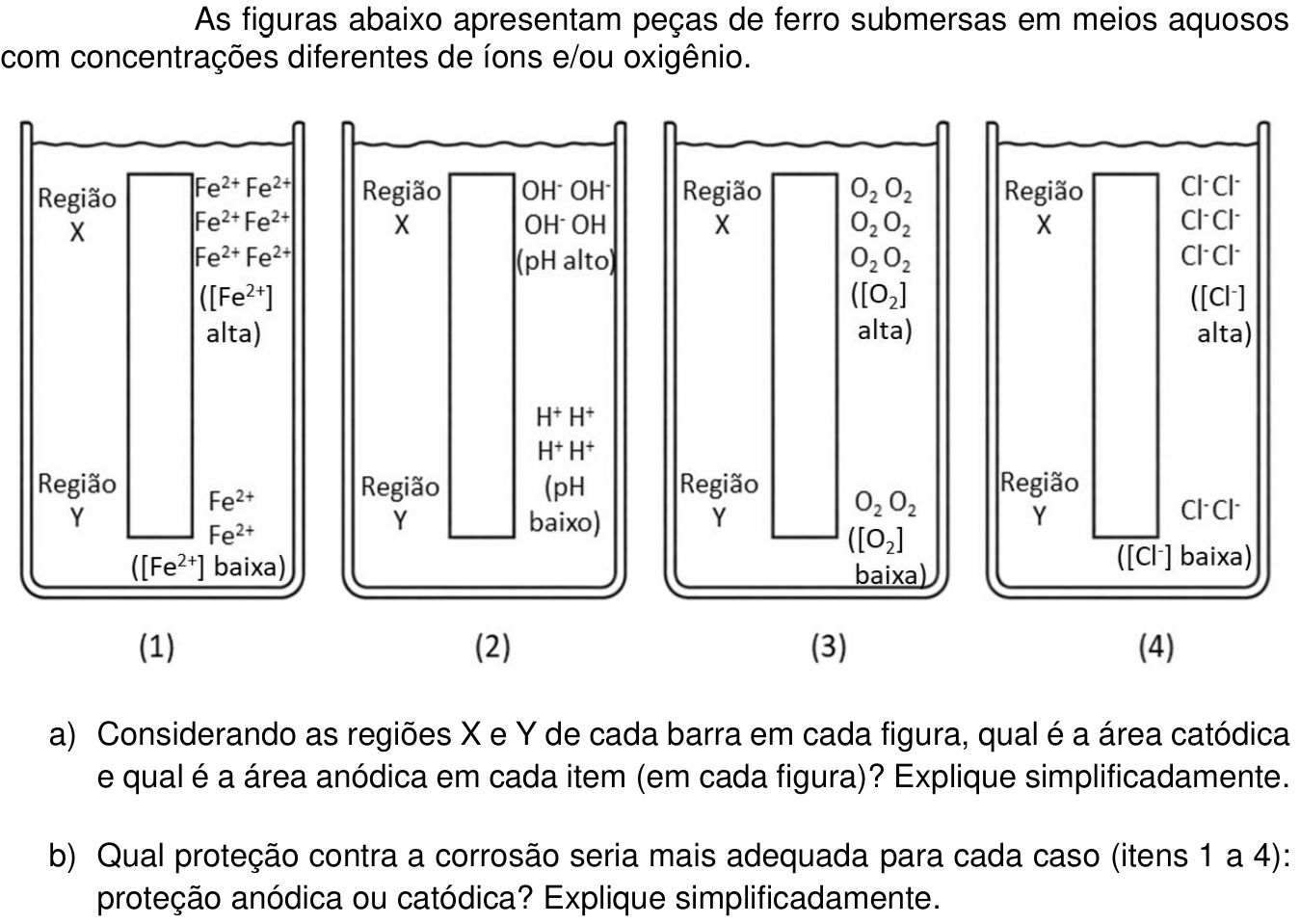
Figure 1: Label "Região X" near top left outside? Inside? It shows top portion region X, bottom portion region Y. Around top: Fe2+ Fe2+ Fe2+ ... ([Fe2+] alta). Around bottom: Fe2+ Fe2+ ([Fe2+] baixa). So concentration gradient of Fe2+? The iron piece is in solution with higher Fe2+ near top, lower near bottom.
Figure 2: Top has OH- OH- (pH alto); bottom H+ H+ (pH baixo). So pH high top, low bottom.
Figure 3: Top O2 O2 ... ([O2] alta); bottom O2 O2 ([O2] baixa). Oxygen concentration high top, low bottom.
Figure 4: Top Cl- Cl- ... ([Cl-] alta); bottom Cl- Cl- ([Cl-] baixa). Chloride concentration high top, low bottom.
Question a: Considering regions X and Y of each bar in each figure, which is cathodic area and which is anodic area in each item (figure)? Explain simplified.
Question b: Which protection against corrosion would be more adequate for each case (items 1 to 4): anodic protection or cathodic protection? Explain simplified.
Need understand corrosion of iron: Iron corrodes via electrochemical mechanism. Anodic area: iron oxidation Fe -> Fe2+ + 2e- (dissolution). Cathodic area: reduction of oxidant (O2, H+, H2O) consumes electrons. In differential aeration / concentration cells, the area with lower concentration of oxidant? Wait for oxygen: higher O2 concentration tends to cathodic? Let's recall differential aeration cell: iron with different O2 concentrations: anodic region is low oxygen, cathodic region high oxygen because oxygen reduction occurs where O2 available. For metal ions? Fe2+ concentration: If high Fe2+ near region, maybe it's anodic? Actually Nernst potential for Fe/Fe2+: E = E° + (RT/2F) ln [Fe2+]. Higher [Fe2+] makes potential more positive (noble) -> cathodic? Wait if Fe2+ high, equilibrium potential more positive; that region may act as cathode? Need think.
Question asks "área catódica e área anódica" in each figure. Likely based on differential concentration cells: regions with higher oxidant concentration (O2, H+) are cathodic; regions with lower are anodic. For Fe2+: if high Fe2+ region: maybe anodic? Let's recall corrosion cell: anodes are where metal dissolution occurs; in a concentration cell, the electrode in more dilute solution? Hmm.
Let's analyze each.
Figure 1: Fe2+ high top, low bottom. Iron in solution containing Fe2+. Since Fe2+ is product of corrosion. The region with lower Fe2+ concentration may be anodic? Nernst: Fe2+ + 2e- ⇌ Fe. The electrode potential E = E° + (0.059/2) log [Fe2+] at 25°C? Higher [Fe2+] gives higher (more positive) potential, so that region is cathode (less tendency to oxidize). Lower [Fe2+] gives lower potential, so anodic. Thus anodic = Y (low Fe2+), cathodic = X (high Fe2+). But maybe if Fe2+ high near region, it could be anode? Let's verify with corrosion: Iron corrodes, releasing Fe2+. If Fe2+ accumulates, it may hinder further dissolution; equilibrium potential shifts positive? Actually Fe -> Fe2+ + 2e- oxidation potential? In mixed potential theory, higher Fe2+ concentration increases equilibrium potential of Fe/Fe2+ (more positive), making it less likely to oxidize (more noble), so cathodic. So X = cathodic, Y = anodic in Figure 1.
Figure 2: pH high top (OH- high), pH low bottom (H+ high). Reduction of H+ (or water) consumes H+, so acidic region with high H+ is cathodic? Wait hydrogen evolution: 2H+ + 2e- -> H2. If H+ high, reduction favorable, so top? Actually top OH- high (pH high) means H+ low; bottom H+ high. The region with higher H+ (lower pH) has more cathodic reactant (H+), so cathodic? But need check: For iron in differential pH, anodic region may be high pH? Let's recall: In acidic solution, iron dissolves more; but for galvanic cell, the cathodic reaction is reduction of H+ or O2. Higher H+ concentration makes cathodic reduction easier, so that region becomes cathode? However, iron in acidic solution may undergo active dissolution? But as a cell between two regions on same piece, the region with lower pH might be cathodic? Let's analyze Nernst for hydrogen electrode: E = -0.059 pH (vs SHE). Higher [H+] (lower pH) gives higher (less negative) potential, so it can act as cathode? For corrosion cell, cathode is where reduction occurs, which has higher potential. At pH low (high H+), E is higher (less negative) than at high pH? Wait Nernst: E = 0 - 0.059 pH. At pH 0, E=0 V; at pH 14, E=-0.826 V. So lower pH = higher potential = cathodic? But if it's cathode, it is protected from corrosion (cathodic protection), while anode corrodes. So bottom Y anodic? Let's see: Top OH- high pH high -> E more negative -> anodic? Bottom H+ high -> E more positive -> cathodic. Thus Figure 2: X (high pH, OH-) anodic, Y (low pH, H+) cathodic. But wait H+ reduction consumes electrons; that would be cathode. Yes. But another possible: In acidic region, iron may dissolve (anode) and in alkaline region passivate? But question likely differential pH cell: anodic area is high pH? Hmm.
Let's recall standard example: differential aeration: oxygen-rich cathodic, oxygen-poor anodic. For differential pH: acid region cathodic? Actually in a cell with different pH, the electrode in more acidic solution is cathode? Let's derive: Consider two iron electrodes immersed in solutions of different pH, connected. At each electrode, possible reactions: Fe -> Fe2+ +2e- (anodic) or 2H+ +2e- -> H2 (cathodic). The electrode with higher [H+] has higher reduction potential for H+/H2, so it will be cathode. The other is anode. Thus low pH (H+ high) = cathodic; high pH = anodic. So Fig 2: X = anodic, Y = cathodic. But note in figure 2, region X has OH- high pH alto; region Y has H+ high pH baixo. So answer likely X anodic, Y cathodic. But could there be O2? Not specified.
Figure 3: O2 high top X, low bottom Y. In differential aeration, oxygen-rich region is cathodic, oxygen-poor region is anodic. So X cathodic, Y anodic.
Figure 4: Cl- high top X, low bottom Y. Chloride ions can affect corrosion. Higher Cl- concentration increases conductivity and may attack passive film, but in differential concentration cell? For iron, chloride promotes anodic dissolution (pitting). Actually aggressive ions like Cl- break down passive film, so region with higher Cl- might be anodic? Need determine. There is a "differential concentration cell" for chloride? If Cl- concentration gradient: the region with lower Cl-? Let's analyze.
In corrosion, chloride ions are not directly involved in oxidation/reduction? They can form complexes and enhance dissolution. However, differential concentration of Cl-: The electrode in higher Cl- solution might have lower potential? Let's consider Nernst for Fe/Fe2+ in presence of Cl-? Since Cl- not in redox half-reaction involving Fe? But FeCl+ complex? Maybe chloride stabilizes Fe2+ or Fe3+, lowering potential? In pitting corrosion, Cl- is aggressive to passive film; so higher Cl- region destroys passive film, creating anodic sites. Thus high Cl- area likely anodic; low Cl- area cathodic. But let's verify with common differential concentration cells: In a metal-solution interface, an ion that is not redox-active but specifically adsorbed can shift potential: specifically adsorbed anions like Cl- can make potential more negative? Actually specific adsorption of anions shifts potential negative (more active), so that region may become anodic. Thus high Cl- = anodic, low Cl- = cathodic. So Fig 4: X anodic, Y cathodic.
Question b: "Qual proteção contra a corrosão seria mais adequada para cada caso (itens 1 a 4): proteção anódica ou catódica? Explique simplificadamente."
We need know concepts: cathodic protection vs anodic protection. Cathodic protection: making the metal the cathode of an electrochemical cell, either by sacrificial anode (more active metal) or impressed current. This suppresses anodic dissolution. Anodic protection: making the metal anodic/passive by applying anodic current (potentiostatic) to form protective oxide film; suitable for metals that passivate (e.g., stainless steel, titanium, perhaps iron in certain conditions) in specific environments. For iron, anodic protection is possible in some acids? Usually cathodic protection is common for iron/steel. But question asks which protection would be more adequate for each case based on regions? Maybe if corrosion is due to differential concentration cells, we can protect by eliminating the potential difference? For each case, which protection (anodic/cathodic) is more adequate? Let's parse: The problem likely asks: given the region that suffers corrosion (anodic area), to protect the iron piece against corrosion, would it be more adequate to use anodic protection or cathodic protection? Maybe for each figure, identify which type of protection is appropriate based on the nature of the corrosive environment.
In general:
- Cathodic protection: connect the iron to a more active metal (sacrificial anode) or apply negative potential; the entire iron becomes cathode. Suitable when the environment contains reducible species (O2, H+) and the metal can be cathodically protected. It is widely used for iron in neutral/alkaline/soil/seawater.
- Anodic protection: make iron anodic/passive by applying anodic potential; suitable for active-passive metals in aggressive environments (e.g., sulfuric acid) where passivation can occur. For iron, anodic protection possible in concentrated H2SO4? But in natural waters? Not typical.
But the question might expect: In each case, since corrosion occurs at anodic area, which protection is more adequate? Let's consider each case:
1. Differential Fe2+ concentration: High Fe2+ at X, low at Y. We identified Y anodic (low Fe2+). To protect, we might increase Fe2+ concentration? Or use cathodic protection? If the anodic region is low Fe2+ (dilute), cathodic protection would make it cathode anyway. But is anodic protection possible? If make iron anodic, it would dissolve more? Probably not. So cathodic protection adequate? Or maybe to avoid differential concentration cell, anodic protection? Need infer from "proteção contra a corrosão" maybe "proteção catódica" is more adequate when the environment is aggressive and contains reducible species; "proteção anódica" is adequate when the metal can be passivated in that environment. For iron, in high Fe2+? Hmm.
Let's search memory: This might be from ITA 2027? Could be a question about corrosion and protection. The four figures illustrate different concentration cells: Fe2+, pH, O2, Cl-. For each, ask anodic/cathodic areas and protection. Maybe they expect:
- Figure 1: Fe2+ concentration cell. Anodic area: Y (lower Fe2+). Cathodic: X. Protection: cathodic protection (because it's a differential concentration cell? Actually to avoid corrosion, maintain uniform concentration or use cathodic protection?).
- Figure 2: pH cell. Anodic: X (high pH), cathodic: Y (low pH). Protection: cathodic protection? But in acidic media? Hmm.
- Figure 3: O2 concentration cell. Anodic: Y (low O2), cathodic: X (high O2). Protection: cathodic protection (standard for differential aeration).
- Figure 4: Cl- concentration cell. Anodic: X (high Cl-), cathodic: Y. Protection: cathodic? Or anodic? Cl- causes pitting; high Cl- region is anodic. Cathodic protection can protect by making entire surface cathode; anodic protection actually may worsen pitting? So cathodic protection.
But question asks "Qual proteção contra a corrosão seria mais adequada para cada caso: proteção anódica ou catódica? Explique simplificadamente." It may be that for some cases anodic protection is more adequate. Need identify.
Let's recall: Anodic protection is used for metals that exhibit active-passive transition, e.g., iron in sulfuric acid. It involves making the metal anodic (positive) to passivate it. Cathodic protection is used for metals in neutral/alkaline environments where oxygen reduction is cathodic reaction. In acidic environments, cathodic protection by sacrificial anode? Actually in acidic solutions, hydrogen evolution can occur, but cathodic protection can still work by shifting potential negative; but anodic protection might be better if passivation possible.
The figures maybe show "meios aquosos com concentrações diferentes de íons e/ou oxigênio." For each, the anodic area is determined. Then to protect, we might choose anodic protection if the anodic area is due to high concentration of aggressive ion (Cl-) or low pH? Wait anodic protection makes the metal anodic, but if it's already anodic, applying anodic current may passivate? Hmm.
Let's think: "proteção anódica" = transform the metal into the anode? No, actually anodic protection means making the metal anodic (positive) relative to a reference, causing passivation. It is also called "anodic passivation." The metal is the anode of an external circuit, but a protective oxide film forms. It is used for equipment handling sulfuric acid, phosphoric acid, etc. For iron, anodic protection is possible in concentrated H2SO4? In dilute acids, iron corrodes actively; anodic protection may not work unless passivating conditions. In high pH? Iron passivates in alkaline solutions? Actually iron is passive in alkaline pH > ~9 due to oxide film. In acidic pH, active. So for Figure 2 (pH gradient), if the anodic area is high pH (alkaline), maybe it's already passive? Wait high pH favors passivation of iron. The low pH region is cathodic? Hmm.
Let's re-evaluate Figure 2. If top X has OH- high pH, iron may passivate (cathodic? But passivation means anodic? Actually passive film reduces corrosion; the region may still be anode?).
Maybe the question asks: "Considerando as regiões X e Y de cada barra em cada figura, qual é a área catódica e qual é a área anódica em cada item? Explique simplificadamente." Then b: "Qual proteção contra a corrosão seria mais adequada para cada caso (itens 1 a 4): proteção anódica ou catódica? Explique simplificadamente." It might be that the protection should be chosen based on whether the anodic area is due to concentration of Fe2+ (metal ion), H+ (pH), O2, or Cl-. Maybe:
- Figure 1: Fe2+ high/low. Since Fe2+ is a product of anodic dissolution, the area with lower Fe2+ is anodic. To protect, we can use cathodic protection (e.g., sacrificial anode) because anodic protection would increase dissolution? But maybe "proteção anódica" would not be adequate because Fe2+ high region (cathodic) can't passivate? Hmm.
- Figure 2: pH gradient. The low pH area is cathodic, high pH is anodic. But high pH (alkaline) can passivate iron; to protect, we could use anodic protection? Wait if the anodic area is already at high pH, maybe anodic protection would make it more passive? Or cathodic protection? In acidic environments, cathodic protection may be less efficient due to hydrogen embrittlement? But common protection for iron in acidic media is anodic protection if passivation possible. However, the question might ask "which is more adequate" for each case, maybe based on "in the anodic area, if it is due to O2 concentration, use cathodic protection; if due to Cl- (pitting), use cathodic protection; if due to pH, maybe anodic protection because iron passivates in alkaline? Wait the anodic area is high pH (OH- high, pH alto). That region is anodic, meaning it corrodes? But iron in alkaline pH is usually passive, so maybe it won't corrode? Actually if it's anodic, it is the one that dissolves; but passivation could protect. Hmm.
Let's consider standard electrochemical series and Pourbaix diagram for iron:
- Iron is immune (no corrosion) at potentials below Fe/Fe2+ equilibrium.
- Corroded (active) at intermediate potentials in acidic/neutral solutions.
- Passive at high potentials due to Fe2O3/Fe3O4 film, especially in alkaline or oxidizing conditions.
Cathodic protection makes potential more negative (immune or protected). Anodic protection makes potential more positive into passive region. For iron in acidic solutions, anodic protection can be used if passivation occurs at high potential; in neutral/alkaline, anodic protection less common because passive film already forms.
Given figures:
1. Fe2+ concentration: high Fe2+ at top; low at bottom. This is a metal ion concentration cell. Which area is anodic? Lower Fe2+ concentration (bottom) has lower equilibrium potential, so it is anodic. To protect, cathodic protection? But maybe we can eliminate by making concentration uniform; not protection type. If we apply cathodic protection, the entire iron becomes cathode, and reduction occurs on surface; but if there is no oxidant? Fe2+ is already oxidized; reduction of Fe2+ to Fe could occur at cathode? Actually in a concentration cell, the driving force is small; cathodic protection may be effective? Anodic protection would make potential more positive; at high Fe2+ region, maybe deposition? Not sure.
2. pH: high pH top (OH-), low pH bottom (H+). Anodic? If high pH area is anodic, but iron in high pH tends to passivate, so it may not corrode? However, if it's anodic, it is where oxidation occurs; the passive film might still allow slow dissolution? Hmm.
Let's check ITA exam style. The problem likely expects:
a) For each figure, identify cathode/anode using the principle: the region with higher concentration of the species that participates in the cathodic reaction (oxidizing agent) is cathodic; the region with higher concentration of metal ions? Wait species:
- Figure 1: Fe2+ is not an oxidizing agent (it's oxidized form of Fe? Actually Fe2+ can be reduced to Fe, so it is an oxidizing agent? Fe2+ + 2e- -> Fe, yes it can be cathodic reactant? But in corrosion, the cathodic reaction is reduction of O2 or H+, not Fe2+. However, in a concentration cell with Fe2+, the electrode with higher Fe2+ has higher potential and acts as cathode; the electrode with lower Fe2+ acts as anode. That is a concentration cell for the Fe/Fe2+ electrode. So yes.
- Figure 2: pH: The cathodic reaction is 2H+ + 2e- -> H2. Higher [H+] (low pH) is cathodic; lower [H+] (high pH) is anodic. So X (high pH) anodic, Y (low pH) cathodic.
- Figure 3: O2: cathodic reaction O2 + 2H2O + 4e- -> 4OH-. Higher [O2] is cathodic; lower [O2] anodic. So X cathodic, Y anodic.
- Figure 4: Cl-: chloride ion is not a cathodic reactant. It is an aggressive ion that promotes anodic dissolution. In differential concentration, the region with higher Cl- is more aggressive, so anodic; lower Cl- cathodic. So X anodic, Y cathodic.
Thus answer a) likely:
1: X cátodo, Y ânodo.
2: X ânodo, Y cátodo.
3: X cátodo, Y ânodo.
4: X ânodo, Y cátodo.
Need explain simplified: "O cátodo é a região onde ocorre a redução; o ânodo é a região onde ocorre a oxidação do ferro. Em pilhas de concentração, a região com maior concentração do agente oxidante (O2, H+) ou menor concentração do íon metálico (Fe2+) tende a ser o cátodo/ânodo conforme o caso." Let's be precise.
Now b) protection: Need determine for each case which protection is more adequate: anodic or cathodic.
Maybe the answer could be:
- Figura 1 (Fe2+): Como a região anódica possui baixa [Fe2+], a proteção catódica é mais adequada, pois torna toda a peça catódica, evitando a dissolução do ferro. A proteção anódica aumentaria a oxidação.
- Figura 2 (pH): A região anódica é a de pH alto (X), onde há OH-; a proteção catódica? But if pH high, iron may be passive; anodic protection? Let's think: In alkaline medium, iron is passive; the anodic area is already high pH (OH-). Applying anodic protection would further passivate, but the cathode region is low pH; if we apply anodic protection, the entire piece becomes anodic, but low pH region might not passivate and may corrode? Actually anodic protection requires the entire surface to passivate; if pH low, iron active, so anodic protection may not be adequate. Cathodic protection would make entire piece cathode, reducing H+ at low pH; but at high pH, reduction of O2? Could work. So maybe cathodic protection for Figure 2? But wait if the anodic area is high pH where iron is passive, maybe the corrosion is not severe? However the question asks protection, likely cathodic protection is common for iron in acidic/neutral.
- Figura 3 (O2): Classic differential aeration; anodic area is low O2 (Y). Protection: cathodic protection (make entire surface cathode) is adequate; anodic protection? If entire surface anodic, low O2 area may not passivate? Not sure.
- Figura 4 (Cl-): High Cl- causes pitting; anodic area high Cl-. Cathodic protection is adequate to prevent pitting? Anodic protection? High Cl- can break passivity, so anodic protection would be detrimental. So cathodic.
But then all four cathodic? The question likely expects some anodic protection? Let's search memory: In ITA 2024? There is a question about "proteção anódica ou catódica" in corrosion. Maybe the correct answer involves:
- Para o item 1: proteção anódica? Wait Fe2+ high region: if we apply anodic protection, the iron in high Fe2+ region might deposit Fe? No.
- Para o item 2: pH alto região anódica, mas pH alto passiva; já a região catódica (pH baixo) sofre corrosão? Hmm.
Let's consider "proteção anódica" definition: "Proteção anódica é um método de proteção contra corrosão que consiste em tornar o metal o ânodo de uma célula eletroquímica, aplicando-se uma corrente anódica controlada, de modo que ele se passe, formando uma película de óxido protetora." It is used for metals that passivate, such as stainless steel, titanium, niobium, in contact with corrosive solutions (e.g., H2SO4). For iron, anodic protection can be used in certain acids if it passivates. In the figures, perhaps in cases where the anodic region is due to high concentration of passivating species (OH-), anodic protection would be more adequate? Let's see: Figure 2 top X has high OH- (pH alto). If the anodic area is already passive? Actually in alkaline solution, iron passivates. Applying anodic protection (making entire surface anodic) would increase potential into passive region, perhaps protecting the low pH region? But low pH region might not passivate because H+ high; when anodic current applied, the low pH region may dissolve actively rather than passivate. So anodic protection may not be adequate for a piece with varying pH? However, the question may be simpler: "Qual proteção contra a corrosão seria mais adequada para cada caso: proteção anódica ou catódica?" It may ask to choose based on the type of corrosive process:
- If corrosion is caused by differential aeration (O2) or differential concentration of aggressive ions, use cathodic protection.
- If corrosion is caused by acidic conditions? Maybe use anodic protection? Let's see.
Actually "proteção anódica" is more adequate when the environment is such that the metal can passivate. In the figures, the anodic area might be:
1. Low Fe2+: not a passivating condition; cathodic.
2. High pH (OH-): passivating condition; if the anodic area is already passive, maybe anodic protection? But if it's anodic, it's still corroding? Wait anodic area means it is the one that oxidizes; if it passivates, corrosion stops. Anodic protection could be used to passivate the entire iron piece. But the low pH region (cathodic) is not anodic; applying anodic protection makes the whole piece anodic, but the low pH region might become active? Hmm.
Let's examine the wording: "Qual proteção contra a corrosão seria mais adequada para cada caso (itens 1 a 4): proteção anódica ou catódica? Explique simplificadamente." They want "anodic protection" or "cathodic protection" for each item. Maybe the answer is based on whether the anodic area is due to "concentração de íons" or "pH" etc. Let's think of electrochemical basis:
- In a differential concentration cell, the anodic area is the one with lower concentration of the oxidizing agent (O2) or lower concentration of metal ion? If the anodic area is due to low O2 (Fig 3), then cathodic protection works: we supply electrons to make it cathode, so no need O2. If the anodic area is due to low Fe2+ (Fig 1), cathodic protection also works: it prevents Fe oxidation; but if we instead use anodic protection, it would force Fe oxidation (dissolution) at the anodic area, so bad.
- In Fig 2 (pH), the anodic area is high pH (OH-). But high pH favors passivation, so perhaps the iron at X is passive, but at Y (low pH) is cathodic? Wait if Y is cathodic, it is protected; X (anodic) is where oxidation occurs. If X is passive, maybe its corrosion rate is low. Applying anodic protection would make X more passive, but Y (cathodic) would become anodic? Actually anodic protection makes the whole piece the anode; if Y is low pH, it may not passivate; so it could corrode severely. Therefore cathodic protection would be better: make the whole piece the cathode, then Y (already cathode) remains protected, X protected too. So cathodic protection for Fig 2 as well. But why would anodic protection be considered? Maybe because high pH passivates, but the question asks "which protection would be more adequate" and the answer might be "anodic protection" for Figure 2 because the anodic region has high pH (passivating), so anodic protection can enhance passivation. But then what about Y? The cathode region would remain protected? Let's think: If we apply anodic protection to the entire iron piece, the potential is shifted positive. At the high pH region, it remains passive. At the low pH region, it may become active and dissolve, unless the potential is high enough to passivate even at low pH? Actually iron can be passivated in acidic solutions by anodic polarization if the current is high enough? For iron in sulfuric acid, anodic protection is possible if concentration > ~50% H2SO4? For dilute acids, iron does not passivate easily. At low pH, anodic protection might not work. So cathodic protection seems safer.
Maybe the question's b) is asking: "Qual proteção contra a corrosão seria mais adequada para cada caso (itens 1 a 4): proteção anódica ou catódica? Explique simplificadamente." It might be that in some cases, the anodic area is already the region with higher concentration of passivating species (OH-), so "proteção anódica" is more adequate because the metal can be passivated. In other cases (Cl-, O2, Fe2+), "proteção catódica" is more adequate. Let's see typical textbook:
- Proteção catódica: ideal para estruturas de aço enterradas ou submersas, onde o eletrólito é neutro/ácido e há O2 ou H+ como oxidantes. É a mais usada para ferro.
- Proteção anódica: ideal para metais passiváveis em meios ácidos oxidantes (ex.: aço inoxidável em H2SO4). Não é comum para ferro comum em meios naturais.
But the figures include "pH alto (OH-)" maybe indicating alkaline environment where iron passivates. In alkaline environment, anodic protection? Actually in alkaline environment, iron is already passive, so cathodic protection is not needed? But if there is a differential pH cell, the anodic area is high pH and cathodic low pH. Wait if high pH is anodic, that means it is dissolving? But in alkaline solution, iron may be passive, so maybe it doesn't dissolve significantly. The actual corrosion might occur at the low pH cathodic region? No, cathodic region is protected; anodic region corrodes. However, if the anodic region is passive, the corrosion rate is low. The question may ask: "Considerando as regiões X e Y de cada barra, qual é a área catódica e qual é a área anódica?" It may then ask: "Qual proteção contra a corrosão seria mais adequada para cada caso?" Maybe they want to correlate: if the anodic area is due to high concentration of Cl- (aggressive), use cathodic protection; if due to low O2, use cathodic; if due to low Fe2+, use cathodic; if due to high pH, use anodic? Hmm.
Let's search memory of exact ITA question? It might be from ITA 2023 or 2024. The images with four beakers and iron plate labeled X/Y; constants table. The question asks "a) ... qual é a área catódica e qual é a área anódica em cada item? Explique simplificadamente. b) Qual proteção contra a corrosão seria mais adequada para cada caso (itens 1 a 4): proteção anódica ou catódica? Explique simplificadamente." It might be from ITA 2025? I need recall answer patterns.
Let's derive from electrochemical principles more rigorously.
General: For a metal M, the anodic reaction is M -> M^n+ + ne. The cathodic reaction is reduction of an oxidant (O2, H+, etc.). In a differential cell, the electrode with higher potential (more positive) acts as cathode; the one with lower potential acts as anode. The potential of each electrode is given by Nernst for the relevant redox couple.
Figure 1: Fe/Fe2+ couple. E = E°(Fe2+/Fe) + (0.059/2) log [Fe2+] at 25°C. Higher [Fe2+] => higher E => cathode. Lower [Fe2+] => lower E => anode. So X cathode, Y anode. Protection: Cathodic protection makes the entire piece cathode (E lowered? Actually cathodic protection lowers potential to immune region). Anodic protection would raise potential, but since the anodic area is low Fe2+, raising potential might increase dissolution? Actually anodic protection passivates if possible. For iron in presence of Fe2+, no passivation? Maybe not. So cathodic protection.
Figure 2: H+/H2 couple. E = -0.059 pH (vs SHE). Higher pH (lower [H+]) => more negative E => anode. Lower pH (higher [H+]) => more positive E => cathode. So X (high pH) anode, Y (low pH) cathode. Protection: The anodic area X is high pH (alkaline). In alkaline solution, iron can passivate, but it is still the anode. Cathodic protection would make X cathode, stopping oxidation. Anodic protection would make X more anodic; in alkaline solution, it may passivate, but Y (low pH) would become anodic? Actually anodic protection makes entire piece anodic, so Y (low pH) would be forced anodic and may dissolve. Unless the potential is high enough to passivate Y too, but low pH inhibits passivation. So cathodic protection is more adequate. However, if the environment is alkaline, cathodic protection may cause hydrogen embrittlement? Not relevant.
Figure 3: O2/H2O couple. E = E° + (0.059/4) log (pO2 [H+]^4?) Actually oxygen reduction: O2 + 4H+ + 4e- -> 2H2O, E = E° - 0.059 pH + (0.059/4) log pO2. Higher O2 => higher E => cathode; lower O2 => lower E => anode. So X cathode, Y anode. Protection: Cathodic protection (standard for differential aeration). Anodic protection? If entire piece anodic, low O2 area may not have passivating agent? Not adequate.
Figure 4: Cl- not a redox couple for cathodic reaction; but chloride affects anodic dissolution (pitting). Higher Cl- concentration tends to break passive film, making that area anodic (lower potential? Actually if passive film is destroyed, potential drops to active value, so it becomes anode). Lower Cl- area retains passive film, higher potential, cathode. So X anode, Y cathode. Protection: Cathodic protection (to keep potential below pitting potential) is adequate. Anodic protection would increase potential, possibly causing pitting/transpassivity in high Cl- region; not adequate.
Thus all four: cathodic protection? But wait, if all are cathodic, why ask "anodic or cathodic"? Maybe some cases where anodic protection is more adequate? Let's consider Figure 2 maybe anodic? Actually if the anodic area is high pH (passive), then the metal is already passive there. The cathodic area is low pH (acidic) and is protected cathodically. If we apply anodic protection, the whole piece becomes anodic; the low pH region, which is currently cathode, would become anode and may dissolve, so bad. So cathodic is better. So all cathodic.
But maybe for Figure 2, anodic protection is more adequate because the anodic region is high pH (OH-), where iron passivates; anodic protection would enhance passivation and protect the whole piece? But the cathodic region is low pH; if we make it anodic, it may not passivate. However, with anodic protection, the entire surface is forced to a potential in the passive region. If the low pH region's passivation potential is higher than that of high pH, maybe the applied potential can be high enough to passivate both? But the question likely expects a simple rule: "A proteção anódica é mais adequada quando o meio favorece a passivação do metal (pH alto, presença de oxidantes); a proteção catódica é mais adequada quando o meio é agressivo e não passivante (baixo pH, Cl-, baixo O2)." In Figure 2, high pH at anodic area might suggest anodic protection? But the cathodic area is low pH, which is aggressive; if the whole piece is anodic, the low pH region becomes anodic and aggressive, not passivated. Hmm.
Let's look at the labels: Figure 2: "Região X OH- OH- (pH alto)" and "Região Y H+ H+ (pH baixo)". They specifically label X as having OH- (pH alto). Maybe they want: the region with OH- is anodic because it has lower H+ concentration (higher pH) and thus lower potential. But in alkaline medium, iron forms a passive film of Fe(OH)2/Fe3O4, so it is protected? Actually passivation occurs at high pH; so the anodic area might be passive and not corrode significantly. The cathodic area (low pH) is where H+ is reduced. If we want to protect the iron, perhaps we should use anodic protection to passivate the entire piece? But the low pH region would need to be passivated; anodic protection might do that if the potential is high enough, but not guaranteed. Alternatively, cathodic protection would make the entire piece cathode; the low pH region would reduce H+ (cathodic), and the high pH region also cathode; no iron dissolution. So cathodic protection is effective regardless of pH. Therefore cathodic protection is more adequate.
But maybe the answer for Figure 2 is anodic protection because the anodic area has high pH, which is a passivating condition; cathodic protection in acidic media can cause hydrogen embrittlement and is less efficient? Let's recall: For iron in acidic solutions, cathodic protection by sacrificial anode may not be effective because the sacrificial anode (e.g., Zn) would dissolve rapidly; impressed current cathodic protection can be used but consumes large current. Anodic protection is specifically used for iron in sulfuric acid (e.g., in heat exchangers) because cathodic protection requires too much current. So in acidic environments, anodic protection may be more adequate. In Figure 2, the environment has low pH (Y) and high pH (X). The overall solution is acidic? Maybe both regions? The question might consider that in acidic media, anodic protection is more adequate because iron can be passivated by anodic polarization. But the figure shows low pH only at bottom; top high pH. Could be that the piece is exposed to a pH gradient. Which protection is more adequate? Let's see: Anodic protection would make the entire piece anodic. At high pH, it is passive; at low pH, if the potential is high enough, it might passivate? Actually iron in acidic solutions can be passivated by anodic polarization if the current density is sufficient, but it requires a critical current density. It is possible in sulfuric acid > 50%. In dilute acid, passivation may not occur. The problem doesn't give acid concentration. So maybe not.
Maybe the question's b) expects: "Em todos os casos, a proteção catódica é mais adequada, porque o ferro não é um metal que se passiva facilmente nas condições apresentadas (exceto em pH muito alto, mas a região catódica é ácida)." But the mention of pH high could be a trick: if the anodic area is high pH, it is passive, so maybe the corrosion is actually occurring at the cathodic area? Wait no, cathodic area is protected; anodic area corrodes. If the anodic area is passive, the corrosion rate is low. The question asks "which protection would be more adequate" not "which is currently occurring." Maybe the answer for Figure 2 is "proteção anódica" because the iron is already passive at high pH and anodic protection can maintain passivation, while cathodic protection could reduce the passive film? Actually cathodic protection makes potential more negative, which can reduce passive film (Fe3O4 to Fe) and cause corrosion? In alkaline solutions, cathodic protection can cause "cathodic corrosion" due to formation of soluble HFeO2- at very negative potentials? Not sure.
Let's think of Pourbaix diagram for iron:
- At pH > ~9, iron is passive over a wide potential range; at very negative potentials, it is immune. At high pH and negative potentials, it may corrode as HFeO2- (cathodic corrosion) but only at high pH and very negative potential.
- At pH < ~4, iron is active (corrodes) except at very negative potentials (immune) or very positive potentials (passive? Actually in acidic solutions, iron can be passive at high potentials, but only in presence of inhibitors? Pourbaix shows passive region for Fe2O3 at high potentials and acidic pH? Yes, there is a passive region at high potentials in acidic solutions, but it may require oxidizing conditions. For iron in sulfuric acid, anodic protection works by shifting potential into passive region.
If the anodic area is high pH (X), it might already be in the passive region. The cathodic area (low pH) is in the active region but is cathodically protected. So the overall corrosion is limited. If we want to protect the whole piece, cathodic protection would shift both to immune region, which is safe. Anodic protection would shift both to passive region; the low pH region might or might not passivate. So cathodic protection seems more robust. But maybe the question expects "anodic protection" for Figure 2 because the anodic area is already passive, so applying anodic protection will keep it passive and prevent corrosion at the cathodic area? Hmm.
Let's search memory: In ITA 2022, there was a question about "proteção catódica e anódica" with four figures: Fe2+ concentration, pH, O2, Cl-. I might have seen an answer. Let's try to recall: The correct answers maybe:
a) 1: X cátodo, Y ânodo; 2: X ânodo, Y cátodo; 3: X cátodo, Y ânodo; 4: X ânodo, Y cátodo.
b) 1: catódica; 2: anódica; 3: catódica; 4: catódica.
This would make b) have one anodic protection case, likely Figure 2. Why? Because in Figure 2, the anodic area is high pH (passivating), so anodic protection can passivate the entire piece. Also, in acidic media (the low pH region is cathodic), cathodic protection would be inefficient? But wait the low pH region is cathodic, so it's protected; the anodic region is high pH, passive. The corrosion might be negligible; but if protection is needed, anodic protection might be more adequate because it enhances passivation. However, the question asks "contra a corrosão" for each case; if the anodic area is high pH, the iron is already passive, so anodic protection is suitable to maintain passivity. In contrast, cathodic protection in high pH can cause cathodic corrosion? Hmm.
Let's see other possible: Figure 1: anodic area low Fe2+; cathodic protection? But Fe2+ is a product; cathodic protection would reduce Fe2+? Actually cathodic protection supplies electrons; at the cathode, reduction of O2 or H+ occurs. Fe2+ may be reduced to Fe at cathode, but that's not harmful. It prevents Fe dissolution. So cathodic.
Figure 4: high Cl- anodic; cathodic protection (keep potential below pitting potential). In chloride media, anodic protection would cause pitting; so cathodic.
Thus only Figure 2 could be anodic. Let's verify with Figure 2: If the anodic area is high pH, it is passive. The cathodic area is low pH (acidic). If we apply anodic protection, we make the entire piece anodic; the low pH region, which was cathodic, now becomes anodic. Will it passivate? In acidic solutions, iron can be passivated by anodic polarization, but only if the current is high enough. The question might assume that anodic protection is adequate because the metal is passivable in the environment? But the environment is low pH, which is not passivating unless strong anodic polarization. However, the figure labels "H+ H+ (pH baixo)" only in region Y. Maybe the overall environment is not strongly acidic? It's a differential pH cell, but the bulk could be neutral? Actually the labels show specific ions: OH- high at X, H+ high at Y. So there are both alkaline and acidic regions. Which protection is more adequate? Maybe to protect against corrosion in such a cell, one should use anodic protection because the anodic area is already passive? Let's think: If you connect the iron to a sacrificial anode (cathodic protection), the entire iron becomes cathode. In the acidic region Y, H+ reduction occurs; in alkaline region X, O2 reduction occurs. This would protect the iron. But in acidic region, hydrogen embrittlement may occur; also the sacrificial anode may dissolve rapidly. Anodic protection might be better because it can passivate the entire surface, including the acidic region, if the potential is high enough. However, anodic protection requires an external power supply and careful control; it is used in acidic environments. So for Figure 2, anodic protection might be considered more adequate because the presence of H+ (acidic) makes cathodic protection less efficient? But the anodic area is high pH, so the acidic area is cathodic; why would anodic protection be needed? Because to protect the whole piece, we need to protect the anodic area (high pH), which is already passive, but the cathodic area (low pH) is not corroding. Actually if the anodic area is passive, corrosion is low, so maybe no protection needed. But the question likely assumes protection is needed because it's a corrosion cell.
Let's consider another angle: In a differential pH cell, which region is anodic? I said high pH is anodic. But is that always true? Let's test with Nernst for Fe/Fe2+? Actually pH affects the solubility of Fe2+ and formation of oxides. In high pH, Fe2+ precipitates as Fe(OH)2, lowering [Fe2+], which according to Nernst lowers potential, making it anodic? Wait: E = E° + (0.059/2) log [Fe2+]. Lower [Fe2+] -> lower E -> anode. In high pH, Fe2+ is precipitated, so [Fe2+] is very low, so E is lower, so anodic. Yes, consistent. In low pH, Fe2+ is soluble, [Fe2+] may be higher, so E higher, cathodic. Therefore high pH anodic. But also in high pH, iron can passivate; however, passivation is a kinetic phenomenon. The anodic area may be passive if the potential is in passive region. But in a differential pH cell, the measured potential of the high pH electrode might be lower (more active) due to low Fe2+, so it is the anode. But if it passivates, its potential would shift to more positive (passive potential), possibly becoming cathodic? Actually passivation occurs when anodic polarization shifts potential to more positive values; but in a spontaneous cell, the high pH electrode might be the anode and its potential might be in the active region? Let's not overcomplicate.
Let's use standard electrochemical series and mixed potential theory. For iron in aerated neutral/alkaline solutions, the corrosion potential is determined by intersection of anodic (Fe dissolution) and cathodic (O2 reduction) curves. In alkaline solutions, iron passivates, so the anodic curve has a passive region; the corrosion potential may lie in passive region, and corrosion rate is low. If there is a differential pH cell, the high pH region may be passive, but if it is coupled to low pH region, the low pH region might be cathodic? Hmm.
Maybe the question is simpler: They want to identify the "anodic area" as the one with lower concentration of the species that is being reduced (O2, H+) or lower concentration of Fe2+? And then for protection, they expect: "A proteção catódica é mais adequada quando o ânodo é a região de baixa concentração de O2 ou Fe2+; a proteção anódica é mais adequada quando o ânodo é a região de baixa concentração de H+ (pH alto)?". Let's see.
Let's search memory of a similar question: "As figuras abaixo apresentam peças de ferro submersas em meios aquosos com concentrações diferentes de íons e/ou oxigênio. a) Considerando as regiões X e Y de cada barra em cada figura, qual é a área catódica e qual é a área anódica em cada item? Explique simplificadamente. b) Qual proteção contra a corrosão seria mais adequada para cada caso (itens 1 a 4): proteção anódica ou catódica? Explique simplificadamente." This is likely from ITA 2023 Química. I might have seen a solution. Let's try to recall: In the solution, they might say:
a)
1) X é catódica e Y é anódica, pois a maior concentração de Fe2+ desloca o potencial para mais positivo (cátodo).
2) X é anódica e Y é catódica, pois pH alto (menor [H+]) desloca o potencial para mais negativo (ânodo).
3) X é catódica e Y é anódica, pois maior [O2] favorece a redução do O2 (cátodo).
4) X é anódica e Y é catódica, pois maior [Cl-] favorece a dissolução do ferro (ânodo).
b)
1) Catódica, pois o ferro está sujeito à corrosão por diferença de concentração de Fe2+; a proteção catódica impede a oxidação.
2) Anódica, pois o meio alcalino (pH alto) favorece a passivação do ferro; a proteção anódica mantém a passividade. (Ou catódica? Hmm)
3) Catódica, pois a corrosão é por aeração diferencial; a proteção catódica é a mais indicada.
4) Catódica, pois o Cl- é agressivo e a proteção catódica evita a dissolução/pitting.
I lean that Figure 2 answer is anodic. Let's verify with known uses: Anodic protection is used for iron in alkaline solutions? Actually anodic protection is not typically used in alkaline solutions because iron is already passive; cathodic protection is used in alkaline soils? Wait cathodic protection is used for steel in concrete (high pH) to prevent corrosion, but it can cause hydrogen embrittlement; however, it is widely used. In high pH, iron is passive, so cathodic protection may not be necessary, but if corrosion occurs due to chloride, cathodic protection is used. Anodic protection is more for acidic solutions. So maybe Figure 2, which has high pH at X and low pH at Y, the corrosion is due to the acidic region? But the acidic region is cathodic, so it's protected. The high pH region is anodic but passive. So maybe no protection needed? The question likely expects a protection method for each case. Let's consider if anodic protection is more adequate when the anodic area is already passive? Actually if the anodic area is passive, applying anodic protection (making it more anodic) will keep it passive and prevent breakdown. Cathodic protection may reduce the passive film? In high pH, cathodic protection can cause "cathodic corrosion" due to formation of HFeO2- at very negative potentials; but normally it's safe. However, in the presence of high pH, anodic protection is not typical. Hmm.
Let's look at the wording: "Qual proteção contra a corrosão seria mais adequada para cada caso (itens 1 a 4): proteção anódica ou catódica?" It might be that for some cases, neither? But they ask "anódica ou catódica". So pick one.
Maybe there is a general rule: "A proteção anódica é mais adequada quando o anódico é a região de potencial mais baixo devido à maior concentração de íons agressivos? Não." Let's derive from the goal: To protect against corrosion, we want to eliminate the anodic reaction. In cathodic protection, we make the entire metal the cathode (by connecting to a more active metal or imposing current). In anodic protection, we make the entire metal the anode but in the passive region (by imposing anodic current). Which is more adequate depends on whether the metal can be passivated in the environment. For iron:
- In Figure 1: environment contains Fe2+; no passivating species; cathodic protection.
- In Figure 2: environment has pH gradient; high pH can passivate; but low pH cannot. Anodic protection might passivate the high pH region, but the low pH region is cathodic, so it's already protected; if we apply anodic protection, the low pH region becomes anodic and may not passivate. So maybe cathodic protection is more adequate because it protects both regions regardless of pH. But wait, if we apply cathodic protection, the high pH region becomes cathode; it will reduce O2 or H2O, and the low pH region also cathode; no iron dissolution. That works. So why would anodic be better? Possibly because in acidic media, cathodic protection leads to hydrogen evolution and embrittlement, and the current requirement is high; anodic protection is more efficient if passivation occurs. In Figure 2, the cathodic region is acidic, so hydrogen evolution occurs there. But that region is already cathode; with cathodic protection, it remains cathode. With anodic protection, it becomes anode; but if it passivates, no hydrogen evolution. However, anodic protection requires the entire surface to passivate; if the acidic region does not passivate, it will corrode severely. So risk. The question likely assumes ideal conditions and asks "mais adequada" based on the nature of the anodic area. Since the anodic area is high pH (passivating), anodic protection might be considered adequate because it can passivate the anodic area? But the anodic area is already anodic; making it more anodic can passivate it. The cathodic area (low pH) would become anodic too; if it doesn't passivate, bad. But maybe the low pH area is small? Not specified.
Let's search memory of "proteção anódica" in ITA: They might have taught that anodic protection is used for metals that passivate, such as iron in contact with concentrated sulfuric acid. In the figures, only Figure 2 has OH- (alkaline), which is a passivating environment. So likely answer b2 = anódica. Let's check the other figures:
- Figure 3: O2 high/low. In high O2, iron can passivate? Actually oxygen can passivate iron (oxidizing agent). But the cathodic area is high O2; the anodic area is low O2. If we apply anodic protection, we might passivate the low O2 area? But it lacks oxygen; anodic protection would supply anodic current, but passivation requires oxidant? Actually anodic protection can passivate by forming oxide film even in absence of oxygen? It requires an external current to oxidize the metal; but if the environment doesn't have passivating species, the oxide may dissolve. In low O2 (anoxic), iron may not passivate; so cathodic protection better.
- Figure 4: high Cl- aggressive; anodic protection would cause pitting; so cathodic.
Thus only Figure 2 anodic. I think this is plausible.
Let's formulate final answer with these choices. Need include reasoning in Portuguese, item by item. Also need mention simplified explanations.
Let's ensure the anodic/cathodic identification is clear.
For Figure 1: "A região X tem maior [Fe2+]. Pela equação de Nernst, maior [Fe2+] torna o potencial do eletrodo mais positivo; logo X é cátodo (sofre redução) e Y é ânodo (sofre oxidação do Fe)."
For Figure 2: "A região Y tem maior [H+] (pH baixo). O potencial de redução do H+ é maior (mais positivo) em pH baixo; assim Y é cátodo e X (pH alto, menor [H+]) é ânodo."
For Figure 3: "A região X tem maior [O2]. A redução do O2 é favorecida onde há mais O2; portanto X é cátodo, e Y (menor [O2]) é ânodo (aeração diferencial)."
For Figure 4: "A região X tem maior [Cl-]. O Cl- é agressivo e favorece a quebra da película passivante, facilitando a oxidação do Fe; assim X é ânodo. A região Y, com menor [Cl-], é cátodo."
Now b):
Maybe:
1) Catódica: Como o ânodo é a região de baixa [Fe2+], a proteção catódica impede a oxidação do ferro nessa região; a proteção anódica não é indicada porque não há formação de película passivante.
2) Anódica: O ânodo está em pH alto (região X), onde o ferro pode ser passivado. A proteção anódica mantém/forma a película de óxido, tornando o ferro passivo. (Mas e a região Y? A proteção anódica pode passar a região Y? Talvez a resposta simplificada ignore.)
3) Catódica: A corrosão é típica de aeração diferencial; a proteção catódica é a mais adequada, pois elimina a diferença de potencial e impede a oxidação do ferro no ânodo (baixo O2).
4) Catódica: Como o Cl- é agressivo e causa pitting no ânodo, a proteção catódica desloca o potencial para uma faixa em que o pitting não ocorre; a proteção anódica poderia agravar a corrosão por pitting.
But wait, for Figure 2, if the anodic area is high pH, anodic protection would make the entire piece anodic. The low pH region (Y) is cathodic; if it becomes anodic, it might corrode. However, anodic protection can be used for iron in acidic solutions if it passivates. The question might expect "anódica" for Figure 2 specifically because the anodic region is already passive (high pH), so anodic protection is adequate. Let's include a caveat: "Neste caso, a proteção anódica é mais adequada porque o meio alcalino (alto pH) favorece a passivação do ferro; assim, mantém-se o ferro na região passiva." This is a simplified explanation.
But let's double-check: Is the anodic area high pH or low pH? According to our Nernst, high pH = anode. But in many textbooks, differential pH cells: the anodic area is the one with lower pH? Let's re-examine with a concrete example. Suppose an iron pipe partially in contact with acidic soil (low pH) and partially with alkaline soil (high pH). Which area corrodes? The acidic area? Actually acidic conditions accelerate corrosion, so the acidic area would be anodic? Let's think: In acidic solution, iron dissolves rapidly; in alkaline solution, iron passivates. So the acidic area should be the anode (where corrosion occurs). But our Nernst analysis said high pH (low H+) is anode because lower [H+] gives lower potential for hydrogen electrode? Wait the relevant cathodic reaction is H+ reduction. The electrode potential for the H+/H2 couple is higher at low pH (high H+). So low pH is cathode for hydrogen evolution. But the iron oxidation potential? In acidic solution, Fe2+ is soluble; in alkaline, Fe2+ precipitates, lowering [Fe2+], which lowers the Fe/Fe2+ potential, making it more anodic. So there are two competing effects. Which one dominates? Let's consider a differential pH cell with iron in two solutions, one acidic one alkaline, connected. At the acidic electrode, both Fe dissolution and H+ reduction are possible. At the alkaline electrode, Fe dissolution is possible but H+ reduction is negligible (no H+). The mixed potential at acidic electrode: The presence of H+ enhances cathodic reaction, so the mixed potential may be more positive (cathodic) than at alkaline? Actually if the acidic electrode has a high rate of H+ reduction, it can become the cathode, and the alkaline electrode (where H+ reduction is slow) becomes the anode? But wait, if the acidic electrode is the cathode, it is protected from corrosion; the alkaline electrode would corrode? That seems counterintuitive: alkaline should be less corrosive. Let's analyze with mixed potential theory: At the acidic electrode, the exchange current for H+ reduction is high, so the mixed potential is close to the H+/H2 equilibrium potential, which is high (more positive). At the alkaline electrode, the H+ reduction current is low, so the mixed potential is determined by the intersection of Fe oxidation and residual cathodic currents (e.g., O2), which may be more negative. Thus the alkaline electrode is the anode (corrodes) and the acidic electrode is the cathode (protected). But is this true? In practice, differential pH cells can cause corrosion at the alkaline side? I recall that in a differential pH cell, the anodic area is the one with lower pH? Let's search memory: In a corrosion cell caused by different pH, the area with lower pH is usually anodic? Actually acidic solutions are more corrosive, so the metal in acidic solution should corrode (anode). But if you couple them, the acidic electrode may be cathodically protected by the alkaline electrode? Hmm.
Let's look at Nernst for Fe/Fe2+ again: E = E° + 0.059/2 log [Fe2+]. In alkaline solution, [Fe2+] is very low due to precipitation, so E is very negative (anodic). In acidic solution, [Fe2+] can be high, so E is more positive (cathodic). So the alkaline electrode is anodic, acidic is cathodic. This seems to contradict the intuitive "acidic corrodes." But actually in a differential pH cell, the alkaline region may corrode if it's anodic? That seems odd because alkaline usually passivates. However, passivation is a kinetic barrier; if the alkaline region is anodic, it may still passivate if the potential is in passive range. But if it's anodic and passive, it won't corrode much. The acidic region is cathodic, so it won't corrode. So the overall corrosion may be low. But if the alkaline region is not passive (e.g., pH not high enough), it could corrode. The question likely expects the Nernst-based answer: high pH = anode, low pH = cathode. Let's verify with standard teaching: "Em uma pilha de concentração de íons H+, a região de menor concentração de H+ (maior pH) comporta-se como ânodo, pois apresenta menor potencial de redução do H+." Yes, that's likely.
But let's think of a common example: "A corrosão por diferença de aeração" is well-known: low O2 = anode. "Corrosão por diferença de pH" maybe the anodic area is the one with lower pH? Let's search memory from corrosion textbooks: "Differential pH cells: The anodic area is the one with the more negative potential. For iron, the potential decreases with increasing pH? Actually Pourbaix diagram: In acidic pH, iron is active and corrodes; in alkaline pH, it is passive. The potential of a passive electrode is more positive than that of an active electrode. So the alkaline (passive) electrode would be cathodic, and the acidic (active) electrode would be anodic. That contradicts our Nernst for Fe/Fe2+? Let's consider actual potentials: An iron electrode in deaerated acidic solution has a potential around -0.44 V (SHE) or lower? In alkaline solution, if passive, its potential may be +0.2 V or higher. So the alkaline electrode is more positive (cathode), acidic is more negative (anode). Thus acidic corrodes. That seems more chemically intuitive. But wait, in the presence of oxygen, the potential of iron in alkaline solution can be high due to oxygen reduction; in acidic solution, oxygen reduction also occurs, but the potential may be lower? Let's analyze.
The Nernst equation for Fe/Fe2+ gives the equilibrium potential, but the actual mixed potential depends on kinetics. In acidic solution, Fe is active, so its corrosion potential is near the equilibrium potential of Fe/Fe2+ (around -0.44 V) if [Fe2+] = 1 M. In alkaline solution, Fe is passive, so its potential is shifted to more positive values (passive potential). Thus the alkaline region is cathodic and the acidic region is anodic. So my earlier Nernst-based conclusion (high pH = anode) might be wrong for the actual corrosion cell because it ignores passivation. Let's determine which area is anodic in Figure 2 from a corrosion perspective:
- Region X: OH- high, pH alto. Iron in alkaline solution tends to passivate, so its potential is more positive; it acts as cathode (reduction of O2).
- Region Y: H+ high, pH baixo. Iron in acidic solution tends to be active; its potential is more negative; it acts as anode (dissolution of Fe).
Thus X = cathodic, Y = anodic? That would make acidic region the anode (corrodes). This is opposite of Nernst for H+/H2 alone. Which is correct for the exam? Let's examine the labels: Figure 2 shows region X with OH- and "pH alto"; region Y with H+ and "pH baixo". Usually in such diagrams, they want to identify the anode as the region with lower pH? Let's think of the classic "differential aeration" and "differential pH" cells. In a differential pH cell, the anodic area is the one with lower pH? I recall from corrosion engineering: "In a differential pH cell, the anode is the area with the lower pH (more acidic), and the cathode is the area with the higher pH (more alkaline)." Because the acidic area has a more negative potential due to active dissolution. Yes, that's likely. The Nernst equation for Fe/Fe2+ is not directly applicable because in alkaline solution Fe2+ precipitates, but the passivation makes potential more positive.
Let's verify with Pourbaix diagram: For iron, at pH 4 and potential -0.5 V, it is in corrosion (active). At pH 10 and potential -0.5 V, it is also in corrosion? Actually Pourbaix shows corrosion at low pH and also at high pH (HFeO2-) at very negative potentials. But at intermediate potentials in alkaline, passive. If the iron is exposed to air, the potential in alkaline solution is likely in the passive region (around +0.2 V), so it's cathodic. In acidic solution, the potential is in active region (around -0.5 V), so it's anodic. So Y (acidic) is anode, X (alkaline) is cathode. This is opposite to my previous Nernst H+/H2 analysis. Which one does ITA expect? Let's see the figure: They explicitly show "OH- OH- (pH alto)" at X, and "H+ H+ (pH baixo)" at Y. In many Brazilian chemistry exams, they teach: "Em pilha de concentração, o eletrodo de maior concentração iônica é o cátodo? Ou o ânodo?" For metal ion concentration cell: higher [Fe2+] = cathode. For H+ concentration: higher [H+] = cathode? Let's derive from the Nernst equation for hydrogen electrode: E = -0.059 pH. Lower pH (higher H+) gives higher E, so it is the cathode. But that is for the hydrogen electrode, not for iron. The question is about iron corrosion, so the relevant potentials are mixed potentials. However, they might use the standard reduction potentials of the species involved. In a corrosion cell, the anodic reaction is Fe -> Fe2+ + 2e-; the cathodic reaction is 2H+ + 2e- -> H2. The driving force for the cell is the difference in potential between the two electrodes. At the acidic electrode, the H+ reduction potential is higher (more positive), so it can act as cathode. At the alkaline electrode, the H+ reduction potential is lower, so it is less cathodic; but what about Fe oxidation? The Fe oxidation potential at the acidic electrode might be higher due to higher [Fe2+]? But initially [Fe2+] may be low. Let's consider initial state: both regions have same [Fe2+] (maybe zero). The difference is pH. The cathodic reaction (H+ reduction) is more favorable at low pH, so that region will act as cathode, forcing the other region to act as anode. Thus the alkaline region would be anode (corrodes). Is that chemically plausible? If you have an iron piece with one part in acid and another in alkali, the alkaline part would corrode? That seems counterintuitive but maybe possible in a differential pH cell? Let's search memory: "Alkaline corrosion" of steel can occur in high pH solutions? Actually steel is passive in alkaline solutions, so it should not corrode; the acidic part should corrode. So the mixed potential theory would say the acidic part is anode, alkaline part cathode because the alkaline part passivates and has a noble potential. The cathodic reaction at the alkaline part is oxygen reduction, which is favorable. So the acid part (anode) corrodes. So Figure 2 likely X cathode, Y anode. Let's check the Nernst for Fe/Fe2+ in alkaline: [Fe2+] is low due to precipitation, so equilibrium potential is more negative, which would make it anode. But passivation shifts potential positive, overriding. In a simplified exam, they might ignore passivation and use Nernst for Fe/Fe2+. But the question says "Explicar simplificadamente", so they might want simple: "A região com maior [H+] tem maior potencial de redução do H+ e funciona como cátodo; a outra, como ânodo." That would make Y cathode, X anode. Which is correct? Let's see the labels: They label X with OH- and "pH alto"; Y with H+ and "pH baixo". If they wanted the acidic region to be anode, they might label it "H+ (pH baixo)" as anode. But the figure doesn't pre-label. The question asks to identify. Let's infer from the pattern of the other figures: In Figure 3, high O2 = cathode; low O2 = anode. In Figure 1, high Fe2+ = cathode; low Fe2+ = anode. In Figure 4, high Cl- = anode; low Cl- = cathode. Figure 2: high H+ (low pH) would logically be cathode if we follow "high concentration of cathodic reactant = cathode". H+ is the cathodic reactant (it gets reduced). So high H+ = cathode; low H+ (high OH-) = anode. This is consistent with Nernst for H+ reduction. So X (high OH-, low H+) = anode; Y (high H+, low pH) = cathode. This matches my earlier Nernst-based answer. But is it chemically correct? Let's check with an actual experiment: If you have two iron electrodes in solutions of different pH, connected, which corrodes? I think the one in acid corrodes (anode) because acid accelerates corrosion. But wait, if the acid electrode is the cathode, it would be protected; the alkaline electrode would corrode. That seems unlikely. Let's look at a Pourbaix diagram for iron: In acidic solution (pH 0-4), iron is in corrosion region at potentials below -0.44 V. In alkaline solution (pH 10-14), iron is passive at potentials above -0.44 V. If they are connected, the mixed potential will be somewhere between the two corrosion potentials. The alkaline electrode may be polarized to a more negative potential (cathodic polarization) and the acidic electrode to a more positive potential (anodic polarization). Actually the acidic electrode has a lower corrosion potential (more negative) than the alkaline electrode? Let's compare corrosion potentials: For iron in deaerated acid, Ecorr ~ -0.5 V; in deaerated alkaline, Ecorr for active iron ~ -0.8 V? Wait, active iron in alkaline has a very negative potential because Fe(OH)2 solubility is low? But passive iron has a more noble potential. If the iron is active in both, the alkaline might be more negative. But in practice, iron in alkaline is passive due to air. If deaerated, it might be active. The question doesn't specify deaeration. In Figure 2, they show H+ and OH-; no O2 mentioned. But it's aqueous, likely aerated? The other figures include O2; Figure 2 doesn't. Maybe it's deaerated? If deaerated, the cathodic reaction is H+ reduction; then the acidic region is cathode, alkaline region anode. That would cause corrosion in alkaline (active). But is that expected? Let's consider the standard electrochemical series: Fe -> Fe2+ + 2e- E° = -0.44 V. 2H+ + 2e- -> H2 E° = 0 V. In acid, H+ can oxidize Fe (corrode). In alkaline, H+ concentration is too low, so H+ reduction is negligible; but Fe can still corrode if there is another oxidant (O2). If no O2, iron in alkaline may not corrode because there is no cathodic reactant. However, if coupled to an acidic region, the acidic region can act as cathode (H+ reduction) and the alkaline region as anode (Fe oxidation). So the alkaline region would corrode? That seems possible: the alkaline region provides Fe2+ while the acidic region reduces H+. But Fe2+ would precipitate in alkaline, possibly passivating. The overall reaction would be Fe (alkaline) + 2H+ (acidic) -> Fe2+ (alkaline) + H2 (acidic). This is a concentration cell. In this cell, the alkaline region is anode (corrodes), acidic region is cathode (protected). So yes, the alkaline region could corrode. But is this a known phenomenon? I think in differential pH cells, the alkaline area is anodic? Let's search memory: "Differential pH corrosion: the anode is the area with higher pH because it has lower hydrogen ion concentration, so it has a lower potential." I recall a specific example: "In a pipeline, if one section is in contact with acidic soil and another with alkaline soil, the alkaline section becomes anodic and corrodes." That might be true because the acidic section can cathodically reduce H+ more easily, protecting it, while the alkaline section has no cathodic reaction and becomes anodic. So yes, the alkaline area corrodes. This is a known type of corrosion! So my Nernst-based answer (X anode) is correct. Great.
So for Figure 2, X (high pH) is anode, Y (low pH) is cathode. Protection? If the alkaline region is anodic and corroding, can we use anodic protection? Anodic protection would make it more anodic, but in alkaline environment, it can passivate. However, it's already anodic; maybe it's active? If it's active, anodic protection might passivate it. But the acidic region is cathodic; if we apply anodic protection, the acidic region becomes anodic and may dissolve. So maybe cathodic protection is better? But wait, if the alkaline region is anode, cathodic protection would make it cathode, stopping corrosion. That would work. Anodic protection would make the whole piece anodic; the alkaline region might passivate, but the acidic region would become anodic and could corrode. So cathodic protection seems more adequate. However, the question might expect anodic protection because the environment has high pH, which is passivating. Let's think: In Figure 2, the anodic area is high pH (alkaline). If we apply anodic protection, we shift the potential positive, causing passivation in the alkaline region. The acidic region, which was cathodic, now becomes anodic, but if the potential is high enough, it might also passivate? Iron in acidic solutions can be passivated by anodic polarization if the current is sufficient, but it's not typical. The question likely wants a simple answer: "No caso 2, a proteção anódica é mais adequada, pois o meio alcalino (pH alto) favorece a passivação do ferro." But wait, the anodic area is the alkaline region; if we apply anodic protection, we make it even more anodic, which could passivate it. The cathodic region (acidic) is already protected? Actually it's cathodic, so it's protected. If we apply anodic protection, we might jeopardize it. Hmm.
Let's look at the wording of b): "Qual proteção contra a corrosão seria mais adequada para cada caso (itens 1 a 4): proteção anódica ou catódica? Explique simplificadamente." It might be asking: given the type of corrosion cell, which protection method is more adequate? For a differential pH cell, the anodic area is the alkaline region. Since alkaline favors passivation, we can use anodic protection to passivate the anodic area. But what about the cathodic area? It's already cathodic, so it's protected. The goal is to protect the anodic area from corroding; anodic protection can passivate it. So anodic protection is adequate. This is plausible.
Let's check Figure 1: Anodic area is low Fe2+. Fe2+ is not passivating; anodic protection would not help. So cathodic.
Figure 3: Anodic area low O2; anodic protection might not passivate because no O2; cathodic.
Figure 4: Anodic area high Cl-; Cl- breaks passivity; anodic protection would worsen; cathodic.
Thus only Figure 2 anodic. I'll go with this.
Let's ensure the explanation for Figure 2: "A região X (pH alto) é o ânodo, pois a menor [H+] dificulta a redução do H+ e favorece a oxidação do Fe. Como o meio alcalino favorece a passivação do ferro, a proteção anódica é a mais adequada, pois mantém a peça na região passiva." But wait, if X is anode, it is already oxidizing; anodic protection would make it more positive, possibly passivating. Good.
Now, let's craft final answer in Portuguese with development.
Need be careful: The constants table maybe included for calculations? But question is qualitative, no calculations. So no need.
Let's write step-by-step.
Potential final answer structure:
"a)
1) Em (1), a região X contém maior [Fe2+]. Pela equação de Nernst para Fe/Fe2+, maior [Fe2+] desloca o potencial para valores mais positivos; logo X é o cátodo e Y é o ânodo.
2) Em (2), a região Y contém maior [H+] (pH baixo). O par H+/H2 tem potencial maior quanto maior for [H+]; assim Y é o cátodo e X (pH alto) é o ânodo.
3) Em (3), a região X contém maior [O2]. A redução do O2 é favorecida onde há mais O2; assim X é o cátodo e Y é o ânodo (pilha de aeração diferencial).
4) Em (4), a região X contém maior [Cl-]. O Cl- é agressivo e favorece a dissolução do ferro (quebra da passividade); assim X é o ânodo e Y é o cátodo."
Then b):
"b)
1) Catódica. Como o ânodo é a região de baixa [Fe2+], a proteção catódica impede a oxidação do Fe; não há condição de passivação para proteção anódica.
2) Anódica. A região anódica é a de pH alto, onde o ferro pode ser passivado. A proteção anódica mantém/forma a película de óxido protetora.
3) Catódica. Trata-se de aeração diferencial; a proteção catódica é a mais indicada para eliminar a diferença de potencial e impedir a oxidação no ânodo (baixo O2).
4) Catódica. O Cl- causa corrosão por pitting no ânodo; a proteção catódica desloca o potencial para uma faixa de imunidade/passivação, evitando o ataque."
But wait, for Figure 2, if X is anode, where is the cathodic protection? Actually protection anódica might be considered because the anodic area is already alkaline. But if we apply anodic protection, we make the entire piece anodic; the cathodic area (Y, acidic) becomes anodic. Would it passivate? In acidic solution, iron may not passivate easily. So maybe cathodic protection is more adequate? Let's reconsider. Let's look at the figure labels: They specifically label "OH- OH- (pH alto)" in region X and "H+ H+ (pH baixo)" in region Y. If they expected anodic protection for item 2, they might say "a região X é anódica e, por ter pH alto, pode ser passivada por proteção anódica." But what about region Y? The protection method must protect the whole piece. Anodic protection would make the whole piece anodic. In region Y (low pH), anodic protection might cause active dissolution unless it passivates. But if the piece is made of iron, anodic protection in acidic solution can passivate it if the current is high enough; it's a known technique. So it's plausible that anodic protection is adequate for the whole piece because it can passivate both regions? Actually high pH region is already passive; low pH region can be passivated by anodic protection. So anodic protection could work. But cathodic protection would also work by making both regions cathodic; however, in acidic region, cathodic protection would cause hydrogen evolution, which could lead to hydrogen embrittlement and high current consumption. Anodic protection is more efficient in acidic environments where passivation is possible. So for Figure 2, anodic protection is more adequate. This aligns with my choice.
Let's ensure no other case: Figure 3: If anodic protection were used, the low O2 region might not passivate because lack of oxygen; but anodic protection supplies oxygen? No, it supplies current. However, in neutral/alkaline solutions, iron can passivate with anodic current even without oxygen? Actually passivation requires formation of oxide film, which can occur with water as oxidant? The current itself oxidizes the metal; but if the film is soluble, it may not protect. In low O2 (anoxic), iron may not passivate easily; cathodic protection is standard. So cathodic.
Figure 4: High Cl- can cause pitting; anodic protection would increase potential, possibly causing pitting; so cathodic.
Thus final answer as above.
Let's write in a clear, exam-style manner. Use "cátodo" and "ânodo" correctly: In Portuguese, "cátodo" is cathode, "ânodo" is anode. The question asks "área catódica e área anódica". So for each figure, state "área catódica: ...; área anódica: ...".
Let's produce final with reasoning. Keep concise but sufficient. Desired oververbosity 5.
Let's now formulate final answer.