Respondeu · diferente da resposta de referência dos cursinhos
0{,}870\ \text{g de MnO}_2.
levou 10 s
Como pensou
**Calculating manganese dioxide reactions**
I need to solve the reactions involving MnO2 and HCl, as well as Cl2 and NaBr, and calculate mols and masses. The mass of MnO2 I approximate as .870 g using values like Mn54.938 and O15.999, confirming Br79.904. I feel confident about the accuracy there and think I can use rounded molar masses for easier math. I’ll make sure to explain the reactions concisely, focusing on the needed calculations and results.
O óxido de manganês(IV), \mathrm{MnO_2}, reage com HCl concentrado, produzindo cloro:
\mathrm{MnO_2 + 4\,HCl \longrightarrow MnCl_2 + Cl_2 + 2\,H_2O}
O cloro produzido oxida os íons brometo, liberando bromo:
\mathrm{Cl_2 + 2\,NaBr \longrightarrow 2\,NaCl + Br_2}
Assim, 1 mol de \mathrm{MnO_2} produz cloro suficiente para reagir com 2 mol de \mathrm{NaBr}.
As massas molares são:
M(\mathrm{NaBr})=22{,}990+79{,}904=102{,}894\ \mathrm{g\,mol^{-1}}
M(\mathrm{MnO_2})=54{,}938+2(15{,}999)=86{,}936\ \mathrm{g\,mol^{-1}}.
Portanto, a massa necessária é:
m(\mathrm{MnO_2})
=\frac{2{,}06}{102{,}894}\cdot\frac{1}{2}\cdot86{,}936
\approx 0{,}870\ \mathrm{g}.
Resposta final: 0{,}870\ \text{g de MnO}_2.
Respondeu · bate com a resposta de referência dos cursinhos
0{,}870\ \mathrm{g} de \mathrm{MnO_2}; reações: \mathrm{MnO_2+4HCl\rightarrow MnCl_2+Cl_2+2H_2O} e \mathrm{Cl_2+2NaBr\rightarrow2NaCl+Br_2}.
levou 9 s
Como pensou
O cloro é obtido pela reação do dióxido de manganês com HCl concentrado:
\mathrm{MnO_2+4HCl\longrightarrow MnCl_2+Cl_2+2H_2O}.
Em seguida, o cloro oxida os íons brometo, liberando bromo:
\mathrm{Cl_2+2NaBr\longrightarrow 2NaCl+Br_2}.
Pelas equações, 1 mol de \mathrm{MnO_2} produz cloro suficiente para reagir com 2 mol de \mathrm{NaBr}.
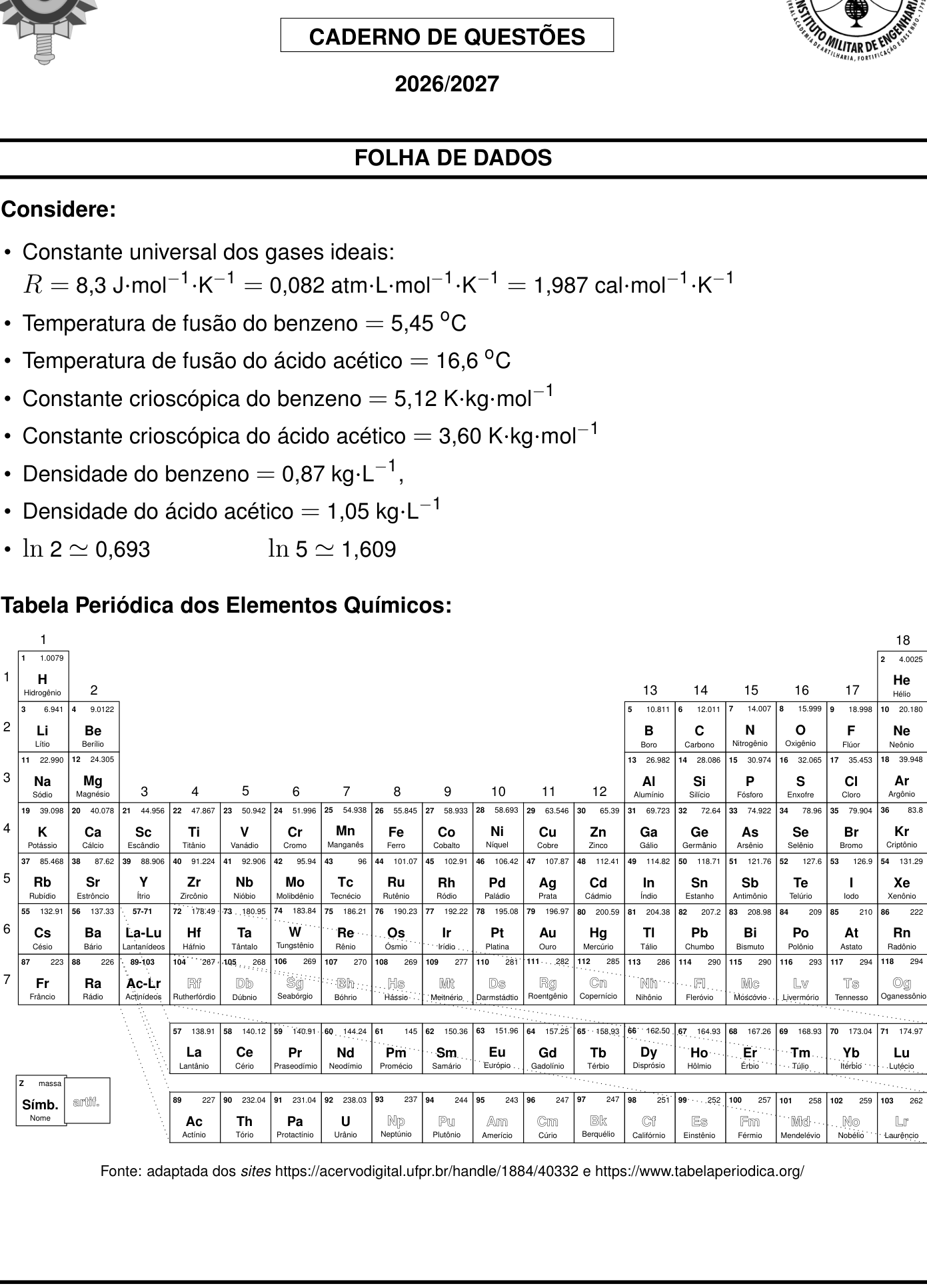
Usando as massas molares da tabela:
M_{\mathrm{NaBr}}=22{,}990+79{,}904=102{,}894\ \mathrm{g\,mol^{-1}},
M_{\mathrm{MnO_2}}=54{,}938+2(15{,}999)=86{,}936\ \mathrm{g\,mol^{-1}}.
Portanto,
m_{\mathrm{MnO_2}}
=\frac{2{,}06}{102{,}894}\cdot\frac{1}{2}\cdot86{,}936
\approx \boxed{0{,}870\ \mathrm{g}}.
Resposta final: 0{,}870\ \mathrm{g} de \mathrm{MnO_2}; reações: \mathrm{MnO_2+4HCl\rightarrow MnCl_2+Cl_2+2H_2O} e \mathrm{Cl_2+2NaBr\rightarrow2NaCl+Br_2}.
Respondeu · diferente da resposta de referência dos cursinhos
0{,}870\ \mathrm{g} de \mathrm{MnO_2}.
levou 8 s
Como pensou
**Calculating chemical values**
I’m working on calculating the equation step by step. First, I find that dividing 2.06 by the sum of 22.990 and 79.904 gives me approximately 0.02002. Then, halving that result leads me to 0.01001. When I multiply that by the molar mass of MnO2, which is 86.936, I get about 0.8703. The equation involves MnO2, HCl, MnCl2, Cl2, and NaBr. So, my final result is roughly 0.870 g.
As reações envolvidas são:
\mathrm{MnO_2 + 4\,HCl \rightarrow MnCl_2 + Cl_2 + 2\,H_2O}
\mathrm{Cl_2 + 2\,NaBr \rightarrow 2\,NaCl + Br_2}
Pelas equações, 1 mol de \mathrm{MnO_2} produz 1 mol de \mathrm{Cl_2}, que reage com 2 mol de \mathrm{NaBr}. Portanto:
n(\mathrm{NaBr})=\frac{2{,}06}{102{,}894}\approx 0{,}0200\ \mathrm{mol}
n(\mathrm{MnO_2})=\frac{0{,}0200}{2}=0{,}0100\ \mathrm{mol}
Como M(\mathrm{MnO_2})=86{,}936\ \mathrm{g\,mol^{-1}},
m(\mathrm{MnO_2})=0{,}0100\cdot86{,}936\approx 0{,}870\ \mathrm{g}
Resposta final: 0{,}870\ \mathrm{g} de \mathrm{MnO_2}.
Respondeu · diferente da resposta de referência dos cursinhos
0{,}870\ \mathrm{g} de \mathrm{MnO_2}.
levou 9 s
Como pensou
**Calculating stoichiometry reactions**
I need to detail the reactions involving manganese dioxide, concentrated HCl, and sodium bromide. The reaction starts with MnO2 and HCl, producing chlorine gas and water. Then, chlorine reacts with NaBr. I’ll calculate the molar mass of NaBr to find the moles in 2.06g, which leads to the amount of chlorine needed. After going through my calculations, I expect to find a product mass of approximately 0.870g, rounding appropriately for significant figures.**Finalizing stoichiometry calculations**
I’m working through the calculations for the reaction involving NaBr and chlorine. By multiplying the moles of NaBr by its molar mass, I confirm a mass close to 0.870g. I'll also note that the reaction consumes HCl (4 moles per MnO2) and mention the generated chlorine. While I can include the specifics about the moles used, I might not need to calculate the mass of the acid. Finally, I’ll ensure to format my results accurately.
As reações envolvidas são:
\mathrm{MnO_2+4HCl\rightarrow MnCl_2+Cl_2+2H_2O}
\mathrm{Cl_2+2NaBr\rightarrow 2NaCl+Br_2}
A massa molar do brometo de sódio é:
M_{\mathrm{NaBr}}=22{,}990+79{,}904=102{,}894\ \mathrm{g\,mol^{-1}}
Logo, em 2{,}06\ \mathrm{g} de NaBr há:
n_{\mathrm{NaBr}}=\frac{2{,}06}{102{,}894}\approx 0{,}0200\ \mathrm{mol}
Pela segunda reação, são necessários 0{,}0200/2=0{,}0100\ \mathrm{mol} de \mathrm{Cl_2}. A primeira reação mostra que a proporção entre \mathrm{MnO_2} e \mathrm{Cl_2} é 1:1; portanto, são necessários 0{,}0100\ \mathrm{mol} de \mathrm{MnO_2}.
M_{\mathrm{MnO_2}}=54{,}938+2(15{,}999)=86{,}936\ \mathrm{g\,mol^{-1}}
m_{\mathrm{MnO_2}}=0{,}0100\times86{,}936\approx0{,}870\ \mathrm{g}
Resposta final: 0{,}870\ \mathrm{g} de \mathrm{MnO_2}.
Respondeu · bate com a resposta de referência dos cursinhos
≈ 0,87 g de MnO₂ (MnO₂ + 4HCl → MnCl₂ + Cl₂ + 2H₂O; Cl₂ + 2NaBr → 2NaCl + Br₂)
levou 11 s
Como pensou
I'm setting up the reaction chain: MnO2 with HCl produces Cl2, which then displaces Br2 from NaBr. Calculating NaBr's molar mass gives about 102.9 g/mol, so 2.06 g corresponds to roughly 0.0200 mol, meaning I need half that amount of Cl2.
That matches MnO2 needed at 0.01 mol, with molar mass 86.94 g/mol giving a mass of about 0.87 g.
Reações envolvidas
- Obtenção do cloro a partir da pirolusita (MnO₂) com HCl concentrado (reação redox: Mn⁴⁺ → Mn²⁺; Cl⁻ → Cl₂):
MnO₂(s) + 4 HCl(conc) → MnCl₂(aq) + Cl₂(g) + 2 H₂O(l)
- Deslocamento do bromo pelo cloro (o Cl₂ é oxidante mais forte que o Br₂):
Cl₂(g) + 2 NaBr(aq) → 2 NaCl(aq) + Br₂(l)
Cálculo estequiométrico
Massa molar do NaBr = 22,990 + 79,904 ≈ 102,9 g/mol
n(NaBr) = 2,06 / 102,9 ≈ 0,0200 mol
Pela reação 2: 2 mol NaBr — 1 mol Cl₂
n(Cl₂) = 0,0200 / 2 = 0,0100 mol
Pela reação 1: 1 mol MnO₂ — 1 mol Cl₂
n(MnO₂) = 0,0100 mol
Massa molar do MnO₂ = 54,938 + 2 × 15,999 ≈ 86,94 g/mol
m(MnO₂) = 0,0100 × 86,94 ≈ 0,869 g
Relação global: MnO₂ + 4 HCl + 2 NaBr → MnCl₂ + 2 NaCl + Br₂ + 2 H₂O, ou seja, 1 mol de MnO₂ libera o bromo de 2 mol de NaBr.
Resposta final: ≈ 0,87 g de MnO₂ (MnO₂ + 4HCl → MnCl₂ + Cl₂ + 2H₂O; Cl₂ + 2NaBr → 2NaCl + Br₂)
Respondeu · bate com a resposta de referência dos cursinhos
≈ 0,87 g de MnO₂ (reações: MnO₂ + 4HCl → MnCl₂ + Cl₂ + 2H₂O; Cl₂ + 2NaBr → 2NaCl + Br₂)
levou 10 s
Como pensou
I'm working through the stoichiometry: MnO2 produces Cl2 which displaces Br2 from NaBr. Using the NaBr molar mass of 102.894, I calculate 2.06 g gives about 0.02002 mol NaBr, half that for Cl2, then multiply by MnO2's molar mass (86.936) to get the required mass of MnO2.
So the mass comes out to about 0.87 g.
Reações envolvidas
-
Obtenção do cloro, a partir da pirolusita com HCl concentrado:
\text{MnO}_2 + 4\,\text{HCl} \rightarrow \text{MnCl}_2 + \text{Cl}_2 + 2\,\text{H}_2\text{O}
-
Liberação do bromo, pela oxidação do brometo pelo cloro:
\text{Cl}_2 + 2\,\text{NaBr} \rightarrow 2\,\text{NaCl} + \text{Br}_2
Cálculos
- Massa molar do NaBr: 22,990 + 79,904 = 102,894 g/mol.
- Quantidade de NaBr: n_{\text{NaBr}} = \dfrac{2{,}06}{102{,}894} \approx 0{,}02002 mol.
- Pela reação 2, 2 mol de NaBr consomem 1 mol de Cl₂. Logo, n_{\text{Cl}_2} \approx 0{,}01001 mol.
- Pela reação 1, 1 mol de MnO₂ produz 1 mol de Cl₂. Logo, n_{\text{MnO}_2} \approx 0{,}01001 mol.
- Massa molar do MnO₂: 54,938 + 2(15,999) = 86,936 g/mol.
- Massa de MnO₂: m = 0{,}01001 \times 86{,}936 \approx 0{,}870 g.
Em resumo, a proporção global é 1 MnO₂ : 1 Cl₂ : 2 NaBr. Portanto, são necessários cerca de 0,87 g de MnO₂.
Resposta final: ≈ 0,87 g de MnO₂ (reações: MnO₂ + 4HCl → MnCl₂ + Cl₂ + 2H₂O; Cl₂ + 2NaBr → 2NaCl + Br₂)
Respondeu · bate com a resposta de referência dos cursinhos
0,87 g de MnO₂ (MnO₂ + 4HCℓ → MnCℓ₂ + Cℓ₂ + 2H₂O; Cℓ₂ + 2NaBr → 2NaCℓ + Br₂)
levou 7 s
Como pensou
Reações envolvidas
- Produção de cloro: MnO₂ + 4 HCℓ → MnCℓ₂ + Cℓ₂ + 2 H₂O
- Deslocamento do bromo: Cℓ₂ + 2 NaBr → 2 NaCℓ + Br₂
Massas molares (valores da tabela)
- NaBr = 22,990 + 79,904 = 102,894 g/mol, aproximadamente 103 g/mol
- MnO₂ = 54,938 + 2(15,999) = 86,936 g/mol, aproximadamente 87 g/mol
Cálculo
- Quantidade de NaBr: n = 2,06 / 103 = 0,02 mol
- Pela reação 2, 2 mol de NaBr consomem 1 mol de Cℓ₂. Logo n(Cℓ₂) = 0,01 mol.
- Pela reação 1, 1 mol de MnO₂ produz 1 mol de Cℓ₂. Logo n(MnO₂) = 0,01 mol.
- Massa de MnO₂ = 0,01 × 87 = 0,87 g
Considerando que o MnO₂ reaja completamente (rendimento de 100%), são necessários cerca de 0,87 g de MnO₂.
Resposta final: 0,87 g de MnO₂ (MnO₂ + 4HCℓ → MnCℓ₂ + Cℓ₂ + 2H₂O; Cℓ₂ + 2NaBr → 2NaCℓ + Br₂)
Respondeu · diferente da resposta de referência dos cursinhos
levou 13 s
Como pensou
The problem is in Portuguese. I will translate it.
The translated problem asks for the mass of manganese(IV) oxide needed to liberate all bromine from 2.06 grams of NaBr using concentrated HCl. The reactions must be shown.
The two reactions are identified. Manganese dioxide reacts with concentrated HCl to produce chlorine gas. That chlorine then liberates bromine from NaBr. The molar mass of NaBr is 103 g/mol. This gives 0.02 mol from 2.06 g.
0.01 mol of Cl₂ is required to liberate all the bromine from 2.06 g of NaBr. This means 0.01 mol of MnO₂ is needed. The molar mass of MnO₂ is 87 g/mol. The mass of MnO₂ is therefore 0.87 g.
A obtenção do cloro a partir do óxido de manganês(IV) e a posterior liberação do bromo ocorrem segundo as reações:
\mathrm{MnO_2 + 4\,HCl \rightarrow MnCl_2 + Cl_2 + 2\,H_2O}
\mathrm{Cl_2 + 2\,NaBr \rightarrow 2\,NaCl + Br_2}
A massa molar do \mathrm{NaBr} é 23 + 80 = 103\,\mathrm{g\cdot mol^{-1}}. Assim, em 2{,}06\,\mathrm{g} de \mathrm{NaBr} há
n(\mathrm{NaBr}) = \frac{2{,}06}{103} = 0{,}020\,\mathrm{mol}.
Pela estequiometria da segunda reação, são necessários 0{,}010\,\mathrm{mol} de \mathrm{Cl_2}. Como a primeira reação produz 1\,\mathrm{mol} de \mathrm{Cl_2} por mol de \mathrm{MnO_2}, também são necessários 0{,}010\,\mathrm{mol} de \mathrm{MnO_2}.
A massa molar do \mathrm{MnO_2} é 55 + 32 = 87\,\mathrm{g\cdot mol^{-1}}, logo
m(\mathrm{MnO_2}) = 0{,}010 \times 87 = 0{,}87\,\mathrm{g}.
Resposta final: 0,87 g
Respondeu · bate com a resposta de referência dos cursinhos
m(MnO_2)\approx 0,87\ \text{g}; reações: MnO_2+4HCl\rightarrow MnCl_2+Cl_2+2H_2O e Cl_2+2NaBr\rightarrow 2NaCl+Br_2.
levou 8 s
Como pensou
We need answer in Portuguese, show development. Need solve chemistry stoichiometry. Need parse question: "Qual a massa de óxido de manganês IV, componente do minério Pirolusita, que deve reagir com HCl concentrado para se obter o cloro necessário à liberação de todo o bromo existente em 2,06 gramas de NaBr? Apresente as reações envolvidas."
We need answer mass MnO2? Need reactions involved.
We need determine mass of manganese IV oxide (MnO2) reacting with concentrated HCl to obtain chlorine needed to liberate all bromine existing in 2.06 g NaBr. Present reactions.
Let's solve.
First, NaBr molar mass: Na 23, Br 80? Use table: Na 22.990, Br 79.904. NaBr ≈ 102.894 g/mol. 2.06 g NaBr => moles = 2.06 / 102.894 = 0.02002 mol ≈ 0.0200 mol. Bromine as Br^-; to liberate all bromine (Br2) from NaBr, need chlorine: 2 NaBr + Cl2 -> 2 NaCl + Br2. Thus moles Cl2 = half moles NaBr = 0.0100 mol. Need Cl2.
Chlorine from MnO2 + HCl concentrated: MnO2 + 4 HCl -> MnCl2 + Cl2 + 2 H2O. Moles MnO2 = moles Cl2 = 0.0100 mol.
Molar mass MnO2: Mn 54.938, O2 31.998 = 86.936 g/mol. Mass = 0.0100 * 86.936 = 0.869 g. Or if using approximate Mn=55, O=16 => 87 g/mol; mass 0.87 g. Need decide.
Question likely expects from data: 2.06 g NaBr. Molar mass NaBr = 23+80 = 103; n=0.02 mol. Cl2 needed 0.01 mol. MnO2 mass = 0.01*87 = 0.87 g. But if using exact table: 2.06 / 102.89 = 0.02002; mass = 0.02002/2 *86.94 = 0.870 g. So answer ~0,87 g.
Need present reactions involved:
1) MnO2 + 4 HCl (conc) → MnCl2 + Cl2 + 2 H2O
2) Cl2 + 2 NaBr → 2 NaCl + Br2 (or 2 NaBr + Cl2 → 2 NaCl + Br2)
Maybe also mention oxidation of bromide by chlorine.
Need include calculations.
Let's ensure "óxido de manganês IV" = MnO2. Pirolusita is MnO2. HCl concentrated. "para se obter o cloro necessário à liberação de todo o bromo existente em 2,06 gramas de NaBr" yes.
Need maybe account excess? No, stoichiometric.
Let's craft final response in Portuguese, item by item if needed. The question has no explicit a/b, but we can structure: Reações, Cálculo. Need maybe show mass. Use data from table? The "folha de dados" gives periodic table; use molar masses: Na=22,99; Br=79,90; Mn=54,94; O=16,00. But in typical IME, use provided table. We can mention using massas molares aproximadas: NaBr = 102,9 g/mol; MnO2 = 86,9 g/mol.
Let's solve precisely:
M(NaBr) = 22.990 + 79.904 = 102.894 g/mol.
n(NaBr) = 2.06 / 102.894 = 0.020020 mol.
From equation: 2 mol NaBr react with 1 mol Cl2. n(Cl2) = 0.010010 mol.
From equation: 1 mol MnO2 produces 1 mol Cl2. n(MnO2) = 0.010010 mol.
M(MnO2) = 54.938 + 2*15.999 = 86.936 g/mol.
m(MnO2) = 0.010010 * 86.936 = 0.8704 g. Approx 0.87 g.
If using rounded atomic masses: Na=23, Br=80 => M=103; n=0.02; n Cl2=0.01; MnO2=55+32=87; mass=0.87 g. Same.
Need include "Reações envolvidas:"
- 2 NaBr + Cl2 → 2 NaCl + Br2
- MnO2 + 4 HCl → MnCl2 + Cl2 + 2 H2O
Maybe order: First produce Cl2, then react with NaBr.
Maybe "HCl concentrado" acts as reducing? Actually MnO2 oxidizes HCl to Cl2; HCl is reducing agent and acid. Reaction: MnO2 + 4 HCl → MnCl2 + Cl2 + 2 H2O.
Need maybe mention "todo o bromo existente" means all bromide oxidized to Br2. Good.
Need final line exactly "Resposta final: ..." Include mass and reactions? The instruction: "Termine com uma linha neste formato: Resposta final: <o resultado de cada item, de forma curta> Por exemplo, ... Se a questão tiver uma resposta só, escreva só o resultado." Since question asks mass and reactions, final line should include result maybe mass and reactions? It says if question has one answer, write only result. But here asks mass and reactions. We can include both in final line? Maybe "Resposta final: m(MnO2) ≈ 0,87 g; reações: MnO2 + 4 HCl → MnCl2 + Cl2 + 2 H2O e Cl2 + 2 NaBr → 2 NaCl + Br2." But the instruction says final line short. We'll include.
Need maybe not include excessive. Let's formulate.
Potential issue: "óxido de manganês IV" could be MnO2, but "componente do minério Pirolusita" maybe not pure, but assume stoichiometric. "massa de óxido de manganês IV ... que deve reagir" yes.
Let's consider if the reaction of MnO2 with HCl concentrated could be:
MnO2 + 4 HCl → MnCl2 + Cl2 + 2 H2O
But sometimes HCl concentration matters, with MnO2 + 4 HCl(conc) -> MnCl2 + Cl2 + 2 H2O. Good.
Then chlorine liberates bromine:
Cl2 + 2 NaBr → 2 NaCl + Br2
Net:
MnO2 + 4 HCl + 2 NaBr → MnCl2 + Cl2 + 2 H2O + 2 NaCl + Br2? But Cl2 intermediate, not net if combine? Actually if Cl2 generated in situ consumed, net: MnO2 + 4 HCl + 2 NaBr → MnCl2 + 2 H2O + 2 NaCl + Br2. But question says "reagir com HCl concentrado para se obter o cloro necessário à liberação..." so likely present two reactions. Could also present global. Let's include both.
Need calculate "massa de óxido de manganês IV" not "massa de pirolusita" maybe if minério contains MnO2? It says "componente do minério Pirolusita" so mass of MnO2.
Let's verify stoichiometry:
2 NaBr + Cl2 -> 2 NaCl + Br2. 2.06 g NaBr = 0.0200 mol. Br2 mol = 0.0100. Cl2 required = 0.0100. MnO2 required = 0.0100. mass = 0.0100*86.94 = 0.8694 g. Good.
Let's prepare final with equations and calculations in Portuguese.
Potential need to use "massa molar" values from table:
Na = 22.99 g/mol; Br = 79.90 g/mol; Mn = 54.94; O = 16.00. Then M(NaBr) = 102.89; M(MnO2)=86.94. Use 2.06/102.89 = 0.02002 mol; m=0.02002/2*86.94 =0.870 g. Could round to 0.87 g.
Let's write:
1) Reação de obtenção de cloro:
MnO2(s) + 4 HCl(conc) → MnCl2(aq) + Cl2(g) + 2 H2O(l)
2) Reação de liberação de bromo:
Cl2(g) + 2 NaBr(aq) → 2 NaCl(aq) + Br2(l) (ou Br2(aq))
Cálculo:
M(NaBr) = 23,0 + 79,9 = 102,9 g/mol
n(NaBr) = 2,06 g / 102,9 g/mol ≈ 0,0200 mol
Pela estequiometria: 2 mol NaBr : 1 mol Cl2 → n(Cl2)=0,0100 mol.
Como 1 mol MnO2 : 1 mol Cl2, n(MnO2)=0,0100 mol.
M(MnO2) = 54,9 + 2(16,0) = 86,9 g/mol.
m(MnO2) = 0,0100 mol × 86,9 g/mol = 0,869 g ≈ 0,87 g.
Final line.
Need ensure "Resposta final:" with result. Maybe include reactions:
"Resposta final: m(MnO2) ≈ 0,87 g; reações: MnO2 + 4 HCl → MnCl2 + Cl2 + 2 H2O e Cl2 + 2 NaBr → 2 NaCl + Br2."
That's likely acceptable. But instruction: "Termine com uma linha neste formato: Resposta final: <o resultado de cada item, de forma curta>". They might want only result, but question asks reactions too; include both. Good.
Let's provide final in Portuguese.
Reações envolvidas:
- Obtenção de cloro a partir do óxido de manganês IV e HCl concentrado:
MnO_2 + 4HCl \rightarrow MnCl_2 + Cl_2 + 2H_2O
- Liberação do bromo pelo cloro:
Cl_2 + 2NaBr \rightarrow 2NaCl + Br_2
Cálculo da massa de MnO_2:
Massa molar do NaBr:
M(NaBr)=23,0+79,9=102,9\ \text{g/mol}
Mols de NaBr em 2,06 g:
n(NaBr)=\frac{2,06}{102,9}\approx 0,0200\ \text{mol}
Pela estequiometria:
2\ \text{mol}\ NaBr \rightarrow 1\ \text{mol}\ Cl_2
n(Cl_2)=\frac{0,0200}{2}=0,0100\ \text{mol}
Pela primeira reação:
1\ \text{mol}\ MnO_2 \rightarrow 1\ \text{mol}\ Cl_2
n(MnO_2)=0,0100\ \text{mol}
Massa molar do MnO_2:
M(MnO_2)=54,9+2(16,0)=86,9\ \text{g/mol}
Massa necessária:
m(MnO_2)=0,0100\times 86,9\approx 0,87\ \text{g}
Resposta final: m(MnO_2)\approx 0,87\ \text{g}; reações: MnO_2+4HCl\rightarrow MnCl_2+Cl_2+2H_2O e Cl_2+2NaBr\rightarrow 2NaCl+Br_2.
Respondeu · diferente da resposta de referência dos cursinhos
levou 19 s
Como pensou
**Calculating Manganese Oxide Mass**
I'm currently working through the stoichiometry of the reaction, focusing on determining the amount of chlorine needed to liberate all bromine from the given sodium bromide. This will then allow me to calculate the necessary mass of manganese(IV) oxide.
**Verifying NaBr Molar Mass**
I've confirmed that the provided 2.06 g of sodium bromide corresponds to exactly 0.02 moles, using a molar mass of 103 g/mol (23 g/mol for Na and 80 g/mol for Br). This precise value strongly suggests the use of rounded atomic masses.
**Calculating Chlorine Needs**
My next step is to determine the exact amount of chlorine gas required to react completely with the 0.02 moles of sodium bromide. This calculation is crucial for proceeding to the final determination of manganese dioxide mass.
**Determining $\text{MnO}_2$ Stoichiometry**
I've established the stoichiometric relationship between manganese(IV) oxide and sodium bromide. One mole of $\text{MnO}_2$ produces one mole of $\text{Cl}_2$, which then reacts with two moles of $\text{NaBr}$. This means a 1:2 molar ratio exists between $\text{MnO}_2$ and $\text{NaBr}$.
**Calculating Manganese Dioxide Mass**
I've confirmed the molar mass of $\text{MnO}_2$ using both rounded and precise atomic values, arriving at approximately 87 g/mol. Based on the 1:2 stoichiometric ratio with $\text{NaBr}$, I've calculated the required moles of $\text{MnO}_2$ to be 0.01 mol. This leads to a precise mass of 0.87 g for manganese dioxide.
**Verifying $\text{MnO}_2$ Molar Mass**
I've calculated the molar mass of $\text{MnO}_2$ using both rounded and precise atomic masses, consistently arriving at approximately 87 g/mol. This value is now ready for use in determining the final mass.
**Confirming Manganese Dioxide Mass**
With the moles of $\text{MnO}_2$ established as 0.01 mol, and its molar mass at ~87 g/mol, I've calculated the final required mass of manganese dioxide to be exactly 0.87 g. This concludes the mass calculation.
**Finalizing Manganese Dioxide Calculation**
Having determined that 0.01 moles of $\text{MnO}_2$ are needed and confirmed its molar mass is 87 g/mol, I've now calculated the final mass of manganese dioxide to be 0.87 g. This resolves the primary calculation.
**Calculating Manganese Dioxide Mass**
I've calculated the molar mass of $\text{MnO}_2$ to be approximately 87 g/mol. Using the previously determined 0.01 moles required, I've now finalized the calculation for the mass of manganese dioxide at 0.87 g.
**Determining Manganese Dioxide Mass**
Using the 1:2 $\text{MnO}_2$ to $\text{NaBr}$ ratio and the established 0.01 mol $\text{NaBr}$, I've calculated 0.01 mol of $\text{MnO}_2$. Combined with its molar mass of 87 g/mol, this yields a final mass of 0.87 g for $\text{MnO}_2$.
**Calculating Manganese Dioxide Mass**
I've now confirmed the molar masses for both $\text{NaBr}$ (~103 g/mol) and $\text{MnO}_2$ (~87 g/mol). The crucial stoichiometric relationship is 1 mole of $\text{MnO}_2$ reacting with 2 moles of $\text{NaBr}$, which I am using to finalize the mass calculation.
Para determinar a massa de óxido de manganês(IV) (\text{MnO}_2) necessária, analisamos as etapas do processo:
1. Reações Envolvidas
-
Obtenção do gás cloro (\text{Cl}_2):
O óxido de manganês(IV) reage com o ácido clorídrico concentrado sofrendo oxirredução:
\text{MnO}_2\text{(s)} + 4\text{ HCl}\text{(aq)} \rightarrow \text{MnCl}_2\text{(aq)} + \text{Cl}_2\text{(g)} + 2\text{ H}_2\text{O}\text{(l)}
-
Liberação do bromo (\text{Br}_2):
O gás cloro liberado oxida os íons brometo presentes no brometo de sódio (\text{NaBr}):
\text{Cl}_2\text{(g)} + 2\text{ NaBr}\text{(aq)} \rightarrow 2\text{ NaCl}\text{(aq)} + \text{Br}_2\text{(l)}
2. Equação Global e Relação Estequiométrica
Somando as duas equações, obtém-se a equação global do processo:
\text{MnO}_2\text{(s)} + 4\text{ HCl}\text{(aq)} + 2\text{ NaBr}\text{(aq)} \rightarrow \text{MnCl}_2\text{(aq)} + 2\text{ NaCl}\text{(aq)} + \text{Br}_2\text{(l)} + 2\text{ H}_2\text{O}\text{(l)}
Dessa relação estequiométrica, tem-se que:
1\text{ mol de }\text{MnO}_2 \iff 1\text{ mol de }\text{Cl}_2 \iff 2\text{ mols de }\text{NaBr}
3. Massas Molares (dados da Tabela Periódica)
-
\text{NaBr}:
M(\text{NaBr}) = M(\text{Na}) + M(\text{Br}) = 22,990 + 79,904 = 102,894\text{ g}\cdot\text{mol}^{-1} \approx 103\text{ g}\cdot\text{mol}^{-1}
-
\text{MnO}_2:
M(\text{MnO}_2) = M(\text{Mn}) + 2 \cdot M(\text{O}) = 54,938 + 2 \cdot (15,999) = 86,936\text{ g}\cdot\text{mol}^{-1} \approx 87\text{ g}\cdot\text{mol}^{-1}
4. Cálculo da Massa de \text{MnO}_2
-
Quantidade de matéria de \text{NaBr}:
n_{\text{NaBr}} = \frac{m_{\text{NaBr}}}{M_{\text{NaBr}}} = \frac{2,06\text{ g}}{103\text{ g}\cdot\text{mol}^{-1}} = 0,02\text{ mol}
-
Quantidade de matéria de \text{MnO}_2 necessária:
n_{\text{MnO}_2} = \frac{n_{\text{NaBr}}}{2} = \frac{0,02\text{ mol}}{2} = 0,01\text{ mol}
-
Massa de \text{MnO}_2:
m_{\text{MnO}_2} = n_{\text{MnO}_2} \times M_{\text{MnO}_2} = 0,01\text{ mol} \times 87\text{ g}\cdot\text{mol}^{-1} = 0,87\text{ g}
(Utilizando diretamente as massas molares da tabela: m = \frac{2,06}{2 \times 102,894} \times 86,936 = 0,870\text{ g})
Resposta final: 0,87 g
Respondeu · bate com a resposta de referência dos cursinhos
0,87 g de MnO2; Reações: MnO2 + 4 HCl -> MnCl2 + Cl2 + 2 H2O e Cl2 + 2 NaBr -> 2 NaCl + Br2
levou 29 s
Como pensou
**Analyzing Chemistry Problem**
I am currently focused on understanding the chemical reaction and stoichiometry required to determine the mass of manganese dioxide needed to produce a specific amount of chlorine gas through its reaction with concentrated hydrochloric acid. I'm referencing the provided data to ensure accuracy.
**Calculating Bromine Quantity**
I've identified the two key chemical reactions and calculated the necessary molar masses, noting the use of rounded atomic values. My focus is now on determining the moles of sodium bromide present.
**Verifying Calculation Accuracy**
I'm double-checking my calculations for manganese dioxide, comparing results derived from both rounded and precise atomic masses. This ensures the stoichiometric determination of $\text{MnO}_2$ moles from $\text{NaBr}$ is robust.
1. Reações químicas envolvidas:
A reação do óxido de manganês IV (\text{MnO}_2) com ácido clorídrico (\text{HCl}) concentrado produz gás cloro (\text{Cl}_2), cloreto de manganês II (\text{MnCl}_2) e água, conforme a equação balanceada:
\text{MnO}_2\text{(s)} + 4\,\text{HCl}\text{(aq)} \rightarrow \text{MnCl}_2\text{(aq)} + \text{Cl}_2\text{(g)} + 2\,\text{H}_2\text{O}\text{(l)}
Em seguida, o gás cloro obtido atua como agente oxidante, deslocando o bromo do brometo de sódio (\text{NaBr}):
\text{Cl}_2\text{(g)} + 2\,\text{NaBr}\text{(aq)} \rightarrow 2\,\text{NaCl}\text{(aq)} + \text{Br}_2\text{(l)}
2. Cálculo estequiométrico:
Consultando a Tabela Periódica fornecida, temos as seguintes massas molares aproximadas:
- \text{Na} = 23,0\text{ g}\cdot\text{mol}^{-1}
- \text{Br} = 80,0\text{ g}\cdot\text{mol}^{-1}
- \text{Mn} = 55,0\text{ g}\cdot\text{mol}^{-1}
- \text{O} = 16,0\text{ g}\cdot\text{mol}^{-1}
Assim, as massas molares das substâncias de interesse são:
- M(\text{NaBr}) = 23,0 + 80,0 = 103,0\text{ g}\cdot\text{mol}^{-1}
- M(\text{MnO}_2) = 55,0 + 2 \times 16,0 = 87,0\text{ g}\cdot\text{mol}^{-1}
Calculando o número de mols de \text{NaBr} presentes em 2,06\text{ g}:
n_{\text{NaBr}} = \frac{m_{\text{NaBr}}}{M(\text{NaBr})} = \frac{2,06\text{ g}}{103,0\text{ g}\cdot\text{mol}^{-1}} = 0,02\text{ mol}
Pela estequiometria das reações apresentadas, 1\text{ mol} de \text{MnO}_2 produz 1\text{ mol} de \text{Cl}_2, que por sua vez reage com 2\text{ mols} de \text{NaBr}. Portanto, a proporção estequiométrica entre o \text{MnO}_2 e o \text{NaBr} é de 1:2:
n_{\text{MnO}_2} = \frac{1}{2} \cdot n_{\text{NaBr}} = \frac{0,02\text{ mol}}{2} = 0,01\text{ mol}
Logo, a massa necessária de \text{MnO}_2 é:
m_{\text{MnO}_2} = n_{\text{MnO}_2} \cdot M(\text{MnO}_2) = 0,01\text{ mol} \times 87,0\text{ g}\cdot\text{mol}^{-1} = 0,87\text{ g}
Resposta final: 0,87 g de MnO2; Reações: MnO2 + 4 HCl -> MnCl2 + Cl2 + 2 H2O e Cl2 + 2 NaBr -> 2 NaCl + Br2