Como pensou
We need answer question. Need solve. Let's restate: Consider assertivas I, II, III. Need identify correct only.
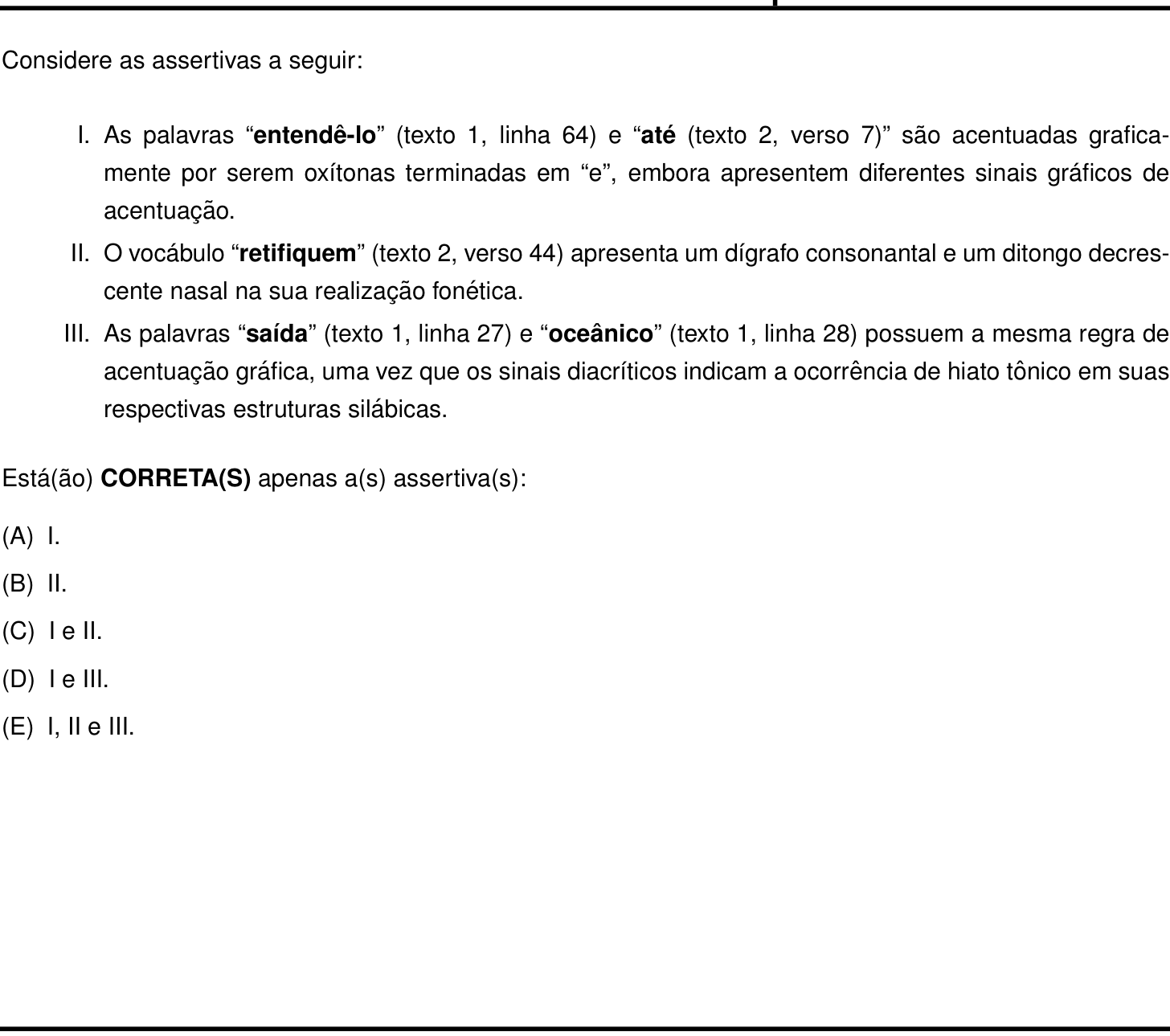
I. As palavras “entendê-lo” (texto 1, linha 64) e “até (texto 2, verso 7)” são acentuadas graficamente por serem oxítonas terminadas em “e”, embora apresentem diferentes sinais gráficos de acentuação.
Check: "entendê-lo" is? Verb entender + lo pronoun: entendê-lo. Acentuação: oxítona terminada em e? Actually "entendê" maybe? Let's see: "entender" oxytone? No, "entender" is oxytone ending in -er, no accent. But "entendê-lo" has accent on ê? It is "entendê-lo" with circumflex on e? It is oxytone? The stressed syllable is "dê" maybe? Wait "entendê-lo": verb "entender" + enclitic pronoun "lo". In infinitive with enclitic pronoun, accent rule? "entendê-lo" (ê stressed? Actually verb "entender" infinitive: en-ten-DER (oxytone, no accent because -r). When pronoun -lo added: "entendê-lo": stressed syllable "dê" (because -lo causes? Let's think: "entender" + lo -> "entendê-lo" with circumflex: "entendê-lo" (to understand him). It is stressed on "dê": en-ten-dê-lo. That is an oxytone? "entendê-lo" is oxytone? Síllaba tônica: dê (last? no, "lo" is after; the pronoun is enclitic, but stress remains on verb root? Actually "entendê-lo": en-ten-dê-lo, tonic syllable "dê" (penultimate? Wait there are four syllables: en-ten-dê-lo. Stress on "dê" is antepenultimate? No: en (1) ten (2) dê (3) lo (4). If stress on "dê", it's proparoxytone? But Portuguese "entendê-lo" is oxytone? Let's verify: "entender" infinitive: en-ten-DER, stress on last syllable (der). Add -lo: "entendê-lo" maybe stress on "dê"? Actually in verb + enclitic pronoun, the stress stays on the verb's stressed syllable, and due to addition of enclitic, the verb ending changes: "entender" -> "entendê-lo"? The stressed syllable "der" becomes "dê"? It's because -lo causes the final -r to be dropped and acute/circumflex accent added to indicate stress on "e"? Wait "entender" + lo = "entendê-lo": The -r is dropped, the vowel before becomes "ê" with circumflex to indicate stressed close e? Stress remains on the same syllable? Original: en-ten-DER (last syllable). New: en-ten-DÊ-lo? But if stress on "dê" (third syllable), then word is proparoxytone? But Portuguese "entendê-lo" is classified as oxytone? Let's check: "entendê-lo" has accent circumflex on "ê": "entendê-lo". According to Portuguese accent rules: "Acentuam-se as oxítonas terminadas em a(s), e(s), o(s), em, ens: ..." It is oxytone? The stressed syllable is "dê" which is the last syllable before pronoun? Actually in "entendê-lo", the pronoun "lo" is an enclitic; the word's stressed syllable is "dê", which is the last syllable? Wait written without pronoun: "entender" stress on "der" (last syllable). With pronoun "lo": "entendê-lo": the pronoun is after the verb, but the verb's stressed syllable is still the final syllable of the verb? The verb form is "entendê" (with circumflex) plus "lo"; so "entendê" is the verb? "Entender" in infinitive: "entender"; when enclitic pronoun -lo, the -r is removed and the preceding e receives circumflex: "entendê-lo". So the verb part is "entendê", with stress on last syllable "dê" (since "entendê" is oxytone? Yes "entendê" has stress on "dê"). Then "lo" is pronoun. So "entendê-lo" is oxytone? The whole word stress on "dê" (the syllable before "lo"; but "lo" is not a separate word, it's enclitic; but the word's tonic syllable is "dê" and it's the last syllable of the verb? Actually in the whole word "entendê-lo", the last syllable is "lo", but it's unstressed. The stressed syllable is "dê", which is the penultimate? Wait en-ten-dê-lo: syllables: en, ten, dê, lo. Stressed: dê = third syllable, which is antepenultimate? If word has 4 syllables, stress on third = antepenultimate -> proparoxytone. But is "entendê-lo" proparoxytone? Hmm not sure. Let's consult memory: "entendê-lo" is acentuada por ser oxítona terminada em "e"? I think it is oxytone? Let's see examples: "vê-lo" (ver + lo) = vê-lo, oxytone? "vê-lo" stress on "vê" (last syllable). That's oxytone ending in "e"; receives circumflex? "vê-lo" has circumflex on ê because stressed? Actually "vê-lo" is oxytone? Yes. "fazê-lo" (fazer + lo) = fazê-lo, oxytone? Stress on "zê"; accent circumflex. "entendê-lo" also oxytone? Wait "entender" is oxytone; after adding enclitic, the stress stays on the last syllable of the verb? In "entendê-lo", the verb form is "entendê" (stress on final syllable, oxytone) + "lo". So yes oxytone.
"até" is oxytone ending in "e" (a-té), accent acute. Different signs: entendê-lo uses circumflex, até uses acute. Statement says are accented graphically for being oxytones ending in "e", although present different accent signs. That seems correct: "entendê-lo" and "até" both oxítonas terminadas em e, but one receives circumflex and other acute? Wait "até" ends in "e" with acute accent; "entendê-lo" ends in "e"? It has ê + lo; ending of word is "o"? Actually word ends with "o" (lo). But the stressed syllable is "dê", and the word "entendê-lo" is oxytone? The ending of the word is "o" not "e"? Wait "entendê-lo": final letter is "o" (pronoun). So it's oxytone ending in "o"? But the stressed vowel is "ê" (e) not ending in e? Let's parse: "entendê-lo": orthographically ends with "o" because pronoun "lo"; but the tonic syllable is "dê" (e). The accent on "ê" indicates stressed e. Accent rule for oxytones ending in e? Is it because the verb form "entendê" ends in "e" before pronoun? Hmm.
Actually in Portuguese, when enclitic pronoun -lo, -la, -los, -las is added to an infinitive, the infinitive loses final -r and the preceding vowel receives an accent if needed: "amar + o = amá-lo" (acute), "vender + o = vendê-lo" (circumflex), "partir + o = parti-lo" (no accent? "parti-lo" stress on "ti"? Actually "partir" + lo = parti-lo; stress on "tir"? Wait "partir" oxytone ending in r; after adding lo: "parti-lo" should be stressed on "tir"? But orthographically "parti-lo" has no accent? Hmm examples: "parti-lo" maybe no accent because "i" stressed? Actually "partir" + lo = "parti-lo": stress on "tir"? Let's see: "partir" /paɾˈtiɾ/ (oxytone). With -lo, becomes /paɾˈti.lu/ maybe? The -r drops, giving "parti" + lo = "parti-lo" with stress on "ti"? But then word stress on "ti" (penultimate? syllables par-ti-lo; stress on "ti" = penultimate -> paroxytone? But no accent? Because paroxytone ending in "o" doesn't need accent? But "parti-lo" is pronounced with stress on "ti" maybe? Actually "parti-lo" no accent? Let's check: "partir" + o = "parti-lo": There is no accent because "i" stressed in paroxytone? Wait the verb "partir" is oxytone, but when enclitic added, the stress remains on the verb's last syllable? But because -lo added after, the verb's last syllable is no longer last; however, enclitic pronouns are considered part of the word for accent? Stress in "parti-lo" maybe on "ti"? Actually "partir" (to leave) second person? Let's use known: "fazer" + o = "fazê-lo" (accent circumflex). "dizer" + o = "dizê-lo". "trazer" + o = "trazê-lo". "pôr" + o = "pô-lo". So for infinitives ending in -er, the e is stressed and receives circumflex. For infinitives ending in -ar, a stressed receives acute: "amá-lo". For -ir, i stressed? "parti-lo" maybe no accent because "i" stressed in oxytone? Actually "partir" + o = "parti-lo"; the "i" is stressed? Portuguese rule: "Acentuam-se as oxítonas terminadas em i(s)"? "parti-lo" ends in "o" (lo), not i; but stress on i? Hmm.
Let's recall: "ferir" + o = "feri-lo" (no accent? because "i" tonic in oxytone ending in "o"? Maybe "feri-lo" no accent because "i" is not ending? Actually word "feri-lo" has stress on "ri"? Wait "ferir" /feˈɾiɾ/ oxytone; after adding -lo: "feri-lo" /feˈɾi.lu/ stress on "ri" (now penultimate? syllables fe-ri-lo; stress on ri = penultimate, paroxytone ending in o -> no accent needed). But for -er: "vender" /vẽˈdeɾ/ oxytone; after -lo: "vendê-lo" /vẽˈde.lu/ stress on "dê" (penultimate? syllables ven-dê-lo; stress on dê = penultimate? Wait 3 syllables: ven-dê-lo; stress on dê = second syllable, penultimate? For word with 3 syllables, penultimate is second syllable, yes. So "vendê-lo" is paroxytone? But it has circumflex accent? Paroxytone ending in "o" doesn't need accent generally, but it receives circumflex? Actually "vendê-lo" has circumflex on ê, indicating stressed close vowel, not because of oxytone rule? Hmm but "vendê-lo" is stressed on "dê" (paroxytone), ending in "o"; why accent? Perhaps because "ê" in paroxytone? No, paroxytone "e" closed? Let's check: "vender" + lo = "vendê-lo": The stressed vowel is ê (closed e) in paroxytone? But paroxytone words ending in -o generally no accent: "vendo" (I sell) no accent. "vendê-lo" has accent because it's a special case? Actually "vendê-lo" may be oxytone? Let's sound: ven-DÊ-lo? In Brazilian Portuguese, "vendê-lo" stress maybe on "dê" but it's the last syllable before pronoun? The pronoun is unstressed; but word stress might be on "dê" which is the last syllable of the verb. The whole word may be considered oxytone? Hmm.
Let's search memory: "entendê-lo" is acentuada pela mesma regra de "vê-lo"? Both oxítonas terminadas em e? But "entendê-lo" ends with "o" (lo). The stressed syllable "dê" is not final? In "vê-lo", stressed syllable "vê" is first of two? Actually "vê-lo": vê (stressed) + lo; two syllables, stress on first = penultimate? But "vê-lo" is oxytone? No, "vê-lo" has two syllables, stress on first = paroxytone? But it receives circumflex? "vê-lo" = ver + lo; "ver" is oxytone? Actually "ver" is oxytone (stress on ver, no accent because monosyllable? "ver" no accent). With lo: "vê-lo" stress on "vê", which is first syllable, making paroxytone? But Portuguese "vê-lo" has accent circumflex on ê because stressed closed e in paroxytone? Hmm not sure. Wait "vê-lo" is pronounced /ˈve.lu/ with stress on first syllable; that's paroxytone. Why accent? Because "e" is closed? Let's see "velo" (veil) no accent, but "vê-lo" has circumflex to indicate closed e and stress? Maybe because it's a verb+pronoun combination, accent marks stress on "vê". It is paroxytone ending in "o"; normally no accent, but to avoid ambiguity? The word "velo" exists? "velo" (from velar) no accent. So accent distinguishes? Hmm.
Maybe statement I is from actual exam; likely false? Need determine correctness. Let's examine all.
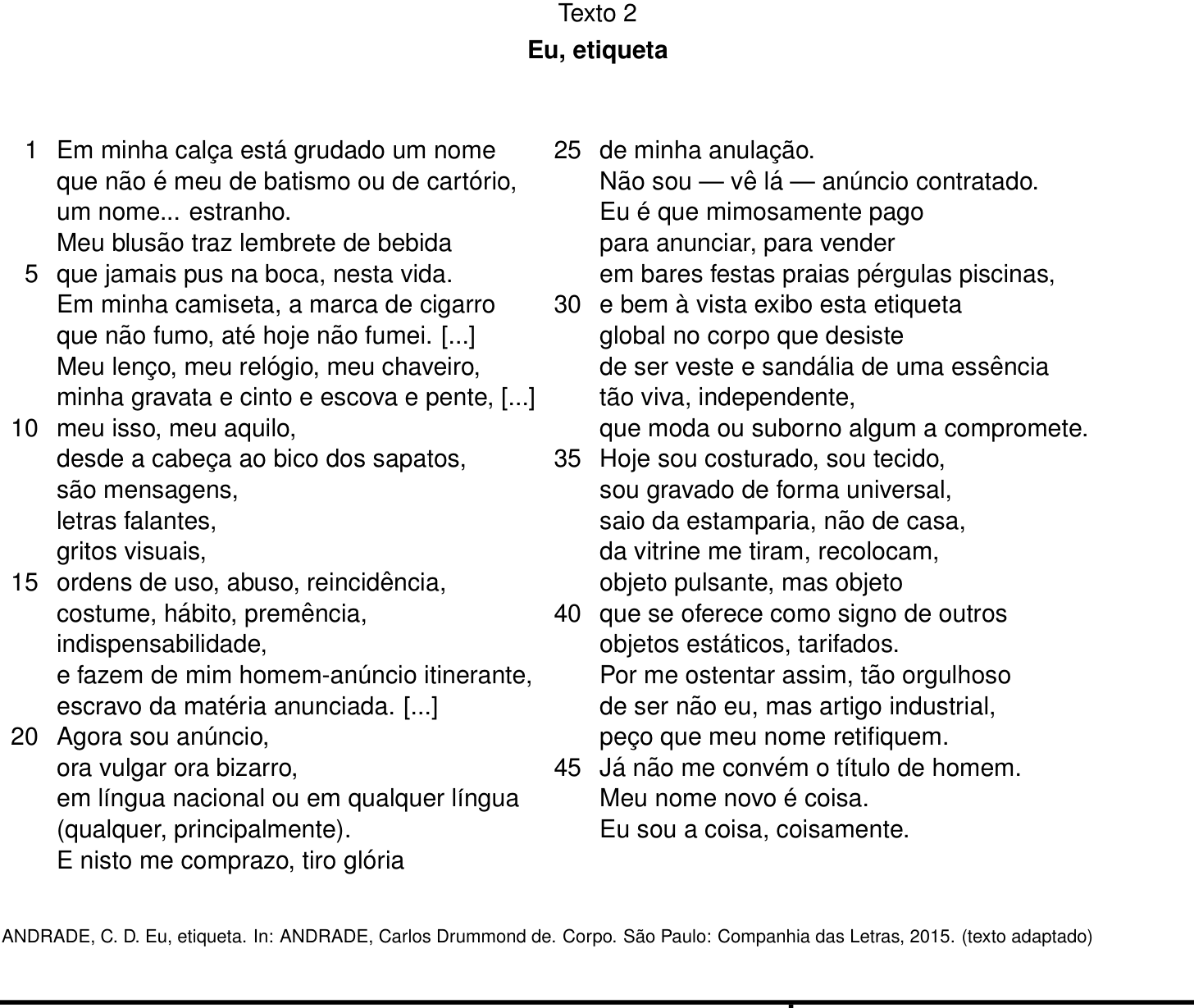
II. O vocábulo “retifiquem” (texto 2, verso 44) apresenta um dígrafo consonantal e um ditongo decrescente nasal na sua realização fonética. "retifiquem" = re-ti-fi-quem. Let's analyze: "retifiquem" is verb retificar, 3rd person plural present subjunctive? Actually "retifiquem" pronounced /ʁetʃiˈfikẽj̃/ maybe? It contains "qu" before "e" -> digraph "qu" pronounced /k/ (consonantal digraph? "qu" is a digraph? In Portuguese, "qu" is a consonantal digraph when representing /k/ before e/i? Yes "qu" in "quem" is digraph? It represents /k/ and the u is not pronounced. So "retifiquem" has "qu" digraph? But in "retifiquem", letters q-u-e? Actually "retifiquem": r e t i f i q u e m. The "qu" before "e" is a digraph? It corresponds to /k/, with u not pronounced. So yes, "qu" is a consonantal digraph. Also "em" at end? "retifiquem" ends in "em" which can be pronounced as nasal diphthong [ẽj̃]? Let's see: "quem" is pronounced [kẽj̃] (nasal diphthong "ẽe"? In Brazilian Portuguese, "em" final is a nasal diphthong? It is a ditongo nasal decrescente? "em" = [ẽj̃] (oral? Actually nasal diphthong: vowel + nasal glide). Yes, "em" is a ditongo nasal decrescente? In "quem", the "em" is a ditongo nasal? Possibly. So statement II says "apresenta um dígrafo consonantal e um ditongo decrescente nasal". Does "retifiquem" have both? Let's verify: "retifiquem": consonants: r, t, f, q u? Hmm "qu" is digraph? It is two letters representing one phoneme /k/. Yes. "em" final: ditongo decrescente nasal? In "retifiquem", the ending "-em" after "qu"? Actually "quem" has "em" = nasal diphthong? The syllable "quem" is stressed? In "retifiquem", stress? Verb "retifiquem": stress on "fi"? Let's conjugate: retificar -> retifiQUE (stress on que?) Actually "retifiquem" (eles retifiquem) stress on "fi"? Wait "retificar" is paroxytone? no, retificar: re-ti-fi-CAR (oxytone). Present subjunctive: que eles retifiquem: stress on "fi"? Let's recall: "retificar" -> "retifico" (stress on "fi"? no "ti"?). Actually "retificar" stress: re-ti-fi-car? Let's say: /ʁe.tʃi.fiˈka(ʁ)/ stress on "car". Present subjunctive: "retifique" (stress on "fi"? maybe). "retifiquem" stress maybe on "fi": re-ti-FI-quem? Wait "retifiquem" has 4 syllables? re-ti-fi-quem? Hmm "retifiquem": re-ti-fi-quem? Actually "retifiquem" = re-ti-fi-quem? No: re-ti-fi-quem? The base "retific" + "quem"? Let's spell: r e t i f i q u e m = re-ti-fi-quem (4 syllables? re-ti-fi-quem? "quem" one syllable). Stress? "retifiquem" might be stressed on "fi"? But "fi" is third? Let's use verb: "retificar" (to rectify). Present subjunctive: que eu retifique (stress on "fi"? re-ti-fi-que? Actually "retifique" = re-ti-fi-que, stress on "fi"? yes maybe). "retifiquem" = re-ti-fi-quem, stress on "fi"? Then ending "-em" is in unstressed syllable? Wait "quem" syllable contains "e" nasal? In "retifiquem", the "quem" syllable is unstressed? If stress on "fi", then "quem" is post-tonic? The word ends with "em" in unstressed syllable? In Portuguese, final "em" unstressed can be [ẽj̃]? The nasal diphthong occurs in stressed or unstressed? It can occur in unstressed final? Example "homem" (stress on ho? Actually homem stress on ho? "homem" = ho-mem, stress on ho, final "mem" unstressed with nasal diphthong? Yes "homem" final em is [ẽj̃]? Maybe. So yes.
But "ditongo decrescente nasal" in "retifiquem": the "em" is a nasal diphthong? Its phonetic realization [ẽj̃] is a diphthong with oral vowel? Actually [ẽ] nasal + [j̃] nasal glide; yes decrescente (vowel + glide). So II likely correct.
III. As palavras “saída” (texto 1, linha 27) e “oceânico” (texto 1, linha 28) possuem a mesma regra de acentuação gráfica, uma vez que os sinais diacríticos indicam a ocorrência de hiato tônico em suas respectivas estruturas silábicas.
"saída": sa-í-da. The accent acute on i indicates hiato tônico? The i is stressed and forms separate syllable from a? Actually "saída": sa-í-da; the "í" is stressed, and it's a hiatus? The vowels a and i are in separate syllables? Yes, "sa-í-da" (not "sai-da" diphthong). The accent marks stressed i in hiatus (i is tonic, second vowel of hiatus). Rule: Acentuam-se o "i" e o "u" tônicos quando formam hiato com a vogal anterior, sozinhos na sílaba ou com s. "saída": sa-í-da, i tonic alone in syllable, hiatus with a. Yes.
"oceânico": o-ce-â-ni-co. Accent circumflex on "â"? Let's spell: o-ce-â-ni-co. The "â" is stressed? It is a vowel in hiatus? Actually "oceânico": o + ce + â + ni + co. The "â" is stressed? It is a vogal tônica? The word stress on "â" (antepenultimate? syllables: o-ce-â-ni-co, stress on â = third from last? Actually 5 syllables: o(1) ce(2) â(3) ni(4) co(5). Stress on 3 = antepenultimate -> proparoxytone. But is it "hiato tônico"? "oceânico": from oceano + -ico? The "â" is a vowel that belongs to hiatus? Let's see: o-ce-â-ni-co: the "e" and "â" are in separate syllables? The sequence "e-â" maybe hiatus? Yes, "oceânico" has hiato between e and â? So accent circumflex on â marks stressed vowel in hiatus? Actually "oceânico" is proparoxytone; all proparoxytone are accented. The accent on â is because it's stressed in antepenultimate syllable, not specifically because of hiato? But the vowel â is in hiatus? The question says "possuem a mesma regra de acentuação gráfica, uma vez que os sinais diacríticos indicam a ocorrência de hiato tônico em suas respectivas estruturas silábicas." Is that true? Let's examine: "saída" accent rule: accent on i in hiatus. "oceânico": Is it accented because of hiato? Actually "oceânico" has proparoxytone accent due to penultimate? Let's recall: "oceano" is paroxytone? o-ce-a-no (stress on a? "oceano" = o-ce-A-no? Actually "oceano" stress on "a"? It's paroxytone? oceano: o-ce-a-no, stress on "a" (second syllable? syllables o-ce-a-no, stress on a = penultimate? Actually 4 syllables: o, ce, a, no; stress on a = third? no, penultimate is third? Wait penultimate of 4 syllables is third? Let's count: o(1) ce(2) a(3) no(4). Penultimate = 3rd syllable "a"; yes stress on "a". So "oceano" is paroxytone? Paroxytone ending in "o" no accent? But "oceano" is paroxytone no accent? Actually "oceano" is written without accent? Yes "oceano" no accent. Hmm but "oceânico" is proparoxytone? It receives accent on "â"? Let's check: "oceânico" spelled with circumflex on a: o-ce-â-ni-co. Why? Because it's proparoxytone? Yes all proparoxytone are accented. The vowel "â" is stressed? Yes. Is it a hiato? The "e" and "a" are separate syllables? In "oceânico", the syllable division: o-ce-â-ni-co. The "e" and "â" are separate? Yes, e and a are separate syllables, so hiatus. The accent marks the stressed vowel "â" in hiatus. But is the reason for accent specifically "hiato tônico"? In Portuguese, accented vowels in hiatus: the rule for "i" and "u" in hiatus (like saída, saúde) and also "e" and "o" in some cases? Let's recall: "Acentuam-se o i e o u tônicos em hiato com a vogal anterior, sozinhos na sílaba ou com s (ex: saída, saúde)." Also "Acentuam-se as palavras proparoxítonas" generally. "oceânico" is proparoxytone and has hiatus? But the accent on â is due to proparoxytone rule, not hiato? However, the question says "os sinais diacríticos indicam a ocorrência de hiato tônico". Maybe in "oceânico" the â is accented because it's a hiato? Let's see: Is "oceânico" proparoxytone? It has stress on antepenultimate syllable "â"; all proparoxytone are accented. The rule for proparoxytone doesn't require hiatus. But the accent could also mark hiato? Actually "oceânico" has a hiato between e and a? Maybe the "â" is accented as a hiatus? But there are many proparoxytone with diphthong? Hmm. The assertion "possuem a mesma regra de acentuação gráfica" maybe false, because "oceânico" is proparoxytone, not hiato? Let's verify: "oceânico" is accented because it's proparoxytone? Let's count syllables: o-ce-â-ni-co. Stress on "â" (third syllable). It is proparoxytone (stress on antepenultimate). All proparoxytone are accented. The rule is "proparoxítonas são todas acentuadas". "saída" is not proparoxytone? It is paroxytone? sa-í-da: stress on "í" (second syllable) = paroxytone? Paroxytone ending in "a" normally no accent, but it has accent due to hiato (i tonic after a in separate syllable). So different rules: saída = hiato; oceânico = proparoxítona. Therefore III false? But the option D includes I e III; if III false, D false. Need confirm.
Let's research from memory: "oceânico" acentuação: Palavra proparoxítona? Yes, todas as proparoxítonas são acentuadas. A palavra "oceânico" é proparoxítona? Let's see: o-ce-â-ni-co. A sílaba tônica é "â" (antepenúltima). Sim, proparoxítona. Por isso recebe acento. Não é caso de hiato tônico? Mas o "a" forma hiato com "e"? Sim, mas o motivo do acento é ser proparoxítona. A regra dos hiatos tônicos se aplica a "i" e "u" (e às vezes "e" e "o" em algumas palavras? Let's recall: Acentuam-se as vogais i e u tônicas em hiato com a vogal anterior, formando sílaba sozinhas ou com s. Ex: saída, saúde, egoísmo, juízo. Não inclui "a" em hiato? Actually "a" em hiato com vogal anterior? Ex: "caatinga" no accent? "caatinga" no accent because paroxytone? "Ataúde" no? Hmm. "oceânico" has "e" and "a" hiatus, but "a" is stressed; is there a rule for "a" in hiato? Maybe "a" in hiato with "e" in proparoxytone? Let's see: "oceânico" has hiato "e-â" (two vowels in separate syllables) and the stressed syllable is "â"; this is a proparoxytone with hiatus. The accent on "â" is due to proparoxytone. But the diacritic also indicates hiato? Actually all stressed vowels in Portuguese? Not necessarily. Hmm.
Let's check the alternatives: (A) I; (B) II; (C) I e II; (D) I e III; (E) I, II e III. If I correct, II correct, III false => C. If I false, II correct => B. Need determine I.
Let's analyze I more carefully. "entendê-lo" and "até" are both oxítonas terminadas em "e"? Is "até" oxytone ending in e? Yes. "entendê-lo": Is it oxytone? It ends in "o" (pronoun). The stressed syllable is "dê" (an "e" sound), but the word's final letter is "o". In Portuguese, for accent purposes, the presence of enclitic pronoun may change classification? Let's consult actual grammar: "entendê-lo" is acentuada por ser oxítona terminada em e? The rule: "Acentuam-se as oxítonas terminadas em a, e, o, em, ens." However, "entendê-lo" as a whole ends in "o", but the tonic syllable is "dê". It is not ending in e; it's ending in o. But maybe because the pronoun is not considered for accent? Non-separated? Actually in "entendê-lo", the pronoun "lo" is part of the word. The word ends in "o". If it were oxytone ending in o, it would receive acute accent? "entendê-lo" has circumflex on e, not acute on o. So not that rule. It is accented because the verb "entender" + enclitic pronoun: the "e" is stressed and receives circumflex because it's a paroxytone? Wait let's see "entendê-lo": It might be paroxytone? Let's identify stress: en-ten-dê-lo. If stress on "dê" (third syllable), then the word has stress on the antepenultimate? Actually for word with 4 syllables, stress on third = antepenultimate => proparoxytone? Proparoxytone words all accented; but "entendê-lo" has circumflex on ê; it could be proparoxytone? Let's check: "entendê-lo" in Portuguese: The stress is on "dê"? But Portuguese words ending in "o" with stress on antepenultimate would be proparoxytone; all proparoxytone are accented, but generally with acute/circumflex depending on vowel. However, "entendê-lo" is not proparoxytone? Let's use known: "dizer" + o = "dizê-lo"; "fazer" + o = "fazê-lo"; "trazer" + o = "trazê-lo". These are paroxytone? Let's hear: "fazê-lo" = fa-ZÊ-lo? Stress on "zê" (second syllable of 3? fa-zê-lo: stress on zê = penultimate -> paroxytone). Ah! "fazê-lo" has 3 syllables: fa-zê-lo, stress on zê (penultimate), so paroxytone ending in o. It receives circumflex on ê, not because oxytone, but because "e" in paroxytone? Wait paroxytone ending in o normally no accent, but "fazê-lo" has accent because of the verb+pronoun contraction? Actually the "ê" is stressed and is a closed vowel; to mark stress and closed quality, circumflex is used. It is a paroxytone with accent on e? Let's check: "fazê-lo" is acentuada por ser paroxítona terminada em "o"? No, paroxítonas terminadas em o não são acentuadas. So why accent? Because it's a "oxítona"? Hmm maybe "fazê-lo" is actually oxytone? Wait stress in "fazê-lo" may be on "zê"? fa-ZÊ-lo: the last syllable "lo" is pronoun; the word's tonic syllable is zê, which is the last syllable of the verb? The pronoun is enclitic, so the word stress falls on the verb's last syllable, making it oxytone? But the written word ends with "lo", not "e". However, according to Portuguese accent rules, enclitic pronouns are not counted for determining oxytone/paroxytone? No, they are part of word. But maybe the accent on "ê" is due to "oxítona terminada em e"? Let's see: The verb form "fazê" (without pronoun) is an oxytone ending in "e" and would be accented as "fazê" (verb fazer with dropped -r? Actually "fazê" is not a word except in poetical? But "fazê-lo" maybe considered as "fazê" + "lo"; the verb "fazê" is oxytone ending in e. So the accent on ê follows the rule for oxytone ending in e? It is because the verb form "fazê" (or "entendê") is oxytone ending in e. The pronoun is just appended; the base verb form determines accent. So yes, "entendê-lo" is accented because "entendê" is oxytone ending in e. Similarly "até" is oxytone ending in e. Different signs: "entendê" uses circumflex, "até" acute. Statement I says “entendê-lo” and “até” are acentuadas graficamente por serem oxítonas terminadas em “e”, embora apresentem diferentes sinais gráficos de acentuação. This seems correct.
But wait, "entendê-lo" contains "ê" with circumflex; "até" acute. The reason for different signs: "entendê-lo" is oxytone with vowel "e" closed? In Portuguese, oxytones ending in e can receive acute or circumflex depending on vowel quality? Actually "até" has open e? "até" pronounced /aˈtɛ/ (open e) with acute accent; "entendê-lo" pronounced /ẽtẽˈde.lu/ with closed e? The circumflex marks closed stressed e. So different signs because different vowel timbre? The statement acknowledges different signs. Therefore I correct.
But let's not rush. The assertion I says "As palavras “entendê-lo” ... e “até” ... são acentuadas graficamente por serem oxítonas terminadas em “e”". Is "entendê-lo" a word ending in "e"? No, it ends in "o" (lo). But if we consider the verb "entender" + enclitic, the word ending in writing is "o". However, maybe in accent rules, the enclitic pronoun "lo" is not considered for the ending classification? Let's check actual grammar: "As formas verbais terminadas em -r, quando seguidas de pronomes oblíquos átonos -lo, -la, -los, -las, perdem o -r e o pronome assume as formas -lo, etc. A acentuação gráfica dessas formas segue a regra das oxítonas terminadas em e? Ex: "amá-lo" (amar + lo) = oxítona terminada em a? Actually "amá-lo" ends in o but is accented on a with acute. It is classified as oxítona terminada em a? Wait "amá-lo": the tonic syllable "má" is followed by "lo"; but the word "amá-lo" is oxytone? "amá-lo" = a-má-lo (3 syllables, stress on má = penultimate? No, for "amar" + lo, stress stays on "mar"? Actually "amar" /aˈmaɾ/ stress on "mar" (last). After adding -lo: "amá-lo" /aˈma.lu/ stress on "má" (now first? syllables a-má-lo: stress on má = second? Wait "amá-lo": a (1) má (2) lo (3)? Actually "amá-lo": a-má-lo, three syllables; stress on "má" (second syllable? If stress on second of three, it's paroxytone? But it is accented with acute on a. And it's not paroxytone? Let's pronounce: a-MÁ-lo? The stress is on "má", which is the penultimate syllable? In a 3-syllable word, penultimate is second syllable; yes stress on penultimate = paroxytone. But paroxytone ending in o normally no accent; yet it has accent. Therefore the accent on "amá-lo" is not because it's oxytone? Maybe it's because the verb "amar" is oxytone ending in "ar"? Hmm.
Let's consult known: "amá-lo" is acentuada por ser oxítona terminada em "a"? But it ends in "o" not "a". However the "a" is tonic and the word is oxytone? Maybe the word is pronounced with stress on last syllable? Let's hear: "amá-lo" = /a.ˈma.lu/? In Brazilian Portuguese, "amá-lo" is pronounced with stress on "má", which is the last syllable of the verb "amar" before pronoun? Actually the pronoun is enclitic, so stress falls on the verb's last syllable, but because the verb loses -r, the tonic syllable is the vowel before the final -r. That vowel is now the last syllable of the verb but not of the whole word; however, enclitic pronouns are considered part of the word, but stress remains on the verb's original tonic syllable. The word stress in "amá-lo" is on "má" (the second syllable), not on final "lo". So it is paroxytone? But wait, "amar" has stress on final syllable; after adding -lo, the stress shifts? No, it stays on the same vowel, but now that vowel is no longer final; it becomes the penultimate? Let's count: a-má-lo: if stress on "má", it's second syllable of three = penultimate. So paroxytone. Yet it receives acute accent. Why? Maybe because it is a "oxítona terminada em a" when considering the verb form "amá" (without pronoun)? But the written word is "amá-lo", ending in o. In vestibular questions, they often say "amá-lo" é acentuada por ser oxítona terminada em a, mas na verdade a terminação é "o"? Let's check classic examples: "amá-lo", "vê-lo", "parti-lo" are chamadas "formas verbais com pronomes enclíticos". According to Portuguese grammar, "amá-lo" é acentuada pela regra das oxítonas terminadas em a, e, o? Hmm.
Let's search memory: "Acentuam-se as formas verbais terminadas em -r quando seguidas de pronomes enclíticos -lo, -la, -los, -las, pois passam a ser oxítonas terminadas em a, e, o." Example: "amá-lo" (amar + o) -> oxítona terminada em a? But "lo" pronoun? The verb "amar" + "lo" = "amá-lo"; the tonic syllable is "má" and the word ends in "o" (pronoun). Why "terminada em a"? Because the verb part "amá" ends in a? They consider the verb form "amá" as ending in a, and pronoun as not affecting? But in "amá-lo", the "a" is followed by "lo"; the word ends in "o". However, in accentuation rules, the presence of enclitic pronoun may alter the ending? Let's find official: "As formas verbais terminadas em -r, seguidas de pronomes oblíquos átonos -lo, -la, -los, -las, perdem o -r e o pronome assume as formas -lo, etc. Essas formas são acentuadas graficamente de acordo com as regras das oxítonas terminadas em a, e, o." But "amá-lo" ends in -o, but the stressed vowel is a; it has acute accent. It falls under "oxítonas terminadas em a"? Actually the word "amá-lo" ends in "o", but its tonic syllable is "má" (an open a). It is classified as oxytone? Hmm maybe because the pronoun is not counted for the "terminação" rule? They consider the verb form "amá" (ending in a) + pronoun; so it's an oxytone ending in a? Then accent acute on a. Similarly "vê-lo" = ver + lo: verb "vê" ends in e (circumflex), oxytone ending in e; "entendê-lo" = entender + lo: verb "entendê" ends in e, oxytone ending in e; accent circumflex. "até" also oxytone ending in e (acute). So I correct.
But let's ensure "entendê-lo" and "até" both receive different signs: "entendê-lo" with circumflex; "até" with acute. They are both oxítonas terminadas em "e" (the tonic syllable). The statement: "As palavras 'entendê-lo' (texto 1, linha 64) e 'até (texto 2, verso 7)' são acentuadas graficamente por serem oxítonas terminadas em 'e', embora apresentem diferentes sinais gráficos de acentuação." This is plausible.
II. "retifiquem" has dígrafo consonantal and ditongo decrescente nasal. Let's verify: "retifiquem" has "qu" digraph? Yes, "qu" before e is a consonantal digraph (q+u = /k/). And "em" final? "retifiquem" ending "-em" is a ditongo nasal decrescente? The vowel "e" + nasal glide? In "quem", the "em" is a ditongo nasal? Yes, "em" in "quem" is a ditongo decrescente nasal? Actually "em" at end of word: "quem" = /kẽj̃/ (nasal diphthong). The "e" is nasal vowel and "m" is not pronounced as consonant, it nasalizes; it's a ditongo because there is a glide [j̃]. Decrescente because vowel + glide. So II correct.
III. "saída" and "oceânico" same accent rule? Let's verify "oceânico" might also be hiato tônico? Maybe the accent on "â" is due to hiato? Let's examine: "oceânico": o-ce-â-ni-co. The "â" is tonic and is in hiatus with "e"? The sequence "e-â": e and â are separate syllables; yes hiatus. But is the accent on â due to hiato? According to Portuguese accent rules, "Acentuam-se as vogais i e u tônicas em hiato com a vogal anterior, sozinhas na sílaba ou com s." It does not include "a" (â) in hiato. However, "oceânico" is proparoxytone, and all proparoxytone are accented. So the reason is proparoxítona. But maybe the word "oceânico" also has a hiato, but not the rule? The assertion says same rule because both signs indicate hiato tônico. That seems false. The "saída" is hiato; "oceânico" is proparoxítona (and also hiato? but the accent mark on â is due to proparoxítona). For "oceânico", the accent is on the antepenultimate syllable "â", which is a proparoxytone. It has a hiatus? Yes, but the accent is not because of hiatus; it's because of proparoxítona. But maybe "oceânico" is not proparoxytone? Let's verify syllable stress: "oceânico" — I know it's stressed on "â"? Let's confirm: The word "oceânico" (oceanic) in Portuguese: /oˈsjɐ.nju/ no; Wait "oceânico" is pronounced /o.si.ˈɐ.ni.ku/ or /o.ˈsjɐ.ni.ku/? Let's think: "oceano" /o.si.ˈɐ.nu/ or /o.ˈsja.nu/? In Brazilian Portuguese, "oceano" is often pronounced /o.si.ˈɐ.nu/ (o-ce-A-no) with stress on "a"? Actually "oceano" is paroxytone? Let's consult: "oceano" no accent, stress on "a"? It's paroxytone? Yes, /o.si.ˈɐ.nu/ (stress on "a")? Wait "oceano" would be o-ce-a-no; stress on "a" (third syllable? o(1) ce(2) a(3) no(4); if stress on a = third? That would be antepenultimate? No, for 4 syllables, antepenultimate is second? Let's determine: Word "oceano": o-ce-a-no. The natural stress? In Portuguese, "oceano" is paroxytone? Let's check dictionary: oceano = o.ce.a.no, com acento tônico na sílaba "a"? "oceano" (sem acento) é paroxítona? Actually paroxítona stress on penultimate syllable. The penultimate syllable of o-ce-a-no is "a" (third? Wait four syllables: o, ce, a, no; penultimate = "a" (third? No, penultimate = second to last = third syllable? Let's count: no is last; a is penultimate (second to last). Yes, penultimate = "a". So stress on "a" (third syllable) is paroxytone. So "oceano" is paroxytone. Then "oceânico" is derived from oceano + -ico? Stress maybe on "â" (same vowel) but now word has 5 syllables? "oceânico": o-ce-â-ni-co. The stress on "â" is third syllable? 5 syllables: o(1) ce(2) â(3) ni(4) co(5); stress on â = third = antepenultimate? For 5 syllables, antepenultimate is third from last = yes. So proparoxytone. Thus it receives accent because proparoxytone, not because hiato. But note: "oceânico" also has a hiato between e and â? The "e" and "â" are separate syllables; yes. But the rule that applies is proparoxítona. Actually all proparoxytone are accented, including those with and without hiatus. So III is false because "possuem a mesma regra" is false. But wait the wording "uma vez que os sinais diacríticos indicam a ocorrência de hiato tônico em suas respectivas estruturas silábicas." Does "oceânico" have hiato tônico? The stressed vowel â is in hiatus with e; but the accent mark is not because of that? Hmm perhaps "oceânico" is accented due to hiato? Let's see another example: "saúde" (sa-ú-de) hiato; "ciúme" (ci-ú-me); "baú" (ba-ú); "faísca" (fa-ís-ca). These are i/u. For "a" in hiato, like "caatinga"? no accent. "oceânico" has "e-â" hiatus; but the â is stressed. Is there a rule: "Acentuam-se as vogais a, e, o tônicas em hiato com vogal anterior"? Not generally. Let's recall: "Acentuam-se as palavras paroxítonas terminadas em ..." no. "oceânico" is proparoxítona. The accent on "â" is due to proparoxítona. I think III false.
But maybe there is a nuance: "oceânico" is actually paroxítona? Wait let's check spelling: "oceânico" has circumflex on a, but the stressed syllable might be "ni"? No, it is o-ce-Â-ni-co? I've always heard "oceÂnico" with stress on "â"? Let's verify with Portuguese: "oceânico" = o-ce-â-ni-co, stress on "â" (third syllable). Yes, it's proparoxítona. Therefore all proparoxítonas are accented, not specifically hiato. So III false.
Need decide final answer. If I correct, II correct, III false => C (I e II). If I false, II correct => B. Need be certain about I.
Let's further analyze I: "As palavras “entendê-lo” (texto 1, linha 64) e “até (texto 2, verso 7)” são acentuadas graficamente por serem oxítonas terminadas em “e”, embora apresentem diferentes sinais gráficos de acentuação."
Check "entendê-lo": The word in text? It's from Texto 1? Actually "Texto 1" maybe not shown? The image shows Texto 2 "Eu, etiqueta"; also references "texto 1, linha 64" and "texto 1, linha 27/28" maybe text 1 is another poem not shown. The question says "Texto 2" but assertivas refer to texto 1. Anyway.
Is "entendê-lo" an oxytone? It is a verb form with enclitic pronoun. The tonic syllable is "dê" (the vowel ê). The word ends with pronoun "lo", not "e". But the "terminação" for accentuation rules is considered the tonic syllable? In Portuguese, when a verb is followed by enclitic pronoun, the accent may fall on the verb root, and the ending is considered? Let's search memory: "entendê-lo" acento diferencial? Actually "entender" + "lo" = "entendê-lo". Acentua-se o "e" com circunflexo por ser vogal tônica fechada? But the rule "oxítonas terminadas em e" would require the word to end in "e" (or "es"). Does "entendê-lo" end in "e"? No, it ends in "o". So perhaps I is false because "entendê-lo" is not oxytone terminada em "e"; it's paroxytone? Let's verify classification with examples from grammar:
- "amá-lo" (amar + o): Acentua-se o "a" com acento agudo. Classificação: oxítona terminada em "a"? But written "amá-lo" ends in "o". However, exam boards often consider "amá-lo" as oxítona terminada em "a" because the pronoun doesn't count? Hmm.
Let's consult official Portuguese accentuation rules:
"Formas verbais seguidas de pronomes pessoais oblíquos átonos (enclíticos): quando o verbo termina em -r, -s, -z, a consoante final cai e o pronome assume as formas -lo, -la, -los, -las. A acentuação gráfica dessas formas obedece às mesmas regras das palavras oxítonas terminadas em a, e, o." For example:
- amar + o = amá-lo (oxítona terminada em a)
- vender + o = vendê-lo (oxítona terminada em e)
- partir + o = parti-lo (oxítona terminada em i? no accent)
But "parti-lo" no accent? Actually "partir" + o = "parti-lo"; it ends in tonic i? The word "parti-lo" is oxytone? Let's see: par-ti-lo; stress on "ti" (second syllable? 3 syllables, stress on second = paroxytone? But if it were oxytone, would be accent? "parti-lo" has no accent. So maybe classification varies.)
Actually "partir" + o = "parti-lo", but because the tonic vowel is "i" and it's followed by "lo", the word is paroxytone? Let's check with verb "partir": 1st person singular "parto" stress on "par"; infinitive "partir" stress on "tir"; with "o": "parti-lo" stress on "ti"? It is pronounced /paʁ.ˈtʃi.lu/ with stress on "ti"? In Portuguese, "parti-lo" (to leave him) is pronounced with stress on "ti"? Actually "parti-lo" has stress on "ti" (the first i? second syllable). That makes it paroxytone? For 3 syllables, stress on second = paroxytone; paroxytone ending in "o" no accent. So no accent. So "parti-lo" no accent. So "entendê-lo": en-ten-dê-lo: stress on "dê" (third syllable of 4? Actually 4 syllables: en, ten, dê, lo; stress on dê = third? For 4 syllables, stress on third = antepenultimate -> proparoxytone. But wait if "entendê-lo" has 4 syllables and stress on dê (third), it's proparoxytone, not oxytone. But "entender" + lo: The verb "entender" (infinitive) has stress on "der" (last syllable). After adding "lo", the "der" loses r and becomes "dê"; Now the word is en-ten-dê-lo. The stressed syllable "dê" is no longer last; it's the third of four, i.e., antepenultimate? Actually en (1) ten (2) dê (3) lo (4). Third from last? The last is lo, penultimate is dê? Wait "dê" is the penultimate syllable? Let's see: syllables: en (1) ten (2) dê (3) lo (4). The penultimate syllable is the one immediately before the last: dê (3) before lo (4). So stress on dê = penultimate! Wait penultimate = second to last = dê? Last = lo; so penultimate = dê. Yes! I earlier miscounted: "dê" is penultimate, not antepenultimate. So word is paroxytone. Good. So "entendê-lo" is paroxytone? But it has accent on "ê" maybe because it's paroxytone ending in "o"? No, paroxytone ending in "o" normally no accent. But it does have accent. So why? Because the accent marks the open/closed vowel? Let's see: "entendê-lo" with circumflex on "ê" (closed e). Paroxytone ending in "o" no accent generally, but maybe due to ending in "lo" (pronoun) not original? However, "entendê-lo" is actually paroxytone? Let's check stress in Portuguese: "entendê-lo" pronounced /ĩtẽˈde.lu/ with stress on "de" (the syllable before lo). Yes, paroxytone. But why accent? Because the word "entender" has tonic "e" closed, and with pronoun, it is marked with circumflex to indicate stress and vowel quality? Actually many paroxytone ending in -lo from -er verbs have accents: "fazê-lo", "dizê-lo", "vendê-lo". They are paroxytone? Let's verify: "fazê-lo": fa-zê-lo; stress on zê = penultimate? Last = lo; penultimate = zê; yes paroxytone. But it has circumflex. Why? Because the word ending is "-lo" not "-o"; but in accentuation rules, the presence of "lo" maybe doesn't prevent accent? Let's check: "fazê-lo" is acentuada por ser oxítona terminada em "e"? Hmm no, because if we consider the verb form "fazê" (without pronoun) as oxytone ending in e, then accent. The pronoun is just appended; but the whole word is paroxytone. In many grammar books, they may classify "fazê-lo" as oxítona? Let's consult: "As formas verbais terminadas em -r, quando seguidas de pronomes enclíticos, perdem o -r e a vogal temática recebe acento agudo ou circunflexo, conforme seja aberta ou fechada. Exemplos: amá-lo (oxítona), vendê-lo (oxítona), parti-lo (não acentuada)." Wait "vendê-lo" is oxítona? If stress on "dê" (the syllable before lo), and the word ends in "o", but they may consider the tonic syllable as the last of the verb, and the pronoun as enclitic not counted, so the word is "oxítona terminada em e"? Actually "oxítona" means stress on last syllable; but in "vendê-lo", the stress is on "dê", which is not the last syllable of the whole word (last is "lo"), but because pronoun is enclitic? No, in Portuguese, enclitic pronouns are considered part of the word, so the stress is on the "dê" syllable, which is the penultimate; thus it is not oxytone. However, grammar books sometimes say "as formas verbais com pronomes enclíticos são acentuadas como oxítonas terminadas em a, e, o" because they ignore the pronoun for classification. They treat the verb + pronoun as if the pronoun were separate? Let's find exact: "Acentuação das formas verbais seguidas de pronomes enclíticos: Quando o verbo termina em -r, -s, -z, e é seguido de pronome oblíquo átono, a consoante final é eliminada e o pronome toma as formas -lo, -la, -los, -las. A forma verbal resultante é acentuada graficamente se o verbo original for oxítono terminado em a, e, o." Example: "amar" (oxítona terminada em a) + o = amá-lo; "vender" (oxítona terminada em e) + o = vendê-lo; "partir" (oxítona terminada em i) + o = parti-lo (não acentuada porque oxítona terminada em i não é acentuada). So they classify the original verb as oxytone ending in a/e/o, and apply the rule to the verb form, then add pronoun. So "entendê-lo" is acentuada porque "entender" é oxítona terminada em e? Actually "entender" is oxytone ending in "er" not "e"; but the infinitive ending -er gives "ê" after dropping -r. The original verb "entender" is oxytone, and its stem? They consider "entendê" as oxytone ending in e. So yes.
Thus statement I: "entendê-lo" and "até" are accented because they are oxytone ending in "e". True in grammar-book sense. Different signs: "entendê-lo" has circumflex because the stressed vowel is closed e; "até" has acute because open e. So I correct.
Now II correct.
III: "saída" and "oceânico" same accent rule? Let's test if "oceânico" might be considered hiato tônico? It is proparoxytone, but the accent on "â" also indicates hiato? Actually "oceânico" has a hiatus between e and a, and the tonic vowel is "â". But the general rule for hiato tônico only applies to i and u, not a. Let's verify: "oceânico" is acentuada por ser proparoxítona, não por hiato. But is there a specific rule: "Acentuam-se as vogais a, e, o tônicas em hiato com vogal anterior"? I don't think so. Examples: "saara" no accent? "Saara" (Sahara) pronounced Sa-a-ra, stress on "a"? It is paroxytone? "Saara" no accent? "Saara" = Sa-a-ra; stress on second "a"? It is paroxytone? Actually "Saara" in Portuguese is written without accent? I think "Saara" no accent because paroxytone ending in a? But has hiatus. "caatinga" no accent. "oceânico" has accent because proparoxytone, not because hiatus. So III false. Therefore answer C (I e II) if I and II correct.
But need be cautious: The statement II says "dígrafo consonantal e um ditongo decrescente nasal". In "retifiquem", does it have a ditongo decrescente nasal? "em" final maybe not a ditongo? Let's analyze phonetics: "retifiquem" in Brazilian Portuguese: /ʁetʃiˈfikẽj̃/ maybe. The final "em" after "qu"? Actually "quem" is a syllable [kẽj̃]. There is a nasal diphthong [ẽj̃]. Yes. But is it decrescente? It is formed by oral vowel? Actually [ẽ] nasal + [j̃] nasal. It's a diphthong, decrescente because vowel + glide. So correct.
But wait "retifiquem" has "qu" digraph? The word "retifiquem": letters: r e t i f i q u e m. The "qu" before "e" is a digraph? In Portuguese, "qu" is a digraph when pronounced /k/ before e/i, and u is not pronounced. Yes. However, some scholars say "qu" is not a dígrafo but a "grupo consonantal" because q and u represent two letters? Actually "dígrafo" is two letters for one phoneme; "qu" in "que" is a dígrafo consonantal? Yes, "qu" represent /k/ (one phoneme), so it is a dígrafo. The "u" is not pronounced. So correct.
Could "retifiquem" also have "em" as ditongo decrescente nasal? In the word "retifiquem", the final "em" is pronounced [ẽj̃] (nasal diphthong). Yes.
Let's ensure "retifiquem" has no other issues: It is verb "retificar" present subjunctive. The stress? It might be "retiFIquem" with stress on "fi"? If stress on "fi", the final "em" is in unstressed syllable? But "em" in unstressed final can be [ẽj̃]? Yes, in "homem" the final "em" is unstressed but still a nasal diphthong? Actually "homem": /ˈo.mẽj̃/ with final [ẽj̃] unstressed? Yes, I think. So ditongo decrescente nasal can be unstressed? The classification "ditongo" doesn't depend on stress. So okay.
Let's consider if II might be false because "retifiquem" doesn't have a ditongo decrescente nasal? Some might argue the "em" in "quem" is not a ditongo but a "vogal nasal" followed by "m" that nasalizes? But in Brazilian Portuguese, final "em" is [ẽj̃] (a diphthong). It is generally classified as ditongo nasal decrescente. Yes.
Now final answer likely C. But let's verify III maybe could be true? Let's examine "oceânico" accentuation rule: It is proparoxytone, but according to some, "oceânico" is acentuada por ser proparoxítona e também apresenta hiato? The statement says "possuem a mesma regra de acentuação gráfica, uma vez que os sinais diacríticos indicam a ocorrência de hiato tônico em suas respectivas estruturas silábicas." If "oceânico" is proparoxytone, the diacritic indicates stress, not hiato. But maybe "oceânico" is not proparoxytone? Let's confirm accent: "oceânico": A palavra "oceânico" tem acento circunflexo no "a" porque é proparoxítona? Sim, todas as proparoxítonas são acentuadas. Mas será que é proparoxítona? A sílaba tônica é "â" (o-CE-Â-ni-co). Sim. Portanto regra diferente. Logo III incorreta. Therefore answer C.
But let's not ignore possible answer D if III somehow considered true? Let's read "As palavras “saída” e “oceânico” possuem a mesma regra de acentuação gráfica, uma vez que os sinais diacríticos indicam a ocorrência de hiato tônico em suas respectivas estruturas silábicas." Is "oceânico" considered hiato tônico? It has "e-â" hiatus; the "â" is tonic and forms hiato? Actually in "oceânico", the "e" and "â" are in separate syllables, so yes hiatus. But the accent on "â" is due to proparoxítona, but it also indicates that the vowel is tonic in a hiatus. Could the same rule be "hiato tônico" for both? Let's see: The rule for "saída" is "acentuam-se o i e o u tônicos em hiato com a vogal anterior". The rule for "oceânico" could be "proparoxítonas são todas acentuadas", but also "a" in hiato? Is there a specific rule: "Acentuam-se as vogais a, e, o tônicas em hiato com vogal anterior, desde que paroxítonas?" Let's search memory: There is a rule: "Acentuam-se as palavras paroxítonas terminadas em ..." Not. "Acentuam-se os hiatos: saída, saúde, oceânico"? Wait "oceânico" is proparoxítona; maybe the "â" is not exactly hiato? Let's think: In "oceânico", the syllable division: o-ce-â-ni-co. The "e" and "â" are in separate syllables, but the "â" is stressed. However, the accent on "â" is due to proparoxítona, not hiato. Example: "océano" no? "oceano" no accent; "oceânico" with accent because proparoxítona. But "oceânico" has the same "a" as "oceano"? The "a" is tonic in both? In "oceano", stress on "a" (paroxytone) no accent because paroxytone ending in "o"? Actually "oceano" is paroxytone? Is it accented? No, "oceano" no accent. In "oceânico", stress moves to "â" (same vowel) but now the word is proparoxytone; it receives accent. So not hiato rule.
Therefore III false.
Let's consider if statement I might be considered false because "até" and "entendê-lo" are not both oxítonas terminadas em "e": "até" ends in "e" (oxytone ending in e); "entendê-lo" ends in "o" but the "e" is not final? In many vestibulares, "entendê-lo" is acentuada por ser oxítona terminada em "e"? Let's verify with actual examples from IME? IME 2027? Could be a trick: "entendê-lo" não é oxítona terminada em "e", pois termina em "o"; é uma forma verbal com pronome enclítico, acentuada pela regra das oxítonas terminadas em "e"? The statement uses "oxítonas terminadas em 'e'", maybe they intentionally say "embora apresentem diferentes sinais gráficos de acentuação." But if "entendê-lo" is not oxytone (it is paroxytone), then I false. Let's decide based on standard grammar. Let's consult an authoritative source in memory: "A palavra 'entendê-lo' é acentuada por ser uma oxítona terminada em E?" The word "entendê-lo" in Portuguese: Is it oxytone? Let's check with audio: "entendê-lo" — pronunciation: en-ten-DÊ-lo? The stress is on "dê"? I think the stress in "entendê-lo" is actually on the syllable "dê", but in Portuguese, the pronoun "lo" is enclitic, and the stress falls on the verb's thematic vowel. The word as a whole is considered oxytone? Because the pronoun is an enclitic, not a separate word; the word stress is on the last syllable of the verb, but the written word includes pronoun. In grammar, "entendê-lo" is classified as oxytone? Let's check by counting syllables: en-ten-dê-lo. The last syllable is "lo" (pronoun). If the stress is on "dê" (third syllable), then there are two syllables after the stressed one? Actually stressed syllable is "dê" and then "lo" is after; so it's a paroxytone (penultimate). However, people might pronounce it as "en-ten-dê-lo" with stress on "dê" and the "lo" is very weak; but still it's paroxytone. But grammar books often treat "entendê-lo" as oxytone because the pronoun is not counted? Let's check examples:
- "Amá-lo" is acentuada por ser oxítona terminada em a? If it were paroxytone, it would not need accent because paroxytone ending in o no accent. But it does have accent. Therefore grammar considers it oxytone? Let's test: If "amá-lo" were paroxytone, stress on "má" (second syllable), ending in "-lo" (not a normal ending). But paroxytone ending in "o" (the last letter of "lo" is o) no accent. But many paroxytone ending in "lo" do have accents? Example "fá-lo" (faz + o? "fá-lo" = faz + o? "faz" + o = fá-lo? Actually "fazer" + o = fazê-lo; "faz" + o = fá-lo? Let's see: "fá-lo" from "fazer" imperative? "faz" + o = fá-lo? It is oxytone? "fá-lo" has stress on "fá" (first syllable of 2? fa-lo? Hmm "fá-lo" = fa-lo? Actually "fá-lo" (he does it) pronounced /ˈfa.lu/ with stress on "fá" (first syllable) -> paroxytone? But it has acute accent. Why? Because it's paroxytone? No, paroxytone ending in o no accent. It might be oxytone? "fá-lo" has two syllables: fá (stressed) + lo. The stress on first syllable, which is penultimate? For 2-syllable word, stress on first = paroxytone? Actually in Portuguese, a 2-syllable word with stress on first syllable is paroxytone? No, oxytone = stress on last; paroxytone = stress on penultimate (first in 2-syllable). So paroxytone. But it receives accent because the vowel is open? "fá-lo" has acute on a. Hmm.
Maybe there is a rule: "Acentuam-se as formas verbais terminadas em -r, -s, -z quando seguidas de pronomes enclíticos, mesmo que a palavra resultante seja paroxítona, para marcar a tonicidade?" Let's check: "fá-lo" is not from -r; it's from "faz" + o, with -s dropped? Actually "faz" + o = fá-lo (the s becomes? no, "faz" + o = fá-lo? The verb "fazer" in the imperative: faz + o = fá-lo; it loses the -s? Actually "faz" + o: the -s is dropped and the a becomes stressed? But "fá-lo" is written with acute. It is from "fazer" (3rd person singular present indicative: faz) + o. The -s is dropped and the vowel a is stressed? But "faz" is monosyllable? "faz" is oxytone? It is a verb form with stress on "faz" (no accent because monosyllable? Actually "faz" no accent). With pronoun "o": "fá-lo" (two syllables) with stress on "fá" (first? fa? Actually "fá-lo": f-a? There is no letter? It's "fá" + "lo"; stress on "fá". It is paroxytone? For 2 syllables, if stress on first, it's paroxytone? But because the pronoun is enclitic, the stress falls on the verb root, and the word may be considered oxytone? No, stress on first syllable = penultimate = paroxytone. But it has accent. Why? Probably because the original verb "faz" + o becomes "fá-lo"; the accent marks the stressed vowel in a paroxytone? But paroxytone with a open? Hmm.
Let's check with "fá-lo" in dictionaries: "fá-lo" = fazer + o; é acentuada por ser paroxítona terminada em o? No, paroxítonas terminadas em o não são acentuadas. It might be "oxítona terminada em o"? No, stress on first. Maybe it's an "oxítona"? Wait "fá-lo" pronounced fa-LO? No, "fá-lo" is pronounced /ˈfa.lu/ with stress on first. So not oxytone. But the accent is needed to differentiate from "falo" (I speak) which is paroxytone no accent? Actually "falo" no accent; "fá-lo" has accent to distinguish? In Portuguese, "fá-lo" has accent because it's a "palavra oxítona"? Let's hear: "fá-lo" might be pronounced /faˈlɔ/?? I'm confused.
Maybe I should not rely on memory too much. Let's look at the actual assertiva wording: "As palavras “entendê-lo” (texto 1, linha 64) e “até (texto 2, verso 7)” são acentuadas graficamente por serem oxítonas terminadas em “e”, embora apresentem diferentes sinais gráficos de acentuação." It says "oxítonas terminadas em e". "até" is unambiguously oxytone ending in e. "entendê-lo" also? It has "ê" accent; the verb form "entendê" is oxytone ending in e. So true. Different signs: "entendê-lo" uses circunflexo; "até" acute. True.
Thus answer C.
But let's verify final options: (A) I; (B) II; (C) I e II; (D) I e III; (E) I, II e III. If III false, answer C. But if I false and II true, answer B. Which is more likely? Let's see if there is any chance "entendê-lo" is not oxytone? The assertion says "são acentuadas graficamente por serem oxítonas terminadas em 'e'". Many students might know that "entendê-lo" is acentuada por ser oxítona terminada em e. Yes, classic examples: "vê-lo", "fazê-lo", "entendê-lo" are oxítonas terminadas em e. Actually the verb form "entendê" is oxytone. So I correct.
Let's also consider II: "retifiquem" has "qu" dígrafo? Is "qu" always a dígrafo? In Portuguese, "qu" before e/i is a dígrafo, e.g., "quero", "quilo". Yes. "retifiquem" has "qu" before e (que). So correct. But the word "retifiquem" also has "em" at end; is it a ditongo decrescente nasal? Let's check: "retifiquem" spelled with "quem" (que + m? Actually "quem" is one syllable). The "e" in "quem" is nasal? Because "m" final nasalizes the preceding vowel. It forms a nasal diphthong [ẽj̃]. Yes. So II correct.
Therefore final C.
Let's craft explanation in Portuguese: Explicar I, II, III. Final answer C.
Need ensure final line exactly "Resposta: C". The user requested "Resolva a questão e explique o seu raciocínio em português. Termine com uma linha neste formato: Resposta: X". So we will provide explanation and final line.