PRÁTICA COM QUESTÕES OFICIAIS
Questão 44 do ITA 2025
Leia o texto a seguir para responder às questões 43 e 44. · 1ª fase
The early development of radar was driven primarily by military imperatives, and the targets that were to be detected were mainly aircraft and ships. It was no surprise that echoes were also received from terrain and from rainstorms, but the discovery, during World War II, that birds were often detectable was less expected. As the technology developed, and specially after transmission at the shorter ‘microwave’ wavelengths became commonplace, echoes from insects were also identified. In the late 1940’s and the 1950’s, radar technology was adapted rapidly to the needs of meteorologists, while ornithologists pioneered the use of defence and air-traffic control radars to study bird migration.
Radar observations of insects, however, were relatively sparse until the early 1960’s, when radar meteorologists became rather intensely interested in a type of warm-weather echo that appeared, puzzlingly from their perspective, when there was not a cloud in sight. Perhaps spurred by the meteorologists’ observations, entomologists began their own exploitation of the technology in 1968, when a rather modest radar, built by G.W. Schaefer specifically for insect observation and operated in West Africa just south of the Sahara, proved to be very effective.
Fonte: DRAKE, V.A. and REYNOLDS, D.R. Radar Entomology: Observing Insect Flight and Migration. CAB Internacional, 2012.
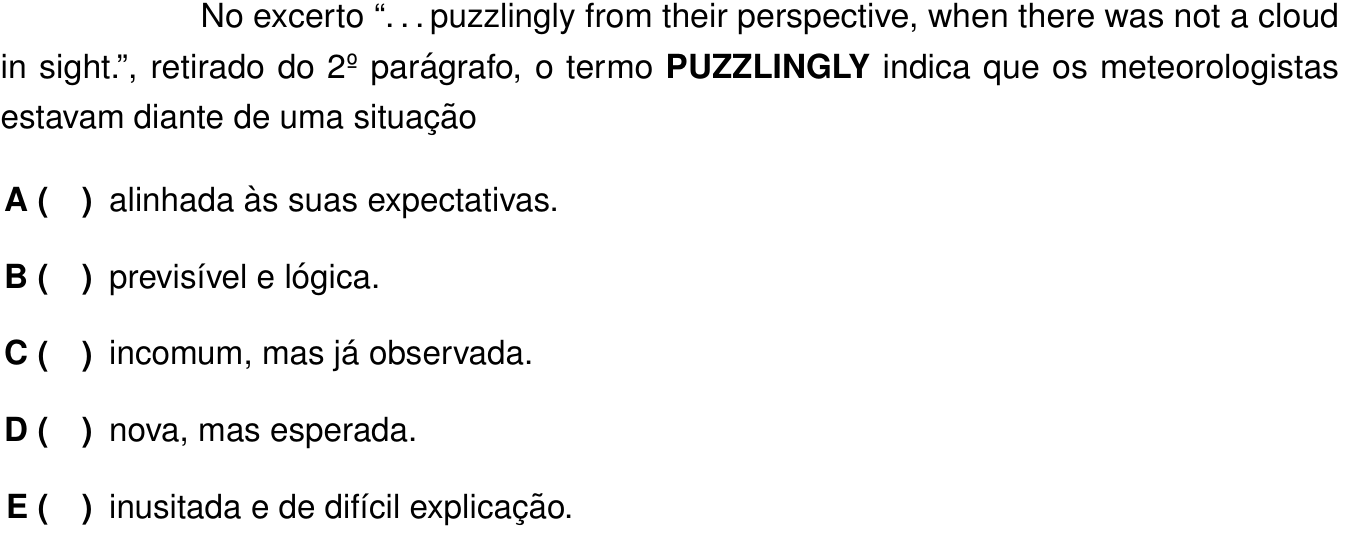
No excerto “. . . puzzlingly from their perspective, when there was not a cloud in sight.”, retirado do 2o parágrafo, o termo PUZZLINGLY indica que os meteorologistas estavam diante de uma situação
- Aalinhada às suas expectativas.
- Bprevisível e lógica.
- Cincomum, mas já observada.
- Dnova, mas esperada.
- Einusitada e de difícil explicação.
Reportar erro na questão
Resolução comentada
Puzzlingly vem do verbo to puzzle (deixar perplexo, intrigar). O advérbio indica que algo parecia estranho e difícil de entender, ou seja, sem explicação imediata.
No trecho, os meteorologistas viam um eco de radar típico de tempo quente que aparecia "quando não havia uma nuvem à vista". Para eles, esse tipo de eco era associado a chuva ou nuvens, então a ausência de nuvens tornava o fenômeno desconcertante. A expressão "from their perspective" reforça que, do ponto de vista deles, aquilo não fazia sentido.
Passos:
- Significado da palavra: intrigante, desconcertante.
- Contexto: eco sem nuvem, algo que contrariava o que o radar meteorológico costumava detectar.
- Conclusão: situação inusitada (fora do comum) e difícil de explicar, o que só a alternativa E reúne.
As demais alternativas dizem o oposto (esperado, previsível, lógico) ou afirmam que já era conhecido, o que o texto não sugere: o interesse "intenso" surgiu justamente por causa da estranheza.
Alternativa E.
Por que as outras alternativas estão erradas
- ADiz que era algo alinhado às expectativas, o contrário de intrigante.
- BPrevisível e lógica contradiz a perplexidade que puzzlingly expressa.
- CO texto não diz que o fenômeno já havia sido observado; ele era desconcertante.
- DEra novo, mas não esperado; a surpresa é justamente o ponto.
Assunto: Vocabulário em contexto e falsos cognatos.
Reportar erro na resolução
Ver como caiu na prova
Fonte: ITA 2025 · 1ª fase. Prova oficial ↗