PRÁTICA COM QUESTÕES OFICIAIS
Questão 43 do ITA 2025
Leia o texto a seguir para responder às questões 43 e 44. · 1ª fase
The early development of radar was driven primarily by military imperatives, and the targets that were to be detected were mainly aircraft and ships. It was no surprise that echoes were also received from terrain and from rainstorms, but the discovery, during World War II, that birds were often detectable was less expected. As the technology developed, and specially after transmission at the shorter ‘microwave’ wavelengths became commonplace, echoes from insects were also identified. In the late 1940’s and the 1950’s, radar technology was adapted rapidly to the needs of meteorologists, while ornithologists pioneered the use of defence and air-traffic control radars to study bird migration.
Radar observations of insects, however, were relatively sparse until the early 1960’s, when radar meteorologists became rather intensely interested in a type of warm-weather echo that appeared, puzzlingly from their perspective, when there was not a cloud in sight. Perhaps spurred by the meteorologists’ observations, entomologists began their own exploitation of the technology in 1968, when a rather modest radar, built by G.W. Schaefer specifically for insect observation and operated in West Africa just south of the Sahara, proved to be very effective.
Fonte: DRAKE, V.A. and REYNOLDS, D.R. Radar Entomology: Observing Insect Flight and Migration. CAB Internacional, 2012.
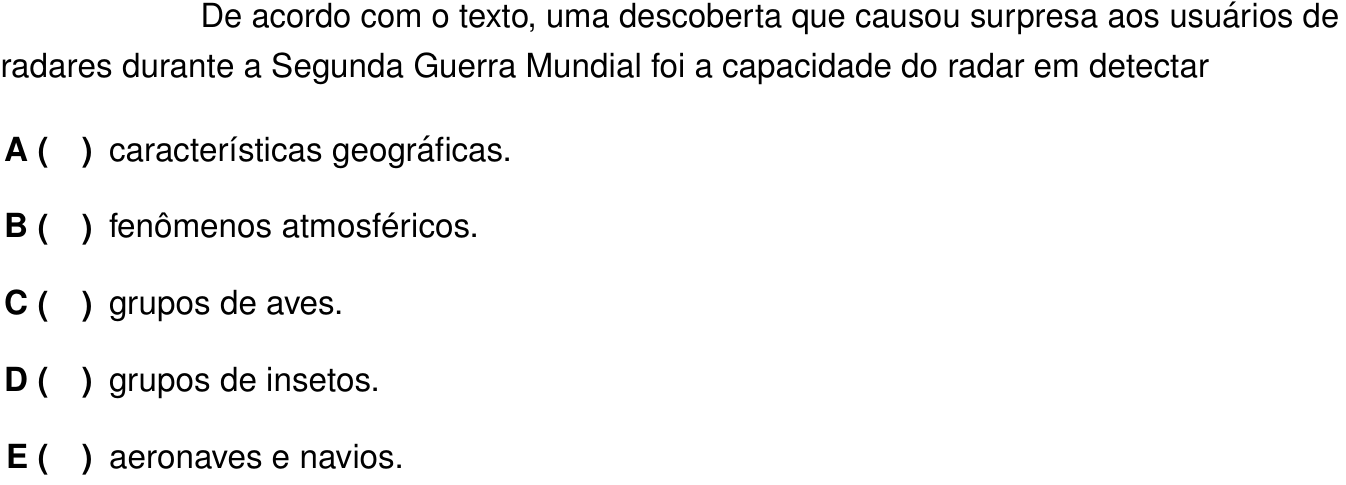
De acordo com o texto, uma descoberta que causou surpresa aos usuários de radares durante a Segunda Guerra Mundial foi a capacidade do radar em detectar
- Acaracterísticas geográficas.
- Bfenômenos atmosféricos.
- Cgrupos de aves.
- Dgrupos de insetos.
- Eaeronaves e navios.
Reportar erro na questão
Resolução comentada
O trecho decisivo está no primeiro parágrafo. O texto diz que o radar foi criado para fins militares e que os alvos esperados eram "mainly aircraft and ships" (principalmente aeronaves e navios).
Depois vem a frase: "It was no surprise that echoes were also received from terrain and from rainstorms", ou seja, não foi surpresa receber ecos do terreno e de tempestades.
A surpresa vem em seguida, com a conjunção "but": "the discovery, during World War II, that birds were often detectable was less expected". Em português: a descoberta, durante a Segunda Guerra, de que aves eram frequentemente detectáveis foi menos esperada.
Portanto, o que surpreendeu foi a detecção de aves.
Os insetos só aparecem depois, quando as microondas se tornaram comuns, e as observações sistemáticas deles são posteriores, dos anos 1960. Eles não fazem parte da descoberta da Segunda Guerra.
O gabarito é a opção sobre aves.
Alternativa C.
Por que as outras alternativas estão erradas
- AO texto diz que ecos do terreno (características geográficas) não foram surpresa.
- BEcos de tempestades (fenômenos atmosféricos) também são citados como esperados.
- DInsetos foram identificados depois, com as microondas, e não na descoberta da Segunda Guerra.
- EAeronaves e navios eram os alvos originais do radar, logo nada surpreendentes.
Assunto: Informações explícitas e detalhes.
Reportar erro na resolução
Ver como caiu na prova
Fonte: ITA 2025 · 1ª fase. Prova oficial ↗