PRÁTICA COM QUESTÕES OFICIAIS
Questão 32 (Português e Inglês) da 2ª fase do IME 2020
PARA AS QUESTÕES 31 A 34, RESPONDA DE ACORDO COM O TEXTO 2 A SEGUIR. · Português e Inglês
Texto 2
HALF A CENTURY AGO, THE MOON LANDING SHOWED US THE FRAGILITY OF OUR PLANET, AND THAT NOTHING WAS IMPOSSIBLE.
Dr Dame SUE ION, DBE FREng FRS
Chair of the UK Nuclear Innovation Research Advisory Board and chair of the judging panel for the MacRobert Award for engineering innovation.
“Fifty years ago, the Apollo 11 space mission took its place in global history.
I remember watching the Apollo 11 moon landing. It was an amazing achievement, enabled by a brilliant team of engineers, scientists and technicians at Nasa. I was still at school, and we were utterly awed by the engineering and ingenuity that made it happen. [...]
Today, half a century later, it’s important to remember how crucial the inspiration of that one small step was to a new generation of engineers around the world – it would underpin so many of the innovations we take for granted today.
Here in the UK, a “new Britain” was being forged in the “white heat” of technology. The MacRobert Award for Engineering Innovation was presented for the first time in 1969. Established by the MacRobert Trust, the medal features a man leaping for the moon to commemorate the lunar landing, and the £50,000 prize recognises those that meet three key criteria – commercial success, societal benefit, and true innovation.
In a year that saw Americans on the moon, ____________________ (33) ____________________. They announced joint winners: a team from Freeman, Fox and Partners for the aerodynamic deck design of the Severn Bridge – later used for long-span bridges all over the world – and a team from Rolls-Royce for the Pegasus engine that powered the Harrier, the world’s first vertical take-off and landing aircraft.
Since 1969, the global influence of winning British innovations has been maintained, with a host of world firsts, including the CT scanner in 1972, the first bionic hand in 2008 and Raspberry Pi, the world’s most affordable computer, in 2017.”
[...]
Adaptado de The Indepedent. Disponível em: https://www.independent.co.uk/voices/apollo-11-moon-landing-anniversary-macrobert-award-british-innovation-a9012426.html. Acesso em: 14/08/2019.
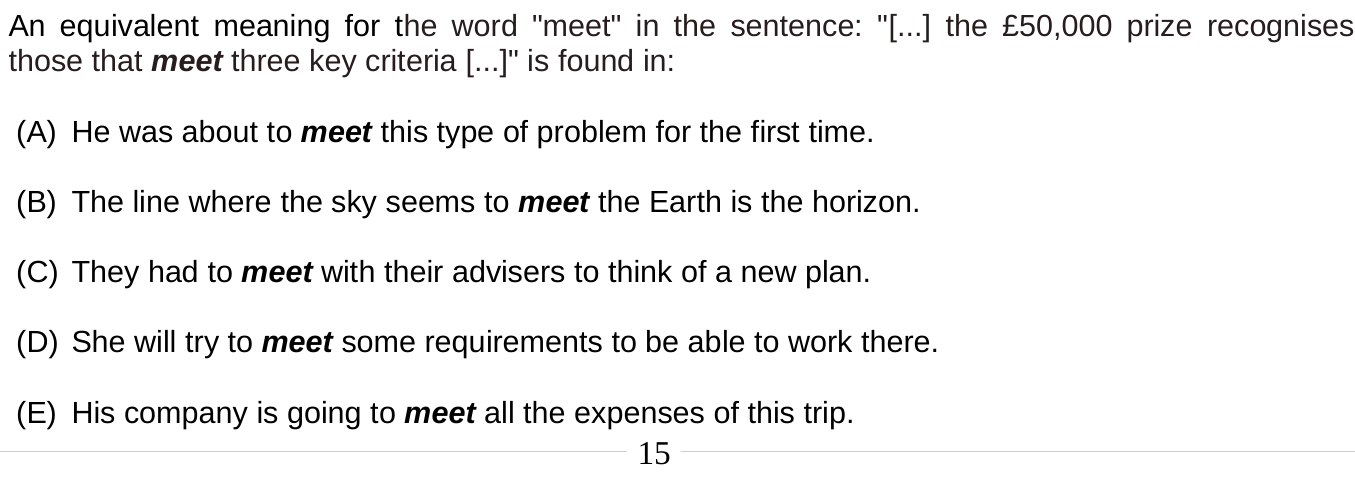
An equivalent meaning for the word "meet" in the sentence: "[...] the £50,000 prize recognises those that meet three key criteria [...]" is found in:
- AHe was about to meet this type of problem for the first time.
- BThe line where the sky seems to meet the Earth is the horizon.
- CThey had to meet with their advisers to think of a new plan.
- DShe will try to meet some requirements to be able to work there.
- EHis company is going to meet all the expenses of this trip.
Reportar erro na questão
Resolução comentada
No texto, o prêmio reconhece quem "meet three key criteria" (sucesso comercial, benefício social e inovação verdadeira). Aqui, meet significa satisfazer, cumprir (critérios, exigências): meet criteria = atender aos critérios.
Vamos ver o sentido de meet em cada alternativa:
- (A) meet a problem: deparar-se com, encontrar um problema.
- (B) sky seems to meet the Earth: encontrar-se, tocar, juntar-se.
- (C) meet with advisers: reunir-se com os assessores.
- (D) meet some requirements: satisfazer, cumprir alguns requisitos. É o mesmo sentido do texto, pois requirements equivale a criteria.
- (E) meet all the expenses: arcar com, pagar as despesas.
Só a D usa meet com o sentido de atender a exigências.
Alternativa D.
Por que as outras alternativas estão erradas
- Ameet no sentido de deparar-se com, enfrentar um problema pela primeira vez.
- Bmeet no sentido de se tocar ou se unir, sentido físico.
- Cmeet with significa reunir-se com alguém.
- Emeet expenses significa pagar, arcar com custos.
Assunto: Vocabulário em contexto e falsos cognatos.
Reportar erro na resolução
Ver como caiu na prova
Fonte: IME 2ª fase 2020 · Português e Inglês. Prova oficial ↗