Respondeu · mesma resposta final de outras 9 IAs
a) Oxidação a ácido acético com \mathrm{K_2Cr_2O_7/H_2SO_4}, sob refluxo, seguida de esterificação com etanol, \mathrm{H_2SO_4} e aquecimento; b) -496{,}2\ \mathrm{kJ\,mol^{-1}}; c) -127{,}2\ \mathrm{J\,mol^{-1}\,K^{-1}}; d) -458{,}3\ \mathrm{kJ\,mol^{-1}}.
levou 31 s
Como pensou
**Exploring oxidation conditions**
I'm looking to address the oxidation of ethanol (CH3CH2OH) under specific conditions using dichromate in acidic reflux. The reaction can be written as CH3CH2OH + 2[O] → CH3COOH + H2O using K2Cr2O7/H2SO4. Although another equation shows O2 as a reactant, it's inconsistent without a catalyst. I should emphasize the reflux method and possibly include a step for esterification and removal of water as needed. While balanced equations are preferred, using generic [O] is acceptable.**Calculating oxidation reactions**
I'm working on the full oxidation of ethanol using a strong oxidant like K2Cr2O7/H2SO4 in reflux, not combustion. To calculate enthalpy changes, I find that ΔH is -496.2 kJ per reaction mole. For entropy, I calculate ΔS as -127.2 J/molK. The Gibbs free energy (ΔG) comes to about -458.3 kJ. I want to summarize these findings concisely, providing equations for the oxidation to acetic acid and esterification, while also considering valid O2 reaction conditions, possibly using a platinum-supported catalyst.**Calculating chemical reaction**
I think I need to clarify the oxidation state in the reaction involving dichromate. I'm considering an equation where [O] represents oxygen provided by the oxidizing agent. The full equation is: 3C2H5OH + 2K2Cr2O7 + 8H2SO4 -> 3CH3COOH + 2Cr2(SO4)3 + 2K2SO4 + 11H2O. It looks correct since four chromium atoms are reduced with twelve electrons in three ethanol oxidations. However, I need to keep it concise and focus on calculations. I'll adjust the output in Portuguese with specified details.
a) Etapas da síntese
1. Oxidação do etanol a ácido acético:
\mathrm{CH_3CH_2OH+2[O]\longrightarrow CH_3COOH+H_2O}
Nessa representação, [O] indica o oxigênio fornecido pelo agente oxidante. Pode-se empregar dicromato de potássio em meio ácido (\mathrm{K_2Cr_2O_7/H_2SO_4}), em excesso, com aquecimento sob refluxo, para que a oxidação prossiga até o ácido carboxílico, sem parar no aldeído.
2. Esterificação do ácido acético com etanol:
\mathrm{CH_3COOH+CH_3CH_2OH
\xrightleftharpoons[\ ]{H_2SO_4,\ \Delta}
CH_3COOCH_2CH_3+H_2O}
Empregam-se catálise ácida, por exemplo com ácido sulfúrico concentrado, e aquecimento. A retirada de água ou o excesso de etanol favorece a formação do éster.
b) Variação de entalpia padrão
Pela lei de Hess:
\Delta_rH^\circ=
\sum_{\text{produtos}}\nu\Delta_fH^\circ-
\sum_{\text{reagentes}}\nu\Delta_fH^\circ.
Substituindo os valores:
\Delta_rH^\circ=
[-480{,}0+2(-285{,}8)]-[2(-277{,}7)+0]
\boxed{\Delta_rH^\circ=-496{,}2\ \mathrm{kJ\,mol^{-1}}}.
Logo, a reação é exotérmica.
c) Variação de entropia padrão
\Delta_rS^\circ=
\sum_{\text{produtos}}\nu S_m^\circ-
\sum_{\text{reagentes}}\nu S_m^\circ.
Assim:
\Delta_rS^\circ=
[259{,}4+2(69{,}9)]-[2(160{,}7)+205{,}0]
\Delta_rS^\circ=399{,}2-526{,}4
\boxed{\Delta_rS^\circ=-127{,}2\ \mathrm{J\,mol^{-1}\,K^{-1}}}.
d) Variação da energia de Gibbs padrão a 298 K
Convertendo a variação de entropia para \mathrm{kJ\,mol^{-1}\,K^{-1}}:
\Delta_rS^\circ=-0{,}1272\ \mathrm{kJ\,mol^{-1}\,K^{-1}}.
Então:
\Delta_rG^\circ=\Delta_rH^\circ-T\Delta_rS^\circ
\Delta_rG^\circ=-496{,}2-298(-0{,}1272)
=-458{,}2944\ \mathrm{kJ\,mol^{-1}}.
\boxed{\Delta_rG^\circ\approx-458{,}3\ \mathrm{kJ\,mol^{-1}}}.
Os valores molares referem-se à reação global tal como escrita.
Resposta final: a) Oxidação a ácido acético com \mathrm{K_2Cr_2O_7/H_2SO_4}, sob refluxo, seguida de esterificação com etanol, \mathrm{H_2SO_4} e aquecimento; b) -496{,}2\ \mathrm{kJ\,mol^{-1}}; c) -127{,}2\ \mathrm{J\,mol^{-1}\,K^{-1}}; d) -458{,}3\ \mathrm{kJ\,mol^{-1}}.
Respondeu · mesma resposta final de outras 9 IAs
a) Oxidação do etanol com \mathrm{K_2Cr_2O_7/H_2SO_4} sob refluxo, seguida de esterificação do ácido acético com etanol, sob catálise ácida e aquecimento; b) -496{,}2\ \mathrm{kJ\,mol^{-1}}; c) -127{,}2\ \mathrm{J\,mol^{-1}\,K^{-1}}; d) -458{,}3\ \mathrm{kJ\,mol^{-1}}.
levou 31 s
Como pensou
**Analyzing oxidation conditions**
I need to address the oxidation of ethanol in an acid environment using dichromate or O2 as an oxidant. I can work with the equations provided, like the Gibbs free energy change and reactants. An essential equation to write is ethanol + 2[O] → acetic acid + H2O using K2Cr2O7 and H2SO4 with reflux. I want to ensure clarity on the chemical equations expected, focusing on using dichromate while also considering the role of O2 overall. A balanced equation might be beneficial.**Simplifying equations overview**
I see that I don't really need an overly complicated equation for the oxidation of ethanol. We can keep it straightforward with a balanced equation like 3C2H5OH + 2K2Cr2O7 + 8H2SO4 → 3CH3COOH + other products, but it might be more than necessary. I should focus on writing a concise equation that captures the oxidant in excess under reflux conditions. I aim to summarize everything clearly while ensuring the response remains within the word limit.
a) Etapas da síntese do acetato de etila
1. Oxidação do etanol a ácido acético:
\mathrm{CH_3CH_2OH+2[O]\longrightarrow CH_3COOH+H_2O}
Nessa equação, [O] representa o oxigênio fornecido pelo agente oxidante. Pode-se utilizar dicromato de potássio em meio ácido (\mathrm{K_2Cr_2O_7/H_2SO_4}), em excesso, com aquecimento sob refluxo, para que a oxidação prossiga até o ácido carboxílico.
2. Esterificação do ácido acético com etanol:
\mathrm{CH_3COOH+CH_3CH_2OH
\xrightleftharpoons[\ ]{H_2SO_4,\ \Delta}
CH_3COOCH_2CH_3+H_2O}
Emprega-se catálise ácida, por exemplo com ácido sulfúrico concentrado, e aquecimento. O excesso de etanol ou a retirada de água favorece a formação do éster.
b) Variação de entalpia padrão
Pela lei de Hess:
\Delta H^\circ=\sum_{\text{produtos}}\nu\Delta H_f^\circ
-\sum_{\text{reagentes}}\nu\Delta H_f^\circ.
Logo,
\Delta H^\circ=
[-480{,}0+2(-285{,}8)]-[2(-277{,}7)+0]
\boxed{\Delta H^\circ=-496{,}2\ \mathrm{kJ\,mol^{-1}}}.
c) Variação de entropia padrão
\Delta S^\circ=\sum_{\text{produtos}}\nu S_m^\circ
-\sum_{\text{reagentes}}\nu S_m^\circ.
Substituindo:
\Delta S^\circ=[259{,}4+2(69{,}9)]-[2(160{,}7)+205{,}0]
\boxed{\Delta S^\circ=-127{,}2\ \mathrm{J\,mol^{-1}\,K^{-1}}}.
d) Variação da energia de Gibbs padrão a 298 K
Convertendo a entropia para \mathrm{kJ\,mol^{-1}\,K^{-1}}:
\Delta S^\circ=-0{,}1272\ \mathrm{kJ\,mol^{-1}\,K^{-1}}.
Assim,
\Delta G^\circ=\Delta H^\circ-T\Delta S^\circ
\Delta G^\circ=-496{,}2-298(-0{,}1272)
=-458{,}2944\ \mathrm{kJ\,mol^{-1}}.
Portanto,
\boxed{\Delta G^\circ\approx-458{,}3\ \mathrm{kJ\,mol^{-1}}}.
Resposta final: a) Oxidação do etanol com \mathrm{K_2Cr_2O_7/H_2SO_4} sob refluxo, seguida de esterificação do ácido acético com etanol, sob catálise ácida e aquecimento; b) -496{,}2\ \mathrm{kJ\,mol^{-1}}; c) -127{,}2\ \mathrm{J\,mol^{-1}\,K^{-1}}; d) -458{,}3\ \mathrm{kJ\,mol^{-1}}.
Respondeu · mesma resposta final de outras 9 IAs
a) Oxidação com excesso de \mathrm{K_2Cr_2O_7/H_2SO_4}, sob refluxo, seguida de esterificação com \mathrm{H_2SO_4} concentrado e aquecimento; b) -496{,}2\ \mathrm{kJ\,mol^{-1}}; c) -127{,}2\ \mathrm{J\,mol^{-1}\,K^{-1}}; d) -458{,}3\ \mathrm{kJ\,mol^{-1}}.
levou 23 s
Como pensou
**Solving oxidation reactions**
I need to figure out the oxidation of ethanol to acetic acid and include the necessary conditions. It looks like I might use acidified dichromate or permanganate as an oxidizing agent under reflux. The balanced equation could be 3 C2H5OH + 2 K2Cr2O7 + 8 H2SO4 -> 3 CH3COOH + 11 H2O. I’ll verify the redox changes to ensure everything balances out with the electrons and atoms on both sides.**Exploring esterification reactions**
I’m working on the molecular equation for the reaction involving sulfuric acid and ethanol: 3 ethanol plus 2 K2Cr2O7 and 8 H2SO4 yields 3 acetic acid, along with chromium sulfate and water. Everything balances nicely, confirming the hydrogen contribution from sulfuric acid. Then, there's the Fischer esterification equation: acetic acid plus ethanol gives ethyl acetate and water, needing concentrated sulfuric acid, heat, and reflux. For that, I think I need to remove water or excess ethanol to shift the equilibrium.**Verifying chemical equation**
I'm analyzing the reaction involving excess acidified dichromate under reflux. The equation is a bit complicated: 3 C2H5OH + 2 K2Cr2O7 + 8 H2SO4 yields various products. I’m checking each element’s balance—like chromium and sulfate—making sure to count the oxygen properly. Oops, I may have messed up on the specifics of sulfuric acid's contribution, realizing it adds more to the total. This is getting tricky, but I'm on it!
a) Na primeira etapa, oxida-se o etanol com excesso de dicromato de potássio em meio ácido, sob aquecimento com refluxo, para favorecer a formação do ácido acético:
3\,\mathrm{C_2H_5OH}+2\,\mathrm{K_2Cr_2O_7}+8\,\mathrm{H_2SO_4}
\rightarrow
3\,\mathrm{CH_3COOH}+2\,\mathrm{Cr_2(SO_4)_3}+2\,\mathrm{K_2SO_4}+11\,\mathrm{H_2O}.
Na segunda etapa, realiza-se a esterificação de Fischer:
\mathrm{CH_3COOH+C_2H_5OH \rightleftharpoons CH_3COOC_2H_5+H_2O}.
As condições são aquecimento, catalisador ácido (por exemplo, \mathrm{H_2SO_4} concentrado) e, para favorecer a formação do éster, uso de excesso de um reagente ou remoção de água.
b)
\begin{aligned}
\Delta_\mathrm r H^\circ
&=\sum \nu\Delta_\mathrm fH^\circ(\text{produtos})
-\sum \nu\Delta_\mathrm fH^\circ(\text{reagentes})\\
&=[-480{,}0+2(-285{,}8)]-[2(-277{,}7)+0]\\
&=\boxed{-496{,}2\ \mathrm{kJ\,mol^{-1}}}.
\end{aligned}
c)
\begin{aligned}
\Delta_\mathrm r S^\circ
&=[259{,}4+2(69{,}9)]-[2(160{,}7)+205{,}0]\\
&=\boxed{-127{,}2\ \mathrm{J\,mol^{-1}\,K^{-1}}}.
\end{aligned}
d) Convertendo a entropia para \mathrm{kJ\,mol^{-1}\,K^{-1}}, temos \Delta_\mathrm r S^\circ=-0{,}1272\ \mathrm{kJ\,mol^{-1}\,K^{-1}}. Assim,
\begin{aligned}
\Delta_\mathrm r G^\circ
&=\Delta_\mathrm r H^\circ-T\Delta_\mathrm r S^\circ\\
&=-496{,}2-298(-0{,}1272)\\
&\approx\boxed{-458{,}3\ \mathrm{kJ\,mol^{-1}}}.
\end{aligned}
Resposta final: a) Oxidação com excesso de \mathrm{K_2Cr_2O_7/H_2SO_4}, sob refluxo, seguida de esterificação com \mathrm{H_2SO_4} concentrado e aquecimento; b) -496{,}2\ \mathrm{kJ\,mol^{-1}}; c) -127{,}2\ \mathrm{J\,mol^{-1}\,K^{-1}}; d) -458{,}3\ \mathrm{kJ\,mol^{-1}}.
Respondeu · mesma resposta final de outras 9 IAs
a) Etapa 1: C₂H₅OH + O₂ → CH₃COOH + H₂O (KMnO₄ ou K₂Cr₂O₇/H₂SO₄, aquecimento); Etapa 2: CH₃COOH + C₂H₅OH ⇌ CH₃COOCH₂CH₃ + H₂O (H₂SO₄ catalisador, refluxo, excesso de etanol/remoção de água); b) ΔH° = −496,2 kJ/mol; c) ΔS° = −127,2 J/(mol·K); d) ΔG° ≈ −458,3 kJ/mol
levou 16 s
Como pensou
I'm working through this synthesis in two steps: first oxidizing ethanol completely to acetic acid using a strong oxidizer like KMnO₄ or K₂Cr₂O₇ in acidic medium with heat, then reacting that acetic acid with ethanol via Fischer esterification to form the ester.
For the thermodynamics, I calculate ΔH° using standard formation enthalpies to get −496,2 kJ/mol, then ΔS° from standard entropies to get −127,2 J/(mol·K), and finally combine these in the Gibbs equation at 298 K to find ΔG° ≈ −458,3 kJ/mol, confirming the reaction is spontaneous.
a) Rota em duas etapas
Etapa 1 – Oxidação completa do etanol a ácido acético:
C₂H₅OH(l) + O₂(g) → CH₃COOH(l) + H₂O(l)
(em meio laboratorial: C₂H₅OH + 2[O] → CH₃COOH + H₂O)
Condições: oxidante forte em meio ácido e aquecimento – por exemplo, KMnO₄/H₂SO₄ ou K₂Cr₂O₇/H₂SO₄ (o etanol passa por acetaldeído, que é oxidado até o ácido). Industrialmente também pode ser feita por oxidação catalítica com O₂ (ou por via biológica, com Acetobacter).
Etapa 2 – Esterificação de Fischer com etanol:
CH₃COOH(l) + C₂H₅OH(l) ⇌ CH₃COOCH₂CH₃(l) + H₂O(l)
Condições: catalisador ácido (H₂SO₄ concentrado), aquecimento sob refluxo; como a reação é reversível, usa-se excesso de etanol e/ou remoção da água formada para deslocar o equilíbrio no sentido do éster.
Somando as duas etapas: 2C₂H₅OH + O₂ → CH₃COOCH₂CH₃ + 2H₂O (reação global).
b) Entalpia padrão da reação global
ΔH° = ΣΔH°f(produtos) − ΣΔH°f(reagentes)
ΔH° = [(−480,0) + 2(−285,8)] − [2(−277,7) + 0]
ΔH° = (−480,0 − 571,6) − (−555,4) = −1051,6 + 555,4
ΔH° = −496,2 kJ·mol⁻¹ (reação exotérmica)
c) Entropia padrão da reação global
ΔS° = ΣS°(produtos) − ΣS°(reagentes)
ΔS° = [259,4 + 2(69,9)] − [2(160,7) + 205,0]
ΔS° = (259,4 + 139,8) − (321,4 + 205,0) = 399,2 − 526,4
ΔS° = −127,2 J·mol⁻¹·K⁻¹ (diminui, pois consome 1 mol de gás)
d) Energia de Gibbs padrão a 298 K
ΔG° = ΔH° − TΔS°
ΔG° = −496,2 kJ − 298 K × (−0,1272 kJ·K⁻¹)
ΔG° = −496,2 + 37,9
ΔG° ≈ −458,3 kJ·mol⁻¹ (reação espontânea nas condições padrão)
Resposta final: a) Etapa 1: C₂H₅OH + O₂ → CH₃COOH + H₂O (KMnO₄ ou K₂Cr₂O₇/H₂SO₄, aquecimento); Etapa 2: CH₃COOH + C₂H₅OH ⇌ CH₃COOCH₂CH₃ + H₂O (H₂SO₄ catalisador, refluxo, excesso de etanol/remoção de água); b) ΔH° = −496,2 kJ/mol; c) ΔS° = −127,2 J/(mol·K); d) ΔG° ≈ −458,3 kJ/mol
Respondeu · mesma resposta final de outras 9 IAs
a) 1ª etapa: CH₃CH₂OH + O₂ (ou 2[O]) → CH₃COOH + H₂O, com K₂Cr₂O₇ ou KMnO₄ em H₂SO₄ sob aquecimento/refluxo (ou Acetobacter/O₂); 2ª etapa: CH₃COOH + CH₃CH₂OH ⇌ CH₃COOCH₂CH₃ + H₂O, com H₂SO₄ concentrado como catalisador, aquecimento e excesso de etanol ou remoção de água; b) ΔH° = −496,2 kJ·mol⁻¹; c) ΔS° = −127,2 J·mol⁻¹·K⁻¹; d) ΔG° ≈ −458,3 kJ·mol⁻¹
levou 16 s
Como pensou
Computing the enthalpy for the ethanol oxidation to ethyl acetate reaction gives -496.2 kJ/mol. Now I'm working out the entropy change using standard molar entropies of reactants and products.
For part a, I'm outlining a two-step synthesis: first oxidizing ethanol to acetic acid using acidified KMnO4 or K2Cr2O7 under reflux, then esterifying the acetic acid with excess ethanol using concentrated H2SO4 as catalyst and heat, removing water to drive the equilibrium toward ethyl acetate. I'm checking that summing these two steps reproduces the overall thermodynamic reaction.
a) Rota sintética em duas etapas
1ª etapa: oxidação completa do etanol a ácido acético
CH₃CH₂OH(l) + O₂ → CH₃COOH + H₂O
Em notação de oxidante genérico: CH₃CH₂OH + 2[O] → CH₃COOH + H₂O.
Condições:
- Usa-se um oxidante forte em excesso, como K₂Cr₂O₇ ou KMnO₄, em meio ácido (H₂SO₄).
- Aquece-se sob refluxo, para que o acetaldeído intermediário não escape e seja oxidado até ácido.
- Alternativa: oxidação por O₂ do ar catalisada por bactérias Acetobacter (fermentação acética).
Por exemplo, com dicromato:
3 CH₃CH₂OH + 2 Cr₂O₇²⁻ + 16 H⁺ → 3 CH₃COOH + 4 Cr³⁺ + 11 H₂O
2ª etapa: esterificação de Fischer com etanol
CH₃COOH + CH₃CH₂OH ⇌ CH₃COOCH₂CH₃ + H₂O
Condições:
- Catálise ácida com H₂SO₄ concentrado, sob aquecimento (refluxo).
- A reação é reversível. Para deslocar o equilíbrio para o éster, usa-se excesso de etanol e/ou remove-se a água (o H₂SO₄ concentrado também atua como desidratante) ou destila-se o éster formado.
A soma das duas etapas reproduz a reação global: 2 C₂H₅OH + O₂ → CH₃COOCH₂CH₃ + 2 H₂O.
b) Variação de entalpia padrão
ΔH° = [ΔHf°(éster) + 2·ΔHf°(H₂O)] − [2·ΔHf°(etanol) + ΔHf°(O₂)]
ΔH° = [−480,0 + 2(−285,8)] − [2(−277,7) + 0]
ΔH° = (−1051,6) − (−555,4) = −496,2 kJ·mol⁻¹
c) Variação de entropia padrão
ΔS° = [S°(éster) + 2·S°(H₂O)] − [2·S°(etanol) + S°(O₂)]
ΔS° = [259,4 + 2(69,9)] − [2(160,7) + 205,0]
ΔS° = 399,2 − 526,4 = −127,2 J·mol⁻¹·K⁻¹
O valor negativo é coerente com o consumo de um gás e a formação apenas de líquidos.
d) Variação de energia de Gibbs padrão a 298 K
ΔG° = ΔH° − TΔS°
ΔG° = −496,2 − 298·(−0,1272) kJ·mol⁻¹
ΔG° = −496,2 + 37,9 ≈ −458,3 kJ·mol⁻¹
A reação é espontânea nas condições padrão a 298 K.
Resposta final: a) 1ª etapa: CH₃CH₂OH + O₂ (ou 2[O]) → CH₃COOH + H₂O, com K₂Cr₂O₇ ou KMnO₄ em H₂SO₄ sob aquecimento/refluxo (ou Acetobacter/O₂); 2ª etapa: CH₃COOH + CH₃CH₂OH ⇌ CH₃COOCH₂CH₃ + H₂O, com H₂SO₄ concentrado como catalisador, aquecimento e excesso de etanol ou remoção de água; b) ΔH° = −496,2 kJ·mol⁻¹; c) ΔS° = −127,2 J·mol⁻¹·K⁻¹; d) ΔG° ≈ −458,3 kJ·mol⁻¹
Respondeu · mesma resposta final de outras 9 IAs
a) Etapa 1: CH₃CH₂OH + 2[O] → CH₃COOH + H₂O, com K₂Cr₂O₇ ou KMnO₄ em H⁺ e aquecimento (excesso de oxidante). Etapa 2: CH₃COOH + CH₃CH₂OH ⇌ CH₃COOCH₂CH₃ + H₂O, com H₂SO₄ catalítico e aquecimento. b) ΔH° = −496,2 kJ; c) ΔS° = −127,2 J·K⁻¹; d) ΔG° ≈ −458,3 kJ
levou 8 s
Como pensou
a) Rota em duas etapas
Etapa 1: oxidação completa do etanol a ácido acético, com oxidante forte em meio ácido, como K₂Cr₂O₇/H₂SO₄ ou KMnO₄/H⁺, sob aquecimento e em excesso de oxidante (refluxo). O aldeído formado como intermediário também é oxidado.
3 CH₃CH₂OH + 2 Cr₂O₇²⁻ + 16 H⁺ → 3 CH₃COOH + 4 Cr³⁺ + 11 H₂O
(Alternativa: CH₃CH₂OH + 2 [O] → CH₃COOH + H₂O.)
Etapa 2: esterificação de Fischer. O ácido acético reage com etanol, com catálise ácida (H₂SO₄ concentrado ou H⁺) e aquecimento. A reação é reversível, então se usa excesso de um reagente ou se remove a água para deslocar o equilíbrio.
CH₃COOH + CH₃CH₂OH ⇌ CH₃COOCH₂CH₃ + H₂O
Somando as etapas, 2 etanol + 2 [O] dão o éster + 2 H₂O, o que é coerente com a reação global dada, com O₂ como oxidante.
b) Variação de entalpia padrão
ΔH° = [ΔHf(éster) + 2 ΔHf(H₂O)] − [2 ΔHf(etanol) + ΔHf(O₂)]
ΔH° = [−480,0 + 2(−285,8)] − [2(−277,7) + 0]
ΔH° = −1051,6 − (−555,4) = −496,2 kJ·mol⁻¹
c) Variação de entropia padrão
ΔS° = [259,4 + 2(69,9)] − [2(160,7) + 205,0]
ΔS° = 399,2 − 526,4 = −127,2 J·mol⁻¹·K⁻¹
d) Variação da energia de Gibbs padrão a 298 K
ΔG° = ΔH° − TΔS°
ΔG° = −496,2 kJ − 298 × (−0,1272 kJ·K⁻¹)
ΔG° = −496,2 + 37,9 = −458,3 kJ·mol⁻¹
A reação é espontânea nas condições padrão a 298 K.
Resposta final: a) Etapa 1: CH₃CH₂OH + 2[O] → CH₃COOH + H₂O, com K₂Cr₂O₇ ou KMnO₄ em H⁺ e aquecimento (excesso de oxidante). Etapa 2: CH₃COOH + CH₃CH₂OH ⇌ CH₃COOCH₂CH₃ + H₂O, com H₂SO₄ catalítico e aquecimento. b) ΔH° = −496,2 kJ; c) ΔS° = −127,2 J·K⁻¹; d) ΔG° ≈ −458,3 kJ
Respondeu · mesma resposta final de outras 9 IAs
a) \mathrm{C_2H_5OH + O_2 \to CH_3COOH + H_2O} (cat., \Delta); \mathrm{CH_3COOH + C_2H_5OH \rightleftharpoons CH_3COOC_2H_5 + H_2O} (\mathrm{H^+}, \Delta); b) -496{,}2\,\mathrm{kJ}; c) -127{,}2\,\mathrm{J\,K^{-1}}; d) -458{,}3\,\mathrm{kJ}
levou 37 s
Como pensou
The problem is from the 2027 ITA Chemistry second phase.
The reaction is 2C₂H₅OH (l) + O₂(g) → CH₃COOCH₂CH₃(l) + 2H₂O(l). The task requires writing the two-step synthesis equations and conditions for ethyl acetate from ethanol.
The first step of the two-step synthesis is the complete oxidation of ethanol to acetic acid. The remaining parts require calculating the standard enthalpy, entropy, and Gibbs energy variations.
The first step likely uses strong oxidants such as K₂Cr₂O₇ or KMnO₄ in acidic medium. The global reaction is a partial oxidation, not a complete one.
The first step equation is C₂H₅OH(l) + O₂(g) → CH₃COOH(l) + H₂O(l). It is balanced. The second step is esterification with ethanol.
The second step is esterification: CH₃COOH + C₂H₅OH → CH₃COOC₂H₅ + H₂O. The first step can use a copper or silver catalyst with heating, or a strong oxidant such as KMnO₄ in acidic medium.
The first step will use O₂ with a catalyst and heating. The esterification will be written as a reversible reaction with H⁺, heating, and reflux.
The standard enthalpy variation is -496.2 kJ. The calculation sums the formation enthalpies of the products and subtracts those of the reactants. The entropy variation will be determined next.
The standard entropy variation is -127.2 J/K. The standard Gibbs energy variation at 298 K is approximately -458.3 kJ.
a) A rota em duas etapas que soma à reação global é:
1ª etapa (oxidação do etanol a ácido acético):
\mathrm{C_2H_5OH(\ell) + O_2(g) \rightarrow CH_3COOH(\ell) + H_2O(\ell)}
Condições: catalisador metálico (Cu ou Ag) e aquecimento.
2ª etapa (esterificação):
\mathrm{CH_3COOH(\ell) + C_2H_5OH(\ell) \rightleftharpoons CH_3COOCH_2CH_3(\ell) + H_2O(\ell)}
Condições: catalisador ácido (\mathrm{H_2SO_4}) e aquecimento (refluxo).
b) Pela definição,
\Delta H^\circ = \sum \Delta H_\mathrm{f}^\circ(\text{produtos}) - \sum \Delta H_\mathrm{f}^\circ(\text{reagentes})
= [-480{,}0 + 2(-285{,}8)] - [2(-277{,}7) + 0] = -1051{,}6 + 555{,}4 = -496{,}2\,\mathrm{kJ}.
c)
\Delta S^\circ = \sum S_\mathrm{m}^\circ(\text{produtos}) - \sum S_\mathrm{m}^\circ(\text{reagentes})
= [259{,}4 + 2(69{,}9)] - [2(160{,}7) + 205{,}0] = 399{,}2 - 526{,}4 = -127{,}2\,\mathrm{J\,K^{-1}}.
d) A 298\,\mathrm{K},
\Delta G^\circ = \Delta H^\circ - T\Delta S^\circ = -496{,}2 - 298(-127{,}2)\times 10^{-3} = -458{,}3\,\mathrm{kJ}.
Resposta final: a) \mathrm{C_2H_5OH + O_2 \to CH_3COOH + H_2O} (cat., \Delta); \mathrm{CH_3COOH + C_2H_5OH \rightleftharpoons CH_3COOC_2H_5 + H_2O} (\mathrm{H^+}, \Delta); b) -496{,}2\,\mathrm{kJ}; c) -127{,}2\,\mathrm{J\,K^{-1}}; d) -458{,}3\,\mathrm{kJ}
Respondeu · mesma resposta final de outras 9 IAs
a) \mathrm{C_2H_5OH + 2[O] \rightarrow CH_3COOH + H_2O} (oxidante forte/H^+, aquecimento) e \mathrm{CH_3COOH + C_2H_5OH \rightleftharpoons CH_3COOCH_2CH_3 + H_2O} (H_2SO_4 conc., aquecimento); b) \Delta H^\circ = -496{,}2\ \mathrm{kJ\cdot mol^{-1}}; c) \Delta S^\circ = -127{,}2\ \mathrm{J\cdot K^{-1}\cdot mol^{-1}}; d) (\Delta G^\circ = -458{,}3\ \mathrm{kJ\cdot mol^{-
levou 33 s
Como pensou
We need answer in Portuguese, solve question. Need parse images. Need provide final with development per item. Let's solve.
We have reaction:
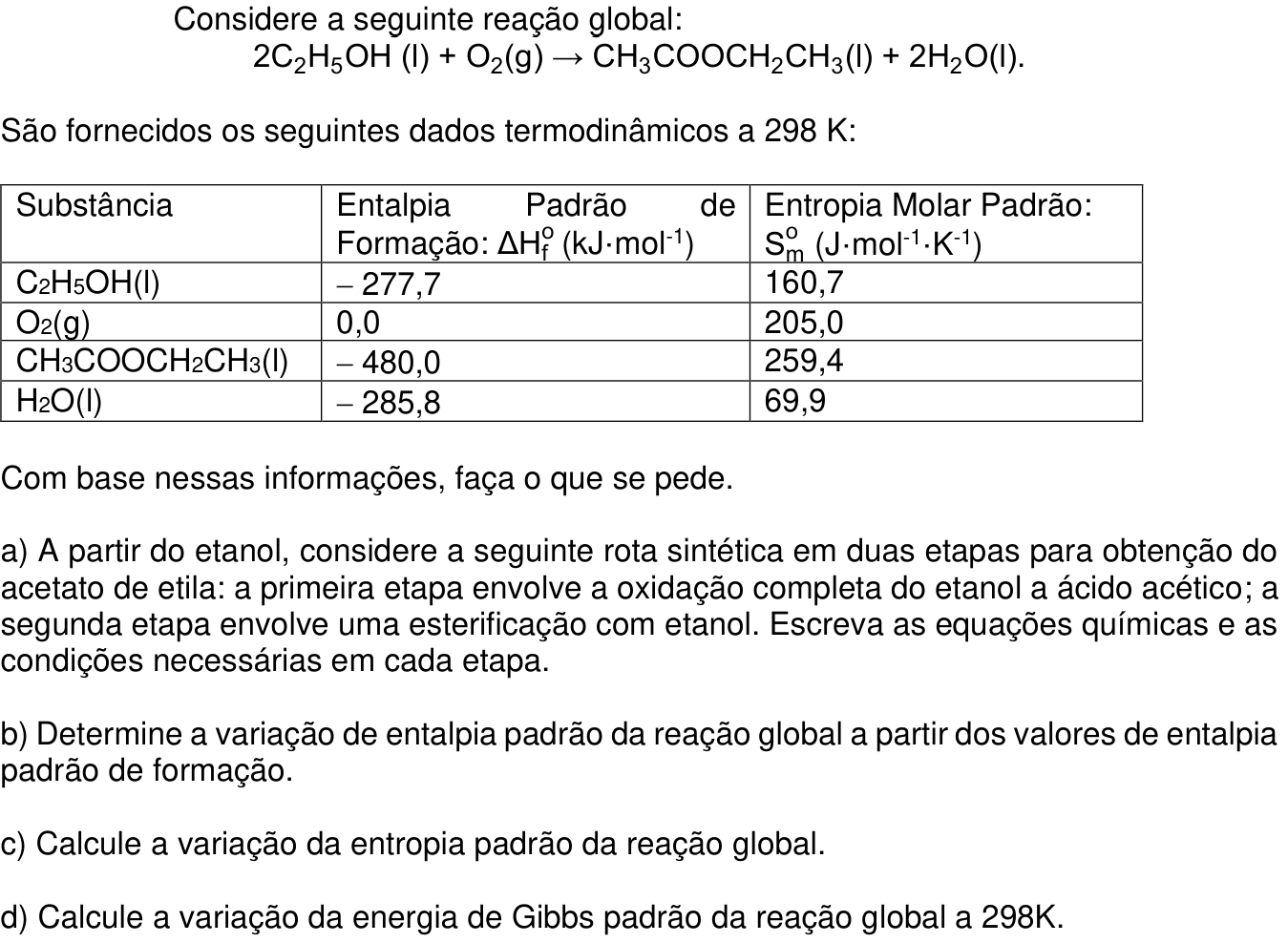
2 C2H5OH(l) + O2(g) -> CH3COOCH2CH3(l) + 2 H2O(l)
Data at 298 K:
Substance | ΔHf° (kJ/mol) | S°m (J/mol.K)
C2H5OH(l): -277.7, 160.7
O2(g): 0.0, 205.0
CH3COOCH2CH3(l): -480.0, 259.4
H2O(l): -285.8, 69.9
Questions:
a) From ethanol, consider following two-step synthetic route to ethyl acetate: first step involves complete oxidation of ethanol to acetic acid; second step involves esterification with ethanol. Write chemical equations and necessary conditions for each step.
b) Determine standard enthalpy change of global reaction from standard enthalpies formation.
c) Calculate standard entropy change global reaction.
d) Calculate standard Gibbs energy change global reaction at 298K.
Need be careful: part a: complete oxidation of ethanol to acetic acid. Equation: C2H5OH + O2 -> CH3COOH + H2O? Let's balance. Ethanol C2H6O -> acetic acid C2H4O2. Need add O? C2H6O + O2 -> C2H4O2 + H2O? Let's balance: C2H5OH + O2 -> CH3COOH + H2O. Left C2 H6 O1 + O2 = O3; right C2 H4 O2 + H2 O = O3, H6. Balanced: 1 ethanol + 1 O2 -> 1 acetic acid + 1 water. But complete oxidation? "oxidação completa do etanol a ácido acético" maybe KMnO4/H+ or dichromate? Conditions: acidified potassium permanganate or dichromate, heating? It's oxidation of primary alcohol to carboxylic acid. Equation: C2H5OH + O2 -> CH3COOH + H2O? But "oxidação completa" could also use oxidant [O] not O2. In organic chemistry: ethanol + oxidizing agent (KMnO4/H2SO4 or K2Cr2O7/H2SO4) -> acetic acid. Usually write [O] and conditions: acidified KMnO4 or K2Cr2O7, heat. Since question says "a primeira etapa envolve a oxidação completa do etanol a ácido acético" maybe equation with O2? "oxidação completa" means combustion? Wait complete oxidation of ethanol would produce CO2 and H2O, but says "a ácido acético" (to acetic acid), so partial oxidation? They say "oxidação completa do etanol a ácido acético" maybe "complete oxidation" meaning oxidation of ethanol to acetic acid (not full combustion). In organic chemistry, oxidation of primary alcohol to carboxylic acid can be considered complete oxidation (to acid) with strong oxidant. But "completa" could mean with excess oxidant. Equation: C2H5OH + 2 [O] -> CH3COOH + H2O? Let's check: C2H6O + 2[O] -> C2H4O2 + H2O? Left O:1+2=3; right O2+1=3. H6=H6. C2=C2. Yes. So maybe better write with [O] (nascent oxygen) or with O2: C2H5OH + O2 -> CH3COOH + H2O. But using O2 as oxidant is combustion? It requires catalyst? Could be with Cu catalyst? But for liquid phase oxidation, use KMnO4/H+.
The second step: esterification with ethanol: acetic acid + ethanol -> ethyl acetate + water. Equation: CH3COOH + C2H5OH ⇌ CH3COOCH2CH3 + H2O. Conditions: acid catalyst (H2SO4 concentrated), heat/reflux; reversible esterification, remove water or use excess alcohol. "Esterificação de Fischer".
Need include "condições necessárias": first step: acidified potassium permanganate/dichromate, heating; second: acid catalysis, heating/reflux.
But let's think: The global reaction for ethyl acetate from ethanol and O2 is 2 ethanol + O2 -> ethyl acetate + 2 water. The two-step route: ethanol -> acetic acid (with O2?) and acetic acid + ethanol -> ethyl acetate. If first step uses 1 ethanol + O2 -> acetic acid + water; second uses acetic acid + ethanol -> ethyl acetate + water. Total: 2 ethanol + O2 -> ethyl acetate + 2 water. Good.
They might expect equations:
Etapa 1: C2H5OH + O2 → CH3COOH + H2O (oxidante: KMnO4/H+ ou K2Cr2O7/H+, aquecimento)
Etapa 2: CH3COOH + C2H5OH ⇌ CH3COOCH2CH3 + H2O (ácido sulfúrico concentrado, aquecimento/refluxo)
Need maybe mention "oxidante enérgico em meio ácido" and "catálise ácida".
b) ΔH°r = Σ n ΔHf°(products) - Σ m ΔHf°(reactants). Products: 1 ethyl acetate (-480.0) + 2 water (-285.8*2 = -571.6) total = -1051.6 kJ. Reactants: 2 ethanol (-277.7*2 = -555.4) + 1 O2 (0) = -555.4 kJ. Difference = -1051.6 - (-555.4) = -496.2 kJ. But check: 2*(-285.8) = -571.6; plus -480 = -1051.6; minus -555.4 = -496.2 kJ. So ΔH° = -496.2 kJ/mol (per mole of ethyl acetate? Actually reaction as written, per mole of ethyl acetate). Enthalpy is extensive; per mol reaction.
c) ΔS°r = Σ S° products - Σ S° reactants. Products: 1*259.4 + 2*69.9 = 259.4 + 139.8 = 399.2 J/K. Reactants: 2*160.7 + 1*205.0 = 321.4 + 205.0 = 526.4 J/K. Difference = 399.2 - 526.4 = -127.2 J/K = -0.1272 kJ/K. Per mole reaction.
d) ΔG° = ΔH° - T ΔS°. T=298 K. Need use consistent units: ΔH = -496.2 kJ; ΔS = -127.2 J/K = -0.1272 kJ/K. Then -TΔS = -298*(-0.1272) = +37.9056 kJ. ΔG = -496.2 + 37.9056 = -458.2944 kJ. Alternatively using J: ΔG = -496200 J - 298*(-127.2 J/K)? Wait formula: ΔG = ΔH - TΔS = -496200 J - 298*(-127.2 J/K) = -496200 + 37905.6 = -458294.4 J = -458.3 kJ. So ΔG° ≈ -458.3 kJ/mol.
Need check arithmetic: 298 * 127.2 = 298*(100+27.2)=29800+8105.6=37905.6. Yes. 496200 - 37905.6 = 458294.4 J. Negative. So -458.3 kJ.
Maybe they expect in kJ mol^-1? "variação da energia de Gibbs padrão da reação global" per mol of reaction.
Need ensure sign: ΔG = ΔH - TΔS. Since ΔS negative, -TΔS positive, so ΔG less negative than ΔH.
Let's consider if reaction is spontaneous at 298K? ΔG negative yes.
Need answer final line: "Resposta final: a) ...; b) -496,2 kJ·mol⁻¹; c) -127,2 J·K⁻¹·mol⁻¹; d) -458,3 kJ·mol⁻¹" maybe.
Need maybe include equations in final line too. The instruction: "Termine com uma linha neste formato: Resposta final: <o resultado de cada item, de forma curta>". So final line should include all item results short. We can also include development before.
Let's craft full answer in Portuguese.
Potential pitfalls:
- Part a: "complete oxidation of ethanol to acetic acid" might require "oxidação enérgica" with KMnO4/H2SO4 or K2Cr2O7/H2SO4; equation with [O] rather than O2? If I write with O2, might be accepted? Let's maybe write both? Better to show:
1) C2H5OH + O2 → CH3COOH + H2O, em presença de oxidante (KMnO4/H+ ou K2Cr2O7/H+), aquecimento.
But if using O2, acidified dichromate? Actually oxygen isn't the oxidant? It is. But organic oxidation often uses KMnO4; the oxygen atoms come from oxidant, not O2. The global reaction uses O2; first step "oxidação completa" maybe with O2 in presence of catalyst? Hmm.
Let's read exact: "A partir do etanol, considere a seguinte rota sintética em duas etapas para obtenção do acetato de etila: a primeira etapa envolve a oxidação completa do etanol a ácido acético; a segunda etapa envolve uma esterificação com etanol. Escreva as equações químicas e as condições necessárias em cada etapa." It says "oxidação completa do etanol a ácido acético"; not necessarily with O2 only. In organic chemistry, complete oxidation of ethanol to acetic acid:
CH3CH2OH + 2 [O] → CH3COOH + H2O, oxidante: KMnO4/H2SO4 ou K2Cr2O7/H2SO4, aquecimento. This is "oxidação enérgica". If they wanted O2, they'd say "com O2". But maybe because global reaction includes O2, first step could be:
C2H5OH + O2 → CH3COOH + H2O (catalisador?).
But in lab, ethanol oxidation to acetic acid by air? Usually with Pt catalyst? Hmm.
Let's think: The global reaction is 2 ethanol + O2 -> ethyl acetate + 2 water. If first step is ethanol + O2 -> acetic acid + water, second is acetic acid + ethanol -> ethyl acetate + water. That uses O2 exactly. It is possible. Conditions for first step: "oxidação catalítica com O2 e catalisador metálico? ou fermentação acética?" Actually vinegar production: ethanol + O2 -> acetic acid + water by Acetobacter bacteria. But in chemistry, "oxidação completa do etanol a ácido acético" can be with KMnO4/H+. I'll mention both? The question likely expects from organic chemistry: oxidante forte em meio ácido. But since the global reaction uses O2, maybe first step could also be "C2H5OH + O2 → CH3COOH + H2O" with "catalisador biológico (Acetobacter) ou oxidante químico". But "condições necessárias" maybe "meio ácido e aquecimento". Let's write equation with [O] to avoid ambiguity:
CH3CH2OH + 2[O] → CH3COOH + H2O
Oxidante: KMnO4/H2SO4 ou K2Cr2O7/H2SO4; aquecimento.
But if they want O2, they may mark wrong? The global reaction uses O2; "a partir do etanol" route to ethyl acetate. If first step uses KMnO4, not O2, overall global would not match O2 consumption? But b-d use global reaction given, independent. Part a asks route, not necessarily balanced with O2? It says "a partir do etanol, considere a seguinte rota sintética em duas etapas". The first step "oxidação completa do etanol a ácido acético"; the second "esterificação com etanol". It doesn't mention O2 in first step. So I can write with [O]. But "oxidação completa" in organic chemistry means strong oxidant. Yes.
Could also write with O2: CH3CH2OH + O2 → CH3COOH + H2O (catalisador de platina? maybe). But "condições necessárias" for oxidation of ethanol to acetic acid by oxygen: "catalisador de platina, aquecimento" maybe? Hmm.
In Brazilian vestibular, they often write:
C2H5OH + O2 → CH3COOH + H2O (oxidante: KMnO4/H+; aquecimento)
Actually equation with O2 doesn't include KMnO4, so inconsistent. Let's use [O] notation:
C2H5OH + 2[O] → CH3COOH + H2O
(agente oxidante: KMnO4/H2SO4 ou K2Cr2O7/H2SO4, aquecimento)
This is standard.
Second step:
CH3COOH + C2H5OH ⇌ CH3COOCH2CH3 + H2O
(ácido sulfúrico concentrado como catalisador, aquecimento e refluxo; deslocamento do equilíbrio por remoção de água ou excesso de álcool)
They might want "esterificação" with ethanol, acid catalyst.
Need maybe include "equação global" not asked? b-d from global. For a, maybe route equations.
Let's verify b-d with units:
b: ΔH° = [1*(-480.0) + 2*(-285.8)] - [2*(-277.7) + 1*(0)] = -480.0 -571.6 - (-555.4) = -496.2 kJ·mol^-1.
c: ΔS° = [259.4 + 2*69.9] - [2*160.7 + 205.0] = 399.2 - 526.4 = -127.2 J·K^-1·mol^-1. (Some might write -0.1272 kJ·K^-1·mol^-1)
d: ΔG° = -496.2 kJ - 298K*(-0.1272 kJ/K) = -496.2 + 37.9 = -458.3 kJ·mol^-1.
Wait formula sign: ΔG = ΔH - TΔS. ΔS = -0.1272 kJ/K. TΔS = 298*(-0.1272)= -37.9 kJ. ΔH - TΔS = -496.2 - (-37.9) = -496.2 + 37.9 = -458.3 kJ. Yes.
Potential issue: Entropy values in J/mol.K, need convert to kJ for ΔG. I'll do.
Let's format final with steps.
Need ensure "padrão" symbols. Use ΔH°_r, ΔS°_r, ΔG°_r.
Let's craft response:
"a) Etapa 1 (oxidação): C2H5OH + 2[O] → CH3COOH + H2O. Condições: meio ácido (H2SO4) e agente oxidante forte (KMnO4 ou K2Cr2O7), com aquecimento.
Etapa 2 (esterificação): CH3COOH + C2H5OH ⇌ CH3COOCH2CH3 + H2O. Condições: H2SO4 concentrado (catalisador ácido), aquecimento/refluxo; remoção de água ou excesso de etanol para deslocar equilíbrio."
Or if they prefer O2 first step: C2H5OH + O2 -> CH3COOH + H2O, conditions: oxidante/catalisador, aquecimento. I'll include [O] and note. Maybe in final line "a) C2H5OH + 2[O] → CH3COOH + H2O (KMnO4/H+, aquecimento); CH3COOH + C2H5OH ⇌ CH3COOCH2CH3 + H2O (H2SO4 conc., aquecimento)".
Need maybe write with O2? Let's decide. The global reaction has O2; but first step "oxidação completa do etanol a ácido acético" might be "CH3CH2OH + O2 → CH3COOH + H2O" if using O2 as oxidant. But if I write [O], it's accepted? Let's maybe write "C2H5OH + O2 → CH3COOH + H2O (usando oxidante forte/meio ácido)"? Wait if equation says O2, then conditions "KMnO4/H+" mismatch. Better to write both possibilities in text? But final answer should be concise. Maybe in development mention: "Pode-se representar a oxidação por C2H5OH + 2[O] → CH3COOH + H2O, com oxidante forte; se se usar O2, a equação é C2H5OH + O2 → CH3COOH + H2O." This covers.
Let's craft final with clear development and then final line.
Potential need to answer "a partir do etanol" maybe "2 C2H5OH + O2 -> CH3COOCH2CH3 + 2 H2O" is global. But part a asks two-step route, not global. Good.
Let's ensure equations balanced:
a1: C2H5OH + 2[O] -> CH3COOH + H2O. Left: C2 H6 O1 + O2 = C2H6O3. Right: C2H4O2 + H2O = C2H6O3. Good.
a1 with O2: C2H5OH + O2 -> CH3COOH + H2O. Left C2H6O3, right C2H6O3. Good.
a2: CH3COOH + C2H5OH -> CH3COOCH2CH3 + H2O. Left C2H4O2 + C2H6O = C4H10O3? Wait acetic acid C2H4O2, ethanol C2H6O; total C4H10O3. Right ethyl acetate C4H8O2 + H2O = C4H10O3. Balanced. Good.
b-d:
Global reaction as given: 2 C2H5OH(l) + O2(g) -> CH3COOCH2CH3(l) + 2 H2O(l).
Let's write:
b) ΔH° = [(-480,0) + 2(-285,8)] - [2(-277,7) + 0] = -1051,6 - (-555,4) = -496,2 kJ·mol⁻¹.
c) ΔS° = [259,4 + 2(69,9)] - [2(160,7) + 205,0] = 399,2 - 526,4 = -127,2 J·K⁻¹·mol⁻¹ = -0,1272 kJ·K⁻¹·mol⁻¹.
d) ΔG° = ΔH° - TΔS° = -496,2 kJ - 298 K (-0,1272 kJ/K) = -496,2 + 37,9 = -458,3 kJ·mol⁻¹.
Need maybe not include mol^-1 after entropy? Yes.
Final line:
Resposta final: a) C2H5OH + 2[O] → CH3COOH + H2O (oxidante forte/H+, aquecimento); CH3COOH + C2H5OH ⇌ CH3COOCH2CH3 + H2O (H2SO4 conc., aquecimento); b) ΔH° = -496,2 kJ·mol⁻¹; c) ΔS° = -127,2 J·K⁻¹·mol⁻¹; d) ΔG° = -458,3 kJ·mol⁻¹.
But maybe final line should list "a) ..." with equations. Let's formulate.
Need maybe include "a) Etapa 1: ...; Etapa 2: ..." in final.
Let's ensure no overlong final. Good.
Let's produce final in Portuguese.
Potential alternative: In c, some might calculate in J: ΔS = -127.2 J/K. In d, use T=298: ΔG = ΔH - TΔS = -496200 J - 298*(-127.2 J/K)= -458294.4 J = -458.3 kJ. Good.
Let's consider if ΔG should be -458.3 kJ or -458.29? Use significant? Data: enthalpies one decimal, entropies one decimal, T 298 maybe 3 sig? 298 K; answer maybe -458.3 kJ. Good.
Need maybe mention "por mol de reação" in final? "kJ·mol⁻¹" enough.
Let's write final.
a) Rota em duas etapas:
Etapa 1 — oxidação do etanol a ácido acético:
\mathrm{C_2H_5OH + 2[O] \rightarrow CH_3COOH + H_2O}
Condições: meio ácido e oxidante forte, como \mathrm{KMnO_4/H_2SO_4} ou \mathrm{K_2Cr_2O_7/H_2SO_4}, com aquecimento.
Se se preferir representar com \mathrm{O_2}:
\mathrm{C_2H_5OH + O_2 \rightarrow CH_3COOH + H_2O}
Etapa 2 — esterificação com etanol:
\mathrm{CH_3COOH + C_2H_5OH \rightleftharpoons CH_3COOCH_2CH_3 + H_2O}
Condições: catálise ácida, geralmente \mathrm{H_2SO_4} concentrado, aquecimento/refluxo; remoção de água ou excesso de etanol para deslocar o equilíbrio.
b) Variação de entalpia padrão:
\Delta H^\circ = \sum \Delta H_f^\circ(\text{produtos}) - \sum \Delta H_f^\circ(\text{reagentes})
\Delta H^\circ = [(-480{,}0) + 2(-285{,}8)] - [2(-277{,}7) + 1(0{,}0)]
\Delta H^\circ = -1051{,}6 - (-555{,}4) = -496{,}2\ \mathrm{kJ\cdot mol^{-1}}
c) Variação de entropia padrão:
\Delta S^\circ = \sum S^\circ_m(\text{produtos}) - \sum S^\circ_m(\text{reagentes})
\Delta S^\circ = [259{,}4 + 2(69{,}9)] - [2(160{,}7) + 205{,}0]
\Delta S^\circ = 399{,}2 - 526{,}4 = -127{,}2\ \mathrm{J\cdot K^{-1}\cdot mol^{-1}}
\Delta S^\circ = -0{,}1272\ \mathrm{kJ\cdot K^{-1}\cdot mol^{-1}}
d) Variação de energia de Gibbs padrão a 298 K:
\Delta G^\circ = \Delta H^\circ - T\Delta S^\circ
\Delta G^\circ = -496{,}2 - 298(-0{,}1272)
\Delta G^\circ = -496{,}2 + 37{,}9 = -458{,}3\ \mathrm{kJ\cdot mol^{-1}}
Resposta final: a) \mathrm{C_2H_5OH + 2[O] \rightarrow CH_3COOH + H_2O} (oxidante forte/H^+, aquecimento) e \mathrm{CH_3COOH + C_2H_5OH \rightleftharpoons CH_3COOCH_2CH_3 + H_2O} (H_2SO_4 conc., aquecimento); b) \Delta H^\circ = -496{,}2\ \mathrm{kJ\cdot mol^{-1}}; c) \Delta S^\circ = -127{,}2\ \mathrm{J\cdot K^{-1}\cdot mol^{-1}}; d) \Delta G^\circ = -458{,}3\ \mathrm{kJ\cdot mol^{-1}}.
Respondeu · mesma resposta final de outras 9 IAs
a) Etapa 1: C2H5OH + O2 -> CH3COOH + H2O (oxidante forte como KMnO4/H+ e refluxo); Etapa 2: CH3COOH + C2H5OH <=> CH3COOCH2CH3 + H2O (catálise ácida com H2SO4 conc. e refluxo); b) -496,2 kJ/mol; c) -127,2 J/(K·mol); d) -458,3 kJ/mol
levou 31 s
Como pensou
**Analyzing Reaction Thermodynamics**
I am currently processing the provided global reaction and its associated thermodynamic data at 298 K. My focus is on dissecting the components and their states to understand the energetic implications of this specific transformation.
**Calculating Reaction Enthalpy**
I'm now focusing on item (b), calculating the standard enthalpy change for the overall reaction. I'm using the provided standard formation enthalpies for each substance, meticulously summing the products and subtracting the reactants.
**Formulating Overall Reaction**
I am now synthesizing the information from both reaction stages. I'm combining the oxidation of ethanol to acetic acid with the subsequent esterification to arrive at the net, overall reaction equation.
**Formulating Step One**
I am now detailing the first reaction step, the oxidation of ethanol to acetic acid. I am considering both simplified and specific reagent-driven equations, noting the crucial role of strong oxidants in an acidic medium, with heat.
**Considering Oxidation Conditions**
My thoughts are now focused on the precise conditions for ethanol oxidation. I'm evaluating common laboratory methods using strong oxidants like $\text{KMnO}_4$ or $\text{K}_2\text{Cr}_2\text{O}_7$ in acidic solution with reflux, while also acknowledging alternative catalytic or biological pathways.
**Identifying Step Two**
I have now recognized the second reaction stage as Fischer esterification, where acetic acid reacts further. I'm preparing to define the reactants and products for this specific transformation.
**Calculating Enthalpy Change**
I have now completed the enthalpy change calculation for the overall reaction. I utilized the standard enthalpies of formation for the products and reactants, carefully summing and subtracting to determine the net energetic outcome.
**Calculating Reaction Entropy**
I've now completed the entropy calculation for the reaction. I meticulously summed the molar entropies of the products and subtracted those of the reactants, confirming the result of $-127.2 \text{ J/K}$.
**Calculating Gibbs Free Energy**
I am now focused on determining the Gibbs free energy change. I'm applying the equation $\Delta G^\circ = \Delta H^\circ - T \Delta S^\circ$, substituting the previously calculated enthalpy and entropy values at 298 K.
**Calculating Gibbs Free Energy**
I have now completed the Gibbs free energy calculation. I applied the $\Delta G^\circ = \Delta H^\circ - T \Delta S^\circ$ equation, substituting the previously determined values, and arrived at a result of approximately $-458.3$ kJ. I am now reviewing the synthesis steps.
**Revising Reaction Stoichiometry**
I'm now refining the overall reaction stoichiometry. My focus is on ensuring all atoms are balanced across the combined steps and clearly representing the net transformation of reactants to products.
**Confirming Reaction Balance**
I've confirmed the overall reaction stoichiometry matches the provided equation by combining the oxidation and esterification steps. This reconciliation solidifies the foundation for numerical calculations.
a)
b) A variação de entalpia padrão da reação global (\Delta H^\circ_{\text{reação}}) é dada por:
\Delta H^\circ_{\text{reação}} = \sum \Delta H_{\text{f}}^\circ(\text{produtos}) - \sum \Delta H_{\text{f}}^\circ(\text{reagentes})
Substituindo os valores da tabela:
\Delta H^\circ_{\text{reação}} = \left[ 1 \cdot \Delta H_{\text{f}}^\circ(\text{CH}_3\text{COOCH}_2\text{CH}_3) + 2 \cdot \Delta H_{\text{f}}^\circ(\text{H}_2\text{O}) \right] - \left[ 2 \cdot \Delta H_{\text{f}}^\circ(\text{C}_2\text{H}_5\text{OH}) + 1 \cdot \Delta H_{\text{f}}^\circ(\text{O}_2) \right]
\Delta H^\circ_{\text{reação}} = [(-480,0) + 2 \cdot (-285,8)] - [2 \cdot (-277,7) + 0,0]
\Delta H^\circ_{\text{reação}} = [-480,0 - 571,6] - [-555,4]
\Delta H^\circ_{\text{reação}} = -1051,6 + 555,4 = -496,2\text{ kJ}\cdot\text{mol}^{-1}
c) A variação de entropia padrão da reação global (\Delta S^\circ_{\text{reação}}) é dada por:
\Delta S^\circ_{\text{reação}} = \sum S_{\text{m}}^\circ(\text{produtos}) - \sum S_{\text{m}}^\circ(\text{reagentes})
Substituindo os valores da tabela:
\Delta S^\circ_{\text{reação}} = \left[ 1 \cdot S_{\text{m}}^\circ(\text{CH}_3\text{COOCH}_2\text{CH}_3) + 2 \cdot S_{\text{m}}^\circ(\text{H}_2\text{O}) \right] - \left[ 2 \cdot S_{\text{m}}^\circ(\text{C}_2\text{H}_5\text{OH}) + 1 \cdot S_{\text{m}}^\circ(\text{O}_2) \right]
\Delta S^\circ_{\text{reação}} = [259,4 + 2 \cdot (69,9)] - [2 \cdot (160,7) + 205,0]
\Delta S^\circ_{\text{reação}} = [259,4 + 139,8] - [321,4 + 205,0]
\Delta S^\circ_{\text{reação}} = 399,2 - 526,4 = -127,2\text{ J}\cdot\text{K}^{-1}\cdot\text{mol}^{-1}
d) A variação da energia livre de Gibbs padrão (\Delta G^\circ) a T = 298\text{ K} é calculada por:
\Delta G^\circ = \Delta H^\circ - T\Delta S^\circ
Convertendo \Delta S^\circ para \text{kJ}\cdot\text{K}^{-1}\cdot\text{mol}^{-1}:
\Delta S^\circ = -0,1272\text{ kJ}\cdot\text{K}^{-1}\cdot\text{mol}^{-1}
Calculando o termo entrópico:
T\Delta S^\circ = 298\text{ K} \times (-0,1272\text{ kJ}\cdot\text{K}^{-1}\cdot\text{mol}^{-1}) = -37,9056\text{ kJ}\cdot\text{mol}^{-1}
Logo:
\Delta G^\circ = -496,2\text{ kJ}\cdot\text{mol}^{-1} - (-37,9056\text{ kJ}\cdot\text{mol}^{-1})
\Delta G^\circ = -496,2 + 37,9056 = -458,2944\text{ kJ}\cdot\text{mol}^{-1} \approx -458,3\text{ kJ}\cdot\text{mol}^{-1}
Resposta final: a) Etapa 1: C2H5OH + O2 -> CH3COOH + H2O (oxidante forte como KMnO4/H+ e refluxo); Etapa 2: CH3COOH + C2H5OH <=> CH3COOCH2CH3 + H2O (catálise ácida com H2SO4 conc. e refluxo); b) -496,2 kJ/mol; c) -127,2 J/(K·mol); d) -458,3 kJ/mol
Respondeu · mesma resposta final de outras 9 IAs
a) 1ª etapa: C2H5OH(l) + O2(g) -> CH3COOH(l) + H2O(l) (catalisador metálico/aquecimento ou oxidante forte como K2Cr2O7 em meio ácido sob refluxo); 2ª etapa: CH3COOH(l) + C2H5OH(l) <=> CH3COOCH2CH3(l) + H2O(l) (meio ácido H2SO4 conc. e aquecimento); b) -496,2 kJ/mol; c) -127,2 J/(mol.K); d) -458,3 kJ/mol
levou 1 min 05 s
Como pensou
**Analyzing Chemistry Problem**
I am currently processing the initial stages of a chemistry problem from an ITA exam. My immediate focus is on thoroughly understanding the provided global reaction equation.
**Calculating Reaction Enthalpy**
I'm now focusing on calculating the standard enthalpy change for the global reaction. I'm using the provided thermodynamic data, specifically the standard enthalpies of formation for each substance, to determine this value.
**Balancing Chemical Equations**
I'm reviewing the provided steps for balancing the chemical equations. My current task is to verify the stoichiometry of the overall reaction by summing the individual steps, ensuring conservation of mass and charge.
**Clarifying Reaction Conditions**
I'm now delving into the specific conditions required for each step. My current focus is on Step 1, detailing both aerobic oxidation methods and classic laboratory oxidations with appropriate reagents and environments to ensure a comprehensive understanding.
**Verifying Chemical Stoichiometry**
I'm confirming the stoichiometric coefficients for Step 2, Fischer esterification, which involves acetic acid and ethanol. I am also reviewing the necessary acidic catalysis and heating conditions for this specific reaction.
**Computing Enthalpy Change**
I've completed the calculation of the standard enthalpy change for the overall reaction, using the provided standard enthalpies of formation. The arithmetic for the sum of products and reactants has been double-checked, yielding a final value of -496.2 kJ·mol⁻¹.
**Calculating Entropy Change**
I've successfully calculated the standard entropy change for the global reaction. The process involved summing the molar entropies of the products and subtracting those of the reactants, yielding -127.2 J·K⁻¹·mol⁻¹.
**Calculating Gibbs Free Energy**
I've now calculated the standard Gibbs free energy change for the overall reaction at 298 K. This involved combining the previously determined enthalpy and entropy values. The arithmetic for $\Delta H^\circ - T\Delta S^\circ$ has been verified.
a) A rota sintética para a produção do acetato de etila a partir do etanol é composta pelas seguintes etapas:
1ª Etapa: Oxidação energética/completa do etanol a ácido acético
-
Via catalítica/aeróbica (alinhada à equação global):
\text{CH}_3\text{CH}_2\text{OH(l)} + \text{O}_2\text{(g)} \xrightarrow{\text{catalisador}} \text{CH}_3\text{COOH(l)} + \text{H}_2\text{O(l)}
Condições necessárias: Presença de oxigênio gasoso sob ação de catalisador metálico (como \text{Pt}, \text{Pd} ou \text{Cu}) e aquecimento, ou via fermentação acética aeróbica catalisada por enzimas de bactérias do gênero Acetobacter.
-
Via clássica de laboratório (com agente oxidante químico):
3\text{CH}_3\text{CH}_2\text{OH(aq)} + 2\text{Cr}_2\text{O}_7^{2-}\text{(aq)} + 16\text{H}^+\text{(aq)} \xrightarrow{\Delta} 3\text{CH}_3\text{COOH(aq)} + 4\text{Cr}^{3+}\text{(aq)} + 11\text{H}_2\text{O(l)}
(ou simplificadamente: \text{CH}_3\text{CH}_2\text{OH(l)} + 2[\text{O}] \xrightarrow{\text{K}_2\text{Cr}_2\text{O}_7 / \text{H}_2\text{SO}_4, \Delta} \text{CH}_3\text{COOH(l)} + \text{H}_2\text{O(l)})
Condições necessárias: Presença de um agente oxidante forte em excesso (como \text{K}_2\text{Cr}_2\text{O}_7 ou \text{KMnO}_4) em meio fortemente ácido (\text{H}_2\text{SO}_4) e sob aquecimento (refluxo).
2ª Etapa: Esterificação de Fischer do ácido acético com etanol
\text{CH}_3\text{COOH(l)} + \text{CH}_3\text{CH}_2\text{OH(l)} \stackrel{\text{H}_2\text{SO}_4\text{(conc)}, \Delta}{\rightleftharpoons} \text{CH}_3\text{COOCH}_2\text{CH}_3\text{(l)} + \text{H}_2\text{O(l)}
Condições necessárias: Catálise ácida (geralmente utilizando ácido sulfúrico concentrado,
\text{H}_2\text{SO}_4\text{(conc)}, que também atua como agente desidratante para deslocar o equilíbrio para a direita) e aquecimento sob refluxo.
b) A variação de entalpia padrão da reação global (\Delta H^\circ) é dada por:
\Delta H^\circ = \sum n_{\text{prod}} \cdot \Delta H_f^\circ(\text{produtos}) - \sum n_{\text{reag}} \cdot \Delta H_f^\circ(\text{reagentes})
Para a reação global 2\text{C}_2\text{H}_5\text{OH(l)} + \text{O}_2\text{(g)} \rightarrow \text{CH}_3\text{COOCH}_2\text{CH}_3\text{(l)} + 2\text{H}_2\text{O(l)}:
\Delta H^\circ = \left[ 1 \cdot \Delta H_f^\circ(\text{CH}_3\text{COOCH}_2\text{CH}_3\text{(l)}) + 2 \cdot \Delta H_f^\circ(\text{H}_2\text{O(l)}) \right] - \left[ 2 \cdot \Delta H_f^\circ(\text{C}_2\text{H}_5\text{OH(l)}) + 1 \cdot \Delta H_f^\circ(\text{O}_2\text{(g)}) \right]
Substituindo os valores fornecidos na tabela:
\Delta H^\circ = \left[ 1 \cdot (-480,0) + 2 \cdot (-285,8) \right] - \left[ 2 \cdot (-277,7) + 1 \cdot (0,0) \right]
\Delta H^\circ = (-480,0 - 571,6) - (-555,4)
\Delta H^\circ = -1051,6 + 555,4 = -496,2\text{ kJ}\cdot\text{mol}^{-1}
c) A variação da entropia padrão da reação global (\Delta S^\circ) é calculada por:
\Delta S^\circ = \sum n_{\text{prod}} \cdot S_m^\circ(\text{produtos}) - \sum n_{\text{reag}} \cdot S_m^\circ(\text{reagentes})
\Delta S^\circ = \left[ 1 \cdot S_m^\circ(\text{CH}_3\text{COOCH}_2\text{CH}_3\text{(l)}) + 2 \cdot S_m^\circ(\text{H}_2\text{O(l)}) \right] - \left[ 2 \cdot S_m^\circ(\text{C}_2\text{H}_5\text{OH(l)}) + 1 \cdot S_m^\circ(\text{O}_2\text{(g)}) \right]
Substituindo os valores da tabela:
\Delta S^\circ = \left[ 1 \cdot (259,4) + 2 \cdot (69,9) \right] - \left[ 2 \cdot (160,7) + 1 \cdot (205,0) \right]
\Delta S^\circ = (259,4 + 139,8) - (321,4 + 205,0)
\Delta S^\circ = 399,2 - 526,4 = -127,2\text{ J}\cdot\text{mol}^{-1}\cdot\text{K}^{-1}
d) A variação da energia de Gibbs padrão (\Delta G^\circ) a T = 298\text{ K} relaciona-se com \Delta H^\circ e \Delta S^\circ pela equação:
\Delta G^\circ = \Delta H^\circ - T\Delta S^\circ
Convertendo \Delta S^\circ para \text{kJ}\cdot\text{mol}^{-1}\cdot\text{K}^{-1}, temos \Delta S^\circ = -0,1272\text{ kJ}\cdot\text{mol}^{-1}\cdot\text{K}^{-1}. Logo:
\Delta G^\circ = -496,2\text{ kJ}\cdot\text{mol}^{-1} - 298\text{ K} \cdot (-0,1272\text{ kJ}\cdot\text{mol}^{-1}\cdot\text{K}^{-1})
\Delta G^\circ = -496,2 + 37,9056 = -458,2944\text{ kJ}\cdot\text{mol}^{-1} \approx -458,3\text{ kJ}\cdot\text{mol}^{-1}
Resposta final: a) 1ª etapa: C2H5OH(l) + O2(g) -> CH3COOH(l) + H2O(l) (catalisador metálico/aquecimento ou oxidante forte como K2Cr2O7 em meio ácido sob refluxo); 2ª etapa: CH3COOH(l) + C2H5OH(l) <=> CH3COOCH2CH3(l) + H2O(l) (meio ácido H2SO4 conc. e aquecimento); b) -496,2 kJ/mol; c) -127,2 J/(mol.K); d) -458,3 kJ/mol