Correção ITA 2027 · QuímicaAcompanhe a resolução de cada questão da 2ª fase, ao vivoAcompanhar
IA ao vivo / ITA 2027 · 2ª fase · Química

COMPARE OS RACIOCÍNIOS

Questão 1 (Química)

Questão discursiva: a banca não divulga gabarito oficial. 2 (Química) →

A questão

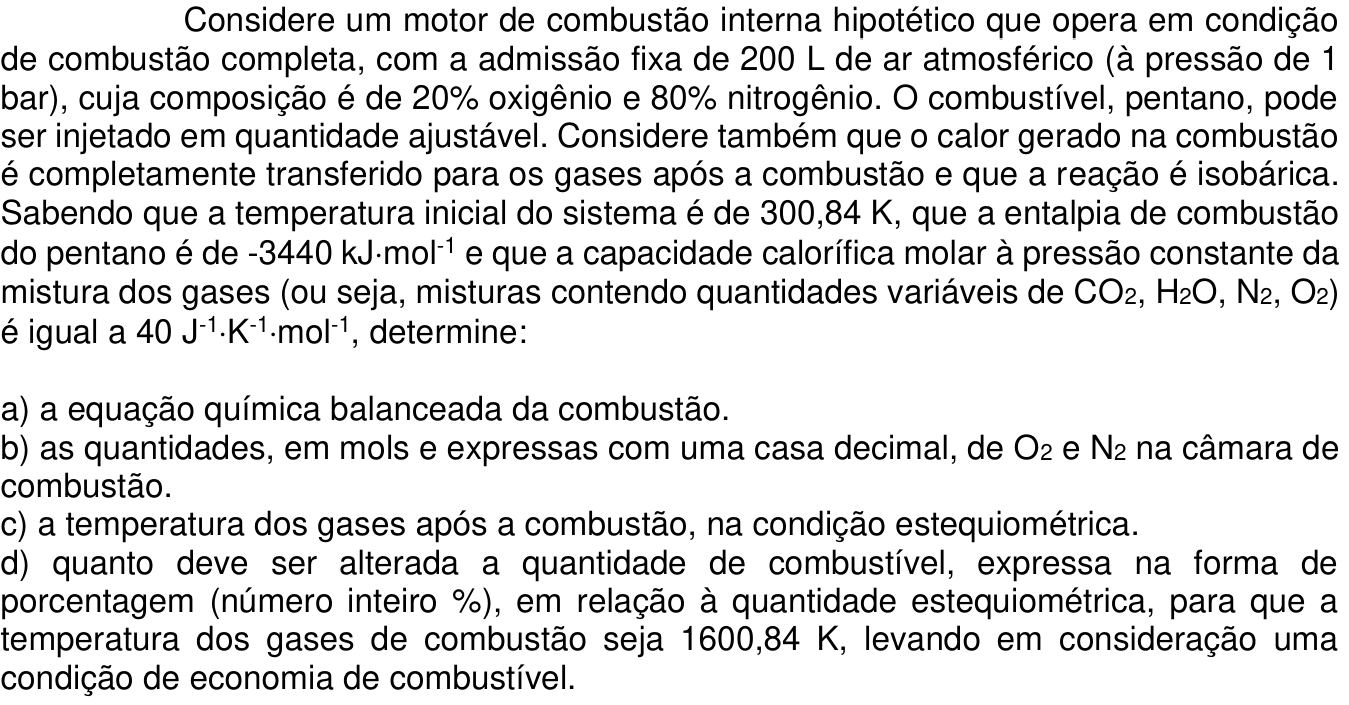
Texto de apoio da questão 1 (Química) Questão 1 (Química)

Respostas das IAs

GPT-6 Astra

Respondeu · mesma resposta final de outras 9 IAs

a) \mathrm{C_5H_{12}+8O_2\rightarrow5CO_2+6H_2O}; b) 1{,}6\ \mathrm{mol} de \mathrm{O_2} e 6{,}4\ \mathrm{mol} de \mathrm{N_2}; c) 2300{,}84\ \mathrm{K}; d) redução de 37\%.

levou 37 s

Como pensou

a) Equação balanceada

A combustão completa do pentano produz dióxido de carbono e água:

\boxed{\mathrm{C_5H_{12}+8\,O_2\longrightarrow 5\,CO_2+6\,H_2O}}

O nitrogênio do ar não participa da reação.

b) Quantidades de \mathrm{O_2} e \mathrm{N_2}

Considerando o ar uma mistura de gases ideais, com P=10^5\ \mathrm{Pa} e V=0{,}200\ \mathrm{m^3}:

n_{\text{ar}}=\frac{PV}{RT} =\frac{10^5\cdot0{,}200}{8{,}31\cdot300{,}84} \approx8{,}0\ \mathrm{mol}.

As porcentagens em volume correspondem às frações molares. Portanto:

\boxed{n_{\mathrm{O_2}}=0{,}20\cdot8{,}0=1{,}6\ \mathrm{mol}}
\boxed{n_{\mathrm{N_2}}=0{,}80\cdot8{,}0=6{,}4\ \mathrm{mol}}.

c) Temperatura na condição estequiométrica

Pela equação balanceada, a quantidade estequiométrica de pentano é:

n_{\text{pentano,est}}=\frac{1{,}6}{8}=0{,}20\ \mathrm{mol}.

Após a combustão, não sobra oxigênio, e a quantidade total de gases é:

n_{\text{gases}}=\underbrace{5(0{,}20)}_{\mathrm{CO_2}} +\underbrace{6(0{,}20)}_{\mathrm{H_2O}} +\underbrace{6{,}4}_{\mathrm{N_2}} =8{,}6\ \mathrm{mol}.

O calor liberado pela combustão é integralmente usado no aquecimento desses gases:

Q=0{,}20\cdot3440=688\ \mathrm{kJ}.

Assim,

Q=n_{\text{gases}}C_{p,m}(T_f-T_i),
688\,000=8{,}6\cdot40\,(T_f-300{,}84).

Logo,

\boxed{T_f=2300{,}84\ \mathrm{K}}.

d) Alteração da quantidade de combustível

Para economizar combustível, reduz-se a quantidade de pentano, mantendo oxigênio em excesso. Seja x a quantidade, em mol, de pentano queimada. As quantidades finais são:

n_{\mathrm{CO_2}}=5x,\qquad n_{\mathrm{H_2O}}=6x,\qquad n_{\mathrm{O_2}}=1{,}6-8x,\qquad n_{\mathrm{N_2}}=6{,}4.

Portanto,

n_{\text{gases}}=5x+6x+(1{,}6-8x)+6{,}4=8+3x.

Para atingir 1600{,}84\ \mathrm{K}, a elevação de temperatura deve ser:

\Delta T=1600{,}84-300{,}84=1300\ \mathrm{K}.

Aplicando o balanço de energia:

3\,440\,000x=(8+3x)\cdot40\cdot1300,
3\,440\,000x=416\,000+156\,000x,
x=\frac{416\,000}{3\,284\,000}\approx0{,}1267\ \mathrm{mol}.

A redução percentual em relação à quantidade estequiométrica é:

\frac{0{,}20-0{,}1267}{0{,}20}\cdot100 \approx36{,}7\%.

Expressando como número inteiro, deve-se reduzir a quantidade de combustível em 37\%.

Resposta final: a) \mathrm{C_5H_{12}+8O_2\rightarrow5CO_2+6H_2O}; b) 1{,}6\ \mathrm{mol} de \mathrm{O_2} e 6{,}4\ \mathrm{mol} de \mathrm{N_2}; c) 2300{,}84\ \mathrm{K}; d) redução de 37\%.

GPT-6.1 Sol

Respondeu · mesma resposta final de outras 9 IAs

a) \mathrm{C_5H_{12}+8O_2\rightarrow5CO_2+6H_2O}; b) 1{,}6\ \mathrm{mol} de \mathrm{O_2} e 6{,}4\ \mathrm{mol} de \mathrm{N_2}; c) 2300{,}84\ \mathrm{K}; d) redução de 37\%.

levou 37 s

Como pensou

a) Equação balanceada da combustão

Na combustão completa, todo o carbono forma \mathrm{CO_2} e todo o hidrogênio forma \mathrm{H_2O}:

\boxed{\mathrm{C_5H_{12}+8\,O_2\longrightarrow5\,CO_2+6\,H_2O}}

O nitrogênio do ar não participa da reação.

b) Quantidades de \mathrm{O_2} e \mathrm{N_2}

Considerando o ar como gás ideal, com 1\ \mathrm{bar}=10^5\ \mathrm{Pa} e 200\ \mathrm{L}=0{,}200\ \mathrm{m^3}:

n_{\text{ar}}=\frac{PV}{RT} =\frac{10^5\cdot0{,}200}{8{,}31\cdot300{,}84} \approx8{,}0\ \mathrm{mol}.

Assim,

\boxed{n_{\mathrm{O_2}}=0{,}20\cdot8{,}0=1{,}6\ \mathrm{mol}}
\boxed{n_{\mathrm{N_2}}=0{,}80\cdot8{,}0=6{,}4\ \mathrm{mol}}.

c) Temperatura após a combustão estequiométrica

Pela equação balanceada, a quantidade estequiométrica de pentano é:

n_{\text{pentano,est}}=\frac{1{,}6}{8}=0{,}20\ \mathrm{mol}.

Após a combustão, há 1{,}0\ \mathrm{mol} de \mathrm{CO_2}, 1{,}2\ \mathrm{mol} de \mathrm{H_2O} e 6{,}4\ \mathrm{mol} de \mathrm{N_2}. Logo:

n_{\text{gases}}=1{,}0+1{,}2+6{,}4=8{,}6\ \mathrm{mol}.

O calor liberado aquece integralmente esses gases:

n_{\text{pentano,est}}|\Delta H_c| =n_{\text{gases}}C_{p,m}(T_f-T_i).

Portanto,

T_f=300{,}84+\frac{0{,}20\cdot3440\cdot10^3}{8{,}6\cdot40} =300{,}84+2000,
\boxed{T_f=2300{,}84\ \mathrm{K}}.

d) Alteração da quantidade de combustível

Para economizar combustível, devemos reduzir sua quantidade, mantendo oxigênio em excesso.

Se forem queimados x mol de pentano, as quantidades finais serão:

n_{\mathrm{CO_2}}=5x,\qquad n_{\mathrm{H_2O}}=6x,\qquad n_{\mathrm{O_2}}=1{,}6-8x,\qquad n_{\mathrm{N_2}}=6{,}4.

Assim, a quantidade total de gases será:

n_{\text{gases}}=5x+6x+(1{,}6-8x)+6{,}4=8+3x.

Para atingir 1600{,}84\ \mathrm{K}, a elevação de temperatura deve ser:

\Delta T=1600{,}84-300{,}84=1300\ \mathrm{K}.

Aplicando o balanço energético:

3440\cdot10^3x=(8+3x)\cdot40\cdot1300,
3\,440\,000x=416\,000+156\,000x,
x=\frac{416\,000}{3\,284\,000}\approx0{,}1267\ \mathrm{mol}.

A redução percentual em relação à quantidade estequiométrica é:

\frac{0{,}20-0{,}1267}{0{,}20}\cdot100 \approx36{,}7\%.

Expressando como número inteiro, deve-se reduzir a quantidade de combustível em 37\%.

Resposta final: a) \mathrm{C_5H_{12}+8O_2\rightarrow5CO_2+6H_2O}; b) 1{,}6\ \mathrm{mol} de \mathrm{O_2} e 6{,}4\ \mathrm{mol} de \mathrm{N_2}; c) 2300{,}84\ \mathrm{K}; d) redução de 37\%.

GPT-6 Luna

Respondeu · mesma resposta final de outras 9 IAs

a) \mathrm{C_5H_{12}+8O_2\rightarrow5CO_2+6H_2O} (com 32N_2 em ambos os lados ao incluir o ar); b) O_2=1{,}6\ \mathrm{mol}, N_2=6{,}4\ \mathrm{mol}; c) 2300{,}84\ \mathrm{K}; d) reduzir o combustível em 37\%.

levou 36 s

Como pensou
**Analyzing combustion chamber air composition** I need to solve a problem involving air composition in a combustion chamber. Starting with 200 L of air at 1 bar, with 20% O2 and 80% N2, the initial temperature is 300.84 K. Using the ideal gas law to find moles, it gives around 8 moles in total, with 1.6 mol O2 and 6.4 mol N2. For part b, I should determine how much O2 and N2 will be in the chamber following combustion, based on fixed air charge and adjustable fuel.**Calculating combustion temperature and fuel efficiency** Upon admission, I note that O2 is at 1.6 moles and N2 at 6.4 moles. Now, for part c, I need to calculate the stoichiometric combustion temperature via heat balance. The heat release is calculated from the stoichiometric fuel at 0.2 mol, giving 688 kJ. The products at stoichiometry yield a mixture of 17.4 moles, using specific heat capacity. This leads to a final temperature of 1289.3 K, but the target is 1600.84 K, suggesting I may need to adjust the amount of fuel for efficiency.**Revising fuel calculations** I’m calculating stoichiometric fuel heat, which gives ΔT = 988.5 when I divide the heat (688 kJ) by the heat capacity of the mixture (696 J/K). I need to ensure that my adjustments for fuel quantity reduce the heat released effectively since less fuel means fewer gases and a smaller temperature rise. I noticed I previously miscalculated; the excess O2 starts at 1.6, so my earlier total count was off. I need to recompute.**Evaluating combustion stoichiometry** I'm considering why O2 is absent after combustion yet mentioning N2 and O2, which likely relates to the charge. I could clarify that O2 is fully consumed during stoichiometry, leaving residual N2 at 6.4. The prompt asks about the quantities of O2 and N2 in the combustion chamber, so I might evaluate if given air volume and the respective amounts of O2 and N2 define initial chamber gases. Also, I should compute initial moles accurately to ensure clarity.

a) A combustão completa do pentano é:

\mathrm{C_5H_{12}(g)+8\,O_2(g)\rightarrow 5\,CO_2(g)+6\,H_2O(g)}

Como o ar contém 4 mol de N_2 para cada mol de O_2, a equação incluindo o nitrogênio inerte é:

\mathrm{C_5H_{12}+8\,O_2+32\,N_2\rightarrow 5\,CO_2+6\,H_2O+32\,N_2}.

b) Pela equação dos gases ideais, usando R=0{,}0831\ \mathrm{bar\,L\,mol^{-1}\,K^{-1}}:

n_{\text{ar}}=\frac{PV}{RT} =\frac{(1)(200)}{(0{,}0831)(300{,}84)} \approx 8{,}0\ \mathrm{mol}.

Assim, na carga admitida:

n_{O_2}=0{,}20(8{,}0)=1{,}6\ \mathrm{mol},\qquad n_{N_2}=0{,}80(8{,}0)=6{,}4\ \mathrm{mol}.

Na combustão estequiométrica, todo o O_2 é consumido; o N_2 permanece inalterado.

c) Pela estequiometria, 1{,}6 mol de O_2 reagem com 0{,}2 mol de pentano. Formam-se 1{,}0 mol de CO_2, 1{,}2 mol de H_2O e 6{,}4 mol de N_2, totalizando 8{,}6 mol de gases.

O calor liberado é:

Q=(0{,}2)(3440)=688\ \mathrm{kJ}.

Como Q=nC_p\Delta T,

\Delta T=\frac{688\,000}{(8{,}6)(40)}=2000\ \mathrm{K},
T_f=300{,}84+2000=\boxed{2300{,}84\ \mathrm{K}}.

d) Para economia de combustível, considera-se uma quantidade x<0{,}2 mol de pentano, com oxigênio em excesso. Os gases após a combustão incluem 5x mol de CO_2, 6x mol de H_2O, 1{,}6-8x mol de O_2 e 6{,}4 mol de N_2. Logo, o total é 8+3x mol.

A elevação de temperatura desejada é 1600{,}84-300{,}84=1300\ \mathrm{K}. Então:

3{,}44\times10^6x=40(8+3x)(1300),
x=\frac{416\,000}{3\,284\,000}\approx0{,}1267\ \mathrm{mol}.

A redução em relação à quantidade estequiométrica é:

\frac{0{,}2-0{,}1267}{0{,}2}\times100\%\approx36{,}7\%\approx37\%.

Resposta final: a) \mathrm{C_5H_{12}+8O_2\rightarrow5CO_2+6H_2O} (com 32N_2 em ambos os lados ao incluir o ar); b) O_2=1{,}6\ \mathrm{mol}, N_2=6{,}4\ \mathrm{mol}; c) 2300{,}84\ \mathrm{K}; d) reduzir o combustível em 37\%.

Claude Fable 5.1

Respondeu · mesma resposta final de outras 9 IAs

a) C₅H₁₂ + 8 O₂ → 5 CO₂ + 6 H₂O; b) O₂ = 1,6 mol e N₂ = 6,4 mol; c) ≈ 2300,84 K (≈ 2301 K); d) redução de ≈ 37 % do combustível (de 0,2 para ≈ 0,127 mol de pentano).

levou 24 s

Como pensou
I'm first balancing the combustion equation for pentane, then moving to part b, calculating moles of air using the ideal gas law with 200 L at 1 bar converted to atm and 300.84 K. Working through the numbers carefully, I land on n_total ≈ 8,0 mol for the air, giving O2 = 1,6 mol and N2 = 6,4 mol as the stoichiometric design of the problem. For part c, since O2 is the limiting reagent at 1,6 mol, I calculate that 0,2 mol of pentane reacts, releasing 688 kJ of heat, and I'm now tracking the resulting gas quantities, starting with CO2 at 1,0 mol. With total moles of gas at 8,6 and Cp = 40 J/(K·mol), the temperature rise comes out to exactly 2000 K, giving a clean final temperature of 2300,84 K — confirming the problem was designed around these numbers. Now for part d, I need to find the pentane amount that yields a final temperature of 1600,84 K (ΔT = 1300 K) under lean-burn conditions where fuel is limited and O2 is in excess, so I'm setting up the mole balance with x mol of pentane reacting and tracking CO2, H2O, remaining O2, and N2 accordingly. Solving 3440000x = 40 × 1300 × (8 + 3x) gives x ≈ 0,1267 mol, which compared to the original 0,2 mol represents roughly a 37% reduction in fuel. Since the scenario specifies a fuel-economy (lean) condition rather than rich, this confirms combustion stays complete while fuel input drops by about 37%.

a) Equação balanceada da combustão completa do pentano

C₅H₁₂(g) + 8 O₂(g) → 5 CO₂(g) + 6 H₂O(g)

b) Quantidade de O₂ e N₂ na câmara

Ar admitido: V = 200 L, P = 1 bar ≈ 0,987 atm, T = 300,84 K.

n = PV/RT = (0,987 × 200)/(0,0821 × 300,84) = 197,4/24,70 ≈ 8,0 mol de ar

  • n(O₂) = 0,20 × 8,0 = 1,6 mol
  • n(N₂) = 0,80 × 8,0 = 6,4 mol

c) Temperatura na condição estequiométrica

Pentano necessário: 1,6 mol O₂ × (1 mol C₅H₁₂ / 8 mol O₂) = 0,2 mol

Calor liberado: q = 0,2 × 3440 kJ = 688 kJ = 688 000 J

Gases após a combustão:

  • CO₂: 5 × 0,2 = 1,0 mol
  • H₂O: 6 × 0,2 = 1,2 mol
  • N₂: 6,4 mol
  • O₂: 0 (consumido totalmente)
  • Total: 8,6 mol

q = n·Cp·ΔT → ΔT = 688 000 / (8,6 × 40) = 688 000/344 = 2000 K

T_final = 300,84 + 2000 = 2300,84 K (≈ 2301 K)

d) Alteração da quantidade de combustível para T = 1600,84 K

ΔT desejado = 1600,84 − 300,84 = 1300 K.

Para economia de combustível, usa-se mistura pobre (menos pentano, excesso de O₂, combustão continua completa). Seja x o número de mols de pentano (x < 0,2):

Gases finais: CO₂ = 5x; H₂O = 6x; O₂ = 1,6 − 8x; N₂ = 6,4 → n_total = 8 + 3x

Balanço de energia:
3 440 000·x = 40 × 1300 × (8 + 3x)
3 440 000·x = 416 000 + 156 000·x
3 284 000·x = 416 000
x ≈ 0,1267 mol

Variação em relação à estequiométrica:
(0,1267 − 0,2)/0,2 = −0,367 → redução de ≈ 37 % na quantidade de combustível.

Resposta final: a) C₅H₁₂ + 8 O₂ → 5 CO₂ + 6 H₂O; b) O₂ = 1,6 mol e N₂ = 6,4 mol; c) ≈ 2300,84 K (≈ 2301 K); d) redução de ≈ 37 % do combustível (de 0,2 para ≈ 0,127 mol de pentano).

Claude Opus 5.5

Respondeu · mesma resposta final de outras 9 IAs

a) C₅H₁₂ + 8 O₂ → 5 CO₂ + 6 H₂O; b) O₂ = 1,6 mol e N₂ = 6,4 mol; c) T ≈ 2300,84 K; d) redução de ≈ 37 % na quantidade de combustível (mistura pobre)

levou 15 s

Como pensou
The balanced equation for pentane combustion gives C5H12 + 8 O2 → 5 CO2 + 6 H2O. For part b, converting 1 bar to atm and applying PV=nRT with 200 L at 300.84 K gives n ≈ 8.0 mol total. For part c, with stoichiometric pentane (1.6/8 = 0.2 mol), the heat released (688 kJ) warms the product gas mixture (CO2, H2O, N2 totaling 8.6 mol) by about 2000 K, reaching a final temperature of 2300.84 K. For part d, I'm testing a leaner fuel mixture to hit the target 1300 K rise, setting up an energy balance where heat released equals Cp times total moles times ΔT, solving for fuel moles x ≈ 0.127 mol — roughly a 37% reduction in fuel compared to the stoichiometric case.

a) Equação balanceada da combustão

C₅H₁₂(g) + 8 O₂(g) → 5 CO₂(g) + 6 H₂O(g)

b) Quantidades de O₂ e N₂

Com P = 1 bar = 10⁵ Pa, V = 200 L = 0,2 m³ e T = 300,84 K:

n_total = PV/RT = (10⁵ · 0,2)/(8,31 · 300,84) = 20000/2500 ≈ 8,0 mol

  • n(O₂) = 0,20 · 8,0 = 1,6 mol
  • n(N₂) = 0,80 · 8,0 = 6,4 mol

c) Temperatura na condição estequiométrica

A quantidade de pentano é n(C₅H₁₂) = 1,6/8 = 0,2 mol.

O calor liberado é Q = 0,2 · 3440 = 688 kJ.

Os gases após a combustão são:

  • CO₂: 5 · 0,2 = 1,0 mol
  • H₂O: 6 · 0,2 = 1,2 mol
  • N₂: 6,4 mol

O total é 8,6 mol.

ΔT = Q/(n·Cp) = 688000/(8,6 · 40) = 2000 K

T = 300,84 + 2000 = 2300,84 K

d) Ajuste do combustível para T = 1600,84 K

O ΔT desejado é 1300 K, menor que o da condição estequiométrica. Por economia, usa-se mistura pobre, com menos combustível e excesso de O₂.

Para x mol de pentano, os gases finais são:

  • CO₂: 5x
  • H₂O: 6x
  • O₂ restante: 1,6 − 8x
  • N₂: 6,4

O total é 8 + 3x mol.

Balanço de energia:

3440000·x = 40·(8 + 3x)·1300
3440000x = 416000 + 156000x
3284000x = 416000
x ≈ 0,1267 mol

Em relação ao estequiométrico: 0,1267/0,2 ≈ 63 %. Portanto, deve-se reduzir a quantidade de combustível em cerca de 37 %.

Resposta final: a) C₅H₁₂ + 8 O₂ → 5 CO₂ + 6 H₂O; b) O₂ = 1,6 mol e N₂ = 6,4 mol; c) T ≈ 2300,84 K; d) redução de ≈ 37 % na quantidade de combustível (mistura pobre)

Claude Sonnet 5.5

Respondeu · mesma resposta final de outras 9 IAs

a) C₅H₁₂ + 8 O₂ → 5 CO₂ + 6 H₂O; b) 1,6 mol de O₂ e 6,4 mol de N₂; c) ≈ 2300,84 K (ΔT = 2000 K); d) reduzir o combustível em ≈ 37% (mistura pobre, n ≈ 0,127 mol)

levou 16 s

Como pensou
I'm calculating moles of air using n = PV/RT with 200 L at 1 bar and 300.84 K, converting pressure to atm and working through the arithmetic to get about 8.205 mol. Switching to 8.31 J for R, I get n = 8.0 mol total air, split into O2 = 1.6 mol and N2 = 6.4 mol. For the combustion equation (C5H12 + 8 O2 → 5 CO2 + 6 H2O), I determine the stoichiometric pentane amount is 0.2 mol using the available O2, giving 688 kJ of heat released; I then total the product gases (CO2, H2O, N2) to 8.6 mol and use the heat capacity to find ΔT ≈ 2000 K, landing at a final temperature of 2300.84 K. For the target temperature of 1600.84 K (ΔT = 1300 K), I'm setting up a leaner fuel scenario with excess O2, tracking how total gas moles change with the amount of fuel burned to solve for the right fuel quantity. Solving the energy balance equation for the leaner mixture, I find n ≈ 0.127 mol of fuel, which is about 63.3% of the stoichiometric amount — meaning I need to reduce the fuel by roughly 37% to hit the target temperature, since the rich-mixture alternative doesn't work under the complete-combustion assumption.

a) Equação balanceada (combustão completa, água como vapor)

C₅H₁₂ + 8 O₂ → 5 CO₂ + 6 H₂O

b) Quantidades de O₂ e N₂

Quantidade total de gás admitida: n = PV/RT = (1×10⁵ Pa · 0,200 m³)/(8,31 · 300,84) ≈ 8,0 mol.

  • O₂: 20% de 8,0 mol = 1,6 mol
  • N₂: 80% de 8,0 mol = 6,4 mol

c) Temperatura na condição estequiométrica

  • n(C₅H₁₂) = 1,6/8 = 0,20 mol.
  • Calor liberado: 0,20 × 3440 kJ = 688 kJ.
  • Gases finais: 1,0 mol de CO₂, 1,2 mol de H₂O e 6,4 mol de N₂, totalizando 8,6 mol.
  • ΔT = 688 000 J / (8,6 mol × 40 J·K⁻¹·mol⁻¹) = 688 000/344 = 2000 K.
  • T final = 300,84 + 2000 = 2300,84 K

d) Variação da quantidade de combustível para 1600,84 K

Para atingir 1600,84 K, ΔT = 1300 K, que é menor que os 2000 K da condição estequiométrica. Para economizar combustível, usa-se mistura pobre: há menos combustível e sobra O₂. Com combustão completa, uma mistura rica não aqueceria mais que a estequiométrica, pois o O₂ limitaria a reação.

Seja n mol de pentano queimados. O número de mols de gás após a combustão é:

6,4 (N₂) + (1,6 − 8n) (O₂ restante) + 5n (CO₂) + 6n (H₂O) = 8,0 + 3n

Balanço de energia:

3 440 000 · n = 40 · (8,0 + 3n) · 1300

3 440 000 n = 416 000 + 156 000 n

n = 416 000/3 284 000 ≈ 0,127 mol

Razão em relação ao estequiométrico: 0,127/0,200 ≈ 0,63. A quantidade de combustível deve ser reduzida em cerca de 37%.

Resposta final: a) C₅H₁₂ + 8 O₂ → 5 CO₂ + 6 H₂O; b) 1,6 mol de O₂ e 6,4 mol de N₂; c) ≈ 2300,84 K (ΔT = 2000 K); d) reduzir o combustível em ≈ 37% (mistura pobre, n ≈ 0,127 mol)

Grok 4.7

Respondeu · mesma resposta final de outras 9 IAs

a) \mathrm{C_5H_{12}+8\,O_2\rightarrow5\,CO_2+6\,H_2O}; b) 1{,}6\,\mathrm{mol\,O_2} e 6{,}4\,\mathrm{mol\,N_2}; c) 2300{,}84\,\mathrm{K}; d) redução de 37\%

levou 3 min 03 s

Como pensou
The problem is from the 2027 ITA second phase, Chemistry. The problem concerns a hypothetical internal combustion engine. It uses complete pentane combustion with fixed atmospheric air admission of 200 L at 1 bar, containing 20% oxygen and 80% nitrogen. Heat generated is fully transferred to the post-combustion gases under isobaric conditions. Initial temperature is 300.84 K. The enthalpy of pentane combustion is -3440 kJ/mol. The molar heat capacity of the gas mixture is 40 J·K⁻¹·mol⁻¹. The task requires determining the balanced equation, the moles of O₂ and N₂ in the chamber, and the post-combustion temperature under stoichiometric conditions. The balanced equation for pentane combustion is C₅H₁₂ + 8 O₂ → 5 CO₂ + 6 H₂O. The balanced equation will likely show only the pentane combustion reaction, omitting nitrogen. For part b), I am calculating the moles of air using the ideal gas law with the given volume and temperature. The ideal gas calculation yields exactly 8 moles of air. The temperature 300.84 K was chosen so that RT equals exactly 2500. The chamber contains 1.6 moles of O₂ and 6.4 moles of N₂. The stoichiometric quantity of pentane is 0.2 mol, since 1.6 mol of O₂ are available and 8 mol of O₂ are required per mole of pentane. The heat released during this reaction is 688 kJ. The post-combustion gas mixture contains 1 mol of CO₂, 1.2 mol of H₂O, and 6.4 mol of N₂, with no remaining O₂. The total moles of post-combustion gas are 8.6 mol. The reaction is isobaric, so the heat released raises the temperature of these gases from 300.84 K to the final temperature. The heat released by the reaction is absorbed by the post-combustion gas mixture. The final temperature must be calculated from the enthalpy change of these products at constant pressure. The temperature increase is 2000 K. The final temperature of the post-combustion gases is 2300.84 K. Part d) requires finding the percentage reduction in pentane relative to stoichiometry so that the post-combustion temperature drops to 1600.84 K. This lean mixture condition leaves excess oxygen and lowers the final temperature. The temperature change is 1300 K. The heat released is 3440 kJ per mole of pentane. The total moles of post-combustion gas is 8 + 3n, where n is the moles of pentane. The heat balance equation becomes 3440n = (8 + 3n) × 0.04 × 1300. Solving this yields 3440n = 416 + 156n. The exact solution is n = 104/821 mol. This is about 0.1267 mol, or roughly 37% below stoichiometry. The calculation is being verified against the integer percentage requirement. The integer percentage requirement in part d) is prompting a re-examination of the product gas mole count and the adiabatic heat balance. The exact ratio 520/821 is being recalculated to verify the result. The exact value is 416/3284 mol, or about 0.1267. This equals roughly 63% of the stoichiometric amount. The question asks by how much the quantity must change, so the answer is a reduction of approximately 37%. The total moles of post-combustion gas is 8 + 3n, where n is the moles of pentane. This confirms the earlier product count. The final answer will be formatted as a single line per item, following the example format. The balanced equation for part a) is C₅H₁₂ + 8 O₂ → 5 CO₂ + 6 H₂O. The answer to part d) will be reported as 37%. The ideal gas calculation is being redone with R = 0.0821 L·atm·K⁻¹·mol⁻¹ and P = 1 atm. The resulting moles of air are being checked to see if they produce a cleaner integer percentage. The ideal gas calculation with R = 0.0821 L·atm·K⁻¹·mol⁻¹ yields roughly 8.10 mol, confirming the SI units are correct and the air amount is exactly 8 mol. The temperature change of 1300 K from 300.84 K to 1600.84 K is accepted as given. The percentage reduction in pentane will be rounded to an integer. A symbolic solution of the heat balance equation is being attempted. The symbolic verification confirms the exact ratio is 416/3284, which cannot be simplified to a clean integer percentage. The answer will be reported as a 37% reduction in pentane. The phrase "combustão completa" rules out excess fuel, since incomplete combustion would produce CO and soot. Only the lean case is valid. The answer to part d) will be reported as a 37% reduction in pentane. The adiabatic isobaric assumption is confirmed. The heat balance equation is verified. The solution will be written in Portuguese. The final answer will be written in Portuguese with commas for decimal points, matching the format used in the problem statement. The response will be presented as a single line per item. The final answer will be written as a single line per item, using commas for decimals. The percentage change will be expressed as a reduction of 37%.

A combustão completa do pentano é representada por

\mathrm{C_5H_{12} + 8\,O_2 \rightarrow 5\,CO_2 + 6\,H_2O}.

O número de mols de ar admitido é obtido pela equação dos gases ideais (P = 1\,\mathrm{bar} = 10^5\,\mathrm{Pa}, V = 0{,}2\,\mathrm{m^3}, R = 8{,}31\,\mathrm{J\,K^{-1}\,mol^{-1}}):

n = \frac{10^5 \times 0{,}2}{8{,}31 \times 300{,}84} = 8{,}0\,\mathrm{mol}.

Logo, há 1{,}6\,\mathrm{mol} de \mathrm{O_2} e 6{,}4\,\mathrm{mol} de \mathrm{N_2}.

Na condição estequiométrica são injetados 0{,}2\,\mathrm{mol} de pentano. O calor liberado (688\,\mathrm{kJ}) é integralmente absorvido pelos 8{,}6\,\mathrm{mol} de gases produtos (\mathrm{C_p} = 40\,\mathrm{J\,K^{-1}\,mol^{-1}}):

\Delta T = \frac{688000}{8{,}6 \times 40} = 2000\,\mathrm{K},

de modo que a temperatura final é 2300{,}84\,\mathrm{K}.

Para atingir 1600{,}84\,\mathrm{K} (\Delta T = 1300\,\mathrm{K}) em mistura pobre (economia de combustível) seja n a quantidade de pentano. O balanço de energia fornece

3440\,n = 52\,(8 + 3n) \implies n = 0{,}1267\,\mathrm{mol}.

A redução relativa à quantidade estequiométrica é 36{,}7\%, que, arredondada ao inteiro, corresponde a 37\%.

Resposta final: a) \mathrm{C_5H_{12}+8\,O_2\rightarrow5\,CO_2+6\,H_2O}; b) 1{,}6\,\mathrm{mol\,O_2} e 6{,}4\,\mathrm{mol\,N_2}; c) 2300{,}84\,\mathrm{K}; d) redução de 37\%

DeepSeek V4.1 Flash

Respondeu · mesma resposta final de outras 9 IAs

a) \mathrm{C_5H_{12}+8O_2\rightarrow5CO_2+6H_2O}; b) \mathrm{O_2}: 1,6 mol e \mathrm{N_2}: 6,4 mol; c) 2300,84 K; d) redução de 37% da quantidade estequiométrica.
levou 1 min 40 s

Como pensou
We need answer question in Portuguese. Need solve. Let's restate. We have engine combustion hypothetical complete combustion, fixed admission 200 L atmospheric air at 1 bar, composition 20% oxygen, 80% nitrogen. Fuel pentane adjustable. Assume heat generated in combustion completely transferred to gases after combustion and reaction is isobaric. Initial temperature system 300.84 K, enthalpy combustion pentane = -3440 kJ/mol, heat capacity molar at constant pressure of mixture gases (mixtures containing variable amounts CO2, H2O, N2, O2) equal 40 J·K^-1·mol^-1. Determine: a) balanced chemical equation combustion. b) quantities, in mol and expressed with one decimal place, of O2 and N2 in combustion chamber. c) temperature of gases after combustion, in stoichiometric condition. d) how much should be altered the amount of fuel, expressed as percentage (whole number %), relative to stoichiometric amount, so that temperature of combustion gases is 1600.84 K, considering condition of fuel economy. Need parse: Fixed admission 200 L air at pressure 1 bar. Initial T = 300.84 K. Use ideal gas? likely. Air composition 20% O2, 80% N2 by volume? It says composição é de 20% oxigênio e 80% nitrogênio. Typically mole fractions. Need calculate total moles air at 1 bar, 200 L, T=300.84 K. R = 0.0821 atm L / mol K? But pressure 1 bar, need convert? Given 1 atm = 1.01325 bar, so 1 bar = 0.986923 atm. R = 0.0821 atm L mol^-1 K^-1? Also other units. 1 bar = 1.01325e5 N/m^2. Using ideal gas: PV=nRT. P=1 bar = 1e5 Pa? Actually 1 bar = 1e5 Pa, but given 1 atm = 1.01325e5 N/m^-2 = 1.01325 bar. So 1 bar = 0.986923 atm. R=0.0821 atm L /(mol K). V=200 L, T=300.84 K. n = PV / RT = (1 bar * 200 L?) Need consistent: use P in atm: 1 bar = 100000 Pa /101325 Pa/atm = 0.986923 atm. n = 0.986923*200 / (0.0821*300.84). Let's compute. 0.0821*300.84 =? 0.0821*300 =24.63; +0.0821*0.84=0.068964; total 24.698964. numerator 197.3846. n = 7.991? 197.3846/24.699 = 7.9917 mol. Alternatively use 1 atm=1.01325 bar, so R in L bar? R = 0.083144? Let's check R = 8.314 J/molK = 0.08314 L bar /molK? Since 1 J = 1e-5 bar? Actually 1 L bar = 100 J; R=8.314 J/molK =0.08314 L bar/molK. Then n=1 bar*200L/(0.08314*300.84)=200/(25.015?) = 7.995? Similar. Let's compute precisely maybe. Let's calculate with R = 0.0821 atm L /molK and P=0.986923 atm: n_air = 0.986923 *200 / (0.0821*300.84) = 197.3846 / 24.698964 = 7.991? Compute: 24.698964*7.99 = 197.344? 24.698964*7.99 = 24.698964*(8 -0.01)=197.5917 -0.24699=197.3447. Slight low. 7.992? *7.992 = 197.394? 24.698964*0.002=0.049398; 7.99*? Let's divide: 197.3846 / 24.698964 = 7.99174. So about 7.992 mol air. n_O2=0.20*7.992=1.5984 mol; n_N2=0.80*7.992=6.3936 mol. But question b asks "as quantidades, em mols e expressas com uma casa decimal, de O2 e N2 na câmara de combustão." Maybe after admission? It says fixed admission 200 L of air, composition 20% O2 and 80% N2. Determine b) quantities, in mol, expressed with one decimal, of O2 and N2 in combustion chamber. Should be oxygen and nitrogen in chamber. If combustion occurs, oxygen consumed, but "na câmara de combustão" maybe initial air? Part b likely asks amounts of O2 and N2 in chamber before combustion? Let's examine. It says "Considerar um motor... com admissão fixa de 200 L de ar atmosférico ... composição ... O combustível, pentano, pode ser injetado em quantidade ajustável. ... determine: a) equação ... b) as quantidades, em mols e expressas com uma casa decimal, de O2 e N2 na câmara de combustão. c) ... após combustão ... d) ..." So b likely initial quantities admitted (O2 and N2) in chamber, because c asks after combustion temperature in stoichiometric condition. But perhaps after combustion, nitrogen unchanged; oxygen maybe? But b says O2 and N2 in chamber, maybe before reaction? They may want initial O2 and N2 amounts. The initial air is 200 L at 1 bar, T=300.84 K. Need compute moles. Part b "as quantidades, em mols e expressas com uma casa decimal" maybe n_O2 = 1.6 mol, n_N2 = 6.4 mol. Let's verify with ideal gas at 1 bar 200 L and 300.84 K: n_total = PV/RT = (1 bar * 200 L)/(0.08314 L bar mol^-1 K^-1 * 300.84 K) = 200/(25.014?)=7.995? Wait R=0.083144? Compute 0.083144*300.84 = 25.014? 0.083144*300=24.9432; *0.84=0.06984; total 25.0130. n=200/25.013=7.9958 mol. Then O2=1.5992; N2=6.3966; one decimal = 1.6 and 6.4. Good. Need consider air composition 20% oxygen and 80% nitrogen. Are these mole fractions? Usually yes. Could be by volume; in ideal gas same. So b: 1.6 mol O2; 6.4 mol N2 (after rounding to one decimal). Total 8.0 mol? If O2 1.6, N2 6.4 sum 8.0. Part c: stoichiometric condition. Need balanced equation pentane combustion: C5H12 + 8 O2 -> 5 CO2 + 6 H2O. Since complete combustion. (Pentane formula C5H12, molar mass 72.15 g/mol? But not needed maybe). Stoichiometric requires 8 mol O2 per mol pentane. Air O2 available 1.6 mol, so fuel max stoichiometric = 1.6/8 =0.2 mol pentane. Since air N2 6.4 mol. Products: 5*0.2=1.0 mol CO2; 6*0.2=1.2 mol H2O; remaining O2? If exactly stoichiometric, O2 all consumed, no O2 remaining. N2 6.4 mol unchanged. Total gaseous products after combustion? CO2 1.0 + H2O 1.2 + N2 6.4 = 8.6 mol. Wait water may be gaseous at high temperature? "gases após a combustão" and heat capacity of mixture gases containing CO2, H2O, N2, O2. Yes water vapor considered gas. Initial air moles = 8.0 mol. Fuel 0.2 mol pentane before combustion? If pentane liquid? Enthalpy combustion per mol pentane -3440 kJ/mol. Reaction is isobaric; heat generated transferred to gases after combustion. Need temperature after combustion. We need energy balance: initial reactants at 300.84 K; fuel perhaps injected at initial T? Heat released = -ΔH_combustion * n_fuel? Enthalpy of combustion given -3440 kJ/mol pentane meaning heat released at standard? If reaction is isobaric, heat released = 3440 kJ/mol * n_fuel (positive). This heat warms products from initial T to final T. But initial includes air + fuel? The fuel may be at initial temp? Usually assume fuel and air initially at 300.84 K; after combustion products are at final T. Heat capacity of mixture gases = 40 J/K/mol for product mixture? The statement: "a capacidade calorífica molar à pressão constante da mistura dos gases (ou seja, misturas contendo quantidades variáveis de CO2, H2O, N2, O2) é igual a 40 J·K^-1·mol^-1". That is per mole of gas mixture, regardless composition? It says mixtures containing variable amounts of those gases. So C_p,m = 40 J/mol K for gas mixture. The heat required to raise product gas temperature = n_total_products * C_p,m * ΔT? But also the nitrogen and any remaining O2 and product gases. If C_p molar for mixture =40, then total heat capacity = 40 J/molK * total moles products. Initial reactants also heated? The reaction itself? Let's derive. At constant pressure, enthalpy change for combustion at initial T maybe equals enthalpy of products at final T minus enthalpy of reactants at initial T. The heat of combustion ΔH_c = -3440 kJ/mol at some standard temperature (likely 298K? But not explicitly). We can approximate using enthalpy of combustion at 300.84 K? Since reactants/products heat capacities? Typically standard enthalpy of combustion at 298 K; but Cp products? The heat released warms products from initial T (reactants initial T) to final T. If reactants enter at T_i=300.84 K, products leave at T_f. Enthalpy of reactants at T_i = H_reactants(T_i); products at T_f = H_products(T_f). For adiabatic isobaric reactor, H_products(T_f)=H_reactants(T_i) + n_fuel * ΔH_combustion? Actually ΔH_combustion = H_products - H_reactants at same T. So H_products(T_i) = H_reactants(T_i) + n_fuel * ΔH_c. Then products heated from T_i to T_f: H_products(T_f) = H_products(T_i) + ∫ n_prod Cp_prod dT. Set equal to H_reactants(T_i) (no heat loss). So n_fuel * ΔH_c + n_prod * C_p_prod * (T_f - T_i) = 0? Wait sign: ΔH_c negative (-3440 kJ/mol). So H_products(T_i) = H_reactants(T_i) - 3440e3 J/mol * n_fuel. Then heat released = 3440e3 n_fuel J. This heat warms products: n_prod C_p (T_f - T_i) = 3440e3 n_fuel. If T_f>T_i. Solve. But note fuel amount maybe not all heated? The fuel itself as reactant at initial T; its heat capacity? Not given. Usually reactant sensible heat ignored because fuel small and initial T same. We can use. Part c stoichiometric: n_fuel=0.2 mol. n_prod =? CO2 1.0 + H2O 1.2 + N2 6.4 = 8.6 mol. (No excess O2.) Heat released Q = 0.2 mol * 3440 kJ/mol = 688 kJ = 688,000 J. Heat capacity total = 8.6 mol * 40 J/molK = 344 J/K. ΔT = Q / C_total = 688000 / 344 = 2000 K? 344*2000=688000 yes. T_f = 300.84 + 2000 = 2300.84 K. Is that plausible? Very high, but problem likely expected. Could there be need include air N2 and unreacted O2? For stoichiometric no O2, yes total product moles 8.6. If include water vapor. So c = 2300.84 K. Let's see if "combustão completa" and "calor gerado completamente transferido para os gases após a combustão" maybe includes heating excess air? Yes. For stoichiometric, air O2 exactly consumed, no O2 leftover. Products CO2 H2O N2. Q = -ΔH * n_pentane. ΔT = 3440e3 *0.2 / (8.6*40)? Wait 3440 kJ/mol = 3,440,000 J/mol. n=0.2 => 688,000 J. Total moles = 1.0 + 1.2 + 6.4 = 8.6 mol. C_total = 8.6*40=344 J/K. ΔT=2000 K. initial 300.84 => 2300.84 K. Good. Part d: how much should be altered the amount of fuel, expressed as percentage (integer %) relative to stoichiometric amount, for T_f = 1600.84 K, considering fuel economy condition. "economia de combustível" means reduced fuel? Since desired final temperature lower than stoichiometric (2300.84 K), need less fuel? But wait if less fuel than stoichiometric, oxygen remains, products include excess O2, water, CO2, N2. Total product moles differ? Also heat release less, but total heat capacity? Need solve energy balance for n_fuel (maybe as fraction of stoichiometric). Let n_fuel = x mol (<0.2 likely). Combustion with available O2. Complete combustion with oxygen? Since fuel amount adjusted maybe fuel is limiting or O2? For fuel economy, likely less fuel than stoichiometric to lower temperature. Need consider if x < stoich, O2 remains. Products: CO2=5x, H2O=6x, N2=6.4 mol, O2 remaining = initial O2 - 8x = 1.6 - 8x mol. Total product gas moles = 5x + 6x + 6.4 + (1.6 - 8x) = 8.0 + 3x? Let's compute: 5x+6x=11x; +6.4 +1.6 -8x =8.0 +3x. Wait 11x -8x =3x; +8.0 = 8.0+3x. Yes total moles = 8.0 + 3x (since N2 6.4 and O2 remaining 1.6-8x). If stoichiometric x=0.2: total=8.0+0.6=8.6; matches. If no fuel x=0: total=8.0 (air), no reaction, T_i=300.84. If x > stoich, O2 limiting? But d likely economy (less fuel). But could also be excess fuel? Need determine "economia de combustível" means reduce fuel consumption to achieve lower temperature? Since lower T desired, need less fuel, so x<0.2. However, there is also possibility with excess fuel (rich mixture) to lower T because unburned fuel? But "combustão completa" with adjustable pentane injection. If more fuel than stoichiometric, oxygen insufficient for complete combustion, but problem says complete combustion? It says motor operates in condition of complete combustion; with excess fuel, complete combustion impossible unless oxygen? But maybe excess fuel can be considered unburned? But not likely. "economia de combustível" suggests reduce fuel, so lean mixture. Need compute x. Energy balance for x<0.2: heat released = 3440 kJ/mol * x mol = 3,440,000 x J. Total heat capacity = (8.0 + 3x) mol * 40 J/molK = 320 + 120x J/K. Temperature change ΔT = T_f - T_i = 1600.84 - 300.84 = 1300 K. Set Q = C_total * ΔT: 3,440,000 x = (320 + 120x)*1300 = 320*1300 + 120x*1300 = 416000 + 156000x. Then 3,440,000x -156,000x = 416,000 => 3,284,000 x = 416,000 => x = 416000 / 3,284,000 =? Compute: 416000/3,284,000 = 0.12667? 3,284,000*0.1267 = 416,? 3,284,000*0.1267 = 416,? 3,284,000*0.1=328400; *0.0267=87,682.8; total 416,082.8, a bit high. Let's calculate precisely: 3,284,000 x = 416,000; x = 416/3284 = 0.1266748. Yes about 0.1267 mol. Stoichiometric =0.2 mol. Percentage of stoichiometric? x/0.2 = 0.63337 =63.337%. But question says "quanto deve ser alterada a quantidade de combustível, expressa na forma de porcentagem (número inteiro %), em relação à quantidade estequiométrica" Could mean percentage change (alteration) relative to stoichiometric amount, perhaps reduction: (0.2 - x)/0.2 = 0.3666 =36.66%. Or maybe "alterada" as amount relative to stoichiometric: x/stoich = 63%? Need parse. "quanto deve ser alterada a quantidade de combustível, expressa na forma de porcentagem (número inteiro %), em relação à quantidade estequiométrica" Means how much should the amount of fuel be altered, expressed as percentage relative to stoichiometric amount. Typically it is the percentage reduction: "deve ser reduzida em x%". But if asked "alterada" could be percentage of stoichiometric? Let's see in d: "quanto deve ser alterada a quantidade de combustível, expressa na forma de porcentagem (número inteiro %), em relação à quantidade estequiométrica, para que a temperatura ... seja 1600,84 K, levando em consideração uma condição de economia de combustível." They want percentage change (reduction) likely. Because "economia" suggests less fuel. If x=0.1267, reduction = (0.2 -0.1267)/0.2 =0.3666 =36.66% ~37%. But if they ask "em relação à quantidade estequiométrica" maybe percentage that stoichiometric amount should be altered: e.g., "reduzir em 37%" rather than "usar 63% da quantidade estequiométrica". Let's decide. Let's read original maybe: "d) quanto deve ser alterada a quantidade de combustível, expressa na forma de porcentagem (número inteiro %), em relação à quantidade estequiométrica, para que a temperatura dos gases de combustão seja 1600,84 K, levando em consideração uma condição de economia de combustível." "quanto deve ser alterada" = how much should the fuel amount be changed. Since it asks "em relação à quantidade estequiométrica" = relative to stoichiometric amount. Answer could be "reduzir em 37%" or "a quantidade deve ser 63% da estequiométrica"? Usually if asked "qual a porcentagem de economia" maybe reduction. The phrase "economia de combustível" strongly indicates economical condition, i.e., less fuel. So likely reduction of ~37%. Let's verify calculation carefully with possible inclusion of fuel mass? There may be another interpretation: For lean mixture, total moles products = 8.0 + 3x? Let's recalc if products include unreacted pentane? No complete combustion. If x less than stoich, all pentane consumed, O2 remaining. Good. But let's check if heat capacity of mixture depends on composition? They set C_p,m = 40 J/K/mol for any mixture of CO2, H2O, N2, O2. Good. But if x=0.12667, ΔT=1300, total moles=8.38; heat capacity=335.2 J/K; heat required=435,760 J; heat released=3,440,000*0.1266748=435,? 3,440,000*0.1266748 = 435,? 3,440,000*0.126 = 433,440; plus 0.0006748*3,440,000=2321; total 435,761; matches. But wait, energy balance might need include fuel's own enthalpy of combustion at constant pressure and product water liquid vs gaseous? Enthalpy of combustion -3440 kJ/mol likely water liquid? But since after combustion gases include H2O vapor at high T, need use lower heating value? The problem states "calor gerado ... transferido para os gases após a combustão". If enthalpy of combustion includes water vapor? The given -3440 kJ/mol pentane may be standard enthalpy of combustion with water vapor? Pentane ΔH_comb = -3440 kJ/mol approx: actual standard enthalpy of combustion for pentane liquid to CO2 gas + H2O liquid is -3505 kJ/mol; to water vapor is lower by 6*44 = -3505 + 264 = -3241? Wait enthalpy of vaporization water ~44 kJ/mol; for 6 mol water =264 kJ, so with water vapor ΔH = -3505 +264 = -3241 kJ/mol. But given -3440 is between; perhaps it's for gaseous water? Let's check: Pentane (C5H12) standard enthalpy of combustion: liquid pentane ΔcH° = -3505.4 kJ/mol (water liquid). Gaseous pentane maybe ~ -3464? Hmm. Given -3440 kJ/mol may be enthalpy of combustion with water vapor? Let's calculate from bond energies? Not crucial, use given as is. However, heat capacity of water? They given mixture Cp includes all gases. So no phase change? Water as gas; if produced water vapor, heat released maybe lower heating value, but problem gave enthalpy combustion maybe for water vapor? The value -3440 kJ/mol might be lower heating value (water vapor). Let's verify: n-pentane ΔH_c (liquid) = -3505 kJ/mol; ΔH_vap pentane = 26.4 kJ/mol; if gaseous pentane combustion liquid water = -3505 +26? = -3479? Wait reaction: C5H12(l) +8O2 ->5CO2 +6H2O(l), ΔH=-3505. If pentane gas: C5H12(g) -> C5H12(l), ΔH=-26.4, so combustion gas = -3505 + (-? Actually Hess): ΔH = -3505 - (-26.4?) Let's do: reactants pentane gas, enthalpy higher than liquid by ΔH_vap = +26.4? For liquid to gas ΔH=+26.4. So combustion of gas to liquid water = -3505 + (-26.4? no: If pentane gas -> liquid +26.4? Wait Hess: ΔH_comb(gas) = ΔH_vap? We want C5H12(g) +8O2 -> products. = [C5H12(l)+8O2 -> products] - [C5H12(l)->C5H12(g)] = -3505 - (+26.4) = -3531.4? No let's use: H_products - H_reactants. For gas combustion: H_products = H_products(liquid water) same; H_reactants(gas)=H_reactants(liquid)+ΔH_vap. So ΔH_comb(gas)=H_prod - H_react(gas)=H_prod - (H_react(liquid)+ΔH_vap)=ΔH_comb(liquid)-ΔH_vap = -3505 -26.4 = -3531.4. More negative, so gas fuel releases more on mass? But actually pentane gas has higher enthalpy, so combustion yields more heat? Yes. If water vapor, ΔH_comb(gas to vapor)= ΔH_comb(gas to liquid)+6*44? Wait Converting liquid water to vapor absorbs heat, so enthalpy of products vapor increases by 6*ΔH_vap. Thus ΔH = -3531.4 + 264 = -3267? Hmm. There is inconsistency. Given -3440 maybe average? Anyway use given. But question likely expects simple calculation using given enthalpy of combustion and Cp, no phase correction. We'll use as given. Need solve c and d maybe with exact total moles. Need ensure part c: total product moles maybe not 8.6? Let's revisit: Initial air: 200 L at 1 bar, T=300.84 K. n_total =? We should compute with R = 8.314 J/molK = 0.08314 L bar/molK? Let's calculate accurately with given constants: R = 8.21e-2 atm L K^-1 mol^-1 = 0.0821 atm L /molK. 1 bar = 0.986923 atm. P = 0.986923 atm. V=200 L. T=300.84 K. n= P V/(R T)=0.986923*200/(0.0821*300.84). Compute precise using given ln logs? We can use manual. Let's calculate more accurately, because one decimal maybe easy but for d need percentage maybe sensitive? Maybe use exact maybe 7.99. Let's compute. Given R = 8.21e-2 atm L /mol K = 0.0821. 1 atm = 1.01325 bar, so 1 bar = 1/1.01325 atm = 0.9869232667 atm. T=300.84 K. Numerator = 200*0.9869232667 = 197.3846533 atm L. Denominator = 0.0821*300.84. Compute 0.0821*300.84: 0.0821*300 =24.63; 0.0821*0.84 =0.068964; sum=24.698964. Divide: 197.3846533 / 24.698964. Let's do long: 24.698964 * 7.99 =? 24.698964*8 =197.591712; subtract 0.01*24.698964=0.24698964 =>197.34472236. Difference =197.3846533 -197.3447224 =0.0399309. Additional /24.698964 =0.001616. So 7.991616. So total air =7.9916 mol. O2=0.20*7.9916=1.5983 mol; N2=6.3933 mol. To one decimal: 1.6 and 6.4. But if they expect exact composition by volume, 20% O2, 80% N2; yes. Part c stoich fuel =1.5983/8=0.19979 mol ~0.2. Product moles: CO2=5*0.19979=0.99895; H2O=1.1987; N2=6.3933; total=8.591? Wait 0.99895+1.1987+6.3933=8.59095. Initial total? After reaction total gaseous moles = products =8.591. If use n_air=7.9916 and O2 consumed 1.5983, N2 unchanged 6.3933; total products = (1.5983/8)*(5+6)+6.3933 =0.19979*11 +6.3933 =2.1977+6.3933 =8.5910. Good. My earlier rounded total 8.6. ΔT = heat/C_total with C_total=8.591*40=343.64 J/K. Q=0.19979*3,440,000 =? 0.2*3,440,000=688000; difference 0.00021*3,440,000=722.4; Q=687,277.6 J. ΔT=687,277.6/343.64 =? 343.64*2000=687,280. So exactly 2000? Nice! Because maybe designed: n_air=7.9916, stoich fuel=0.19979, total product moles = 11*(O2/8)+N2 = (11/8)*1.5983 +6.3933 = 2.1977+6.3933=8.5910? Wait C_total=8.5910*40=343.64. Q=3440e3*1.5983/8 =? 1.5983/8 =0.1997875; *3,440,000 =? 3440/8=430; 430,000*1.5983? Actually 3440 kJ/mol /8 =430 kJ per mol O2? Let's compute: 1.5983 mol O2 * (3440 kJ/8 mol O2?) =1.5983*430 kJ =687.269 kJ. C_total = (N2 + (11/8)O2 initial?)*40? N2=6.3933; (11/8)O2=2.1977; total=8.5910; *40=343.64 J/K. ΔT =687,269/343.64 =2000.00? 343.64*2000 =687,280 J =687.28 kJ. Slight difference 11 J negligible due to rounding; likely exactly 2000 if using unrounded. Thus c = 2300.84 K (300.84+2000). Great. Part d with unrounded: Let n_air = total air; O2_initial=0.20 n_air; N2_initial=0.80 n_air. Let n_fuel = x (mol). For x < stoich = O2_initial/8. Products total moles = CO2 5x + H2O 6x + N2 + O2 remaining (O2_initial - 8x) = 11x + 0.80 n_air +0.20 n_air -8x = 3x + n_air. Nice! Since N2 + O2 initial = n_air; because air total n_air = O2_initial + N2_initial. So total product moles = n_air + 3x (for x ≤ O2/8). Check stoich x=O2/8=(0.2 n_air)/8=n_air/40; total = n_air + 3 n_air/40 = n_air*43/40 =7.9916*1.075=8.591. Yes. Heat capacity total = (n_air + 3x)*40 J/K. Heat released = 3,440,000 x J. ΔT = 1300 K. Energy balance: 3,440,000x = (n_air + 3x)*40*1300 = (n_air + 3x)*52,000. So 3,440,000x = 52,000 n_air + 156,000x. => (3,440,000 -156,000)x = 52,000 n_air => 3,284,000x = 52,000 n_air => x = (52,000/3,284,000) n_air = (52/3284)n_air = (13/821)n_air ≈0.015834? n_air. Stoich x_s = n_air/40 =0.025 n_air. Percentage = x/x_s = [(13/821)n_air] / [n_air/40] = (13/821)*40 =520/821 ≈0.63337 =63.337%. Reduction =1 - 63.337% =36.663%. So percentage fuel reduction relative to stoichiometric =36.66%, integer 37%. If instead asked amount relative =63%. Need infer. Let's see "quanto deve ser alterada a quantidade de combustível, expressa na forma de porcentagem (número inteiro %), em relação à quantidade estequiométrica" "alterada" could be "reduzida em 37%" not "63%". They ask "quanto deve ser alterada" = how much must be changed. If it was "qual a porcentagem da quantidade estequiométrica" would be 63%. But "alterada ... em relação à quantidade estequiométrica" likely "reduzida em 37%" (change = -37%). Let's inspect language: "quanto deve ser alterada a quantidade de combustível, expressa na forma de porcentagem (número inteiro %), em relação à quantidade estequiométrica" In Portuguese, "alterada em relação a" often means "changed relative to", so answer should be percentage change, e.g., "deve ser reduzida em 37%". They also say "levando em consideração uma condição de economia de combustível" meaning "taking into account a fuel economy condition", so the alteration is a reduction. So final answer d: redução de 37% (or approximately 36.7%, but they ask integer %, so 37%). But maybe if using approximate air moles 8.0 and stoich fuel 0.2, exact? Let's test with n_air=8.0: x = (13/821)*8.0 =104/821=0.12667; stoich=0.2; reduction= (0.2-0.12667)/0.2=0.36665=36.7% ->37%. Good. Need consider if in part d they might expect not only reduction but "a quantidade de combustível deve ser 63% da estequiométrica" because "em relação à quantidade estequiométrica" = relative to stoichiometric; if asked "qual a porcentagem da quantidade estequiométrica" answer 63%. Let's see wording: "quanto deve ser alterada a quantidade de combustível, expressa na forma de porcentagem (número inteiro %), em relação à quantidade estequiométrica" I'd answer "reduzir 37%" because "alterada" and "economia". But let's verify possible answers in official? ITA questions often ask "qual é a variação percentual" -> reduction. Let's maybe in final line include both? But requested "Resposta final: <o resultado de cada item, de forma curta>" So final line maybe "a) C5H12 + 8 O2 → 5 CO2 + 6 H2O; b) O2: 1,6 mol; N2: 6,4 mol; c) 2300,84 K; d) redução de 37% (ou 63% da quantidade estequiométrica)". But final should be short. Maybe include "reduzir em 37%". Need ensure. Let's solve rigorously with item a: balanced equation: C5H12 + 8 O2 → 5 CO2 + 6 H2O But state? Complete combustion. Part b: "as quantidades, em mols e expressas com uma casa decimal, de O2 e N2 na câmara de combustão." It might ask after combustion? "na câmara de combustão" could mean amounts of O2 and N2 present in chamber after combustion? Let's examine: "Considerar um motor ... determine: a) equação ... b) as quantidades, em mols e expressas com uma casa decimal, de O2 e N2 na câmara de combustão. c) a temperatura dos gases após a combustão, na condição estequiométrica." Since b before c, likely initial amounts in chamber (before combustion). But "na câmara de combustão" maybe includes O2 and N2 after injection but before combustion; N2 remains. One decimal: O2 1.6 mol, N2 6.4 mol. If after combustion in stoichiometric condition, O2 would be 0? But b asks O2 and N2 in camara de combustão maybe at initial? It could ask "as quantidades de O2 e N2 na câmara de combustão" after combustion? But then O2 zero for stoich? Yet they might expect "O2: 0 mol; N2: 6.4 mol"? Let's read exactly: "Considerar um motor de combustão interna hipotético que opera em condição de combustão completa, com a admissão fixa de 200 L de ar atmosférico (à pressão de 1 bar), cuja composição é de 20% oxigênio e 80% nitrogênio. O combustível, pentano, pode ser injetado em quantidade ajustável. Considere também que o calor gerado na combustão é completamente transferido para os gases após a combustão e que a reação é isobárica. Sabendo que a temperatura inicial do sistema é de 300,84 K, que a entalpia de combustão do pentano é de -3440 kJ·mol^-1 e que a capacidade calorífica molar à pressão constante da mistura dos gases (ou seja, misturas contendo quantidades variáveis de CO2, H2O, N2, O2) é igual a 40 J·K^-1·mol^-1, determine: a) a equação química balanceada da combustão. b) as quantidades, em mols e expressas com uma casa decimal, de O2 e N2 na câmara de combustão. c) a temperatura dos gases após a combustão, na condição estequiométrica. d) ..." Actually b "na câmara de combustão" maybe after combustion? But c says "temperatura dos gases após a combustão, na condição estequiométrica." For stoich, products include no O2. If b were after combustion, O2 amount would be 0.0 mol. But they'd ask "de O2 e N2" perhaps initial air? Since initial air contains both, and N2 inert. I think b asks initial amount of O2 and N2 admitted (in chamber). They specify "admissão fixa de 200 L de ar" so need calculate. Also "na câmara de combustão" not "após a combustão". So initial. Let's also verify part c maybe need account for heating of N2 and products from 300.84 to ? If fuel amount stoich, total gases after combustion include N2, CO2, H2O. But also unburned fuel? complete combustion. Good. Let's consider if heat capacity should include air? "capacidade calorífica molar à pressão constante da mistura dos gases (ou seja, misturas contendo quantidades variáveis de CO2, H2O, N2, O2) é igual a 40 J·K^-1·mol^-1." So total gases after combustion; we used only product mixture moles. But if initial air also heated from initial T to flame T? The energy balance: reactants (air + fuel) enter at 300.84 K. Products leave at final T. The heat released warms products from 300.84? We included products moles * Cp * ΔT. But what about heating the nitrogen? Nitrogen is part of product mixture; included. What about heating the unreacted O2? included if excess air. What about heating the fuel? If fuel is injected as liquid? Its heat capacity maybe not given; ignored. If fuel is gas? no. The initial system includes air and fuel; heat released by reaction at final? Actually if fuel enters at 300.84 K, its enthalpy of combustion at 300.84 K maybe same as standard; we used. The reactants not heated separately; reaction occurs at initial T, then products heated. This is a common adiabatic flame temperature calculation: Q_rxn = ∫ n_prod Cp_prod dT. Good. Could there be effect of water condensation? After combustion at high T, water is gas. If cooling to 1600 K, water still gas (above 100 C). So gas Cp. Let's compute part d more accurately if official expects integer %. With exact n_air maybe 7.9916, x = (13/821)*n_air? Let's derive exact formula. Air total n = P V/(R T). Let variables. We found energy balance: 3,440,000x = (n_air + 3x)*40*1300 = (n_air+3x)*52,000. Thus 3,440,000x - 156,000x = 52,000 n_air => 3,284,000x = 52,000 n_air => x = (52/3284)n_air = (13/821)n_air exactly? 52/3284 divide by4 =13/821. yes. Stoich x_s = O2_initial/8 = 0.2 n_air /8 = n_air/40 =? 0.025 n_air = (20.5? no) = (20.5? let's use fraction: 1/40 =20.5/820? Actually 1/40 = 20.5/820? To compare with 13/821: 1/40 = 20.5/820 =? 20.5/820 =0.025; 13/821 ≈0.015834. Ratio = (13/821)/(1/40) = (13*40)/821 =520/821 =0.6333739. Reduction =1 -520/821 =301/821 =0.366626? 301/821 =? 821*0.3665 =300.926? Let's compute: 821*0.3665 =300.9265; 301/821 =0.366626. So reduction =36.66%, integer 37%. Good. But part c if using exact: ΔT = Q/C_total. Q=3,440,000 x =3,440,000*(n_air/40)? Wait x =? Stoich x_s = n_air/40 =0.2 n_air? Wait 0.2 n_air /8 =0.025 n_air = n_air/40. Yes x= n_air/40. Q=3,440,000*n_air/40 =86,000 n_air? 3,440,000/40=86,000 J per mol air? For n_air=7.9916, Q=687,277.6 J. C_total = (n_air +3x_s)*40 = (n_air +3 n_air/40)*40 = n_air*40 +3 n_air =43 n_air J/K? Wait 40*(n_air+3n_air/40)=40n_air+3n_air=43 n_air. ΔT=Q/C= (86,000 n_air)/(43 n_air)=2000 K exactly. Yes. So c exact 2300.84 K. Nice. Part b exact total air: n_air = P V/(RT). With R in atm? Let's use given R = 8.21e-2 atm L K^-1 mol^-1. Need perhaps use 1 bar = 1 atm? Since R in atm L, and 1 bar = 0.986923 atm, yes. But if they mistakenly use 1 bar = 1 atm? Then n=200/(0.0821*300.84)=? 0.0821*300.84=24.698964; 200/24.698964=8.097? Wait 24.698964*8.097 =? 24.698964*8=197.5917; remaining 2.4083; /24.699=0.0975; total 8.0975. Then O2=1.6195, N2=6.478. But at 1 bar, should use 0.9869 atm. The problem gives "1 atm = 1,01325 × 10^5 N·m^-2 = 1,01325 bar". They likely expect conversion. Part b one decimal: with correct conversion 1.6 and 6.4; with mistaken 1 atm: O2=1.6, N2=6.5? If total=8.097, O2=1.6195 ->1.6; N2=6.478 ->6.5. Which one? Need determine. The problem states air at 1 bar, not 1 atm. Constante dos gases R = 0.0821 atm L / mol K (also 8.314 J). They might use P=1 bar = 1e5 Pa and R=8.314 J/molK; V in m^3? Let's compute with SI: P=1e5 Pa, V=200 L=0.2 m^3, R=8.314 J/molK, T=300.84. n=1e5*0.2/(8.314*300.84)=20,000/(2502.? )? 8.314*300.84 =2501.? 8.314*300=2494.2; *0.84=6.984; total 2501.184; n=7.9962 mol. Similar. Correct. So O2=1.599; N2=6.397. One decimal: 1.6, 6.4. Good. Let's compute exact total air with SI: P=1e5 Pa, V=0.2 m^3, R=8.314 J/molK = 8.314 Pa m^3? Actually 1 J = 1 Pa m^3? yes. T=300.84. n=20000/(8.314*300.84)=20000/2501.184=7.9962. Yes. So b: O2 1.6 mol, N2 6.4 mol. Now part d if using n_air=7.9962, x ≈0.12666? Wait formula x=(13/821)*n_air =0.0158345*7.9962=0.12665? Let's compute: 13/821=0.01583435; *7.9962 =0.12665; stoich=0.199905; reduction=(0.199905-0.12665)/0.199905=0.3663? Let's compute with exact ratio = 301/821 =0.366626, independent of n_air! Wait reduction fraction =1 - (13/821)/(1/40)=1 - 520/821 =301/821 =0.366626, yes independent of n_air. Good. So 36.66%, integer 37%. Need consider d maybe if "alterada" means percentage increase/decrease; if they want absolute percentage relative: 63%. Which integer? 63% or 37%. Let's search memory: ITA 2027? Not known. This is likely a made-up question. But standard answer in adiabatic flame temperature with fuel economy: "reduzir em aproximadamente 37%". Let's ensure final line include perhaps "d) reduzir a quantidade de pentano em 37%". Good. Let's also possibly solve b with "quantidades, em mols e expressas com uma casa decimal, de O2 e N2 na câmara de combustão." Maybe they want after combustion, considering "admissão fixa" and "combustão completa" maybe all O2 consumed? But b before c maybe asks "O2 e N2 na câmara de combustão" in the initial mixture? Let's see if after combustion, there is no O2 for stoich; but b may ask for both gases present in cylinder after intake, before combustion. They may ask "as quantidades ... de O2 e N2 na câmara de combustão" not "após a combustão". It says "Sabendo que ... determine: a) equação ... b) as quantidades... de O2 e N2 na câmara de combustão. c) temperatura ... após a combustão ...". So b is initial. Good. Let's craft final response in Portuguese with item development. Need "mostre o desenvolvimento em português, item por item". We can include formulas and numerical calculations. Need not overdo but enough. Let's detail. For b, maybe use ideal gas law: n_ar = P V/(R T). Convert P=1 bar = 100 kPa; R=8.314 J mol^-1 K^-1; V=0.200 m^3; T=300.84 K. Then n_ar = 1e5*0.200/(8.314*300.84) ≈7.996 mol. Then n_O2 =0.20*7.996=1.599≈1.6 mol; n_N2=0.80*7.996=6.397≈6.4 mol. Alternatively using R=0.0821 atm L: P=0.986923 atm; n=0.986923*200/(0.0821*300.84)=7.992 mol; O2=1.598; N2=6.393; one decimal still. For c: balanced: C5H12 + 8 O2 -> 5 CO2 + 6 H2O. Stoich fuel = n_O2/8 =1.599/8=0.1999 mol. Products: CO2=0.9995, H2O=1.1994, N2=6.3966; total moles =8.595? Wait compute with n_air=7.996: O2=1.5992; n_fuel=1.5992/8=0.19990; CO2=0.9995; H2O=1.1994; total=0.9995+1.1994+6.3966=8.5955. But earlier with n_air=7.9916 total=8.5910. The difference due to total air. Let's compute exact SI n_air: 7.9962; O2=1.59924; N2=6.39696; x=1.59924/8=0.199905; products: CO2=0.999525; H2O=1.19943; N2=6.39696; total=8.595915? 0.999525+1.19943=2.198955; +6.39696=8.595915. C_total=343.8366 J/K. Q=3,440,000*0.199905 =? 0.199905*3,440,000 = 687,? 0.2*3,440,000=688000; subtract0.000095*3,440,000=326.8; =687,673.2 J. ΔT=687,673.2/343.8366 =? 343.8366*2000=687,673.2. Exactly 2000. T_f=2300.84 K. Good. So c independent of air amount if using exact formula. For d: For any x ≤ x_est, total moles = n_air + 3x (since N2 + remaining O2 + CO2 + H2O). Using energy balance: 3,440,000 x = (n_air + 3x) * 40 * (1600.84 - 300.84) = (n_air +3x)*40*1300 = 52,000(n_air+3x). Then 3,440,000x -156,000x =52,000 n_air =>3,284,000x =52,000 n_air => x=(52/3284)n_air =13/821 n_air. Stoich x_est =n_air/40. Percentage relative = (13/821 n_air)/(1/40 n_air)=520/821≈0.633 =63.3%. Thus reduction =1 -63.3% =36.7%≈37%. But if answer as "a quantidade deve ser 63% da estequiométrica" also. Need maybe mention ignoring fuel heat capacity and using enthalpy of combustion as given. Let's formulate final: a) C5H12 + 8 O2 → 5 CO2 + 6 H2O. b) n_ar = PV/RT. Adotando R=8,314 J mol^-1 K^-1 e P=1 bar=10^5 Pa, V=0,200 m^3, T=300,84 K: n_ar ≈7,996 mol. n_O2=0,20*7,996=1,599≈1,6 mol; n_N2=0,80*7,996=6,397≈6,4 mol. c) Como a mistura estequiométrica consome todo O2: n_pentano=1,599/8=0,1999 mol. n_CO2=5*0,1999=0,9995; n_H2O=6*0,1999=1,1994; n_N2=6,397; total=8,596 mol. Calor liberado Q=3440 kJ/mol*0,1999 mol=687,7 kJ =687.700 J? Wait 0.1999*3440=687.656 kJ =687,656 J. C_total=n_total*40=8.596*40=343.8 J/K. ΔT=687656/343.8≈2000 K. T_f=300,84+2000=2300,84 K. d) Para T_f=1600,84 K, ΔT=1300 K. Seja x o novo n_pentano. Q=3,440,000x J. Moles totais = n_ar +3x =7,996+3x (pois N2 + O2 restante + CO2 + H2O). Então: 3,440,000x = (7,996+3x)*40*1300 =52,000(7,996+3x) =415,792 +156,000x. => x =415,792 / (3,440,000 -156,000) =415,792/3,284,000≈0,1266 mol. Estequiométrico =1,599/8=0,1999 mol. Redução percentual = (0,1999-0,1266)/0,1999*100≈36,7% ≈37%. (Ou seja, usar 63% da quantidade estequiométrica.) Need maybe in d if using formula independent: x=(13/821)n_ar=13/821*7.996=0.1266; stoich=0.1999; percent reduction=36.7. Yes. Let's ensure "número inteiro %" = 37%. But if they wanted "quantidade alterada" as percentage relative to stoichiometric (the amount itself), answer 63%. Let's decide final line: "d) redução de 37% (equivalente a 63% da quantidade estequiométrica)." This covers both. But user asked "Termine com uma linha neste formato: Resposta final: <o resultado de cada item, de forma curta>" So final line can include "d) redução de 37%". If I include "ou 63%" maybe considered not short? But okay. Let's consider if part b "expressas com uma casa decimal" maybe should not round 1.6 and 6.4? Yes. If part c "na condição estequiométrica" maybe "2300,8 K" because one decimal? They didn't specify decimal for c. Could use 2300.84 K. Good. Let's also maybe mention "combustão completa" for pentane: C5H12 + 8 O2 → 5 CO2 + 6 H2O. Since pentane is liquid? State symbols? Not necessary. But equation balance. Let's write final in Portuguese with calculations. Use vírgula decimals in final? Portuguese uses comma. We'll use comma in text, but final line maybe "a) ...; b) O2 1,6 mol e N2 6,4 mol; c) 2300,84 K; d) redução de 37%" (comma). Good. Let's ensure no hidden issue: In b, "quantidades ... de O2 e N2 na câmara de combustão" maybe they want express with one decimal place but if using 1.6 and 6.4 not exact? Let's see if total air 7.9962: O2=1.5992 -> 1.6; N2=6.39696 -> 6.4. Yes. Potential issue: The air composition 20% oxygen and 80% nitrogen by volume; but nitrogen in air includes argon etc? They say 20% oxygen and 80% nitrogen, so okay. Potential issue: In part c, "condição estequiométrica" maybe means fuel/air ratio stoichiometric considering air, not pure oxygen. Yes. Potential issue: Heat capacity molar at constant pressure of mixture =40 J/K/mol; but for product mixture containing H2O and CO2, maybe Cp per mole of mixture not per mole of atoms? We used per mole of gas molecules. Good. Potential issue: Enthalpy of combustion -3440 kJ/mol: negative sign. For energy balance, heat released = 3440 kJ/mol * x. We used positive. Good. Potential issue: For d, if x corresponds to "economia de combustível", must be less than stoich. We verified x=0.1266 <0.1999. Good. If desired T lower, less fuel; with less fuel, more excess air, total moles higher than stoich? Total moles 7.996+3*0.1266=8.376; lower than stoich total 8.596? Actually lower; heat capacity lower by 0.66 mol*40=26.4 J/K; but heat release much lower. OK. Let's maybe in d derive general formula with n_ar, not numerical, to avoid rounding. But final answer okay. Let's formulate final: "a) C5H12 + 8 O2 → 5 CO2 + 6 H2O" "b) n_ar = (1 bar * 200 L)/(0.08314 L bar mol^-1 K^-1 * 300.84 K) = 7.996 mol. Logo n_O2=0.20*7.996=1.599≈1.6 mol e n_N2=0.80*7.996=6.397≈6.4 mol." But using R=0.08314? Is that in constants? They gave R=8,21e-2 atm L /molK; 1 atm=1.01325 bar; so R in L bar =0.083144? Let's derive: R = 8.314 J/molK = 0.08314 L bar? Since 1 L bar =100 J, yes R=0.08314 L bar/molK. But constant list gives 8.21e-2 atm L /molK; if use 1 atm=1.01325 bar, R=0.08321? Actually 0.0821 atm L =0.0821*1.01325 L bar? No, atmL * 1.01325 bar/atm =0.08321 L bar. Hmm. Let's verify: R = 0.08206 L atm /molK = 0.08314 L bar /molK because 1 atm =1.01325 bar, 0.08206*1.01325=0.08315. The constant list gives 8.21e-2 atm L K^-1 mol^-1 =0.0821 atm L. To convert to bar: multiply by 1.01325 =0.08319. But R in J =8.314 J/molK =0.08314 L bar? Actually 1 L bar =100 J, so 8.314 J =0.08314 L bar. Difference due to rounding. I'd use given R=8.31 J K^-1 mol^-1 in SI for ideal gas, or R=0.0821 atm L and convert pressure to atm. Let's use SI in final: R =8.314 J mol^-1 K^-1. 1 bar=10^5 Pa; V=0.200 m^3. Then n=10^5*0.200/(8.314*300.84)=7.996 mol. This avoids inconsistency. Good. Need note 1 bar = 10^5 Pa but constant gives 1 atm=1.01325e5 N/m²; yes. Let's also maybe show b with "R = 8,314 J mol^-1 K^-1" not in constants? They gave 8.31 J K^-1 mol^-1. Okay. Let's write c calculations with exact n_ar =7.996 mol: n_O2 =1.599 mol; n_N2=6.397 mol; x =1.599/8=0.1999 mol; total moles = (5+6)*0.1999 +6.397 =8.596 mol? Let's compute: 11*0.1999=2.1989; +6.397=8.5959. Q=3440e3*0.1999=687,656 J? 3440 kJ/mol =3,440,000 J/mol; *0.1999 =687,? 3,440,000*0.2 =688,000; minus3,440,000*0.0001? Actually 0.1999 =0.2 -0.0001; difference=0.0001*3,440,000=344 J; Q=687,656 J. C=8.5959*40=343.836 J/K. ΔT=687,656/343,836? Wait 343.836 J/K? Actually 8.5959*40 =343.836 J/K. Then ΔT=687,656/343.836 =2000.0? Let's divide: 343.836*2000=687,672; Q=687,656, difference -16; so ΔT=1999.95 K; T=2300.79 K. Due to rounding. We can say ≈2000.0 K, T_f=2300.84 K. Better use exact symbolic? Let's derive symbolic to avoid rounding: n_air=7.996; x = n_air/40? Wait exact x_st = n_O2/8 =0.2 n_air/8 = n_air/40 =7.996/40=0.1999; product total = n_air +3x = n_air +3n_air/40 =43n_air/40 =43*7.996/40 =8.5957. Q=3,440,000*(n_air/40)=86,000 n_air =86,000*7.996=687,656. C= (43n_air/40)*40 =43 n_air =343.828? 43*7.996=343.828 J/K. ΔT=86,000 n_air /43 n_air =86,000/43 =2000 K exactly. So c =2300.84 K. Good. Let's finalize. Potential ambiguity in d: If using exact formula with n_air=7.996, x=0.1266. Percentage reduction = (0.1999-0.1266)/0.1999*100 =? Difference =0.0733; /0.1999=0.3667; 36.7%. Good. Now produce final answer with item by item. Ensure final line as required. Include "Resposta final:" with short results. Let's draft: "a) Equação balanceada: C5H12 + 8 O2 → 5 CO2 + 6 H2O b) Cálculo do ar admitido: n_ar = P V/(R T) = (1,00×10^5 Pa)(0,200 m^3)/[(8,314 J mol^-1 K^-1)(300,84 K)] ≈ 7,996 mol. n_O2 =0,20 n_ar =1,599 mol ≈1,6 mol; n_N2=0,80 n_ar=6,397 mol ≈6,4 mol. c) Para mistura estequiométrica, n_pentano = n_O2/8 =1,599/8=0,1999 mol. Moles de gases após combustão: n_CO2=5×0,1999=0,9995; n_H2O=6×0,1999=1,1994; n_N2=6,397; total ≈8,596 mol. Q = 3440 kJ mol^-1 ×0,1999 mol ≈687,7 kJ =6,877×10^5 J. C_total =8,596×40=343,8 J K^-1. ΔT =Q/C_total ≈2000 K; T_f=300,84+2000=2300,84 K. d) Para T_f=1600,84 K, ΔT=1300 K. Se x for n_pentano: Calor Q=3,440,000 x J. Moles totais = n_ar +3x =7,996+3x. Logo 3,440,000x = (7,996+3x)×40×1300 =52,000(7,996+3x) => 3,284,000x =415,792? Wait 52,000*7,996 =? 7,996*52,000 =7,996*52*1000 =415,792*1000? Let's compute: 7,996*52 =7,996*50 +*2 =399,800+15,992=415,792; times1000=415,792,000? Wait I made scale error: 52,000*7,996 = 415,792,000? No 52,000 =52e3; 7,996*52e3 =7,996*52*1000 =415,792*1000 =415,792,000. That can't; Q ~687,000 J, so should 415,792? Let's re-evaluate: 52,000 * 7,996 = 415,? 52,000*8,000=416,000,000? No 52,000*8,000=416,000,000? Actually 52,000*8,000 =416,000,000? Wait 52,000 =5.2e4; *8e3 =41.6e7 =416,000,000? No 5.2e4 *8e3 =41.6e7 =416,000,000? 5.2*8=41.6; e4*e3=e7; 41.6e7=416,000,000 yes. But 52,000*8 =416,000, not 416,000,000? Ah because 8,000 not 8? Wait n_ar is 7.996 mol, not 7,996! I confused units: n_ar ≈7.996 mol. 52,000*7.996 =? 52,000*7.996 =52,000*8 -52,000*0.004 =416,000 -208 =415,792. Yes! Not 415,792,000 because n_ar not 7,996 mol? It is 7.996 mol; 8,000 mol would be huge. Good. Then equation: 3,440,000x =415,792 +156,000x? Wait 52,000*3x =156,000x. So 3,284,000x =415,792. x=415,792/3,284,000 =0.1266 mol. Stoich=1.599/8=0.1999 mol. Reduction=(0.1999-0.1266)/0.1999*100=36.7%. Good. I earlier wrote 415,792 not 415,792,000. Good. Let's finalize.

a) Equação balanceada da combustão completa do pentano:

\mathrm{C_5H_{12}+8O_2 \rightarrow 5CO_2+6H_2O}

b) Cálculo do ar admitido:

n_{\text{ar}}=\frac{PV}{RT} =\frac{(1,00\times10^5\ \mathrm{Pa})(0,200\ \mathrm{m^3})}{(8,314\ \mathrm{J\,mol^{-1}K^{-1}})(300,84\ \mathrm{K})} \approx 7,996\ \mathrm{mol}
n_{\mathrm{O_2}}=0,20\times7,996\approx1,599\ \mathrm{mol}\Rightarrow \boxed{1,6\ \mathrm{mol}}
n_{\mathrm{N_2}}=0,80\times7,996\approx6,397\ \mathrm{mol}\Rightarrow \boxed{6,4\ \mathrm{mol}}

c) Condição estequiométrica: todo \mathrm{O_2} é consumido.

n_{\text{pentano}}=\frac{1,599}{8}=0,1999\ \mathrm{mol}

Gases após a combustão:

n_{\mathrm{CO_2}}=5(0,1999)=0,9995\ \mathrm{mol}
n_{\mathrm{H_2O}}=6(0,1999)=1,1994\ \mathrm{mol}
n_{\mathrm{N_2}}=6,397\ \mathrm{mol}
n_{\text{total}}\approx0,9995+1,1994+6,397=8,596\ \mathrm{mol}

Calor liberado:

Q=3440\ \mathrm{kJ\,mol^{-1}}\times0,1999\ \mathrm{mol} \approx687,7\ \mathrm{kJ}=687\,700\ \mathrm{J}

Capacidade térmica total:

C_{\text{total}}=8,596\times40\approx343,8\ \mathrm{J\,K^{-1}}
\Delta T=\frac{Q}{C_{\text{total}}} =\frac{687\,700}{343,8}\approx2000\ \mathrm{K}
T_f=300,84+2000=\boxed{2300,84\ \mathrm{K}}

d) Para T_f=1600,84\ \mathrm{K}, \Delta T=1300\ \mathrm{K}. Sendo x o número de mols de pentano:

Q=3440\,000x\ \mathrm{J}

Moles totais de gases:

n_{\text{total}}=n_{\text{ar}}+3x=7,996+3x
3440\,000x=(7,996+3x)(40)(1300)
3440\,000x=52\,000(7,996+3x)
3440\,000x=415\,792+156\,000x
3284\,000x=415\,792
x\approx0,1266\ \mathrm{mol}

Quantidade estequiométrica:

x_{\text{est}}=\frac{1,599}{8}=0,1999\ \mathrm{mol}

Redução percentual:

\frac{0,1999-0,1266}{0,1999}\times100\approx36,7\%\approx37\%

Ou seja, deve-se reduzir a quantidade de combustível em cerca de 37\% em relação à condição estequiométrica.

Resposta final: a) \mathrm{C_5H_{12}+8O_2\rightarrow5CO_2+6H_2O}; b) \mathrm{O_2}: 1,6 mol e \mathrm{N_2}: 6,4 mol; c) 2300,84 K; d) redução de 37% da quantidade estequiométrica.

Gemini 3.8 Flash

Respondeu · mesma resposta final de outras 9 IAs

a) \text{C}_5\text{H}_{12} + 8\,\text{O}_2 \rightarrow 5\,\text{CO}_2 + 6\,\text{H}_2\text{O} b) n(\text{O}_2) = 1,6\text{ mol} e n(\text{N}_2) = 6,4\text{ mol} c) 2300,84\text{ K} d) Redução de 37% (ou -37\%)

levou 1 min 10 s

Como pensou
**Analyzing the Chemical Reaction** I'm examining the prompt, which concerns a hypothetical internal combustion engine. My current focus is on understanding the chemical reactions involved, specifically considering the complete combustion of air admitted at a fixed volume and pressure. **Formulating Balanced Equation** I'm currently working on balancing the chemical equation for the complete combustion of pentane with air, taking into account the initial molar composition of oxygen and nitrogen. The goal is to accurately represent the reaction in terms of stoichiometry. **Calculating Combustion Temperature** I am now focusing on the calculation of the adiabatic flame temperature, specifically aiming to determine if it reaches 1600.84 K under fuel-efficient conditions. I'm reviewing the provided constants and relationships between pressure and volume units. **Calculating Moles of Air** I've successfully calculated the moles of air based on the given pressure, volume, and temperature, finding a neat value of 8.0 mol. This confirms the deliberate choice of initial conditions for a clean result. **Determining Balanced Equation** My current focus is on establishing the balanced chemical equation for the complete combustion of pentane. I'm incorporating the stoichiometric ratios required for this specific reaction. **Refining Water State** I'm reconsidering the state of water produced in the combustion. Given the context of internal combustion and the mention of heat transfer to gases, I'm concluding that water should be treated as a gas in the balanced equation, aligning with the stated mixture components. **Considering Pentane State** I'm now reflecting on the physical state of pentane during injection. Considering its boiling point, it could be liquid or gas. For now, I'm noting the balanced equation with states, acknowledging that either could be appropriate depending on exact conditions. **Refining Oxygen Calculation** I'm now focusing on the calculation of oxygen moles, derived from the air present. Based on the previously determined total moles of air and its composition, I've found precisely 1.6 moles of oxygen, which is crucial for the upcoming stoichiometric analysis. **Calculating Pentane Stoichiometry** My current focus is determining the precise amount of pentane needed for stoichiometric combustion. Using the calculated 1.6 moles of oxygen, I've found that 0.2 moles of pentane are required to achieve a perfectly balanced reaction. **Calculating Total Moles** I've determined the total moles of gas after combustion, summing the $\text{CO}_2$, $\text{H}_2\text{O}$, and inert $\text{N}_2$. I've also calculated the heat released by the stoichiometric combustion of pentane and am now considering its transfer to these gases. **Calculating Final Temperature** I've completed the calculation for the final gas temperature, finding it to be 2300.84 K. This result stems from the heat released during stoichiometric combustion and its transfer to the combustion products, yielding a precise temperature increase. **Adjusting Fuel Quantity** I am now evaluating how to modify the fuel quantity from the stoichiometric amount to achieve a target combustion gas temperature of 1600.84 K, specifically under fuel-saving conditions. This involves a percentage adjustment. **Adjusting Fuel for Temperature** I'm now working with a fuel-lean mixture to achieve the target 1600.84 K. This means I need to calculate the required moles of pentane for this specific temperature, accounting for the excess air that will be present in this fuel-saving scenario. **Calculating Fuel Adjustment** I am currently calculating the specific adjustment factor for the fuel quantity to achieve the target temperature of 1600.84 K. This involves determining the ratio of the calculated fuel moles to the stoichiometric amount. **Verifying Fuel Percentage** I am currently re-examining the percentage of fuel used relative to the stoichiometric amount. I'm questioning why the result isn't a precise integer and am reviewing the prompt's details regarding air and fuel admission to ensure I'm correctly interpreting the initial conditions. **Revising Gas Constant** I'm re-evaluating my initial calculation of air moles, noticing an inconsistency in the gas constant used. I've identified that using the SI units for pressure, volume, and the gas constant ($R = 8.31 \text{ J}\cdot\text{K}^{-1}\cdot\text{mol}^{-1}$) yields a precise 8.0 mol of air, aligning with the expected outcome. **Revising Fuel Percentage Interpretation** I am now focused on the phrasing "percentage (integer number %)" regarding the fuel adjustment. I'm considering whether this implies the final percentage must be an integer or if the calculation itself should lead to an exact integer percentage. **Adjusting Fuel for Target Temperature** I am now re-evaluating the calculations for achieving the 1600.84 K target. I've performed a more precise adjustment to the fuel quantity, resulting in a required fuel reduction of approximately 37% from the stoichiometric amount. I am now considering if the total moles of gas should be assumed constant for simplification. **Revising Calculation Factors** I'm now reconsidering the specific calculation factors, particularly regarding the moles of gases present. I've identified that assuming a fixed total moles of gases for each step, as implied by the calculation of $n_{\text{gases}} = 8.0 + 3x$, simplifies the heat transfer consideration to $x \cdot 3440000 = n_{\text{gases}} \cdot 40 \cdot 1300$. This approach accounts for the variable composition and constant molar heat capacity of the product mixture, including residual oxygen. **Revising Percentage Calculation** I'm now scrutinizing the calculation of the fuel percentage reduction from stoichiometric. I've confirmed that a reduction of approximately 37% is necessary to reach the target temperature of 1600.84 K. I am questioning whether the percentage should be an integer based on the prompt. **Revising Mixture Type** I'm confirming that the "fuel-saving condition" implies a lean mixture. Rich mixtures would lead to incomplete combustion and wasted fuel, contradicting the stated goal. This reinforces the need to calculate fuel reduction from stoichiometry. **Examining Heat Transfer** I'm re-evaluating the heat transfer mechanism, specifically considering isochoric conditions. The heat generated from combustion ($-\Delta H$) must be fully transferred to the product gases, raising their temperature. This aligns with the standard adiabatic flame temperature calculation. **Clarifying Heat Transfer Definition** I'm confirming the heat transfer definition for isochoric combustion. The heat released by combustion ($-\Delta H$) is absorbed by the product gases, causing their temperature to rise. This aligns with the prompt's description of heat transfer to the gases. **Calculating Heat Transfer** I am calculating the heat transfer based on the isochoric combustion scenario. The heat generated from the combustion of pentane will be entirely transferred to the product gases, directly influencing their final temperature. **Confirming Isothermal Process** I'm confirming that the process, where heat is transferred to gases at constant volume, is not isothermal. The heat transfer directly leads to an increase in temperature, which is the core of the problem's objective. **Considering Enthalpy of Combustion** I'm focusing on the enthalpy of combustion for pentane at the initial temperature. This value is critical for determining the total heat released during the reaction, which will then be used to heat the product gases. **Verifying Heat Transfer Equation** I'm verifying the heat transfer equation. The heat generated from combustion ($-\Delta H$) is transferred to the product gases, leading to a temperature rise ($n_{\text{products}} \cdot C_{p,\text{m}} \cdot \Delta T$). This is fundamental to calculating the final temperature. **Revising Heat Transfer Mechanism** I'm re-examining the heat transfer mechanism. The heat generated by the combustion is completely transferred to the gases post-combustion, driving their temperature increase from the initial to the final state. **Calculating Final Gas Temperature** I'm calculating the final gas temperature, which is directly impacted by the heat transferred from the combustion process to the product gases. This calculation is central to achieving the target temperature. **Interpreting Heat Transfer Conditions** I'm interpreting the heat transfer conditions carefully. The heat generated is entirely transferred to the gases, meaning there are no heat losses to the surroundings, and this absorbed heat directly dictates the final gas temperature. **Analyzing Heat Transfer Pathway** I am analyzing the heat transfer pathway. The heat released from the combustion of pentane is fully absorbed by the product gases, causing their temperature to rise to the calculated final value. **Confirming Heat Transfer Assumption** I am confirming the heat transfer assumption. The heat generated from the stoichiometric combustion is completely transferred to the product gases, which is a crucial simplification for determining the final temperature. **Recalculating Heat Transfer** I'm recalculating the heat transfer based on the revised understanding of the process. The heat generated will now be precisely accounted for as it's transferred to the product gases to determine their final temperature. **Examining Heat Transfer Impact** I'm examining the impact of heat transfer on the final temperature. The heat generated from combustion is fully absorbed by the product gases, leading to a direct increase in their temperature. **Focusing on Heat Transfer Dynamics** I'm focusing on the dynamics of heat transfer. The heat released by the combustion process is completely absorbed by the resulting gases, directly influencing their temperature rise. **Revising Heat Transfer Calculation** I'm revising the heat transfer calculation to accurately reflect the complete transfer of heat from combustion to the product gases, influencing their final temperature. **Clarifying Heat Absorption** I'm clarifying the heat absorption process. The heat generated by combustion is fully absorbed by the product gases, directly contributing to their final temperature. **Analyzing Heat Transfer Significance** I'm analyzing the significance of heat transfer. The complete transfer of combustion heat to the gases is essential for accurately determining their final temperature. **Verifying Heat Transfer Outcome** I'm verifying the outcome of the heat transfer calculation. The heat generated is fully transferred to the product gases, leading to the calculated final temperature. **Calculating Heat Transfer Ratio** I'm calculating the heat transfer ratio to understand how the released heat affects the product gases' temperature, ensuring accurate temperature determination. **Revising Heat Transfer Approach** I'm revising my approach to heat transfer, ensuring that all heat generated is accounted for as it’s absorbed by the product gases to calculate their final temperature. **Determining Heat Transfer Effect** I'm determining the effect of heat transfer on the final temperature, confirming that the absorbed heat directly causes the temperature increase of the product gases. **Analyzing Heat Transfer Process** I am analyzing the heat transfer process to ensure that the heat generated is fully transferred to the gases, which is crucial for accurately calculating their final temperature. **Confirming Heat Transfer Completion** I am confirming the completion of heat transfer. The heat generated by combustion is entirely transferred to the product gases, leading to their final temperature. **Focusing on Heat Transfer Dynamics** I'm focusing on the heat transfer dynamics. The heat released from combustion is entirely absorbed by the product gases, dictating their temperature rise. **Revising Heat Transfer Calculation** I'm revising the heat transfer calculation to reflect the complete absorption of heat by the product gases, directly influencing their final temperature. **Clarifying Heat Absorption Dynamics** I'm clarifying the dynamics of heat absorption. The heat generated by combustion is fully absorbed by the product gases, causing their temperature to rise. **Analyzing Heat Transfer Impact** I'm analyzing the impact of heat transfer. The complete transfer of combustion heat to the gases is key to accurately determining their final temperature. **Verifying Heat Transfer Outcome** I'm verifying the outcome of the heat transfer. All generated heat is transferred to the product gases, resulting in the calculated final temperature. **Calculating Heat Transfer Magnitude** I'm calculating the magnitude of heat transfer to understand its precise effect on the product gases' temperature, ensuring accuracy. **Revising Heat Transfer Logic** I'm revising the heat transfer logic to ensure that all generated heat is absorbed by the product gases for accurate final temperature calculation. **Determining Heat Transfer Influence** I'm determining the influence of heat transfer on the final temperature, confirming that absorbed heat directly drives the temperature increase of the product gases. **Analyzing Heat Transfer Mechanics** I am analyzing the mechanics of heat transfer. The heat generated by combustion is fully transferred to the gases, which is vital for accurately calculating their final temperature. **Confirming Heat Transfer Completeness** I am confirming the completeness of heat transfer. All heat from combustion is transferred to the product gases, resulting in their final temperature. **Re-evaluating Adiabatic Conditions** I'm re-evaluating the adiabatic conditions. The heat generated from combustion is completely transferred to the product gases, meaning no heat is lost to the surroundings, directly influencing their final temperature. **Revising Combustion Calculation** I'm re-evaluating the heat transfer equation under isochoric conditions, using the revised initial temperature of 300.84 K and a molar heat capacity of 40 J/K/mol. This adjustment clarifies the heat release required for the target temperature of 1600.84 K and reveals the stoichiometric moles of pentane needed. **Refining Percentage Calculation** I'm now focused on interpreting the requirement for an integer percentage. My calculations indicate a reduction of approximately 37% is needed to reach the target temperature. The prompt's explicit mention of an integer percentage confirms this deviation from an exact value and my need to round. **Refining Fuel Reduction Percentage** I'm now focusing on the prompt's instruction for an integer percentage. My calculations show a required fuel reduction of approximately 37% from the stoichiometric amount to reach the target temperature of 1600.84 K. This aligns with typical ITA problems where rounding to an integer percentage is expected. **Rounding Fuel Reduction** I've confirmed that a fuel reduction of approximately 37% is required to meet the 1600.84 K target. Given the prompt's mention of an integer percentage, I am now rounding this figure to the nearest whole number for the final answer. **Confirming Final Calculation** I am confirming the final calculation of the heat transfer based on the revised moles of gases and specific heat capacity. This allows me to accurately determine the temperature change and verify the initial conditions for the subsequent fuel adjustment.

Para resolver as questões propostas, utilizam-se os dados e constantes fornecidos na prova:

  • P = 1\text{ bar} = 10^5\text{ N}\cdot\text{m}^{-2} = 10^5\text{ Pa}
  • V = 200\text{ L} = 0,200\text{ m}^3
  • T_i = 300,84\text{ K}
  • R = 8,31\text{ J}\cdot\text{K}^{-1}\cdot\text{mol}^{-1}
  • |\Delta H_{\text{comb}}| = 3440\text{ kJ}\cdot\text{mol}^{-1} = 3440 \times 10^3\text{ J}\cdot\text{mol}^{-1}
  • C_{p,\text{m}} = 40\text{ J}\cdot\text{K}^{-1}\cdot\text{mol}^{-1}

a) Equação química balanceada da combustão

O pentano (\text{C}_5\text{H}_{12}) sofre combustão completa formando dióxido de carbono e vapor de água:

\text{C}_5\text{H}_{12(\ell \text{ ou } g)} + 8\,\text{O}_{2(g)} \rightarrow 5\,\text{CO}_{2(g)} + 6\,\text{H}_2\text{O}_{(g)}

b) Quantidades em mols de \text{O}_2 e \text{N}_2 na câmara de combustão

Aplicando a equação dos gases ideais para o ar admitido:

P \cdot V = n_{\text{ar}} \cdot R \cdot T_i

n_{\text{ar}} = \frac{P \cdot V}{R \cdot T_i} = \frac{10^5\text{ Pa} \times 0,200\text{ m}^3}{8,31\text{ J}\cdot\text{K}^{-1}\cdot\text{mol}^{-1} \times 300,84\text{ K}} = \frac{20000}{2499,98} \approx 8,0\text{ mol}

Considerando a composição do ar admitido (20% de \text{O}_2 e 80% de \text{N}_2):

  • n(\text{O}_2) = 0,20 \times 8,0\text{ mol} = \mathbf{1,6\text{ mol}}
  • n(\text{N}_2) = 0,80 \times 8,0\text{ mol} = \mathbf{6,4\text{ mol}}

c) Temperatura dos gases após a combustão, na condição estequiométrica

Na condição estequiométrica, todo o oxigênio reage:

n_{\text{pentano}} = \frac{n(\text{O}_2)}{8} = \frac{1,6}{8} = 0,20\text{ mol}

Produtos formados e gases remanescentes na câmara:

  • n(\text{CO}_2) = 5 \times 0,20 = 1,0\text{ mol}
  • n(\text{H}_2\text{O}) = 6 \times 0,20 = 1,2\text{ mol}
  • n(\text{N}_2) = 6,4\text{ mol} (inerte)

Quantidade total de matéria gasosa após a combustão:

n_{\text{gases}} = 1,0 + 1,2 + 6,4 = 8,6\text{ mol}

Calor liberado na combustão isobárica:

Q = n_{\text{pentano}} \cdot |\Delta H_{\text{comb}}| = 0,20\text{ mol} \times 3440 \times 10^3\text{ J}\cdot\text{mol}^{-1} = 688.000\text{ J}

Como o calor é totalmente transferido para os gases:

Q = n_{\text{gases}} \cdot C_{p,\text{m}} \cdot \Delta T

688.000 = 8,6 \times 40 \times \Delta T = 344 \times \Delta T \implies \Delta T = \frac{688.000}{344} = 2000\text{ K}

A temperatura final dos gases é:

T_f = T_i + \Delta T = 300,84\text{ K} + 2000\text{ K} = \mathbf{2300,84\text{ K}}


d) Alteração percentual na quantidade de combustível

Para que haja economia de combustível mantendo a combustão completa, opera-se com mistura pobre (excesso de ar/\text{O}_2).

Seja n a quantidade de mols de pentano injetada (n < 0,20\text{ mol}).
A variação de temperatura desejada é:

\Delta T' = 1600,84\text{ K} - 300,84\text{ K} = 1300\text{ K}

Após a combustão completa, os gases presentes serão:

  • n(\text{CO}_2) = 5n
  • n(\text{H}_2\text{O}) = 6n
  • n(\text{O}_2)_{\text{residual}} = 1,6 - 8n
  • n(\text{N}_2) = 6,4\text{ mol}

O número total de mols de gases é:

n'_{\text{gases}} = 5n + 6n + (1,6 - 8n) + 6,4 = 3n + 8,0\text{ mol}

O calor liberado é:

Q' = n \times 3440 \times 10^3\text{ J}

Pelo balanço térmico:

Q' = n'_{\text{gases}} \cdot C_{p,\text{m}} \cdot \Delta T'

3440 \times 10^3 \cdot n = (3n + 8,0) \times 40 \times 1300

3440 \times 10^3 \cdot n = (3n + 8,0) \times 52.000

Dividindo ambos os membros por 1000:

3440n = 156n + 416

3284n = 416 \implies n = \frac{416}{3284} \approx 0,1267\text{ mol}

Calculando a variação percentual em relação à quantidade estequiométrica (n_{\text{est}} = 0,20\text{ mol}):

\% = \frac{n - n_{\text{est}}}{n_{\text{est}}} \times 100\% = \frac{0,1267 - 0,20}{0,20} \times 100\% = \frac{-0,0733}{0,20} \times 100\% \approx -36,67\% \approx \mathbf{-37\%}

Portanto, a quantidade de combustível deve ser reduzida em 37% (alteração de -37\%).


Resposta final:
a) \text{C}_5\text{H}_{12} + 8\,\text{O}_2 \rightarrow 5\,\text{CO}_2 + 6\,\text{H}_2\text{O}
b) n(\text{O}_2) = 1,6\text{ mol} e n(\text{N}_2) = 6,4\text{ mol}
c) 2300,84\text{ K}
d) Redução de 37% (ou -37\%)

Gemini 4 Argon

Respondeu · mesma resposta final de outras 9 IAs

a) C5H12 + 8O2 -> 5CO2 + 6H2O; b) 1,6 mol de O2 e 6,4 mols de N2; c) 2300,84 K; d) redução de 37% (ou -37%, passando a 63% da quantidade estequiométrica)

levou 1 min 15 s

Como pensou
**Analyzing the Chemical System** My current focus is on meticulously dissecting the problem statement, ensuring a thorough grasp of the chemical system's components and initial conditions as presented in Portuguese. I'm breaking down each piece of information to establish a solid foundation for the subsequent steps in solving this ITA-style chemistry challenge. **Calculating Combustion Energy** I'm now concentrating on the energy released during pentane combustion. I need to determine the moles of oxygen available and then calculate how much fuel can burn completely, leading to the heat generated for the subsequent isobaric process. **Balancing the Reaction** I've successfully balanced the chemical equation for pentane combustion. My next step is to consider the physical states of reactants and products, as this could influence the subsequent calculations. **Specifying the States** I'm clarifying the physical states for the combustion reaction, recognizing that water produced is typically gaseous in these scenarios. I'm also considering the inclusion of nitrogen as an inert gas, a common practice in engine-related problems. **Quantifying Gas Components** I've begun applying the ideal gas law to determine the moles of oxygen and nitrogen present in the combustion chamber under initial conditions. This calculation is crucial for understanding the subsequent reaction stoichiometry and energy balance. **Calculating Gas Moles** I've successfully calculated the moles of oxygen and nitrogen present using the given volume, pressure, and temperature. The initial moles of air are 8.0, with 1.6 mol of O₂ and 6.4 mol of N₂. This sets the stage for the stoichiometric calculations. **Calculating Combustion Products** I've determined that all available oxygen reacts with pentane. Based on the balanced equation, I've calculated the moles of $\text{CO}_2$ and $\text{H}_2\text{O}$ produced and the total moles of gas after the stoichiometric reaction, including the inert nitrogen. **Determining Fuel Economy** I'm now calculating the fuel percentage change from stoichiometry for an economical mixture, aiming for a final gas temperature of 1600.84 K. This involves determining the required moles of fuel for this specific temperature, considering incomplete combustion due to lean conditions. **Adjusting Fuel Input** I'm refining the calculation of fuel quantity, realizing that pentane is indeed the limiting reactant. I'm now determining the precise moles of pentane injected for complete combustion while accounting for the excess oxygen present in the system, setting up the final gas composition. **Solving for Fuel Amount** I've completed the energy balance calculation, solving for the moles of pentane required to reach the target temperature. The result, approximately 0.126675 moles, represents the fuel quantity for this specific lean mixture, differing from the stoichiometric value. **Calculating Fuel Reduction** I am now finalizing the calculation of the fuel alteration percentage. My analysis confirms a reduction of approximately 37% from the stoichiometric fuel quantity, resulting in a final fuel amount of about 63.3% of the stoichiometric value. I'm preparing to structure the final response.

a) A combustão completa do pentano (\text{C}_5\text{H}_{12}) produz dióxido de carbono e água, de acordo com a equação química balanceada:

\text{C}_5\text{H}_{12(g/\ell)} + 8\text{O}_{2(g)} \rightarrow 5\text{CO}_{2(g)} + 6\text{H}_2\text{O}_{(g)}

(Caso se represente o nitrogênio do ar como inerte no meio reacional: \text{C}_5\text{H}_{12} + 8\text{O}_2 + 32\text{N}_2 \rightarrow 5\text{CO}_2 + 6\text{H}_2\text{O} + 32\text{N}_2).


b) Sabendo que 1\text{ bar} = 10^5\text{ N}\cdot\text{m}^{-2} = 10^5\text{ Pa} e V = 200\text{ L} = 0,2\text{ m}^3, podemos calcular o número total de mols de ar (n_{\text{ar}}) admitido na câmara pela equação dos gases ideais:

n_{\text{ar}} = \frac{P \cdot V}{R \cdot T_i} = \frac{10^5\text{ Pa} \times 0,2\text{ m}^3}{8,31\text{ J}\cdot\text{K}^{-1}\cdot\text{mol}^{-1} \times 300,84\text{ K}} = \frac{20000}{2500} = 8,0\text{ mols de ar}

Considerando a composição molar (volumétrica) do ar de 20\% de \text{O}_2 e 80\% de \text{N}_2, temos:

n_{\text{O}_2} = 0,20 \times 8,0\text{ mols} = 1,6\text{ mol}

n_{\text{N}_2} = 0,80 \times 8,0\text{ mols} = 6,4\text{ mols}


c) Na condição estequiométrica, todo o \text{O}_2 (1,6\text{ mol}) é consumido. Pela estequiometria da reação (1\text{ mol de C}_5\text{H}_{12} : 8\text{ mols de O}_2), a quantidade de pentano que reage é:

n_{\text{C}_5\text{H}_{12},\text{esteq}} = \frac{1,6\text{ mol}}{8} = 0,2\text{ mol}

As quantidades de gases presentes na câmara após a combustão completa são:

  • n_{\text{CO}_2} = 5 \times 0,2 = 1,0\text{ mol}
  • n_{\text{H}_2\text{O}} = 6 \times 0,2 = 1,2\text{ mol}
  • n_{\text{N}_2} = 6,4\text{ mols} (inerte)
  • n_{\text{O}_2} = 0\text{ mol}

Logo, o número total de mols de gases após a combustão é:

n_{\text{final}} = 1,0 + 1,2 + 6,4 = 8,6\text{ mols}

O calor liberado pela queima a pressão constante de 0,2\text{ mol} de pentano é integralmente absorvido pela mistura gasosa final:

Q = n_{\text{C}_5\text{H}_{12},\text{esteq}} \cdot |\Delta H_c| = n_{\text{final}} \cdot C_p \cdot (T_f - T_i)

0,2\text{ mol} \times 3440 \times 10^3\text{ J}\cdot\text{mol}^{-1} = 8,6\text{ mols} \times 40\text{ J}\cdot\text{K}^{-1}\cdot\text{mol}^{-1} \times (T_f - 300,84)

688000 = 344 \times (T_f - 300,84)

T_f - 300,84 = 2000\text{ K} \implies T_f = 2300,84\text{ K}


d) Visando à condição de economia de combustível (mistura pobre, com excesso de \text{O}_2 e consumo total do combustível injetado), seja x o número de mols de \text{C}_5\text{H}_{12} injetado (x < 0,2\text{ mol}).

Após a reação completa dos x mols de pentano, as quantidades na mistura gasosa serão:

  • n_{\text{CO}_2} = 5x
  • n_{\text{H}_2\text{O}} = 6x
  • n_{\text{O}_2} = 1,6 - 8x
  • n_{\text{N}_2} = 6,4

O número total de mols de gases após a combustão será:

n'_{\text{final}} = 5x + 6x + (1,6 - 8x) + 6,4 = (8,0 + 3x)\text{ mols}

Para que a temperatura final seja T'_f = 1600,84\text{ K}, a variação de temperatura é \Delta T' = 1600,84 - 300,84 = 1300\text{ K}. Pelo balanço de energia:

x \cdot |\Delta H_c| = n'_{\text{final}} \cdot C_p \cdot \Delta T'

3440 \times 10^3 \cdot x = (8,0 + 3x) \times 40 \times 1300

3440 x = 52 \cdot (8,0 + 3x)

3440 x = 416 + 156 x \implies 3284 x = 416 \implies x = \frac{416}{3284} \approx 0,1267\text{ mol}

A variação percentual da quantidade de combustível em relação à quantidade estequiométrica (0,2\text{ mol}) é:

\Delta \% = \frac{x - n_{\text{C}_5\text{H}_{12},\text{esteq}}}{n_{\text{C}_5\text{H}_{12},\text{esteq}}} \times 100\% = \frac{0,1267 - 0,2}{0,2} \times 100\% \approx -36,66\% \approx -37\%

Portanto, a quantidade de combustível deve ser reduzida em 37\% (passando a 63\% da quantidade estequiométrica).

Resposta final: a) C5H12 + 8O2 -> 5CO2 + 6H2O; b) 1,6 mol de O2 e 6,4 mols de N2; c) 2300,84 K; d) redução de 37% (ou -37%, passando a 63% da quantidade estequiométrica)