Como pensou
We need answer question. Need solve. Let's restate.
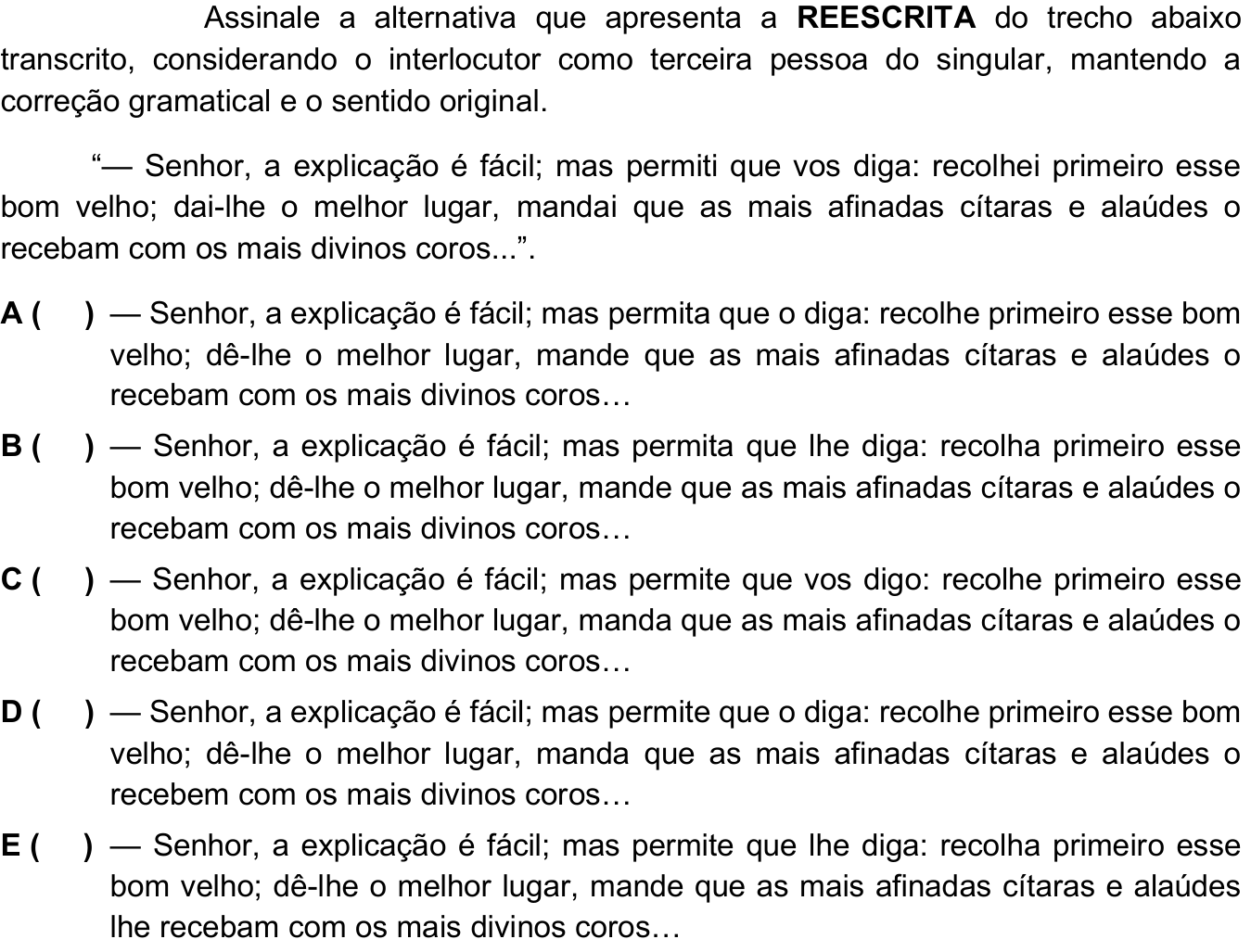
Question: Assinale a alternativa que apresenta a REESCRITA do trecho abaixo transcrito, considerando o interlocutor como terceira pessoa do singular, mantendo a correção gramatical e o sentido original.
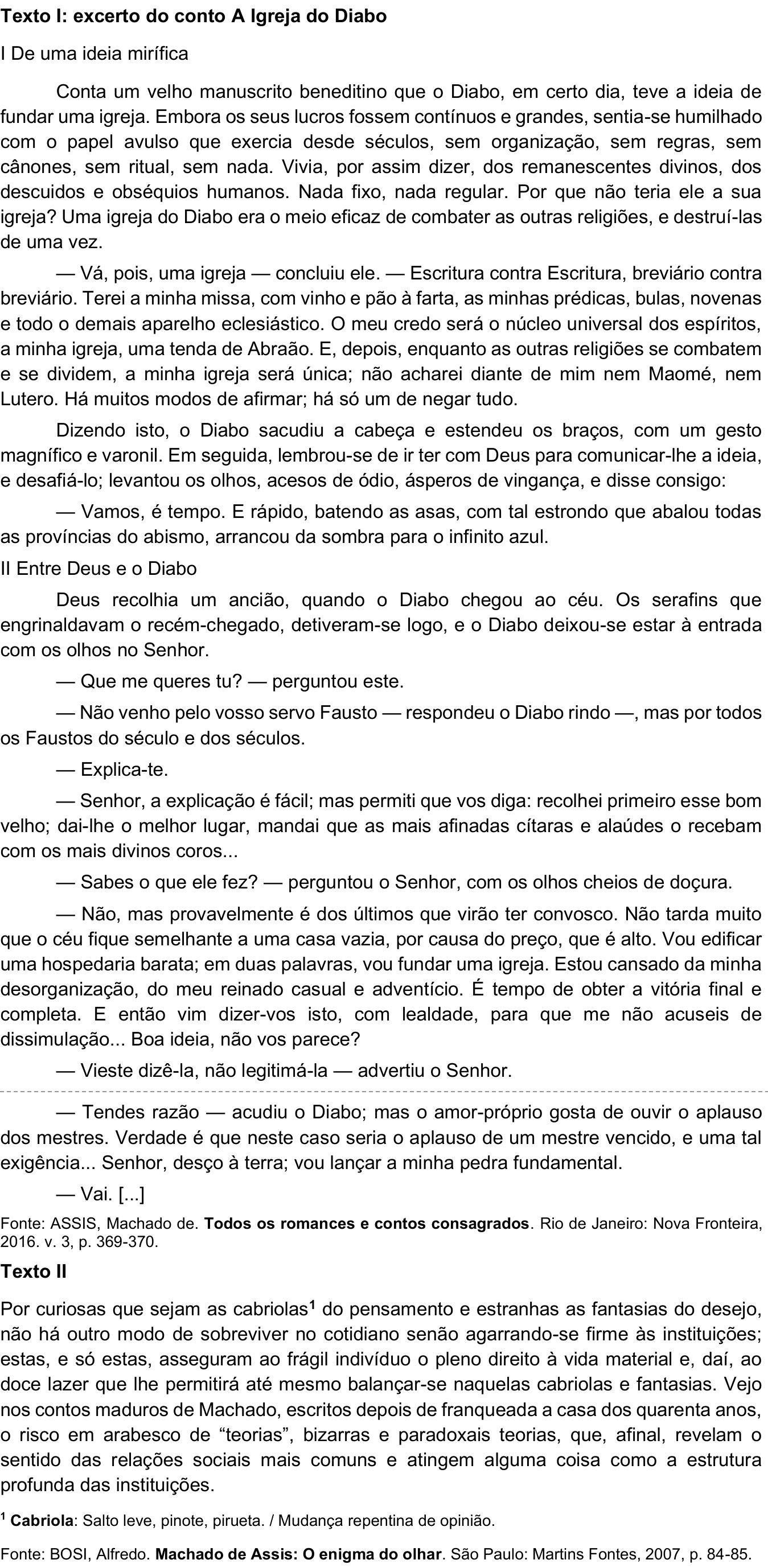
Trecho: “— Senhor, a explicação é fácil; mas permiti que vos diga: recolhi primeiro esse bom velho; dai-lhe o melhor lugar, mandai que as mais afinadas cítaras e alaúdes o recebam com os mais divinos coros...”.
We need rewrite considering interlocutor as third person singular. Original is direct speech by Devil to God? The interlocutor is "Senhor" addressed as second person (vos). We need convert to third person singular? Wait "considerando o interlocutor como terceira pessoa do singular" means the person spoken to is referred to as third person singular. So the original has "Senhor" as vocative, and verbs/pronouns directed to "vós" (second person plural, formal "vos"). Need rewrite so interlocutor is treated as third person singular? Hmm.
Original: "permiti que vos diga" = allow that I say to you (vós). "dai-lhe" = give him (lhe = to him? Actually "dai-lhe" imperative vós + lhe indirect object referring to "bom velho"? Let's parse: "recolhi primeiro esse bom velho; dai-lhe o melhor lugar, mandai que as mais afinadas cítaras e alaúdes o recebam..." Here "dai-lhe" = give him (the old man) the best place. "mandai" = command (you). "o recebam" = receive him. So verbs "permiti", "diga", "recolhi", "dai", "mandai", "recebam" etc.
Question asks considering interlocutor as third person singular. Perhaps means instead of addressing "vós" (Senhor), use "ele/ela" third person? But "Senhor" is vocative; if interlocutor is third person singular, how address? Maybe it's a reported speech? Wait "considerando o interlocutor como terceira pessoa do singular" means the person being addressed (Senhor) should be referred to in third person singular, i.e., "a ele" instead of "vos"? Let's examine options.
Options all start "Senhor, a explicação é fácil; mas ..." and then differ in pronoun/verb forms. They keep "Senhor" vocative. But they change "permiti que vos diga" to something. Let's see:
A) "mas permita que o diga: recolhe primeiro esse bom velho; dê-lhe o melhor lugar, mande que as mais afinadas cítaras e alaúdes o recebam..." Here "permita" (você? third person singular imperative? Actually "permita" is third person singular present subjunctive/imperative for você). "que o diga" = that I say it (o = o quê? maybe explanation? But original "vos diga" = say to you. "o diga" = say it. Changed meaning? "recolhe" (você recolhe), "dê-lhe", "mande", "recebam" (same). Interlocutor treated as "você" (third person singular? Actually você is second person semantically but grammatically third person). But "Senhor" vocative with "permita" ( third person singular imperative? In Brazilian Portuguese, "permita" is imperative for você). However original "permiti" is vós. Could be.
B) "mas permita que lhe diga: recolha primeiro esse bom velho; dê-lhe o melhor lugar, mande..." Here "permita que lhe diga" = allow me to tell him? "lhe" = to him (third person). But original "vos diga" = tell you. If interlocutor is third person, "lhe diga" = say to him. But then "Senhor" vocative? Hmm. "recolha" (você? third person singular imperative/subjunctive). "dê-lhe", "mande", "recebam".
C) "mas permite que vos digo: recolhe primeiro..." Here "permite" (você? third person singular present indicative? Actually "permite" is third person singular indicative, but vocative "Senhor" can take third person? In Portuguese, "Senhor" as subject? No, "Senhor" vocative with third person verb? "Senhor, permite" is ungrammatical? Actually "Senhor" (vocative) can be used with second person "permite" (tu) or "permita" (você). "permite" is tu imperative? Wait "permite" is present indicative 2nd person? No, "tu permites"; "você permite"; "permite" is 3rd person singular indicative or 2nd person singular imperative? In Portuguese, imperative for tu is "permite" (regular? "permite" yes). But "Senhor" could be addressed with tu? Maybe. But "que vos digo" = that I say to you (vós), but "permite" (tu) inconsistent? Also "recolhe" (tu imperative), "dê-lhe" (você? mixed). Not likely.
D) "mas permite que o diga: recolhe primeiro..." Similar.
E) "mas permite que lhe diga: recolha primeiro..." Mixed.
Let's understand the task. "considerando o interlocutor como terceira pessoa do singular" means the "interlocutor" i.e., the person being addressed (Senhor) is to be treated as third person singular. In direct speech, we normally address with second person forms ("vós", "tu", "você"). But if we consider the interlocutor as third person, we would use pronouns/verbs for "ele" (third person). However, a vocative like "Senhor" can be used with third person? Actually in Portuguese, when addressing someone with a title, we often use third person singular: "O senhor está bem?" (você = third person). So "Senhor" can be treated as third person singular (você). The original uses "vós" (second person plural, formal). The rewrite should use third person singular forms (você) and pronouns "o, lhe, se" etc.
Let's map original to third person singular interlocutor:
Original direct speech: "Senhor, a explicação é fácil; mas permiti que vos diga: recolhi primeiro esse bom velho; dai-lhe o melhor lugar, mandai que as mais afinadas cítaras e alaúdes o recebam com os mais divinos coros..."
- "permiti" = imperative vós. For third person singular (você), imperative: "permita".
- "vos diga" = that I say to you (indirect object vós). For third person singular, "lhe diga" (to him/her/you formal). But if "interlocutor" is third person, "lhe" = to you (formal você). So "permita que lhe diga". Options B/E have "permita que lhe diga". Option A has "permita que o diga" (o = direct object? "diga-o" = say it, not "say to you"). So A/D change meaning? "permita que o diga" = allow me to say it. Original "que vos diga" = allow me to say to you. So "lhe diga" preserves meaning as "say to you (formal third person)". So B/E likely.
- "recolhi" = I collected (first person preterite). For direct speech to third person, "recolhi" remains same? Actually the speaker remains first person, so "recolhi" unchanged. Options have "recolhe" or "recolha". Why? Because original "dai-lhe" and "mandai" are imperatives addressed to interlocutor (you). If interlocutor is third person, those imperatives become third person singular imperative: "dê-lhe", "mande". But "recolhi" is first person past, not an imperative addressed to you. However options A/C have "recolhe" (imperative tu? or 3rd person indicative? Actually "recolhe" is 2nd person singular imperative or 3rd person indicative). Option B has "recolha" (third person singular imperative/subjunctive). Why change "recolhi" to "recolha"? Let's check original: "recolhi primeiro esse bom velho; dai-lhe o melhor lugar, mandai..." The verb "recolhi" is first person singular preterite, meaning "I collected first this good old man". It's not an imperative. So rewriting to third person interlocutor should not change "recolhi" to "recolha"? Wait maybe the original punctuation: "recolhi primeiro esse bom velho; dai-lhe o melhor lugar..." It's two clauses: I collected; you give him... So "recolhi" is first person. But in options, all have "recolhe" or "recolha" instead of "recolhi". That's odd. Maybe I misread: original "recolhi" has accent? It is "recolhi" (first person). But options: A "recolhe primeiro", B "recolha primeiro", C "recolhe", D "recolhe", E "recolha". Why would they change? Perhaps because the whole phrase is considered as reported speech? Wait question says "considerando o interlocutor como terceira pessoa do singular". Maybe "interlocutor" means the speaker (Diabo) is being addressed? No, "interlocutor" is the one with whom one speaks, i.e., the person addressed. So the addressee (Senhor/God) is third person. But the verb "recolhi" is speaker's action, not addressee's. So should remain "recolhi". However options have "recolhe/recolha". Let's re-read original excerpt maybe "recolhei" (imperative vós?) Ah! The text might be "recolhei primeiro esse bom velho" not "recolhi"? Let's look at image: "recolhi primeiro esse bom velho" in Texto I: "recolhi primeiro esse bom velho; dai-lhe o melhor lugar..." Wait text: "recolhi primeiro esse bom velho; dai-lhe o melhor lugar" in the image? Let's inspect carefully: In Texto I, the devil says: "— Senhor, a explicação é fácil; mas permiti que vos diga: recolhi primeiro esse bom velho; dai-lhe o melhor lugar, mandai que..." It looks "recolhi" with i? The image: "recolhi primeiro esse bom velho" yes "recolhi" (first person singular preterite of recolher). But then in question transcription: "recolhi primeiro esse bom velho; dai-lhe..." Yes.
But options all have "recolhe/recolha" not "recolhi". Could be a typo in question? Maybe they intend to rewrite entire sentence including imperative? Let's examine: Original: "recolhi primeiro esse bom velho; dai-lhe o melhor lugar, mandai que..." The instructions: rewrite the excerpt, considering interlocutor as third person singular. If the interlocutor is third person, the imperative "dai" becomes "dê", "mandai" becomes "mande". But "recolhi" (I collected) is first person, so should stay "recolhi". Why options have "recolhe/recolha"? Maybe because the original actually says "recolhei" (imperative vós, meaning "receive/collect you first this good old man"?) Let's verify in Texto I: The devil says "recolhi primeiro esse bom velho; dai-lhe o melhor lugar..." Wait "recolhi" could be "recolhei" with accent? In the image, the text: "recolhi primeiro esse bom velho; dai-lhe o melhor lugar, mandai..." It's "recolhi" no accent, first person. But maybe the font: "recolhi" with i? Actually "recolher" first person: "recolhi". Imperative vós: "recolhei". The text might be "recolhei" but due to typo? Let's examine image Texto I: "— Senhor, a explicação é fácil; mas permiti que vos diga: recolhi primeiro esse bom velho; dai-lhe o melhor lugar, mandai que as mais afinadas cítaras e alaúdes o recebam com os mais divinos coros..." It clearly "recolhi" (i not e). But maybe the question's transcription is "recolhi" but options use "recolhe/recolha" because they consider "recolher" as imperative? Hmm.
Maybe the task is not converting direct speech to indirect speech but simply changing the addressee from second person to third person within the same direct speech. That means all verbs addressing the interlocutor (imperatives, pronouns) change. But "recolhi" is not addressing the interlocutor; it's the speaker's action. So it should remain "recolhi". However, none of the options have "recolhi"; all have "recolhe/recolha". Could the original actually be "recolhe" (imperative tu) or "recolha" (você)? Let's check the source Machado de Assis "A Igreja do Diabo". The passage: "— Senhor, a explicação é fácil; mas permiti que vos diga: recolhei primeiro esse bom velho; dai-lhe o melhor lugar, mandai que as mais afinadas cítaras e alaúdes o recebam..." Wait maybe original is "recolhei" (imperative vós: recolhei = receive). The text in image Texto I: I see "recolhi" maybe it's "recolhei" but the "e" is small? Let's zoom: The word after diga: "recolhi primeiro esse bom velho; dai-lhe..." The letters: r e c o l h i? Actually in the image, the word is "recolhi" or "recolhei"? Let's look at the phrase: "recolhi primeiro esse bom velho; dai-lhe o melhor lugar, mandai..." The font is serif. The word "recolhi" has accent? It is "recolhi" (i). But consider Portuguese: "recolher" imperative vós: "recolhei". The sentence would be "recolhei primeiro esse bom velho" = "receive/collect first this good old man". That makes more sense: The devil instructs God? Actually the devil says "permiti que vos diga: recolhi primeiro esse bom velho; dai-lhe..." Wait "recolhi" first person: "I collected first this good old man" doesn't make sense because the devil is talking to God; he says "recebe primeiro este bom velho" (imperative). Actually context: The devil meets God and says: "Senhor, a explicação é fácil; mas permiti que vos diga: recolhei primeiro esse bom velho; dai-lhe o melhor lugar, mandai que..." Wait if it's "recolhei" (imperative vós), then the devil asks God to receive the old man first, give him the best place, order the citharas etc. That makes sense: The devil is telling God to do something. Then "recolhi" in image maybe is "recolhei" with e? Let's check the image closely: The word in Texto I: "recolhi" maybe "recolhei" but the "e" is not visible? It says "recolhi primeiro". Actually the printed text in the image from the book? I see "recolhi" - the letters are r e c o l h i. But in the question transcription, it also says "recolhi". However options have "recolhe" (tu) or "recolha" (você) - which would correspond to imperative for tu/você. So maybe original is "recolhe" or "recolha"? Let's check: The devil says to God using "vós": "recolhei" (imperative vós). The question transcription might contain a typo: "recolhi" instead of "recolhei". But options offer "recolhe" (tu) and "recolha" (você) for third person? Wait third person singular imperative for "recolher" is "recolha" (você). For second person singular (tu) imperative is "recolhe". For second person plural (vós) imperative is "recolhei". So if original is "recolhei" (vós), converting to third person singular (você) should be "recolha". Option B/E have "recolha"; A/C/D have "recolhe" (tu). So likely original is "recolhei" (vós) and question's transcript has a typo? Or maybe "recolhi" is first person and the options are all wrong? But likely the correct answer is B or E. Let's examine all differences.
Let's list original clause by clause with vós forms and pronouns:
Original: "— Senhor, a explicação é fácil; mas permiti que vos diga: recolhi primeiro esse bom velho; dai-lhe o melhor lugar, mandai que as mais afinadas cítaras e alaúdes o recebam com os mais divinos coros...".
Actually "recolhi" if first person: "I collected first this good old man; give him the best place, command that..." Not coherent: "I collected the old man; give him..." Could be: "I have gathered first this good old man; you give him..." Hmm.
Let's parse the syntax: "permiti que vos diga: recolhi primeiro esse bom velho; dai-lhe..." The colon introduces what he says: "recolhi primeiro esse bom velho" = "I have taken in first this good old man" (maybe God? no). Then "dai-lhe o melhor lugar" = "give him the best place" (imperative). That could be: "I have already taken in this good old man; now you give him the best place..." Actually the devil says he has "recolhido" (received) the old man? But "recolhi" first person preterite: "I received first this good old man; give him the best place..." It could be: The devil is saying he already took the old man (brought him to heaven), and asks God to give him best place. That makes sense: The devil brought the old man's soul? Hmm.
But all options have "recolhe/recolha" not "recolhi". So maybe original is not "recolhi" but "recolhei" (imperative). Let's look at the image Texto I: The word after "diga: " is "recolhi" but maybe it's "recolhei" with a tiny e? In the image, the letters are "recolhi" maybe the "e" is missing due to font? Actually in the transcription provided by user: "recolhi primeiro esse bom velho" yes. But in the book, it might be "recolhei". I can search memory: Machado de Assis, "A Igreja do Diabo": "— Senhor, a explicação é fácil; mas permiti que vos diga: recolhei primeiro esse bom velho; dai-lhe o melhor lugar, mandai que as mais afinadas cítaras e alaúdes o recebam..." I think it's "recolhei" (imperative). Because the devil is asking God to receive the old man. Let's verify: The context: The devil arrives in heaven and God asks "Que me queres tu?" The devil says he doesn't come for Faust but for all Fausts. God asks "Sabes o que ele fez?" The devil says "Não, mas provavelmente..." Then he says "Senhor, a explicação é fácil; mas permiti que vos diga: recolhei primeiro esse bom velho; dai-lhe o melhor lugar, mandai que..." So he is instructing God: "receive first this good old man; give him the best place; order that the citharas receive him..." So original is "recolhei" (vós imperative). Thus question transcript "recolhi" is a typo. So we must convert "recolhei" (vós) to third person singular "recolha" (você). Similarly "permiti" -> "permita"; "dai" -> "dê"; "mandai" -> "mande"; "vos diga" -> "lhe diga" (or "o diga"?). Let's verify pronouns.
Original: "permiti que vos diga" = allow that I say to you. For third person singular (você), indirect object pronoun is "lhe": "permita que lhe diga". Also "dai-lhe" already has "lhe" = to him (the old man). "o recebam" = receive him (direct object). In third person, "o" remains? "as cítaras e alaúdes o recebam" = may they receive him. That's fine.
Now options:
A) "permita que o diga: recolhe primeiro ... dê-lhe ... mande ... o recebam" -> "permita que o diga" = allow that I say it (not "to you"). Also "recolhe" (tu imperative) inconsistent with third person "permita" (você). So wrong.
B) "permita que lhe diga: recolha primeiro ... dê-lhe ... mande ... o recebam" -> correct: permita (você), lhe diga (to you formal), recolha (você), dê-lhe (você), mande (você), o recebam. This seems correct.
C) "permite que vos digo: recolhe ... dê-lhe ... manda ... o recebem" -> mixed, wrong.
D) "permite que o diga: recolhe ... dê-lhe ... manda ... o recebem" -> wrong.
E) "permite que lhe diga: recolha ... dê-lhe ... mande ... lhe recebam" -> "permite" (tu) but "lhe diga" (third person indirect object) mixed; "recolha" (você) but "permite" (tu) inconsistent; also "lhe recebam" = receive to him? Not correct (original "o recebam" direct object). So E wrong.
Thus likely answer B.
But let's be thorough: The question says "considerando o interlocutor como terceira pessoa do singular" - in Portuguese, "terceira pessoa do singular" for treatment pronouns is "você" (though semantically second person, grammatically third). So imperatives should be third person singular (subjunctive forms: permita, recolha, dê, mande). Pronouns: "lhe" for indirect object, "o" for direct object. So B.
Need produce final answer in Portuguese with reasoning and final line "Resposta: B". Need include explanation.
But let's ensure no hidden issue: The original has "permiti que vos diga" - if interlocutor is third person, should it be "permita que lhe diga" or "permita que vos diga" still? No, "vos" is second person plural, so must change to "lhe". Option B has "lhe". Good.
What about "recolhi" -> "recolha"? We need explain original is imperative "recolhei" addressed to "vós"; converting to third person singular -> "recolha". The question text may have typo "recolhi", but options use "recolha" (B) and "recolhe" (A,C,D). Since "recolhe" is second person singular (tu), not third person, so B.
Also "dai-lhe" -> "dê-lhe" (third person singular imperative of dar). "mandai" -> "mande". "o recebam" remains because it's third person plural referring to cítaras/alaúdes receiving "o" (the old man). Good.
Thus final answer: B. Need maybe mention "A opção B é a única que uniformiza o tratamento em terceira pessoa (você), com pronomes e verbos adequados: 'permita', 'lhe diga', 'recolha', 'dê', 'mande', mantendo 'o recebam'." Final line exactly "Resposta: B".
Need produce final with reasoning. Desired oververbosity 5, so concise but explanatory.
A reescrita deve converter o tratamento original em segunda pessoa do plural (“vós”: permiti, vos diga, recolhei, dai, mandai) para terceira pessoa do singular, isto é, tratamento por “você” / “o senhor”. Assim, os verbos imperativos passam às formas de terceira pessoa: permita, recolha, dê, mande. O pronome “vos” passa a lhe, e mantém-se “o” como objeto direto referente ao “bom velho”.
Na alternativa B, todas as formas estão coerentes com a terceira pessoa:
- “permita que lhe diga” = permita que eu diga ao senhor;
- “recolha primeiro esse bom velho”;
- “dê-lhe o melhor lugar”;
- “mande que as mais afinadas cítaras e alaúdes o recebam”.
As demais alternativas misturam formas de segunda pessoa (“permite”, “recolhe”) com terceira pessoa, ou alteram o sentido (“permita que o diga” = permitir que eu diga isso, e não “diga ao senhor”; “lhe recebam” também não corresponde ao original).
Resposta: B