PRÁTICA COM QUESTÕES OFICIAIS
Questão 18 da Santa Casa 2027
Leia o texto para responder às questões de 14 a 18. · Conhecimentos Gerais
Published research from the University of Vienna and the Swiss Federal Institute of Technology Zurich now establishes that human activity has pushed the planet’s rotation into territory unlike anything in 3.6 million years — and the engineers who keep Global Positioning System (GPS) working are already watching the numbers.
The finding, published in March 2026 in the Journal of Geophysical Research: Solid Earth, quantifies precisely what glaciologists and geodesists had been building toward: Earth’s days are currently lengthening at 1.33 milliseconds per century due to climate-driven ice melt and sea-level rise. That rate is, by the geological record stretching back to the Late Pliocene (a period in Earth’s history that lasted from about 5.33 million to 2.58 million years ago), without precedent.
A companion finding — from a separate 2023 study by Ki-Weon Seo and colleagues at Seoul National University — adds a second human fingerprint: agricultural groundwater extraction shifted Earth’s rotational pole roughly 80 centimeters eastward between 1993 and 2010 alone, making groundwater pumping the single largest climate-related driver of polar drift, according to that research.
Together, the two lines of work establish something that the prior generation of Earth scientists could not have stated with confidence: humanity has become, in the span of decades, a geological force potent enough to alter the mechanics of how the planet moves through space.
(Maxwell Templeton. www.techtimes.com, 04.06.2026. Adaptado.)
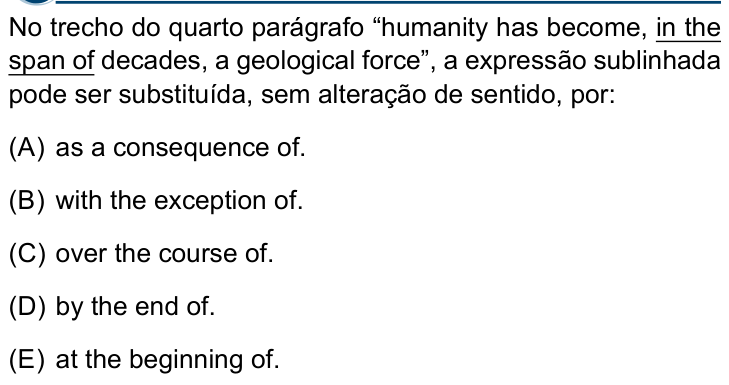
No trecho do quarto parágrafo “humanity has become, in the span of decades, a geological force”, a expressão sublinhada pode ser substituída, sem alteração de sentido, por:
- Aas a consequence of.
- Bwith the exception of.
- Cover the course of.
- Dby the end of.
- Eat the beginning of.
Você já respondeu questões neste aparelho. Crie sua conta grátis para guardar o histórico e refazer as que errou.
Resposta salva no seu histórico.
Reportar erro na questão
Resolução comentada
A expressão in the span of indica o intervalo de tempo em que algo acontece. Span é o "período" ou "espaço de tempo"; logo, in the span of decades significa "no espaço de décadas", isto é, "ao longo de algumas décadas". O texto diz que a humanidade se tornou uma força geológica em poucas décadas, um período relativamente curto na escala geológica.
Basta procurar, entre as opções, a que também marca duração de tempo:
- As a consequence of indica causa ("como consequência de"), não tempo.
- With the exception of indica exclusão ("com exceção de").
- Over the course of significa "ao longo de", "no decorrer de", ou seja, um intervalo de tempo. Mantém o sentido da frase: "ao longo de décadas".
- By the end of indica um prazo final ("até o fim de"), e não a duração do processo.
- At the beginning of indica o início de um período.
Só over the course of expressa um processo que se desenrola durante o período citado.
Alternativa C.
Por que as outras alternativas estão erradas
- A"As a consequence of" expressa causa, não o período de tempo em que a mudança ocorreu.
- B"With the exception of" indica exclusão ("com exceção de"), sentido que não aparece no trecho.
- D"By the end of" marca um ponto final ou prazo ("até o fim de"), não a duração do processo.
- E"At the beginning of" marca o início de um período, não o intervalo em que algo ocorre.
Assunto: Vocabulário em contexto e falsos cognatos.
Reportar erro na resolução
Ver como caiu na prova
Fonte: Santa Casa 2027 · Conhecimentos Gerais. Prova oficial ↗