PRÁTICA COM QUESTÕES OFICIAIS
Questão 17 da Santa Casa 2027
Leia o texto para responder às questões de 14 a 18. · Conhecimentos Gerais
Published research from the University of Vienna and the Swiss Federal Institute of Technology Zurich now establishes that human activity has pushed the planet’s rotation into territory unlike anything in 3.6 million years — and the engineers who keep Global Positioning System (GPS) working are already watching the numbers.
The finding, published in March 2026 in the Journal of Geophysical Research: Solid Earth, quantifies precisely what glaciologists and geodesists had been building toward: Earth’s days are currently lengthening at 1.33 milliseconds per century due to climate-driven ice melt and sea-level rise. That rate is, by the geological record stretching back to the Late Pliocene (a period in Earth’s history that lasted from about 5.33 million to 2.58 million years ago), without precedent.
A companion finding — from a separate 2023 study by Ki-Weon Seo and colleagues at Seoul National University — adds a second human fingerprint: agricultural groundwater extraction shifted Earth’s rotational pole roughly 80 centimeters eastward between 1993 and 2010 alone, making groundwater pumping the single largest climate-related driver of polar drift, according to that research.
Together, the two lines of work establish something that the prior generation of Earth scientists could not have stated with confidence: humanity has become, in the span of decades, a geological force potent enough to alter the mechanics of how the planet moves through space.
(Maxwell Templeton. www.techtimes.com, 04.06.2026. Adaptado.)
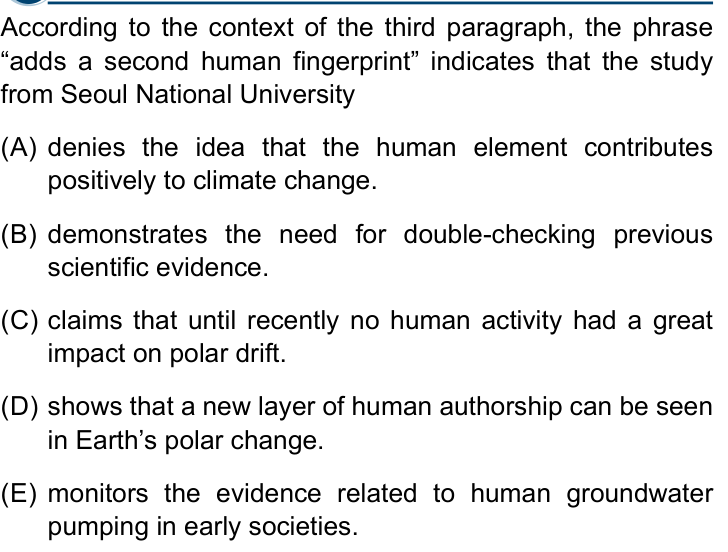
According to the context of the third paragraph, the phrase “adds a second human fingerprint” indicates that the study from Seoul National University
- Adenies the idea that the human element contributes positively to climate change.
- Bdemonstrates the need for double-checking previous scientific evidence.
- Cclaims that until recently no human activity had a great impact on polar drift.
- Dshows that a new layer of human authorship can be seen in Earth’s polar change.
- Emonitors the evidence related to human groundwater pumping in early societies.
Você já respondeu questões neste aparelho. Crie sua conta grátis para guardar o histórico e refazer as que errou.
Resposta salva no seu histórico.
Reportar erro na questão
Resolução comentada
A expressão "fingerprint" (impressão digital) é usada aqui como metáfora: é o vestígio que mostra que alguém, no caso os seres humanos, foi o autor de um fenômeno. Em "adds a second human fingerprint", o estudo de Seoul acrescenta uma segunda marca da ação humana sobre a rotação da Terra.
O primeiro vestígio, citado no parágrafo anterior, é o derretimento do gelo causado pelo clima, que alonga os dias. O segundo, trazido por Seo e colegas, é a extração agrícola de água subterrânea, que deslocou o polo de rotação cerca de 80 cm para leste entre 1993 e 2010.
Assim, o estudo mostra que há mais uma camada de autoria humana, uma segunda causa de origem humana, por trás da mudança no eixo polar.
Conferindo as demais: o texto não nega nem relativiza o papel humano (A), não fala em rever evidências anteriores (B), não diz que antes não havia impacto humano (C) e trata de agricultura moderna, entre 1993 e 2010, não de sociedades antigas (E).
Alternativa D.
Por que as outras alternativas estão erradas
- AO estudo não nega a influência humana; ele reforça que ela existe, e não fala em contribuição positiva.
- B"Second fingerprint" indica nova evidência complementar, não a necessidade de conferir de novo evidências anteriores.
- CO texto não afirma que nenhuma atividade humana teve impacto antes; apenas soma uma causa à já citada.
- EO estudo trata da extração de água entre 1993 e 2010, não de sociedades antigas.
Assunto: Linguagem figurada, ironia e humor.
Reportar erro na resolução
Ver como caiu na prova
Fonte: Santa Casa 2027 · Conhecimentos Gerais. Prova oficial ↗