PRÁTICA COM QUESTÕES OFICIAIS
Questão 43 do ITA 2027
Texto-base das questões 43 a 45 · 1ª fase
Brazil’s last asbestos miners are switching to rare earth minerals. Can they offer a brighter future?
Minaçu, a small city in inland Brazil and home to the only asbestos mine in the Americas, is set to become the first operation outside Asia to produce four rare earths on a commercial scale. [...]
Until now, China has dominated the separation of rare earths, and accounts for 90\% of the manufacture of rare-earth magnets, or super magnets, which are made with these elements and used in electric cars, wind turbines and military equipment such as jets.
But in April, China restricted its exports of the minerals in response to US tariffs, causing uncertainty over global supply. Brazil’s incipient production could hardly be better timed. To stimulate the sector, the Brazilian government has issued a call for tenders with an investment forecast of 5bn reals (£670m) in projects related to the supply of strategic minerals, such as rare earths. [...]
Rare earths are a group of 17 elements with high magnetism and the ability to absorb light, features that make them essential for the transition to clean energy. Some of the most coveted are neodymium, praseodymium, dysprosium, and terbium – used in the manufacture of electric motors and wind turbines, two industries that fuel the demand for rare earths, which have doubled globally between 2015 and 2023. [...]
For Minaçu, rare earths are the promise of a fresh start. In 2017, Sama, part of the Brazilian company Eternit, was compelled to halt the asbestos mining that for 50 years had shaped the town. The temporary permit granted for export extraction two years later permitted it to keep operating, but with diminished capacity.
Fonte: SETA, Isabel.Brazil’s last Asbestos miners are switching to rare earth minerals.Can they offer a brighter future? The Guardian. 01 jul 2025. Disponível em https://www.theguardian.com/globaldevelopment/2025/jul/01/minerals-brazil-asbestos-miners-rare-earths-transition-mining
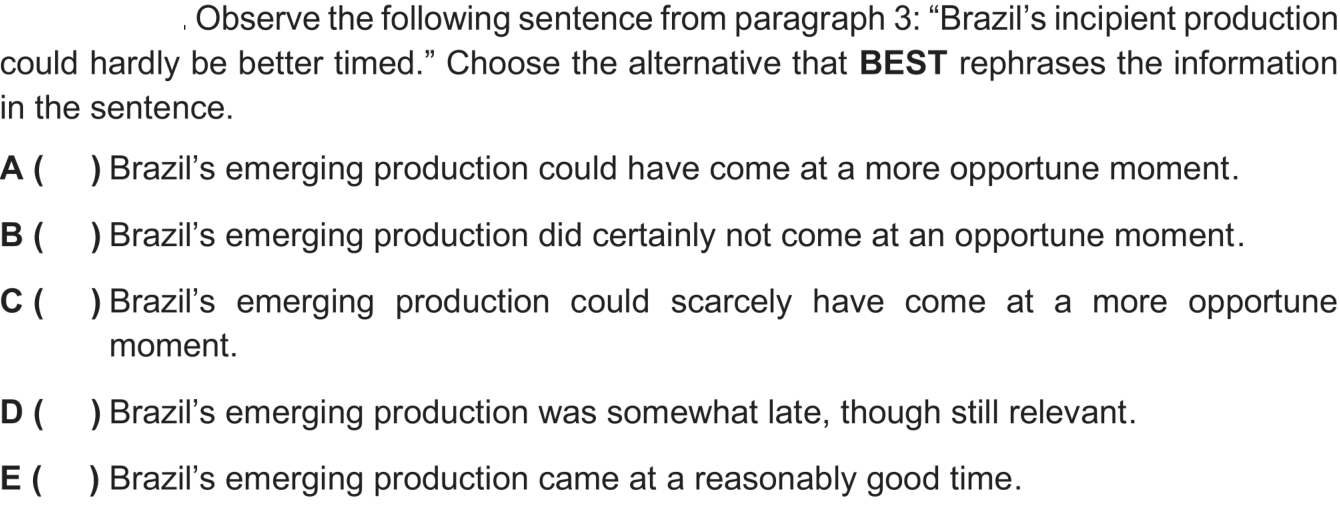
Observe the following sentence from paragraph 3: “Brazil’s incipient production could hardly be better timed.” Choose the alternative that BEST rephrases the information in the sentence.
- ABrazil’s emerging production could have come at a more opportune moment.
- BBrazil’s emerging production did certainly not come at an opportune moment.
- CBrazil’s emerging production could scarcely have come at a more opportune moment.
- DBrazil’s emerging production was somewhat late, though still relevant.
- EBrazil’s emerging production came at a reasonably good time.
Reportar erro na questão
Resolução comentada
A frase usa "could hardly be better timed". Aqui, hardly tem sentido negativo ("quase nada", "dificilmente"), então a estrutura "could hardly be + comparativo" equivale a "não poderia ser mais...". Ou seja, é uma forma de dizer que o momento é o melhor possível, o ideal.
Traduzindo: "A produção incipiente do Brasil dificilmente poderia ter melhor timing" = o momento é perfeito. O contexto confirma: a China restringiu as exportações de terras raras e há incerteza no fornecimento global, então produzir agora é muito oportuno.
Passo a passo:
- incipient = emerging (inicial, em surgimento).
- could hardly be better timed = could scarcely have come at a more opportune moment (scarcely é sinônimo de hardly, e more opportune corresponde a better timed).
- A alternativa C mantém a negação com scarcely e o comparativo, preservando o sentido de "momento ideal".
As demais mudam o sentido: A tira a negação e sugere que um momento melhor era possível; B diz que o momento não foi oportuno; D e E diminuem o elogio.
Alternativa C.
Pegadinha: A alternativa A engana quem lê "could hardly be better" como "poderia ser melhor", ignorando que hardly é negativo.
Por que as outras alternativas estão erradas
- ASem a negação (hardly/scarcely), diz que poderia ter vindo em momento mais oportuno, o contrário do original.
- BAfirma que o momento não foi oportuno, invertendo o sentido da frase.
- DDiz que a produção foi um pouco tardia, ideia ausente e contrária ao texto.
- EDiz apenas que o momento foi razoavelmente bom, enfraquecendo o sentido de momento ideal.
Assuntos: advérbios negativos, paráfrase, interpretação de texto.
Reportar erro na resolução
Ver como caiu na prova
Fonte: ITA 2027 · 1ª fase. Prova oficial ↗