PRÁTICA COM QUESTÕES OFICIAIS
Questão 42 do ITA 2027
Texto-base das questões 40 a 42 · 1ª fase
The Secret Agent: ‘truly special’ Brazilian thriller barely puts ‘a foot wrong’
Wagner Moura is ‘soulful and seductive’ in starring role as an academic on the run

Set during Brazil’s military dictatorship in the 1970s, this political thriller is “populated by so many characters”, you may despair of keeping track of who is who, said Deborah Ross in The Spectator. But “do hang on in there”, as it repays the effort. Justly nominated for four Oscars, this is a “truly special” (if rather sprawling) film.
Wagner Moura (known for playing Pablo Escobar in the Netflix hit “Narcos”) stars as Marcelo, a widowed academic who has gone on the run from a pair of hitmen. Quite why they are targeting him isn’t initially clear but there’s a lot else to think about in the meantime: there is a “hitman hired by the hitmen”; there’s a corrupt police chief; there’s a “head-scratcher” of a sequence in which a human leg “comes to life and kicks gay people”. It is, in sum, a heady mix, but it barely puts “a foot wrong”, and the performances are superb.
“If you’re expecting a Brazilian ‘Bourne’, forget it,” said Tom Shone in The Sunday Times. “For a film about a man shadowed by two assassins, ‘The Secret Agent’ has a daringly languid pace”. Gradually, “a disquieting paranoia begins to creep into everything” until “even the sunlight seems off”.
Fonte: Ross, Deborah. The Spectator; Shone, Tom. The Sunday Times. Disponível em https://theweek.com/culture-life/film/the-secret-agent-truly-special-brazilian-thriller-barely-puts-a-foot-wrong. Adaptado.
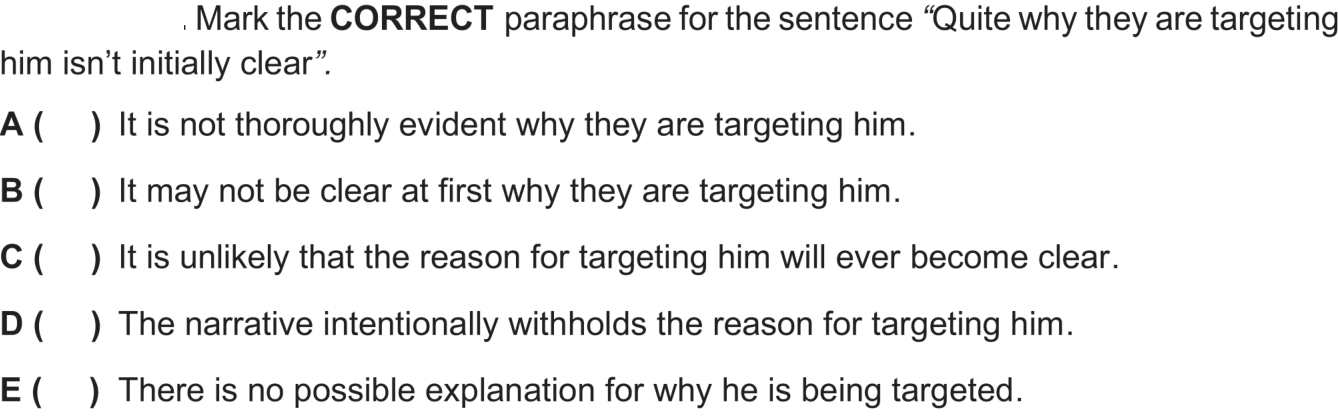
Mark the CORRECT paraphrase for the sentence “Quite why they are targeting him isn’t initially clear”.
- AIt is not thoroughly evident why they are targeting him.
- BIt may not be clear at first why they are targeting him.
- CIt is unlikely that the reason for targeting him will ever become clear.
- DThe narrative intentionally withholds the reason for targeting him.
- EThere is no possible explanation for why he is being targeted.
Reportar erro na questão
Resolução comentada
A frase original diz: "Quite why they are targeting him isn't initially clear". Em português: "O motivo exato de eles o estarem perseguindo não fica claro de início".
Duas palavras são decisivas:
- initially = no início, a princípio. Ela indica que a falta de clareza é temporária e que o motivo pode se esclarecer depois.
- quite why = exatamente por quê, o motivo preciso.
A paráfrase correta precisa manter a ideia de que o motivo não está claro no começo e não pode afirmar nada além disso, como o fato de nunca ser esclarecido ou de ser omitido de propósito.
A alternativa B, "It may not be clear at first why they are targeting him", traz "at first" como equivalente de "initially" e mantém a mesma estrutura de oração interrogativa indireta ("why they are targeting him"). O "may" suaviza um pouco o sentido, mas ainda é a única opção que preserva o aspecto temporal.
As demais alternativas mudam o sentido. Algumas retiram a referência temporal, outras afirmam que o motivo nunca será revelado ou que não existe explicação, e uma atribui uma intenção à narrativa que o texto não menciona.
Alternativa B.
Pegadinha: A alternativa A engana porque soa próxima do original, mas omite "initially", o aspecto temporal da frase.
Por que as outras alternativas estão erradas
- A"Not thoroughly evident" significa não totalmente evidente, e a alternativa perde a noção temporal de "initially".
- CDiz que provavelmente o motivo nunca ficará claro, contrariando "initially", que indica esclarecimento posterior.
- DAtribui à narrativa uma intenção de esconder o motivo, algo que o texto não afirma.
- EAfirma que não há explicação possível, o que é um exagero ausente do original.
Assuntos: paráfrase, advérbios, interpretação de texto.
Reportar erro na resolução
Ver como caiu na prova
Fonte: ITA 2027 · 1ª fase. Prova oficial ↗