PRÁTICA COM QUESTÕES OFICIAIS
Questão 42 do ITA 2025
Leia o texto a seguir para responder às questões de 40 a 42. · 1ª fase
What links Sir Isaac Newton, alien solar systems, and a new multi-million dollar TV show ? The answer is “the three-body problem”: a conundrum in astronomy and mathematics that describes why it’s often difficult to predict the long-term trajectory of planets, moons and stars. So, what exactly is the problem? And how did it end up becoming the title of a TV series?
To understand, you first need to know a bit about the background to the TV show, and its premise. The story is based on Liu Cixin’s epic sci-fi trilogy, the Remembrance of Earth’s Past, of which The Three-body Problem is the first book. The original trilogy is characterised by the author’s attention to scientific detail. The adaptation is less so, but still crammed with scientific ideas.
The TV series focuses on the “Oxford Five”, who all studied under the same professor at the University of Oxford. Some have gone on to become scientists themselves (a post-doctoral physics researcher, a founder and chief scientific officer of a nano-tech company, and a theoretical physics academic), one has become a school physics teacher, while the fifth is now a snack-food entrepreneur. Scientific credentials abound.
The crux of the story is that an alien race – called the Trisolarans or San-Ti Ren attempt to intimidate human scientists into slowing down our rapid technological advancement, making Earth easier to conquer. But why are these aliens so hell-bent on taking over our planet in the first place? This is where the three-body problem comes in.
Bodies, in this context, is a scientific byword for planets, moons, suns or any other massive astronomical object. The extraterrestrials’ home planet is situated in a solar system with three suns, hence their name in the English translation of the book – the Trisolarans. This three-sun system can be highly unstable, making conditions difficult for life, hence the desire to travel across the Universe in order to inhabit our relatively stable Solar System. We only have one Sun, so Earth’s future is relatively predictable – at least for the next few million years.
Fonte: YATES, kit. What is the three-body problem? The chaotic, cosmic mathematics behind the Netflix TV show. BBC, 2024. Disponível em: https://www.bbc.com/future/article/20240328-the-science-astronomy-and-mathematics-of-netflixs-3-body-problem-tv-show. Adaptado.
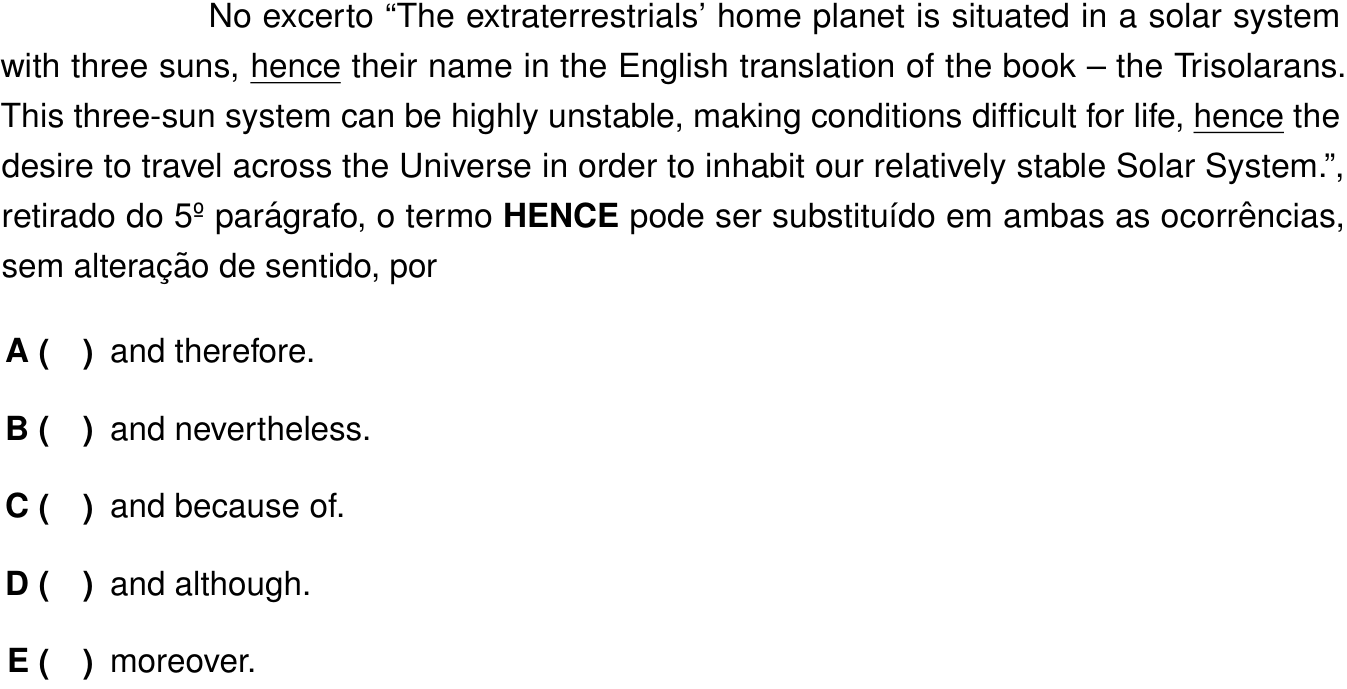
No excerto “The extraterrestrials’ home planet is situated in a solar system with three suns, hence their name in the English translation of the book – the Trisolarans. This three-sun system can be highly unstable, making conditions difficult for life, hence the desire to travel across the Universe in order to inhabit our relatively stable Solar System.”, retirado do 5o parágrafo, o termo HENCE pode ser substituído em ambas as ocorrências, sem alteração de sentido, por
- Aand therefore.
- Band nevertheless.
- Cand because of.
- Dand although.
- Emoreover.
Reportar erro na questão
Resolução comentada
Hence é um conectivo de consequência, equivalente a "por isso", "daí", "portanto". Vamos conferir as duas ocorrências.
- Primeira: o sistema tem três sóis, daí o nome Trisolarans. O nome é consequência dos três sóis.
- Segunda: o sistema trissolar é instável e dificulta a vida, daí o desejo de viajar até o nosso Sistema Solar. O desejo é consequência da instabilidade.
Portanto, a ideia é de causa seguida de efeito, e o termo que expressa isso é therefore ("portanto"). A forma "and therefore" mantém o sentido nas duas frases.
As outras opções mudam a relação lógica: nevertheless e although indicam contraste, moreover apenas acrescenta informação, e because of inverte a relação, pois exige um substantivo depois e indica causa, não consequência.
Alternativa A.
Por que as outras alternativas estão erradas
- B"Nevertheless" indica contraste ("no entanto"), mas a relação no texto é de consequência.
- C"Because of" marca causa e pede um substantivo em seguida, invertendo a relação de consequência de "hence".
- D"Although" expressa concessão, ideia que não aparece no trecho.
- E"Moreover" só adiciona informação, sem indicar consequência.
Assunto: Conectivos e relações lógicas.
Reportar erro na resolução
Ver como caiu na prova
Fonte: ITA 2025 · 1ª fase. Prova oficial ↗