PRÁTICA COM QUESTÕES OFICIAIS
Questão 40 (Português e Inglês) da 2ª fase do IME 2026
Texto-base das questões 38 a 40 · Português e Inglês
Text 3
A new ”eye” may radically change how robots see
The low-power robotics system LENS merges a brainlike sensor, a chip and an AI model
By Kathryn Hulick
This hexapod robot recognizes its surroundings using a vision system that occupies less storage space than a single photo on your phone. Running the new system uses only 10 percent of the energy required by conventional location systems, researchers report in the June Science Robotics.
Such a low-power ‘eye’ could be extremely useful for robots involved in space and undersea exploration, as well as for drones or microrobots, such as those that examine the digestive tract, says roboticist Yulia Sandamirskaya of Zurich University of Applied Sciences, who was not involved in the study.
The system, known as LENS, consists of a sensor, a chip and a super-tiny AI model to learn and remember location. Key to the system is the chip and sensor combo, called Speck, a commercially available product from the company SynSense. Speck’s visual sensor operates “more like the human eye” and is more efficient than a camera, says study coauthor Adam Hines, a bioroboticist at Queensland University of Technology in Brisbane, Australia.
Cameras capture everything in their visual field many times per second, even if nothing changes. Mainstream AI models excel at turning this huge pile of data into useful information. But the combo of camera and AI guzzles power. Determining location devours up to a third of a mobile robot’s battery. “It is, frankly, insane that we got used to using cameras for robots,” Sandamirskaya says.
In contrast, the human eye detects primarily changes as we move through an environment. The brain then updates the image of what we’re seeing based on those changes. Similarly, each pixel of Speck’s eyelike sensor “only wakes up when it detects a change in brightness in the environment,” Hines says, so it tends to capture important structures, like edges. The information from the sensor feeds into a computer processor with digital components that act like spiking neurons in the brain, activating only as information arrives — a type of neuromorphic computing.
The sensor and chip work together with an AI model to process environmental data. The AI model developed by Hines’ team is fundamentally different from popular ones used for chatbots and the like. It learns to recognize places not from a huge pile of visual data but by analyzing edges and other key visual information coming from the sensor.
This combo of a neuromorphic sensor, processor and AI model gives LENS its low-power superpower. “Radically new, power-efficient solutions for . . . place recognition are needed, like LENS,” Sandamirskaya says.
Adapted from: ScienceNews in https://www.sciencenews.org/article/robot-eye-artificial-intelligence-ai [Accessed on 14th July 2025].
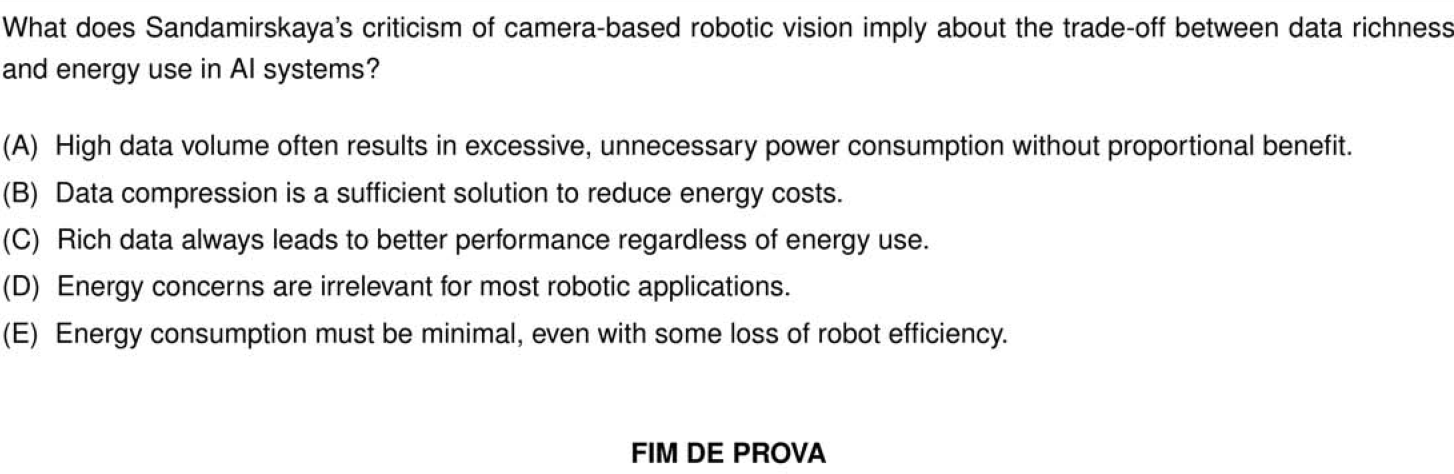
What does Sandamirskaya’s criticism of camera-based robotic vision imply about the trade-off between data richness and energy use in AI systems?
- AHigh data volume often results in excessive, unnecessary power consumption without proportional benefit.
- BData compression is a sufficient solution to reduce energy costs.
- CRich data always leads to better performance regardless of energy use.
- DEnergy concerns are irrelevant for most robotic applications.
- EEnergy consumption must be minimal, even with some loss of robot efficiency.
Reportar erro na questão
Resolução comentada
Sandamirskaya diz que é "insane that we got used to using cameras for robots". O contexto explica o motivo: câmeras capturam tudo no campo visual muitas vezes por segundo, "even if nothing changes", gerando uma enorme quantidade de dados. A combinação de câmera e IA "guzzles power" (gasta energia demais), e determinar a localização consome até um terço da bateria do robô.
Portanto, a crítica implica que o volume de dados da câmera é em grande parte redundante, já que muita coisa não muda entre um quadro e outro. Isso custa muita energia sem benefício proporcional. O sensor Speck, ao contrário, só registra mudanças de brilho (bordas, estruturas importantes), usando só 10% da energia e ainda reconhecendo o local.
Assim, o trade-off que o texto sugere é: muito dado nem sempre vale o gasto energético, pois parte dele é desnecessária.
Verificando as demais: nada no texto diz que compressão basta, que mais dados sempre melhoram o desempenho, que energia é irrelevante, ou que se deva aceitar perda de eficiência. O LENS mantém a função com menos energia.
Alternativa A.
Por que as outras alternativas estão erradas
- BO texto não fala em compressão; a solução é um sensor que só capta mudanças, não comprimir dados.
- CContradiz a crítica: dados abundantes da câmera custam energia sem ganho proporcional.
- DO texto diz que a localização devora até um terço da bateria, logo energia é central.
- EO LENS reduz energia sem apontar perda de eficiência; o texto não propõe sacrificar desempenho.
Assunto: Inferência e ponto de vista do autor.
Reportar erro na resolução
Ver como caiu na prova
Fonte: IME 2ª fase 2026 · Português e Inglês. Prova oficial ↗