PRÁTICA COM QUESTÕES OFICIAIS
Questão 40 (Português e Inglês) da 2ª fase do IME 2020
PARA AS QUESTÕES 38 a 40, RESPONDA DE ACORDO COM O TEXTO 4 A SEGUIR. · Português e Inglês
Texto 4
HOW MUCH CAN WE KNOW?
The reach of the scientific method is constrained by the limitations of our tools and the intrinsic impenetrability of some of nature's deepest questions.
“What we observe is not nature in itself but nature exposed to our method of questioning,” wrote German physicist Werner Heisenberg, who was the first to fathom the uncertainty inherent in quantum physics. To those who think of science as a direct path to the truth about the world, this quote must be surprising, perhaps even upsetting.
People will quickly counterstrike with something like: Why do airplanes fly or antibiotics work? Why are we able to build machines that process information with such amazing efficiency? Surely, such inventions and so many others are based on laws of nature that function independently of us. There is order in the universe, and science gradually uncovers this order.
No question about it: There is order in the universe, and much of science is about finding patterns of behavior—from quarks to mammals to galaxies—that we translate into general laws. We strip away unnecessary complications and focus on what is essential, the core properties of the system we are studying. We then build a descriptive narrative of how the system behaves, which, in the best cases, is also predictive.
Often overlooked in the excitement of research is that the methodology of science requires interaction with the system we are studying. We observe its behavior, measure its properties, and build mathematical or conceptual models to understand it better. We can see only so far into the nature of things, and our ever shifting scientific worldview reflects this fundamental limitation on how we perceive reality.
Just think of biology before and after the microscope or gene sequencing, or of astronomy before and after the telescope, or of particle physics before and after colliders or fast electronics. Now, as in the 17th century, the theories we build and the worldviews we construct change as our tools of exploration transform. This trend is the trademark of science.
Sometimes people take this statement about the limitation of scientific knowledge as being defeatist: “If we can’t get to the bottom of things, why bother?” This kind of response is misplaced. There is nothing defeatist in understanding the limitations of the scientific approach to knowledge. Science remains our best methodology to build consensus about the workings of nature. What should change is a sense of scientific triumphalism—the belief that no question is beyond the reach of scientific discourse.
[...]
Adaptado de GLEISER, Marcelo. How Much Can We Know? Nature, International Journal of Science. Disponível em: https://www.nature.com/articles/d41586-018-05100-5. Acesso em: 14/08/2019.
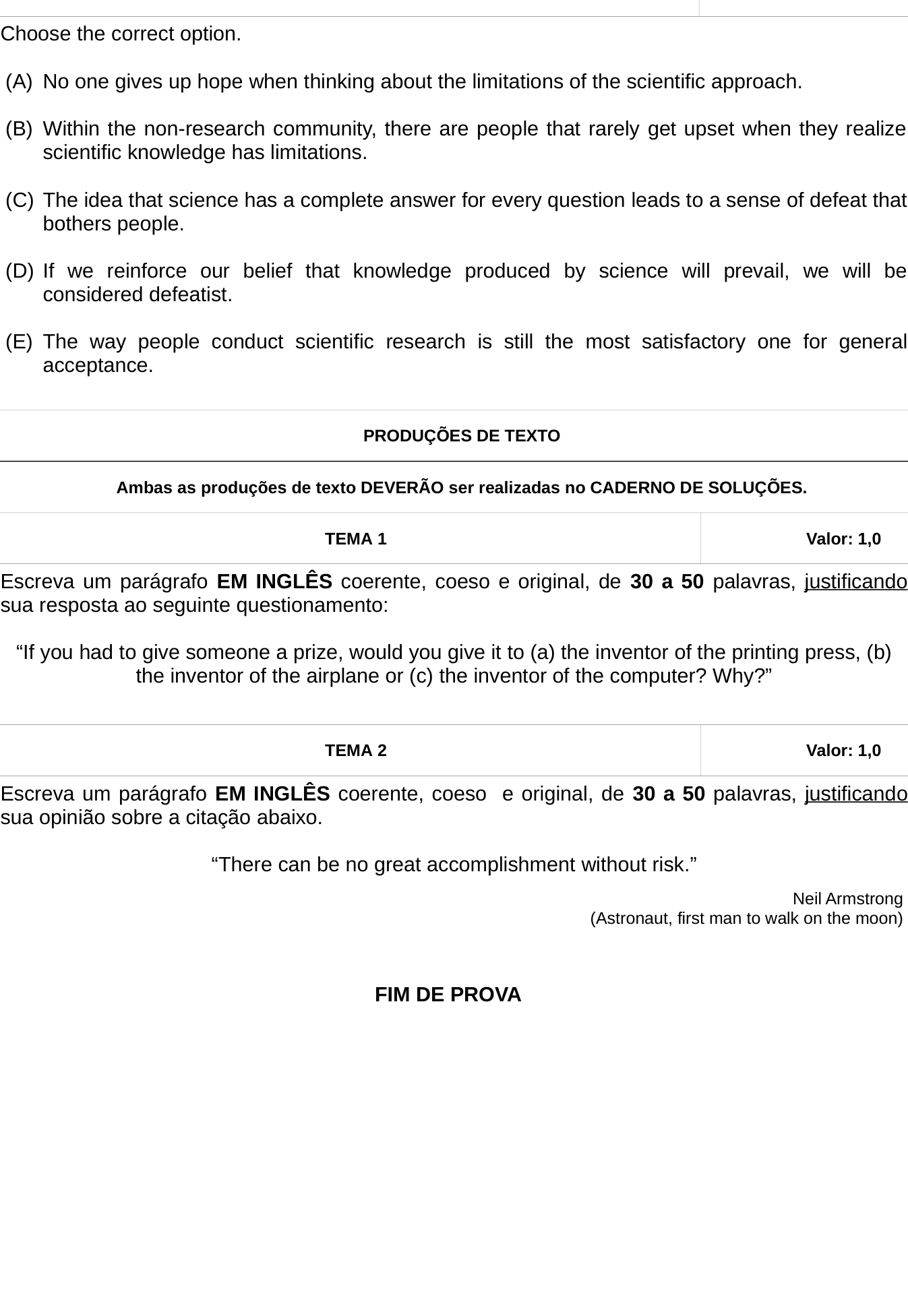
Choose the correct option.
- ANo one gives up hope when thinking about the limitations of the scientific approach.
- BWithin the non-research community, there are people that rarely get upset when they realize scientific knowledge has limitations.
- CThe idea that science has a complete answer for every question leads to a sense of defeat that bothers people.
- DIf we reinforce our belief that knowledge produced by science will prevail, we will be considered defeatist.
- E
The way people conduct scientific research is still the most satisfactory one for general acceptance.
:::
PRODUÇÕES DE TEXTO
Ambas as produções de texto DEVERÃO ser realizadas no CADERNO DE SOLUÇÕES.
TEMA 1 Valor: 1,0 Escreva um parágrafo EM INGLÊS coerente, coeso e original, de 30 a 50 palavras, justificando sua resposta ao seguinte questionamento:
“If you had to give someone a prize, would you give it to (a) the inventor of the printing press, (b) the inventor of the airplane or (c) the inventor of the computer? Why?”
TEMA 2 Valor: 1,0 Escreva um parágrafo EM INGLÊS coerente, coeso e original, de 30 a 50 palavras, justificando sua opinião sobre a citação abaixo.
“There can be no great accomplishment without risk.”
Neil Armstrong
(Astronaut, first man to walk on the moon)FIM DE PROVA
Reportar erro na questão
Resolução comentada
Cada alternativa precisa ser conferida contra o texto.
- Em (A), o autor diz que algumas pessoas reagem de forma derrotista ("If we can't get to the bottom of things, why bother?"). Logo, nem todos mantêm a esperança, e "no one" é falso.
- Em (B), o texto diz que a ideia de a ciência ser o caminho direto para a verdade torna a citação de Heisenberg "surprising, perhaps even upsetting". Isso contradiz "rarely get upset".
- Em (C), o texto não diz que a crença na ciência completa causa derrota. O derrotismo vem de reconhecer os limites da ciência, e não da crença em seu alcance total.
- Em (D), reforçar a crença no triunfo da ciência é o que o autor chama de "scientific triumphalism", e ele critica isso. Quem é chamado de defeatist é quem rejeita a ciência por causa de seus limites, não quem nela acredita.
- Em (E), o último parágrafo diz: "Science remains our best methodology to build consensus about the workings of nature". Ou seja, o método científico ainda é o melhor para construir consenso, o que corresponde a "most satisfactory one for general acceptance".
A única alternativa que concorda com o texto é a (E).
Alternativa E.
Pegadinha: A alternativa C engana ao inverter a causa do sentimento de derrota: ele vem de admitir os limites da ciência, não de acreditar que ela tem todas as respostas.
Por que as outras alternativas estão erradas
- AO texto cita quem reage com derrotismo ("why bother?"), então "ninguém desiste" é falso.
- BO texto diz que a citação de Heisenberg pode deixar as pessoas surpresas e até incomodadas, o contrário de "raramente se incomodam".
- CO derrotismo, segundo o texto, vem de reconhecer os limites da ciência, não da crença de que ela responde a tudo.
- DReforçar a crença no triunfo da ciência é o "triumphalism" criticado; o rótulo de derrotista vale para outra reação.
Assunto: Inferência e ponto de vista do autor.
Reportar erro na resolução
Ver como caiu na prova
Fonte: IME 2ª fase 2020 · Português e Inglês. Prova oficial ↗