PRÁTICA COM QUESTÕES OFICIAIS
Questão 39 (Português e Inglês) da 2ª fase do IME 2020
PARA AS QUESTÕES 38 a 40, RESPONDA DE ACORDO COM O TEXTO 4 A SEGUIR. · Português e Inglês
Texto 4
HOW MUCH CAN WE KNOW?
The reach of the scientific method is constrained by the limitations of our tools and the intrinsic impenetrability of some of nature's deepest questions.
“What we observe is not nature in itself but nature exposed to our method of questioning,” wrote German physicist Werner Heisenberg, who was the first to fathom the uncertainty inherent in quantum physics. To those who think of science as a direct path to the truth about the world, this quote must be surprising, perhaps even upsetting.
People will quickly counterstrike with something like: Why do airplanes fly or antibiotics work? Why are we able to build machines that process information with such amazing efficiency? Surely, such inventions and so many others are based on laws of nature that function independently of us. There is order in the universe, and science gradually uncovers this order.
No question about it: There is order in the universe, and much of science is about finding patterns of behavior—from quarks to mammals to galaxies—that we translate into general laws. We strip away unnecessary complications and focus on what is essential, the core properties of the system we are studying. We then build a descriptive narrative of how the system behaves, which, in the best cases, is also predictive.
Often overlooked in the excitement of research is that the methodology of science requires interaction with the system we are studying. We observe its behavior, measure its properties, and build mathematical or conceptual models to understand it better. We can see only so far into the nature of things, and our ever shifting scientific worldview reflects this fundamental limitation on how we perceive reality.
Just think of biology before and after the microscope or gene sequencing, or of astronomy before and after the telescope, or of particle physics before and after colliders or fast electronics. Now, as in the 17th century, the theories we build and the worldviews we construct change as our tools of exploration transform. This trend is the trademark of science.
Sometimes people take this statement about the limitation of scientific knowledge as being defeatist: “If we can’t get to the bottom of things, why bother?” This kind of response is misplaced. There is nothing defeatist in understanding the limitations of the scientific approach to knowledge. Science remains our best methodology to build consensus about the workings of nature. What should change is a sense of scientific triumphalism—the belief that no question is beyond the reach of scientific discourse.
[...]
Adaptado de GLEISER, Marcelo. How Much Can We Know? Nature, International Journal of Science. Disponível em: https://www.nature.com/articles/d41586-018-05100-5. Acesso em: 14/08/2019.
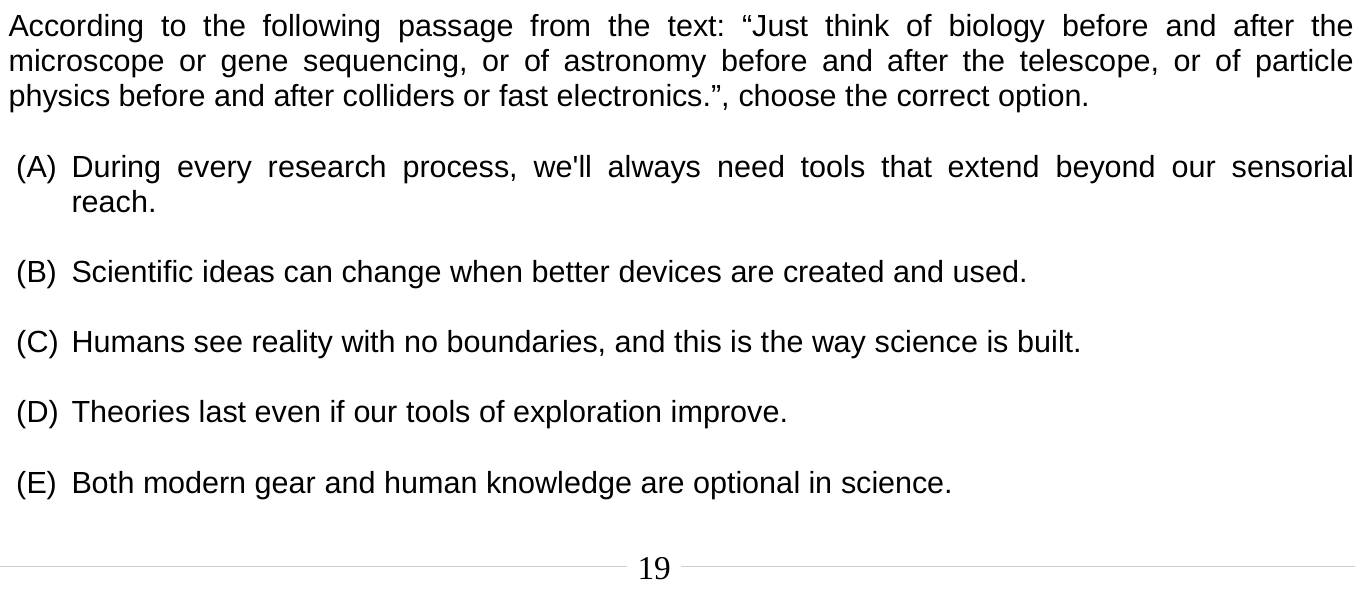
According to the following passage from the text: “Just think of biology before and after the microscope or gene sequencing, or of astronomy before and after the telescope, or of particle physics before and after colliders or fast electronics.”, choose the correct option.
- ADuring every research process, we'll always need tools that extend beyond our sensorial reach.
- BScientific ideas can change when better devices are created and used.
- CHumans see reality with no boundaries, and this is the way science is built.
- DTheories last even if our tools of exploration improve.
- EBoth modern gear and human knowledge are optional in science.
Reportar erro na questão
Resolução comentada
O trecho pede que o aluno pense em áreas da ciência "antes e depois" de um instrumento: o microscópio, o sequenciamento de genes, o telescópio, os colisores. Ou seja, o autor dá exemplos de como a chegada de uma nova ferramenta muda o que a ciência consegue enxergar.
O parágrafo seguinte confirma a ideia: "the theories we build and the worldviews we construct change as our tools of exploration transform" (as teorias que construímos e as visões de mundo mudam à medida que nossas ferramentas de exploração se transformam).
Agora, as alternativas:
- A diz que sempre precisaremos de ferramentas além do alcance dos sentidos. O texto fala de ferramentas e de limites, mas o trecho não afirma essa necessidade universal.
- B diz que as ideias científicas podem mudar quando dispositivos melhores são criados e usados. Isso resume exatamente os exemplos de antes e depois.
- C diz que o ser humano vê a realidade sem fronteiras. O texto diz o contrário: "We can see only so far into the nature of things".
- D diz que as teorias duram mesmo com ferramentas melhores. Isso contradiz o trecho.
- E diz que equipamentos modernos e conhecimento humano são opcionais. O texto mostra que são essenciais.
Portanto, a única opção coerente com o trecho é a B.
Alternativa B.
Por que as outras alternativas estão erradas
- AGeneraliza demais: o trecho mostra que as ferramentas mudam o conhecimento, não que sempre dependeremos de ferramentas que superem nossos sentidos.
- CContradiz o texto, que afirma que só vemos até certo ponto a natureza das coisas (limitação fundamental).
- DInverte a ideia: as teorias mudam conforme as ferramentas se transformam.
- EContraria o texto, em que instrumentos e conhecimento humano são centrais para a ciência.
Assunto: Informações explícitas e detalhes.
Reportar erro na resolução
Ver como caiu na prova
Fonte: IME 2ª fase 2020 · Português e Inglês. Prova oficial ↗