PRÁTICA COM QUESTÕES OFICIAIS
Questão 26 (Português e Inglês) da 2ª fase do IME 2020
PARA AS QUESTÕES DE 21 A 30, ESCOLHA A ALTERNATIVA QUE COMPLETA O TEXTO 1 APROPRIADAMENTE. · Português e Inglês
PARA AS QUESTÕES DE 21 A 30, ESCOLHA A ALTERNATIVA QUE COMPLETA O TEXTO 1 APROPRIADAMENTE.
(VALOR 0,3 / QUESTÃO)
Texto 1
ON THE ORIGIN OF SPECIES BY MEANS OF NATURAL
SELECTION, OR THE PRESERVATION OF FAVOURED RACES
IN THE STRUGGLE FOR LIFE
CHARLES DARWIN, M.A.
Fellow of the Royal, Geological, Linnæan, etc. societies; Author of Journal of researches during H. M. S. Beagle’s Voyage round the world. London: John Murray, Albemarle Street, 1859.
Introduction
________ (21) ________ on board H.M.S. 'Beagle,' as naturalist, I was much ________ (22) ________ with certain facts in the distribution of the inhabitants of South America, and in the geological relations of the present to the past inhabitants of that continent. These facts seemed to me to ________ (23) ________ some light on the origin of species–that mystery of mysteries, as it has been called by one of our greatest philosophers. ________ (24) ________ my return home, it occurred to me, in 1837, that something might perhaps be made out on this question by patiently accumulating and reflecting on all sorts of facts which could possibly have any bearing on it. After five years' work I allowed myself to speculate on the subject, and drew up some short notes; these I enlarged in 1844 into a ________ (25) ________ of the conclusions, which ________ (26) ________ seemed to me probable: from that period to the present day I ________ (27) ________ the same object. I hope that I may be excused for entering on these personal details, as I give them to show that I have not been ________ (28) ________ in coming to a decision.
My work is now nearly finished; but ________ (29) ________ it will take me two or three more years to complete it, and as my health is far from strong, ________ (30) ________ to publish this Abstract.
[...]
Extraído de DARWIN, Charles Robert. On the Origin of Species. Disponível em: http://www.vliz.be/docs/Zeecijfers/Origin_of_Species.pdf. Acesso em: 02/08/2019.
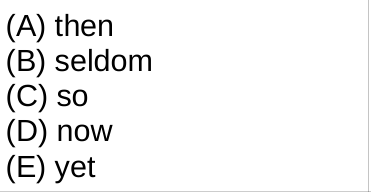
- Athen
- Bseldom
- Cso
- Dnow
- Eyet
Reportar erro na questão
Resolução comentada
A lacuna 26 está em: "I enlarged in 1844 into a (25) of the conclusions, which (26) seemed to me probable". Darwin conta que, em 1844, ampliou suas notas num resumo de conclusões que, naquela época, lhe pareciam prováveis.
Precisamos de um advérbio de tempo que localize o passado (1844), em contraste com o presente da frase seguinte ("from that period to the present day").
- then = "então, naquela época": encaixa perfeitamente, pois remete a 1844.
- seldom = "raramente": não faz sentido, pois Darwin não diz que as conclusões raramente pareciam prováveis.
- so = "assim, tão": exigiria complemento ("so probable") e a ordem ficaria estranha.
- now = "agora": contradiz o tempo passado de "seemed" e a marcação de 1844.
- yet = "ainda, até agora": não combina com o verbo no passado simples nem com a ideia de época específica.
Lida com a frase completa: "...conclusions, which then seemed to me probable". Há coerência de tempo e sentido.
Alternativa A.
Por que as outras alternativas estão erradas
- B"seldom" (raramente) cria um sentido ilógico: Darwin não fala de frequência.
- C"so" pediria um adjetivo como complemento direto ("so probable") e não indica tempo.
- D"now" indica o presente, incompatível com "seemed" e com o ano de 1844.
- E"yet" não se usa com passado simples nesse contexto e não marca a época de 1844.
Assuntos: Classes de palavras, Conectivos e relações lógicas.
Reportar erro na resolução
Ver como caiu na prova
Fonte: IME 2ª fase 2020 · Português e Inglês. Prova oficial ↗