PRÁTICA COM QUESTÕES OFICIAIS
Questão 90 (CFS 1) da EEAR 2026
Read the text and answer questions 85, 86, 87, 88, 89 and 90. · CFS 1
What is a friend?
Márcio Paulo Barbosa Pena Mascarenhas
Laurie: To me, a friend is someone who stands by you when you need them, someone who cares. Not like your parents, ________. Parents are either picking on you or telling you off, so sometimes it’s a pain. To a friend you can always open up.
Angela: I agree with Laurie but personally, I don’t think a friend has to be physically around all the time. I have friends that I haven’t seen in years, but I know if we get together, we’ll pick up right where we left off.
Fran: I think a friend is that old pal you’ve always gotten on with. I often look back on my schooldays and I think of the funny things my friends and I did together. As I see it, the friends you make in youth are friends to keep for a lifetime.
Gary: If you ask me, a friend is a person you have fun and relax with. My friends and I talk about movies, sports or politics. I don’t go round telling them my troubles and I don’t particularly want to hear theirs. I believe that if you don’t expect too much from people, you won’t be let down.
Grade 1, Student’s book, Belo Horizonte, 14th edition.
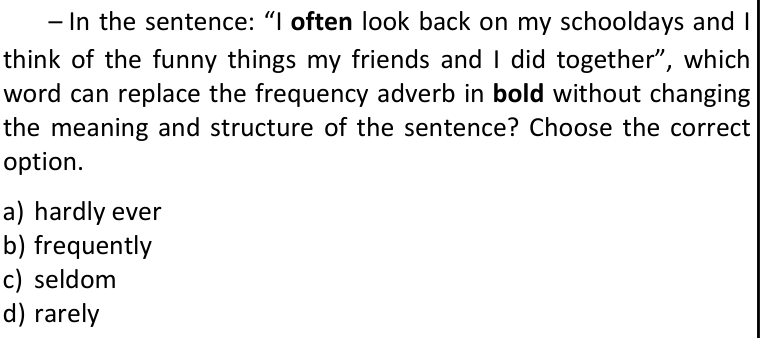
– In the sentence: “I often look back on my schooldays and I think of the funny things my friends and I did together”, which word can replace the frequency adverb in bold without changing the meaning and structure of the sentence? Choose the correct option.
- Ahardly ever
- Bfrequently
- Cseldom
- Drarely
Reportar erro na questão
Resolução comentada
O advérbio de frequência often ("frequentemente") indica que a ação acontece muitas vezes. Para trocá-lo sem mudar o sentido, procuramos um advérbio também de alta frequência.
Analisando cada opção:
- hardly ever = "quase nunca": frequência muito baixa, sentido oposto.
- frequently = "frequentemente": é sinônimo exato de often.
- seldom = "raramente": frequência baixa.
- rarely = "raramente": também frequência baixa.
Além disso, a estrutura da frase se mantém: frequently ocupa a mesma posição do advérbio, antes do verbo principal ("I frequently look back on my schooldays..."). Assim, a frase continua dizendo que o falante costuma recordar com frequência os tempos de escola.
Alternativa B.
Por que as outras alternativas estão erradas
- A"Hardly ever" significa "quase nunca", o oposto de "often".
- C"Seldom" significa "raramente", frequência baixa, contrária a "often".
- D"Rarely" também significa "raramente", mudando o sentido da frase.
Assuntos: Vocabulário em contexto e falsos cognatos, Classes de palavras.
Reportar erro na resolução
Ver como caiu na prova
Fonte: EEAR 2026 · CFS 1. Prova oficial ↗