Respondeu
levou 11 s
Como pensou
**Constructing wedding context**
I'm thinking about creating a concise rationale regarding the ludic aspects of festive weddings during Easter. I want to emphasize that it's not about unique elements but about supporting a joyful context without neutralizing any sentiments attached. I should clarify E's point about how ludic roles promote dance and play, yet retain the communal joy associated with ceremonies.
It's crucial to avoid generalizations that don't apply in all cases. I'll aim for around 170 words and perhaps structure my thoughts in two paragraphs or bullet points for clarity.
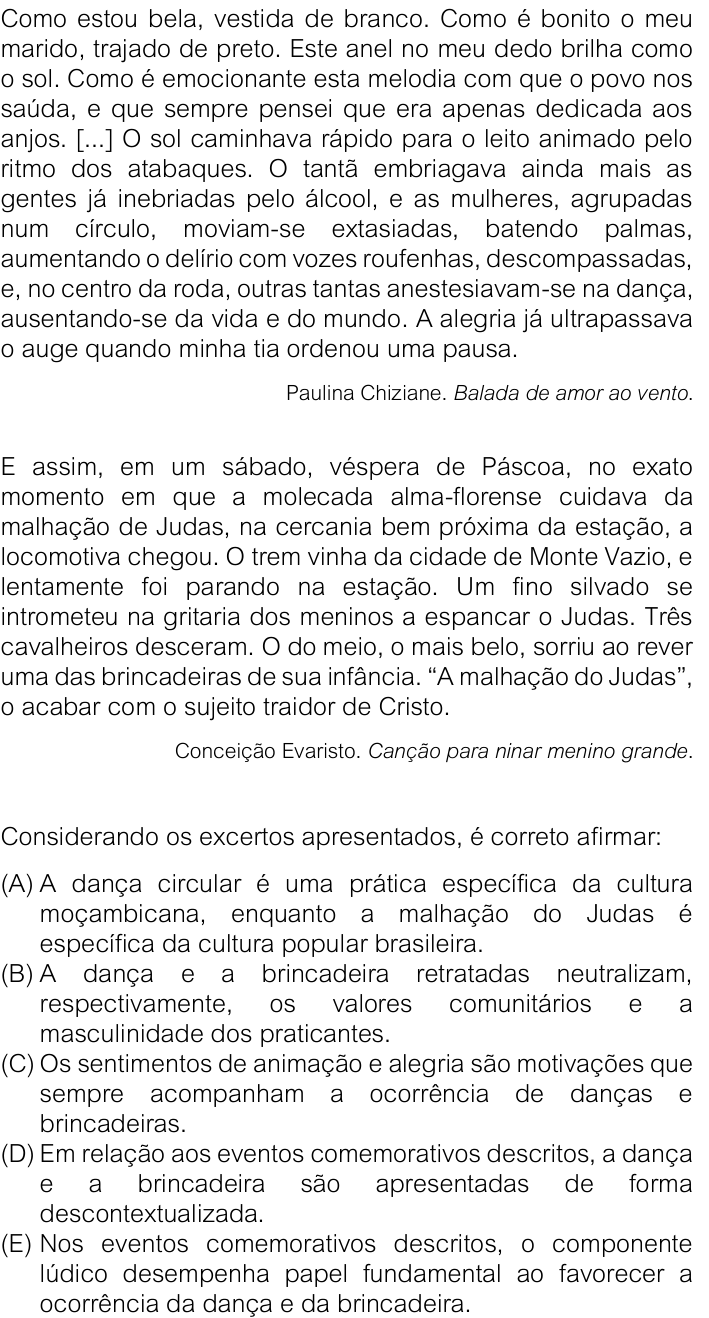
A alternativa correta é E. Nos dois excertos, o componente lúdico, ligado à diversão e à participação em atividades festivas, favorece a dança e a brincadeira.
Em Balada de amor ao vento, a celebração do casamento envolve música, palmas e dança coletiva, em um ambiente de alegria e êxtase. Em Canção para ninar menino grande, a malhação de Judas é apresentada como uma brincadeira vinculada à celebração da Páscoa, que desperta em um dos personagens uma lembrança prazerosa da infância.
As demais alternativas apresentam problemas:
- A: essas práticas não são exclusivas das culturas mencionadas.
- B: os textos não indicam neutralização dos valores comunitários nem da masculinidade.
- C: o termo “sempre” generaliza indevidamente: danças e brincadeiras podem envolver outros sentimentos e motivações.
- D: as práticas estão contextualizadas em eventos comemorativos e em situações de participação coletiva.
Resposta: E
Respondeu
levou 8 s
Como pensou
**Crafting a concise Portuguese response**
I need to provide a concise explanation in Portuguese, focusing on the essence of dance in weddings and events like the malhação during Easter. I see that it encourages collective participation and universal joy. I could articulate how this festive dance manifests, intertwining children's malhação and wedding contexts. It's important to maintain a balance of joy without losing the essence, taking care to avoid contradictions, while clearly outlining the communal rhythms and celebratory nature of these occasions.
A alternativa correta é a E. Nos dois excertos, o componente lúdico — associado à diversão, à brincadeira e à participação coletiva — integra os eventos comemorativos. No casamento narrado por Paulina Chiziane, ele se manifesta na música, nas palmas e na dança; no texto de Conceição Evaristo, aparece na malhação do Judas, realizada pelas crianças na véspera da Páscoa.
As demais alternativas apresentam problemas:
- A: essas práticas não são exclusivas das culturas mencionadas.
- B: não há indicação de que elas neutralizem valores comunitários ou a masculinidade dos participantes.
- C: o termo “sempre” cria uma generalização que os excertos não permitem sustentar.
- D: as práticas estão contextualizadas: uma ocorre em um casamento; a outra, no período pascal.
Resposta: E
Respondeu
levou 4 s
Como pensou
**Explaining wedding celebrations**
I think I need to provide a concise explanation for the E wedding celebration. It seems to be a collective circle and playful event that connects to Judas Easter and has a festive, ludic quality. It's important to recognize that this concept isn't tied to a specific country, but instead is contextualized and perhaps even invented. That way, I can ensure the answer is well-rounded.
No primeiro excerto, a dança coletiva integra a celebração do casamento; no segundo, a malhação de Judas aparece como brincadeira associada à Páscoa. Em ambos, o componente lúdico participa dos eventos comemorativos.
As demais alternativas atribuem exclusividade cultural às práticas, fazem generalizações indevidas ou ignoram sua relação com o contexto das celebrações.
Resposta: E
Respondeu
levou 8 s
Como pensou
No primeiro excerto, a dança integra uma celebração coletiva: o ritmo dos atabaques, a música e a participação das pessoas intensificam a festa. No segundo, a malhação de Judas é apresentada como uma brincadeira de infância, realizada na véspera da Páscoa. Assim, nos dois eventos, o componente lúdico favorece a dança ou a brincadeira.
As demais alternativas generalizam práticas como se fossem exclusivas de certas culturas, atribuem a elas efeitos que os textos não mostram ou ignoram o contexto em que ocorrem.
Resposta: E
Respondeu
levou 8 s
Como pensou
Os dois excertos descrevem eventos comemorativos: no primeiro (Paulina Chiziane), um casamento em Moçambique, em que a dança circular das mulheres, ao som dos atabaques e do tantã, expressa a alegria coletiva; no segundo (Conceição Evaristo), a véspera de Páscoa, em que a "molecada" se diverte com a malhação de Judas, brincadeira tradicional que também marca a infância de um dos personagens que chega de trem.
Analisando as alternativas:
- (A) A dança circular não é exclusiva de Moçambique, nem a malhação do Judas é exclusiva do Brasil (é de origem ibérica, comum em Portugal e em outros países). Incorreta.
- (B) A dança reforça (não neutraliza) os valores comunitários; a brincadeira não "neutraliza" a masculinidade. Incorreta.
- (C) A generalização "sempre" é indevida: danças e brincadeiras podem ter outras motivações (rituais, de luto, religiosas etc.). Incorreta.
- (D) Ambas as práticas estão claramente contextualizadas: o casamento e a Páscoa. Incorreta.
- (E) Em ambos os eventos, o componente lúdico (a festa, o divertimento, o jogo) é o que propicia a ocorrência da dança e da brincadeira, integradas às celebrações. Correta.
Resposta: E
Respondeu
levou 9 s
Como pensou
I'm weighing the five options against each other. A and B don't hold up, C leans on an overgeneralizing word like "sempre," and D only works in a specific context like a wedding or Easter. E fits best, since the playful element is what drives the dancing and play, so E is the likely answer.
Análise dos excertos
- Chiziane: a dança em roda acontece numa festa de casamento, com música, atabaques, álcool, palmas e êxtase coletivo. Há alegria, celebração e entrega ao ritmo.
- Evaristo: a malhação do Judas acontece no sábado de Aleluia. Os meninos brincam de "espancar" o boneco, e o cavalheiro sorri ao lembrar uma brincadeira de sua infância.
Avaliação das alternativas
- (A) Incorreta. Danças circulares não são exclusivas de Moçambique. A malhação do Judas também não é exclusiva do Brasil, pois existe em vários países de tradição católica. Os textos não autorizam essa "especificidade".
- (B) Incorreta. A dança reforça os laços comunitários, em vez de neutralizá-los. A brincadeira não tem relação com a neutralização da masculinidade.
- (C) Incorreta. O advérbio "sempre" generaliza indevidamente. Danças e brincadeiras podem ter outras motivações, como rituais fúnebres ou religiosas.
- (D) Incorreta. As práticas estão bem contextualizadas: a dança no casamento e a malhação do Judas na véspera de Páscoa.
- (E) Correta. Nos dois eventos comemorativos, o casamento e a Páscoa, o elemento lúdico (festa, música, diversão, brincadeira infantil) é central e favorece a dança e a brincadeira.
Resposta: E
Respondeu
levou 5 s
Como pensou
Os dois excertos retratam eventos comemorativos: um casamento em Moçambique (Paulina Chiziane), com dança, tambores (atabaques) e o tantã, e a Páscoa no Brasil (Conceição Evaristo), com a malhação do Judas.
Análise das alternativas:
(A) Incorreta. Afirmar que a dança circular é específica da cultura moçambicana é um exagero, pois ela existe em muitas culturas. A malhação do Judas também não é exclusivamente brasileira, já que vem da tradição ibérica e é praticada em vários países.
(B) Incorreta. Os textos não mostram neutralização de valores, e sim a vivência desses valores pela comunidade. A dança reforça a coesão comunitária e a brincadeira tem caráter coletivo.
(C) Incorreta. O "sempre" torna a afirmação absoluta, e nem toda dança ou brincadeira vem acompanhada de alegria.
(D) Incorreta. Ao contrário, a dança e a brincadeira aparecem contextualizadas: o casamento no primeiro texto e a véspera de Páscoa, no sábado de Aleluia, no segundo.
(E) Correta. Nos dois eventos, o lúdico (o prazer, o jogo, a diversão coletiva, a embriaguez, a música e a brincadeira dos meninos) é o que favorece a dança e a brincadeira, que fazem parte da celebração.
Resposta: E
Respondeu
levou 3 min 51 s
Como pensou
This is a question from the 2027 FUVEST exam.
The question compares two excerpts. One is from Paulina Chiziane's "Balada de amor ao vento," describing a wedding with dancing and atabaques in Mozambique. The other is from Conceição Evaristo's "Canção para ninar menino grande," describing the "malhação de Judas" on Easter Saturday in Alma-florense, Brazil.
The four options are:
- (A) The circular dance is specific to Mozambican culture, while the Judas beating is specific to Brazilian popular culture.
- (B) The dance and play neutralize community values and male identity.
- (C) Joy and animation always accompany these events.
- (D) These practices are presented without context.
The fifth option states that the playful component plays a fundamental role in these celebrations. The wedding excerpt shows a festive, communal event where dancing is part of the joy. The second excerpt describes children playing the Judas beating game.
Option (A) is being evaluated. Circular dances are not unique to Mozambique, so the claim that the wedding dance is specific to that culture may be incorrect.
Option (B) is incorrect. The wedding dance strengthens community bonds and ecstasy rather than undermining them.
Option (C) is too absolute. The texts show joy and play, but they do not prove that these emotions always accompany dancing and games.
Option (D) is incorrect. Both excerpts are deeply contextualized within their respective celebrations.
Option (E) appears correct. The wedding dance has a playful, festive quality that supports the ludic role described.
The second excerpt explicitly calls the Judas beating a "brincadeira" of childhood. The first excerpt's dance is driven by joy, alcohol, and rhythm rather than playful intent. This raises doubt about whether the ludic component truly favors the occurrence of both practices.
The bride's perspective in the first excerpt is being examined. The bride describes her own beauty and her husband's handsomeness, which may reveal the emotional motivation behind the dance.
The bride's perspective reveals the wedding dance is driven by ecstasy and delirium. The ring glows like the sun, the melody seems dedicated to angels, and the women in the circle move ecstatically while clapping and singing hoarsely. Some participants become anesthetized by the rhythm, absenting themselves from life and the world.
The second excerpt describes the Judas beating on Easter Saturday near the station. The train arrives from Monte Vazio, its whistle interrupting the children's shouting. Three knights disembark.
The knight in the middle smiles upon seeing the Judas beating, recognizing it as a childhood game. The malhação is explicitly a playful effigy-beating activity.
The wedding dance is driven by joy and ecstasy rather than playful intent. The author is reconsidering whether the circular dance is truly specific to Mozambican culture, since it may be a traditional ceremony rather than an exclusive cultural practice.
The circular dance is not unique to Mozambique. The option may intend to contrast the two excerpts by culture, but the claim of exclusivity is inaccurate. The Judas beating is also not exclusive to Brazil; it appears in Portuguese and Spanish traditions as well.
The wedding dance is described as ecstatic and delirious, with participants anesthetized by rhythm. This suggests a trance-like state rather than playful lúdico activity. The excerpt also contains ritual and sacred elements, such as music dedicated to angels. Therefore the claim that the lúdico component plays a fundamental role in this celebration may be inaccurate.
The second excerpt clearly presents the Judas beating as a playful childhood game. The first excerpt's wedding dance is more complex, mixing ecstasy with ritual elements. Option E may still be correct because both celebrations emphasize joyful participation that enables these activities. This appears to be an exam question on African and Brazilian cultural manifestations.
Option E is being reconsidered. The phrase "favorecer a ocorrência" may be tautological, since brincadeira is inherently playful. The goal is to find the option without flaws.
Option A is problematic because the excerpts do not establish the circular dance as uniquely Mozambican. The question asks for an inference drawn from the texts, yet the excerpts only describe the practices without comparing their cultural specificity. This makes option A unsupported by the provided material.
The train whistle interrupts the children's shouting in the second excerpt. Joy is more prominent in the first text. Option C is too broad. In the second text, the Judas beating is explicitly called a childhood game. In the first, the dance is festive and playful without being explicitly labeled as lúdico. Both celebrations appear to center on playful participation.
The author is Mozambican, so the first excerpt naturally presents a Mozambican cultural practice. The second excerpt describes a Brazilian tradition. This suggests option A may actually be correct.
The circular dance is not exclusive to Mozambique. Samba de roda and other Brazilian traditions also feature circular formations, so option A incorrectly asserts cultural specificity.
The author now considers option A potentially correct because the Judas beating is indeed a well-known Brazilian folk tradition. However, since the first part of the statement is not strictly accurate, the entire option may still be invalid. The author is now evaluating whether option E is correct.
The first excerpt describes the sun itself as animated by the rhythm of the atabaques. Joy is central to both celebrations. The author is now considering whether this playful element qualifies as a lúdico component in the anthropological sense.
The texts describe the events without explicitly stating that the lúdico component favors their occurrence. The dance and brincadeira appear to be the playful expressions themselves rather than being driven by a separate playful element. Joy is present but seems to be a consequence of the celebration, not its motivation.
The excerpts do not mention Mozambique. Without external knowledge, the circular dance cannot be proven specific to Mozambican culture.
The atabaque is also used in Afro-Brazilian traditions, so it cannot prove the circular dance is uniquely Mozambican. The author questions whether students are expected to know the authors' nationalities from the required reading list, or if the excerpts should stand alone.
The author now suspects option A is a deliberate trap. The question likely assumes students know the authors' nationalities from the required reading list, but it does not explicitly prove the circular dance is uniquely Mozambican.
The playful element may indeed favor the occurrence of both practices. The second excerpt presents the malhação as a playful tradition that motivates the children. In the first excerpt, the festive and joyful atmosphere, including inebriation and clapping, could be interpreted as playful conditions that enable the dance. The author is now searching for the standard interpretation.
The phrase "específico de" means characteristic or particular to a region, not exclusive. The malhação de Judas is shared with Portuguese and Spanish traditions, so option A is inaccurate. The second excerpt names the locality as Alma Flor, suggesting a local tradition. Option E is now considered the intended answer because the playful element appears central to both celebrations.
Option C is rejected because it uses the absolute word "sempre," which cannot be confirmed from the excerpts alone. The texts describe cases where joy and animation accompany these celebrations, but they do not prove this is always the case.
The author is now evaluating the options as a FUVEST examiner would, looking for the alternative that precisely matches the texts and identifying any distortions. Option A may be correct if the circular dance is attributed to the Mozambican text and the malhação to the Brazilian one.
Option B is incorrect because the texts show community exaltation rather than neutralization. The dance forms a circle and the brincadeira appears as a traditional male play, not a neutralizing act.
Option D is incorrect because the texts present the dance and brincadeira within specific events rather than in isolation. The author is now verifying whether option E can be confirmed.
The first excerpt shows inebriation and ecstasy as the festive conditions that enable the intense dance. The second excerpt presents the malhação as a playful game itself, with children engaged in play and shouting on that commemorative day.
The playful element appears to be the fundamental condition enabling both celebrations. Option E is now viewed as correct, though it may slightly overstate the role of joy and play. The author briefly considers whether this might be a Portuguese language test rather than an anthropological one.
The first excerpt describes the dance as ecstatic and trance-like, not merely playful. This suggests the lúdico component may not be the fundamental driver. The author is now weighing whether both options A and E have merit before choosing one.
The image reveals the authors' names, but students may not know that Chiziane is Mozambican or Evaristo is Brazilian. This confirms option A cannot be safely inferred from the excerpts alone.
The phrase "específica da" may mean "characteristic of" rather than "exclusive to." In multiple-choice contexts, this interpretation is common. The author notes that option A uses the absolute word "é," which is too strong for the excerpts alone.
Option E is limited to the described events, so it is safer than option A. The author is now checking whether the texts actually support that the lúdico component plays a fundamental role in these celebrations.
The first excerpt describes a Dionysian trance rather than playful game. Ecstasy and anesthetization suggest a ritual or ceremonial dimension, not merely ludic joy. This complicates the claim that the lúdico component is fundamental to these celebrations.
In the Brazilian educational context, dances and playful activities are grouped together. The festive atmosphere of music, alcohol, and collective emotion in the first excerpt can be interpreted as a lúdico condition that favors the dance. In the second excerpt, the children's play itself is clearly ludic. This makes option E a plausible fit.
The author is now reconsidering option A. The question may intend to test knowledge of the authors' nationalities from the required reading list, where Chiziane represents Mozambican culture and Evaristo represents Brazilian popular culture. The malhação de Judas is a general Brazilian Catholic tradition, not exclusively Portuguese or Spanish.
The author is now weighing whether option A is factually loose enough to be incorrect, despite the excerpts illustrating it. They are searching their knowledge for the exact question wording.
The first excerpt appears to come from a wedding scene in Chiziane's novel, where the dance reaches a state of ecstatic delirium. The second excerpt describes children playing the Judas game when a train arrives, and an adult character recognizes the familiar childhood activity.
The author is now checking online for the exact question wording, since both excerpts are provided as supporting material.
The author now believes the correct answer is the one that interprets the excerpts without overgeneralization. Option A is rejected because it asserts exclusivity, which the texts do not prove.
The author now confirms option E as the correct answer. The texts provide rich contextual details, so options C and D are rejected for their absolute generalizations.
Os dois excertos descrevem eventos comemorativos em que práticas coletivas ganham destaque: no primeiro, uma festa (recepção nupcial) em que a dança em círculo, ao ritmo de tambores, ocorre em meio a êxtase, palmas e alegria que ultrapassa o auge; no segundo, a malhação de Judas, explicitamente recuperada como brincadeira infantil na véspera de Páscoa.
A alternativa (A) não se sustenta, porque a dança em círculo não é prática exclusiva da cultura moçambicana, nem a malhação de Judas é exclusiva da cultura popular brasileira. A (B) inverte o sentido dos textos: a dança reforça, em vez de neutralizar, a experiência comunitária, e nada no segundo excerto indica neutralização da masculinidade. A (C) esbarra no “sempre”, generalização absoluta que os excertos não autorizam. A (D) contradiz a própria construção das cenas, que situam dança e brincadeira em tempo, lugar, motivo e significado bem determinados.
Resta a (E): em ambos os eventos, o caráter lúdico (o delírio festivo que arrasta as mulheres à dança; a natureza mesma de brincadeira da malhação, reconhecida com sorriso pelo personagem) é o que propicia e intensifica a ocorrência dessas práticas.
Resposta: E
Respondeu
levou 15 s
Como pensou
We need answer in Portuguese. Need solve. Need inspect image text. Question compares excerpts Paulina Chiziane Balada de amor ao vento and Conceição Evaristo Canção para ninar menino grande. Ask: Considerando os excertos apresentados, é correto afirmar:
Options:
(A) A dança circular é uma prática específica da cultura moçambicana, enquanto a malhação do Judas é específica da cultura popular brasileira.
(B) A dança e a brincadeira retratadas neutralizam, respectivamente, os valores comunitários e a masculinidade dos praticantes.
(C) Os sentimentos de animação e alegria são motivações que sempre acompanham a ocorrência de danças e brincadeiras.
(D) Em relação aos eventos comemorativos descritos, a dança e a brincadeira são apresentadas de forma descontextualizada.
(E) Nos eventos comemorativos descritos, o componente lúdico desempenha papel fundamental ao favorecer a ocorrência da dança e da brincadeira.
Need determine correct. Let's parse excerpts.
First: Wedding? narrator dressed white, husband black, ring, melody people greet, thought dedicated angels. Sun walked fast to bed animated by rhythm of atabaques. Tontã? embriagava... women grouped in circle moved ecstatic clapping increasing delirium; central other women danced. Joy surpassed. Aunt ordered pause. This depicts Mozambican traditional dance circular, community celebration, female, alcohol, joy, body. Paulina Chiziane.
Second: Saturday, eve of Easter, exactly when molecada alfa-florense? cuidava da malhação de Judas, near station, train arrived from Monte Vazio, slowly stopped. Thin whistle in gritaria dos meninos a espancar o Judas. Three horsemen descended. Middle most beautiful smiled seeing one of childhood pranks. “A malhação do Judas”, ao acabar com o sujeito traidor de Cristo. This is Brazilian popular tradition on Easter Saturday: malhação de Judas, a playful/ritual practice by boys, community.
Need option. A says circular dance specific Mozambican and Judas Brazilian. Is that correct? Hmm question likely from literature/sociology? Need consider "cultura moçambicana" e "cultura popular brasileira". Dance circular not specific only Mozambique (many cultures). Malhação Judas specific Brazilian? It is Brazilian popular but perhaps also Portugal etc. "específica" too strong. The text shows dance in Mozambique, Judas in Brazil, but "specific" claim maybe false.
B says dance and prank neutralize respectively community values and masculinity. Doesn't fit. Dance reinforces community, prank? masculinity? no.
C says feelings animation and joy always accompany dance and pranks. "sempre" too absolute; malhação de Judas involves aggression/violence (espancar) not just joy. No.
D says in relation to commemorative events described, dance and prank are presented decontextualized. No, contextualized (wedding? dance ceremony, Easter Saturday).
E says in described commemorative events, playful component plays fundamental role by favoring occurrence of dance and prank. Hmm likely correct. In first, the dance is part of festivity, ludic; in second, malhação de Judas is a brincadeira (children's prank) that is a playful component. "componente lúdico ... favorecer a ocorrência da dança e da brincadeira." Wait dance itself? Maybe "o componente lúdico" in both events (festive/ritual) enables dance and prank. The excerpt says "brincadeira" explicitly for Judas, and dance is "delirium" etc. Need choose E likely.
But let's be careful: Maybe answer could be A? Let's examine wording. It asks "Considerando os excertos apresentados, é correto afirmar:" Options:
(A) A dança circular é uma prática específica da cultura moçambicana, enquanto a malhação do Judas é específica da cultura popular brasileira.
(B) A dança e a brincadeira retratadas neutralizam, respectivamente, os valores comunitários e a masculinidade dos praticantes.
(C) Os sentimentos de animação e alegria são motivações que sempre acompanham a ocorrência de danças e brincadeiras.
(D) Em relação aos eventos comemorativos descritos, a dança e a brincadeira são apresentadas de forma descontextualizada.
(E) Nos eventos comemorativos descritos, o componente lúdico desempenha papel fundamental ao favorecer a ocorrência da dança e da brincadeira.
This looks like an interpretation question. They likely want identify ludic as fundamental. Let's inspect text details: first is a wedding? It mentions "Como estou bela, vestida de branco... marido trajado de preto... anel... melodia que o povo nos saúda" wedding celebration. Dance circle by women. Second: "brincadeira de sua infância" (malhação de Judas), boys, horsemen. Both are celebrations with playful dimension. E best.
Need provide reasoning in Portuguese. Need perhaps mention A wrong due "específica"/not exclusive and texts only exemplify; B wrong because dance values community and prank not neutralize masculinity; C "sempre" false; D contextualized; E correct.
Need final line exactly "Resposta: E". Could include explanation.
Need ensure answer in Portuguese. Final with concise. Use no markdown? Fine.
Need maybe discuss "componente lúdico" (dance and brincadeira). In first excerpt, festa de casamento/circunstancias coletivas; second malhação de Judas as brincadeira. E.
Let's craft final: "Os dois trechos mostram celebrações coletivas: no primeiro, dança em roda durante festa de casamento; no segundo, a malhação de Judas como brincadeira infantil na véspera da Páscoa. Em ambos, o lúdico/ritual festivo é o que organiza e possibilita essas práticas. As alternativas A, B, C e D fazem generalizações ou interpretações incompatíveis..." Then answer.
Need line final.
Os dois excertos retratam práticas coletivas ligadas a festejos: no primeiro, a dança circular ocorre em um contexto comunitário de celebração; no segundo, a “malhação do Judas” é apresentada explicitamente como uma brincadeira infantil de Páscoa. Assim, em ambos os casos, o componente lúdico/festivo é central para que a dança e a brincadeira aconteçam.
As demais alternativas fazem generalizações inadequadas: a dança circular não é exclusiva de Moçambique; as práticas não “neutralizam” valores comunitários nem masculinidade; alegria não acompanha “sempre” toda dança ou brincadeira; e as práticas estão contextualizadas nos eventos comemorativos.
Resposta: E
Respondeu
levou 17 s
Como pensou
**Reflecting on Beauty**
I'm currently contemplating the reflections on beauty and elegance, particularly how appearances can be enhanced by attire and adornments. The contrast in clothing between myself and my husband, along with the brilliance of a ring, are central to this line of thought, set against a backdrop of a cheering crowd and a stirring melody.
**Observing Cultural Practices**
I'm focusing on how music and dance, like the ecstatic circle of women moved by the atabaques, and traditions such as the effigy burning on Easter Eve, contribute to communal expression and catharsis. The arrival of the train and the memory of a childhood game are also shaping my thoughts.
**Analyzing Literary Options**
I'm currently sifting through the provided literary excerpts and options. My focus is on dissecting each alternative, particularly in relation to the described cultural practices and their contexts. I'm weighing the accuracy of claims about the origins of traditions and the broader impact of cultural expressions.
**Evaluating Cultural Narratives**
I'm carefully scrutinizing the provided options, specifically their claims about cultural practices. I'm focusing on the nuances of how traditions are described, questioning generalizations and identifying potential inaccuracies in statements about communal values and the motivations behind certain celebrations.
**Reconsidering Narrative Context**
I'm currently re-evaluating the provided literary options. My focus is on how the playful and celebratory elements are integrated within specific cultural events, particularly challenging the assertion that dance and play are presented without context. I'm confirming their strong ties to wedding and Easter traditions.
Com base na leitura e análise dos excertos:
- (A) Incorreta: A dança circular está presente em diversas culturas ao redor do mundo, assim como a tradição da malhação de Judas tem raízes católicas/ibéricas e ocorre em vários países, não sendo exclusividades de Moçambique e do Brasil, respectivamente.
- (B) Incorreta: As práticas retratadas não "neutralizam" os valores comunitários nem a masculinidade; pelo contrário, reforçam laços comunitários e ritos de socialização cultural.
- (C) Incorreta: A afirmação generaliza indevidamente ("sempre acompanham"), desconsiderando que danças e brincadeiras/rituais podem ter diversas outras motivações (religiosas, de luto, bélicas, etc.).
- (D) Incorreta: As práticas estão devidamente contextualizadas nos eventos comemorativos: o primeiro excerto descreve a festa de um casamento, e o segundo, o Sábado de Aleluia (véspera de Páscoa).
- (E) Correta: Em ambos os excertos, o aspecto lúdico (a dimensão festiva, a dança e o jogo) desempenha um papel essencial no desenrolar e na vivência das celebrações descritas.
Resposta: E
Respondeu
levou 23 s
Como pensou
**Analyzing Test Question**
I'm currently processing the provided text excerpts to understand the context for the multiple-choice question. My focus is on identifying key themes and details within the passages to determine the correct answer.
**Dissecting Cultural Nuances**
I'm delving into the rich cultural depictions in these excerpts. My current thoughts are on how the music, dance, and specific rituals like "malhação de Judas" reveal distinct social and celebratory atmospheres.
**Unpacking Brazilian Traditions**
I'm focused on the specific cultural references within the text. My current thoughts center on how the "malhação do Judas," as described by Conceição Evaristo, represents a childhood memory and a communal activity, likely tied to specific Brazilian popular culture.
**Evaluating Scholarly Assertions**
I'm scrutinizing the claims made about the role of dance and play. My current focus is on whether these activities are presented as universally inherent to celebrations or as contextually driven, particularly in light of the provided textual examples.
**Validating Cultural Connections**
I'm verifying the origins and scope of the discussed cultural practices. My current focus is on refuting claims about exclusivity, establishing that both round dances and "malhação do Judas" have broader origins beyond specific regions.
Para resolver a questão, devemos analisar como as práticas corporais (a dança e a brincadeira popular) se relacionam com os contextos culturais e festivos apresentados nos dois fragmentos literários:
- No primeiro excerto, retirado de Balada de amor ao vento, de Paulina Chiziane, descreve-se uma festa de casamento (indicada pelo vestido branco da noiva, o traje preto do marido e o anel no dedo), na qual a celebração atinge o ápice por meio da música e de uma dança circular coletiva e extasiante.
- No segundo excerto, retirado de Canção para ninar menino grande, de Conceição Evaristo, o contexto é o Sábado de Aleluia ("véspera de Páscoa"), momento em que os meninos da cidade realizam a tradicional brincadeira popular da "malhação do Judas".
Analisando as alternativas:
- (A) Incorreta: Nem a dança circular é exclusiva da cultura moçambicana (estando presente em inúmeras culturas ao redor do mundo, inclusive no Brasil), nem a malhação do Judas é exclusiva do Brasil (trata-se de uma tradição de matriz ibérica e católica difundida em diversos países).
- (B) Incorreta: As práticas retratadas não neutralizam os valores comunitários; pelo contrário, reforçam a coesão social, o pertencimento comunitário e a socialização entre os participantes.
- (C) Incorreta: A afirmação faz uma generalização indevida ao empregar o advérbio "sempre". Danças e brincadeiras podem assumir diferentes motivações e sentidos (como rituais solenes, fúnebres, religiosos ou, no próprio caso da malhação de Judas, a encenação simbólica de vingança/punição contra um traidor).
- (D) Incorreta: Ambas as manifestações aparecem perfeitamente contextualizadas dentro de seus respectivos eventos comemorativos (o casamento e a véspera de Páscoa).
- (E) Correta: Nos dois eventos comemorativos (o matrimônio e a festividade pascal), o elemento lúdico — ligado à fruição, ao divertimento, ao prazer e à celebração coletiva — é fundamental para impulsionar a realização tanto da dança de roda quanto da brincadeira popular.
Resposta: E