Correção FUVEST 2027 · 1ª faseAcompanhe a resolução de cada questão da 1ª fase, ao vivoAcompanhar
IA ao vivo / FUVEST 2027 · 1ª fase

COMPARE OS RACIOCÍNIOS

Questão 75

Gabarito oficial: C. ← 74 76 →

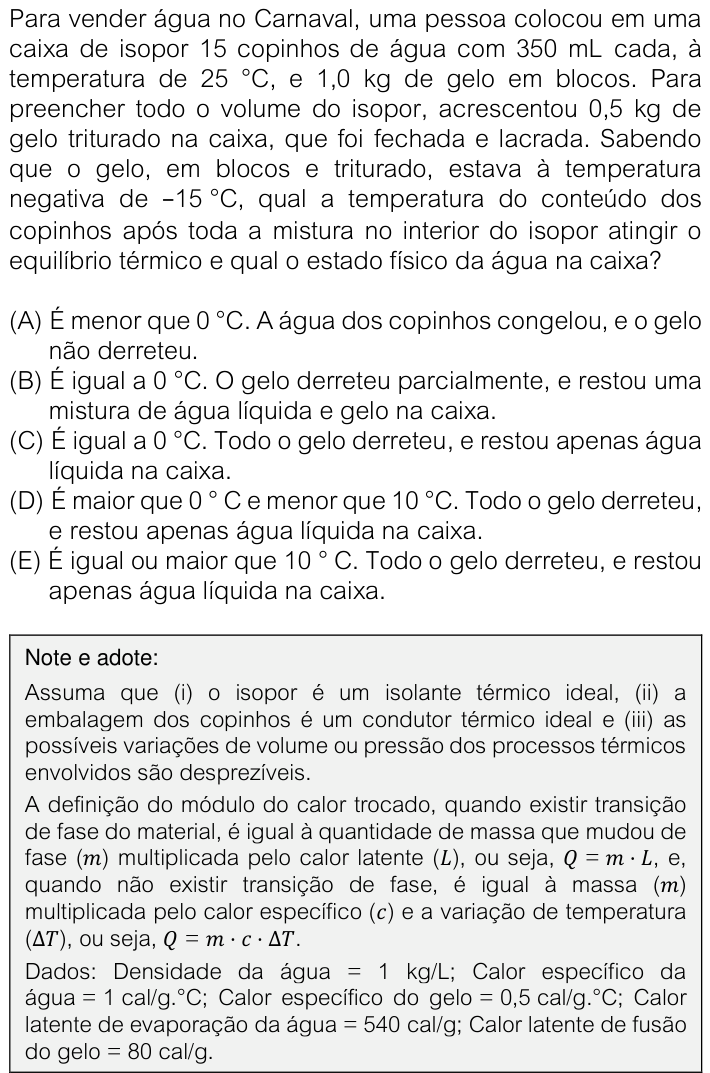
A questão

Questão 75

Respostas das IAs

GPT-6 Astra

C

Respondeu

levou 8 s

Como pensou
**Calculating water and heat** I need to compute the heat related to 5250 grams of water at 25 degrees Celsius, which equates to a total of 131250 calories. This includes heating ice (1500 grams at -15 degrees) and melting it (120000 calories). I want to ensure all ice melts completely and check for equality with no latent evaporation. I’ll present the steps clearly. My final answer should state that all ice melted leads to a final temperature of 0 degrees Celsius.

Como o isopor é um isolante térmico ideal, o calor cedido pela água dos copinhos é igual ao calor recebido pelo gelo.

A massa total de água nos copinhos é

m_{\text{água}}=15\cdot350=5250\ \text{g},

pois a densidade da água é 1\ \text{g/mL}. Ao esfriar de 25\,^\circ\text{C} até 0\,^\circ\text{C}, essa água libera

Q_{\text{água}}=mc\Delta T=5250\cdot1\cdot25 =131\,250\ \text{cal}.

A massa total de gelo é 1{,}0+0{,}5=1{,}5\ \text{kg}=1500\ \text{g}. Para aquecê-lo de -15\,^\circ\text{C} até 0\,^\circ\text{C}, são necessárias

Q_1=1500\cdot0{,}5\cdot15=11\,250\ \text{cal}.

Para derreter todo esse gelo a 0\,^\circ\text{C}, são necessárias

Q_2=mL=1500\cdot80=120\,000\ \text{cal}.

Portanto,

Q_1+Q_2=131\,250\ \text{cal}=Q_{\text{água}}.

O calor liberado pela água ao chegar a 0\,^\circ\text{C} é exatamente suficiente para aquecer e derreter todo o gelo, sem sobrar energia para elevar a temperatura final. Assim, o equilíbrio ocorre a 0\,^\circ\text{C}, com apenas água líquida.

Resposta: C

GPT-6.1 Sol

C

Respondeu

levou 6 s

Como pensou

A massa total de água nos copinhos é

m_a=15\cdot350=5250\ \text{g},

pois a densidade da água é 1\ \text{g/mL}.

Ao esfriar de 25\,^\circ\text{C} até 0\,^\circ\text{C}, essa água libera

Q_a=m_ac_a\Delta T=5250\cdot1\cdot25=131\,250\ \text{cal}.

A massa total de gelo é 1{,}5\ \text{kg}=1500\ \text{g}. Para aquecê-lo de -15\,^\circ\text{C} até 0\,^\circ\text{C}, são necessárias

Q_1=1500\cdot0{,}5\cdot15=11\,250\ \text{cal}.

Para derreter todo esse gelo a 0\,^\circ\text{C}, são necessárias mais

Q_2=1500\cdot80=120\,000\ \text{cal}.

Assim,

Q_1+Q_2=131\,250\ \text{cal}=Q_a.

O calor liberado pela água dos copinhos é exatamente suficiente para aquecer e derreter todo o gelo, sem elevar a temperatura acima de zero. Portanto, o equilíbrio ocorre a 0\,^\circ\text{C}, com apenas água líquida.

Resposta: C

GPT-6.1 Terra

C

Respondeu

levou 6 s

Como pensou
**Calculating water and ice reaction** I'm computing the situation where I have 5250g of water at 25 degrees Celsius and 11250g of ice melting. That gives me a total of 131250 Joules, which shows that when all the ice melts, it perfectly matches when everything reaches zero degrees Celsius. It’s interesting how the mass and temperature balance out! I'll make sure to present these calculations clearly, showing how they interact at that ideal melting point.

A massa de água nos copinhos é 15 \times 350 = 5250 g. Ao esfriar de 25 °C até 0 °C, ela libera:

Q_{\text{água}}=5250\cdot 1\cdot 25=131\,250\ \text{cal}.

A massa total de gelo é 1500 g. Para aquecê-lo de −15 °C até 0 °C, são necessárias:

Q_1=1500\cdot 0{,}5\cdot 15=11\,250\ \text{cal}.

Para derreter todo esse gelo, são necessárias mais:

Q_2=1500\cdot 80=120\,000\ \text{cal}.

Como Q_1+Q_2=131\,250 cal, o calor liberado pela água é exatamente suficiente para aquecer e derreter todo o gelo. Assim, no equilíbrio, toda a água está líquida, a 0 °C.

Resposta: C

GPT-6 Luna

C

Respondeu

levou 5 s

Como pensou

A massa total de água nos copinhos é 15 \times 350\ \text{g} = 5\,250\ \text{g}. Ao esfriar de 25\,^\circ\text{C} até 0\,^\circ\text{C}, ela libera

Q_{\text{água}}=5\,250 \cdot 1 \cdot 25=131\,250\ \text{cal}.

Os 1\,500\ \text{g} de gelo precisam de

Q_{\text{aquecimento}}=1\,500 \cdot 0{,}5 \cdot 15=11\,250\ \text{cal}

para chegar a 0\,^\circ\text{C}. Sobram 120\,000\ \text{cal}, exatamente o necessário para derreter todo o gelo:

Q_{\text{fusão}}=1\,500 \cdot 80=120\,000\ \text{cal}.

Portanto, o equilíbrio ocorre a 0\,^\circ\text{C}, com todo o gelo derretido e apenas água líquida na caixa.

Resposta: C

Claude Fable 5.1

C

Respondeu

levou 7 s

Como pensou

Vamos calcular o balanço de energia.

Água nos copinhos: 15 × 350 mL = 5250 mL → 5250 g a 25 °C.

Calor que a água pode liberar ao esfriar até 0 °C:
Q_água = 5250 × 1 × 25 = 131 250 cal

Gelo: 1,0 kg + 0,5 kg = 1500 g a −15 °C.

Calor para aquecer o gelo até 0 °C:
Q₁ = 1500 × 0,5 × 15 = 11 250 cal

Calor para derreter todo o gelo:
Q₂ = 1500 × 80 = 120 000 cal

Total para levar todo o gelo a água a 0 °C: 11 250 + 120 000 = 131 250 cal

Repare que o calor que a água libera ao chegar a 0 °C (131 250 cal) é exatamente igual ao calor necessário para aquecer e derreter todo o gelo (131 250 cal). Assim, o equilíbrio ocorre a 0 °C, com todo o gelo derretido e apenas água líquida na caixa (nenhuma sobra de energia para elevar a temperatura acima de 0 °C).

Resposta: C

Claude Opus 5.5

C

Respondeu

levou 8 s

Como pensou
I'm converting the water and ice masses to grams, then working out the heat the ice needs to warm to 0°C and the heat the water gives up cooling to 0°C. That leaves 120000 cal, which is exactly what it takes to melt all the ice, so everything melts. So the ice fully melts and the final state is 0°C with everything liquid, which points to answer C.

Resposta: (C) — o equilíbrio é a 0 °C e todo o gelo derrete.

Dados:

  • Água dos copinhos: 15 × 350 mL = 5250 mL, ou seja, 5250 g a 25 °C.
  • Gelo: 1,0 kg + 0,5 kg = 1500 g a −15 °C.

1) Calor que a água cede ao esfriar de 25 °C até 0 °C:
Q = 5250 · 1 · 25 = 131 250 cal

2) Calor para aquecer o gelo de −15 °C até 0 °C:
Q = 1500 · 0,5 · 15 = 11 250 cal

Sobram 131 250 − 11 250 = 120 000 cal.

3) Calor para fundir todo o gelo:
Q = 1500 · 80 = 120 000 cal

O calor que sobra é exatamente o necessário para fundir todo o gelo. Assim, todo o gelo derrete e não resta energia para aquecer a mistura acima de 0 °C.

O equilíbrio ocorre a 0 °C, com apenas água líquida na caixa.

Resposta: C

Claude Sonnet 5.5

C

Respondeu

levou 6 s

Como pensou

Dados:

  • Água: 15 × 350 mL = 5250 mL, ou seja, 5250 g a 25 °C.
  • Gelo: 1500 g a −15 °C (1,0 kg em blocos + 0,5 kg triturado).

Calor liberado pela água ao resfriar de 25 °C até 0 °C:
Q = 5250 × 1 × 25 = 131 250 cal

Calor para aquecer o gelo de −15 °C até 0 °C:
Q = 1500 × 0,5 × 15 = 11 250 cal

Calor disponível para fundir o gelo:
131 250 − 11 250 = 120 000 cal

Calor necessário para fundir todo o gelo:
Q = 1500 × 80 = 120 000 cal

Os dois valores são exatamente iguais. Assim, a água dos copinhos chega a 0 °C e o gelo termina de se fundir também a 0 °C, sem sobra de calor para aquecer a mistura além disso. O equilíbrio ocorre a 0 °C, com todo o gelo derretido, restando apenas água líquida.

(Nota: a água dos copinhos não congela, pois todo o calor liberado por ela é usado para aquecer e fundir o gelo; no limite exato, o sistema termina em 0 °C com toda a água líquida.)

Resposta: C

Grok 4.7

C

Respondeu

levou 48 s

Como pensou
The problem is a physics question from the 2027 FUVEST exam in Portuguese. The problem involves thermal equilibrium in a sealed styrofoam box. The system contains 15 cups of water at 25°C and 1.0 kg of ice blocks at -15°C, plus 0.5 kg of crushed ice also at -15°C. The goal is to find the final temperature and the physical state of the water after the mixture reaches equilibrium. The styrofoam box is an ideal thermal insulator, but the cup packaging is a perfect conductor. Heat can therefore transfer freely between the water inside the cups and the ice outside. The given data includes water density, specific heat capacities for water and ice, and the latent heat of fusion. The question asks for the temperature of the water inside the cups and the physical state of the water in the box. The box contains the added ice and any melted water, while the cups hold their own water. The cup packaging is a conductor, so the water inside and outside the box should reach the same temperature at equilibrium. The ice in the box surrounds the cups to cool them. I need to determine whether any phase change occurs during this process. The total mass of water inside the cups is 5.25 kg, and the total mass of ice outside is 1.5 kg. The two phases do not mix; only heat transfers between them. I am now examining the answer options to determine the final temperature and physical state. The answer options are now mapped out. Option A suggests the water inside the cups froze below zero degrees Celsius. Options B and C both show equilibrium at exactly zero degrees Celsius, but with different states of the ice outside the cups. Options D and E indicate temperatures above zero degrees Celsius, with all ice having melted. I am now setting up the heat balance. The warm water will transfer heat to the cold ice. I am considering possible scenarios for the final equilibrium. I am calculating the heat required to warm all 1.5 kg of ice from -15°C to 0°C without melting it. This will help determine whether the available heat from the 5.25 kg of water at 25°C is sufficient to reach equilibrium above zero degrees Celsius or if the system must settle at exactly zero degrees with a mixture of ice and liquid. The heat required to warm the 1.5 kg of ice from -15°C to 0°C is 11250 cal. Melting all of it requires 120000 cal. The total needed is therefore 131250 cal. The 5.25 kg of water at 25°C releases exactly 131250 cal when it cools to 0°C. The two quantities are identical. The final state is confirmed: all ice melts and the water inside the cups reaches exactly 0°C. This matches option C, which states the temperature equals 0°C.

A massa de água nos copinhos é 15 \times 350\,\mathrm{g} = 5250\,\mathrm{g} e a massa total de gelo é 1500\,\mathrm{g}.

O calor liberado pela água dos copinhos ao ser resfriada de 25^\circ\mathrm{C} até 0^\circ\mathrm{C} é

Q = 5250 \times 1 \times 25 = 131250\,\mathrm{cal}.

O calor absorvido pelo gelo para ir de -15^\circ\mathrm{C} até 0^\circ\mathrm{C} e fundir-se completamente é

Q = 1500 \times 0{,}5 \times 15 + 1500 \times 80 = 131250\,\mathrm{cal}.

Os dois valores são idênticos. Portanto, no equilíbrio térmico o conteúdo dos copinhos está exatamente a 0^\circ\mathrm{C} (ainda líquido) e todo o gelo se transformou em água líquida a 0^\circ\mathrm{C}. Não resta gelo na caixa.

Resposta: C

DeepSeek V4.1 Flash

C

Respondeu

levou 11 s

Como pensou
We need answer in Portuguese, solve. Need parse question. Need be careful. We have 15 copos each 350 mL water at 25°C. Total water volume 15*350 mL = 5250 mL = 5.25 L. Density 1 kg/L => mass water = 5.25 kg = 5250 g. Initial ice: 1.0 kg blocos + 0.5 kg triturado = 1.5 kg =1500 g at -15°C. Need equilibrium, isopor insulated. But "acrescentou 0.5 kg de gelo triturado... caixa fechada e lacrada." Existing 1.0 kg gelo em blocos and water cups? Wait water in cups are inside caixa? Need consider heat exchange between water in cups and ice in box. Packaging of cups ideal conductor. Isopor insulator. So all inside isolated. Need determine final temp and state. Need compare heat needed to warm ice to 0 and melt all vs heat available cooling water to 0 etc. Given c_gelo=0.5 cal/g°C, L_fusão=80 cal/g. c_água=1. Mass water m_w=5250 g at 25. Heat released cooling water to 0 = 5250*1*25 = 131,250 cal. Need heat to warm ice from -15 to 0: 1500*0.5*15 = 11,250 cal. Remaining for melting =120,000 cal. Heat to melt all ice =1500*80=120,000 cal exactly! Ah exactly. Let's check numbers: 5250*25=131250; warm ice 11250; difference 120000; melt 1500*80=120000. So final at 0°C with all ice just melted and water at 0 (no ice?). Need be careful: exactly all ice melts; final mixture all liquid at 0°C. No remaining ice. If exactly, state: all gelo derreteu, água líquida at 0. Option C says É igual a 0°C. Todo o gelo derreteu, restou apenas água líquida na caixa. Perfect. But check "Copos" and "caixa" state: water in cups? They ask temperatura do conteúdo dos copinhos após mistura no interior isopor atingir equilíbrio e estado físico da água na caixa? The ice is in caixa outside cups? "colocou em uma caixa de isopor 15 copinhos... e 1,0 kg gelo em blocos. Para preencher todo volume... acrescentou 0.5 kg gelo triturado na caixa, que foi fechada..." The ice likely surrounds cups. At equilibrium, water in cups at 0; ice? Heat transfer through cup packaging. All ice melts exactly. Thus final all liquid water at 0 in caixa and inside cups liquid? The water inside copos may not freeze because final 0 and no more heat remove. It is liquid at 0. Rest only liquid water (outside from melted ice plus cup water). Option C. Need explain. Need maybe mention latent heat of vaporization irrelevant. Ensure no issue with volume expansion ignored. They say variations volume/pressure negligible. Ice in blocks/triturado at -15; c ice; latent fusion. Use energy balance. Need final line exactly Resposta: C. Need explain in Portuguese. Could mention if heat to cool water to 0 equals all needed warm+melting; final at exactly 0. Since no excess heat, no heating above 0. All ice melted just at endpoint, so liquid. If all melted exactly at 0, final phase pure liquid (not ice) because no leftover ice. But physically at 0 can coexist; since just enough heat to melt all, at the end, all melted and no ice. It doesn't spontaneously freeze. Good. Let's craft final answer with calculations concise. Need final line.

Calculando as trocas de calor até 0 °C:

  • Massa de água nos copinhos:
15 \times 350\text{ mL}=5250\text{ mL}=5{,}25\text{ L}=5{,}25\text{ kg}=5250\text{ g}
  • Calor que essa água pode ceder ao resfriar de 25^\circ\text{C} até 0^\circ\text{C}:
Q_{\text{água}}=m c \Delta T=5250\cdot 1\cdot 25=131\,250\text{ cal}
  • Calor necessário para aquecer os 1{,}5\text{ kg} de gelo de -15^\circ\text{C} até 0^\circ\text{C}:
Q_{\text{aquecer gelo}}=1500\cdot 0{,}5\cdot 15=11\,250\text{ cal}

Restam:

131\,250-11\,250=120\,000\text{ cal}
  • Calor necessário para fundir todo o gelo a 0^\circ\text{C}:
Q_{\text{fusão}}=1500\cdot 80=120\,000\text{ cal}

Como os valores coincidem exatamente, todo o gelo derrete e a temperatura final é exatamente 0^\circ\text{C}. Não sobra gelo, pois o calor disponível foi exatamente o necessário para a fusão total.

Resposta: C

Gemini 3.8 Flash

C

Respondeu

levou 17 s

Como pensou
**Analyzing Calorimetry Scenario** I'm currently examining a calorimetry problem. It details heat exchange between liquid water and ice within an insulated styrofoam box. My focus is on the provided data, specifically the 15 cups of water, each containing 350 mL. **Calculating Initial Heat Demands** I'm calculating the heat required to bring the ice from its initial $-15^\circ\text{C}$ to its melting point of $0^\circ\text{C}$. This involves using the specific heat capacity of ice and its total mass. **Determining Ice State Changes** I've calculated the heat needed to warm the ice to $0^\circ\text{C}$ and the heat the water can release cooling to $0^\circ\text{C}$. The water's cooling capacity significantly exceeds the ice's warming requirement, indicating all ice will melt and water will remain. **Completing Melting Calculations** I've confirmed that the heat required to fully melt the ice at $0^\circ\text{C}$ is $120,000\text{ cal}$. This, combined with the heat to warm the ice to $0^\circ\text{C}$ ($11,250\text{ cal}$), totals $131,250\text{ cal}$ to transform all ice into water at $0^\circ\text{C}$. This precisely matches the heat the initial water can release by cooling to $0^\circ\text{C}$. **Confirming Final Equilibrium** I've confirmed the heat exchange balance. All ice melts and transforms into water at $0^\circ\text{C}$, with the liquid water cooling precisely to $0^\circ\text{C}$. This means the final equilibrium temperature is $0^\circ\text{C}$, with only liquid water remaining. **Reviewing All Calculations** I'm re-examining every detail to ensure no reading or calculation errors. I've confirmed the total mass of water and ice, their initial temperatures, and the specific heat capacities and latent heat values. **Verifying Heat Exchange Totals** I've double-checked the heat released by the water cooling to $0^\circ\text{C}$ and the total heat required to warm the ice to $0^\circ\text{C}$ and then completely melt it. The balance confirms all ice melts, reaching equilibrium at $0^\circ\text{C}$.

Para determinar a temperatura de equilíbrio térmico e o estado físico da água na caixa, vamos calcular as trocas de calor entre a água líquida dos copinhos e o gelo.

  1. Massa e condições iniciais da água líquida:

    • Volume total: V = 15 \times 350\text{ mL} = 5250\text{ mL} = 5,25\text{ L}
    • Sabendo que a densidade da água é de 1\text{ kg/L} (1\text{ g/mL}):
      m_{\text{água}} = 5250\text{ g}
    • Temperatura inicial: T_i = 25\ ^\circ\text{C}
  2. Massa e condições iniciais do gelo:

    • Massa total de gelo: m_{\text{gelo}} = 1,0\text{ kg} + 0,5\text{ kg} = 1,5\text{ kg} = 1500\text{ g}
    • Temperatura inicial: T_i = -15\ ^\circ\text{C}
  3. Calor liberado pela água líquida para resfriar de 25\ ^\circ\text{C} até 0\ ^\circ\text{C}:

    Q_{\text{resfriamento}} = m_{\text{água}} \cdot c_{\text{água}} \cdot |\Delta T|

    Q_{\text{resfriamento}} = 5250 \cdot 1 \cdot 25 = 131.250\text{ cal}

  4. Calor necessário para o gelo aquecer de -15\ ^\circ\text{C} até 0\ ^\circ\text{C}:

    Q_1 = m_{\text{gelo}} \cdot c_{\text{gelo}} \cdot \Delta T

    Q_1 = 1500 \cdot 0,5 \cdot (0 - (-15)) = 1500 \cdot 0,5 \cdot 15 = 11.250\text{ cal}

  5. Calor necessário para fundir completamente todo o gelo a 0\ ^\circ\text{C}:

    Q_{\text{fusão}} = m_{\text{gelo}} \cdot L_f

    Q_{\text{fusão}} = 1500 \cdot 80 = 120.000\text{ cal}

  6. Calor total necessário para transformar todo o gelo em água líquida a 0\ ^\circ\text{C}:

    Q_{\text{total}} = Q_1 + Q_{\text{fusão}} = 11.250 + 120.000 = 131.250\text{ cal}

Como o calor cedido pela água líquida ao atingir 0\ ^\circ\text{C} (131.250\text{ cal}) é exatamente igual ao calor absorvido pelo gelo para atingir 0\ ^\circ\text{C} e derreter por completo (131.250\text{ cal}), o equilíbrio térmico é atingido a 0\ ^\circ\text{C}, momento no qual todo o gelo derreteu e restou apenas água líquida no sistema.

Resposta: C

Gemini 4 Argon

C

Respondeu

levou 38 s

Como pensou
**Analyzing the Physics Problem** I'm currently dissecting the physics question presented in the image. My immediate focus is on understanding the initial conditions and parameters described, specifically the quantity and temperature of water in the cooler. I'm proceeding to extract all relevant numerical data and units to prepare for the subsequent calculations. **Defining System Parameters** I've successfully identified and quantified all the initial components involved in this thermal equilibrium problem. My focus is now on consolidating the masses and temperatures of both the liquid water and the ice, preparing to analyze their interactions. **Calculating Initial Heat Exchanges** I'm now calculating the heat required to bring the ice to $0\text{ }^\circ\text{C}$ and the heat released by the water cooling to the same temperature. This establishes the initial energy balance for the system. **Confirming Energy Balance** I've confirmed that the heat released by the water cooling to $0\text{ }^\circ\text{C}$ precisely matches the heat absorbed to raise the ice to $0\text{ }^\circ\text{C}$ and completely melt it. This implies the final state is all liquid water at $0\text{ }^\circ\text{C}$. **Verifying Energy Calculations** I've meticulously rechecked all my calculations regarding heat transfer. The figures for melting the ice and the energy released by the initial water mass align perfectly, confirming the final equilibrium temperature. I've completed the calculations for the heat required to bring the ice to melting point and then melt it. The energy released by the surrounding water cooling to $0\text{ }^\circ\text{C}$ precisely matches this, confirming all ice melts. Therefore, the final temperature is $0\text{ }^\circ\text{C}$.

Para determinar a temperatura final de equilíbrio térmico e o estado físico da água no interior da caixa de isopor (sistema termicamente isolado), vamos calcular as quantidades de calor envolvidas nos processos de variação de temperatura (calor sensível) e de mudança de fase (calor latente).

1. Massa total de água líquida e de gelo:

  • Água nos copinhos: São 15 copinhos de 350\text{ mL} cada, totalizando um volume de:

    V_{\text{água}} = 15 \times 350\text{ mL} = 5250\text{ mL} = 5,25\text{ L}

    Como a densidade da água é 1\text{ kg/L} (1\text{ g/mL}), a massa total de água líquida é:
    m_{\text{água}} = 5250\text{ g}

  • Gelo (em blocos + triturado):

    m_{\text{gelo}} = 1,0\text{ kg} + 0,5\text{ kg} = 1,5\text{ kg} = 1500\text{ g}


2. Calor cedido pela água dos copinhos para resfriar até 0\text{ }^\circ\text{C} (Q_1):
A água está inicialmente a 25\text{ }^\circ\text{C}. Para chegar a 0\text{ }^\circ\text{C} sem congelar, ela precisa liberar uma quantidade de calor dada por:

Q_1 = m_{\text{água}} \cdot c_{\text{água}} \cdot \Delta T

Q_1 = 5250\text{ g} \cdot 1\text{ cal/g}\cdot^\circ\text{C} \cdot (0 - 25)\text{ }^\circ\text{C} = -131\,250\text{ cal}

Portanto, a água líquida pode fornecer até 131\,250\text{ cal} ao resfriar até 0\text{ }^\circ\text{C}.


3. Calor recebido pelo gelo para aquecer até 0\text{ }^\circ\text{C} (Q_2) e derreter totalmente (Q_3):
O gelo encontra-se inicialmente a -15\text{ }^\circ\text{C}. Para aquecer até a temperatura de fusão (0\text{ }^\circ\text{C}), ele precisa absorver:

Q_2 = m_{\text{gelo}} \cdot c_{\text{gelo}} \cdot \Delta T

Q_2 = 1500\text{ g} \cdot 0,5\text{ cal/g}\cdot^\circ\text{C} \cdot [0 - (-15)]\text{ }^\circ\text{C} = 11\,250\text{ cal}

Para que toda a massa de gelo a 0\text{ }^\circ\text{C} sofra fusão (derreta completamente), a quantidade de calor latente necessária é:

Q_3 = m_{\text{gelo}} \cdot L_{\text{fusão}}

Q_3 = 1500\text{ g} \cdot 80\text{ cal/g} = 120\,000\text{ cal}

Somando o calor necessário para aquecer o gelo até 0\text{ }^\circ\text{C} e fundi-lo integralmente, temos:

Q_{\text{absorvido}} = Q_2 + Q_3 = 11\,250\text{ cal} + 120\,000\text{ cal} = 131\,250\text{ cal}


4. Conclusão (Equilíbrio Térmico):
Como o calor cedido pela água líquida ao resfriar até 0\text{ }^\circ\text{C} (131\,250\text{ cal}) é exatamente igual ao calor necessário para levar todo o gelo a 0\text{ }^\circ\text{C} e derretê-lo completamente (131\,250\text{ cal}):

\sum Q = Q_1 + Q_2 + Q_3 = -131\,250 + 11\,250 + 120\,000 = 0

Conclui-se que o equilíbrio térmico é atingido exatamente a 0\text{ }^\circ\text{C}, no instante em que todo o gelo termina de derreter, restando apenas água no estado líquido dentro da caixa.

Resposta: C