PRÁTICA COM QUESTÕES OFICIAIS
Questão 89 da UFPR 2026 (inglês)
The following text is reference to questions 89 and 90. · 1ª fase
A clean, well-lighted place
How less clutter can reduce stress!
Clutter, for many of us, is a simple annoyance; but to others, it is a highly personal and sensitive topic. For some, parting with even the smallest scrap of paper can cause emotional turmoil. If there is a deeper fear of loss, scarcity, or if the clutter is used as self-protection from relationships, it may be a sign of a serious (but treatable) mental disorder known as hoarding. But for those who are simply disorganized, yet feeling stressed by it, the following benefits of cleaning up may prove illuminating – because we all, as Hemingway said, long for “a clean, well-lighted place.”
What are the benefits we can expect to receive upon cleaning up the mess?
✓ Save time by not spending time looking for things.
✓ Save money by not buying items you already have.
✓ Reduce stress related to lost items or lost information.
✓ Manage activities and deadlines more efficiently.
✓ Have more time to do things you really want to do.
✓ Have a more attractive and inviting home.
Available in: https://bewell.stanford.edu/a-clean-well-lighted-place. Adapted.
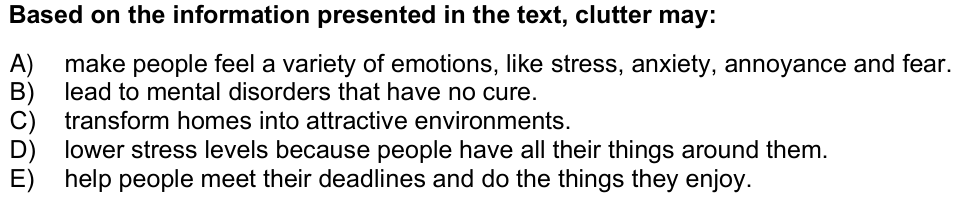
Based on the information presented in the text, clutter may:
- Amake people feel a variety of emotions, like stress, anxiety, annoyance and fear.
- Blead to mental disorders that have no cure.
- Ctransform homes into attractive environments.
- Dlower stress levels because people have all their things around them.
- Ehelp people meet their deadlines and do the things they enjoy.
Reportar erro na questão
Resolução comentada
A questão pede o que o texto permite concluir sobre a desordem (clutter). Vamos conferir cada afirmação com o que está escrito.
O texto diz que a desordem, para muitos, é "a simple annoyance" (um simples incômodo). Para outros, é um assunto pessoal e sensível, que pode causar "emotional turmoil" (turbulência emocional) e ligar-se ao medo de perda ("fear of loss"). Além disso, quem é desorganizado pode sentir estresse ("feeling stressed by it"), e a lista de benefícios cita "reduce stress related to lost items".
Ou seja, a desordem pode gerar estresse, incômodo e medo. A ansiedade não aparece literalmente, mas "emotional turmoil" a abrange, e a alternativa A fala em "variedade de emoções", o que condiz com o texto.
As demais vão contra o texto:
- O transtorno de acúmulo é descrito como "serious (but treatable)", ou seja, tratável.
- Casa atraente e convidativa é benefício de arrumar, não da desordem.
- A desordem não reduz o estresse: é a limpeza que o reduz.
- Cumprir prazos com eficiência e ter tempo livre também são benefícios de organizar.
Alternativa A.
Por que as outras alternativas estão erradas
- BO texto diz que o transtorno de acúmulo é grave, mas tratável ("treatable"), e não incurável.
- CLar atraente e convidativo é benefício de arrumar a bagunça, não efeito dela.
- DInverte a ideia do texto: a desordem causa estresse, e é a organização que o reduz.
- ECumprir prazos e ter tempo para o que gosta são benefícios de se organizar, não da desordem.
Assunto: Informações explícitas e detalhes.
Reportar erro na resolução
Ver como caiu na prova
Fonte: UFPR 2026 · 1ª fase. Prova oficial ↗