PRÁTICA COM QUESTÕES OFICIAIS
Questão 88 da UFPR 2026 (inglês)
The following A.I. generated definition is reference to questions 87 and 88. · 1ª fase
Brain rot definition
“Brain rot” is a slang term that refers to the perceived deterioration of a person’s mental or intellectual state, often due to overconsumption of trivial or unchallenging content, particularly online content. It’s not a medical condition, but a way to describe the mental effects of excessive screen time and engagement with certain types of online material.
Here’s a more detailed explanation:
Perceived deterioration:
The term suggests a decline in cognitive abilities like attention, memory, and mood, caused by consuming low-effort content.
Overconsumption of unchallenging content:
Brain rot is often associated with activities like “doomscrolling”, where individuals spend excessive time online, passively consuming news or other content without engaging in deeper thought or analysis.
Mental fogginess:
It can also describe a state of mental fogginess, where individuals struggle with focus and clarity.
Not a medical diagnosis:
It's important to note that “brain rot” is not a recognized medical diagnosis.
Slang term:
The term is popular among Gen Z and Gen Alpha social media users.
Available in www.google.com: https://acesse.one/YWnDy. Adapted.
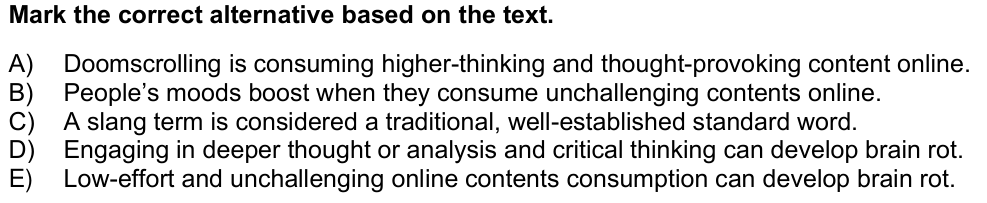
Mark the correct alternative based on the text.
- ADoomscrolling is consuming higher-thinking and thought-provoking content online.
- BPeople’s moods boost when they consume unchallenging contents online.
- CA slang term is considered a traditional, well-established standard word.
- DEngaging in deeper thought or analysis and critical thinking can develop brain rot.
- ELow-effort and unchallenging online contents consumption can develop brain rot.
Reportar erro na questão
Resolução comentada
O texto define "brain rot" como a deterioração percebida do estado mental, causada pelo consumo excessivo de conteúdo trivial e pouco desafiador, sobretudo online. Vamos conferir cada alternativa contra o texto.
- Doomscrolling é descrito como passar tempo excessivo online consumindo notícias passivamente, "without engaging in deeper thought or analysis" (sem pensamento profundo ou análise). Logo, não é consumir conteúdo que estimula o raciocínio.
- O texto diz que o consumo de conteúdo de baixo esforço leva a um declínio em atenção, memória e humor ("mood"). Então o humor piora, não melhora.
- O texto chama "brain rot" de "slang term" (gíria), popular entre a Geração Z e a Geração Alpha. Gíria não é palavra padrão e consagrada.
- O pensamento profundo e a análise são justamente o que falta no "brain rot"; eles não o causam.
- O texto afirma que o termo sugere um declínio cognitivo "caused by consuming low-effort content" (causado pelo consumo de conteúdo de baixo esforço). Isso corresponde à alternativa E.
A ideia central é a relação de causa: conteúdo fácil e sem desafio, consumido em excesso, leva ao "brain rot".
Alternativa E.
Por que as outras alternativas estão erradas
- ADoomscrolling é consumo passivo, sem pensamento profundo, e não de conteúdo que estimula o raciocínio.
- BO texto diz que o humor (mood) declina, não que melhora.
- CO texto classifica o termo como gíria, não como palavra padrão e tradicional.
- DInverte a causa: pensamento profundo e análise são o que falta no brain rot, não o que o provoca.
Assunto: Informações explícitas e detalhes.
Reportar erro na resolução
Ver como caiu na prova
Fonte: UFPR 2026 · 1ª fase. Prova oficial ↗