PRÁTICA COM QUESTÕES OFICIAIS
Questão 90 da UFPR 2026 (inglês)
The following text is reference to questions 89 and 90. · 1ª fase
A clean, well-lighted place
How less clutter can reduce stress!
Clutter, for many of us, is a simple annoyance; but to others, it is a highly personal and sensitive topic. For some, parting with even the smallest scrap of paper can cause emotional turmoil. If there is a deeper fear of loss, scarcity, or if the clutter is used as self-protection from relationships, it may be a sign of a serious (but treatable) mental disorder known as hoarding. But for those who are simply disorganized, yet feeling stressed by it, the following benefits of cleaning up may prove illuminating – because we all, as Hemingway said, long for “a clean, well-lighted place.”
What are the benefits we can expect to receive upon cleaning up the mess?
✓ Save time by not spending time looking for things.
✓ Save money by not buying items you already have.
✓ Reduce stress related to lost items or lost information.
✓ Manage activities and deadlines more efficiently.
✓ Have more time to do things you really want to do.
✓ Have a more attractive and inviting home.
Available in: https://bewell.stanford.edu/a-clean-well-lighted-place. Adapted.
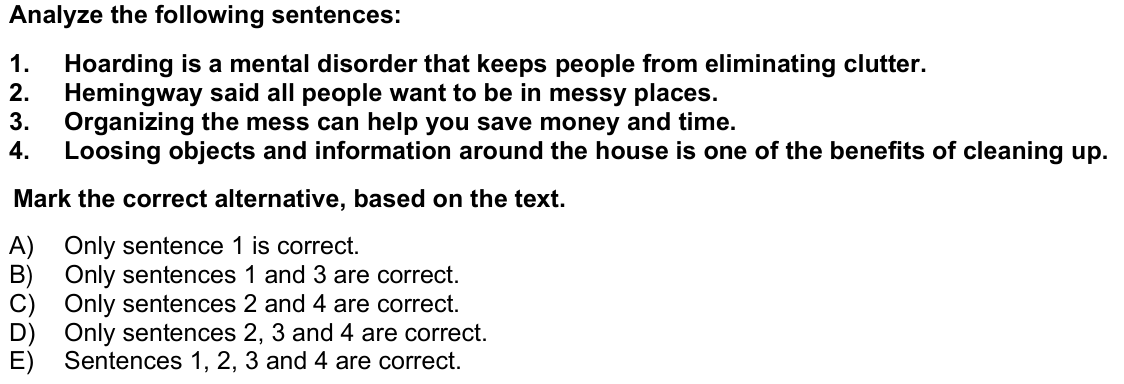
Analyze the following sentences:
1. Hoarding is a mental disorder that keeps people from eliminating clutter.
2. Hemingway said all people want to be in messy places.
3. Organizing the mess can help you save money and time.
4. Loosing objects and information around the house is one of the benefits of cleaning up.
Mark the correct alternative, based on the text.
- AOnly sentence 1 is correct.
- BOnly sentences 1 and 3 are correct.
- COnly sentences 2 and 4 are correct.
- DOnly sentences 2, 3 and 4 are correct.
- ESentences 1, 2, 3 and 4 are correct.
Reportar erro na questão
Resolução comentada
Confira cada frase com o texto.
-
O texto diz que, quando há medo de perda ou o acúmulo serve de autoproteção, pode haver um transtorno mental chamado hoarding (acumulação compulsiva). Ou seja, é um transtorno que mantém a pessoa presa à bagunça, sem conseguir se desfazer das coisas. Correta.
-
Hemingway disse que todos desejamos "a clean, well-lighted place" (um lugar limpo e bem iluminado), o oposto de lugares bagunçados. Incorreta.
-
A lista de benefícios traz "Save time" e "Save money by not buying items you already have". Organizar a bagunça poupa tempo e dinheiro. Correta.
-
A lista fala em reduzir o estresse ligado a itens ou informações perdidos. Perder objetos não é benefício de arrumar a casa, é justamente o problema que a arrumação evita. Incorreta.
Só as frases 1 e 3 estão corretas.
Alternativa B.
Pegadinha: A frase 4 engana por usar o tema 'objetos e informações perdidos', que aparece no texto, mas como algo que a arrumação reduz, não como benefício.
Por que as outras alternativas estão erradas
- AIgnora que a frase 3 também está correta: o texto cita economia de tempo e de dinheiro.
- CMarca como corretas justamente as duas falsas: Hemingway fala de lugar limpo, e perder objetos é o problema, não o benefício.
- DInclui as frases 2 e 4, que contradizem o texto, e deixa de fora a frase 1.
- EConsidera todas corretas, mas as frases 2 e 4 invertem o sentido do texto.
Assunto: Informações explícitas e detalhes.
Reportar erro na resolução
Ver como caiu na prova
Fonte: UFPR 2026 · 1ª fase. Prova oficial ↗